
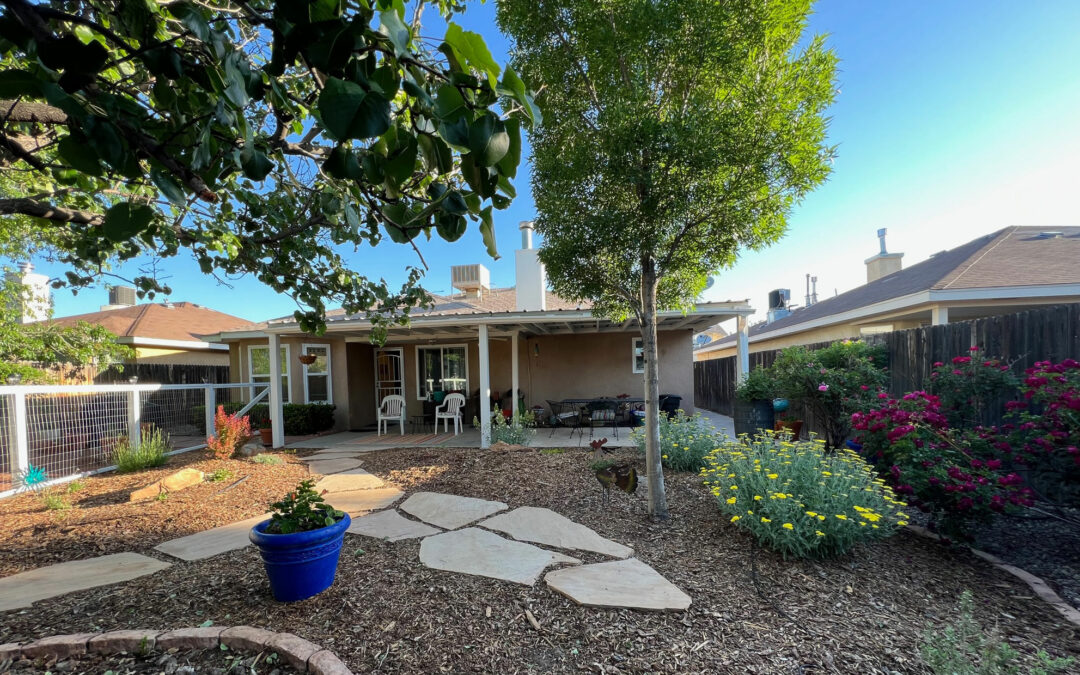
As homes around the Greater Albuquerque Area are converting their high-water-use turf grass to desert friendly xeriscapes, many are choosing to use wood chip mulch instead of gravel or other aggregate, which can be hot and allow weeds to pop up. 

The Water Authority checked in on some recent xeriscape conversion projects. Two West Side homeowners with small backyards shared their grass transformation stories with 505Outside. Both homes had grass and gravel landscape. The decision to convert to a desert friendly xeriscape was an easy one, as one homeowner commented, “While I liked having grass, I couldn’t justify the water it took to keep the lawn healthy. I do enjoy not having to mow and feel much better about saving water.”

Both homeowners chose to use wood chip mulch. One homeowner learned through their contractor that shredded wood chip mulch is cooler than gravel and retains moisture around the plants. The second homeowner was used to the idea of mulch from their time living in New England.   

Wood chip mulch is made up of chipped trees. This is a long-lasting mulch that decomposes slowly over bare dirt, retains moisture and is superior to other mediums at suppressing weeds. Most wood mulches available on the market are chipped flat and are consistent in shape and size. These are great in areas that receive foot traffic as they compact down to a firm surface.

Both homes installed a 3- to 4-inch layer of organic mulch. That depth is effective at preventing sunlight from reaching annual weed seeds, thereby preventing weed germination. The homeowners noted that mulch was easy to install and much less expensive than gravel, and they noticed that the mulch also was much cooler than the hot gravel. For these West Side homeowners, wind was their biggest concern. However, after living with the mulch for over a year, it’s only blown around a little bit and has been easy to sweep back into the garden. 

One surprise for these homeowners has been the increase in wildlife. “We see whiptail lizards and ground feeding birds like robins, thrashers and roadrunners foraging for insects in the wood mulch.” Both agreed they do not miss mowing a lawn, plus they love the bonus of a low water bill. The Water Authority rebates were a huge incentive to make the change. There was definitely a learning curve for these first-timers to using a drip irrigation system, but it’s been easier than they thought, and their landscapes are low maintenance overall.
Additional Facts on Mulches:

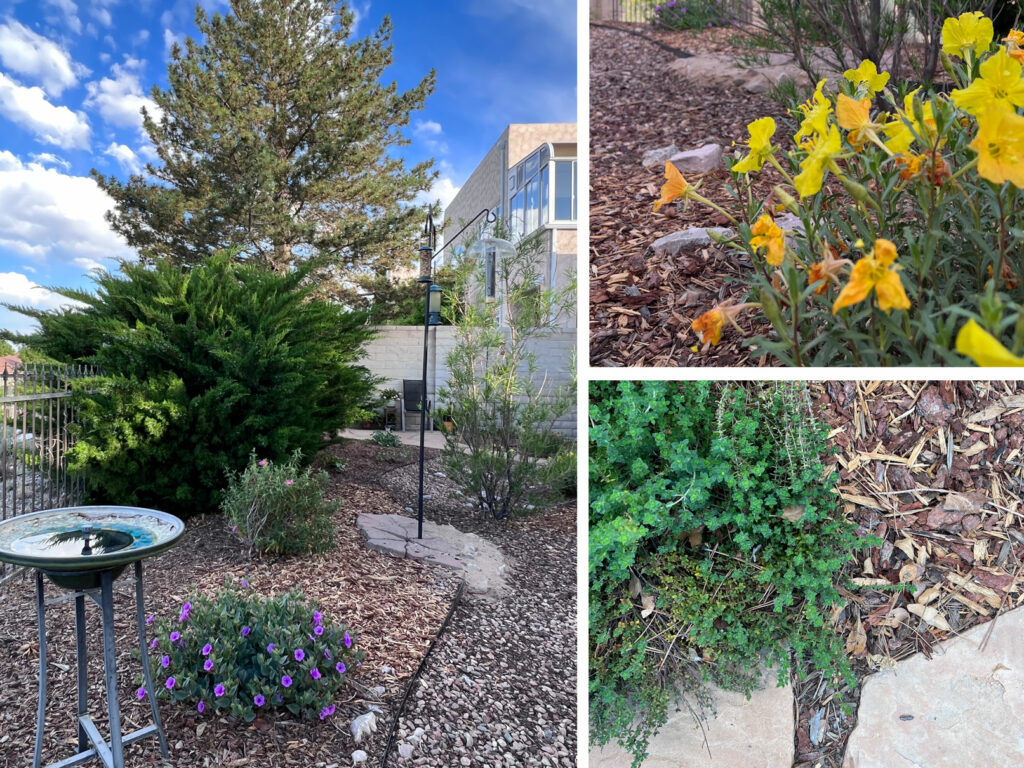
Wood chip mulch insulates plant roots from both heat and cold, reducing moisture loss from the soil by evaporation, feeding beneficial soil microorganisms that enhance plant growth and improving soil health. This makes the soil more sponge-like and better able to hold water. By installing 3-4 inches of mulch over bare dirt, weeds are reduced, the soil is enriched, and new plants retain more moisture.

Another benefit of organic mulches is that they can visually accommodate a little bit of leaf litter, reducing the need for constant raking and clean-up. A thin top dressing of mulch added every two to three years keeps the landscape looking fresh and replaces the material that has broken down to sustain the soil. Organic mulches are lightweight, making them easy to transport in a wheelbarrow and spread with a rake.

Mulches are available in bags from most local garden centers (avoid the dyed ones as the colors will fade) and in bulk from several retailers in the Albuquerque area. When you buy from local bulk retailers, you are supporting the recycling of local organic materials that may otherwise end up in a landfill and contribute to greenhouse gas emissions. Buying bulk also means less plastic! Mulch can sometimes be available at no cost from local tree trimming companies. In addition, Bernalillo County offers free mulch to residents who load it themselves at the East Mountain Transfer Center. County staff can load the mulch in your vehicle with a tractor for a $5 charge. The county also will deliver 30 cubic yards of mulch for $60, plus $2 a round trip mile for delivery. Mulches are a renewable resource that will improve landscape health and conserve water. 

In areas of higher wind exposure or periodic inundation with water, use a wood chip mulch that is irregularly shaped and sized as the pieces will knit together better. This type of mulch can include recycled yard waste and tree trimmings as well as commercially available, locally processed wood products.   
Property Data:

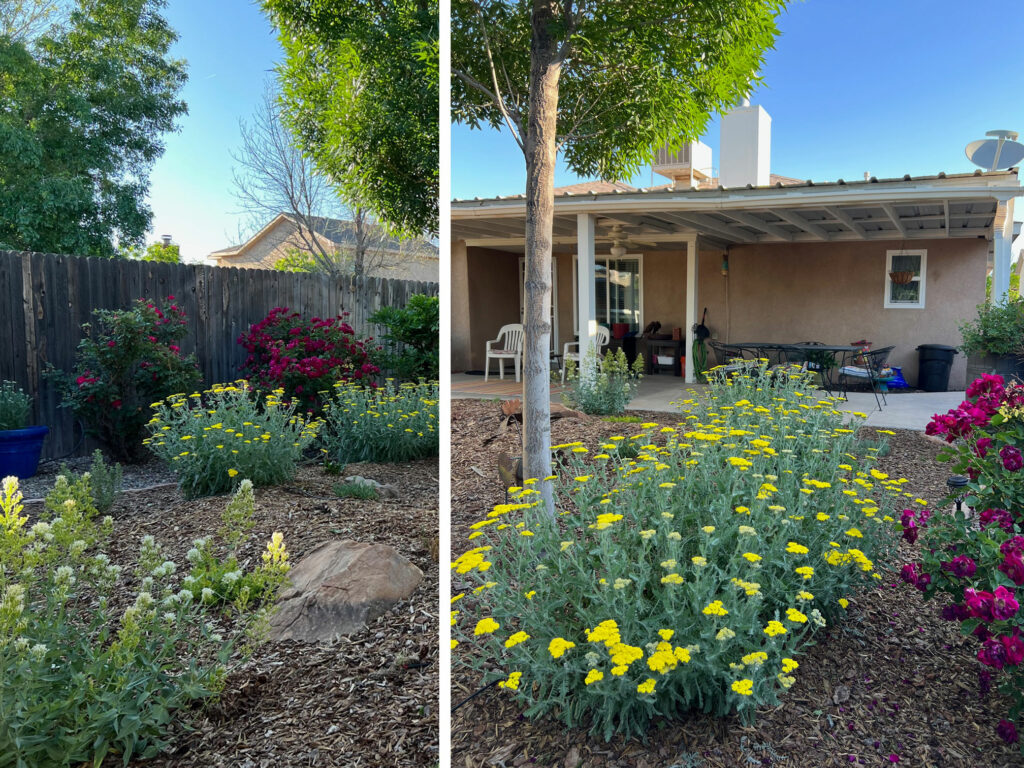
Each homeowner converted under 800sf of park blend grass to desert friendly xeriscape. Total rebate received: $2,310.

Thinking about converting your yard from high-water-use grass to xeriscape? Check out the Desert Friendly Xeriscape Rebate page to learn more about the qualifications, requirements and process to apply for this generous rebate. Additionally, xeriscape rebate participants get 25% off the cost of installing bulk organic mulch, up to $100. If you want to top dress mulch around your trees, take advantage of our Treebates. You are welcome to contact our xeriscape specialist, Amos Arber, at aarber@abcwua.org or 505-208-2015.

Learn more about mulches here:

4 Common Myths about Organic Mulch

Types of Mulches

Mulching

How to Make a Tree Watering System for Your Established and Mature Trees

Author:  Amos Arber, Xeriscape Rebate Inspector with the Water Resources Conservation Department for the Water Authority. And Jill Brown, ASLA MyLandscapeCoach.com Have a question about the article? AskAnExpert@abcwua.org

Water-Wise Vegetable Gardening

With our hot summers and low precipitation, growing vegetables in NM can be
challenging. This talk will provide strategies and recommendations for growers to
cultivate a thriving vegetable harvest in the region. Discussion will include irrigation and infrastructure suggestions, as well as selection of vegetable varieties that are well-adapted to the area.

Instructor: Stephanie Walker, PhD. Professor and Vegetable Specialist, New Mexico
State University, Extension Plant Sciences Department.

Maintaining Tree Health During Drought

Learn from Albuquerque’s leading tree expert how to identify drought stress in trees,
understand their responses to drought, and implement strategies to keep them alive and thriving in hot, dry weather.

Instructor: Joran Viers, Board Certified Master Arborist and Municipal Specialist,
International Society of Arboriculture (ISA). Senior Arborist, Legacy Tree Company,
Albuquerque. Former City Forester, City of Albuquerque

Creating a Drought-Tolerant Refuge for Yourself and Wildlife

Instructor: Laurel Ladwig, M.S. She is the ABQ Backyard Refuge Program Director for the Friends of Valle de Oro National Wildlife Refuge, a part-time faculty member in the Department of Geography and Environmental Studies, and Associate Director of the R.H. Mallory Center for Community Geography at the University of New Mexico and is enthusiastic about all opportunities to encourage people to develop a relationship with our wild neighbors.

Designing Resilient Landscapes: Plant Adaptations, Communities, and Selection for Arid Environments

Instructor: Maria Thomas is the Curator of Plants at the ABQ BioPark where she manages the botanical exhibits, plant collections, horticultural staff, and related programs for the 150-acre public park and garden. Additionally, Maria is an Adjunct Professor at the University of New Mexico in the Landscape Architecture department.

Climate-Ready Trees- Planting for a Warmer and (Hopefully) Shadier Future

Instructor: Marisa Y. Thompson, PhD Extension Urban Horticulture Specialist. New Mexico State University Department of Extension Plant Sciences, Los Lunas Agricultural Science Center, Think Trees NM, President of the Board (2023-current).

Plant Adaptations to Heat & Drought

Noticing the Ways Plants Thrive in our Yards and Natural Areas Learn how to Recognize Drought-Adapted Traits in Everyday Plants all Around Us.

Instructor: Marisa Y. Thompson, PhD Extension Urban Horticulture Specialist. New Mexico State University Department of Extension Plant Sciences, Los Lunas Agricultural Science Center, Think Trees NM, President of the Board (2023-current).

Hose Bib Tree Irrigation System for Your Trees: Simple Systems for Thriving Trees!

Instructor: Richard Perce has twenty years’ experience working with trees and irrigation here in New Mexico. He is a former certified arborist and currently holds the Irrigation Association’s Landscape Irrigation Auditor certification and is a certified QWEL irrigation instructor. He worked as a landscape contractor for more than a decade and is the Water Authority’s former Irrigation Efficiency Specialist. He also has a Masters of Community and Regional Planning from UNM and currently works at Anthropopulus Design + Planning.

Passive Rainwater Harvesting

This workshop introduces participants to the principles and practices of passive rainwater harvesting. Attendees will learn how to capture, slow, spread, and infiltrate rainwater into the landscape using simple, low-cost methods such as swales, berms, and basins. The workshop emphasizes working with the natural flow of water to reduce runoff, prevent erosion, and support healthy soil and plant life. By implementing passive rainwater harvesting, participants can conserve water, and create more resilient, self-sustaining landscapes.

Instructors: Anthony Luketich, Natural Resource Scientist, Anthony Luketich is a Natural Resources Scientist for Bernalillo County where he is focused on water conservation and water-wise landscape practices. He received a degree in Watershed Management and Ecohydrology from the University of Arizona where he studied the relationship between trees and water. Anthony has worked across the Southwest US as a research scientist as well as a water harvesting field technician where he became a certified water harvesting practitioner.

Bobby Mullin, Natural Resource Scientist, Bernalillo County Stormwater Quality Program Bobby Mullin is a Natural Resource Scientist for Bernalillo County in the Stormwater Quality Program. He focuses on improving stormwater quality in the Middle Rio Grande Watershed and promoting sustainable and resilient landscapes using Green Stormwater Infrastructure and rainwater harvesting. Bobby received his Bachelor of Science in Environmental Science from Bucknell University in 2011. Before joining Bernalillo County, he had worked as an environmental consultant remediating contaminated soil and groundwater and as a Research Scientist studying the impacts of climate change, drought and plant mortality in New Mexico ecosystems.

Xeriscape: The Desert Friendly Yard

Join us for learning all of the tips, and benefits of our Xeriscape program!

3 Steps to Landscape Success

Service, Settings, and Selection are the keys to landscape success!