In our hot, arid climate, drip irrigation efficiently waters trees, shrubs and other landscape plants by delivering the right amount directly to roots, promoting healthier plants and reducing waste. The drip systems greatest advantage is flexibility. It’s easy to install and modify a drip system as a landscape grows and changes. However, they can be incredibly wasteful if not installed and maintained correctly. Like many things, it’s easiest to learn from mistakes. We compiled the most common drip irrigation mistakes we see in our Albuquerque landscapes.
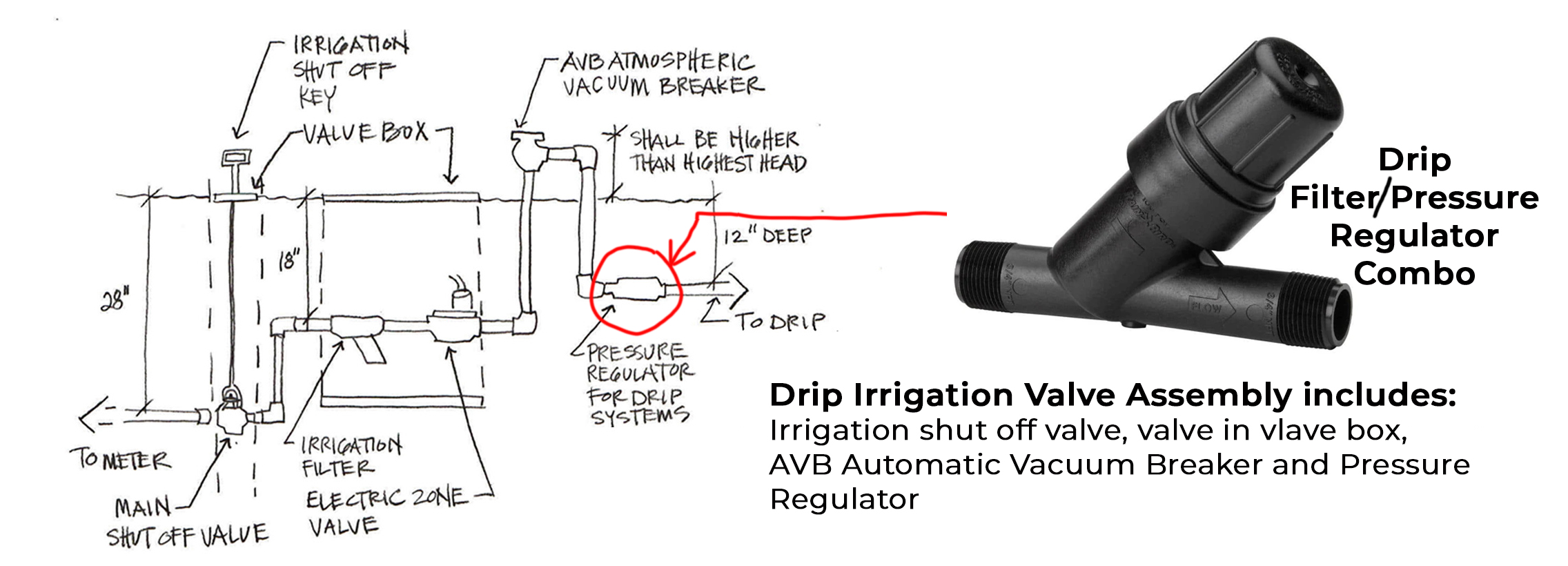
Mistake 1: Not installing a drip filter/pressure regulator combination.
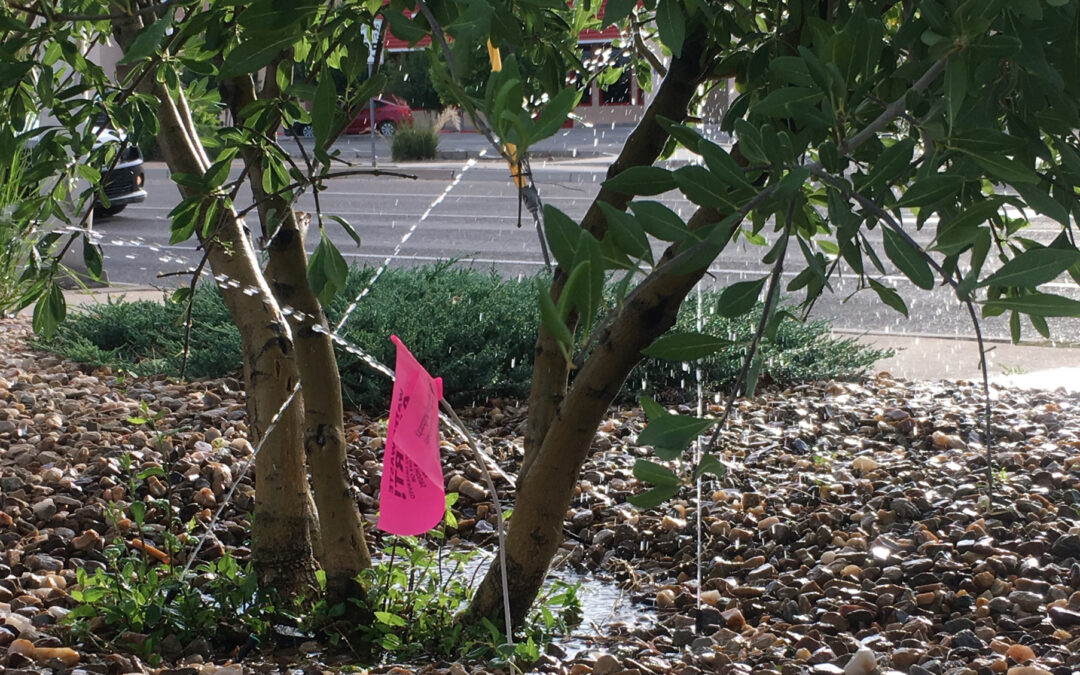
Average water pressure in Albuquerque ranges from 45-80 PSI, but drip irrigation systems have been designed to operate best at 25 PSI. All drip systems should have a pressure regulator to reduce the pressure and a filter to screen dirt and debris from water. If you notice drip emitters are popping off or leaking, then the water pressure is too high. Install a drip filter/pressure regulator combination downstream of the valve, immediately after the backflow preventer or vacuum breaker. If your system has a pressure reducer but emitters keep popping out of the ¼-inch distribution tubing then the end of the tubing may have become stretched. If so, cut off a small section of the tubing and reinstall the emitter into the fresh tubing to create a more secure fit.
Mistake 2: Relying on the existing sprinkler heads and sprinkler lines for drip irrigation.
Don’t rely on the old piping when converting sprinklers to drip. Abandon all old PVC and galvanized lateral lines and install sprinkler irrigation directly downstream of the valve assembly and backflow preventer. You may have seen the spray-to-drip retrofit kits locally available and wonder if this is a good approach. We don’t recommend this approach because studies show that nearly half of the water saved from converting a lawn to a xeriscape comes from abandoning leaky underground piping and fittings. Install your drip directly downstream of the valve assembly. Click here to learn how..
Mistake 3: Not burying or covering drip irrigation tubing.
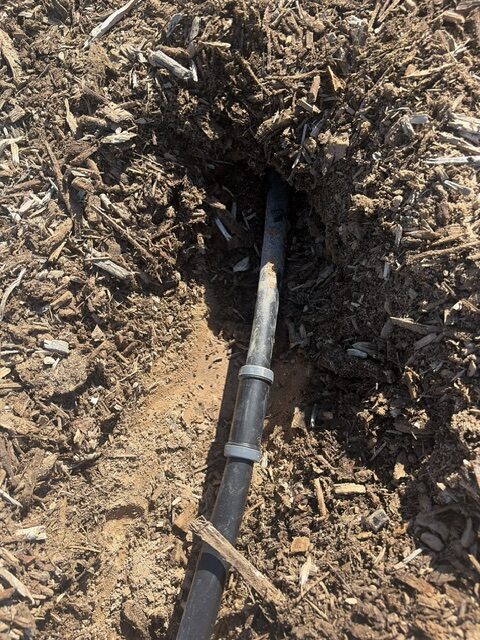
One of the best ways to extend the life of your drip system is to keep it out of direct sunlight and hidden from rodents. Although drip tubing is UV-resistant, prolonged exposure to the sun gradually breaks down the plastic, making it brittle causing it to weaken and leak over time. To protect from the elements, ½” and ¾” distribution tubing should be installed with landscape staples and buried in a 4-6” depth trench and cover with 3-4″ of mulch.
Polyline drip tubing buried underground.
Mistake 4: Going over instead of under retaining wall.
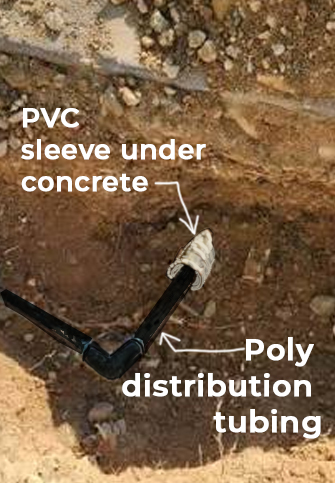
Avoid running drip tubing over the top of retaining walls (or landscape edging) whenever possible. A better option is to install a PVC sleeve beneath the wall before construction. Be sure to cover both ends of the sleeve with tape to prevent soil and debris from entering during construction. When you’re ready to install the irrigation system, simply feed the drip tubing through the sleeve. The sleeve protects the tubing from damage while also providing a convenient pathway for future repairs, replacements or system modifications.
Irrigation PVC sleeve under concrete.
Mistake 5: Runs of ¼-inch distribution line (often called spaghetti tubing) that are too long.
In a perfect world, these smaller tubing lengths wouldn’t exceed 2 or 3 feet between the larger lateral tubing (½-inch or ¾-inch size) and the base of the plant. Keeping ¼-inch distribution tubing short, pinned down with landscape staples, and covered effectively with mulch helps prevent pressure loss from long runs plus reduces the opportunity for physical damage from UV sunlight, rodents or dogs.
Mistake 6: Having unnecessary fittings.
Every fitting creates an opportunity for leaks, compared to a continuous run of tubing. Whenever possible, use a single uninterrupted length of tubing. For example, if the tubing can be gently bent around a corner without kinking, there is no need to install a 90-degree elbow fitting,
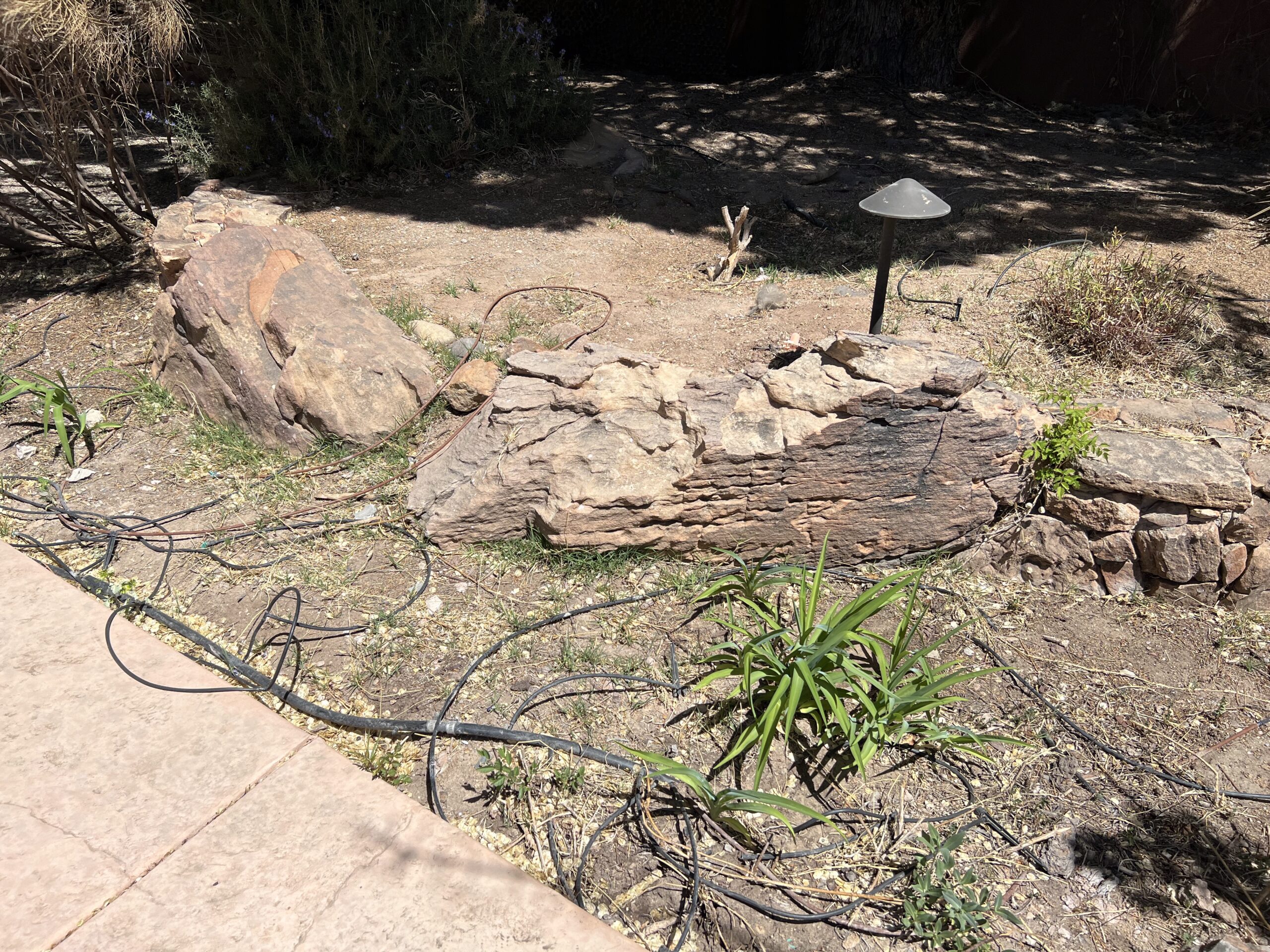
Lots of dripline connectors and long runs of ¼” distribution tubing – likely leading to damage and leaks.
Mistake 7: Not using enough landscape pins or staples.
Properly securing irrigation tubing with staples keeps it in place. Temperature fluctuations can cause the lines to expand and contract, which, over time, can allow the tubing to migrate to the surface, exposing it to sunlight and physical damage. Pin down the larger lateral supply line tubing and use at least one landscape pin on each ¼-inch tubing line to prevent the emitter from moving away from the plant’s root zone.
Mistake 8: Insufficient emitters for existing trees and plants.
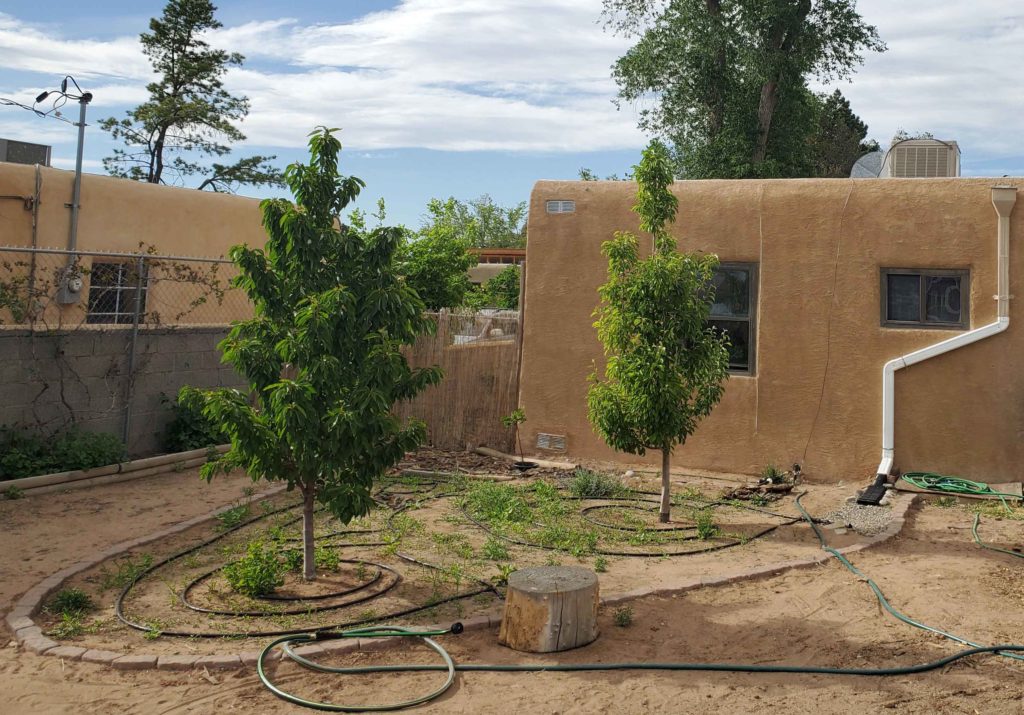
This problem is most common when a lawn is converted to a xeriscape landscape with drip irrigation. Existing trees may have relied on sprinkler irrigation for many years, allowing their roots to spread throughout the lawn and often well beyond the edge of the canopy. When sprinklers are removed, homeowners or contractors sometimes replace the irrigation with just two or three emitters near the base of a mature tree. This does not provide enough water, and the water is not being applied where the majority of the feeder roots are located. This issue also occurs in newly installed landscapes when plants receive too few emitters; if the emitters are not repositioned, the problem continues as the plants mature. For newly installed landscapes use our Irrigation Guide page 28 to learn how many emitters should be installed per plant.
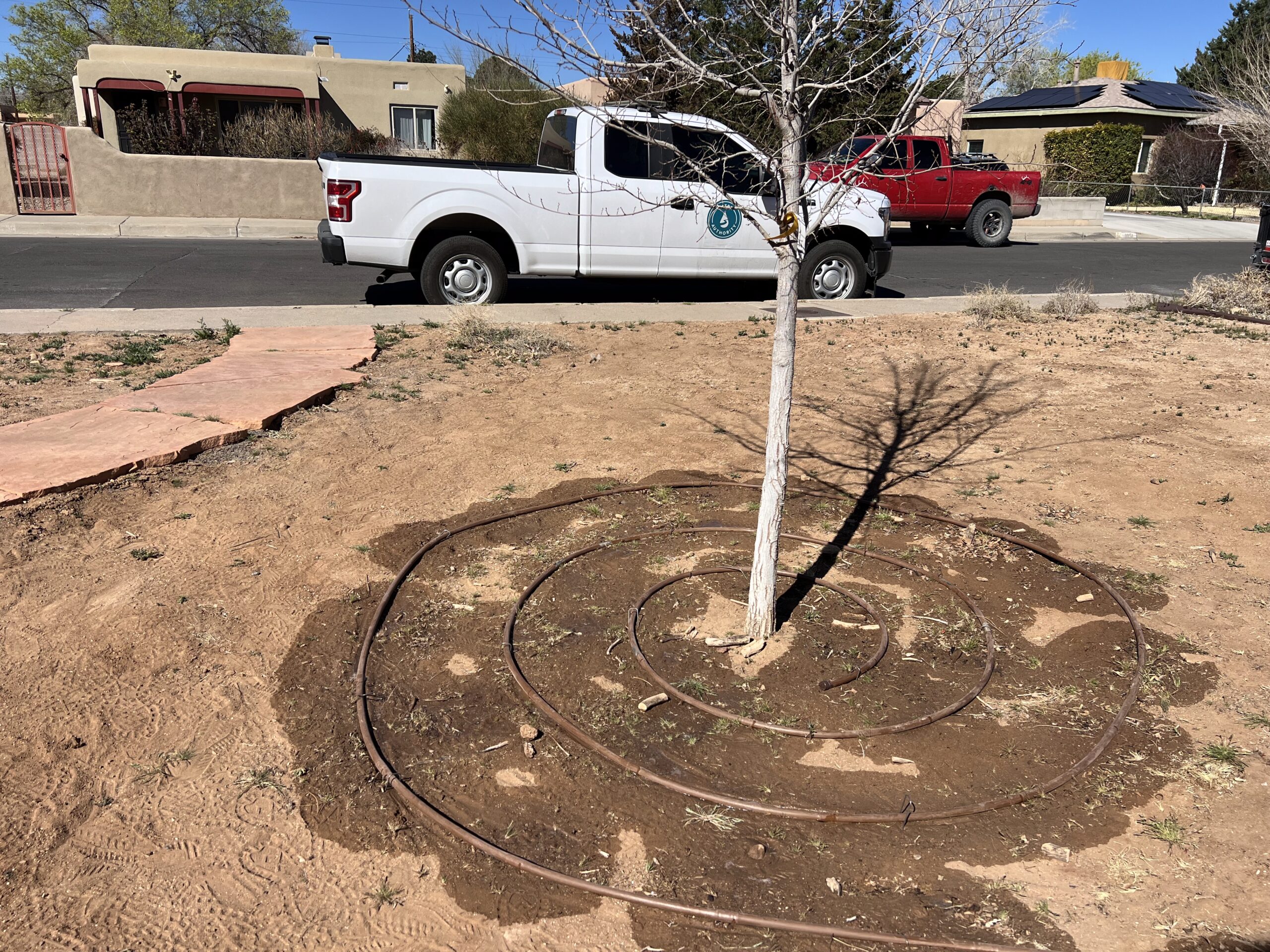
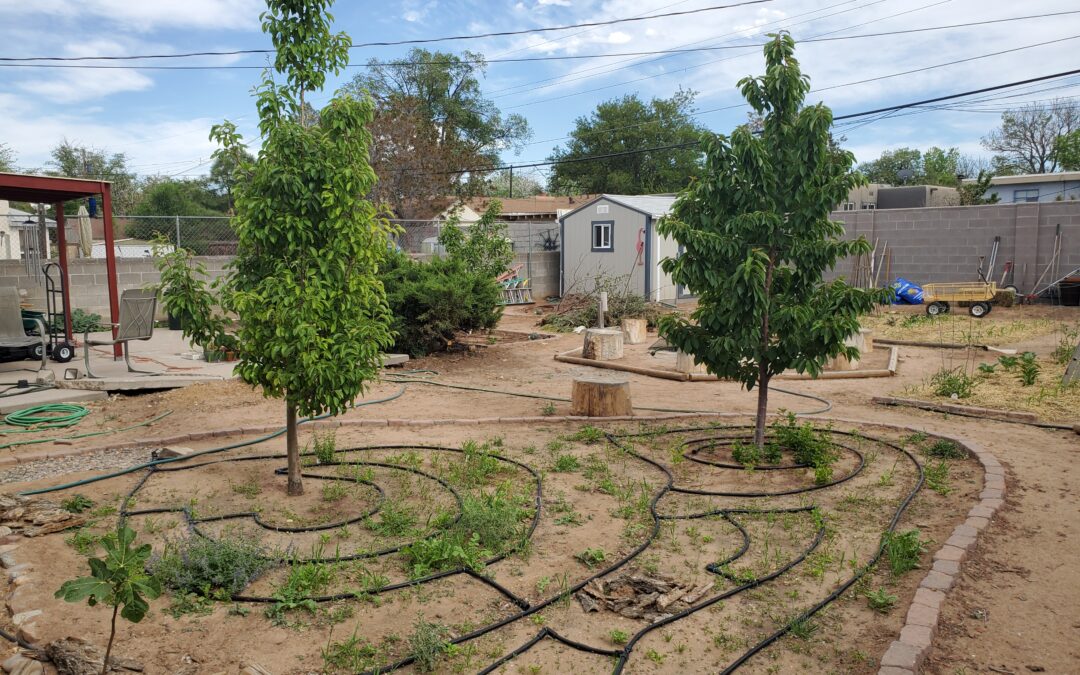
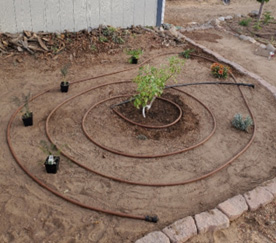
Newly installed tree watering system around a newly planted tree
Tree watering system around existing tree to accommodate watering of the root zone around the large existing tree.
Mistake 9: Not separating trees and perennials into different irrigation zones.
We often find that customers have their low water use plants and medium water use trees on a single drip irrigation zone. One of the best irrigation practices – called ‘hydrozoning’ is to place trees and desert-friendly plants on separate watering zones. This allows each plant grouped by water need type to receive water according to its specific needs. Established trees typically benefit from deep, infrequent watering once or twice per month, while smaller plants generally require more frequent watering, often two to three times per week during the growing season. Separating these plants into different zones improves water efficiency, promotes healthier root systems and helps prevent both overwatering and underwatering. Occasionally, we come across a single irrigation zone or valve that contains both sprinklers for grass and drip irrigation for plants — this should always be avoided because it results in overwatered plants or underwatered grass.
Mistake 10: Not keeping emitters visible.
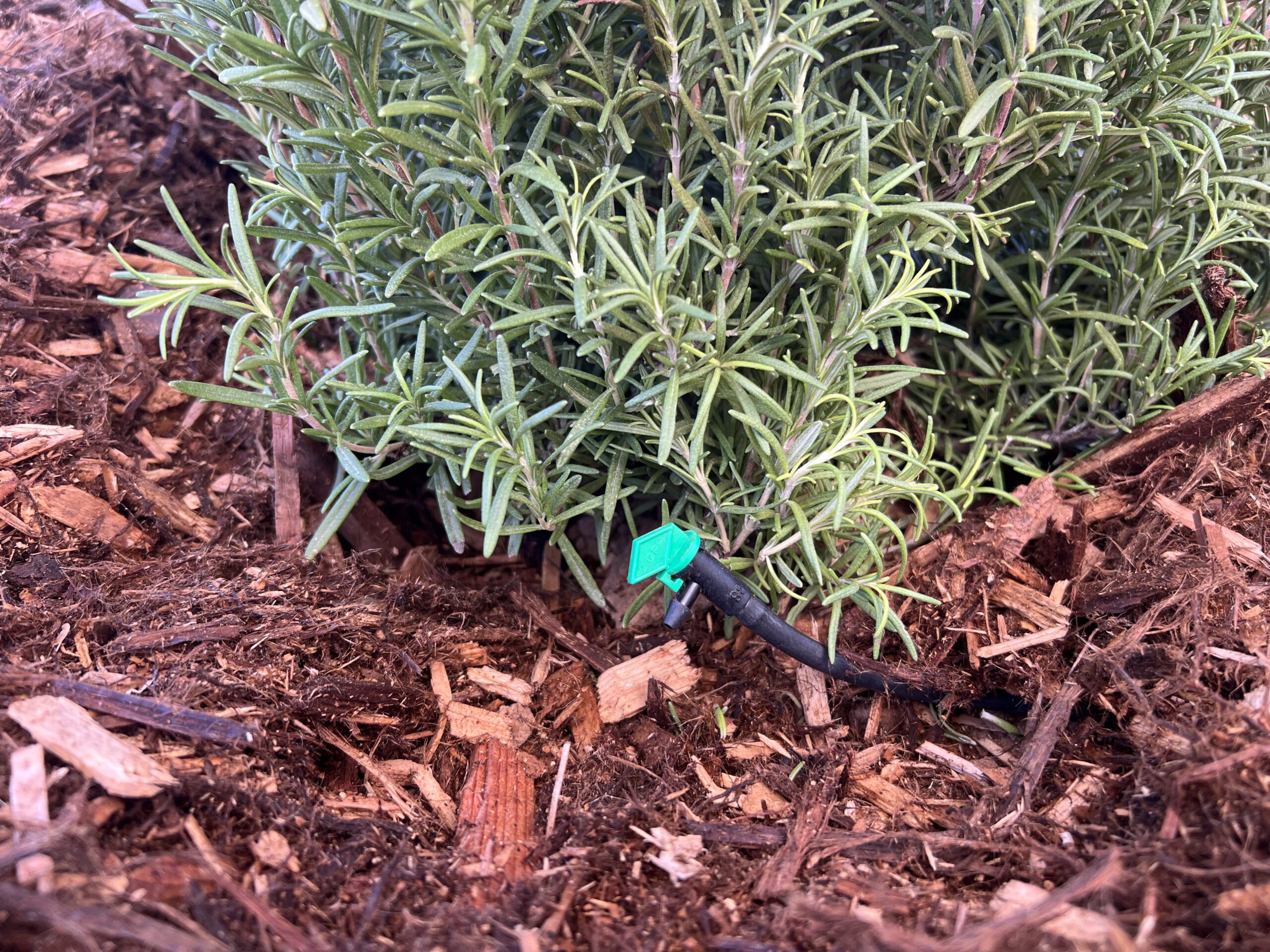
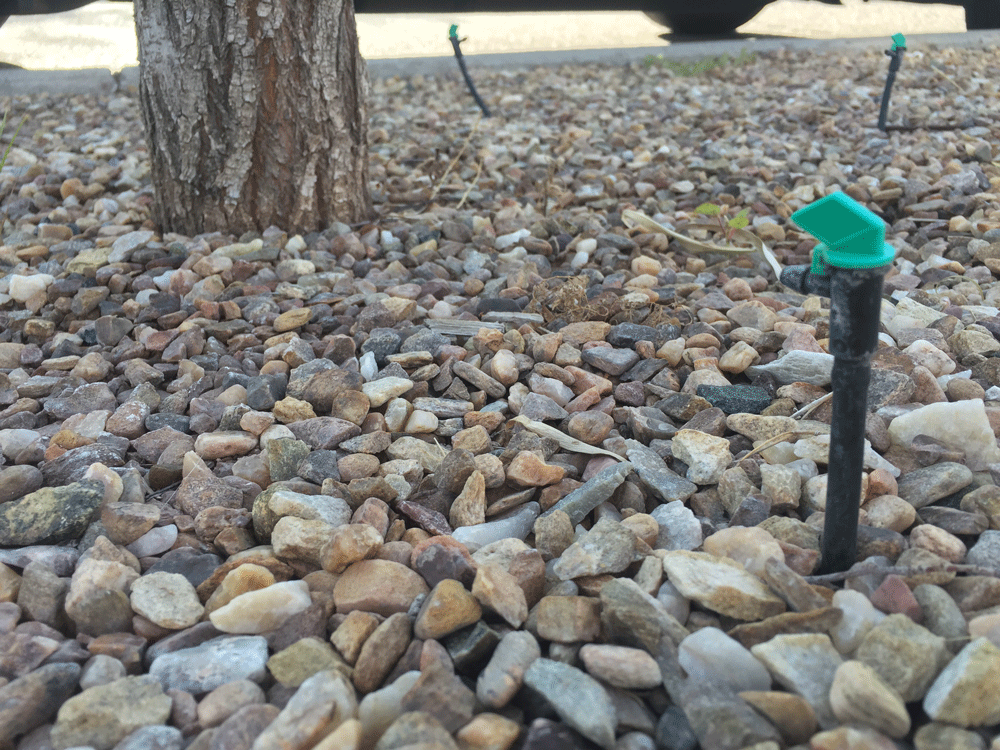
When walking through your newly installed landscape, you should be able to see the drip emitters positioned 2 to 3 inches above the mulch or gravel. (Emitters should also be placed on the uphill side of the plant.) Keeping emitters visible during the establishment period makes it much easier to verify that they are working properly and delivering water where it is needed. While they may not be the most attractive feature at first, the emitters will become less noticeable as plants grow and fill in. In a mature landscape, however, they can become hidden by plant growth and groundcover. In this case, the overall appearance and health of the plants provides clues if an irrigation problem exists. When you do need to locate an emitter, try listening when the drip zone first turns on. The sound of water flowing through the emitter can often help you pinpoint its location.
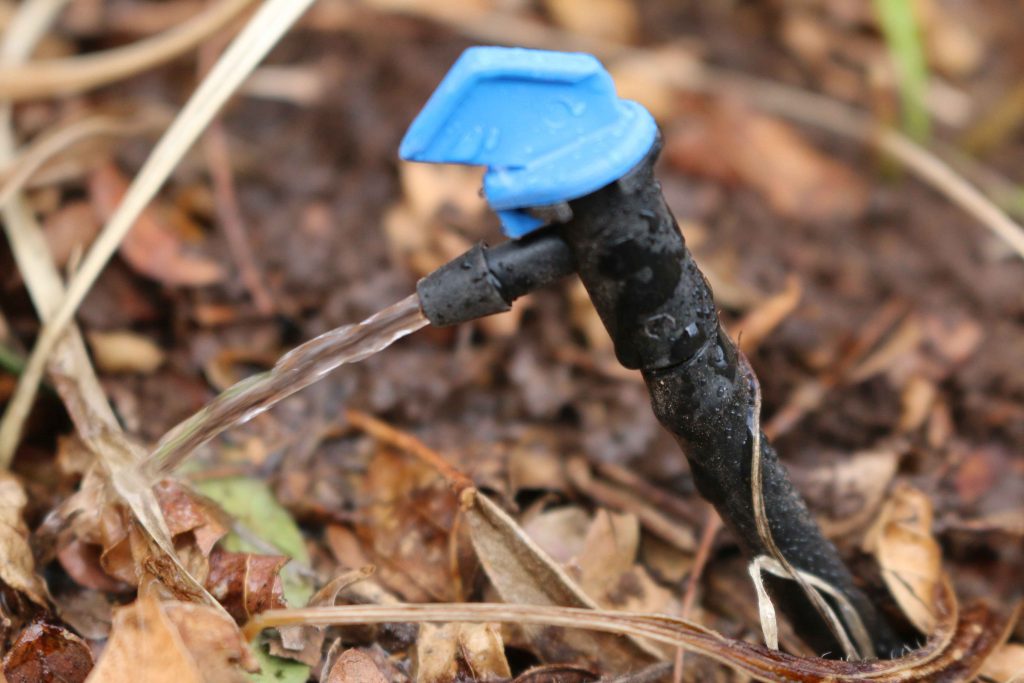
Emitter next to shrub.
Mistake 11: Using specialty parts that aren’t readily available at most irrigation or hardware stores.
When designing and installing your drip irrigation system, it’s best to use common, readily available parts. Choosing specialized components that are difficult to find or incompatible with standard fittings can lead to frustration, delays in repairs and resulting plant stress when repairs or replacements are needed in the future. We recommend purchasing supplies from irrigation specialty stores, as they offer higher-quality products, stock the same parts from the same manufacturers, and have experts available that can answer your questions. Be selective in the parts you purchase and keep a stash of extra parts in your toolbox so you can make a quick repair and avoid wasted water or stressed plants.
Folks, it’s a hot, dry summer here in central New Mexico. No surprise, you say — we live in a desert. Even for our location, though, it’s hot and dry. This creates a little conundrum for us: keeping our landscape plants growing while using water efficiently.
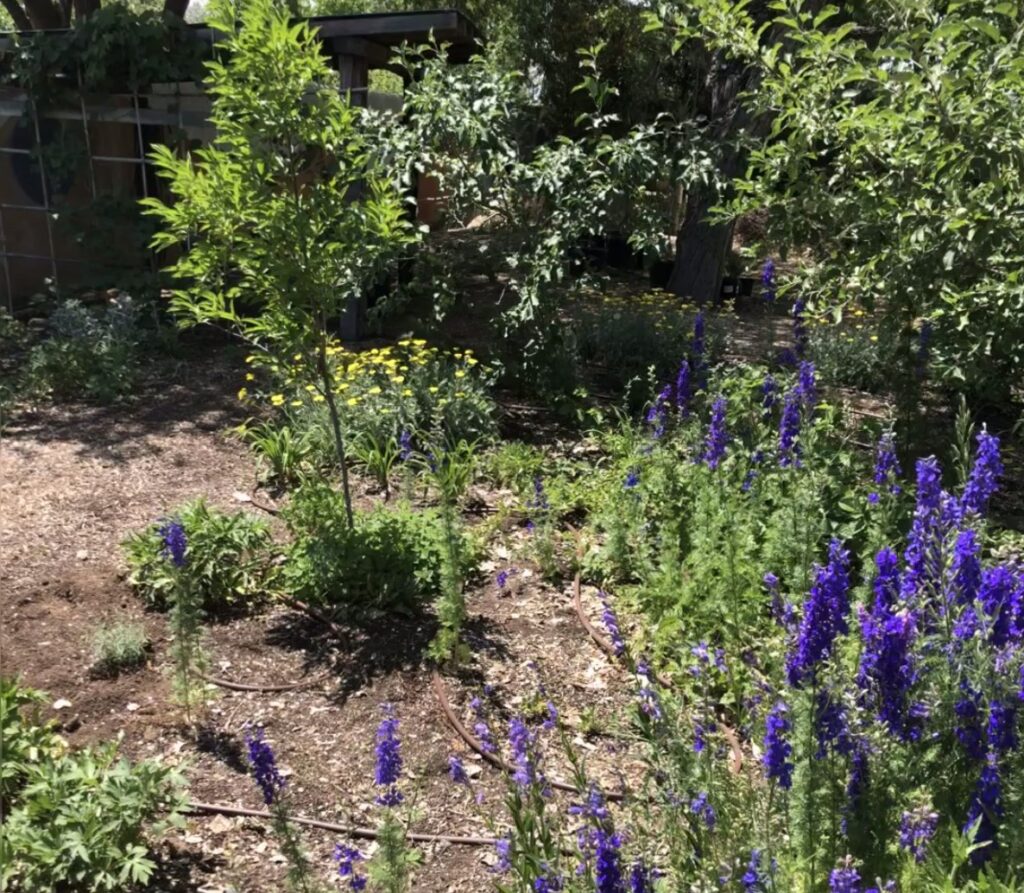
Tree and surrounding plants being watered by inline drip irrigation.
This applies especially to trees because as large plants with lots of leaves, they need regular adequate water for their size and species to remain happy and continue creating positive benefits for your yard and the city as a whole. Call that a biological law and reality. As temperatures go up, trees’ water demand goes up. That is a good starting point to keep in mind — in times of drought, you should water your trees a little more frequently than you would in a year with abundant rainfall.
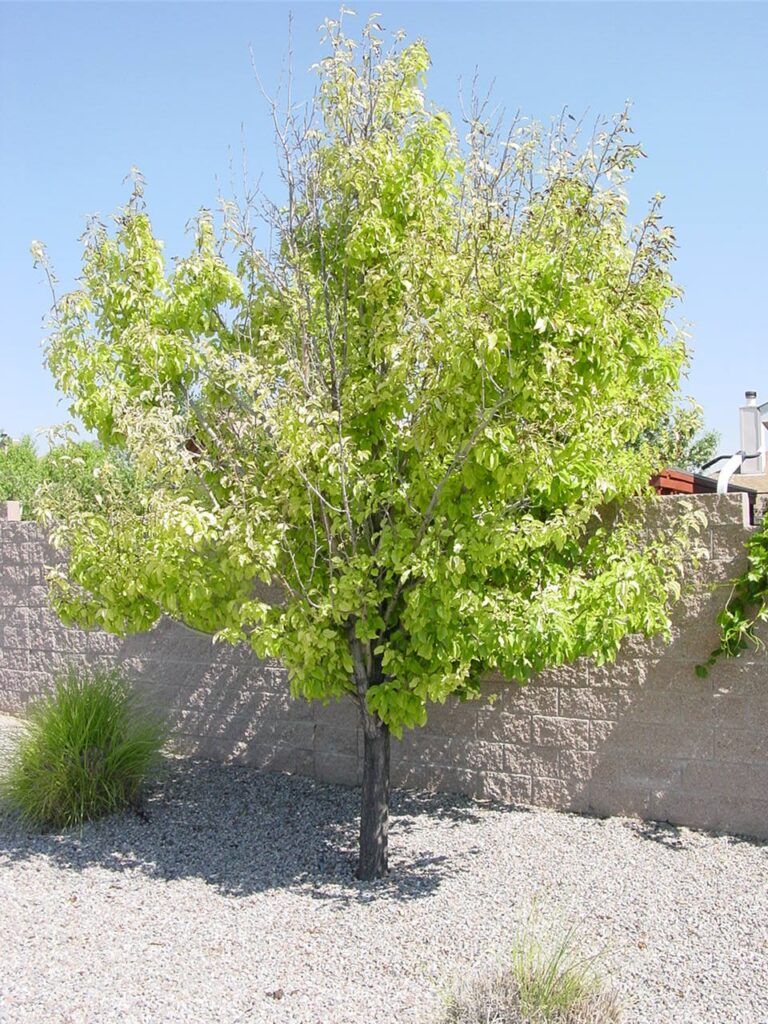
Drought stressed tree showing missing leaves and yellowing.
It turns out that over 90% of the water that comes into a tree simply escapes through the leaves as water vapor; the tree keeps very little water inside to grow. This loss of water vapor provides the “suction” that causes more water to enter the root system. It also cools the leaves and keeps them within comfortable working temperatures. Someone once said trees (and plants generally) have figured out a way to guide the natural movement of water from soil to atmosphere, channeling it through their bodies and using it to grow and function, which is one part of the water cycle. Having trees increases moisture in the air, allowing your swamp cooler to perform better.
Trees “drink” very differently than you and I. We have one fairly large mouth into which all the water goes. However much we need, we have one target to hit in order to drink that water. Trees, on the other hand, take water in through their tiny, young roots out in the soil. Water has to get to a lot of soil in order to hit enough of those “mouths” to matter. A lot of tree irrigation eventually fails because there are only a few emitters (and those are often too close to the trunk). Those few emitters cannot put out enough water to satisfy the tree’s demand, nor do they wet enough surface area. (See examples in the photos below.)
Drip emitters located very close to the tree trunk.
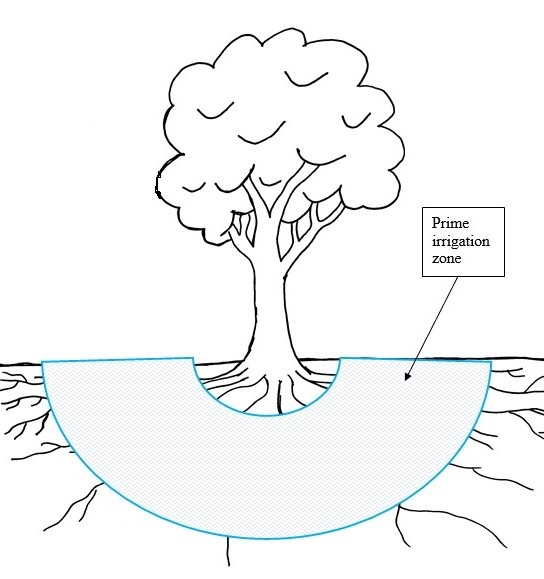
What matters to a tree is the volume of water it has to work with. That volume is entirely dictated by the volume of soil that is holding water. And THAT volume is dictated by the surface area that received and absorbed water. The key is to disperse the water throughout the main root zone and do it in a way that allows the water to soak in where applied and not flow to low spots on the ground (which often are gutters. Science has found that most tree roots are located within the top three feet of the soil surface and quite likely even more shallow in landscapes that have not been deeply irrigated for the life of the tree, which is a common condition in Albuquerque.
To properly water your trees, you will need some sort of irrigation system. It could be a bucket you fill from the sink or a state-of-the-art sensor-controlled automated drip system. But somehow you need to put water on the soil surface in a slow, controlled manner so that it can soak into the soil where it is applied. While buckets and hoses work, their simplicity makes them very labor intensive. In-line emitter drip tubing, laid out in a spiral or concentric circles, does a much better job. Once in place, these drip systems can be set to run for two to four hours at a time, about once a week during the hottest part of the year and less often during other seasons. Irrigation improvements qualify for the Water Authority Treebate. See our rebates here.
The ideal target area to irrigate is both theoretical and grounded to the reality of the site. Imagine a donut shaped area centered around the tree trunk. The trunk sits in the center of the donut hole. The body of the donut begins halfway between the trunk and the edge of the branch canopy and extends some distance beyond the edge of the canopy. This theoretical donut represents the ideal critical irrigation zone.
Now enters site reality — maybe there is a house or driveway or sidewalk covering part of the donut (or all three, with the tree located in a tiny unpaved space). We don’t want to encourage root growth at the house foundation, so don’t water within a couple of feet of it. Similarly, where concrete or asphalt covers the soil, root growth is moisture-limited and concentrated immediately under the impervious cover and under any planned or accidental cracks that allow rainwater to slip through. Ideally, we don’t want to water next to the pavement. The more of the donut that is unavailable for watering, the more often you may need to water the limited areas of open soil. Even so, it may simply not be enough soil volume to support the tree, which will then decline. In that case, replace it with a nice xeric shrub!
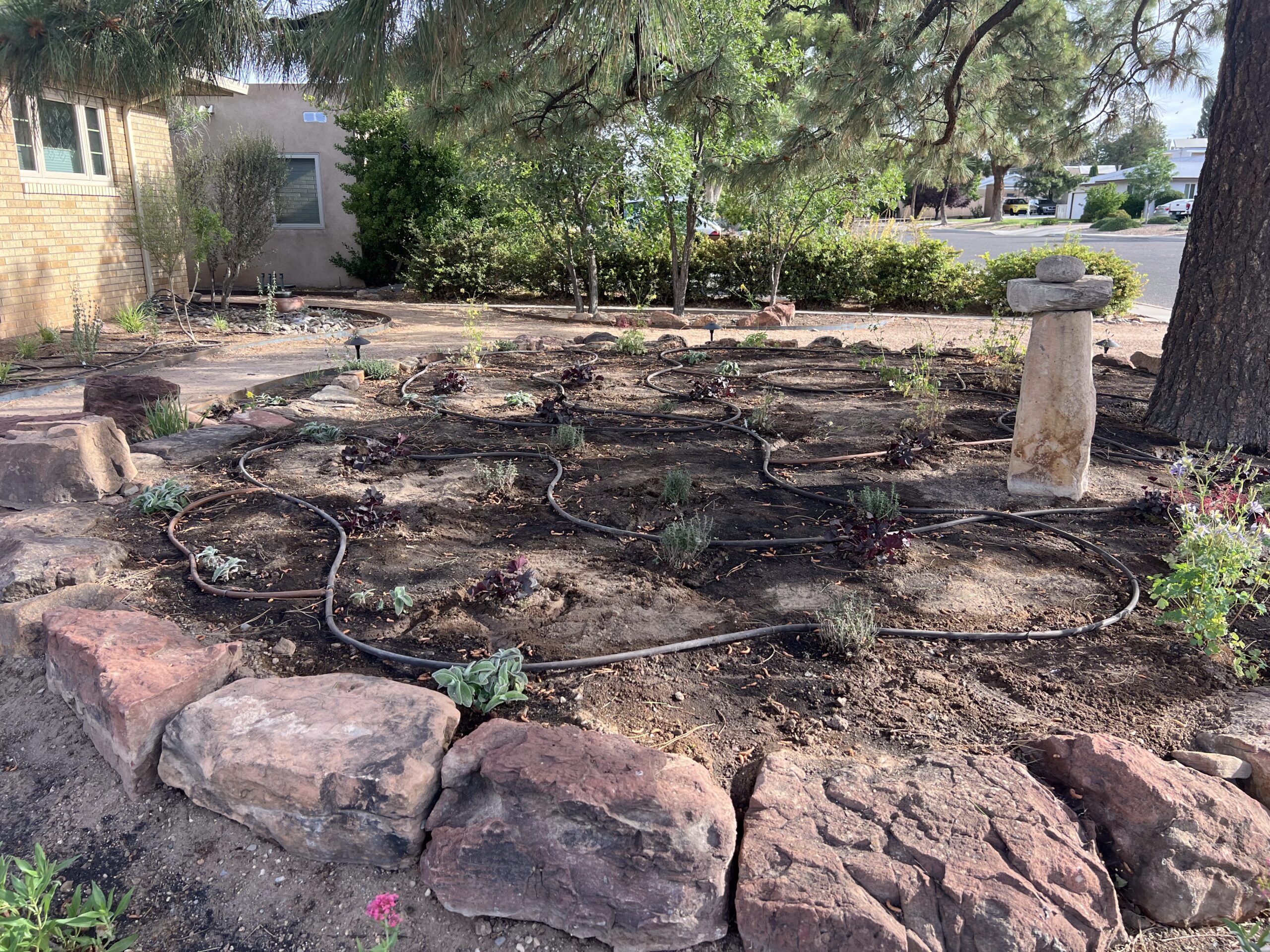
Recently installed drip tubing around a newly planted Mexican elder and some to-be-planted fennel. Both of those plants are excellent pollinator forage. A 4-inch depth of wood chip mulch will be installed over the top.
Author: Joran Viers is an arborist at Legacy Tree Company. Contact him at [email protected]. He’ll be speaking about this topic in greater detail on July 25. Sign up here. Have a question about the article? [email protected]
In celebration of five years of bringing you 505Outside, we’d like to share our most popular articles from the website. 505Outside is your resource for beautiful, desert friendly landscapes. Desert friendly landscapes are resilient, sustainable, enjoyable and inspiring.
The articles below are the ones our community keeps coming back to year after year, month after month.
The Dirt on Albuquerque Weeds There are two times a year in the greater Albuquerque area when weeds can get out of hand. This happens typically in early spring after a wet winter and after a monsoon season in late summer. The first thing to do is to identify the plant and decide whether it is actually a weed. This article reviews the most common weeds in town.
Basics about Turf Grasses in New Mexico Many homeowners would like a turf grass lawn, but might feel irresponsible watering a lawn in the arid Southwest. The key to choosing a turf grass is to determine the one most suited to the specific needs of your landscape. This article discusses four different grass types.
Use Drip Irrigation for Trees and Shrubs Drip irrigation is the recommended method of delivering water to shrubs, trees and all other plants that are not considered turf grasses. This article discusses the rules of thumb for irrigating trees and shrubs.
Basics of Fruit Tree Pruning All trees require some amount of pruning, especially when young, in order to set up good structure. Fruit trees have a few special considerations related to our intense sunlight, specific pests, and where on the tree the fruit is produced. This article covers the basics.
Three Ways to Water Established Trees. Trees are incredibly valuable and provide a wide array of benefits, from increasing home values to improving mental health. It’s more important now than ever to take care of your existing trees. This article outlines three strateties for watering your mature established trees.
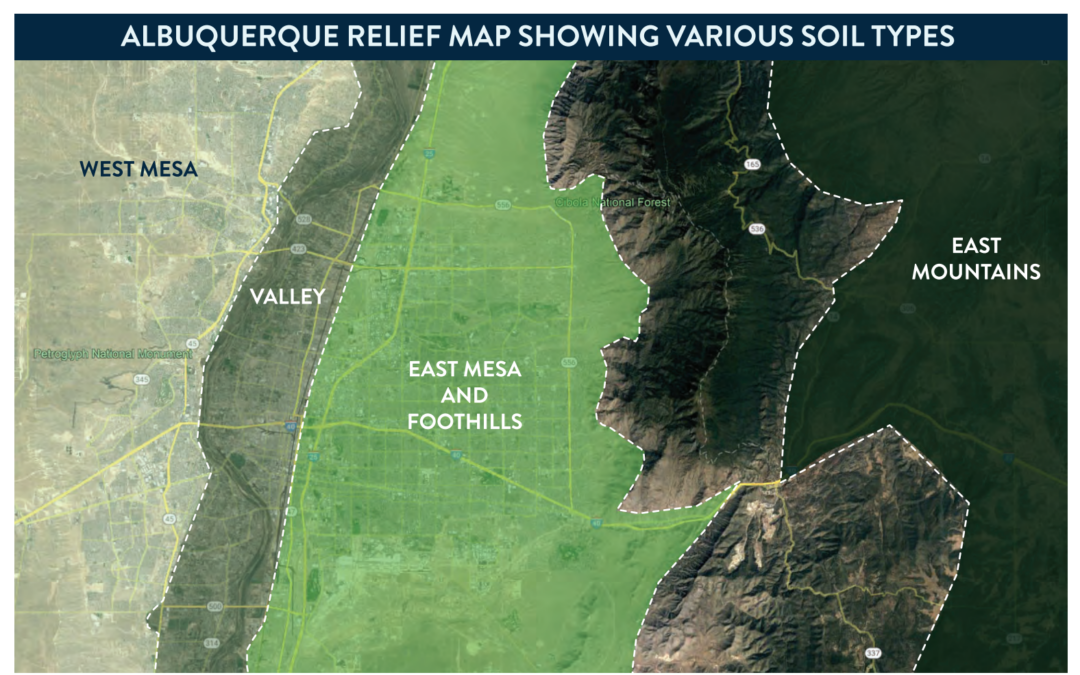
Albuquerque has a variety of soil types. Learning what type of soil is in your yard is a critical step to understanding how water will infiltrate the soil and how long specific plants need to be watered to get the water to the correct depth.
VALLEY SOILS
Valley soils vary from dense clay to grainy sand. They are layered and braided through the area because of the historic flooding of the Rio Grande. The valley also is where acequias weave through the community, providing many essential benefits. They provide water for creating foodsheds and are culturally significant for our community. They also help create and maintain our tree canopy and provide much needed pollinator habitat. This remains particularly important in our changing climate.
EAST MESA AND FOOTHILLS SOILS
The soils in the foothills are usually coarse, whereas the decomposed granite soils on the mesa are generally finer and prone to compaction. These soils have a broad range of organic material along with the base of decomposed granite, making for a huge diversity, even within a building site. Groundwater is deep — only shallow enough to be occasionally accessible to plants in unpaved arroyos near the foothills and stormwater basins fed by urban pavement.
WEST MESA SOILS
West Mesa soils, which vary from silty clay loam to finer sands, are sometimes deposited in a shallow layer above volcanic basalt. Groundwater is too deep to be accessible to most plants except in large stormwater collecting basins.
EAST MOUNTAIN SOILS
East Mountain soils tend to be a mix of moisture-retaining clay loams with some fast-draining gravelly deposits. The density and type of plant cover reflect the relative soil moisture. In upslope areas, where temperatures are consistently cooler and rain and snow more abundant, shrubland transitions to mixed conifer forest. Slopes tend to be drier than depressions, which accumulate moisture.
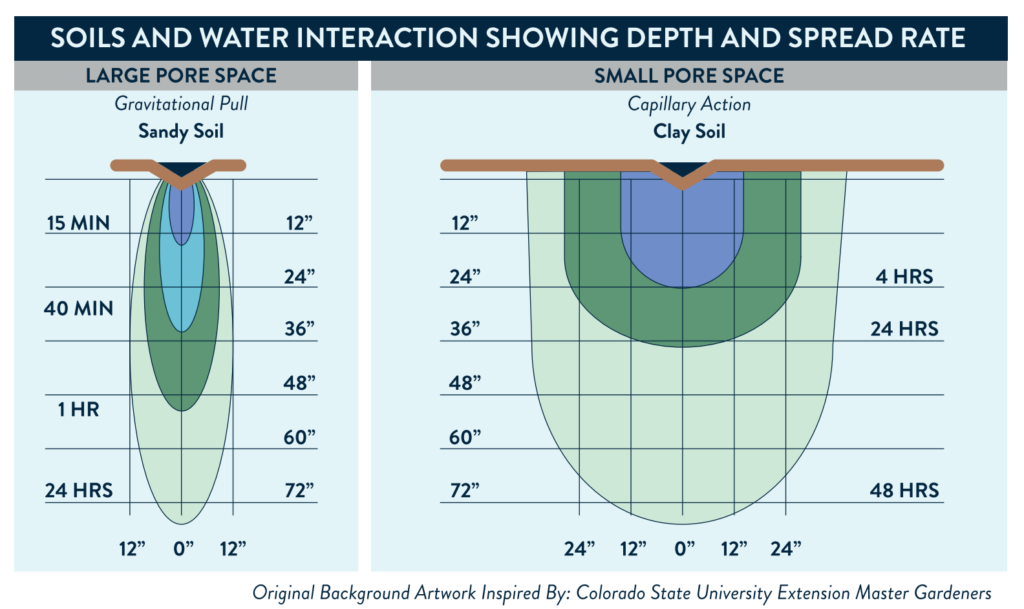
HOW WATER MOVES THROUGH DIFFERENT SOILS
Water soaks into sandy soils much more quickly than in clay soils, but it travels downward in a narrow pattern. In clay soils, the water travels much more slowly and spreads out in a much wider pattern.
Pro Tips:
• Plants in sandy soils generally need additional emitters to distribute water more evenly in a root zone. They also may need to be watered more frequently but for shorter amounts of time.
• Plants in clay soils generally need fewer emitters because the water spreads out. They will probably need to be watered less frequently but for longer periods.
• All soils need to drain between waterings to allow oxygen back into the soil pores.
A struggling plant may be receiving too much water. If soil stays saturated, plants will drown. Since there is a lot of clay in our soils, it is very easy to drown plants. A drowning plant often has similar symptoms to one not receiving enough water: wilted leaves and poor color. Always check soil moisture with a moisture meter before adding more water.
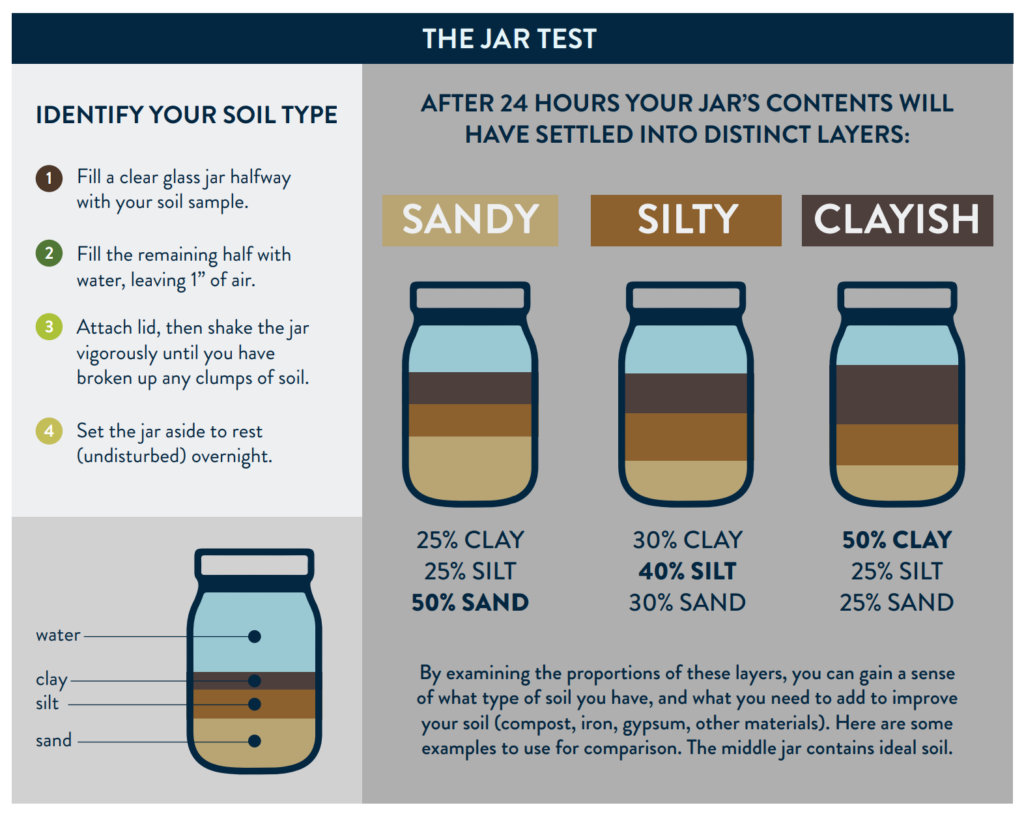
PERFORMING A JAR TEST TO DETERMINE SOIL TYPE
An easy way to get a better idea of what type of soil you are working with is to conduct a jar test. A jar test will separate the three main components of soil: sand, silt and clay. These determine the soil texture that contributes to drainage and overall plant health.
Most building sites, including home sites and the land directly surrounding them, have areas of heavy compaction. When soil is compacted, pore space that allows oxygen and water to get to the root zone is reduced, building an impermeable layer in the soil.
Soil compaction adversely affects percolation rates (the movement of water through the pores) and makes it much harder for roots to expand within the soil and thrive.
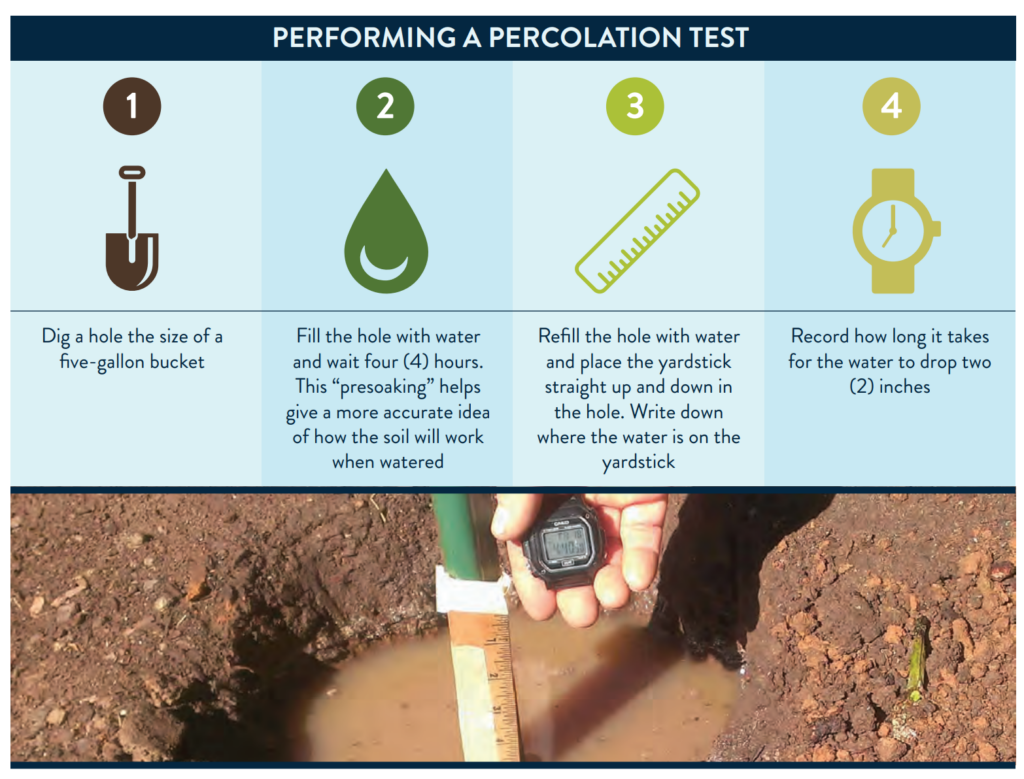
HOW TO TEST THE PERCOLATION RATE IN SOIL
If you do a jar test you will have a pretty good idea what percentage of sand, silt and clay make up your soil. Performing a percolation test will allow you to see how your soil interacts with water.
TOOLS NEEDED:
Shovel, yardstick, timer/watch, pen, paper and hose
To get your hourly percolation rate, divide how long it takes the water to drop 2 inches by 120. A soil percolation rate between 1 and 3 inches per hour is adequate for plants with average drainage needs. If the rate is less than 1 inch per hour, drainage is too slow, and the soil will either need to be improved by adding compost or planted with plants that tolerate wet soils. Watering should be less frequent but longer.
If the drainage is more than 4 inches per hour, it is too fast. Soil will need to be amended with compost and other organic matter either by digging it in or using it as a top dressing. Watering should be more frequent and for shorter time periods.
WHY IS MY SOIL COMPACTED?
Many things — including construction, heavy equipment or vehicles, or a lack of organic matter — can create compacted soil that won’t allow water to drain. One way to prevent further compaction is to park your vehicles and store heavy items only in your driveway or on soil devoid of trees or landscaping.
HOW DO I IMPROVE MY SOIL?
Add organic matter (compost) to clay to make it more permeable and add compost to sand to improve its water-holding capacity.
Add a deep (3”-4”) layer of organic mulch to help all soil types retain moisture better, suppress weeds and feed soil microorganisms. Native and low water use, desert friendly plants do not need compost. Although they will grow slowly in uncompacted native soil, they thrive best there.
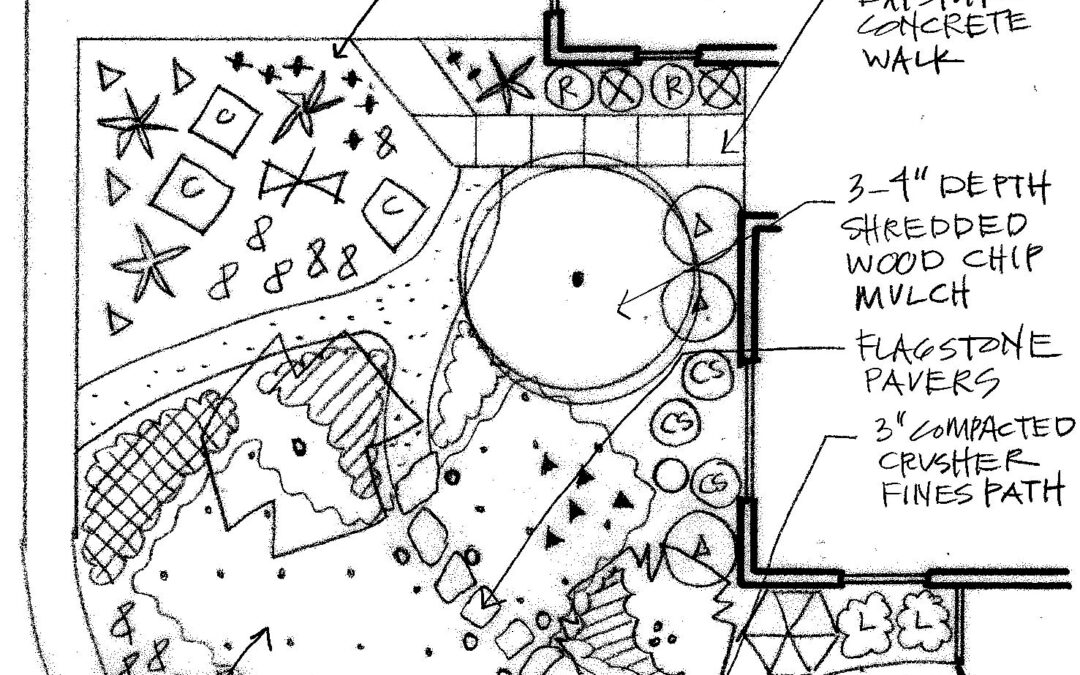
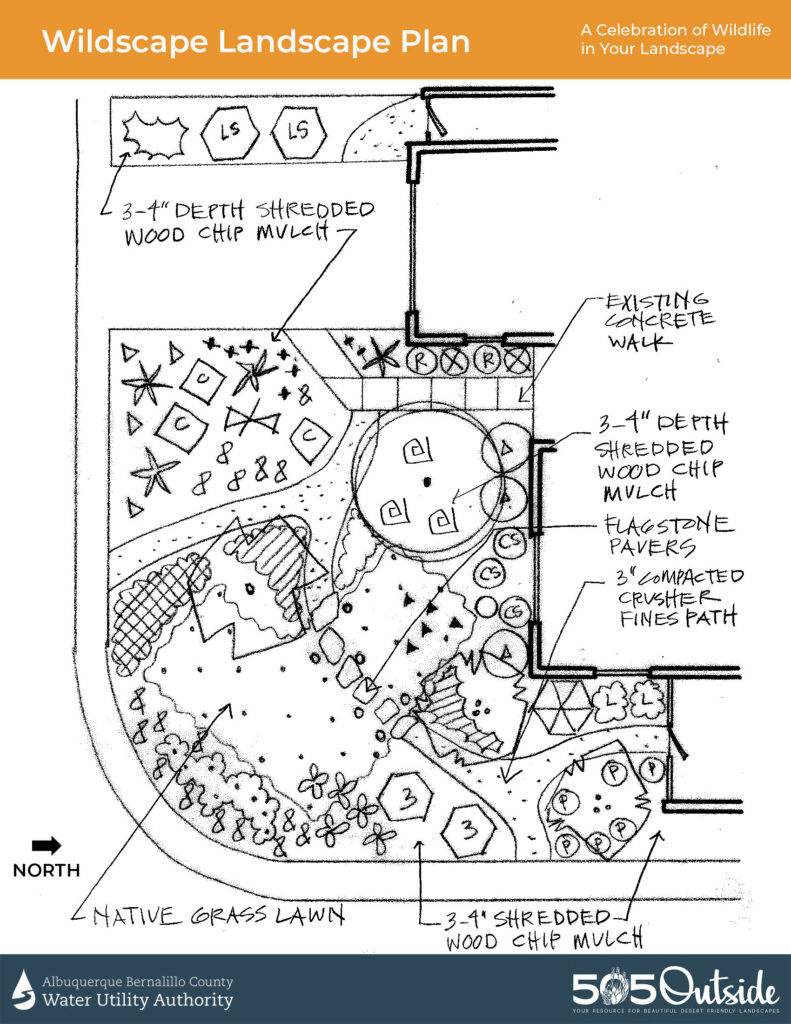
A lot goes into designing a landscape; hence, there’s an entire profession called landscape architecture devoted to designing outdoor spaces. We won’t be able to make you a landscape architect today, but we’re sharing a unique landscape plan designed by New Mexico landscape designer Judith Phillips to get you inspired with ideas for designing your own yard. We’ll be sharing five more landscape plans in future issues of 505Outside.
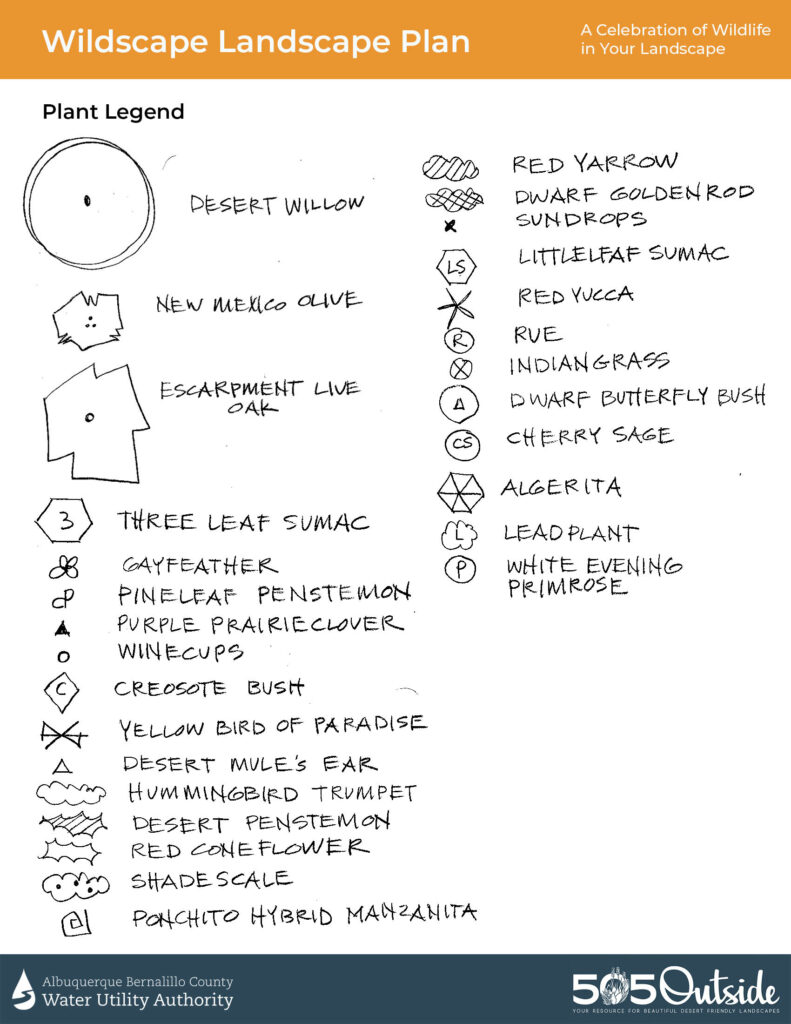
Plant for wildlife and you will host a never-ending garden party. Wildscapes should have tiers of canopy to provide shelter and food for a wide variety of wildlife, including birds, hummingbirds, bees and butterflies. Tall trees provide shade and shelter. Dense thickets of middle-height shrubs provide spaces for roosting and nesting and also give the landscape a sense of enclosure. Open areas with low-growing groundcovers provide areas for nesting and foraging, and the colorful flowers and berries appeal to people as well as winged visitors. A mix of evergreen plants for cover, brilliant flowers for nectar and pollen, and fruits and seeds ripening through the seasons will keep your wildlife friends fat and happy. In this wildscape, the gayfeather, dwarf goldenrod, leadplant, yarrow, rue, grasses and dwarf butterfly bush are lures for butterflies. Hummingbirds are drawn to plants with nectar-rich tubular flowers, such as desert willow, penstemons, cherry sage, coral honeysuckle and red yucca. Local songbirds and quail will be attracted by New Mexico olive, sumacs, creosote bush, desert mule’s ear, coneflowers, shadscale, gayfeather and algerita.
Designed by Judith Phillips, author of Plants for Natural Gardens
Learn more about specific types of gardening here:
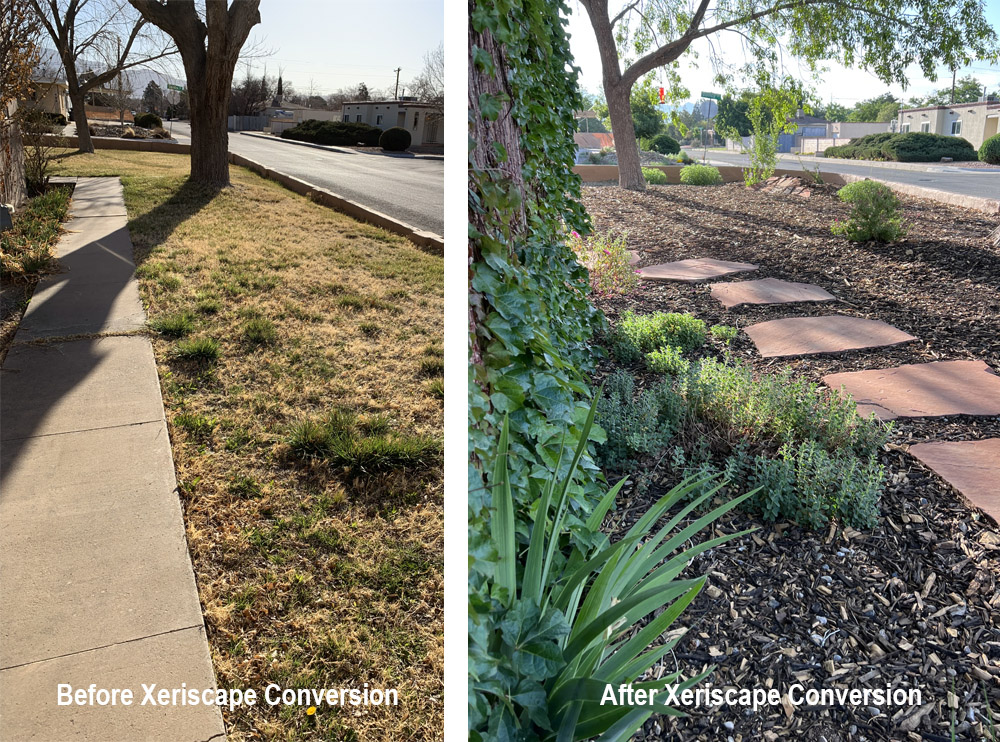
As homeowners around the Greater Albuquerque area are converting their high-water use turfgrass areas to desert-friendly xeriscapes, many are choosing to use wood chip mulch instead of gravel, which can be hot, expensive and also very good at cultivating weeds. Gravel can use up to as much as 60% of the materials cost of a landscape transformation project.
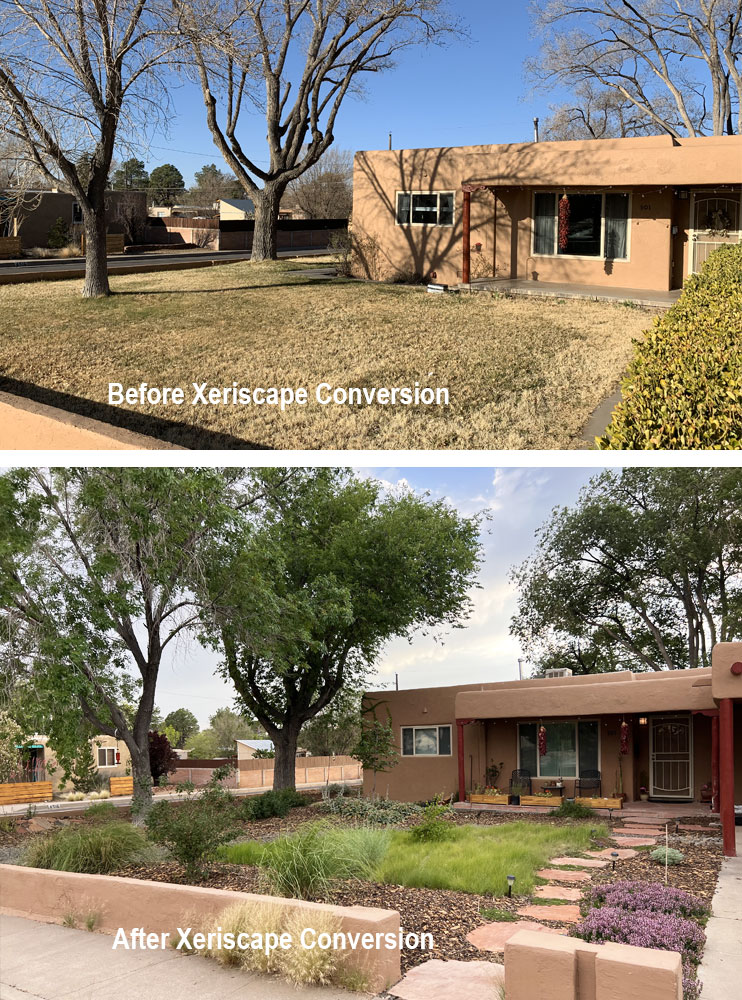
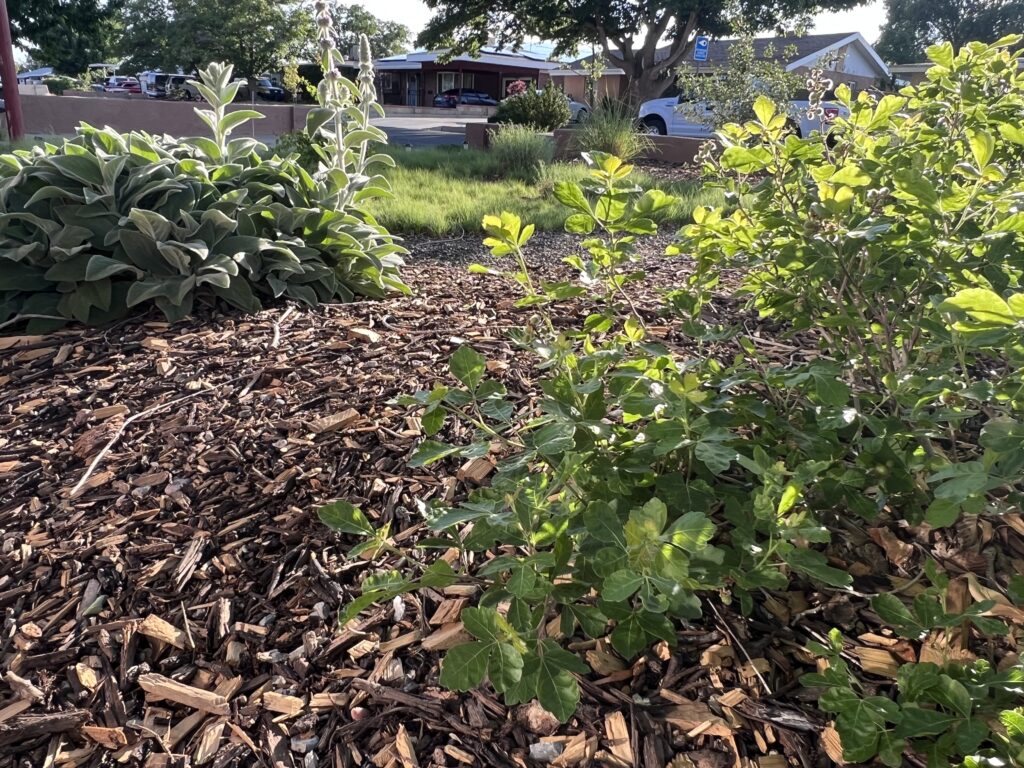
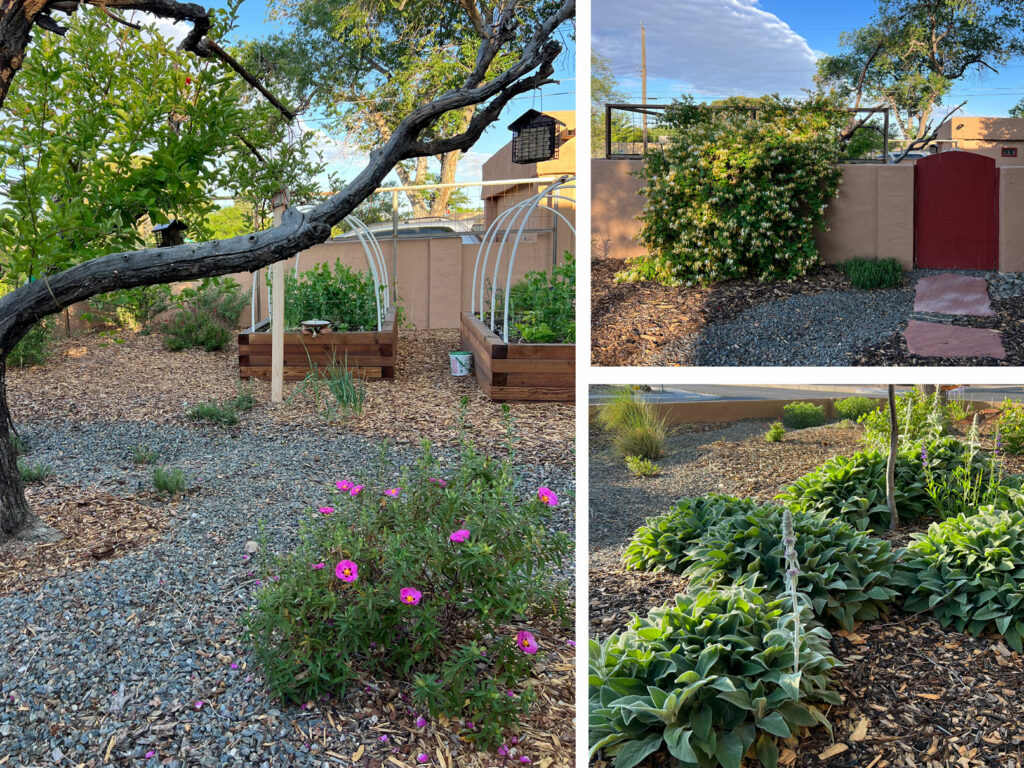
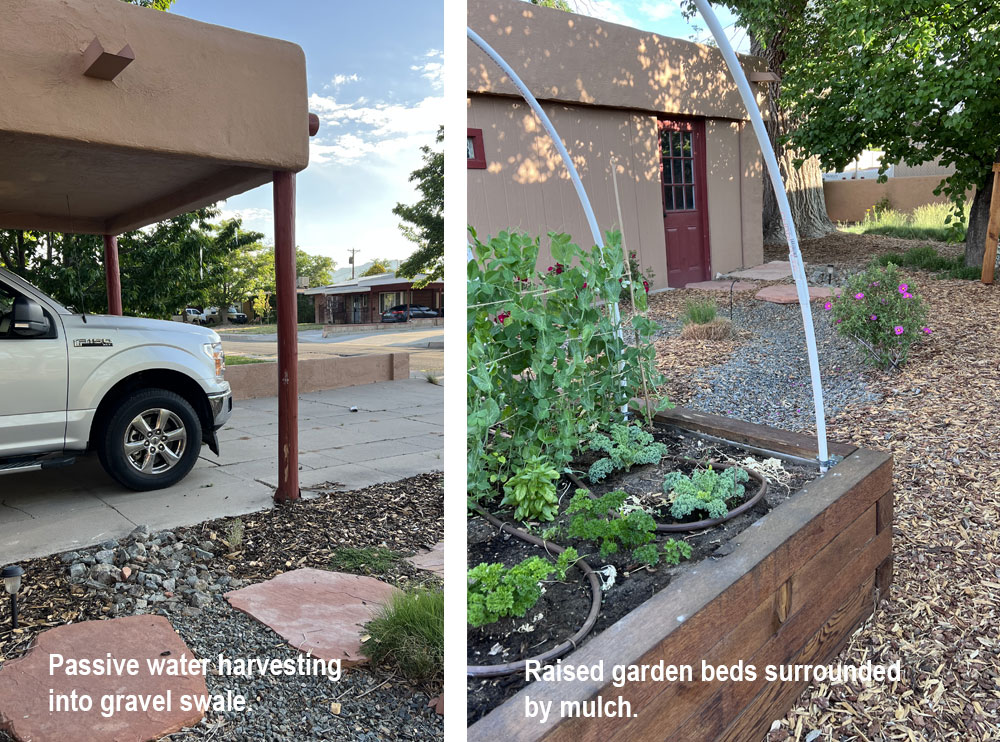
The Water Authority checked in on some recent xeriscape conversion projects that use wood chip mulch. One of these homes was built in the 1950’s and is located in the near NE Heights, an area where the original landscapes for homes consisted of both front and backyards with Bermuda grass and large elm trees. The homeowners wanted to remove the grass in both the front and back of the house and create desert-friendly xeriscapes while retaining their mature trees. They became fans of wood chip mulch many years ago while living in Florida. “Wood chip mulch is easy to maintain,” explains the homeowner. "I do nothing to it except occasionally blow out whatever drifts into the swales and top dress it every couple of years with a thin layer of new mulch. Not only does it reduce the evaporation of moisture from the soil, it helps keep our property much cooler than rock because it doesn’t retain heat or reflect the intense light we get here. I also think the mulch along with the trees helps dull the sounds of the city.”
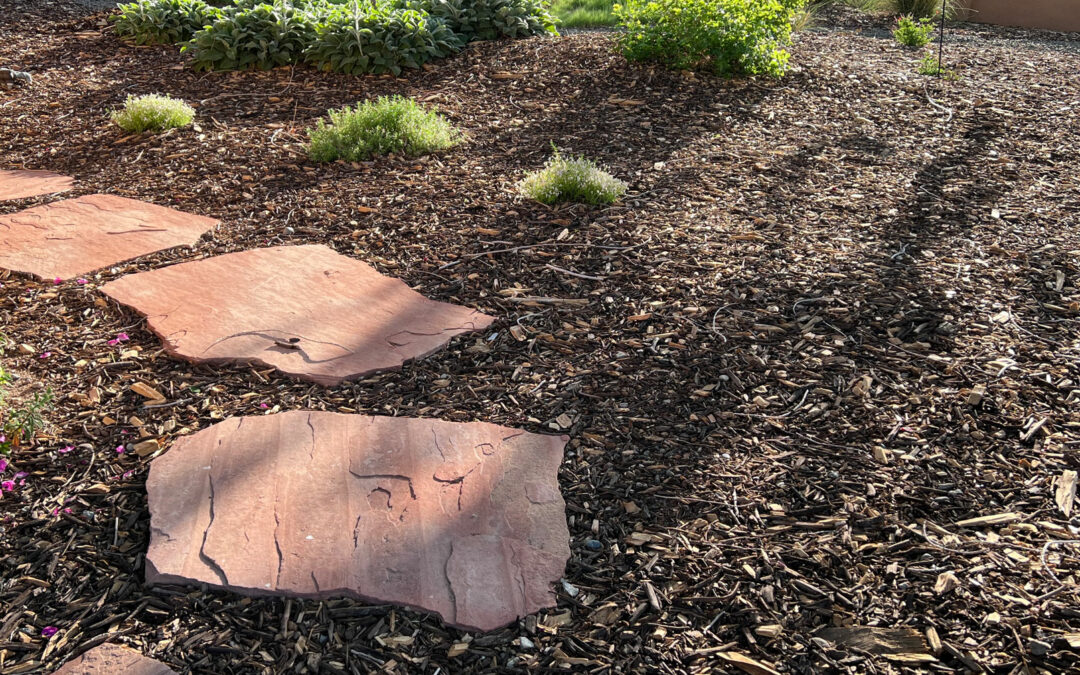
The mulch, which is laid down 3” to 4” deep, makes weeding much less of a task. Fewer things germinate in the mulch and when things do – in particular, the zillions of elm seeds that drop every spring — all that’s needed is to rake back the mulch layer, let it dry out for a day or so, and then rake it back into place. The seedlings dry up, die and become part of the mulch layer. The hardest part of the project, according to the homeowner, was removing the Bermuda grass. Due to the nature of its rooting system, the grass was completely eradicated before beginning the installation process. In this situation, the homeowner used an herbicide treatment to eradicate the grass. Since there are many options for eradication, we invite homeowners to take advantage of our free, ask-an-expert email service, [email protected], if you have questions about what type of lawn you have or any other questions about xeriscape transformations.
It’s been two years since their yard transformation. The homeowners say they noticed changes in the wildlife in their yard almost immediately. Fruit-bearing shrubs and wildflowers are allowed to go to seed, which means there are food sources for pollinators and birds most of the year as well as more cover in which critters can take shelter.
Since these homeowners moved to Albuquerque from a subtropical area, they did note that the one big lesson has been how much patience is required when undertaking a project like this in our desert environment. “The first year, most of what had been planted survived the winter, but a lot of things didn’t show much growth,” explains the homeowner. “I was a little frustrated. But this spring, things just burst forth – partially because of the amount of rain, but also because it simply takes that long for things to really establish a root system that can sustain significant growth.”
Sitting in their yard is more enjoyable now, say the homeowners, as the cooler landscape makes the outdoors more comfortable. They continue to learn from their landscape, picking up a few new irrigation drip skills along the way. They receive many positive comments from neighbors and are proud that their yard is an example of a healthy, sustainable and low-water use desert-friendly landscape.
Additional Facts on Mulches:
Wood chip mulchinsulates plant roots from both heat and cold, reducing moisture loss from the soil by evaporation, feeding beneficial soil microorganisms that enhance plant growth and improving soil health. This makes the soil more sponge-like and better able to hold water. By installing 3”- 4” of mulch over bare dirt, weeds are reduced, the soil is enriched and new plants retain more moisture.
Another benefit of organic mulches is that they can visually accommodate a little bit of leaf litter, reducing the need for constant raking and clean-up. A thin top dressing of mulch added every 2-3 years keeps the landscape looking fresh and replaces the material that has broken down to sustain the soil. Organic mulches are also lightweight, making them easy to transport in a wheelbarrow and spread with a rake.
Mulches are available in bags from most local garden centers (avoid the ones dyed with different colors as these will fade) and in bulk from several retailers in the Albuquerque area. When you buy from local bulk retailers, you are supporting the recycling of local organic materials that may otherwise end up wasting away in a landfill and contributing to greenhouse gas emissions. Buying bulk also means less plastic! Mulch can sometimes be available at no cost. Check with your local tree trimming companies and/or try your local county for free mulch resources. Mulches are a renewable resource that will improve landscape health and conserve water.
In areas of higher wind exposure or periodic inundation with water, use a wood chip mulch that is irregularly shaped and sized as the pieces will knit together better. This type of mulch can be recycled yard waste and tree trimmings as well as commercially-available, locally-processed wood products.
Property Data:
Homeowner converted 4,640 square feet of Bermuda grass to a desert-friendly xeriscape. Total gallons saved since conversion: 61,001 gallons. Total gallons per month homeowner saves: 3,050 gallons. Total rebate received: $4,740
Thinking about converting your yard from high-water use grass to xeriscape? Check out the Desert Friendly Xeriscape Rebate page to learn more about the qualifications, requirements and process to apply for this generous rebate. Additionally, xeriscape rebate participants get 25% off the cost of installing bulk organic mulch up to $100. If you want to top dress mulch around your trees, take advantage of our Treebates. You are welcome to contact our xeriscape specialist Amos Arber, at [email protected] or 505-208-2015
Author: Amos Arber, Xeriscape Rebate Inspector with the Water Resources Conservation Department for the Water Authority. And Jill Brown, ASLA MyLandscapeCoach.com Have a question about the article? [email protected]