We recently spoke with Judith Phillips, a local garden writer and landscape designer, about why vines are so useful in Southwest landscapes and how homeowners can use them successfully.
Vines can feel intimidating because many grow quickly and can become large or unruly. But Phillips points out that they solve landscape challenges where other plant types may not work. Vines create fast shade, screen narrow spaces, add winter interest and provide food and habitat for pollinators.
Below are suggestions of vine species for each of these four landscape scenarios.
CREATE FAST SHADE
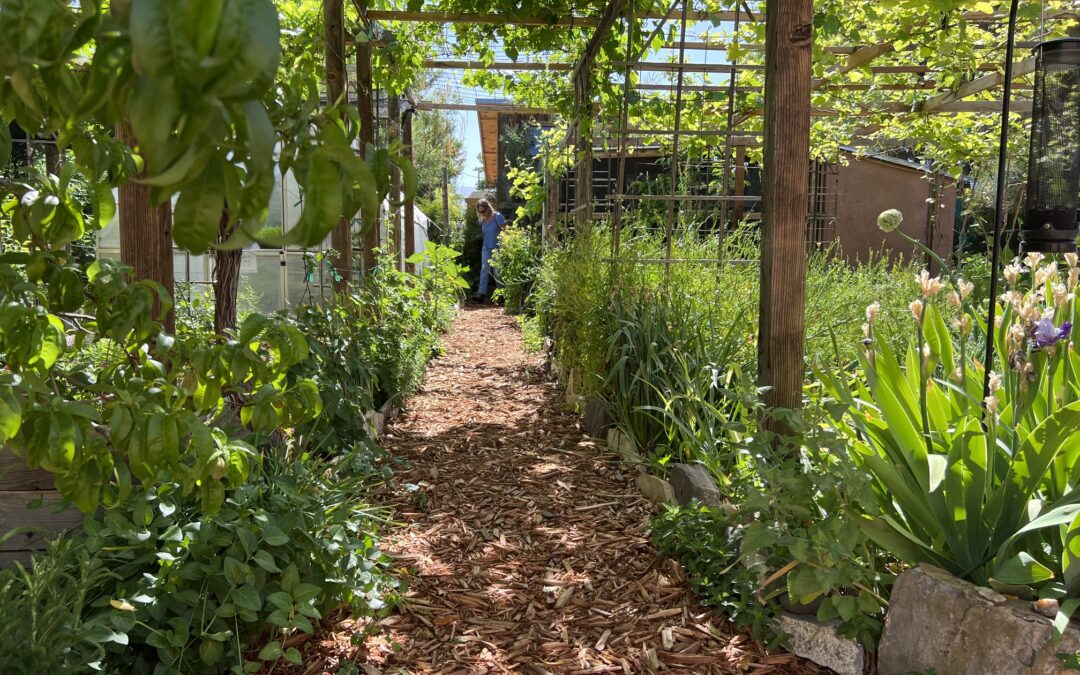
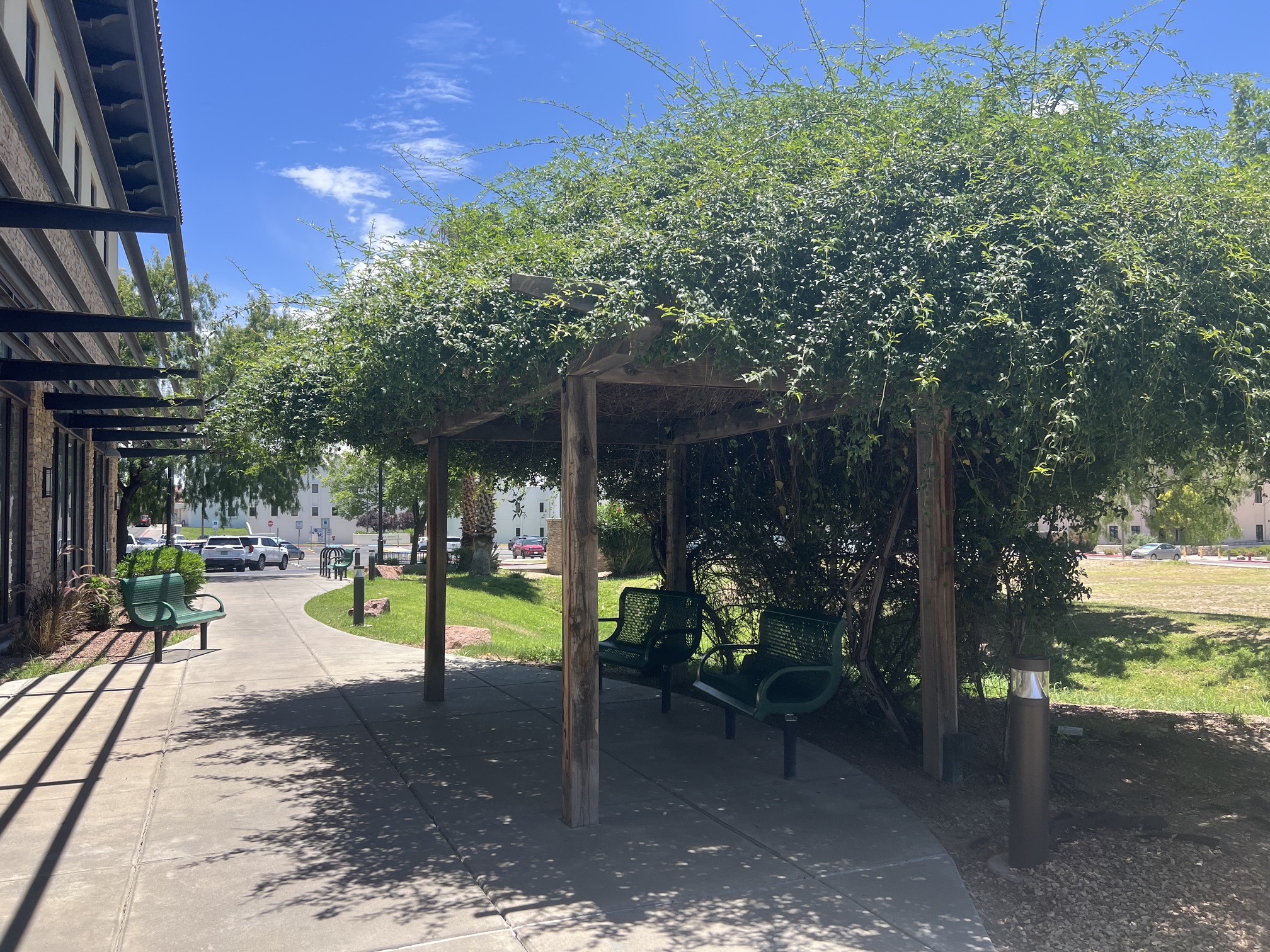
When you don’t have the time or space needed to grow shade trees, but you can’t live comfortably outdoors in the blistering sun, building an arbor and planting a vine to provide a cool leafy canopy may be the solution.
Phillips notes that vines can create shade faster than a tree. Once established, many vines, such as grapes, can have individual canes that grow as much as 10 feet a year, allowing them to quickly climb up and over a pergola or other structure. Because many vines are naturally riparian, an established large woody vine may use about as much water as a medium-sized tree. Their fast growth also means they require regular guidance and pruning, but the reward is a comfortable, inviting outdoor space.
Open lattice ramadas, arbors and pergolas all work well for vines. Wood is commonly used for structures because it is simple and easy to build with, but in Albuquerque’s climate, steel is often ideal because it is strong, long-lasting, low maintenance and resists UV damage.
Vines can be guided around structures, fences and trellises by gently weaving stems or attaching them with twist ties, string or twine through chain-link fencing or welded wire mesh, sometimes called “hog panel.” Remove ties once the vine has grown into place.
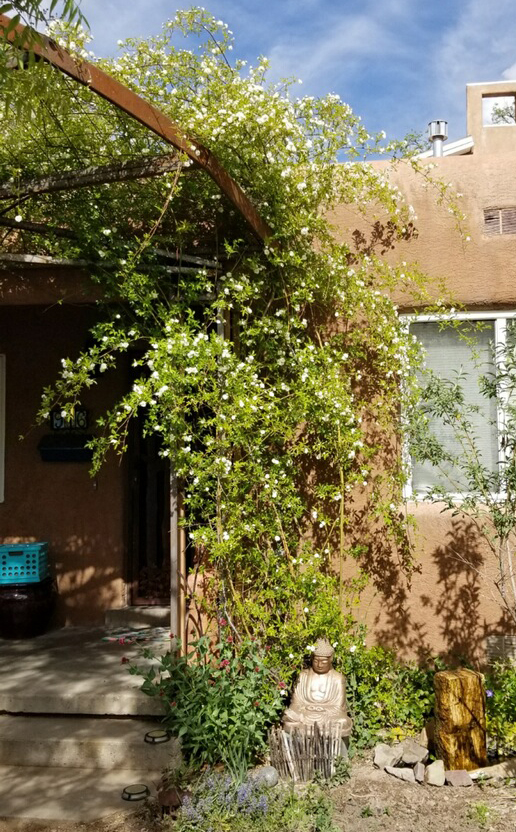
Lady Banks’ rose growing on pergola providing shade to seating area.
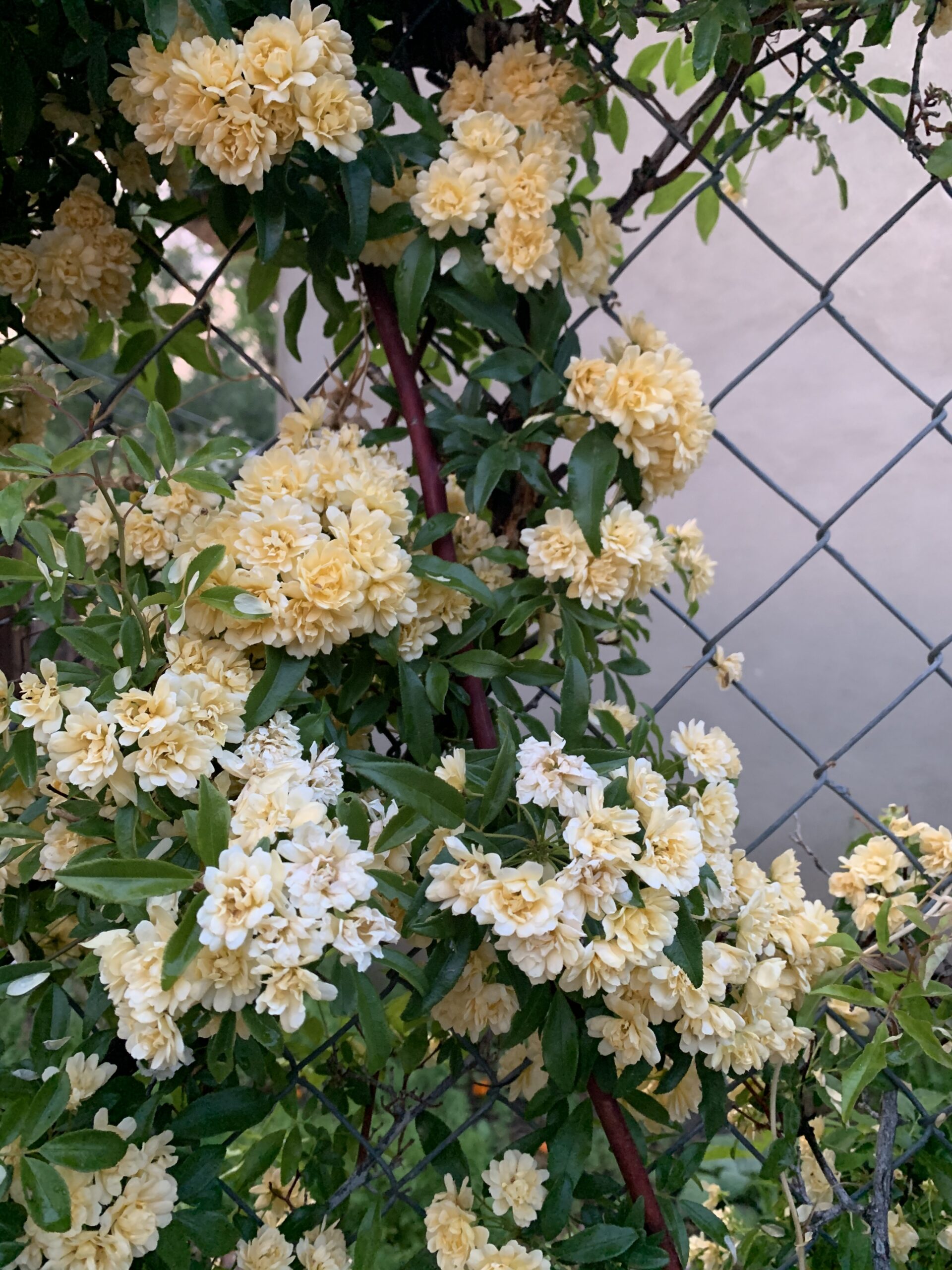
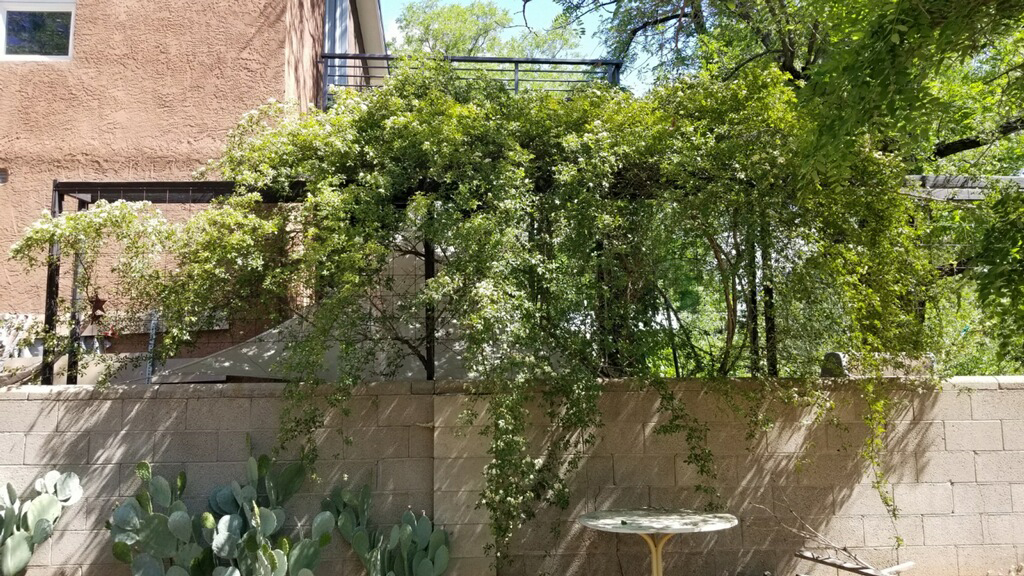
Lady Banks’ rose (Rosa banksiae): Rarely do you find a plant that is fast growing, evergreen and long-lived. Lady Banks’ rose is all those things, and it produces a beautiful if brief show of flowers in spring. And it uses surprisingly little water and grows well in sun or shade. This plant becomes quite large and, unlike most roses, blooms on old wood. If it grows too large, guide it around the structure or prune away unwanted growth; it adapts well to heavy pruning. Lady Banks’ is thornless and has incredible show stopping spring blooms.
Lady Banks’ on metal trellis.
Lady Banks Rose blooming on chain link fence.
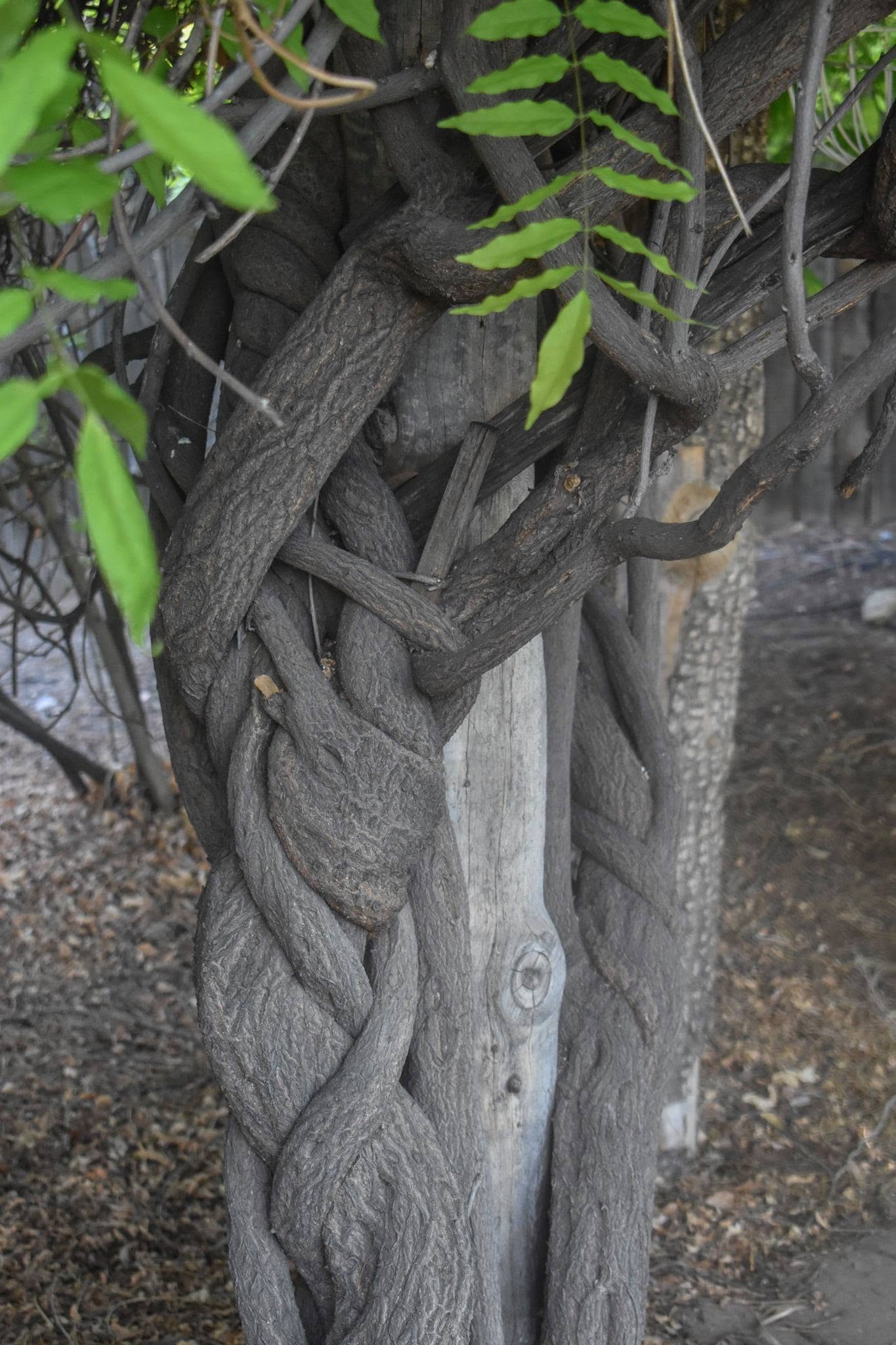
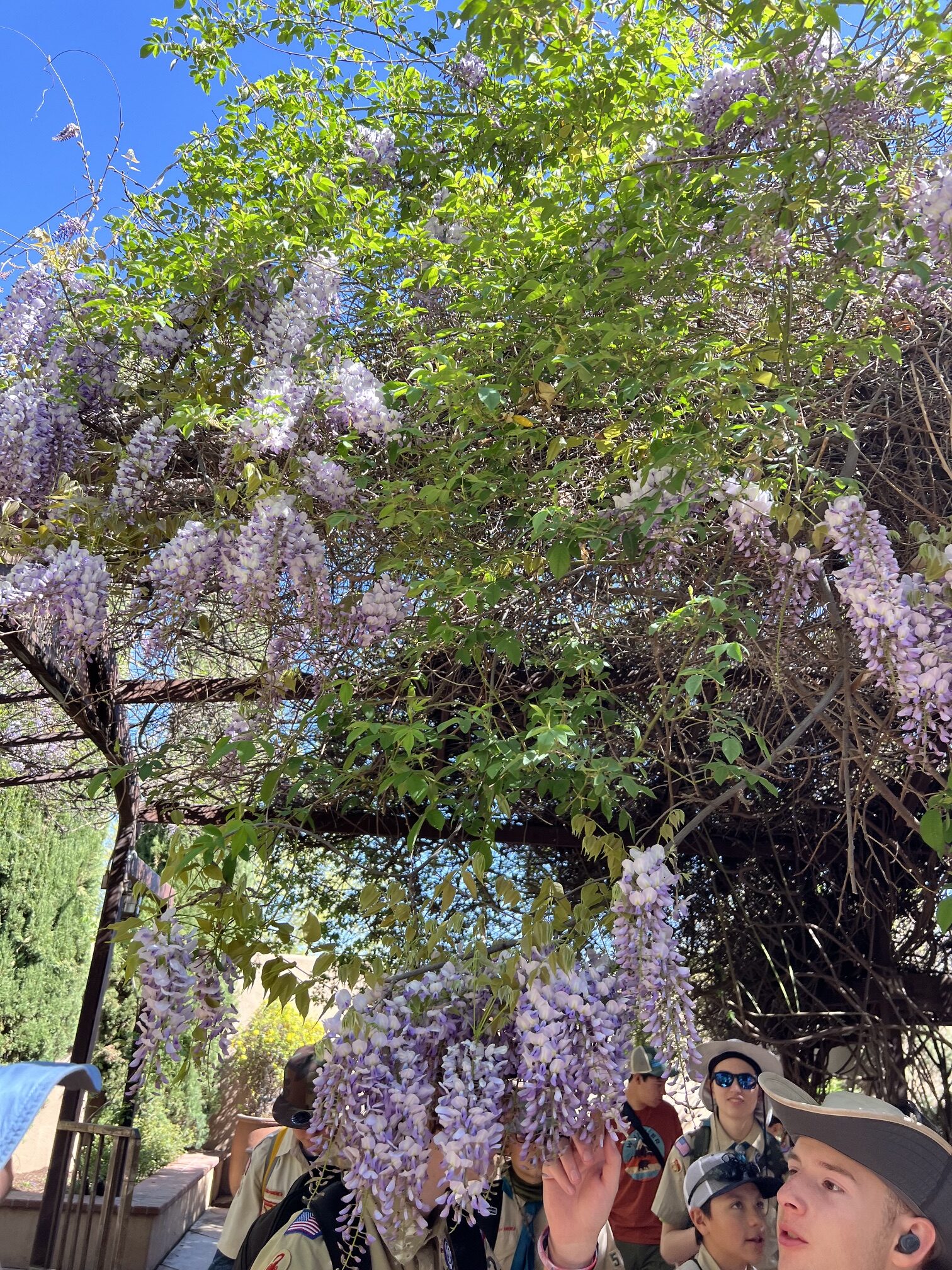
Wisteria (Wisteria sinensis): The pendulous, sweet-scented lavender flowers of this vine are some of the first to bloom in the spring. Bright green leaves follow shortly thereafter, filling the plant and creating lots of dappled shade below. Once the flowers fade, the leaves fill in to provide dense shade in the summer. Expect woody stems over time and train the vine strategically as it develops. Wisteria grows well in sun, shade and part shade.
Close up of Wisteria Trunk by Hunter Ten Broeck
Wisteria blooms hanging from a pergola.
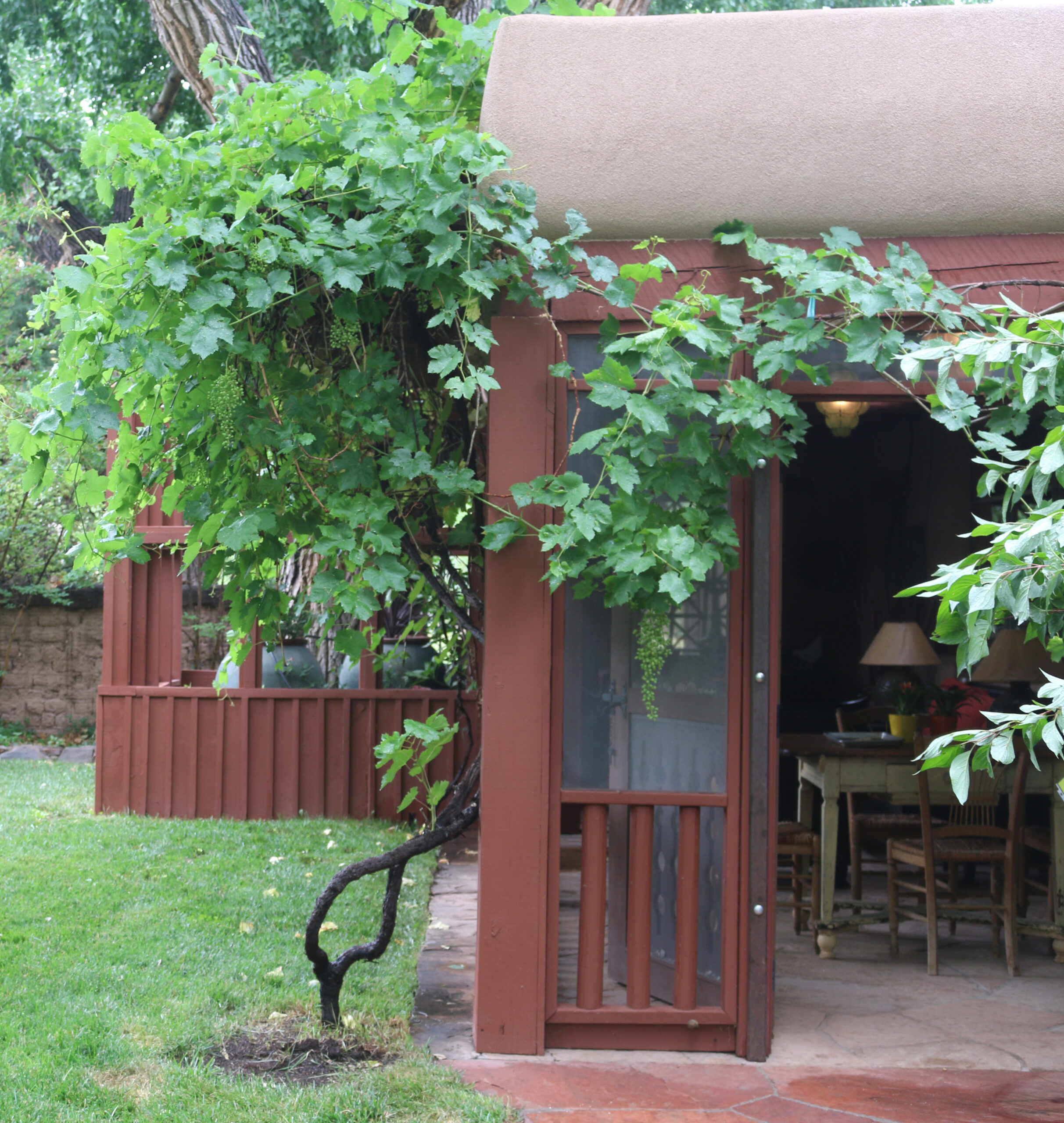
Grapes, multiple varieties: New Mexico is one of the oldest grape growing regions in North America, with plants brought to the state by Spanish colonialists and planting records dating back to 1652. Grapes prefer consistent moisture during their first year of establishment and grow best in full sun. The vines are fast growing and long-lived. Beautiful bright leaves create dense shade, and the fruit is delicious Grapes are deciduous so be prepared for a sculptural woody vista throughout the winter months. Late winter, before the last frost, is the best time to train and prune them. Some varieties to try are Himrod, an early ripening seedless white table grape; Red Flame, a seedless red table grape; Canadice, a cold hardy seedless red table grape known for disease resistance; and the unique Flambeau, a seedless pink table grape with strawberry sweetness. Another the Canyon grape, has beautiful fall color and grapes are loved by wildlife.
Grape vine growing on trellis at a home in the North Valley of Albuquerque.
SCREEN NARROW SPACES
Narrow spaces, such as side yards, can be difficult to plant because shrubs may become too wide before they provide enough height to provide screening. Vines trained on a trellis against a wall can fill vertical space without overwhelming the walkway and adjacent space.
Sun exposure in these narrow spaces affects which vines will do the best, explains Phillips. The west and south facing sides of the property receive the hottest afternoon sun, while the north facing side is typically cooler because of the shade, and the east facing side receives morning light.
Lady Banks’ rose growing on metal trellis attached to block wall on side of the house.
For southern and western exposures, Phillips suggests using passionflower vine and silver lace vine.
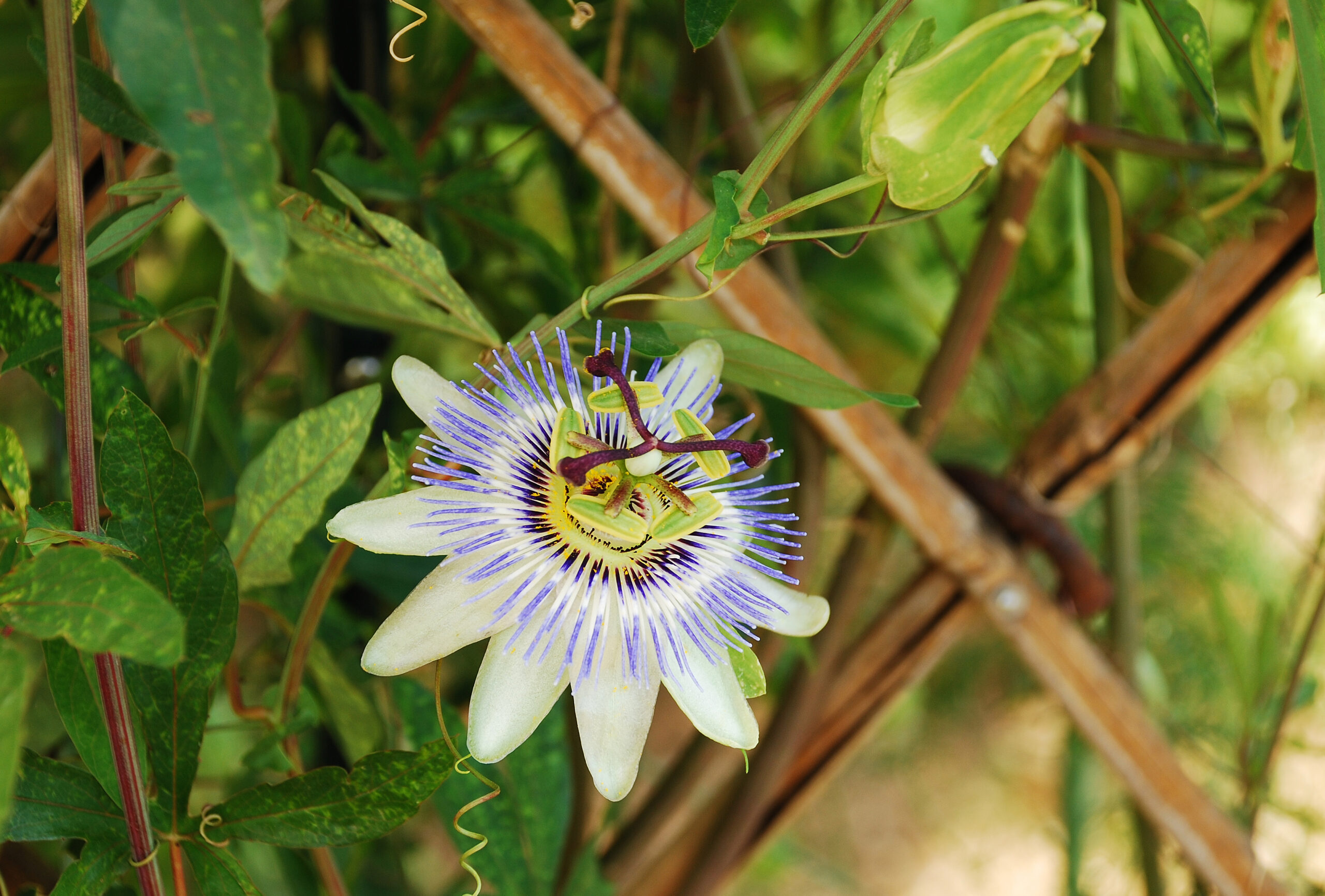
Passionflower vine (Passiflora caerulea): Stunning dark blue and ivory flowers appear in the summer flocked with butterflies. This vine grows well in heat but will freeze to the ground in winter. It will regrow from root-sprouts in the spring and climb again using tendrils.
A single Bluecrown Passiflora flower, also known as Passilfora Caerulea, an evergreen tendril climbing vine.
Silver lace vine (Fallopia baldschuanica):This is one of the most xeric and heat tolerant of the vines as well as a good pollinator that can smell like lilacs when blooming. Because it can become a tangle of spaghetti-like twigs, Phillips recommends cutting it to the ground every few years so that it will return with great exuberance in the spring.
Silverlace vine in bloom.
For shadier locations, she recommends using Carolina jessamine and Algerian ivy.
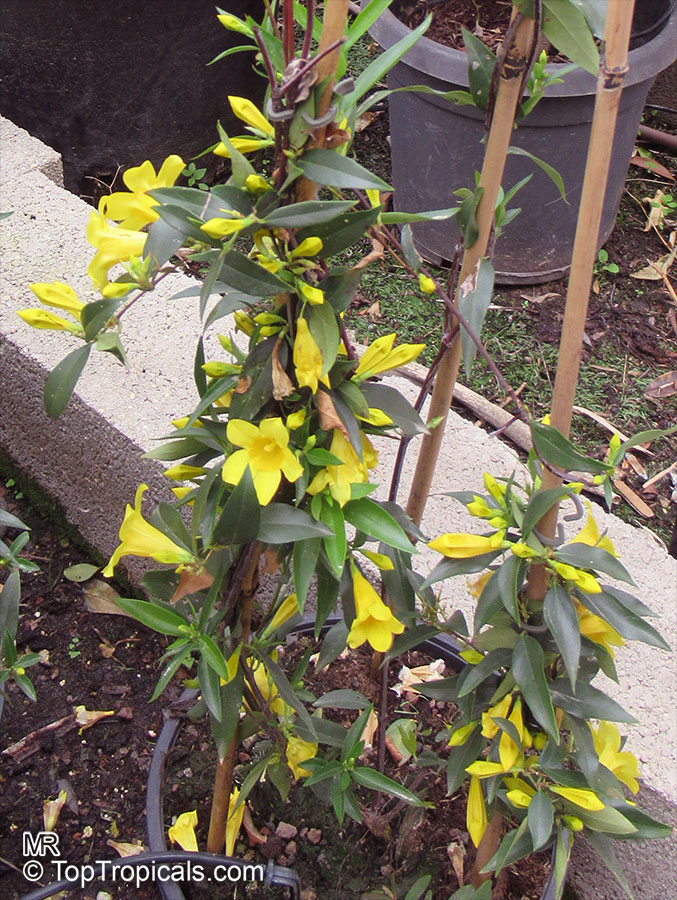
Carolina Jessamine (Glesemium sempervirens): This vine performs best in shade. It is not particular about soil and produces beautiful yellow flowers in early spring while retaining winter color. Note that it is toxic to humans, pets and livestock if ingested, even in small amounts. Prune one fourth of the vine’s mass every three years to keep it from getting too woody and to encourage vigorous plant growth.
Carolina Jessamine
Carolina jessamine (from internet, not great)
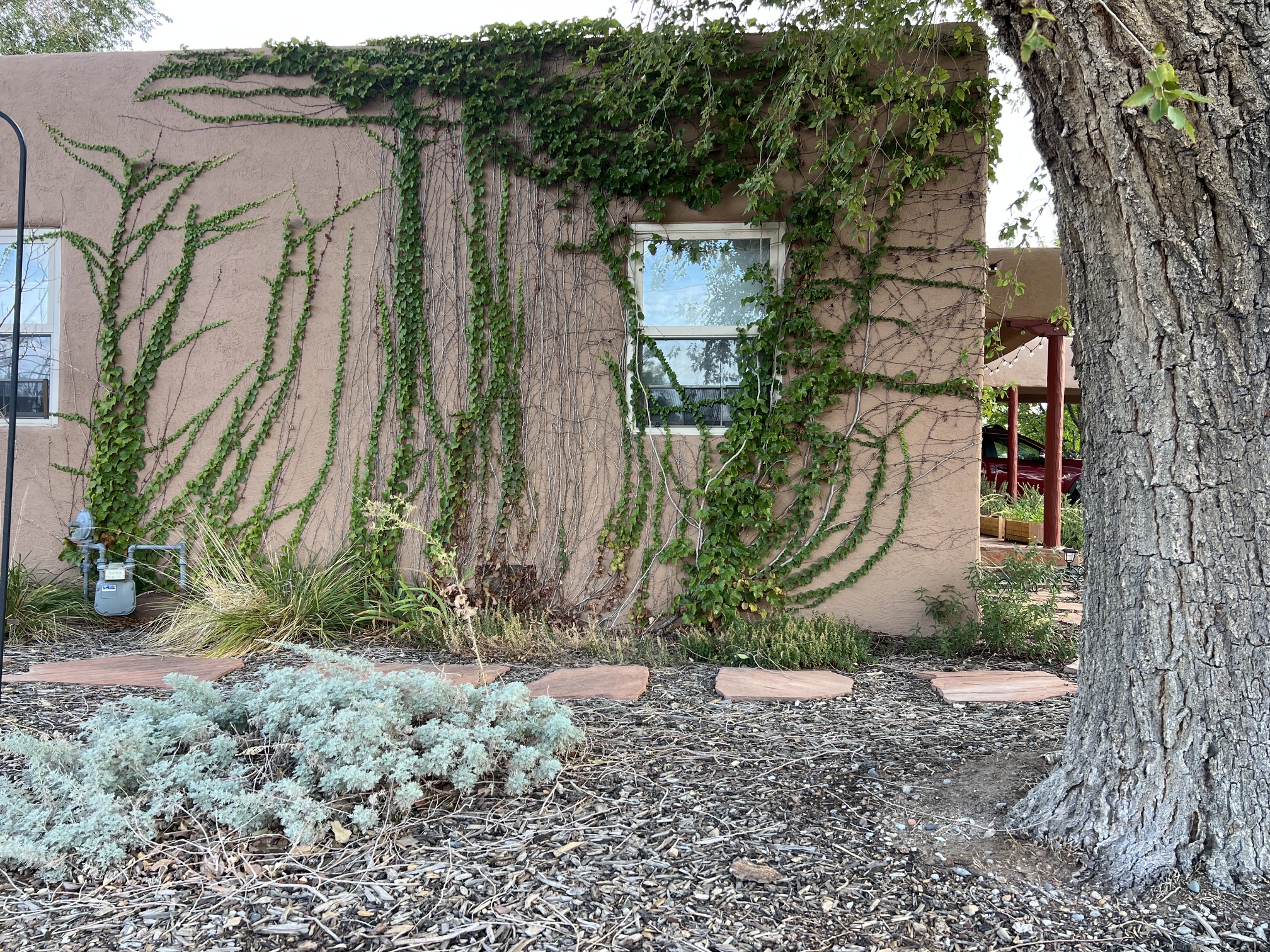
Algerian ivy (Hedera canariensis): This ivy climbs walls with clasping roots and provides evergreen color. It does best on north or northeast facing walls. Its large, bright green leaves resemble English ivy. The needlepoint dwarf variety is a smaller option that also performs well.
Ivy climbing up the side of a home.
ADD WINTER INTERST
Many vines fade or freeze back in winter, but some continue to add structure, color or texture. Phillips recommends Lady Banks’ rose and Algerian ivy for evergreen color along with wisteria for its sculptural woody branches.
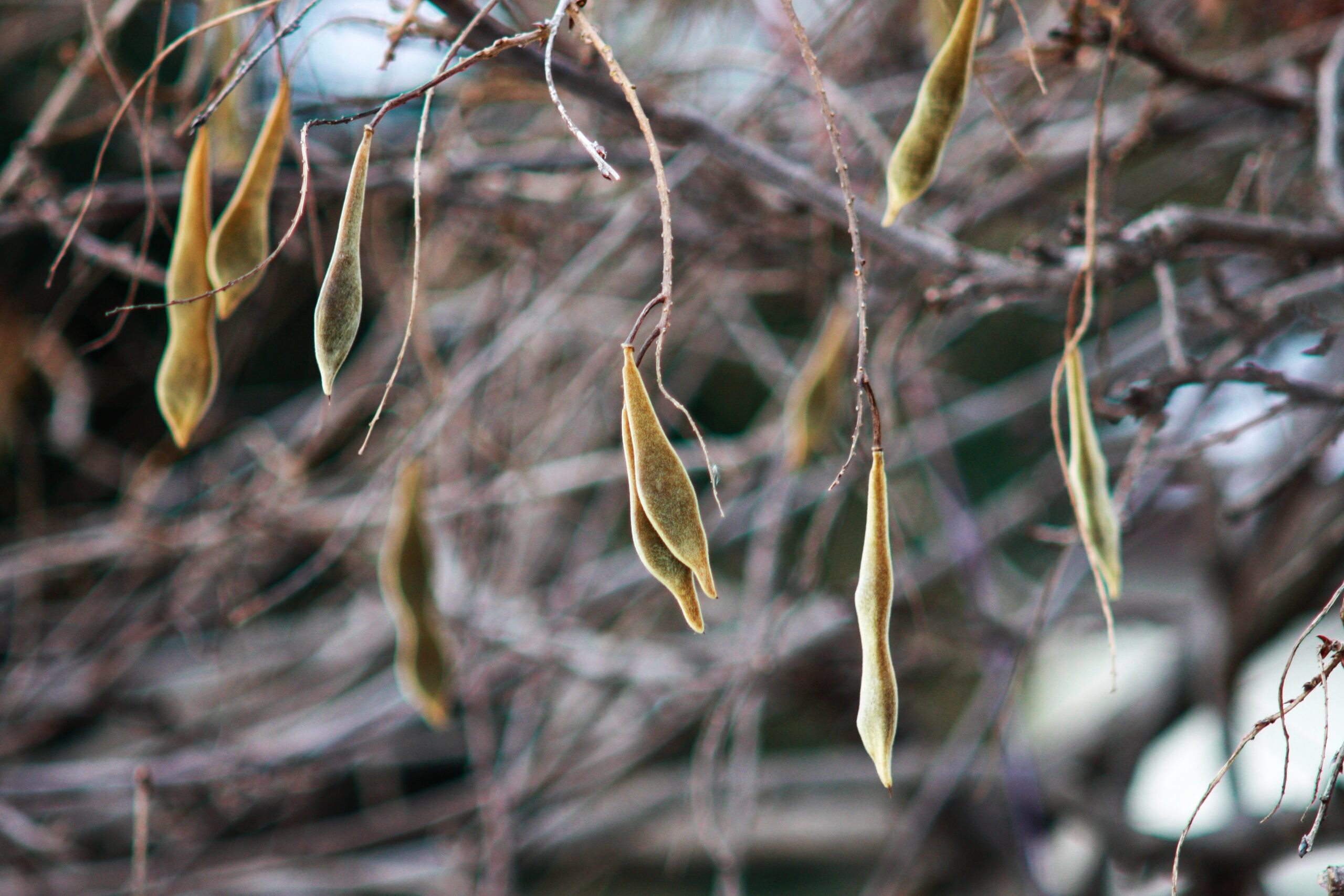
Wisteria seed pods in winter.
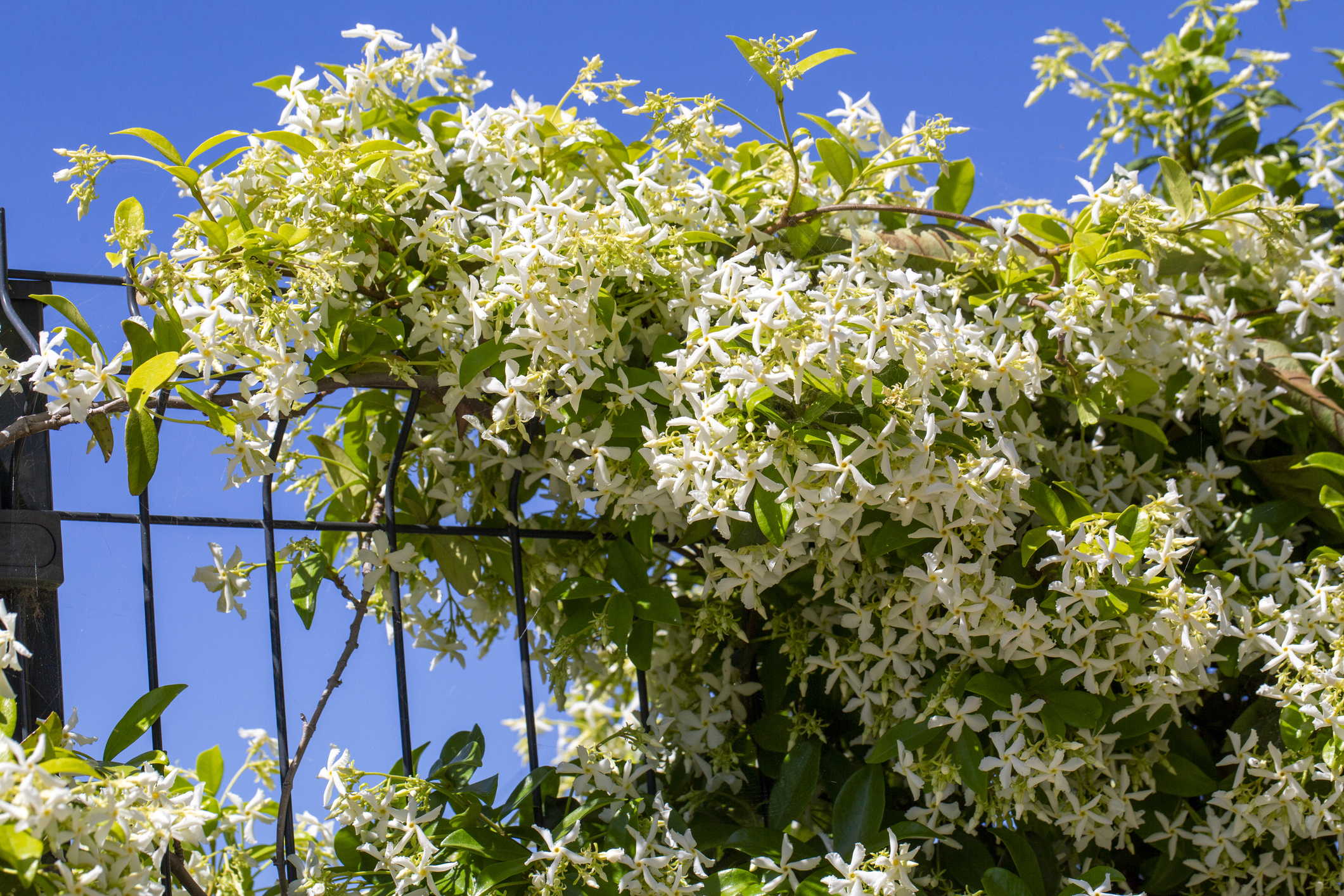
Star jasmine (Trachelospermum jasminoides): This vine has dark green foliage, fragrant spring flowers and smooth stems. When trained onto a trellis, it forms a dense cover. It grows well in partial shade, is a medium water user and is adapted to a wide range of soils. The sweet, pinwheel-shaped white flowers produce nectar for pollinators.
Star jasmine growing on a fence.
PROVIDE FOOD AND HABITAT FOR POLLINATORS
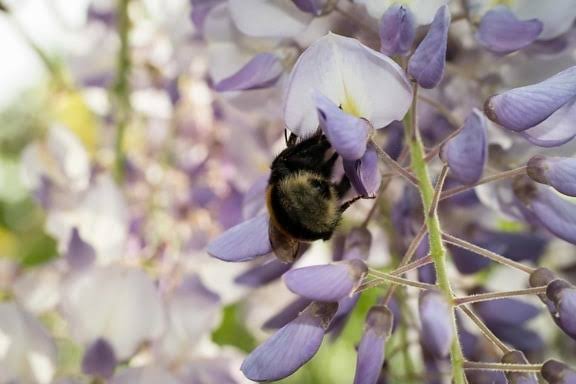
Several vines already mentioned — including wisteria, star jasmine, Carolina jessamine, silver lace vine and passionflower — support pollinators.
Wisteria blossom.
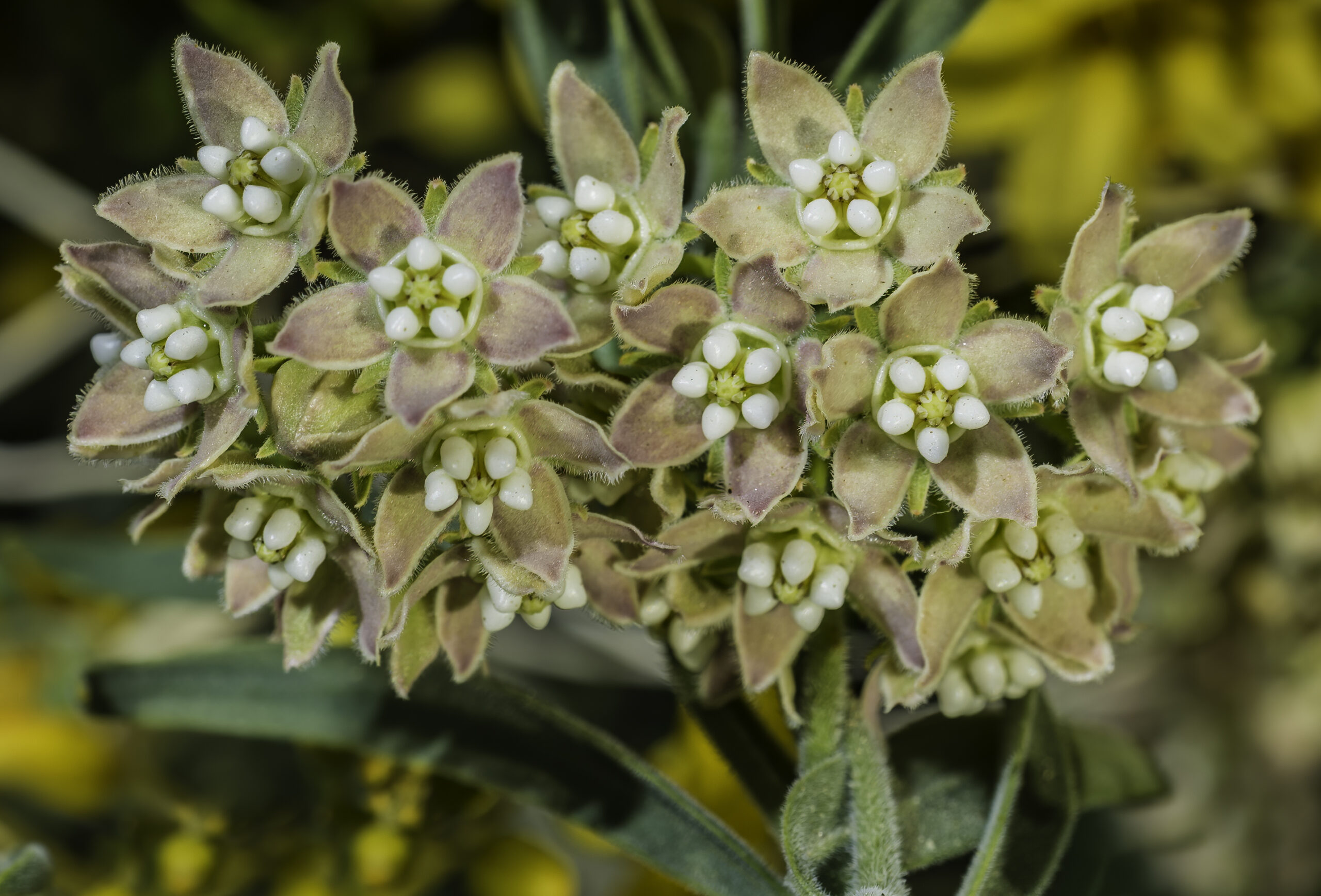
Climbing milkweed (Funastrum cynanchoides): This New Mexico native is one of Phillips new favorites. It dies back completely in winter but grows vigorously in spring, forming tangled curtains across fences, boulders and shrubs. It prefers heavier soils such as clay rather than
Climbing Milkweed, Funastrum cynanchoides var. hartwegii
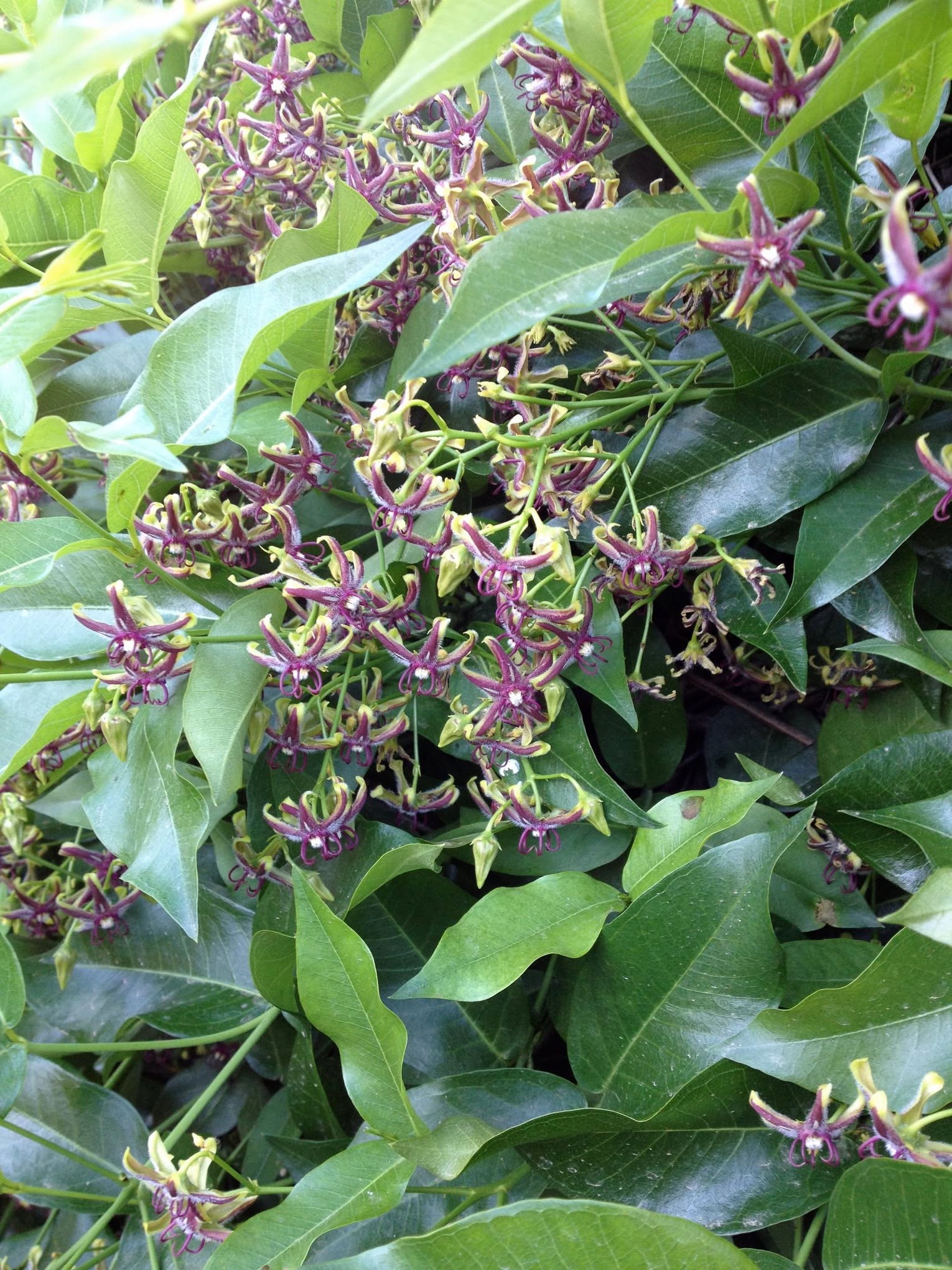
Silkvine (Periploca graeca): This deciduous vine can grow three feet or more in a year and sports glossy dark green leaves and dark maroon spring flowers. It’s fast growing and loves to climb up ramadas, wire fencing and trellises. On a pergola, it provides dense shade in the summer then loses its leaves in winter, letting the sun penetrate through the sculptural coiled stems. It tolerates both clay and sandy soil. Brought here by the earliest colonizers from the Valencia region of Spain, it’s found along the historic stagecoach routes of the Camino de Real.
Silkvine flower by Hunter Ten Broeck
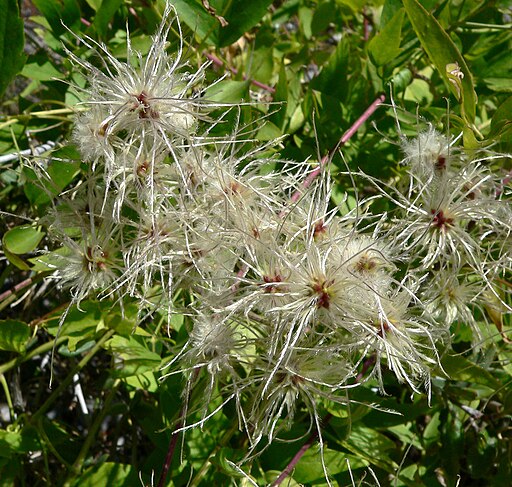
Western virgin’s bower (Clematis ligusticifolia): Also known as old man’s beard, this vine is fast growing where water is available and does well on north and east sides. Native to New Mexico, it can be found climbing over small trees and shrubs in the Jemez Mountains. Butterflies adore the fragrant white blooms, and attractive seed heads — one of the best parts of this plant — provide winter interest.
Clematis flower by Hunter Ten Broeck
Locally familiar trumpet vine and honeysuckle are not included here because Phillips is using them less often in home landscapes. Orange trumpet vine can root aggressively and become difficult to manage. Instead, Phillips has been using crossvine, a related species that she finds easier to live with and more evergreen, making it more attractive through winter. Honeysuckle (Lonicera sempervirens), including the Major Wheeler variety, can be temperamental, especially when it experiences leaf loss during late, hot summer months. Even so, both trumpet vine and honeysuckle are established local favorites and can still find homes in the right locations.
Whether used for shade, screening, winter structure or pollinator support, vines can bring beauty and function to places where other plants may struggle. With the right species, sturdy support, thoughtful placement and regular training, they can become some of the most versatile and rewarding plants in a Southwestern garden.
Interview with Judith Phillips, owner of Design Oasis and a landscape designer and garden writer with 30 years of experience designing arid-adapted and native gardens in the high desert. Have a question about the article or anything else? [email protected]
Growing winter veggies is a fun and valuable effort more people should experiment with in our area. In many ways, winter gardening is a lot easier than trying to garden in the summer — there are fewer pests, cooler temperatures require less watering and common winter veggie’s seeds are super easy to germinate and then cultivate. Two things are important to ensure success: the timing of starting seeds and modifying the climate to extend the season.
If you're hoping to enjoy sweet, delicious, and healthy salads and other dishes all winter long, it's important to start your seeds by the middle to late August. Unfortunately, by then, we're usually very tired of the heat and of taking care of the plants in our yards. It’s not a time we often think about starting new seeds. However, it's important to start seeds early so the plants can reach a good size before it gets cold. This is where being able to modify the climate in your garden is important on both sides of the spectrum. When starting seeds at the end of the summer and it's still hot, having some sort of shade fabric to keep things a little bit cooler makes all the difference. Later, when it starts to get cool, being able to cover your garden bed with a row cover material, sometimes called Reemay (white polyester nonwoven fabric), modifies the climate in the other direction by making it a few degrees warmer and more protected — crucial for having productive beds of kale, Swiss chard, beets, lettuce, spinach, radishes and other yummy veggies. Most of those veggies are super easy to germinate, usually popping up within a couple of days — another reason why this kind of gardening is especially fun for beginners or people feeling frustrated with starting seeds.
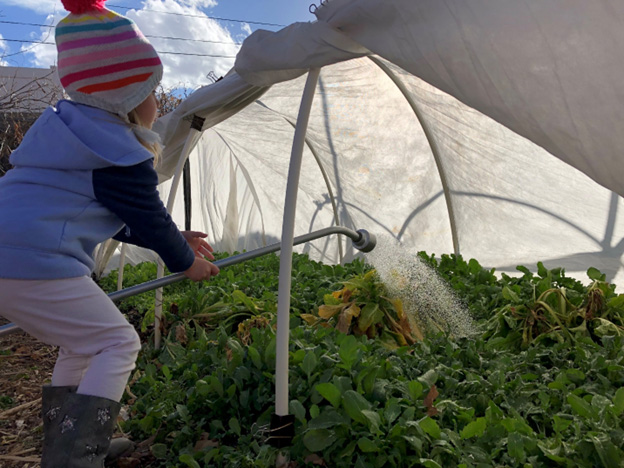
Winter Gardening with Hoops
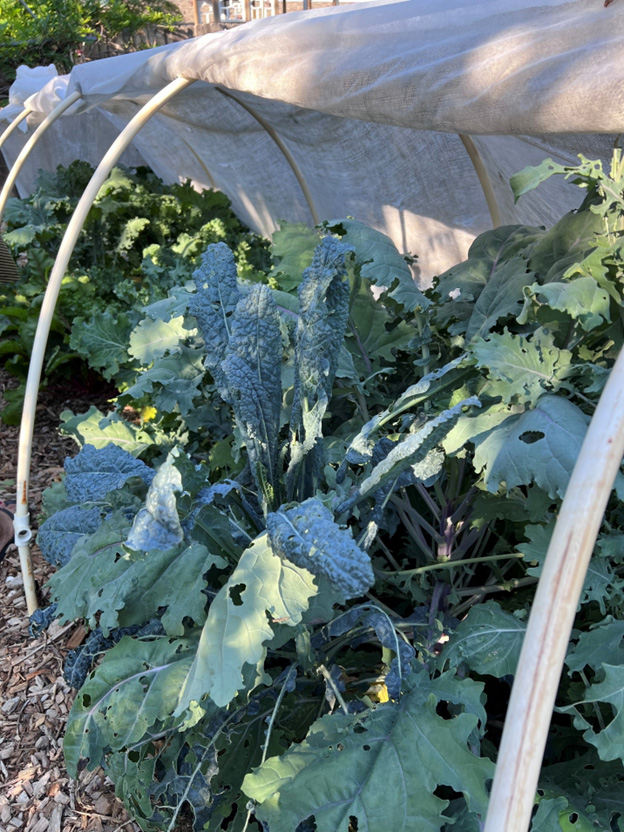
Being able to walk out to your garden and harvest a colander full of fresh kale and Swiss chard is a true delight and can save a lot of money if it's something that you purchase at the store regularly. Winter gardening is easier because the temperatures are cooler and you have to water only once about every two or three weeks, December-February. Also, the cold temperatures don't allow for many pests. Some of my favorite veggies to grow in the winter are kale — I really enjoy red Russian and Dino — beets and collard greens, all of which increase in sweetness substantially once the temperatures begin to drop.
Winter bounty of Arugala
There are substantially less pests in the fall, winter, and early spring compared to the summer. Two pests that you might encounter are aphids and cabbage worms which are relatively easy to manage. Cabbage worms can be avoided by covering your plants with the row cover material to exclude the cabbage moth from laying eggs on your tender greens.
Another advantage of having hoops and shade or frost fabric is that it can protect plants from hail damage. Similarly, some people like to start their tomatoes under row covers to exclude leaf hoppers which can transfer the curly top tomato virus (Learn More in this article by NMSU.)
Creating hoops for your garden to help modify the climate and extend the season is easy to do using common materials — ½” by 10-foot lengths of PVC, 2-foot lengths of 3/8” rebar (both items can be purchased pre-cut at home improvement centers), extra-large binder clips (available at office supply stores), row cover material or shade fabric (available at some local nurseries and greenhouse supply stores), and some stones or bricks to help hold down the fabric at the edges and ends. You may also consider having loose-weave burlap to lay on the soil to facilitate seed germination and keep foraging birds at bay.
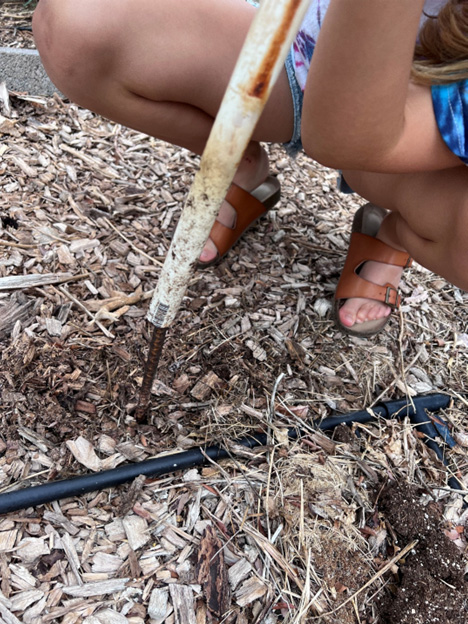
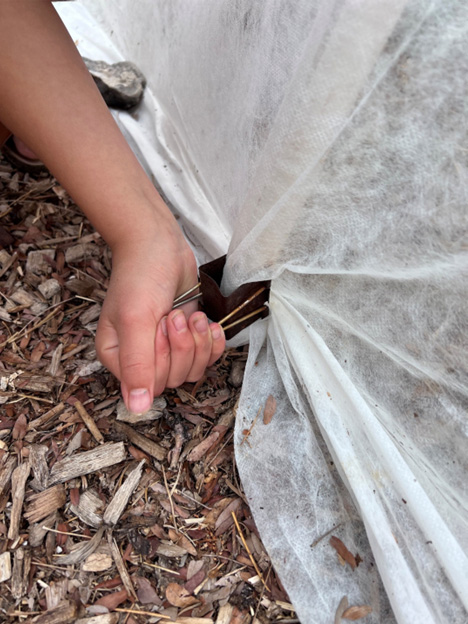
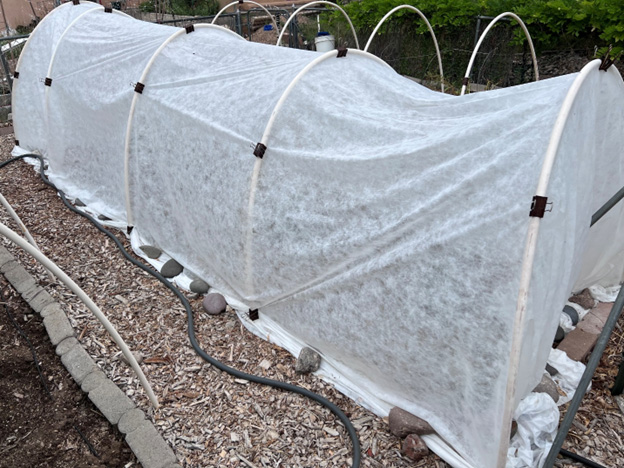
Installing hoops on rebar stakes.Clipping fabric to hoops.Hoop garden.
Other Tips:
Use burlap to help retain soil moisture between waterings and keep birds away when germinating seeds.
A thick, 3-4” layer of mulch such as straw or leaves (once seeds have germinated) is incredibly helpful for keeping moisture in the soil and regulating soil temperature.
If you have room, allow winter veggies such as arugula to flower and go to seed. Arugula flowers are beautiful and beneficial for pollinators. If left to go to seed, they also benefit birds and often result in new “volunteer” plants the following year.
You don’t need much space for a winter garden — a thriving 4’ x 8’ bed of leafy greens is plenty for a small family.
Installing hoops is simple: Pound the 3/8” rebar about 12”-14” deep, slip the ½” PVC over the rebar, clip the fabric to the PVC with extra-large binder clips and weigh down the edges and ends with stones.
A 10’ length of PVC on a 4’ wide bed makes a hoop about 4’ tall. Having a 12’ wide piece of row cover fabric allows for 1’ on each side to secure it with stones.
Below are some great gifts for that homeowner who likes to tinker in their yard and also save water. Practical gifts are always in style!
Xeriscape Guide and Irrigation Efficiency Guide: Check out the Albuquerque Bernalillo County Water Utility Authority’s FREE xeriscape and irrigation guides that you can download for your stocking stuffers.
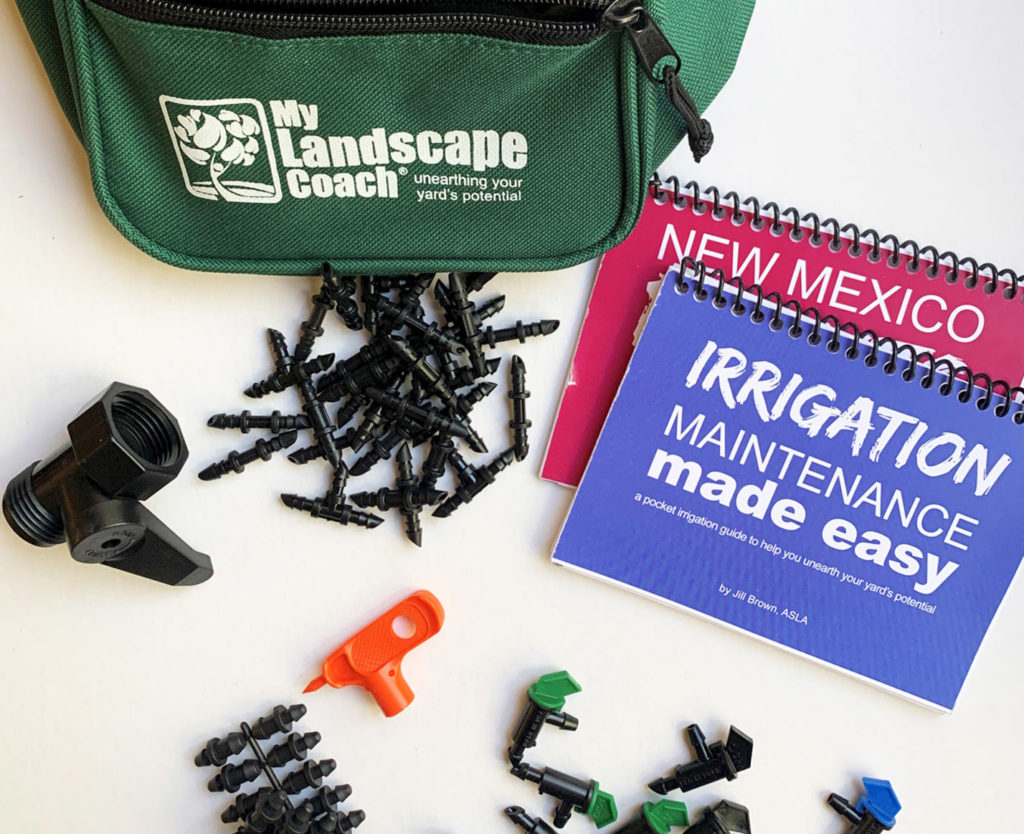
Irrigation Fanny Pack Maintenance drip kit: Drip irrigation isn’t rocket science. Fixes and tweaks can easily be done by the homeowner. This fanny pack drip maintenance kit ($40) comes with all the parts you need to maintain your system. The kit also contains two books: Irrigation Maintenance Made Easy, which teaches you how to make those simple fixes, and New Mexico Plants Made Easy, which features 60 plants that grow well in the Albuquerque area.
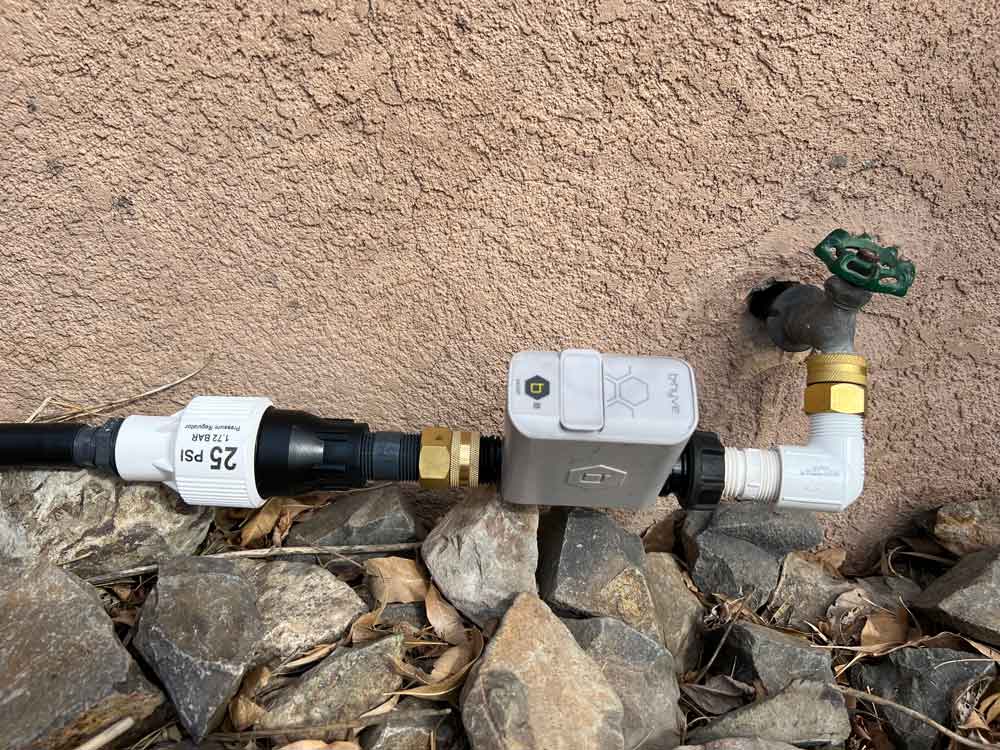
Hose watering system is great for homeowners who aren’t ready to install an in-ground irrigation system and need an inexpensive (under $100) way to water. The hose timer attaches to high-quality irrigation polypipe with drip emitters or connects to a professional landscape dripline. The irrigation dripline can stay in the ground year-round and be easily connected to an automatic in-ground irrigation system in the future.
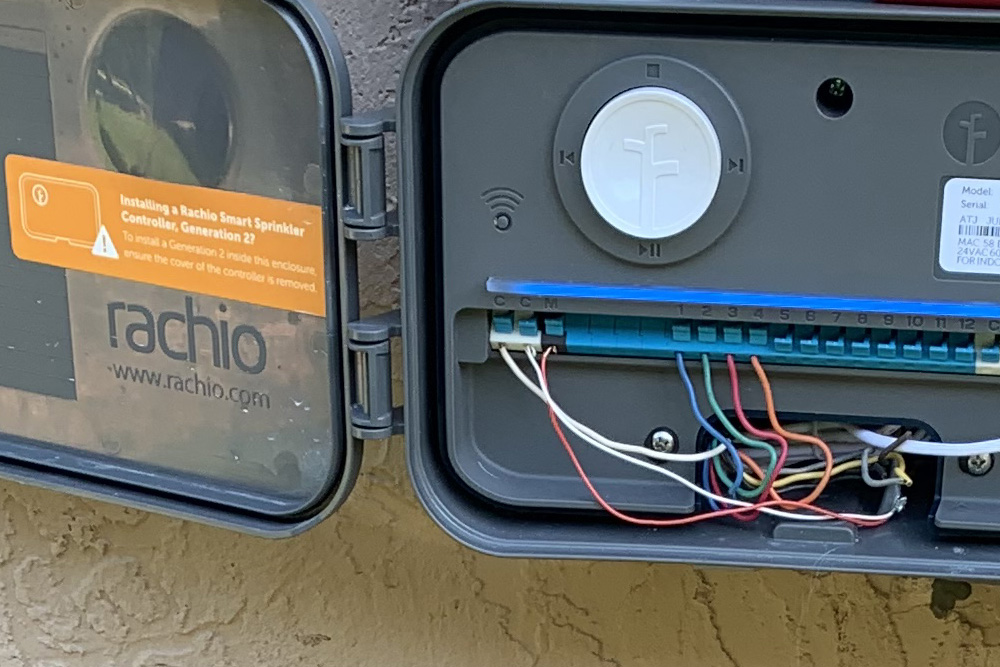
Smart Controller: This handy device ($100-$200) allows you to program days of the week, times of the day and the number of minutes to automatically irrigate your landscape according to seasonal weather and plant needs. EPA Water Sense Smart Controllers adjust landscape irrigation schedules using WIFI to collect weather data in conjunction with the information you provide about your plant type, soil type and other important factors that affect the irrigation schedule. The Water Authority’s irrigation efficiency specialist says, “While an irrigation controller is a must for your landscape, a smart controller adjusts your watering based on the local weather conditions.”
Author: Jill Brown, ASLA, is a Landscape Architect and owner of My Landscape Coach in Albuquerque, NM. Have a question about the article? [email protected]
The desert friendly xeriscape conversion incentive rebate has been around since the early ’90s and is still going strong. Millions of square feet of thirsty lawns have been converted to healthy xeriscapes that save billions of gallons of water. Although the xeriscape conversion rebate’s application process has a few more steps than our other rebates, our experts are here to help you every step of the way. Remember to contact our xeriscape inspector, Amos Arber, before you stop caring for your lawn or start tearing it up.
Below, Amos answers some of the most frequently-asked questions.
Q: I want to replace my lawn with gravel because I’m trying to save water. Why do I need to include new plants in order to be eligible for a rebate?
A: The xeriscape rebate is meant to incentivize our customers to add a 50% coverage (at maturity) of new plants, drip irrigation, and mulch (gravel, crusher fines, wood chips) to encourage healthy xeriscapes. Plants provide a range of benefits, such as shading the ground to help our city stay cooler, providing wildlife habitat and keeping our neighborhoods looking beautiful.
Q: Do I have to convert my entire lawn to get the rebate?
A: No. Projects can be done in phases or only part of the lawn can be converted as long as it is at least 500 square feet.
Q: Will I receive a check from the Water Authority when the project is complete?
A: We do not issue checks. All rebates are credits towards your account. Participants do not have to pay on their account until the rebate is used up, which may take more than one year.
Q: Can I include a patio or pathway in the project area?
A: Yes. Plants do not have to be spread evenly throughout the former lawn area. They can be denser in some areas to accommodate a small patio or pathways.
Q: I want to replace my lawn with artificial turf. Can I get a rebate?
A: If the area of fake grass is small and you can fit in the required amount of plants in the rest of the project area, you can get the rebate. If the area of plastic lawn is covering all or most of the former living lawn area, you will not be able to meet the rebate requirements.
Q: Do I have to hire a professional to do the design or installation work?
A: No. We encourage folks to do the designing and installation work themselves and have many helpful resources. Not only can DIY projects save money but they can empower homeowners and help them feel comfortable performing necessary landscape maintenance.
Q: I’d like to convert my lawn, but I have no idea how to get started. What do I do?
A: Check out the Resources and Landscape Tips tabs on our website. We have several great articles on everything you need to know to get started. Another option is to ask our xeriscape expert Amos Arber (505-208-2015) to meet you on-site. He will explain the rebate process, tell you about important site conditions to consider, offer plant and design ideas and help you put together a list of questions to ask a contractor.
Q: Is it okay to use plants I’ve grown myself?
A: Yes. A good way of saving money is to transplant or propagate your own plants.
Q: Do you have any tips for doing a project on the cheap?
A: We encourage folks to do the projects themselves since DIY projects can save at least 75% of the cost of hiring a contractor. Other ways of saving money include using free woodchip mulch that’s available from tree services (gravel and weed fabric can be expensive) and purchasing bulk organic mulch to receive an extra $100 rebate. When purchasing container plants, compare costs. For example, a five-gallon rosemary plant gets the same number of plant points as quart-sized rosemary but costs 80% less. Also consider using recycled materials, such as broken concrete pieces, instead of expensive flagstones.
Q: I’ve already completed a xeriscape project but did not apply for a rebate or get my lawn inspected before it was removed. Can I still get a rebate?
A: Unfortunately, no. We need to document the existing lawn before it is removed. This ensures that our customers’ funds are used only to convert thirsty lawns.
Q: I don’t have a lawn but want to fix up my yard with new xeric plants. Can I get a xeriscape rebate?
A: No, however, we have lots of rebates that might apply for other yard renovation projects such as the Treebate.
Q: Some of the plants I want to use are not on the master plant list. Can I use those plants in my project?
A: If the plants you want to use are cultivated varieties of plants on our master plant list (plant names are listed in quotes), you can use them. If not, you are welcome to install them in your yard, but they will not count towards the required plant total for your project. Our master plant list contains over 600 plants proven to thrive in our area for all landscape types and conditions.
Author: Amos Arber, Xeriscape Rebate Inspector with the Water Resources Conservation Department for the Water Authority. Have a question about the article? [email protected] Want to start on your Xeriscape conversion project today? Click here to get started.
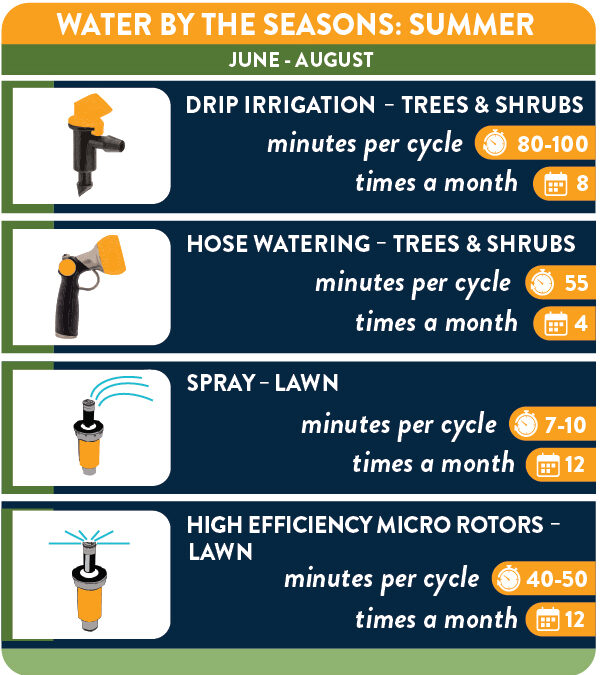
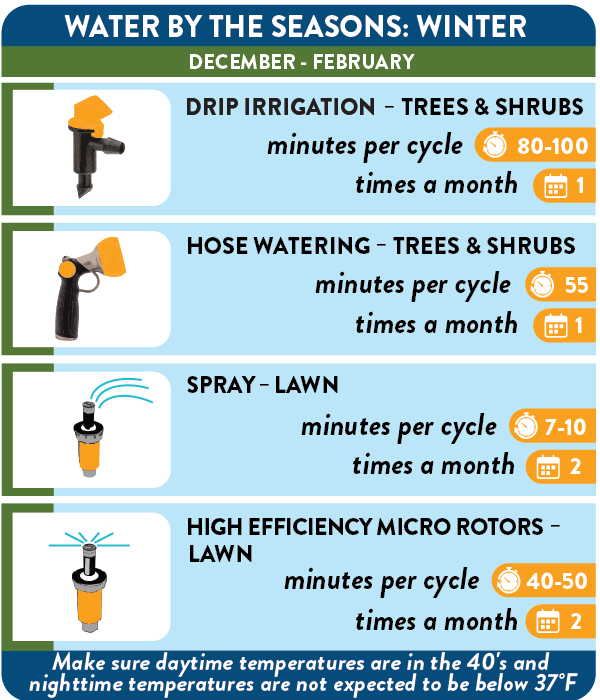
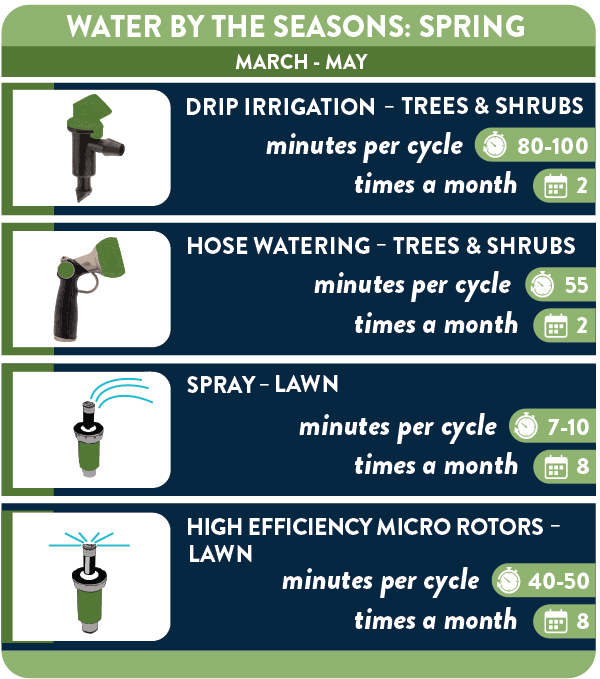
Baby, it’s cold outside. Or is it? How do you water during the cold and dry winter season?
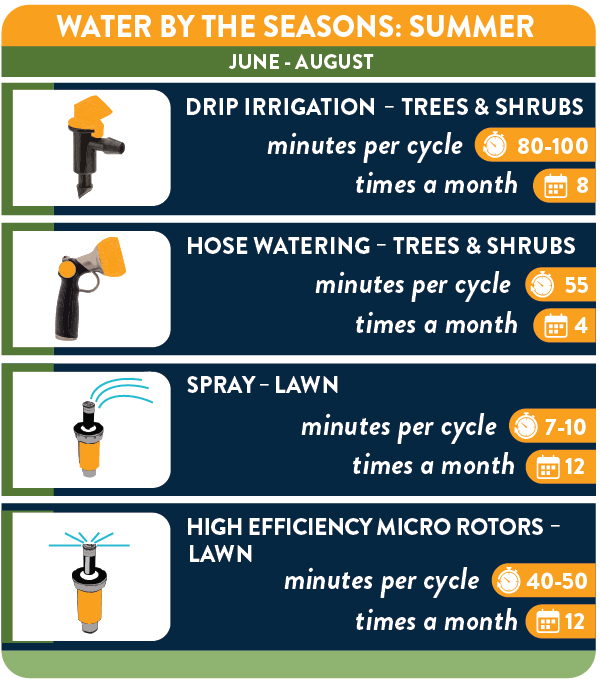
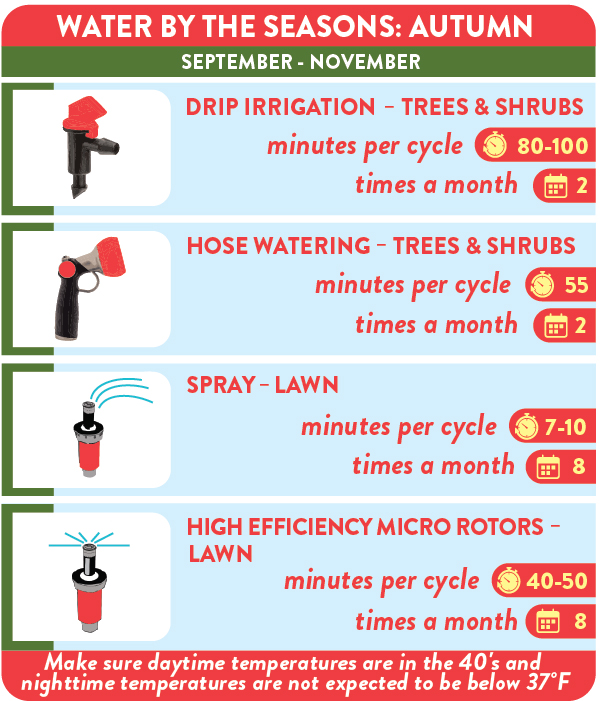
The weather predictions are in, and we are headed into a very dry La Niña winter season. This means we need to water our plants this winter in order to keep them healthy. Due to our freezing temperatures we recommend turning off your irrigation system for the season and using your hose to water once a month during the middle of a warm winter day.
Watering Tips:
For cool season grass lawns, thoroughly water every other week.
For deciduous and evergreen trees, lilacs, photina’s, euonymous, rose of Sharon, spirea and forsynthia, water once a month to 24” deep.
Author: Richard Perce, Irrigation Efficiency Specialist with the Water Conservation Department for the Water Authority. Research: Farmers Almanac, Drought Watch New Mexico State. Have a question about the article? [email protected]