If you have heard of Bermuda grass or live in one of the older areas of Albuquerque, just the name might make you flinch or grimace. The reason it gets a bad rap is because it is dormant in winter, it spreads like crazy into garden beds and can magically appear out of a dirt mess after monsoon season.
You may be surprised to hear that some of us actually like Bermuda grass lawns. In fact, I’ve even planted the grass in my backyard. I’ll take you through the pros and cons and why I’ve come to love the Bermuda grass lawn. It can be the right plant for the right space to fill the right need.
Many homeowners would like turfgrass but feel irresponsible watering a lawn in the arid Southwest. The key to choosing a turfgrass is to determine the one most suited to the specific needs of your landscape The Water Authority is not anti-lawn that is efficiently irrigated and physically used and enjoyed. Bermuda grass cultivars are one means of having a traffic/play/dog tolerant surface that uses half the amount of water of a traditional cool season lawn
According to the “turf research lab” at New Mexico State University (NMSU), “Certain turf characteristics, such as climate adaptation, water use, traffic tolerance, color, quality, maintenance requirements, and available resources, are all factors that need to be considered when selecting a turf species. Climatic adaptation and traffic tolerance, which largely determine the future use of the turf area, are the two most important factors. Many problems encountered in maintaining turfs can be attributed directly to selecting the wrong turfgrasses for Albuquerque’s difficult growing conditions and to the lack of resources, especially water, that homeowners and professional turf growers face in the state.” This means that understanding how much traffic (kids and dogs playing) and our very dry local climate are how we should be selecting turf grass species not what the big box store happens to have in stock.
There are two different categories of turfgrasses: cool season and warm season. Common Cool season grasses are Kentucky Bluegrass, Perennial Ryegrass and Tall Fescue. These are cold tolerant, green most of the year and hold up to extensive foot traffic. But they use a lot of water, up to 50” a year If efficiently irrigated. The water authority frequently has many customers (especially commercial customers) that water grass 80-100” per year! in a town that only gets an average 8” of precipitation. Common warm season grasses are Bermuda grass, Blue Grama and Buffalo Grass. Warm season grasses have a shorter growing season. This means they green up in mid spring, are low maintenance and require less water than cool season grasses. But blue grama and buffalo grass can’t take extensive foot and paw traffic plus they go dormant in the winter.
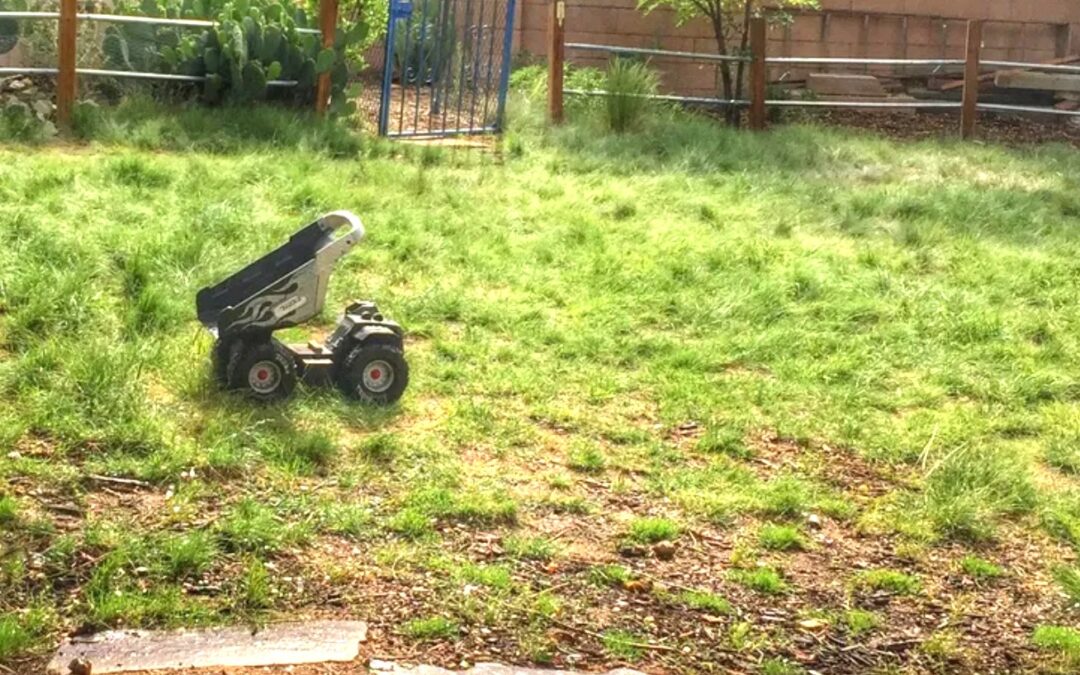
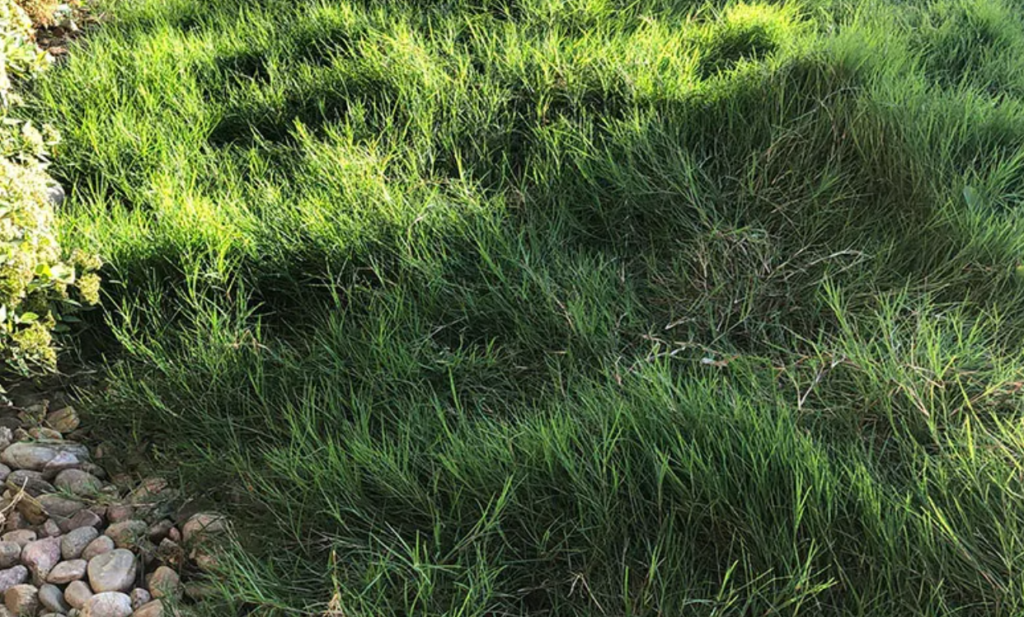
In my case, I had an existing native buffalo and blue grama grass lawn. It had always been perfect for our home. It’s native, low water use, easy to maintain and beautiful to look at. Fast forward to three kids and two dogs later. I was noticing wear and tear in certain areas of my lawn from two large dogs leaving run paths and kids playing soccer. I’m a professional landscape architect and knew Bermuda grass is a prolific spreader but in this case, I was actually looking for a grass to take over and fill in around the heavily accessed places in my yard. I found a species that could meet both my needs called Cynodon hybrida Dog Tuff ™ Grass Plugs, originally from High Country Gardens. There are many cultivars available check out the many options researched by NMSU. It is a Bermuda grass hybrid perfect for high traffic and play areas. It has excellent durability in yards with dogs. Once established, it is highly weed resistant, deep rooted and provides a soft, cushioned feel for bare feet.
The grass itself “produces an extensive system of creeping rhizomes and stolons commonly called runner roots that often have a scaly appearance. It also produces fibrous roots at the stem nodes. Bermuda grass reproduces through seed and vegetatively through rhizomes and stolons,” according to NMSU, allowing it to spread with just a little bit of water, around 20” a year. I find that it rarely needs mowing because of the traffic we give it. I mow it about twice a summer to the highest setting my mower goes around 4”.
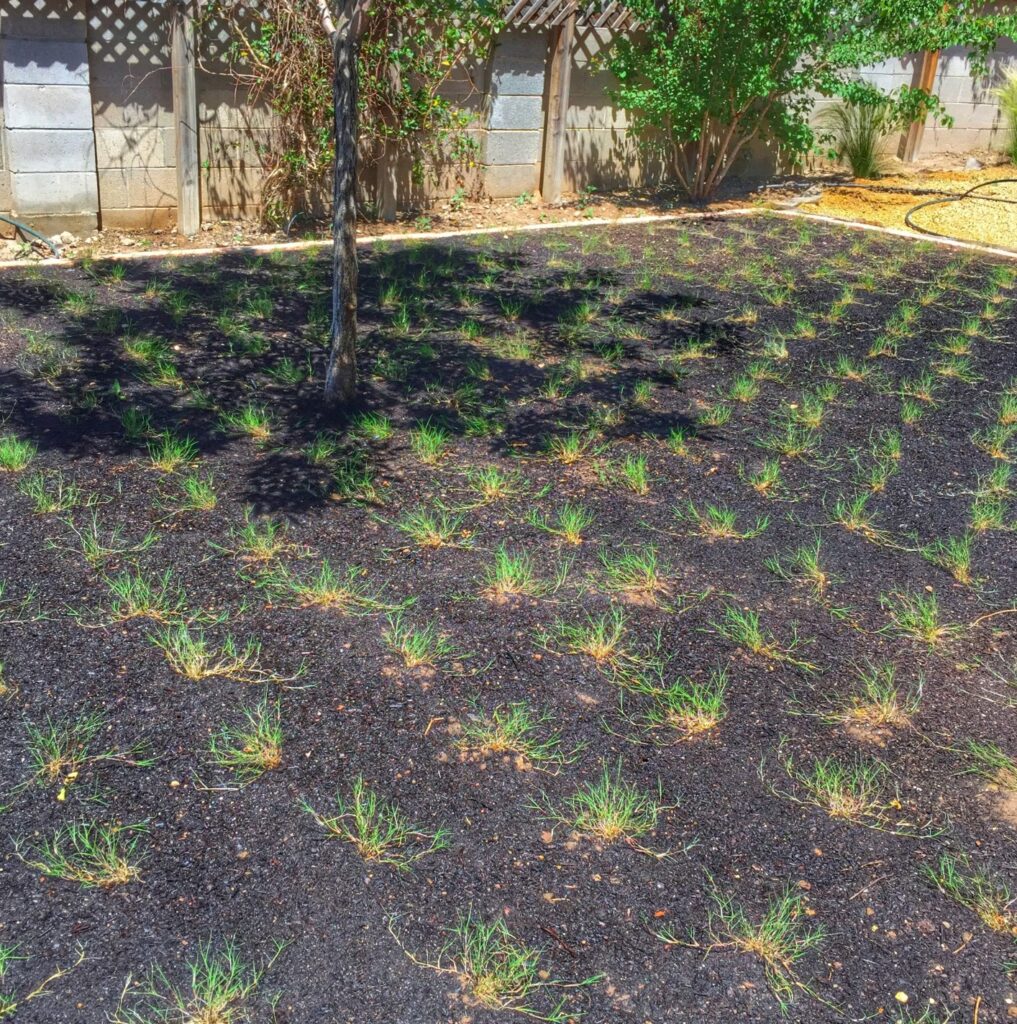
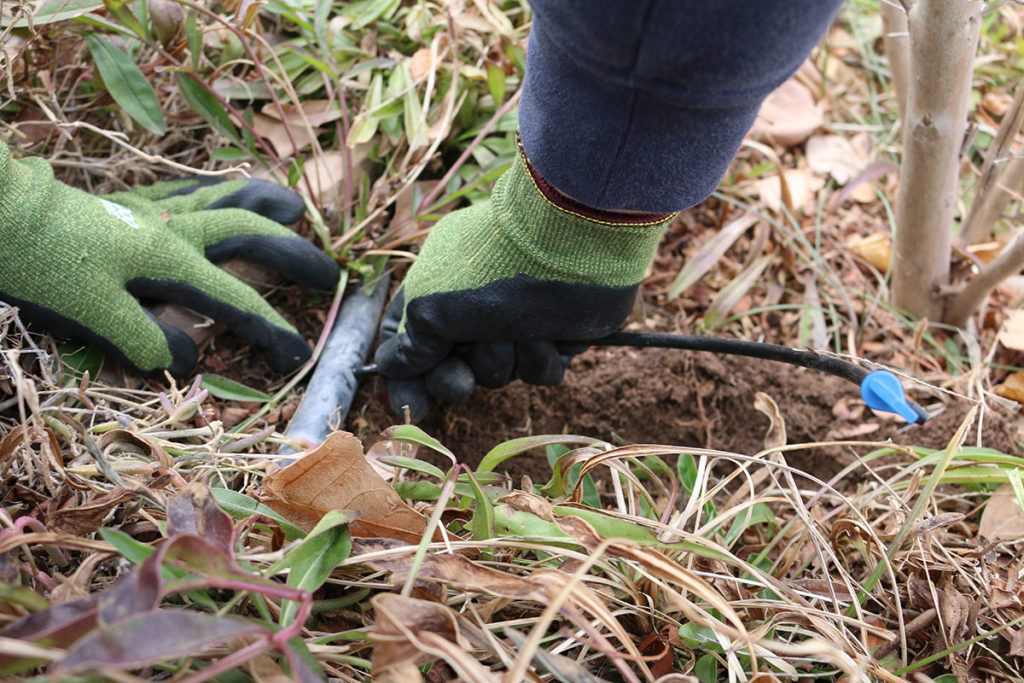
Bermuda grass plugs.
The data on this grass comes from NMSU, which has turf study sites in Las Cruces and Farmington. A few key points from their study sites mentions that “Bermudagrass (Cynodon dactylon) is similar to Kentucky bluegrass in its tolerance to traffic and turfgrass recuperative capabilities after stress or damage, but it appeared to be more aggressive than Kentucky bluegrass during hot weather in mid-summer.” NMSU evaluated five different varieties of bermudagrass, Guymon, Riviera, Wrangler, and Yukon, at both their northern NM and southern NM sites. “Riviera was given higher quality ratings than the other varieties due to finer leaf blades. Being a warm-season grass, the bermudagrasses required less irrigation to exhibit a quality comparable to the cool-season grasses.”
The shocking reason homeowners don’t like Bermuda grass is that it can become a troublesome weed, especially in southern NM, so it is wise to separate this grass from garden areas with a dry, unirrigated buffer strip, concrete mow strip at least 8”x 8” or other barrier. I like to design a concrete walk, patio or edger around these grass areas.
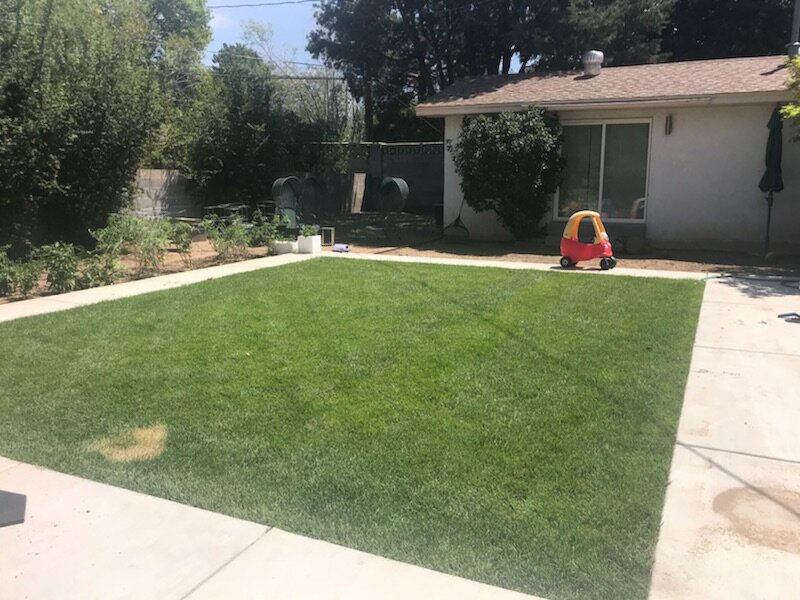
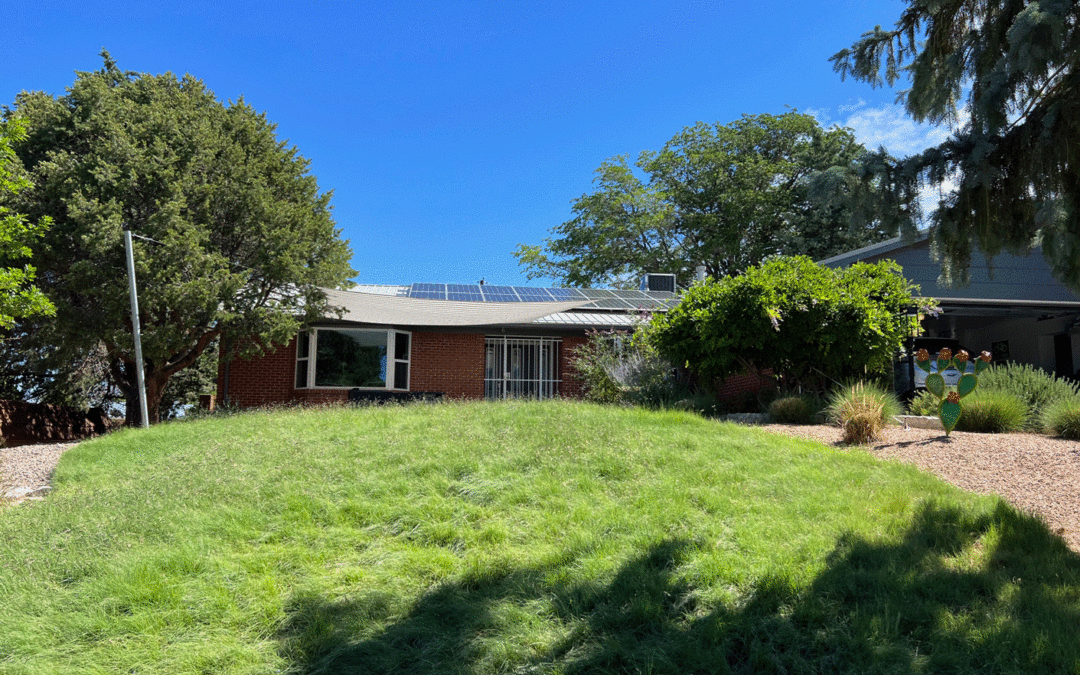
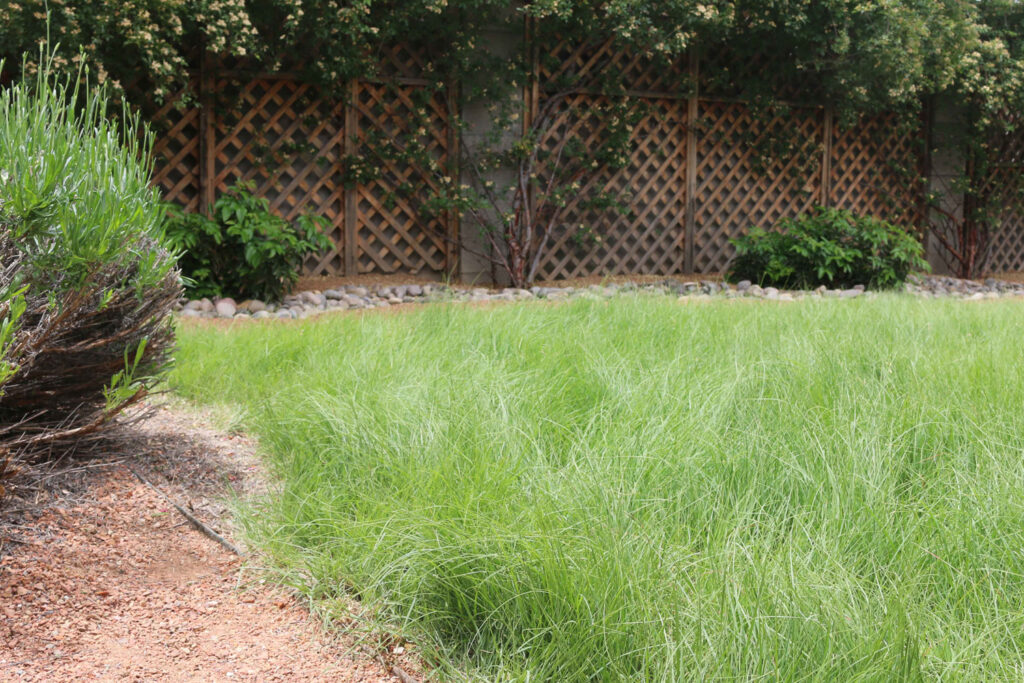
Grass lawn framed by concrete walk.
When placed strategically in a landscape this water friendly, high traffic, low mow grass is a winner in my book.
Author: Jill Brown, ASLA Landscape Architect and owner of My Landscape Coach in Albuquerque. Even more resources about turfgrasses can be found over at NMSU, one of our nations top university turfgrass science programs. Have a question about the article? [email protected]
You undoubtedly have seen your neighbors and friends around town removing their grass lawns and replacing them with water efficient desert friendly xeriscapes. You may yourself be interested in doing the same with your yard but perhaps are overwhelmed by the tasks or concerned about how much it would cost. Don’t fret, it’s much simpler than you think. We’re walking you through the six steps to transform your lawn into a beautiful desert friendly xeriscape.
STEP 1
COME UP WITH A DESIGN, then apply for the $3-a-square-foot rebate.
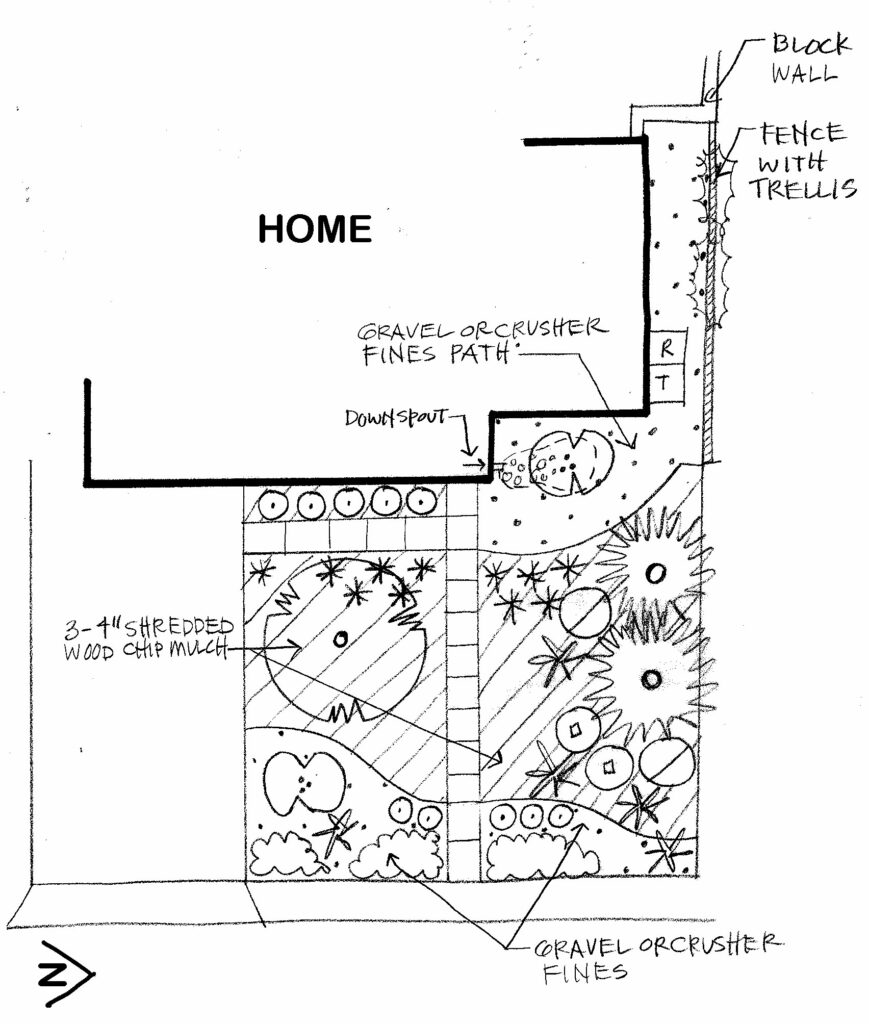
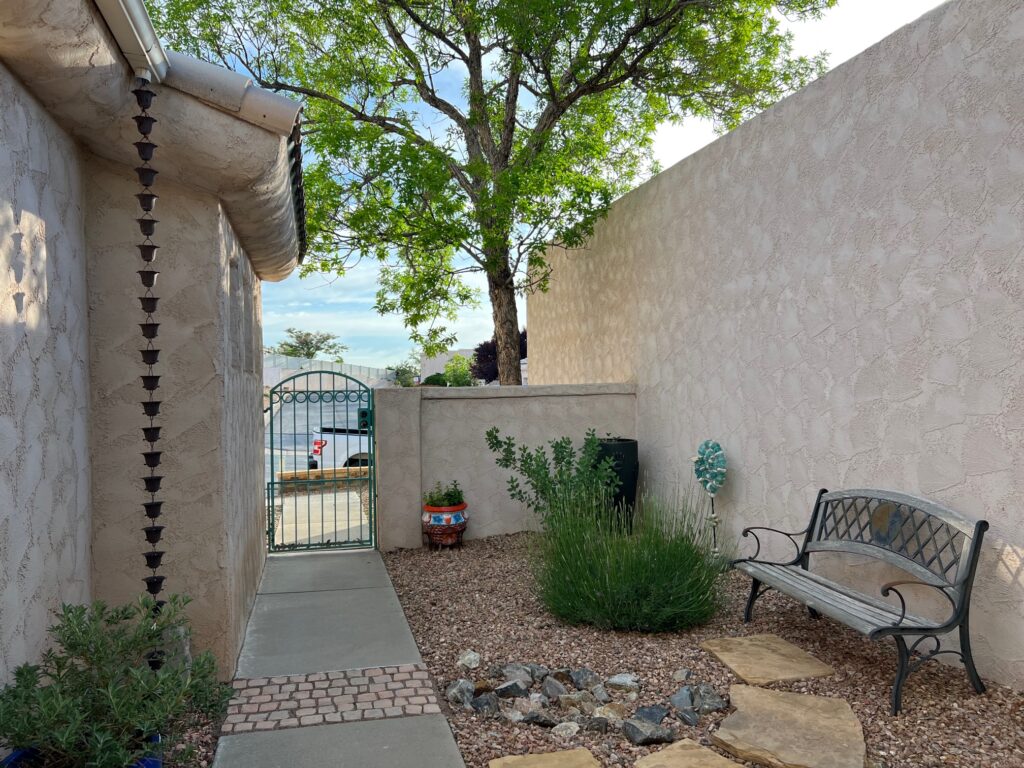
No need to get overwhelmed by this step. You know your yard best, so observe and understand how you want to use your space. Brainstorm elements you want to include. Take into account existing plants and trees, views you want to preserve or hide, shady or very sunny spots, and downspouts/canales or other places where water collects.
Once you have your design, use spray paint or old hoses to lay it out on the ground. Walk around the space and make changes as needed.
Before demolition and removal of the lawn, call 811 to mark underground utilities. Also note existing tree roots that you need to protect during your work.
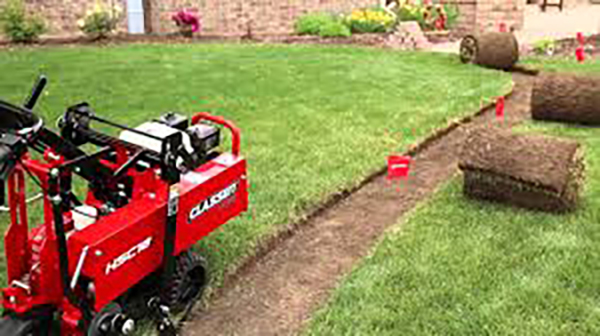
Lawn removal techniques: A sod cutter works best for most lawns unless there are large roots or the grass is Bermuda. Hand dig grass out around large roots so as not to cut any that are more than 2” thick. Use an herbicide to kill Bermuda due to its invasive and prolific roots. Along sidewalks you’ll want to dig down 4” by 12” wide to make room for 3” of mulch and slope the soil back up to the surrounding grade gently. Avoid using a skid steer to remove the grass, this can unnecessarily remove useful existing topsoil.
Drainage Considerations: Always grade water away from your house, masonry walls or walking paths and towards planting areas.
Install any hardscape elements such as walls, pergolas, sidewalks, pavers and boulders.
STEP 4
IRRIGATION
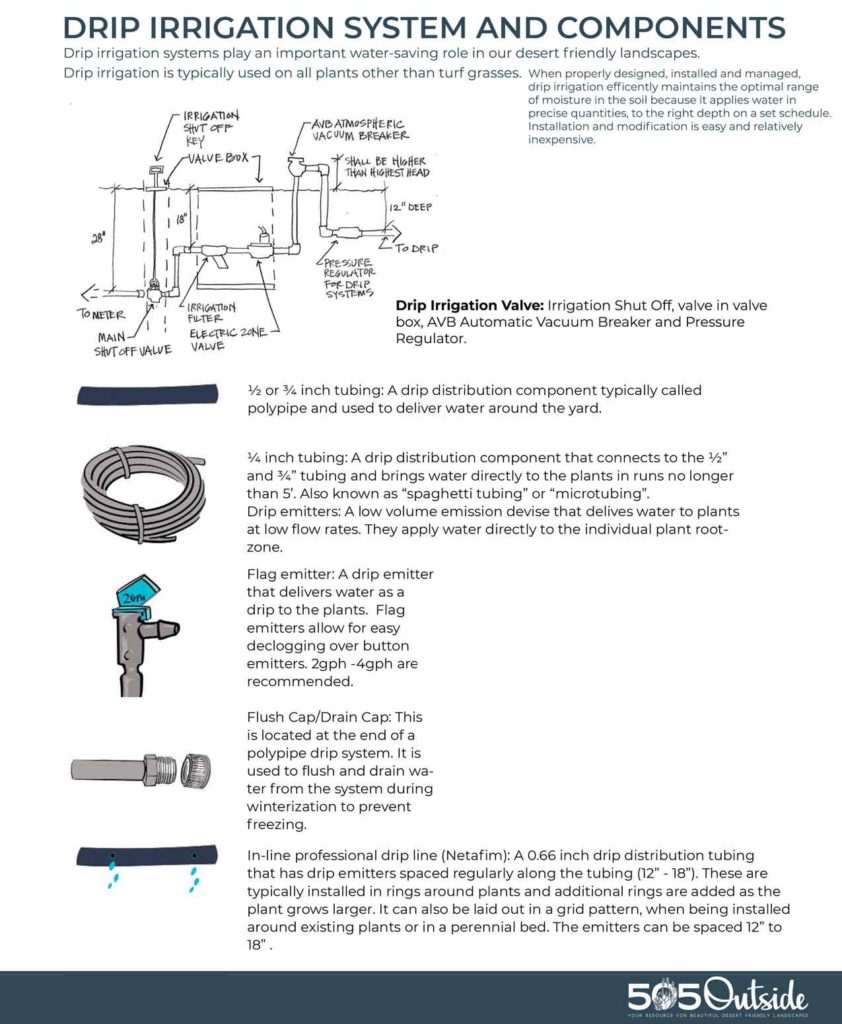
You’ll use a drip system to irrigate your new beautiful desert friendly xeriscape. Check that your existing spray valves are in good working condition. If so, you can reuse these valves. Simply have a licensed irrigator or plumber add a pressure reducer after the valve, then you can add your ½” drip polyline.
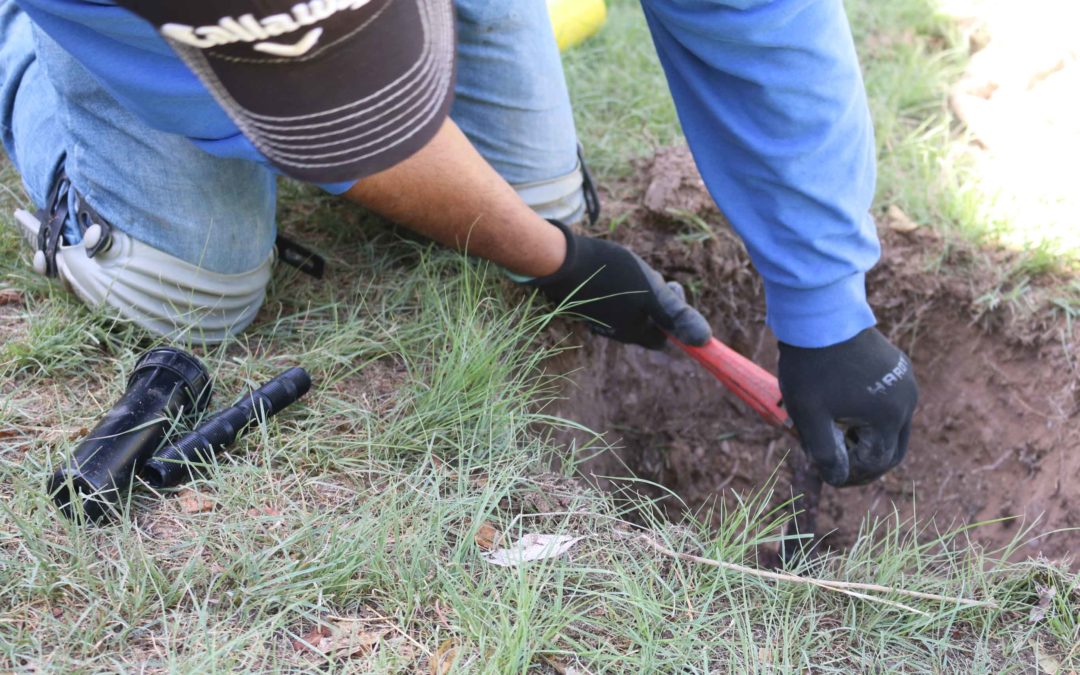
Irrigation Components: If your existing valves are damaged or non-functional you’ll need to install new ones. Typically, an irrigation specialist or licensed plumber would install your new manual shut-off valve, automatic valves, box, backflow preventers and pressure reducers. But if you want to do it yourself, do your research and reach out to local landscape irrigation suppliers for advice.
Drip Tubing: The drip tubing is everything downstream of the pressure reducers, and it’s relatively easy for homeowners to install. Uncoil the ½” or ¾” poly tubing in the sun until it’s flexible enough to manage (making sure there are no kinks in the process). Then, dig shallow 6” trenches, lay out the ½” poly in the trench, staking it with 6” weed fabric staples along the way, and snake the poly within a few feet of the plant locations. Wait until the plants are installed to cover the poly unless you have long lengths of it without plants.
Install the plants (link to article). Water your new plants with a hose right after they’re installed. You might need to create temporary basins around each plant to keep the water from running off.
At this point, you’ll want to set up the permanent irrigation. Use your drip tubing punch tool to create a hole for the ¼” coupler and ¼” tubing. Always punch the hole in the side of the ½” poly, not the top, so a footstep doesn’t damage the connection. Carve a small trench in the dirt and run the ¼” tubing to the base of the plant and attach the emitter (use a weed fabric staple to hold it in place if necessary). Avoid running ¼” tubing farther than 3 feet in order to keep things orderly. After the ¼” tubing is installed, cover it with dirt to protect it and keep it from being tripped over.
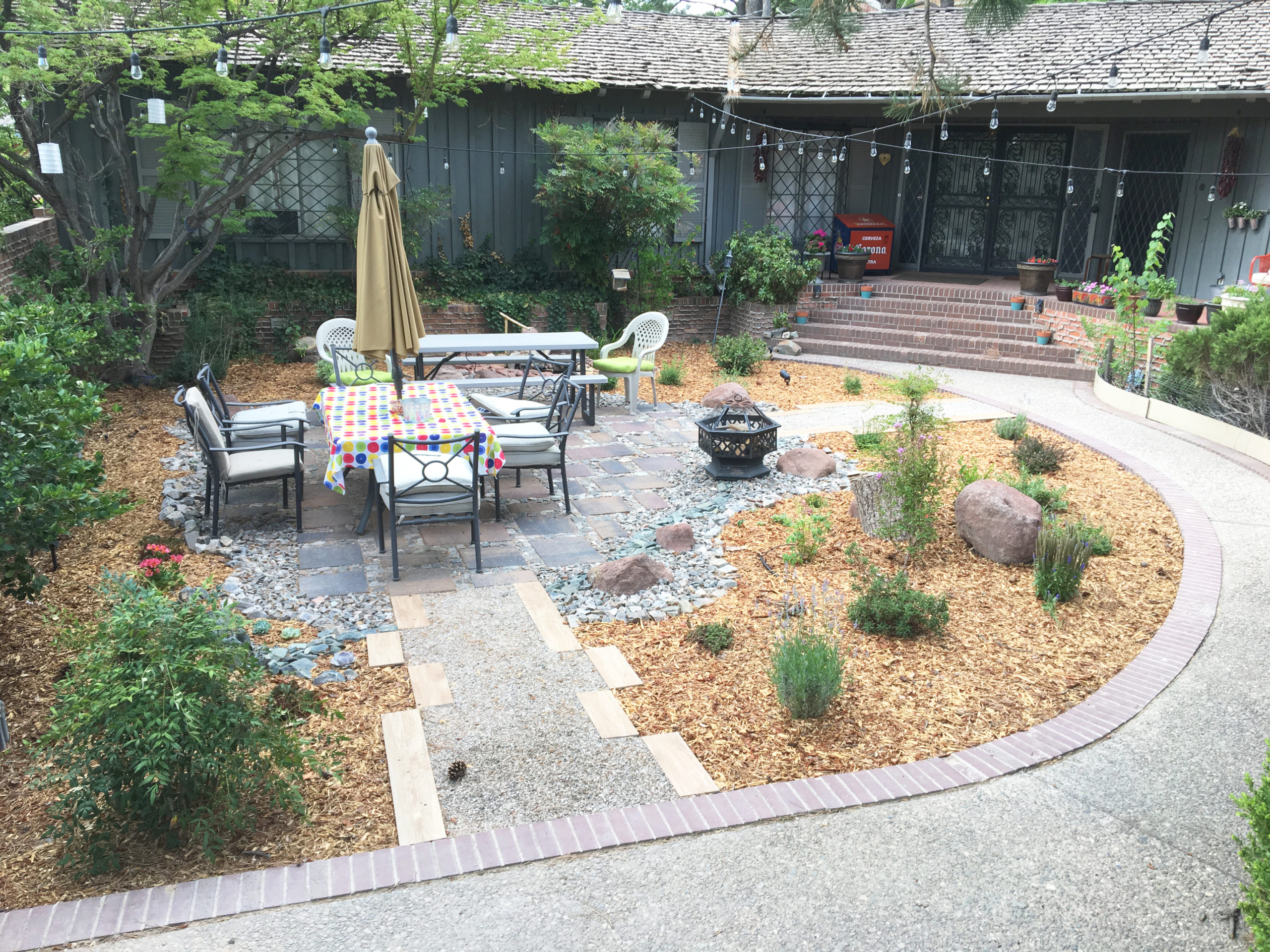
If you’re using gravel, the complexity and layout of your yard will determine whether you install weed barrier fabric before or after planting, but you do want the drip tubing under the weed fabric. For shredded wood chip mulch, lay the irrigation line down over the bare dirt then top with 3-4” of wood mulch.
If the mulch has been delivered in the street or on a concrete driveway, use a square shovel to scoop it up. From there, just load each wheelbarrow full and dump it throughout the yard. Spread it out with a rake and you’re done!
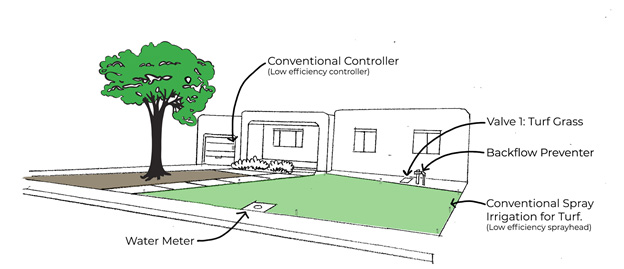
Typically, a conventional turfgrass yard includes a few large trees and some planting beds for flowers and shrubs around the foundation of the home. This type of yard often has a couple of existing irrigation valves for sprinkler irrigation. A conventional turfgrass landscape requires tremendous amounts of water to thrive in our region — a minimum of 40” (with an average of 50"-55”) of water per growing season, which is about three to five times more than what is provided by natural precipitation each year. This is why we do not consider a turfgrass yard a desert-friendly landscape.
Climate change is causing us to rethink our yards, and that includes yards with lawns. For a yard with a lawn to be truly desert-friendly, the amount and type of grass used must be considered. A desert-friendly turfscape should also have efficient sprinkler nozzles and pressure compensating sprinkler bodies to maximize the water that’s used to maintain the lawn.
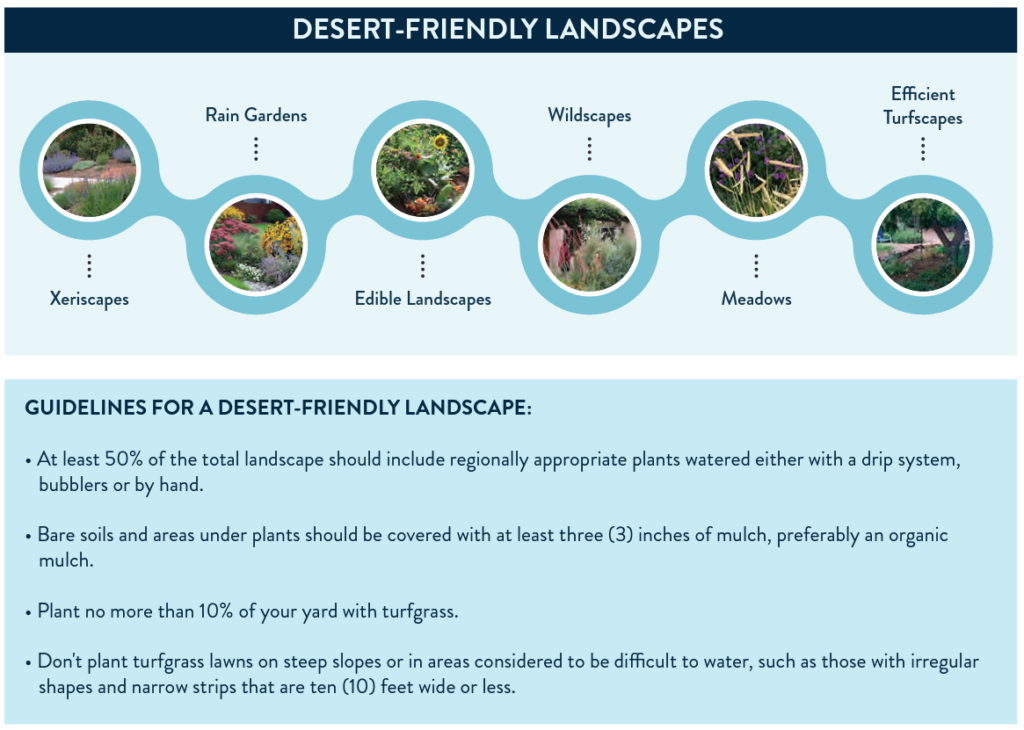
We recommend that no more than 10% of your total yard is devoted to a lawn. Research from various universities in the Southwest and lawn seed producers (such as Pennington Seed) is now suggesting that New Mexico’s climate is no longer suitable for cool-season grasses to thrive. Instead, we need to make a shift to various warm-season grasses, which will grow well with significantly less water.
Cool-season and warm-season lawns are the two different categories of turfgrass lawns found in Albuquerque. Cool-season grasses (Kentucky bluegrass, perennial ryegrass and tall fescue) thrive between 65F and 75F degrees in the summer. They create a softer, darker green and lush-looking lawn. In Albuquerque, most lawns are composed of cool-season grasses that are cold-tolerant and green most of the year. They can withstand considerable amounts of foot traffic. One disadvantage is that they use a substantial amount of water in the summer months. Parkblend (a blend of cool season grasses) is the most common lawn in the Albuquerque metro area. It uses around 40” of water a year.
Warm-season grasses (Bermuda grass, blue grama, and buffalo grass), which thrive in 70F to 90F degrees, have been used in Albuquerque for many years. There are parts of town where they are quite prevalent. Warm-season grasses have a shorter growing season. They green up later and go dormant earlier than cool-season lawns. They are low maintenance and require less water than cool-season grasses.
Buffalo GrassBermuda Grass
Knowing what type of lawn or turfgrass is being installed or already being watered can make a significant difference in how much water should be applied. The key to choosing a turfgrass for a new area is to determine the one most suited to the specific needs of the landscape.
Water Budget (this includes 1,000 square feet of cool-season grass and a number of mature trees, shrubs and vines):
Since the Albuquerque area receives about 9” of rain on average per year and grass lawns can use up to 50” of water per year, the proper design of an irrigation system for a grass lawn is of utmost importance when it comes to water efficiency. Irrigation efficiency can save up to 30% of the water you use by avoiding water waste.
While the Water Authority does not encourage grass lawns, we understand that some homeowners may want to install new lawns or reduce the size of their existing lawns. If you are going to have a turfgrass lawn, we recommend that it’s a lawn you use and not just maintain for curb appeal. Proper irrigation layout and design are key to having a healthy and water-efficient lawn.
When designing your lawn, keep these tips in mind:
1) Lawns smaller than 10’x 10’ are hard to water with a spray irrigation system.
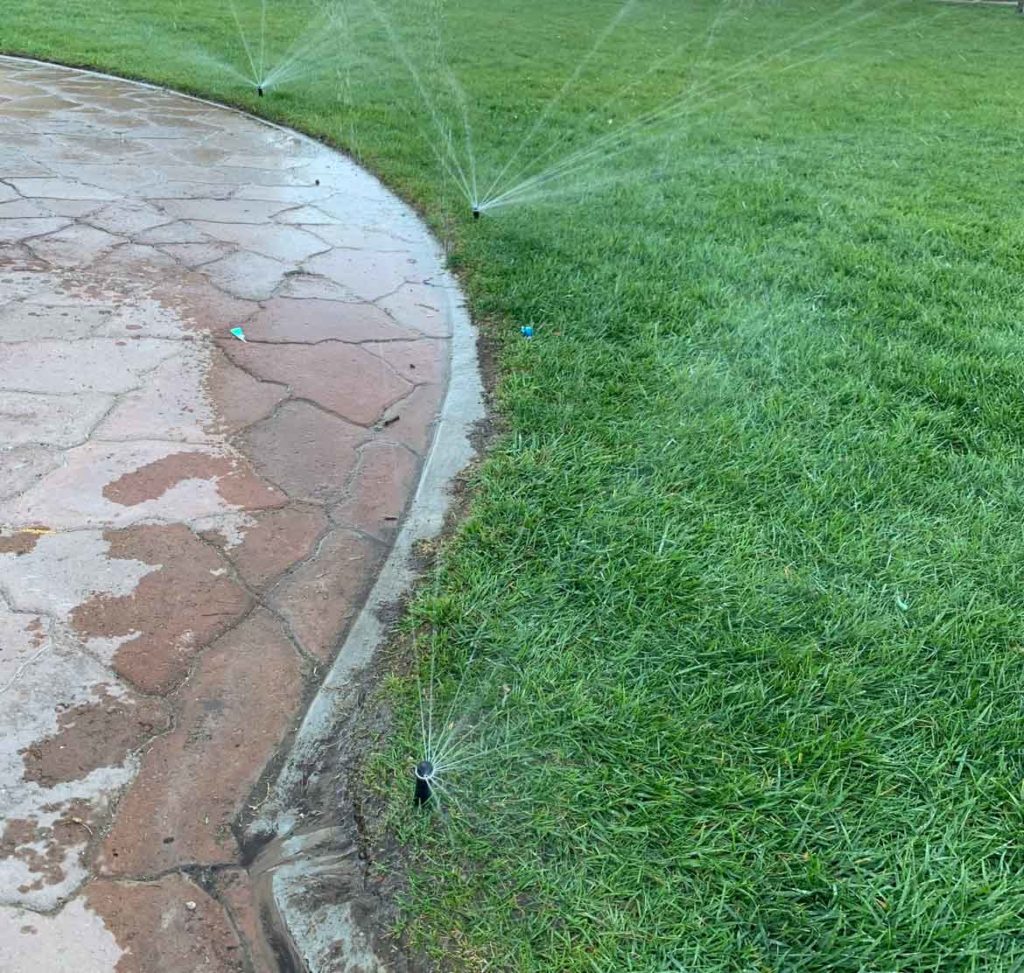
2) To get the most efficient irrigation coverage, design square and rectangular lawns since sprinkler heads spray in fixed patterns-such as a quarter circle, half circle or full circle-but not curves. If curves are necessary, broad curves have the best chance of being irrigated without over spraying, while zigzag narrow curves are the toughest to irrigate effectively.
3) We recommend using WaterSense Pressure Regulating Spray Sprinkler Bodies.
WaterSense labeled spray sprinkler bodies with internal pressure regulation can reduce water waste by providing a consistent flow at the sprinkler nozzle. When the sprinkler body maintains pressure near its optimal operating pressure, the connected nozzle is better able to generate the right amount of water spray and coverage for a more uniform distribution of water across the landscape. Customers can choose from a list of pre-qualified spray sprinkler bodies.
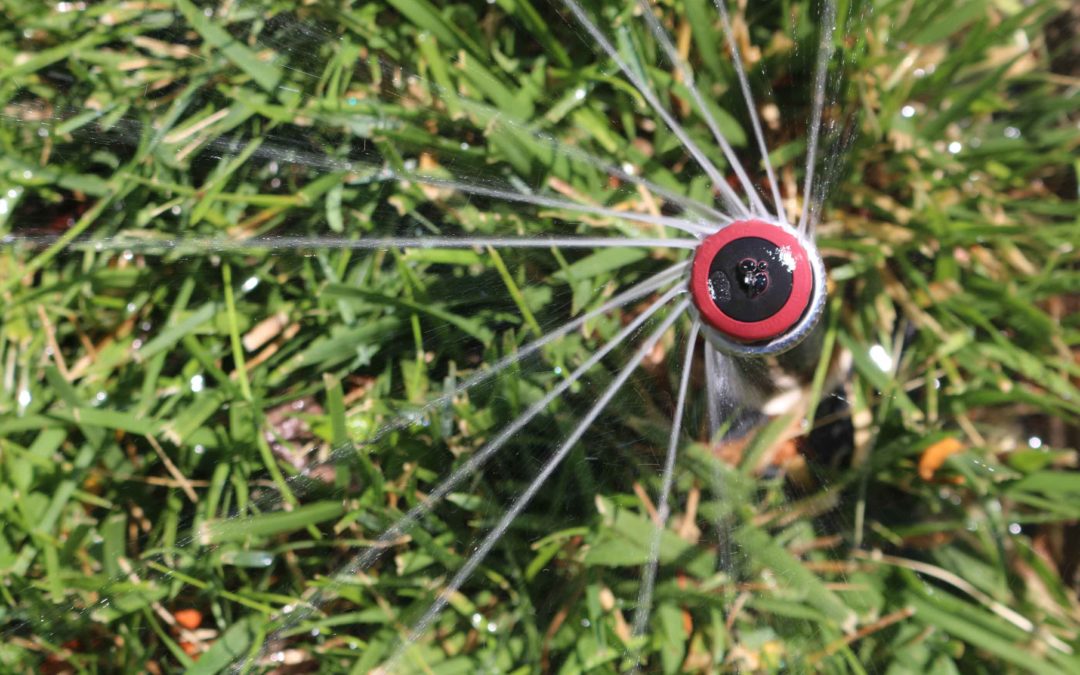
4) We also recommend using High-Efficiency Rotating Sprinkler Nozzles (multi-stream). These nozzles minimize water waste and feature a unique multi-trajectory rotating stream that delivers water at a steady rate. This slower application allows water to gently soak in at rates that soils can absorb. Use these nozzles to replace the sprinkler head on any conventional spray head body or pop up sprinkler. For more information on these nozzles read this post.
5) Irrigation sprinkler nozzles are designed for 100% overlap of watered areas, which means each sprinkle nozzle throws water to the next sprinkler in all directions. If a system is not built this way, there will be dry spots (see the below image).
Designing, reducing and changing the shape of your lawn doesn’t have to be an expensive project but it can save a lot of water. Visit your favorite local irrigation supply store for professional equipment and expert advice.
Learn more by checking out these other useful irrigation articles:
Author: Jill Brown, ASLA, is a Landscape Architect and owner of My Landscape Coach in Albuquerque, NM. Have a question about the article? [email protected]
One of the biggest obstacles holding homeowners back from removing their high-water turfgrass and installing xeriscape is believing that setting up the irrigation system is difficult. Luckily, it is not as hard as you may think.
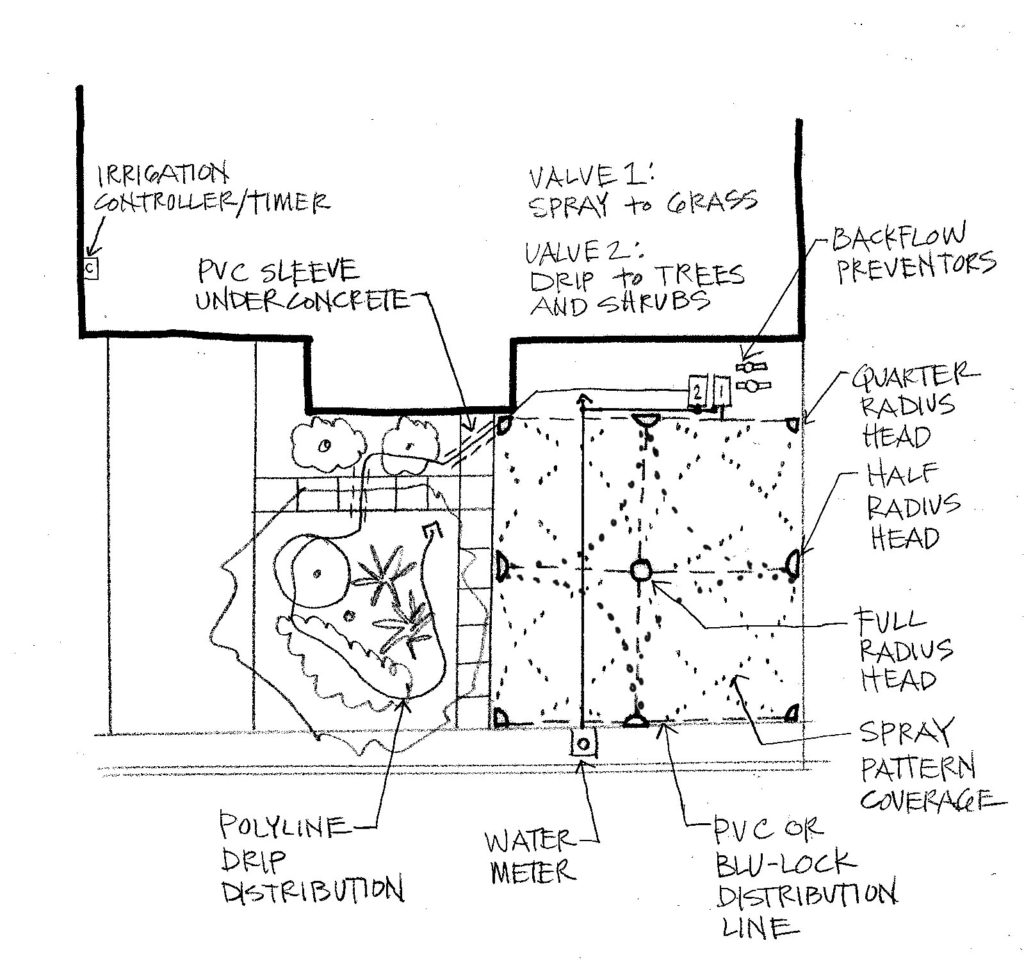
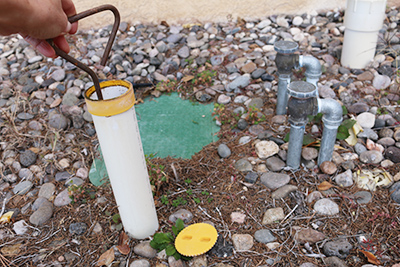
If you have an automatic irrigation spray system, you already have an existing valve and, most likely, an AVB backflow preventer. It may look something like this.
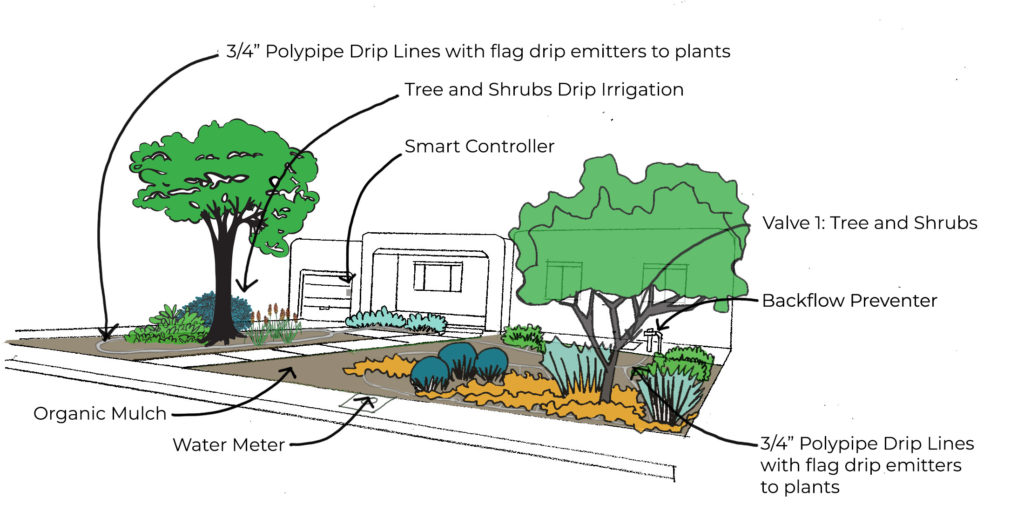
Desert Friendly Xeriscape with spray to drip conversion.
The first thing to do before converting to drip is to get the valves checked out by a professional to make sure they are in working order. When you know they’re fine, add a pressure regulator filter combo just past the existing valve and backflow preventer. Then attach ¾”polyline, snaking it around the yard to the new plants and inserting flag emitters at each plant.
The existing underground piping and spray heads are no longer needed. Simply remove all the existing spray heads. There is no need to dig up any existing pipe.
You may have seen the spray-to-drip retrofit kits locally available and wonder if this is a good approach. We don’t recommend this approach because studies show that nearly half of the water saved from converting a lawn to a healthy xeriscape comes from abandoning leaky underground piping and fittings. A Sprinkler system’s lifespan is less than 20 years. If you are not sure how old your system is, or if it is older than 10 years, it’s best to not rely on old underground piping. Since sprinklers typically run for 8-12 minutes and drip often runs for 45-60 minutes, if you have a leak in your old sprinkler piping and it is now part of the drip system you could be wasting a ton of water – negating the savings from getting rid of your thirsty lawn.
Drip irrigation tubing is very inexpensive per foot and only needs to be in a shallow trench. Properly converting to drip irrigation is not as expensive as many people think, while converting your sprinklers to drip the cheap and easy way with a retrofit kit is likely to cost more in the long run.Contact [email protected] to learn more.
Learn more by checking out these other useful drip irrigation articles:
Author: Amos Arber, Xeriscape Rebate Inspector with the Water Resources Conservation Department for the Water Authority. Have a question about the article? [email protected]
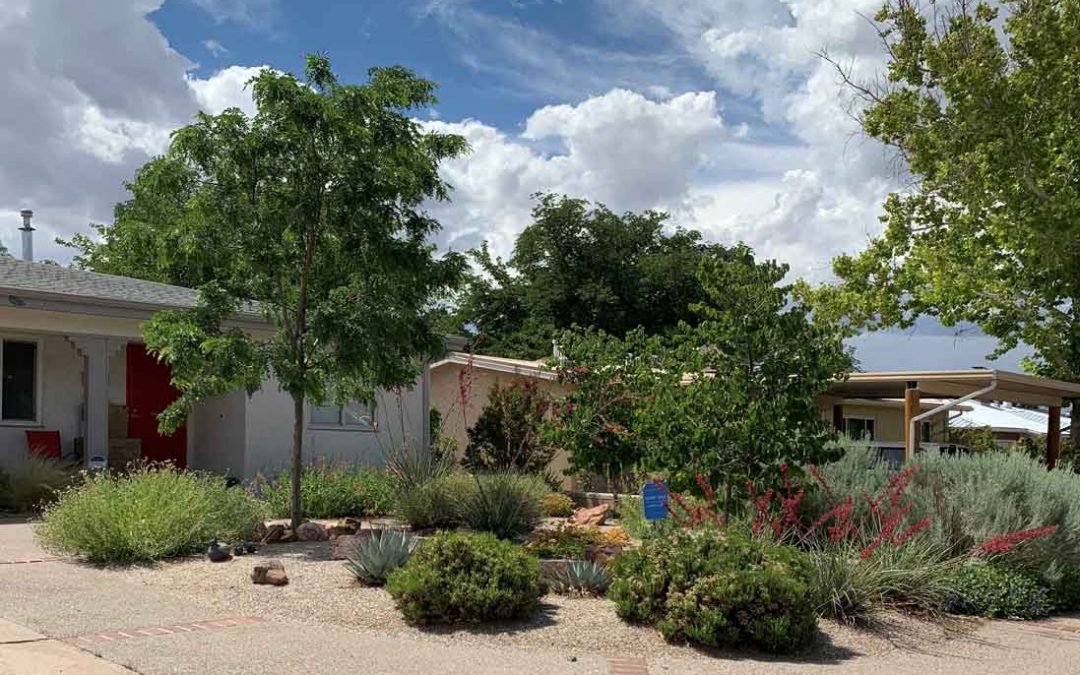
ALBUQUERQUE, N.M. — By and large, New Mexican homeowners are getting the all-important message of the arid Southwest: Water is precious, and not to be wasted.
But local experts say an important piece of the story is still often lost when it comes to landscaping: Conserving water doesn’t have to mean a yard consisting of one plant surrounded by gravel.
“We’ve got to go away from that,” said Carlos Bustos, water conservation program manager for the Albuquerque Bernalillo County Water Utility Authority. “Xeriscapes are luscious, they’re beautiful, they’re abundant, they’re resilient, they’re sustainable. … We hope that 10 years from now we’re not still dealing with the idea of ‘zeroscapes.'”
Solange Serquis, of Santa Fe-based Serquis + Associates Landscape Architecture, agreed.
“I am a big believer that we all deserve aesthetic and beauty,” she said. “When you combine aesthetic and beauty to achieve something else, like passive cooling or low-consumption plants or an invitation to be outdoors, better use of … energy indoors, that’s the main thing.”
Plant selection
According to Jill Brown, a landscape architect and owner of My Landscape Coach, selecting plants tends to be a point in the landscaping process where homeowners get very engaged.
“If I go back and look at the most popular articles, the most popular things, discussions, questions that we’ve received, it’s always about plants,” said Brown, who also provides content for the water utility authority’s landscape website 505 Outside. “So people are really interested in plants and learning about plants and in that aspect of a landscape.”
For several local landscape pros, planting trees tops the list.
“That’s going to provide shade, which is going to reduce your energy bills if you put it … on the south side of the home … or the west side of the home,” Brown said.
Bustos said if a tree is well planned and well-positioned, those energy savings can be significant.
“There’s studies out there that say that if you place a tree strategically where you need to, you can save up to 25% of the energy in a typical household use,” he said, adding that tree shade helps reduce water lost by other plants nearby.
“By creating this microclimate, you can reduce the water need between 6 and 20%,” he said. “It’s always cooler in the shade.”
Serquis says planting trees adds long-term value.
“I always say planting a tree is an act of … citizenship,” she said. “Because you plant that tree today and in maybe 50 years, it’s … a heritage for the neighborhood.”
With trees as well as with smaller plants, Serquis said she’s looking for ways to passively cool living spaces – both indoors and outdoors – and selects varieties that have low water consumption.
When it comes to choosing specific plant varieties, Brown’s got a simple approach.
“Basically native plants that you buy from a local nursery are going to work in your soil,” she said. “That’s like a generalization we like to tell homeowners: Don’t over-stress about your soil. If you buy plants from a local nursery, you’ll be OK.”
Of course, there’s a caveat: Those plants and trees still have to be watered properly.
Irrigation
Brown said data and her own experience suggest that in the universe of homeowners who care about their landscaping, about half use an irrigation system of some kind, and about half are hand-watering.
Those hand-waterers, according to Brown and Bustos, should think about installing an irrigation system.
“Hand-watering is wasteful, because they’re spraying the leaves and … we need to get to the roots,” Brown said.
Those who already have an irrigation system can consider whether it’s efficient or fine-tuned enough.
Those who use spray sprinklers, for example, may consider swapping out sprayers for highly efficient models that are more available to homeowners today than in the past, often on the shelf of local irrigation supply companies, Brown said.
Homeowners can look at whether plants in their yard are being watered to the right depth, whether their irrigation system adjusts with the seasons – less water during the spring and fall than in summer – or with the weather.
Plants’ water needs also vary depending in what type of soil they’re planted – which even in the Albuquerque metro area can range widely, from sand on the West Side to clay in the valley.
Brown concedes the considerations can overwhelm homeowners.
“People really just want you to say, ‘Hey, water your landscape 20 minutes two times a week in the summer, 20 minutes once a week in the spring and fall,” Brown said.
Lawns
Serquis said when she first moved to New Mexico from Argentina, the trend was incentivizing homeowners to get rid of their lawns altogether in favor of gravel. But lawns don’t get quite such a bad rap with conservation-minded landscapers these days.
“I think there is something in between” lawn and gravel, Serquis said. “(It) depends how you look at the grass, or what type of grass – it’s not that bad. And a xeriscape with no plants, just as a reflecting surface, could be even worse” because of the heat generated.
Brown said there are types of grass that require less water – and even if homeowners want the grass “that’s at the park,” there are better ways to water it than with a spray system that throws water high in the air and risks evaporation. Bustos agreed.
“If you have a lawn and you’re enjoying it and it’s functional and you’re taking care of it, then update it,” he said. “You know, update that irrigation system. There’s technology out there that just can make things a lot more efficient.”
Mulch
Brown said mulch is an important part of landscaping in the Southwest.
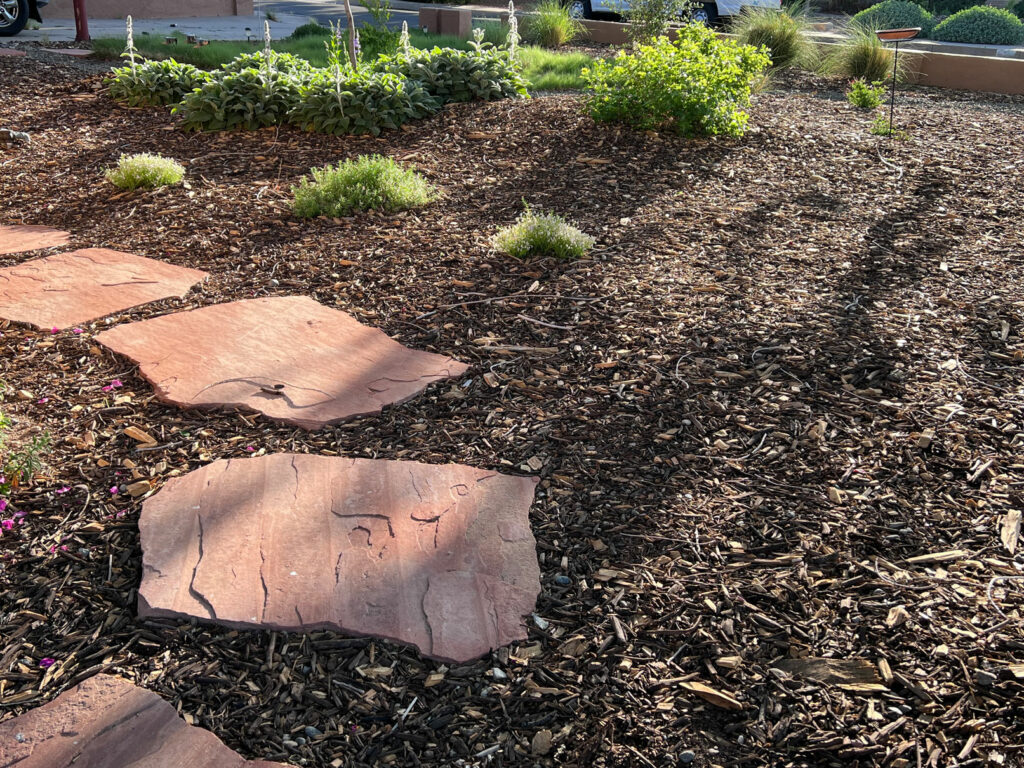
“One of the biggest things people complain about are weeds in New Mexico, and a lot of that is because wherever there is bare dirt, you’re going to get weeds,” she said. “… The simplest solution and the most inexpensive solution and easy to install is 3 to 4 inches of a shredded wood chip mulch over the entire yard.”
Mulch helps soil hold in moisture and insulate plant roots, and it breaks down over time to enrich the soil. Brown said a mulch layer often means replacing expanses of gravel.
“All gravel does is produce more heat and more weeds,” she said. “Even if you have the weed cloth, the weed cloth just makes it easier to pull the weeds.”
Starting small
Bustos acknowledged the process of adapting a landscape can be daunting. He said he encourages residents to start with the “lowest investment,” which is changing behaviors. People can start following the seasonal irrigation needs of their landscape, rather than giving the same amount of water all year.
Those ready to invest some resources can take small steps like installing smart irrigation controllers, swapping out sprinkler heads and efficient nozzles – steps Bustos said can save up to 30% of water usage in some cases.
“If you really want to invest, you want to transform your yard into a desert-friendly landscape, then we got a xeriscape rebate that folks can tap into,” he said.
Brown said while her clients may be in different phases with their landscapes, they tend to share one thing in common. “Overall, in general, people in Albuquerque want to save water,” she said. “That is a no-brainer now.”
Author: Gabrielle Porter, Albuquerque Journal Business Editor. Reprinted with permission from the Albuquerque Journal. Have a question about the article? [email protected]