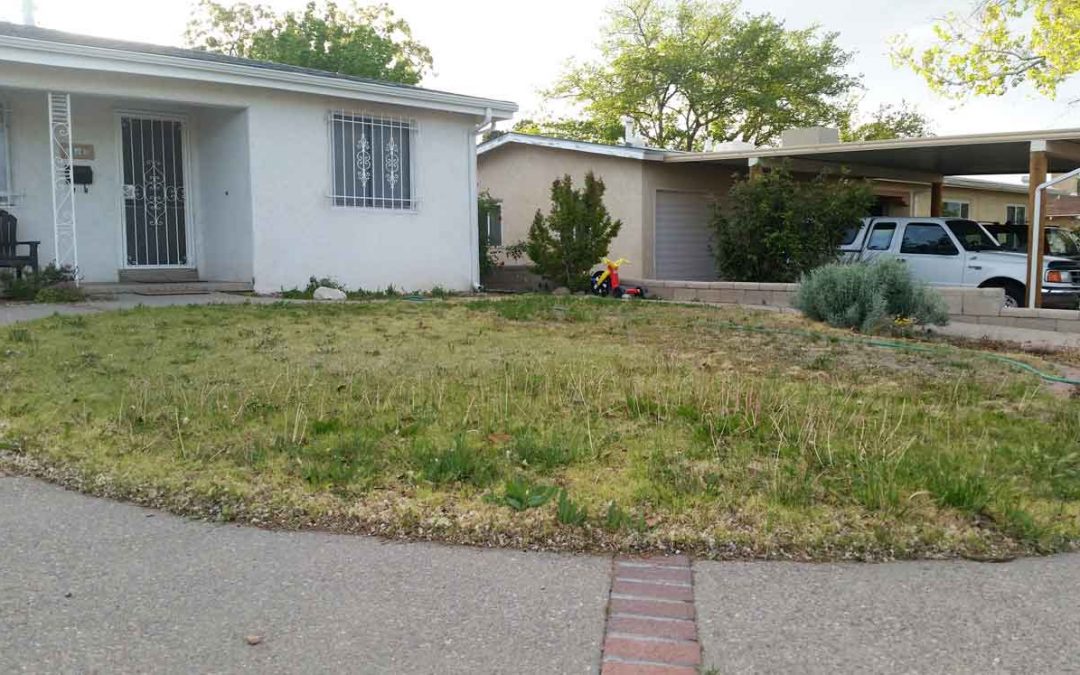
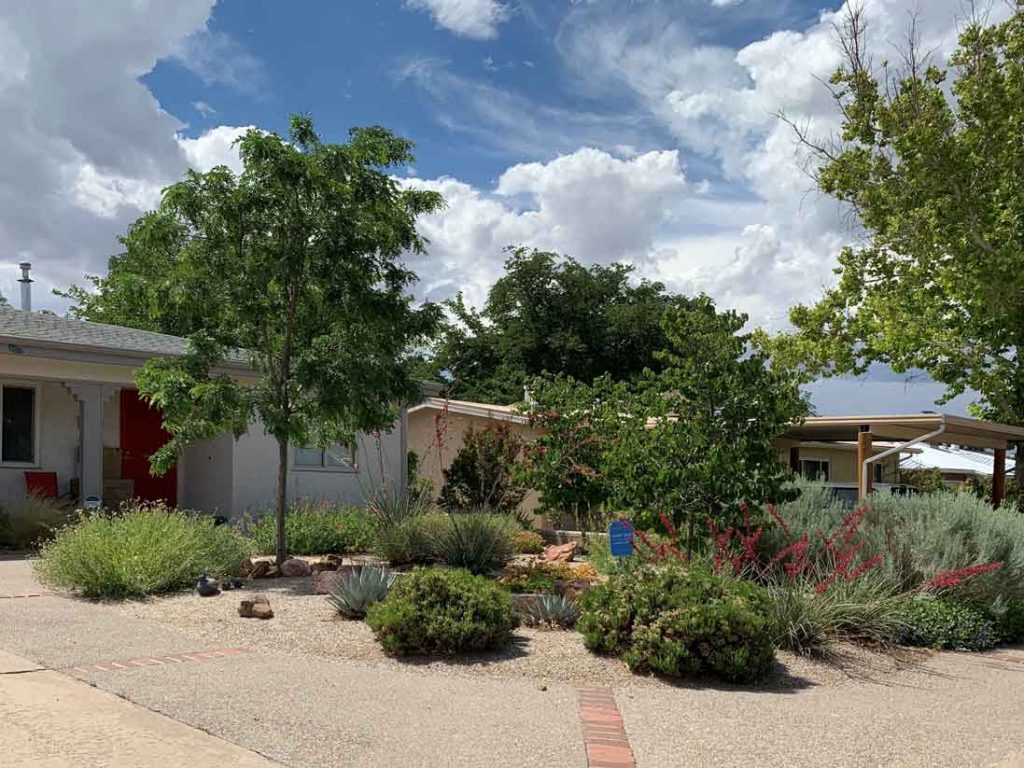
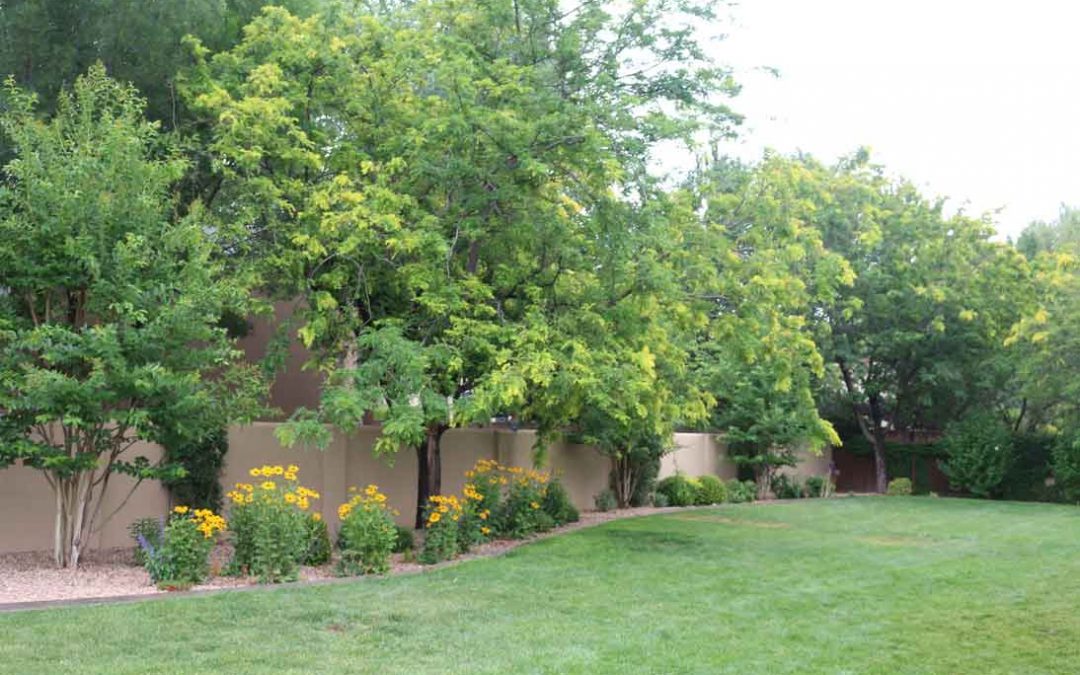
Current Drought conditions mean even more water will need to be used for your high-water use lawn to remain healthy. If you have been thinking about transforming your lawn into a desert friendly xeriscape there is no better time to do it than right now! These types of landscapes are more resilient to climate variability and can provide for up to 30% in water savings or more. Rebates of $1.00 per square foot are available for our residential customers. Certain restrictions apply, and your plans must be approved in advance by Water Authority staff so don’t start removing your lawn until you have submitted an application and contacted the inspector. Learn about our Xeriscape rebate here and get the link to the application portal.
Our expert staff can provide advice and free resources on how to start your beautiful xeriscape transformation. If your application is approved an inspection will be scheduled to verify that your grass type is considered high water use and has sprinkler irrigation. The grass must be currently cared for at the time of the inspection to qualify for the rebate. The inspection is a great opportunity to ask questions and get opinions from our xeriscape expert on various aspects of transformation projects such as plant selection, irrigation conversion and tips for saving money by doing it yourself or hiring a professional landscaper.
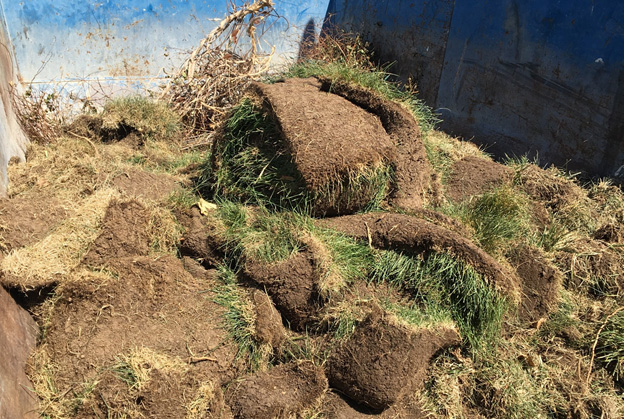
To remove your lawn we recommend using a sod cutter because it’s a fast and effective, chemical-free method to remove your lawn. Many local equipment rental companies rent sod cutters. Approved participants of the xeriscape conversion rebate program may receive 25% up to $100 in rebate off the cost of renting equipment like a sodcutter or skidsteer for removing grass. Before removing the lawn, make sure the soil is not too wet or too dry. Set the cutting blade depth at the shallowest setting necessary on the sod cutter to help retain as much valuable soil on site as possible. The removed sod should be recycled at one of our local composting facilities. One advantage of using a sod cutter is that it is chemical-free, fast, and you can continue with the next step of your project on that same day.
Please note: This method is not recommended for lawns that have mature trees. Sod cutters can damage shallow, fine-hair feeder roots that are critical for water and air uptake. Sod cutters are also not recommended for lawns with Bermuda grass due to the nature of its rooting system. For these cases you might want to consider herbicides. Take advantage of our free ask an expert email service if you have questions about what type of lawn you have or any other questions about xeriscape transformations.
Additionally, xeriscape rebate participants get 25% off the cost of installing bulk organic mulch up to $100. Not only is organic mulch such as shredded wood chips, aesthetically appealing, it provides numerous other benefits. Mulch increases moisture retention in the soil, encourages healthy root establishment, and greatly reduces weeds. A 3”-4” thick layer of organic mulch and drip irrigation are two of the best tools we have for keeping our landscapes healthy and resilient in times of drought.
Check out the Desert Friendly Xeriscape Rebate page to learn more about the qualifications, requirements and process to apply for this generous rebate. You may also contact our xeriscape specialist Amos Arber, at [email protected] or 505-208-2015
Author: Amos Arber, Xeriscape Incentive Inspector, and Certified Arborist for the Water Conservation Department of the Water Authority. Have a question about the article? [email protected]
Adopting water efficiency strategies will be the key to weathering the drought this year. These three simple steps can help you conserve water, rebates available for all three recommendations.
1. Update your controller with a WaterSense Smart Irrigation Controller
2. Replace your spray bodies with WaterSense Pressure Regulating Spray Sprinkler Bodies
WaterSense labeled spray sprinkler bodies with internal pressure regulation can reduce water waste by providing a consistent flow at the sprinkler nozzle. When the sprinkler body maintains pressure near its optimal operating pressure, the connected nozzle is better able to generate the right amount of water spray and coverage for a more uniform distribution of water across the landscape. Customers can choose from a list of pre-qualified spray sprinkler bodies.
High-efficiency sprinkler nozzles are a great solution for upgrading an old and poorly performing sprinkler system. These nozzles minimize water waste and feature a unique multi-trajectory rotating stream that delivers water at a steady rate. This slower application rate allows water to gently soak in at rates that soils can absorb. Use these nozzles to replace the sprinkler head on any conventional spray head body or pop up sprinkler. In most cases, you just remove the old, water wasting spray nozzle and replace it with the new head. For more information on these nozzles read this post.
Making these simple changes can result in 30% water savings. For installation, questions contact your favorite irrigation supply store professional or send us a question at [email protected]
Author: Jill Brown, ASLA, is a Landscape Architect and owner of My Landscape Coach in Albuquerque, NM. Have a question about the article? [email protected]
Native ornamental grasses play an integral role in a landscape. Throughout the seasons, grasses enhance the beauty of our gardens and are often at their showiest during autumn. They create a masterful mix of hues, textures, and seasonal delight. From their graceful flower clusters that gently dance in the wind to their vibrant plumage and foliage illuminated by the red glow of the sun, grasses create attractive and alluring backdrops while also adding motion and sound to our landscape.
Several considerations should be made before selecting ornamental grasses regardless of the style of the garden. Understanding the site requirements – sun tolerance, water use, and hardiness – as well as the growth form of grasses can help determine which species will be ideal for your landscape. Growing a species with weedy or invasive tendencies in moist habitats, for example, may not be ideal near the bosque. Similarly, growing a variegated variety of grass in a sun-exposed slope could result in blistering and discoloration which may detract from its beauty and health. Being aware of how site conditions and plant characteristics interact can help in selecting ideal species.
Consider adding the following ornamental grasses to the landscape:
Muhly Grasses (Muhlenbergia species)
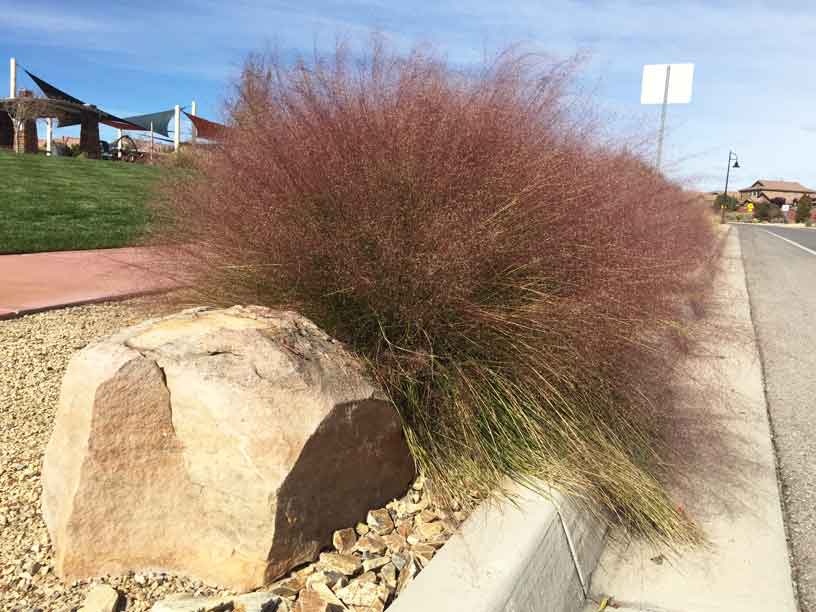
Muhly grasses (genus Muhlenbergia) are a non-invasive, ornamental grass native to the southwest. These grasses provide a wide range of favorable characteristics and perform well in full sun as well as partial shade. They are also heat and cold tolerant and can persist in most soil conditions. The plumy foliage often described as whispering, is quite attractive when a gentle breeze brings these plants to life. This species range in height from 1½ to 5 feet and has a variety of seed colors and textures blooming from August to November. Pink muhly (Muhlenbergiacapillaries) is an outstanding accent plant with its feathery, pink-hued flowers that float above dark green foliage (typically 3 feet). For a larger accent plant with a more subdued color, Deer grass (Muhlenbergiarigens) can make an excellent addition to any garden with its bright green leaves and slender tan flower stalks reaching upwards of 6 feet.
Big Bluestem Grass (Andropogon gerardii)
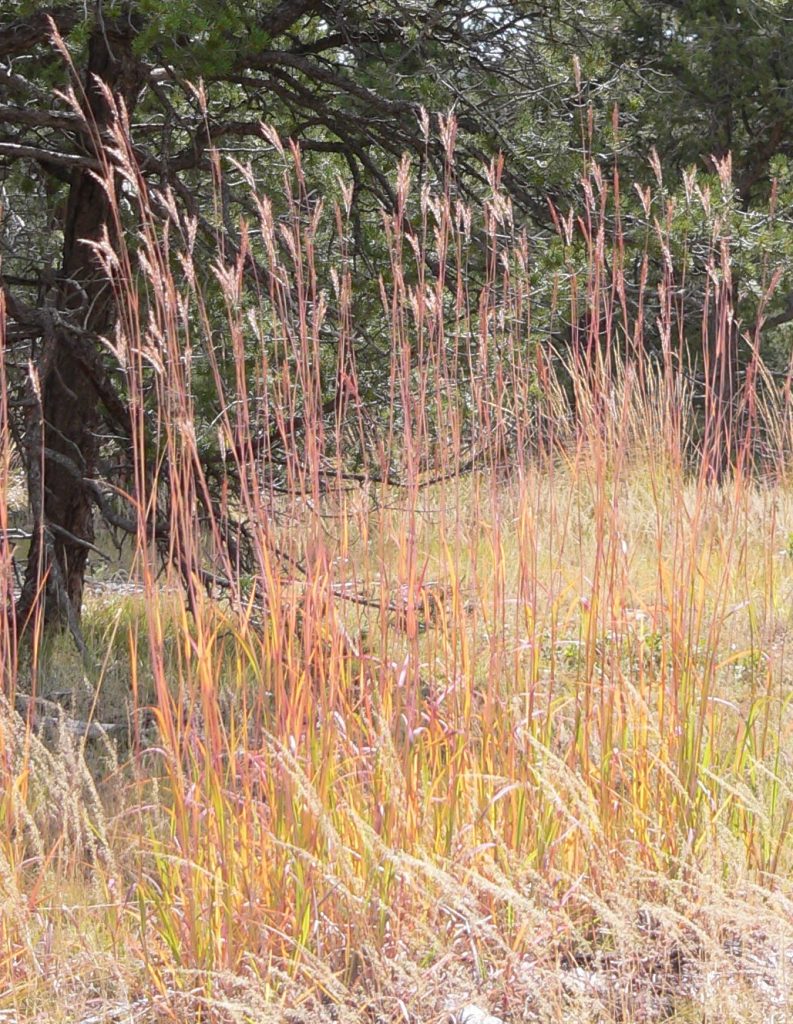
Several cultivars of the native prairie grass Big Bluestem (Andropogon gerardii) can be spectacular in a landscape and reach heights up to 6 feet. ‘Red October’ is a common cultivar that boasts year-round visual interest. It emerges in the spring with vibrant red foliage that transitions to a striking scarlet color for the remainder of the season. ‘Rain Dance’ Big Bluestem is also a very showy cultivar, providing maroon foliage in both summer and fall. These clump-forming grasses will grow in attractive mounds that add wonderful accents or backgrounds to the landscape in higher elevation plantings like the East Mountains.
Prairie Dropseed Grass (Sporobolus heterolepis)
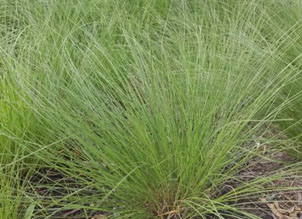
Prairie Dropseed Grass (Sporobolus heterolepis) is an exceptional bunch of grass that reaches 2 to 3 feet in height. This grass creates a fountain-like effect with its finely textured foliage – bright green in the summer and delightfully golden in the fall. Its flower spikes create a cloud of texture that becomes airier with see-through seed heads in autumn. Moreover, Prairie Dropseed Grass performs well in a wide range of conditions and soil types and is an excellent drought-tolerant addition to the landscape.
On top of their inherent aesthetic value, ornamental native grasses provide refuge and forage for pollinators and wildlife, which enhance the landscape’s ecosystems. Many bird species feast on the seeds of grasses, while the larval stage of butterflies use native grasses to shelter through the winter. For these reasons, ornamental grasses should be left uncut until early spring where they can be trimmed to encourage new growth. Incorporating ornamental grasses is a beautiful way to impart functionality and complexity to any landscape. Autumn is the perfect time to enjoy all that these grasses have to offer.
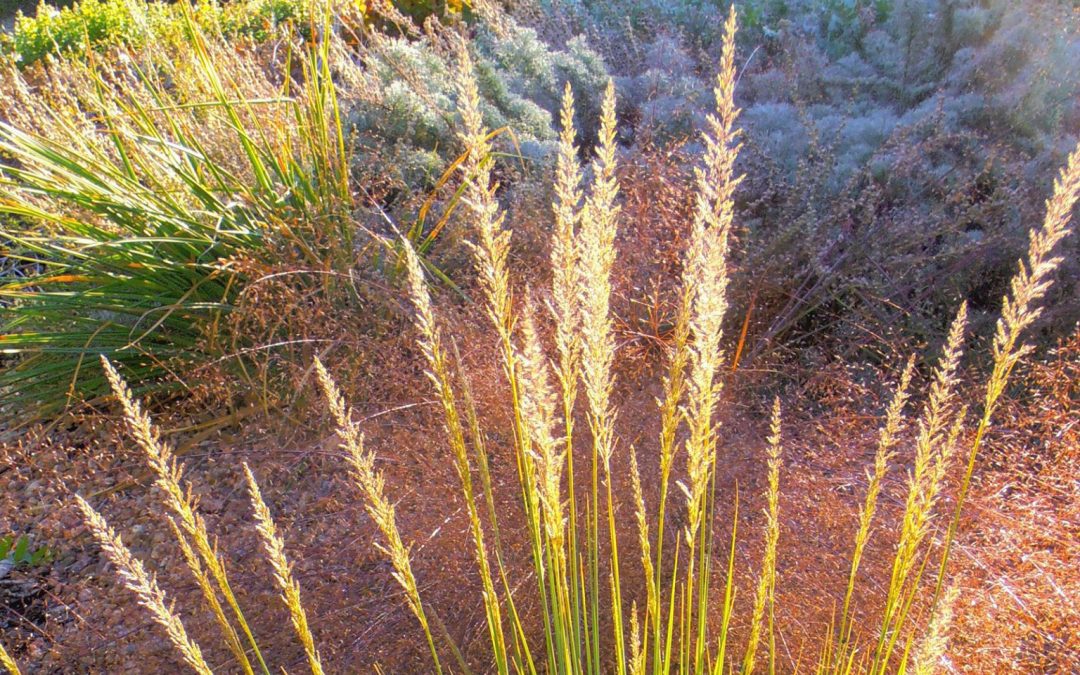
Author: Alissa Freeman, plant ecologist with an M.S. in Plant Biology, Ecology, and Evolution, has worked with NMSU Plant Extension and the City of Albuquerque on using native plants to enhance pollinator habitats. Photography: by Hunter Ten Broeck of Waterwise Landscapes and Judith Phillips of Design Oasis. Have a question about the article? [email protected]Caption for Feature Photo: Karl Forester Grass plumes with pink Bush Muhly grass located behind it.
Water Authority customers have been inspired to convert their turf to sustainable, resilient xeriscapes that save water, time and money and provide habitat for wildlife and pollinators for many reasons. Below are some of our favorites:
“We just didn’t see the point of maintaining and paying to water the grass in the front yard. No matter how much we water and fertilize, the front lawn never looks good, and we don’t want to be the last house on the block with a not-so-great lawn.”
“Now that the kids are out of the house and we no longer have dogs, we don’t want to have such a high water-use landscape that requires weekly maintenance. We want to do our part in saving water for future generations and create a beautiful patch of nature in our backyard, especially now that we’re into birdwatching.”
“We may downsize someday, and our realtor said that having a beautiful low water use landscape is a good selling point.”
“We just moved to Albuquerque from another part of the country where grass grows easily, and we spent several hours a week mowing and weeding. We are done with mowing. We want a landscape that is regionally appropriate, with native and low water use plants and trees.”
“Our irrigation system seems to always need repair, and the grass never really looks that great.”
“We needed to replace our sewer line which meant digging up the front yard. It seemed like a good time to ditch the grass and convert it to a low maintenance landscape with new drip irrigation.”
Qualifying conversion projects by Water Authority residential customers may receive $1.00 per square foot of converted turf grass. This rebate has a specific application process. Only projects that have completed the application and passed inspections will qualify for the rebate. For more information visit our rebates page.
Pro Tip: Are you ready to convert your lawn to a xeriscape? Here is what local landscape contractor Tyson Hafler, owner of Southwest Horticulture, wants you to know before you start.
“Make sure you start with a green lawn. It is important to have a green lawn for two reasons. Water Authority needs to see a currently cared for, in good living condition green lawn to quality for the rebate. A live, green lawn is much easier and speedier to get rid of than a brown, dry, dead and dying lawn.”
Author: Amos Arber, Xeriscape Incentive Inspector with the Water Resources Division of the Water Authority. Pro Tip: Tyson Hafler, Landscape Contractor and Owner, Southwest Horticulture. Have a question about this article [email protected]
Do you want to walk barefoot across cool, soft grass? Especially on those hot summer days? We’d love for you to do that! We also want you to take care of your lawn in a healthy way that saves the most water.
One might assume that proper lawn care begins in the spring
but creating that beautiful lawn can start at any time. Sometimes it’s even better
to start in the fall. Either way, you need to begin with good soil, full of
organic material that will both provide nutrition and help hold in that
moisture. But if you don’t already have that, how do you get it?
First, dethatch your lawnonce a year. Most lawns need this done when the layer of thatch reaches roughly ½” thick. Cool season grasses, such as bluegrass, need to be dethatched in the fall, whereas warm season grasses, such as Bermudagrass, need to be dethatched in the spring.
Aeratingis the second step needed to keep your lawn as healthy and water efficient as possible. If you have an older lawn, or have highly compacted soil, you should aerate twice a year -- once in the spring and again in the fall. If you are aerating, or hiring someone else to do it, run the irrigation first and flag all your spray heads or rotors. This prevents inadvertently creating the need for sprinkler repairs! Aerate the whole lawn one direction and then again perpendicular to the first pass.
Also, regularly sharpen the blades on your mower and set it up as a mulching mower. Your mowing height should be as high as possible to help maintain a healthy lawn and conserve water.
Watering correctly is most important, so maintain your irrigation system year-round, and follow the Water by the Seasons watering recommendations. Check all the filters on each of your spray heads or rotors, then run your system to ensure that all of your spray nozzles or rotors are aligned and aren’t clogged. Repair or replace anything that isn’t working properly. Also check the base of each spray head to make sure you don’t have a leak at the base. The ground will probably be soft and squishy if there is one. To improve efficiency of your system, choose high efficiency sprinkler nozzles (rebates of $2 are available).
One last thing. Kick those shoes off and go enjoy that lawn!
Author: Richard Perce, Irrigation Efficiency Specialist with the Water Resources Division for the Water Authority. Have a question about the article [email protected]
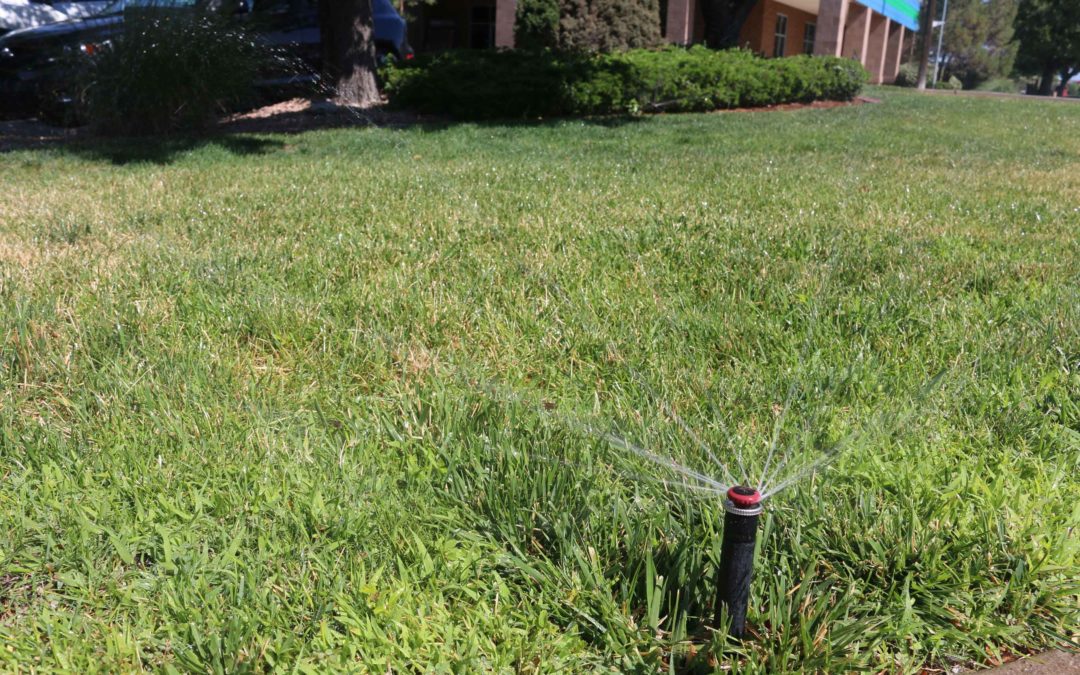
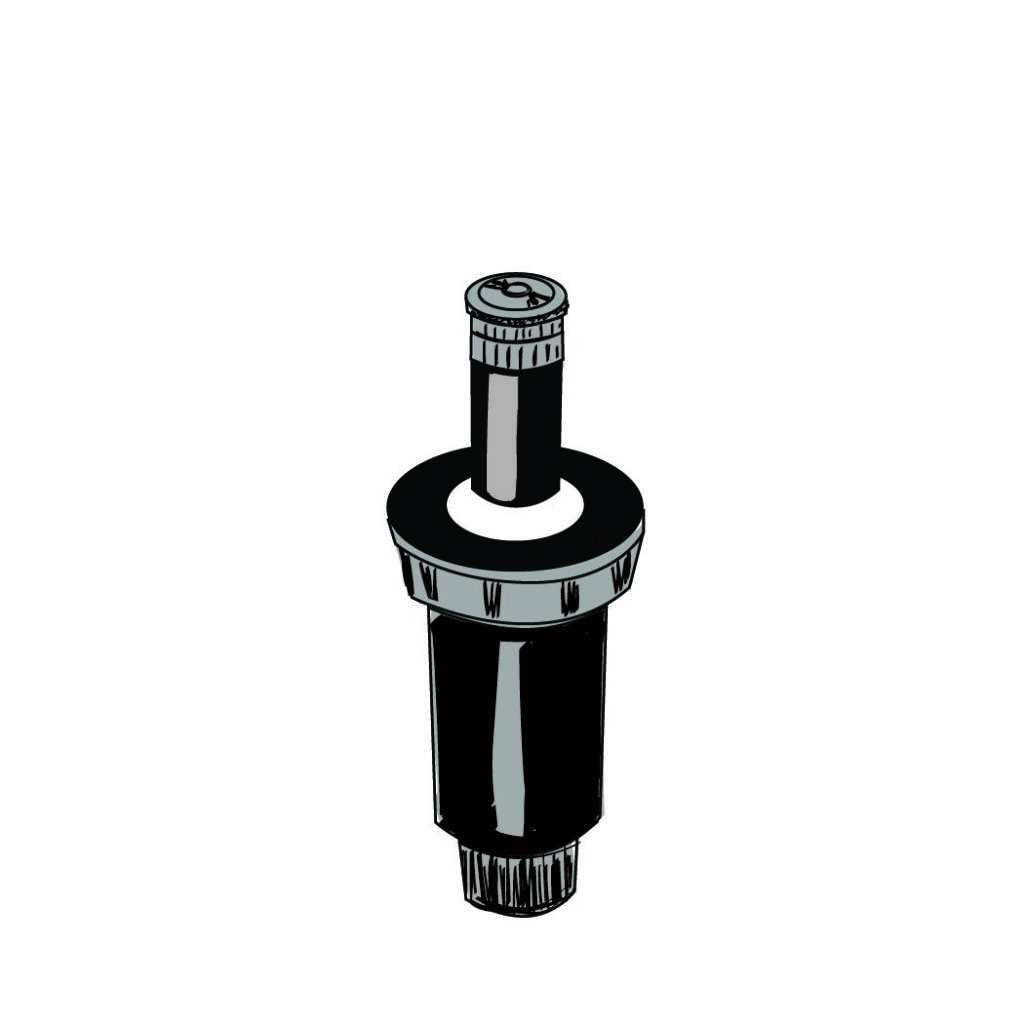
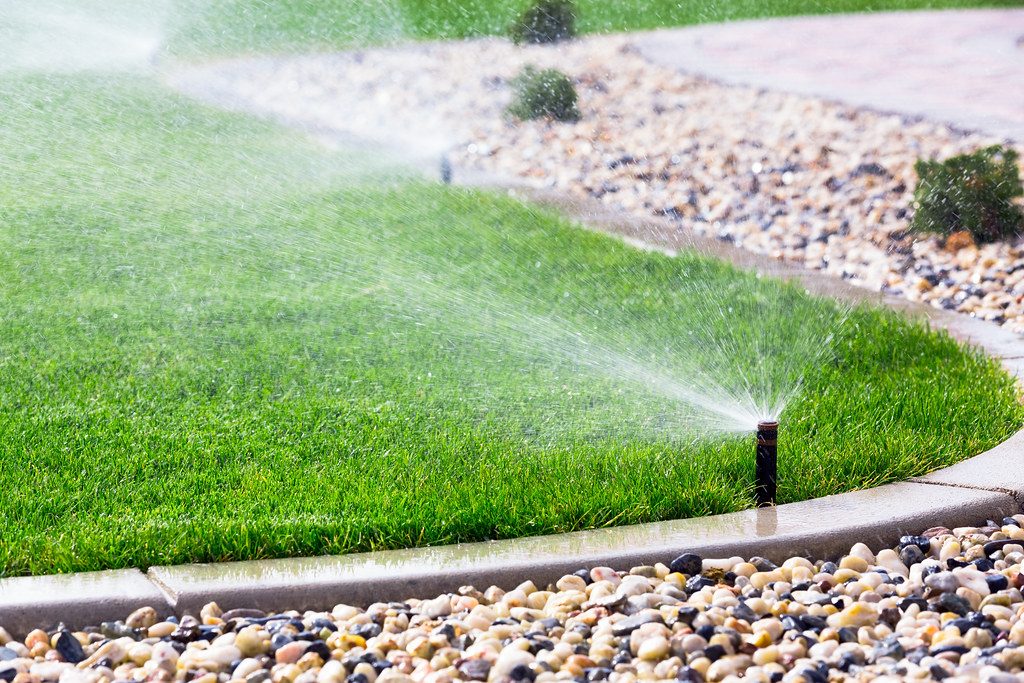
Grass lawns in the greater Albuquerque area require supplemental irrigation in order to survive our high desert climate. Most residential landscapes are watered by pop up spray heads with conventional nozzles, as pictured below.
Pop up spray head
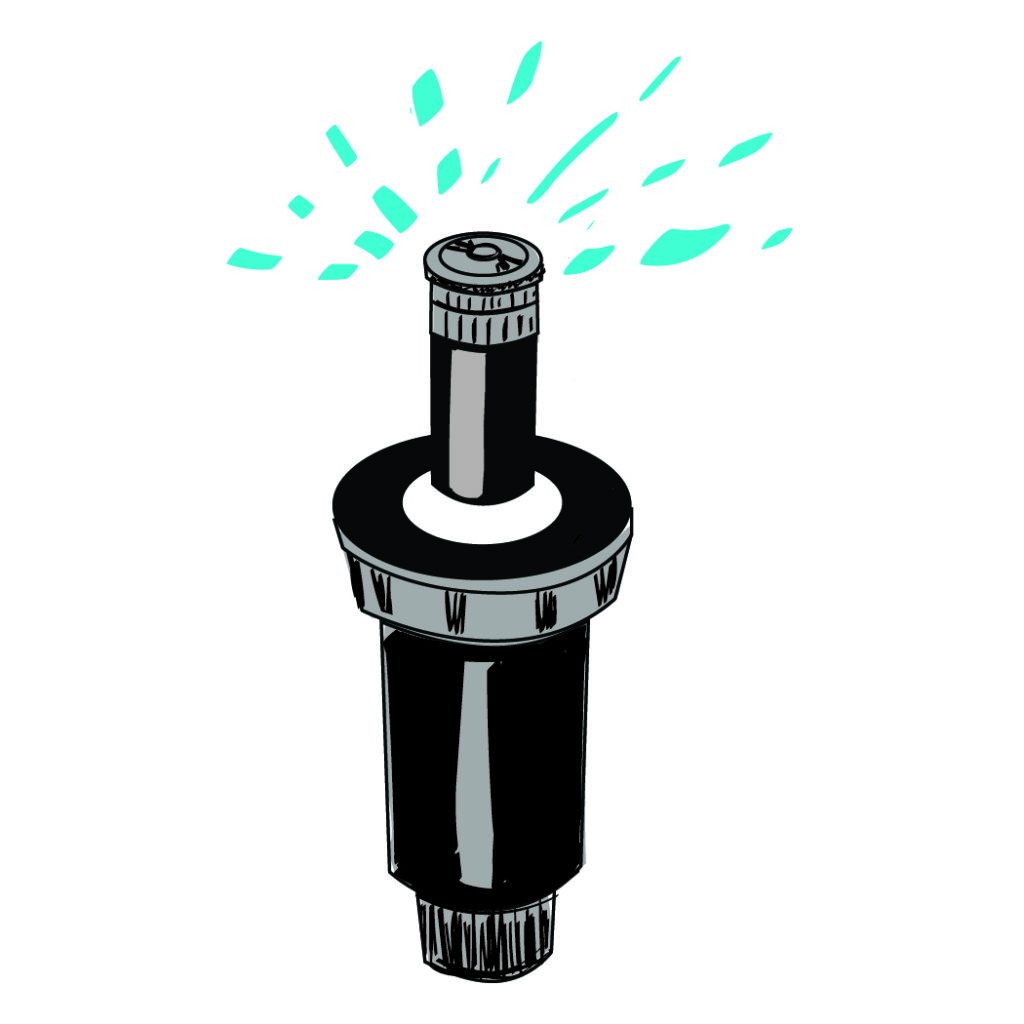
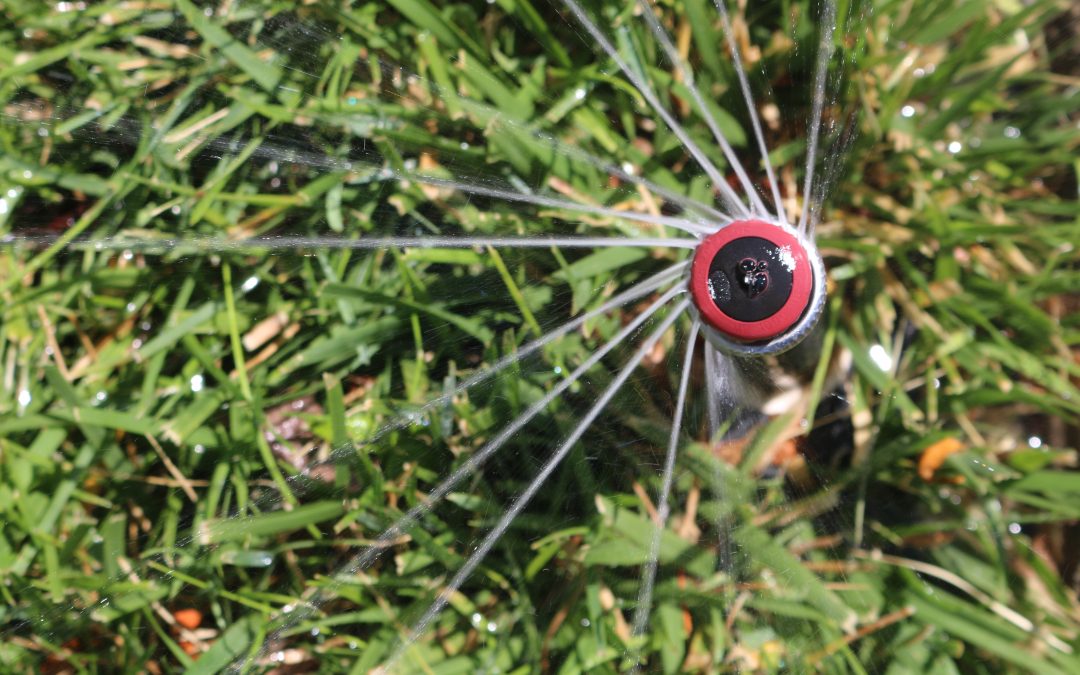
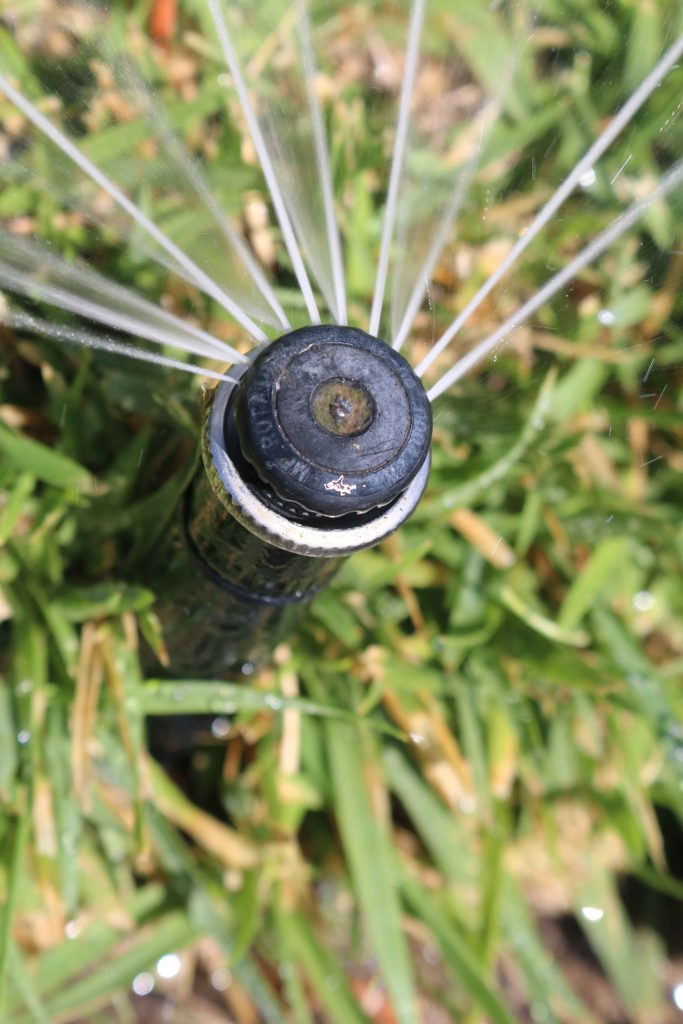
But did you know that water waste from these conventional spray nozzles can be reduced by simply swapping the nozzle out for high efficiency rotary nozzles? And for just a few dollars per head. Rotary nozzles improve irrigation efficiency by delivering water more slowly. That prevents runoff by giving soil time to absorb the water and allows the water to reach the root zone of the plant. These nozzles also deliver water in a larger droplet size, making the spray less susceptible to being carried off by the wind. This is all accomplished via their distinctive multiple rotating streams of water, pictured below.
High efficiency rotary nozzle
505Outside visited local irrigation supply stores to find out their most
frequently asked questions about these nozzles.
Can I replace my existing spray nozzles with these high efficiency rotary nozzles?
Yes. In most cases it’s as simple as unscrewing the existing nozzle and
dropping in the rotary nozzle and filter basket. These are available at any
local irrigation supply store. If you bring in your existing spray head, the
staff can recommend the best solution for you. Water Authority has rebates
available for the purchase of rotary nozzles, too. Visit the link here.
Sounds too good to be true. Are there any negatives?
They tend to clog with the hard water typically found in Albuquerque.
Make sure the brand you select comes with an inline filter basket, so you can
easily flush out and unclog your spray head.
What else should I know about high efficiency rotary nozzles?
They require longer run times. This is where most homeowners get confused. Wouldn’t
a longer run time mean I’m using more water? The answer is no, because rotary
nozzles deliver water at a slower rate than typical spray nozzles. Therein lies
the efficiency: water saturates deep into the root zone rather than running off
and evaporating. This can also help reduce the frequency of runs, thereby
saving water.
They work best at 30-40 psi. If the pressure running through your irrigation
system is too high, the rotary nozzle will spin out of control and break. The
average pounds per inch (psi) in Albuquerque ranges between 40 and 70 psi, so
you may need a pressure regulator on your system to avoid damage. Check with
your local supplier to figure out if you need to regulate the pressure on your
system, and how.
They are adjustable. Most rotary nozzle brands provide matched precipitation rates across radius, arcs, and pattern types, making it easy to install a system with even distribution. Nozzles can be easily adjusted by tool or by hand while the heads are running, to avoid water waste through overspray.
Stop by your local irrigation supplier and learn all about these high efficiency rotary nozzles.
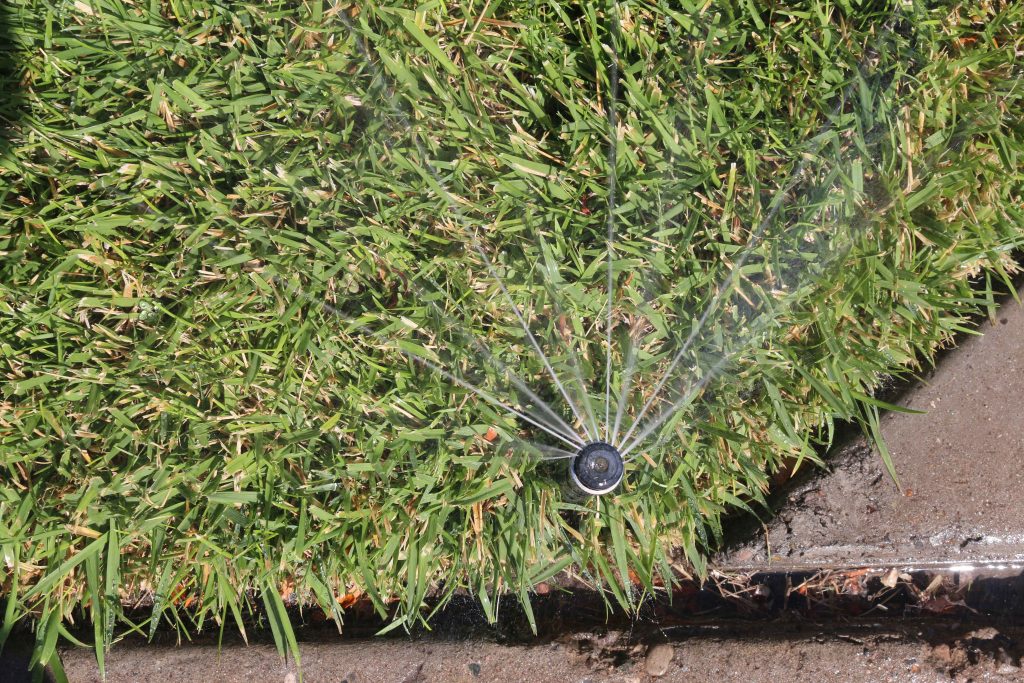
High efficiency rotary nozzle watering a 135 degree angle.