
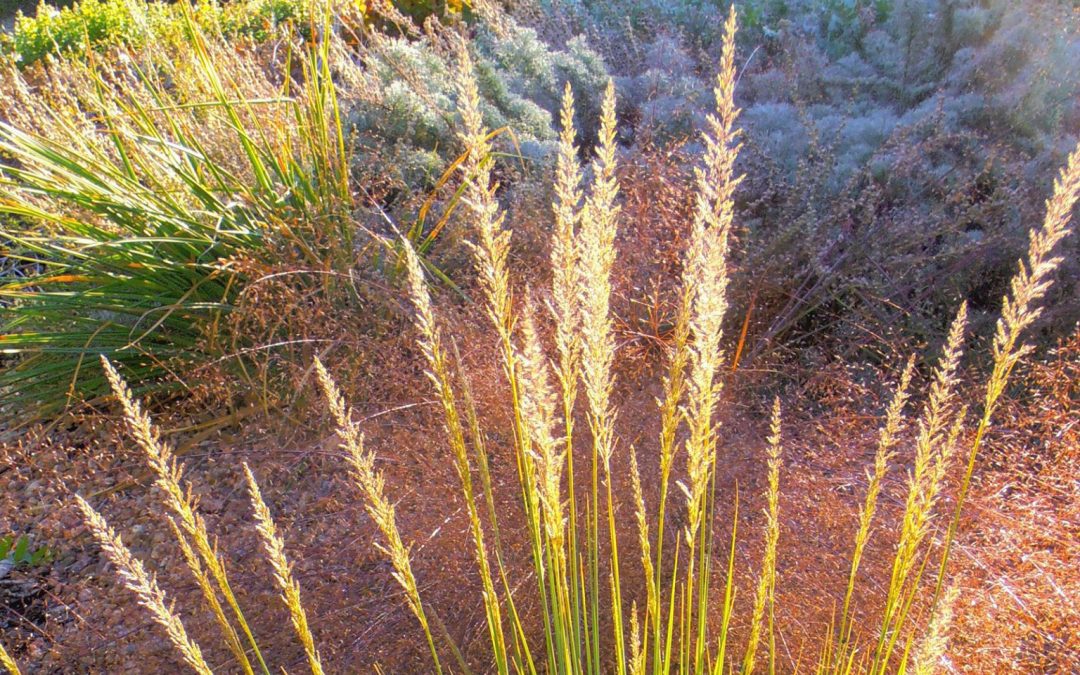
Native ornamental grasses play an integral role in a landscape. Throughout the seasons, grasses enhance the beauty of our gardens and are often at their showiest during autumn. They create a masterful mix of hues, textures, and seasonal delight. From their graceful flower clusters that gently dance in the wind to their vibrant plumage and foliage illuminated by the red glow of the sun, grasses create attractive and alluring backdrops while also adding motion and sound to our landscape.
Several considerations should be made before selecting ornamental grasses regardless of the style of the garden. Understanding the site requirements – sun tolerance, water use, and hardiness – as well as the growth form of grasses can help determine which species will be ideal for your landscape. Growing a species with weedy or invasive tendencies in moist habitats, for example, may not be ideal near the bosque. Similarly, growing a variegated variety of grass in a sun-exposed slope could result in blistering and discoloration which may detract from its beauty and health. Being aware of how site conditions and plant characteristics interact can help in selecting ideal species.
Consider adding the following ornamental grasses to the landscape:
Muhly Grasses (Muhlenbergia species)
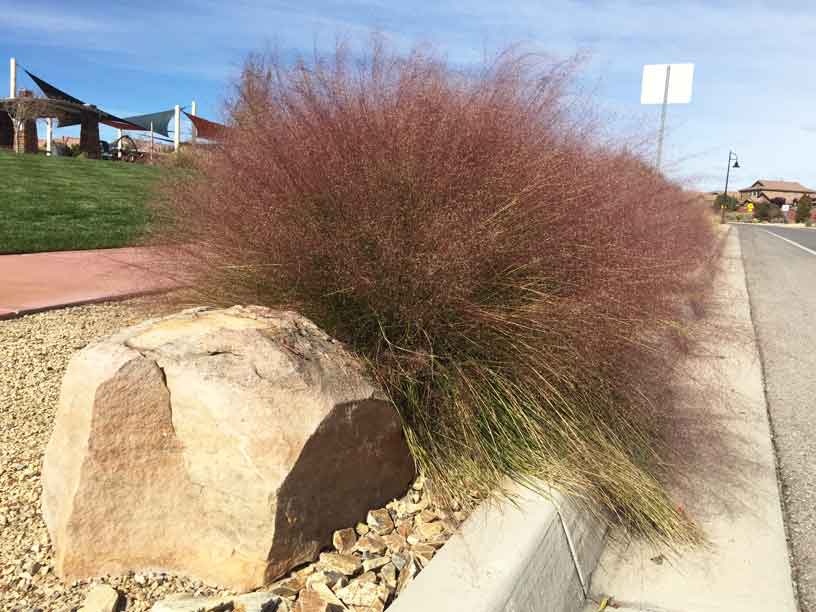
Muhly grasses (genus Muhlenbergia) are a non-invasive, ornamental grass native to the southwest. These grasses provide a wide range of favorable characteristics and perform well in full sun as well as partial shade. They are also heat and cold tolerant and can persist in most soil conditions. The plumy foliage often described as whispering, is quite attractive when a gentle breeze brings these plants to life. This species range in height from 1½ to 5 feet and has a variety of seed colors and textures blooming from August to November. Pink muhly (Muhlenbergiacapillaries) is an outstanding accent plant with its feathery, pink-hued flowers that float above dark green foliage (typically 3 feet). For a larger accent plant with a more subdued color, Deer grass (Muhlenbergiarigens) can make an excellent addition to any garden with its bright green leaves and slender tan flower stalks reaching upwards of 6 feet.
Big Bluestem Grass (Andropogon gerardii)
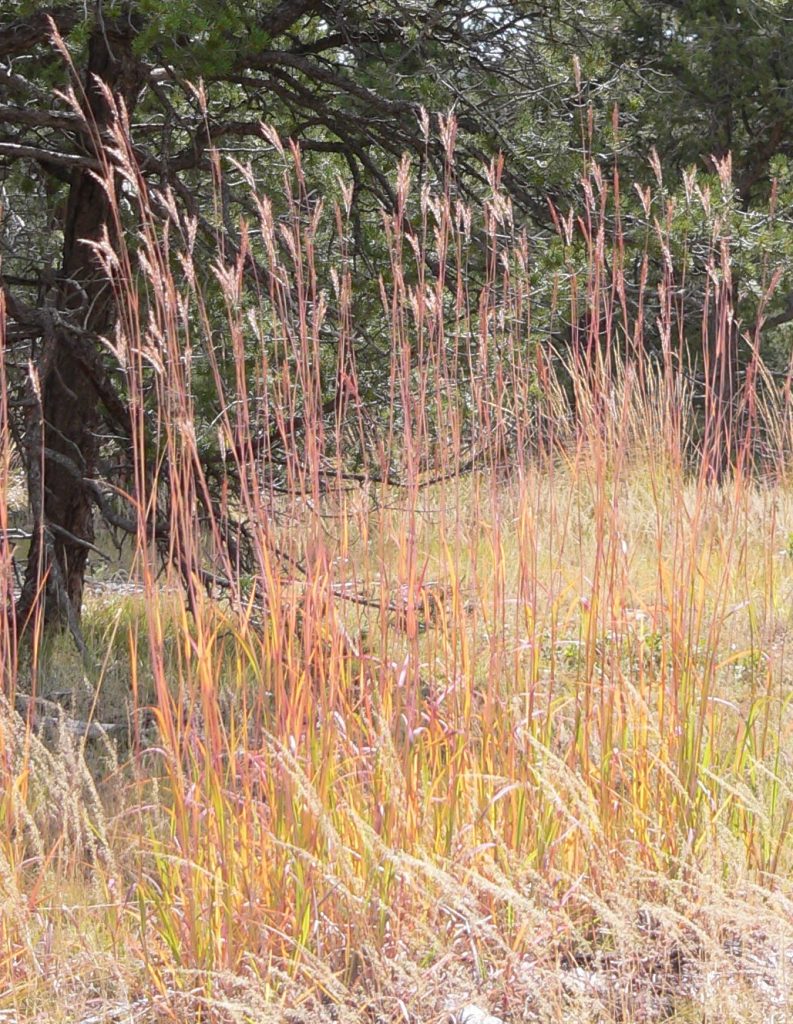
Several cultivars of the native prairie grass Big Bluestem (Andropogon gerardii) can be spectacular in a landscape and reach heights up to 6 feet. ‘Red October’ is a common cultivar that boasts year-round visual interest. It emerges in the spring with vibrant red foliage that transitions to a striking scarlet color for the remainder of the season. ‘Rain Dance’ Big Bluestem is also a very showy cultivar, providing maroon foliage in both summer and fall. These clump-forming grasses will grow in attractive mounds that add wonderful accents or backgrounds to the landscape in higher elevation plantings like the East Mountains.
Prairie Dropseed Grass (Sporobolus heterolepis)
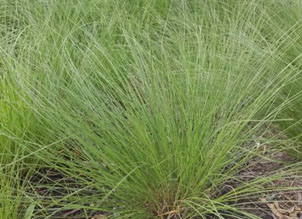
Prairie Dropseed Grass (Sporobolus heterolepis) is an exceptional bunch of grass that reaches 2 to 3 feet in height. This grass creates a fountain-like effect with its finely textured foliage – bright green in the summer and delightfully golden in the fall. Its flower spikes create a cloud of texture that becomes airier with see-through seed heads in autumn. Moreover, Prairie Dropseed Grass performs well in a wide range of conditions and soil types and is an excellent drought-tolerant addition to the landscape.
On top of their inherent aesthetic value, ornamental native grasses provide refuge and forage for pollinators and wildlife, which enhance the landscape’s ecosystems. Many bird species feast on the seeds of grasses, while the larval stage of butterflies use native grasses to shelter through the winter. For these reasons, ornamental grasses should be left uncut until early spring where they can be trimmed to encourage new growth. Incorporating ornamental grasses is a beautiful way to impart functionality and complexity to any landscape. Autumn is the perfect time to enjoy all that these grasses have to offer.

Author: Alissa Freeman, plant ecologist with an M.S. in Plant Biology, Ecology, and Evolution, has worked with NMSU Plant Extension and the City of Albuquerque on using native plants to enhance pollinator habitats. Photography: by Hunter Ten Broeck of Waterwise Landscapes and Judith Phillips of Design Oasis. Have a question about the article? AskAnExpert@abcwua.orgCaption for Feature Photo: Karl Forester Grass plumes with pink Bush Muhly grass located behind it.
Water-Wise Vegetable Gardening
With our hot summers and low precipitation, growing vegetables in NM can be challenging. This talk will provide strategies and recommendations for growers to cultivate a thriving vegetable harvest in the region. Discussion will include irrigation and infrastructure suggestions, as well as selection of vegetable varieties that are well-adapted to the area.
Instructor:Stephanie Walker, PhD. Professor and Vegetable Specialist, New Mexico State University, Extension Plant Sciences Department.
Maintaining Tree Health During Drought
Learn from Albuquerque’s leading tree expert how to identify drought stress in trees, understand their responses to drought, and implement strategies to keep them alive and thriving in hot, dry weather.
Instructor:Joran Viers, Board Certified Master Arborist and Municipal Specialist, International Society of Arboriculture (ISA). Senior Arborist, Legacy Tree Company, Albuquerque. Former City Forester, City of Albuquerque
Creating a Drought-Tolerant Refuge for Yourself and Wildlife
Instructor:Laurel Ladwig, M.S. She is the ABQ Backyard Refuge Program Director for the Friends of Valle de Oro National Wildlife Refuge, a part-time faculty member in the Department of Geography and Environmental Studies, and Associate Director of the R.H. Mallory Center for Community Geography at the University of New Mexico and is enthusiastic about all opportunities to encourage people to develop a relationship with our wild neighbors.
Designing Resilient Landscapes: Plant Adaptations, Communities, and Selection for Arid Environments
Instructor:Maria Thomas is the Curator of Plants at the ABQ BioPark where she manages the botanical exhibits, plant collections, horticultural staff, and related programs for the 150-acre public park and garden. Additionally, Maria is an Adjunct Professor at the University of New Mexico in the Landscape Architecture department.
Climate-Ready Trees- Planting for a Warmer and (Hopefully) Shadier Future
Instructor:Marisa Y. Thompson, PhD Extension Urban Horticulture Specialist. New Mexico State University Department of Extension Plant Sciences, Los Lunas Agricultural Science Center, Think Trees NM, President of the Board (2023-current).
Plant Adaptations to Heat & Drought
Noticing the Ways Plants Thrive in our Yards and Natural Areas Learn how to Recognize Drought-Adapted Traits in Everyday Plants all Around Us.
Instructor:Marisa Y. Thompson, PhD Extension Urban Horticulture Specialist. New Mexico State University Department of Extension Plant Sciences, Los Lunas Agricultural Science Center, Think Trees NM, President of the Board (2023-current).
Hose Bib Tree Irrigation System for Your Trees: Simple Systems for Thriving Trees!
Instructor:Richard Perce has twenty years’ experience working with trees and irrigation here in New Mexico. He is a former certified arborist and currently holds the Irrigation Association’s Landscape Irrigation Auditor certification and is a certified QWEL irrigation instructor. He worked as a landscape contractor for more than a decade and is the Water Authority’s former Irrigation Efficiency Specialist. He also has a Masters of Community and Regional Planning from UNM and currently works at Anthropopulus Design + Planning.
Passive Rainwater Harvesting
This workshop introduces participants to the principles and practices of passive rainwater harvesting. Attendees will learn how to capture, slow, spread, and infiltrate rainwater into the landscape using simple, low-cost methods such as swales, berms, and basins. The workshop emphasizes working with the natural flow of water to reduce runoff, prevent erosion, and support healthy soil and plant life. By implementing passive rainwater harvesting, participants can conserve water, and create more resilient, self-sustaining landscapes.
Instructors:Anthony Luketich, Natural Resource Scientist, Anthony Luketich is a Natural Resources Scientist for Bernalillo County where he is focused on water conservation and water-wise landscape practices. He received a degree in Watershed Management and Ecohydrology from the University of Arizona where he studied the relationship between trees and water. Anthony has worked across the Southwest US as a research scientist as well as a water harvesting field technician where he became a certified water harvesting practitioner.
Bobby Mullin, Natural Resource Scientist, Bernalillo County Stormwater Quality Program Bobby Mullin is a Natural Resource Scientist for Bernalillo County in the Stormwater Quality Program. He focuses on improving stormwater quality in the Middle Rio Grande Watershed and promoting sustainable and resilient landscapes using Green Stormwater Infrastructure and rainwater harvesting. Bobby received his Bachelor of Science in Environmental Science from Bucknell University in 2011. Before joining Bernalillo County, he had worked as an environmental consultant remediating contaminated soil and groundwater and as a Research Scientist studying the impacts of climate change, drought and plant mortality in New Mexico ecosystems.
Xeriscape: The Desert Friendly Yard
Join us for learning all of the tips, and benefits of our Xeriscape program!
3 Steps to Landscape Success
Service, Settings, and Selection are the keys to landscape success!