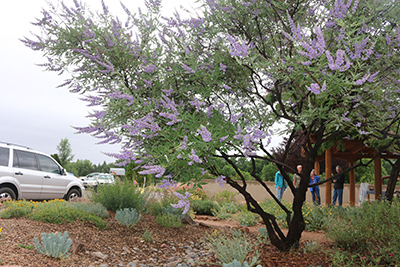
Trees play a vital role in the plant palette for Albuquerque gardens. They provide cooling shade, screening, and habitat for birds, pollinators and other wildlife. Trees take more time to establish than shrubs or smaller plants. They live longer but are more expensive than other plants, so it is vital to select a tree that will thrive and provide the most benefit over its lifespan.
Often people select trees based on what they see in their neighborhood or what is most readily available at the nurseries. Unfortunately, when too many of one species are planted, the possibility of pest issues rises greatly, and entire swaths of trees can die off at the same time. (For example, Dutch elm disease and emerald ash borers have killed millions of trees in other areas of the U.S.) Planting a diverse selection of trees minimizes the possibility of mass species extinction. Trees are generally resilient, and varying the species planted protects against a variety of harmful conditions.
Oaks
Oak trees (Quercus) tend to be very long-lived and tough trees, well adapted to the climate conditions in Albuquerque. There are about 30 species of oaks native to New Mexico. They vary greatly in size, form, foliage and growth rate. Some are deciduous while others are evergreen. There is an oak suitable for almost any place in your landscape.
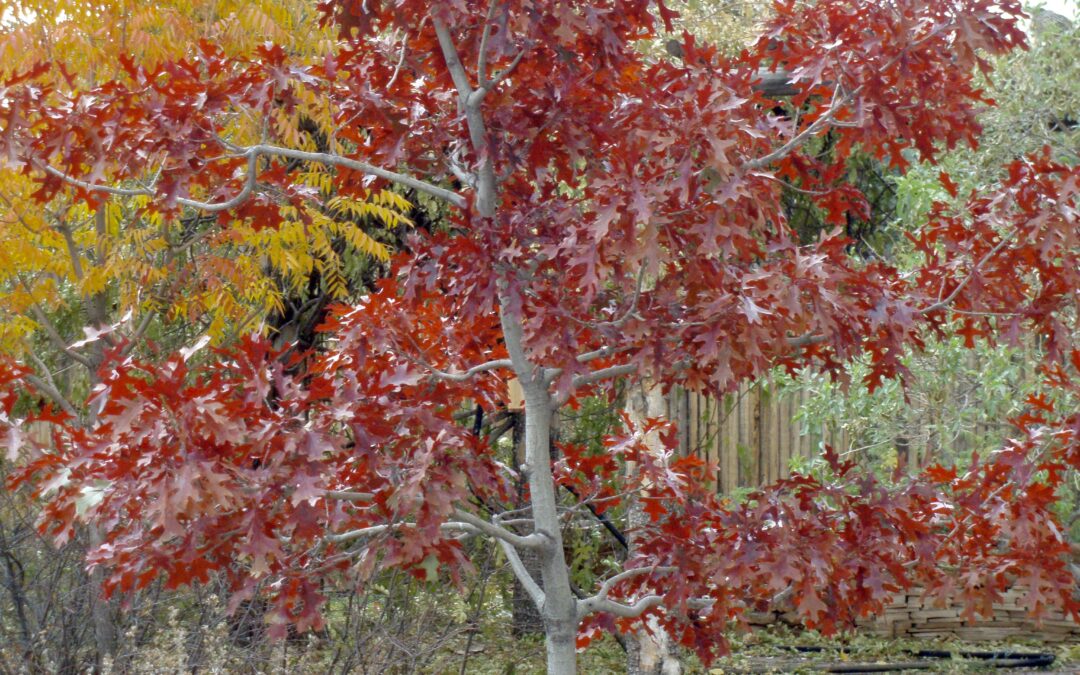
Chinkapin (aka Chinquapin) oak — Quercus muehlenbergii — is a faster growing, larger oak for our area. They can grow from 25’ to 50’ tall . It produces large acorns which wildlife relish and were an important food source for Native Americans. They are an excellent shade tree with subtle color in the fall. This tree is both very heat and cold tolerant and prefers well-drained soil. Water to 24" depth twice a month once established at around three years. Tree establishment rule of thumb is the first year the tree sleeps, second year the tree creeps and the third year it is established and ready to leap.
Chinkapin Oak
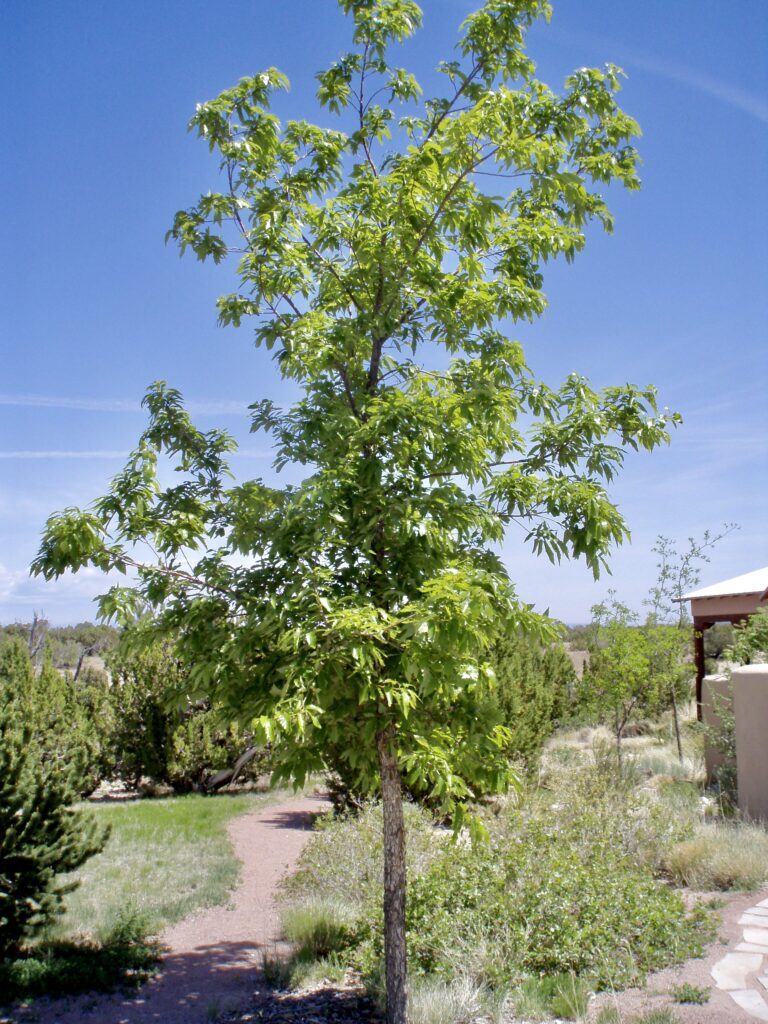
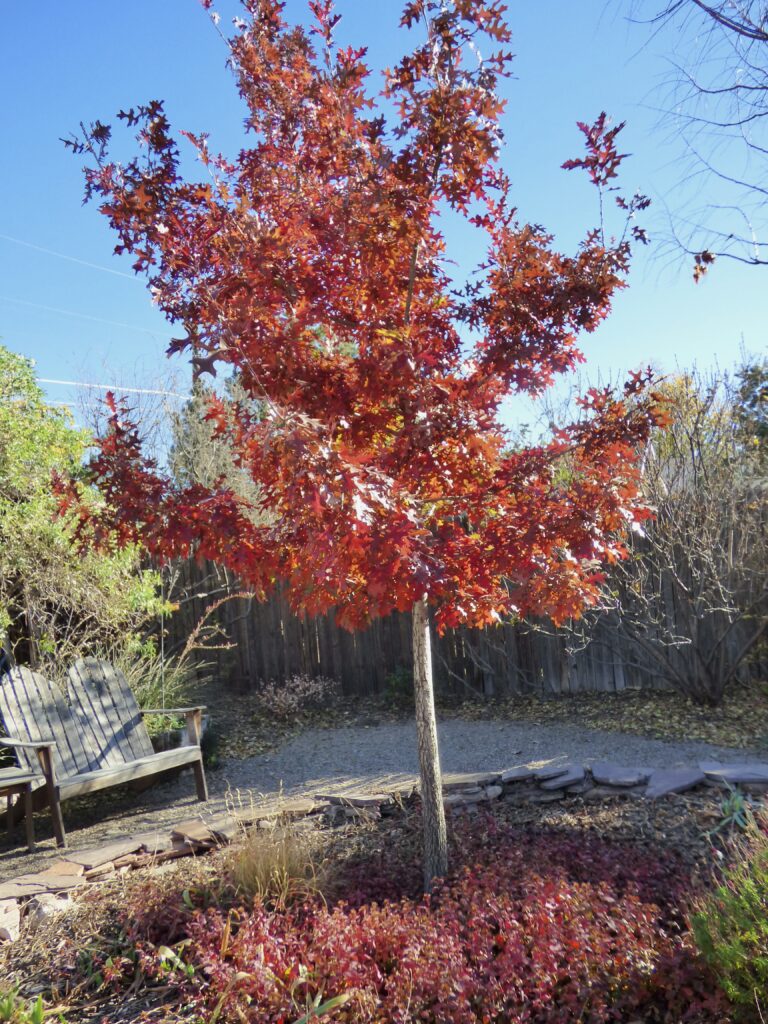
Texas red oak — Quercus texana — is another large deciduous shade tree, growing to about 35’ in Albuquerque. This beauty has long-lasting, spectacular red to maroon fall foliage that will become a focal point in your garden. This tree prefers to be planted in cooler areas surrounded by wood chip mulch.
Texas Red Oak
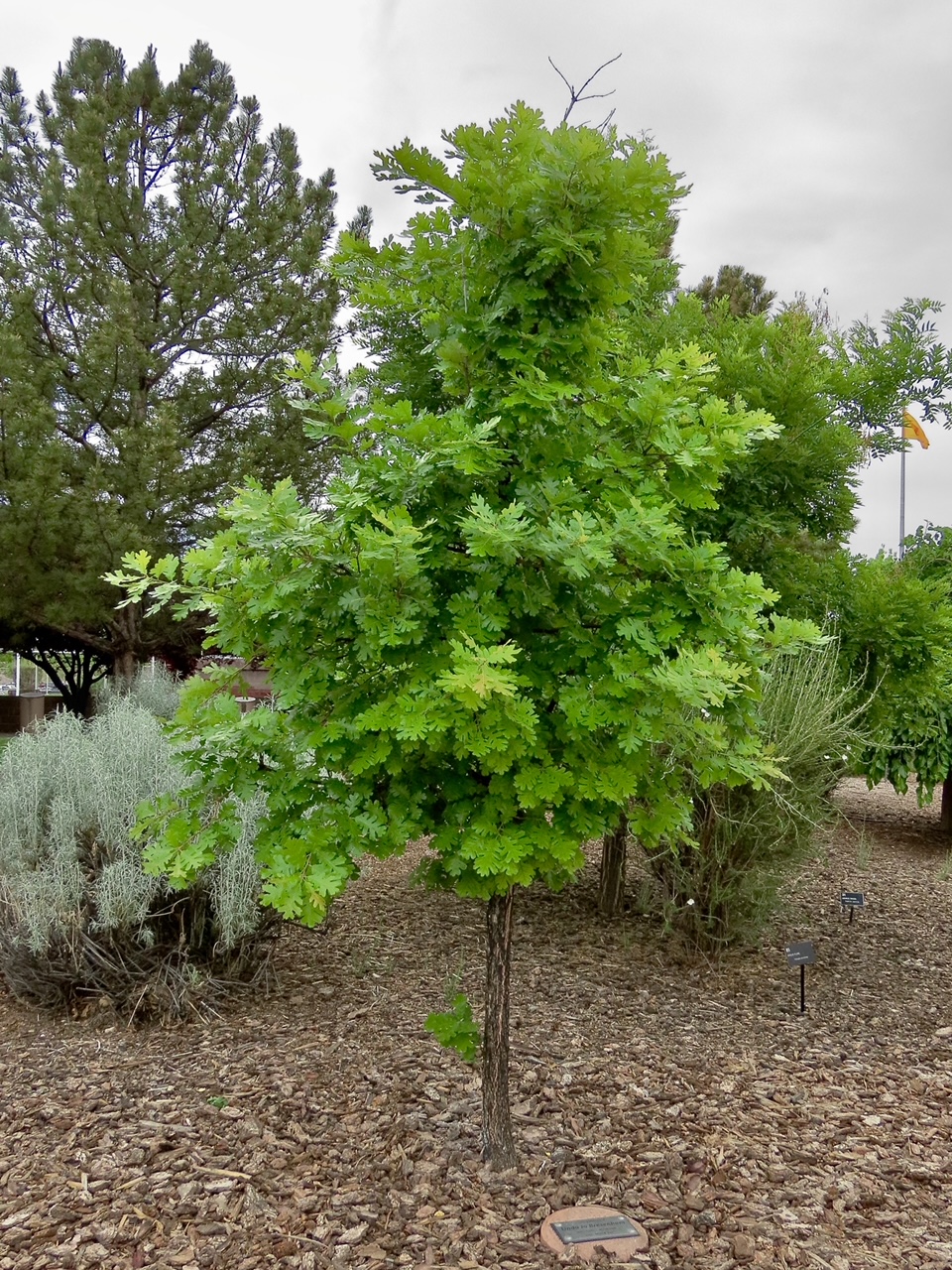
Gambel oak — Quercus gambelii — is an adaptable, native deciduous tree whose shape can vary from a large shrubby cluster to a single-trunk tree. It grows 10’ to 30’ tall in groups and is found at both higher and lower elevations of our local mountains. It provides food and shelter to many wildlife species. Depending on its form and how it’s pruned, Gambel oak can be used as a informal hedge or as an individual shade tree. The red to maroon fall foliage gradually turns brown and persists well into winter, which can provide extended screening.
Quercus gambelii (Photo by @BrandtMagic)
Another native, shrub live oak — Quercus turbinella — has small, holly-like silvery green leaves. This slow grower should be considered more of a shrub and is found locally in the foothills. It is very long-lived (hundreds of years) and grows into a thick trunked form when fully mature.
Escarpment live oak — Quercus fusiformus — is a regionally native tree that can grow 25’ to 30’ tall and 25’ wide in Albuquerque. Its oblong evergreen leaves provide both shade and year-round screening with the benefit of minimal fall cleanup. Make sure to plant the escarpment and the shrub live oak from late spring to the end of summer as cold season planting tends to stunt their establishment and growth.
Escarpment Live Oak
Mesquites
Mesquites are native trees well adapted to extreme heat and drought conditions. Some are not very cold hardy so are best planted in warm or protected microclimates (courtyards or against south or west facing walls). Their spring flowers provide a great resource for pollinators, and their beans can be ground into a sweet flour for baking.
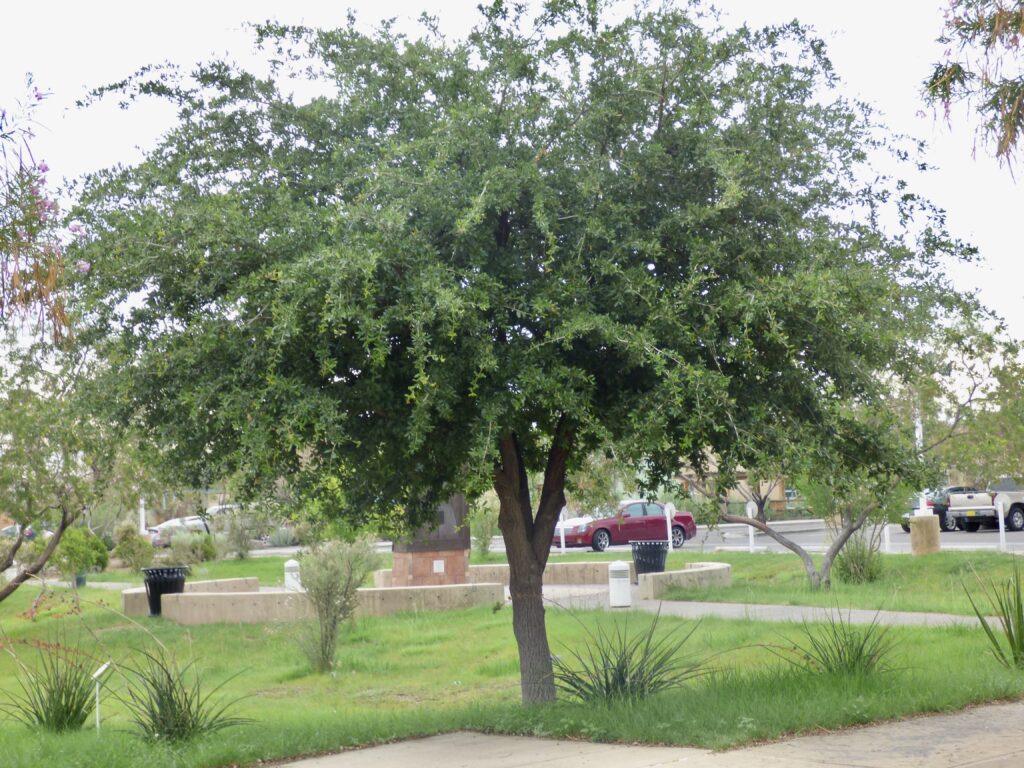
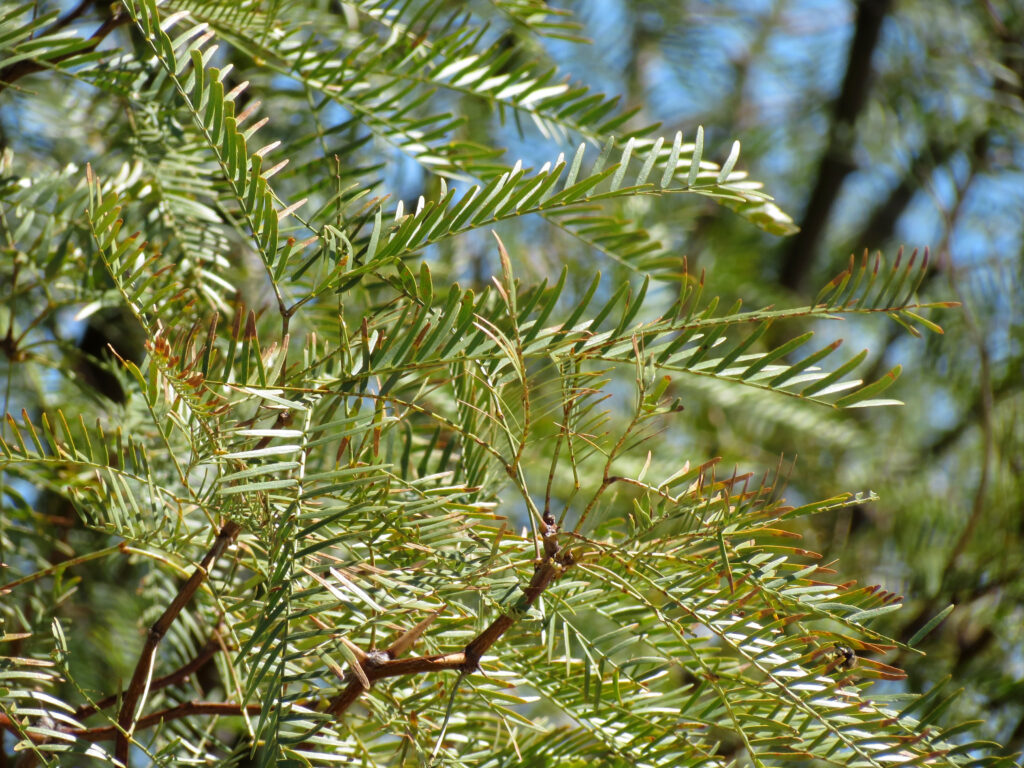
Honey mesquite — Prosopis glandulosa — is a great, tough, small to medium sized tree that can eventually be completely removed from irrigation. 'Maverick' mesquite is a thornless cultivar that is more user friendly in an urban landscape but is not as cold hardy. 'Maverick' can accommodate heavily trafficked courtyards and along pathways. Unlike the regular honey mesquite the 'Maverick' cultivar may need continued watering over its lifetime. Both these trees do better in warmer areas south of Albuquerque.
Honey Mesquite
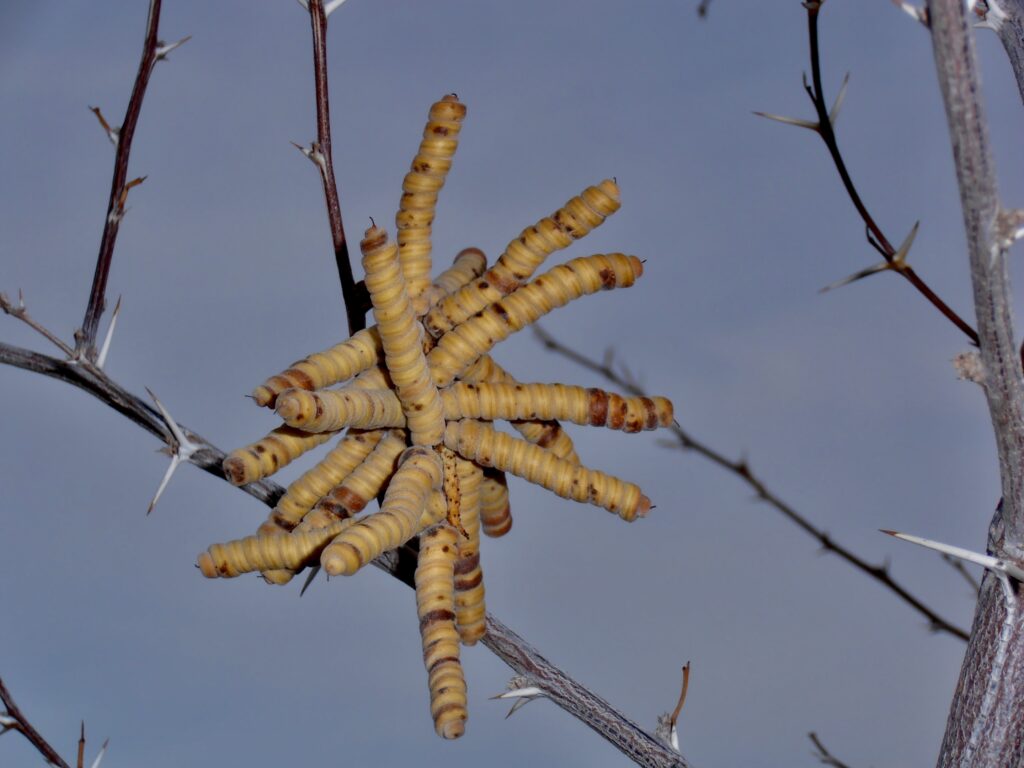
Screwbean mesquite — Prosopis pubescens — is a very drought tolerant multi-trunk tree. It grows up to 20’ tall. As it can handle periods of extra water (flooding), it works well in a rainwater harvesting basin. Locally you will find it growing in the bosque near Socorro. Its unique seed pods look like wonderful mini sculptures. This tree may take some work to find in nurseries, but it is well worth the search.
Screwbean Mesquite Pods
Fundamentally, when selecting trees for your landscape, it’s crucial to find a tree that will thrive in the space and micro-climate where you want to plant it. Oaks and mesquites can provide a variety of options in an Albuquerque garden.
Author: Hunter Ten Broeck, landscape contractor and owner of WaterWise Landscapes Inc. in Albuquerque. Have a question about the article or anything else? [email protected]
From the leafy corridors along the Rio Grande to the resilient specimens lining our streets and parks, trees are much more than just scenery — they are essential to our health, happiness and sense of place. Residents and visitors alike have come to appreciate, love and depend on Albuquerque’s urban forest, which transforms our city in countless ways.
For many, the presence of mature trees is a sign of a thriving, welcoming community.
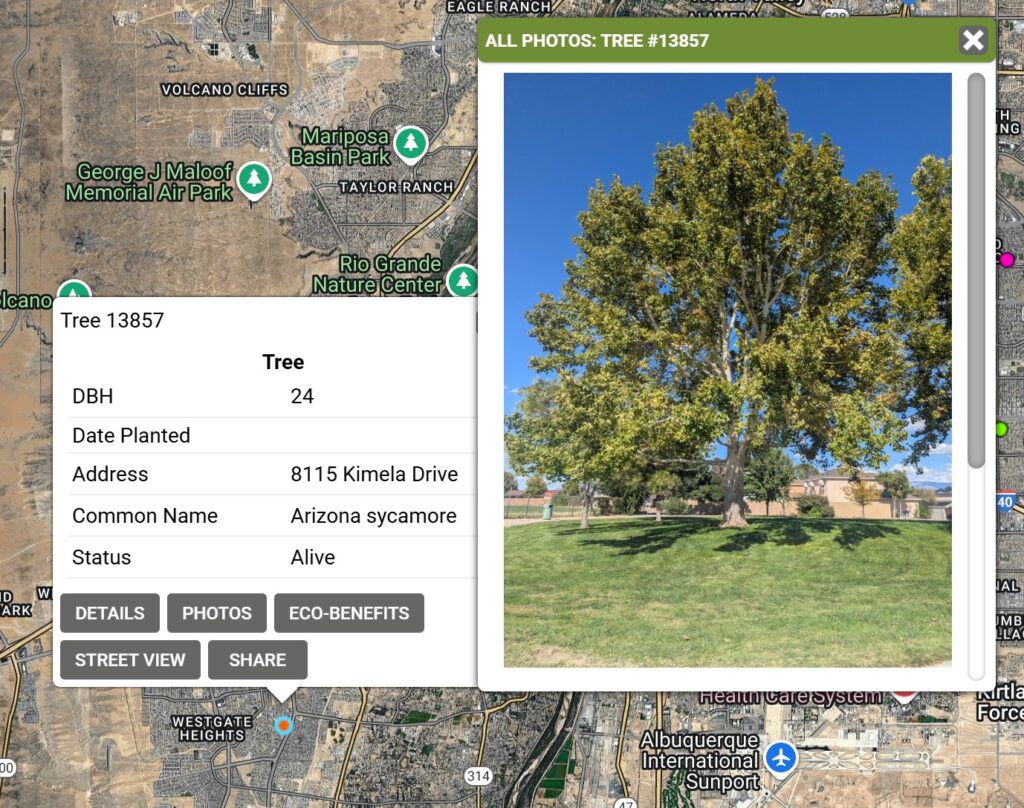
The City of Albuquerque’s Urban Forestry staff has taken an active role in cataloging and celebrating the city’s best tree specimens. The Urban Forestry team within Parks and Recreation maintains a list of “champion trees” — remarkable individuals recognized for their size, age, beauty or historical significance.
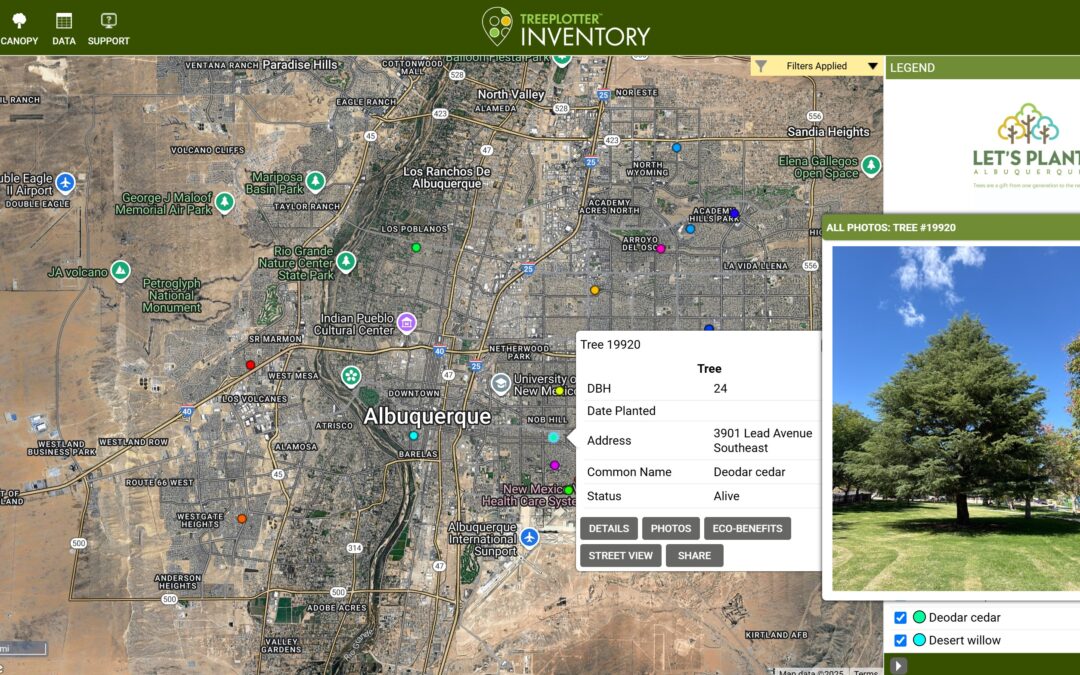
The City of Albuquerque’s Champion Tree GIS site shows the locations of all 23 Champion trees around public spaces managed by the city and includes information on their species, size, history and unique features. To use, simply click on one of the circles to learn all about the specific tree, its properties and its location.
Whether you’re a lifelong resident or a newcomer to Albuquerque, exploring the city’s champion trees is a unique way to visit our numerous parks and streetscapes plus celebrate the trees that make our urban environment vibrant and resilient.
In addition to managing 30,000 trees across 300 city parks, Urban Forestry has launched the Let’s Plant ABQ initiative. This initiative aims to plant 100,000 trees by 2030 to provide one tree for every child as a gift from one generation to the next. To track these trees, Urban Forestry uses software called Treeplotter for inventorying, planning and growing our urban canopy. As well as tracking Champion trees, Urban Forestry maintains a robust inventory of all trees in city parks where residents are welcome to explore our urban canopy, including ecosystem benefits of our trees. Urban Forestry’s data aids in informed decision making for urban designs and developments. Understanding what we have can help us preserve and enhance our urban forest.
Let’s continue to love, depend on and protect the trees that make Albuquerque a truly special place to live. You can help by planting more new trees; check out the Water Authority’s Treebates.
As a landscape professional, one question I’ve always dreaded is, “How much should I water this tree?” Honestly, there are so many variables that giving a blanket answer is fanciful. More than likely, a part of the answer is, “More than you are now!” Trees are big plants with lots of leaves, and they can transpire a lot of water. That water is “lost” while the leaves are making sugars via photosynthesis, so trees have a high water demand.
If supply doesn’t keep up with demand, the tree gets stressed. How do you know if your tree needs more water? Learning to recognize signs of water stress can help you stay on top of your trees’ needs. There are some common symptoms and situations that may indicate that they are thirsty.
Water stress can be long-term (chronic) or sudden (acute). Chronic drought stress occurs commonly, as many irrigation systems are set up to be adequate for a newly planted tree. As that tree grows, though, it has more leaves and needs more water. Adding emitters and covering more ground is key to keeping up with the growth. Acute drought stress is less common; it happens when a tree suddenly loses most or all of its water supply, which up to that point was adequate. Finally, most rare of all, water stress can happen from too much water in the soil.
Chronic drought stress occurs when trees haven’t had enough water for some months or years. These trees will have smaller than normal leaves, and those leaves will be sparser in the canopy than normal for that species. They may be off-color, not as vibrantly green as normal. Often, there is dieback in the small, outer branches and twigs.
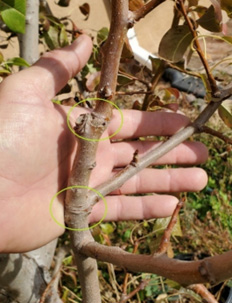
Annual growth will slow down. Evidence of this can be seen in small diameter branches if you can identify the ring scars that mark the annual growth segments. Ring scars are lines that circle all the way around the twig; they are not bud scars that form at each dormant bud and do not circle the twig. If annual growth segments are shorter last year than the year before, something bad is going on.
The short distance between these ring scars indicates a year of poor growth. This may have been the year it was planted, as that is stressful to trees.
In conifers, we see similar evidence — smaller and fewer needles and shorter growth segments. Often, pine needles will brown out from their tips, maybe just a little or maybe halfway. Conifers keep their leaves for several years, so partially browned needles can really slow down growth potential as the brown part isn’t making sugars. Chronically drought stressed conifers abound in New Mexico forests. They are more susceptible to bark beetle attacks than unstressed trees. Combine beetle-killed trees with very dry trees and wildfire becomes a huge concern.
Acute drought stress might happen when a trench cuts through the root system, such as with a new sewer line is installed. Acutely stressed trees tend to have sudden yellowing and then drying of leaves, maybe just on one side of the tree (the trench side, for example). Acute stress is hard for the tree to recover from.
In either chronic or acute stress situations, leaves may develop brown and dead edges. Termed “marginal browning,” this happens when excess salt in soil water gets deposited at the furthest edge of the leaf, building up to toxic levels. Leaves will often turn pale and then yellow during mid-season, well before fall temperatures normally trigger that.
Yellowing of leaves can be a sign of stress.
How about those few trees getting too much water? In some ways, symptoms can mimic too little water. When the soil is very wet, roots stop functioning due to lack of oxygen. This is of most concern for dryland conifers like juniper and pine. Usually, it is linked to an irrigation system that only has emitters at the base of the tree that run often. The tree doesn’t have the fine root mass near the trunk to take up the water, so the soil remains wet. Fungal diseases are likely to pop up, leading to root death and then tree death. Another symptom of overly wet soils shows up in leaves on deciduous trees like cottonwood — oedema. These are corky scars on the surface of the leaf.
You can reduce tree stress with proper irrigation. Trees seem to do well when irrigation is deep, broad and not too frequent. Watering every day is actually not helpful, especially when right at the base of the tree. Cover the soil with an organic mulch to keep the soil cool and the moisture available to your trees.
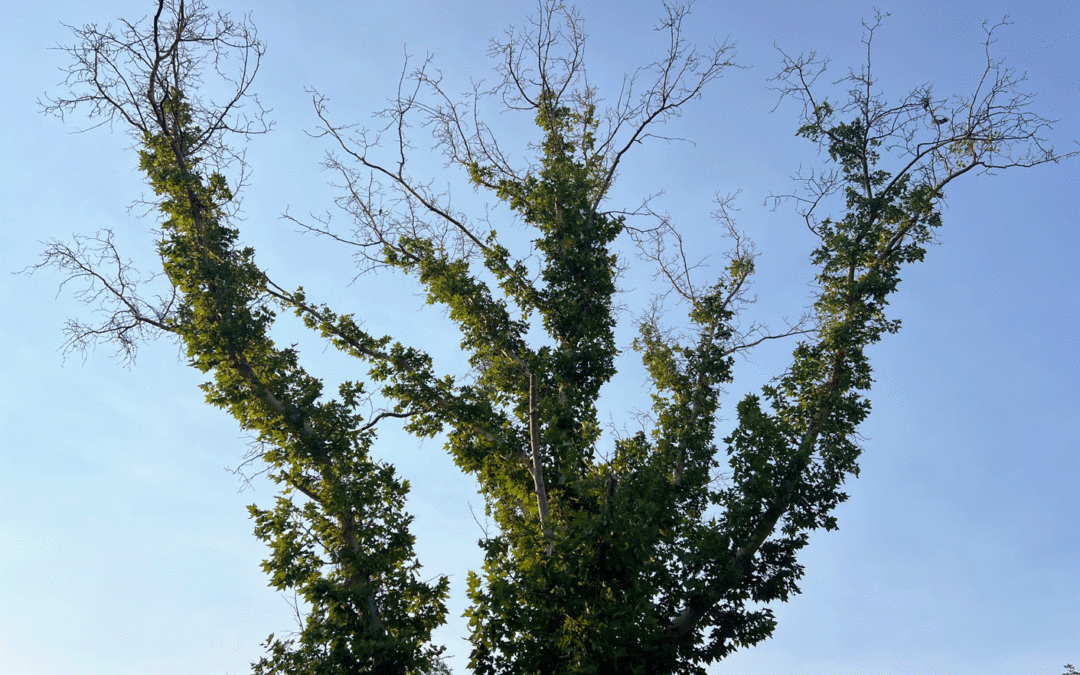
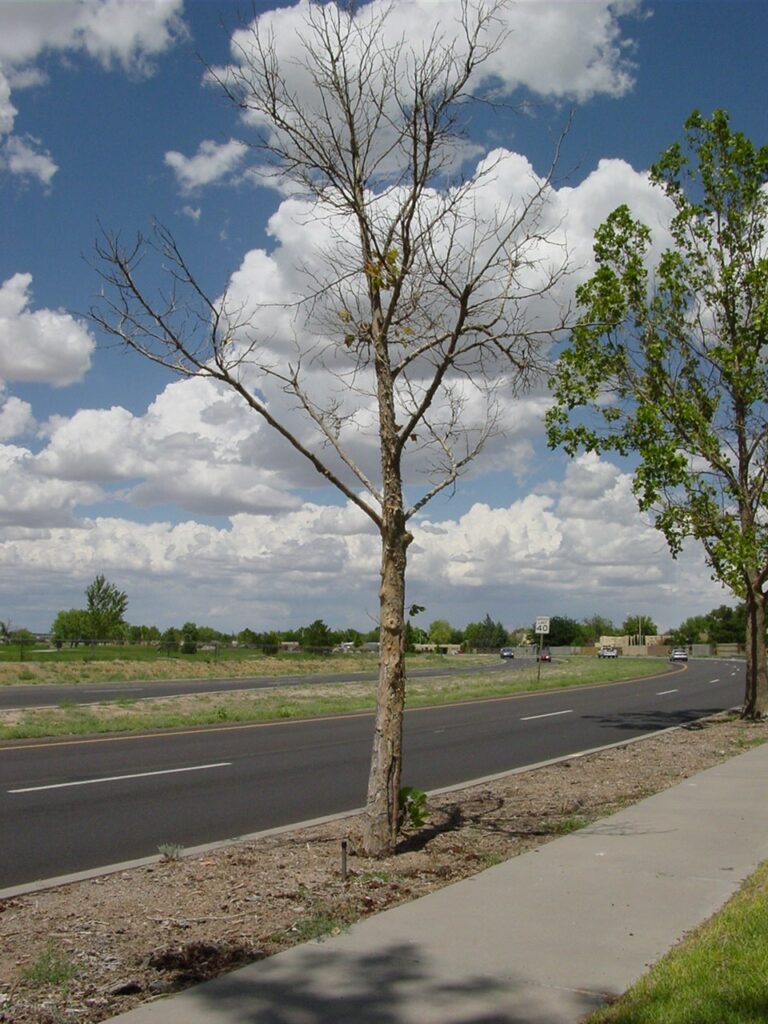
Drought stressed sycamore tree, insufficient irrigation and small growing area.
Author: Joran Viers is an arborist at Legacy Tree Company. Contact him at [email protected]. He’ll be speaking about this topic in greater detail on July 25. Sign up here. Have a question about the article? [email protected]
Folks, it’s a hot, dry summer here in central New Mexico. No surprise, you say — we live in a desert. Even for our location, though, it’s hot and dry. This creates a little conundrum for us: keeping our landscape plants growing while using water efficiently.
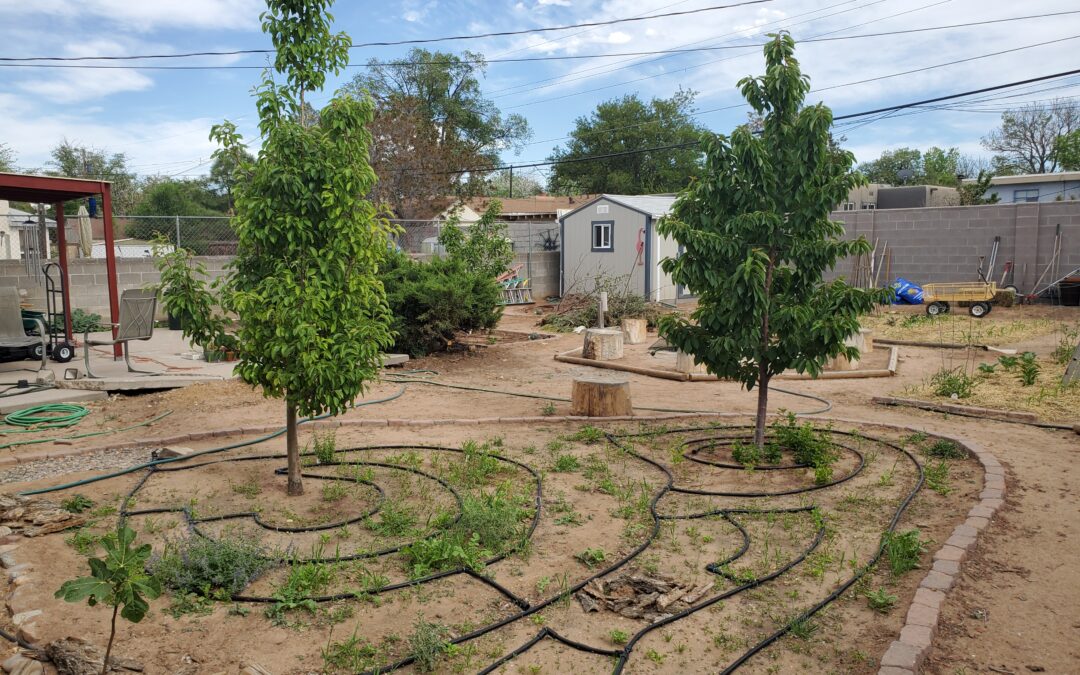
Tree and surrounding plants being watered by inline drip irrigation.
This applies especially to trees because as large plants with lots of leaves, they need regular adequate water for their size and species to remain happy and continue creating positive benefits for your yard and the city as a whole. Call that a biological law and reality. As temperatures go up, trees’ water demand goes up. That is a good starting point to keep in mind — in times of drought, you should water your trees a little more frequently than you would in a year with abundant rainfall.
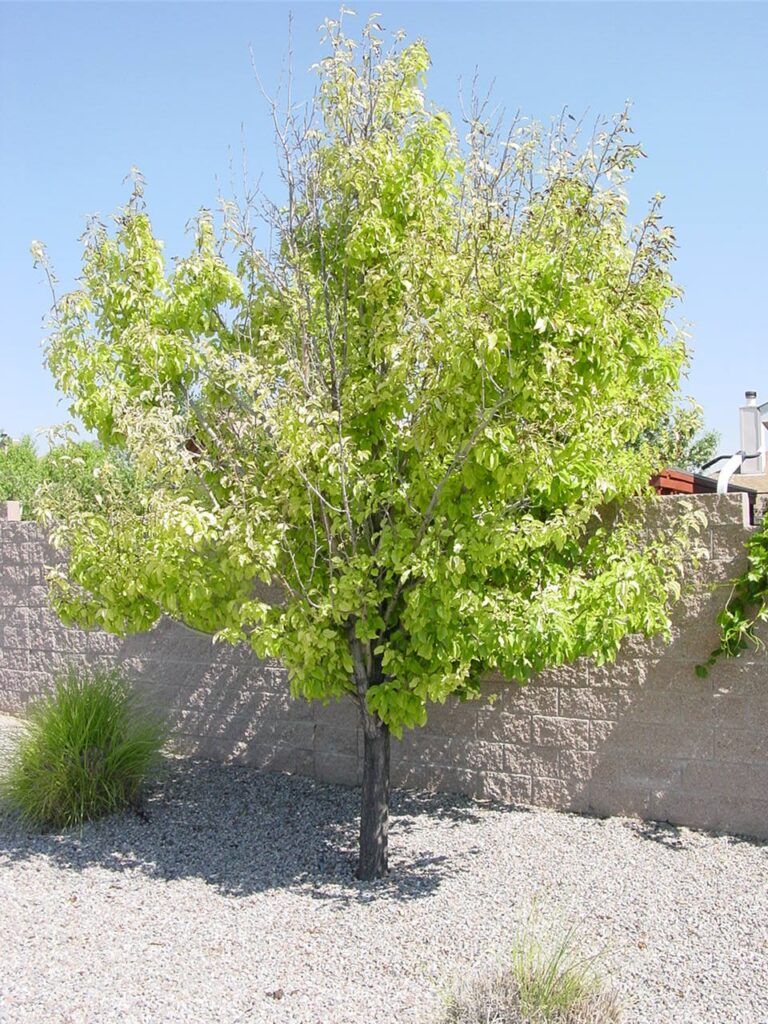
Drought stressed tree showing missing leaves and yellowing.
It turns out that over 90% of the water that comes into a tree simply escapes through the leaves as water vapor; the tree keeps very little water inside to grow. This loss of water vapor provides the “suction” that causes more water to enter the root system. It also cools the leaves and keeps them within comfortable working temperatures. Someone once said trees (and plants generally) have figured out a way to guide the natural movement of water from soil to atmosphere, channeling it through their bodies and using it to grow and function, which is one part of the water cycle. Having trees increases moisture in the air, allowing your swamp cooler to perform better.
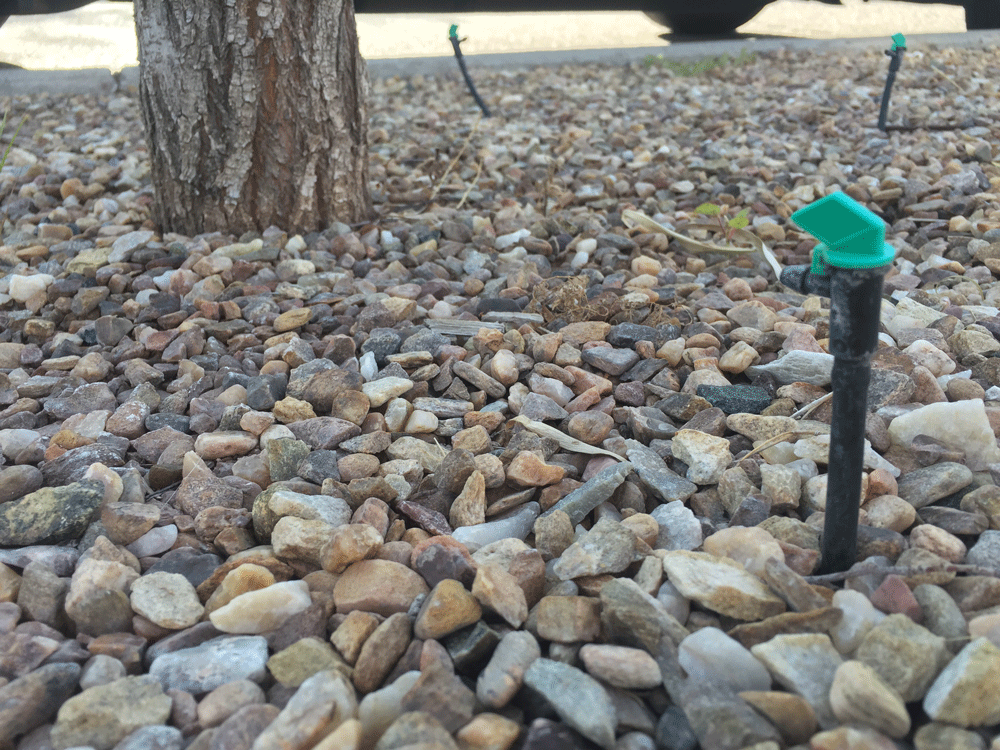
Trees “drink” very differently than you and I. We have one fairly large mouth into which all the water goes. However much we need, we have one target to hit in order to drink that water. Trees, on the other hand, take water in through their tiny, young roots out in the soil. Water has to get to a lot of soil in order to hit enough of those “mouths” to matter. A lot of tree irrigation eventually fails because there are only a few emitters (and those are often too close to the trunk). Those few emitters cannot put out enough water to satisfy the tree’s demand, nor do they wet enough surface area. (See examples in the photos below.)
Drip emitters located very close to the tree trunk.
What matters to a tree is the volume of water it has to work with. That volume is entirely dictated by the volume of soil that is holding water. And THAT volume is dictated by the surface area that received and absorbed water. The key is to disperse the water throughout the main root zone and do it in a way that allows the water to soak in where applied and not flow to low spots on the ground (which often are gutters. Science has found that most tree roots are located within the top three feet of the soil surface and quite likely even more shallow in landscapes that have not been deeply irrigated for the life of the tree, which is a common condition in Albuquerque.
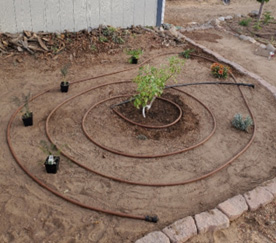
To properly water your trees, you will need some sort of irrigation system. It could be a bucket you fill from the sink or a state-of-the-art sensor-controlled automated drip system. But somehow you need to put water on the soil surface in a slow, controlled manner so that it can soak into the soil where it is applied. While buckets and hoses work, their simplicity makes them very labor intensive. In-line emitter drip tubing, laid out in a spiral or concentric circles, does a much better job. Once in place, these drip systems can be set to run for two to four hours at a time, about once a week during the hottest part of the year and less often during other seasons. Irrigation improvements qualify for the Water Authority Treebate. See our rebates here.
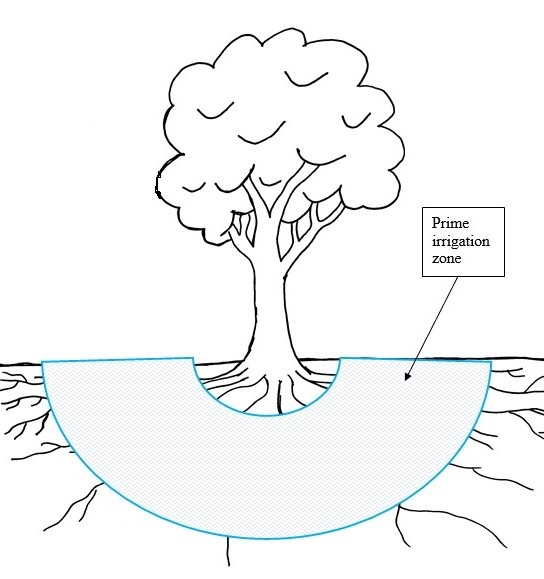
The ideal target area to irrigate is both theoretical and grounded to the reality of the site. Imagine a donut shaped area centered around the tree trunk. The trunk sits in the center of the donut hole. The body of the donut begins halfway between the trunk and the edge of the branch canopy and extends some distance beyond the edge of the canopy. This theoretical donut represents the ideal critical irrigation zone.
Now enters site reality — maybe there is a house or driveway or sidewalk covering part of the donut (or all three, with the tree located in a tiny unpaved space). We don’t want to encourage root growth at the house foundation, so don’t water within a couple of feet of it. Similarly, where concrete or asphalt covers the soil, root growth is moisture-limited and concentrated immediately under the impervious cover and under any planned or accidental cracks that allow rainwater to slip through. Ideally, we don’t want to water next to the pavement. The more of the donut that is unavailable for watering, the more often you may need to water the limited areas of open soil. Even so, it may simply not be enough soil volume to support the tree, which will then decline. In that case, replace it with a nice xeric shrub!
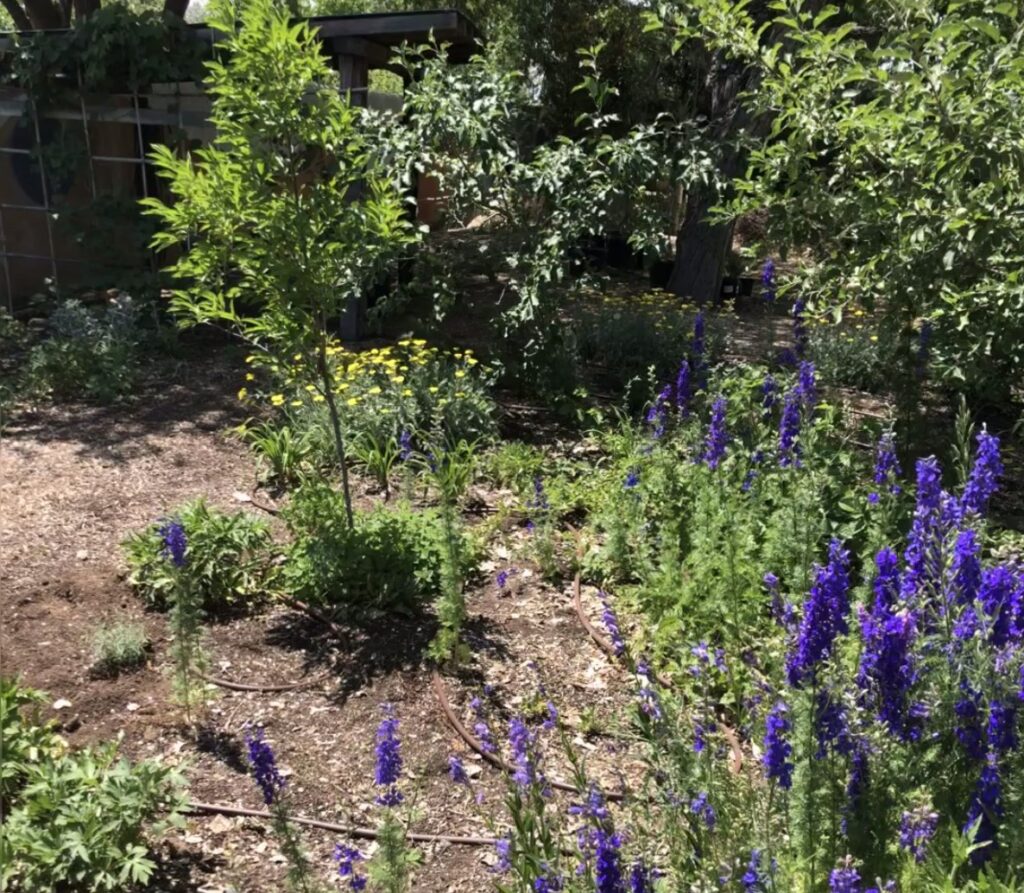
Recently installed drip tubing around a newly planted Mexican elder and some to-be-planted fennel. Both of those plants are excellent pollinator forage. A 4-inch depth of wood chip mulch will be installed over the top.
Author: Joran Viers is an arborist at Legacy Tree Company. Contact him at [email protected]. He’ll be speaking about this topic in greater detail on July 25. Sign up here. Have a question about the article? [email protected]
Nothing adds the same quality and value to a landscape as a healthy mature tree. Trees are so important to our community now and for future generations. The benefits include cooler outdoor spaces and homes, aesthetic appeal, carbon capture, stormwater mitigation, and more. There are some key things to think about when it comes to keeping your tree happy.
The two best things we can do for our trees are simple. We can reasonably and regularly irrigate the trees and apply a layer of organic mulch over the root zone.
The roots of our trees lie in the dry desert soil, waiting for water. In the arid Southwest, our soil also lacks living and dead organic matter. The water that falls on our land falls either infrequently, too little or too much all at once. Still, the plants and trees persist. It is up to us, the human caretakers of these places and trees, to do whatever we reasonably can to provide them with what they need to survive.
Watering Trees:
Newly planted trees (planted within one to three years) are more susceptible to damage from dry conditions and should be watered more frequently than established trees. Aim to water them to a depth of 24 inches three times a month in the fall and twice a month in the winter.
Evergreen trees lose water through their needles in the dry winter air. They need more stored water going into the winter season to make up for that. In addition, cold dry winds can strip water from evergreens faster than their roots can absorb it. That’s why it is especially important to provide enough water in the fall and during dry, warm spells in the winter. Water evergreen trees to a depth of 24 inches twice a month during the fall and once a month in the winter.
Even though they lose their leaves, deciduous trees also should not get too dry in the fall and winter. Water acts as an insulator for both the tree and soil. Soil that stays moist will be warmer. Likewise, plant cells that are plump with water will be less susceptible to damage from the cold. Water deciduous trees to a depth of 24 inches twice a month during the fall and once a month in the winter.
When watering any tree, remember to apply water out to the edge of the tree’s canopy drip line. Most established trees have a root spread equal to their height and beyond. Watering to the right depth depends on your specific soils, so you will want to measure how much water it takes to reach 24 inches deep in your soils.
Since every tree in every yard is different, how often you’ll need to water your trees largely depends on how quickly water moves through the soil. In sandy and gravelly areas (Westside and Foothills), the water passes through the soil quickly, moving past the tree roots. These types of soil need watering more often but with less water each time. On the other hand, the best way to water soil that has more clay in it is to irrigate less often but with more water. This kind of soil holds more water, but that water moves slowly. Be careful not to overwater, especially near the trunk.
How cany you tell how deeply you are watering your trees? After a day, when the water has soaked in, the soil should be moistened about 16-24 inches deep. Poke a thin piece of metal (a long screwdriver or something similar will work) into the ground and see how deep you can push it in. That will tell you approximately how deep the water penetrated the soil.
Adding Organic Mulch to Trees:
Shredded wood chips, which can be obtained from a tree service or a local vendor, are the ideal mulch. No matter what soil type and irrigation pattern you have, putting approximately 3 inches of shredded wood chip mulch directly on the soil does wonders for your trees. As with any mulch, wood chips cover and cool the soil and reduce evaporation. They also reduce weed growth. As the chips decay, they foster the development of a forest-like soil ecosystem with minerals and soil fungi, which is just what tree roots really benefit from. Think of the ground surface in a forest — bits and pieces of old trees, slowly decaying at the surface. Adding a thick layer of organic mulch is the only way to replicate those forest conditions in our urban environments.
What harms a tree? Things that harm the root system (soil compaction, drought, heat, chemicals), things that damage the root flare (stem girdling roots, mowers, construction), things that damage the living rind (wire girdling, kids with hatchets, vehicles) and things that damage leaves (over pruning, certain herbicides, heat). There are feedback loops, especially between the roots and the leaves. Root damage that reduces water uptake leads to leaves making less sugar which means fewer resources to grow new roots. Herbicide damage that deforms leaves leads to less sugar feeding root function as well as less pull on the water, both leading to less water and nutrient uptake going back to the leaves. The life for a tree in Albuquerque is difficult and just one of the aforementioned insults can be the small push which sends a tree into a slow death spiral.
How to Avoid Harming Your Tree:
Protect roots by covering the soil with 3 or 4 inches of shredded wood chips. Avoid cutting roots over one inch when possible; when absolutely necessary, use a sharp, sterilized pruning saw to make a clean cup, cut as few as possible and cut as far from the trunk as possible. Don’t compact soil by dumping gravel or parking on the root zone. Don’t apply herbicides to the root zone, which is larger than the canopy above.
Protect the leaves by avoiding over pruning. Most mature trees don’t need regular pruning, and, in fact, that should be avoided. Pruning takes away energy sources (leaves) and creates energy sinks (wounds that must be dealt with). Excessive pruning can send a tree into a starvation spiral. Prune for specific goals. Avoid herbicides like those found in weed-and-feed fertilizers.
Protect the living rind by taking away Junior’s hatchet. More seriously, don’t tie wires, ropes, and holiday lights around the trunk or branches unless you check them every year to make sure they aren’t girdling the tree.
What is urban heat? Dark surfaces like concrete, asphalt and brick absorb and retain heat from the sun. Little spaces between buildings can create heat canyons that trap this heat, forming “islands” that are warmer than rural or suburban areas.
Urban heat can affect us in many ways, such as increasing heat stroke, heart and lung diseases, energy costs, general discomfort, hyperthermia, and poor air quality. The U.S. Environmental Protection Agency projects that by 2040 Albuquerque will see four times the current annual number of days with temperatures of over 100 degrees.
But trees can help! Trees provide shade to keep us and the ground cool, as well as cooling the air through water loss, or evapotranspiration. Increasing the urban canopy can lower city temperatures.
Let’s Plant Albuquerque is a broad community alliance dedicated to planting 100,000 new trees in the city by 2030. The alliance represents a broad range of civic, government and community organizations dedicated to this goal.
DEVELOP, a NASA Applied Sciences Program, studied Albuquerque’s urban heat. DEVELOP conducts feasibility studies that bridge the gap between Earth science information and society and works with communities and organizations to address environmental and policy concerns.
NASA DEVELOP found that a 30% increase in tree shade can help offset rising temperatures and allow neighborhoods to be cooler. Trees can also increase your body’s “thermal comfort,” how cool and comfortable you feel on hot days.
The city’s parks canopy alone provides many benefits, including energy savings, air quality improvements and increased property values. The nearly 30,000 trees in the city’s public spaces provide:
$1.7 million in carbon monetary benefit
$624,000 in stormwater monetary benefit
$3.6 million in (overall monetary benefit
The Water Authority would like to encourage you to help cool our city by planting trees. The Tree-Bate program helps offset the cost of planting and maintaining trees.
When you buy a new tree, you can receive a rebate equal to 25% of the purchase price up to $100 a year. To help customers narrow down their purchasing decisions, the Water Authority assembled a list of 20 trees that are proven to thrive in our area, are commonly available for purchase, fit a variety of situations and provide numerous environmental benefits. A broader list of more than 160 qualifying trees is in the Water Authority’s Xeriscaping Guide. They include: