
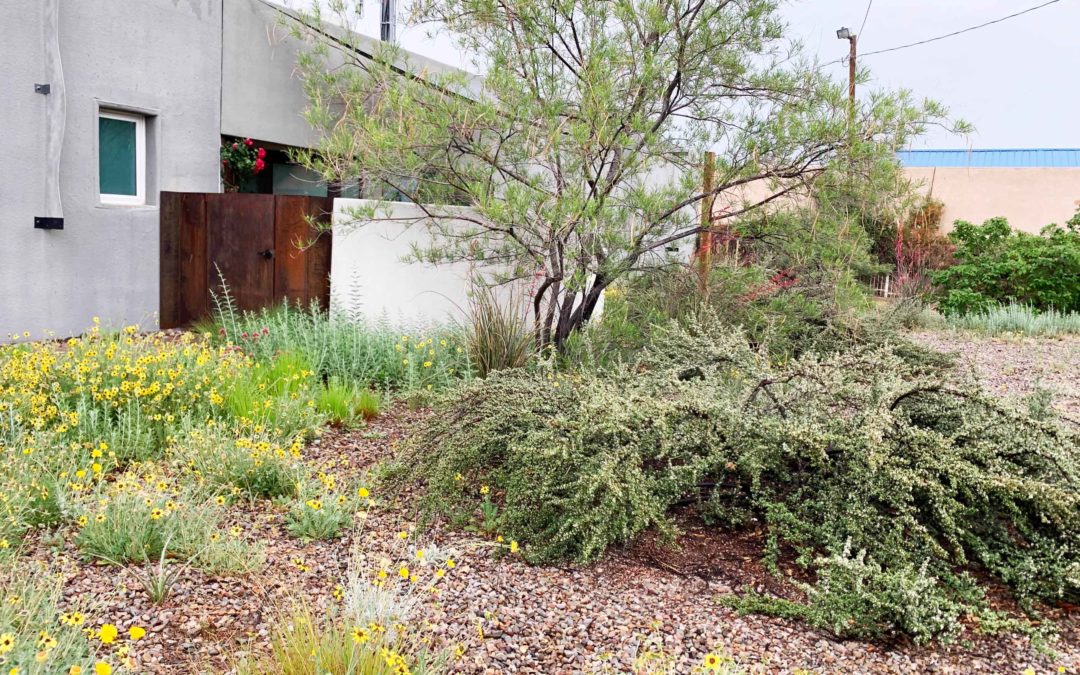
Irrigation is essential to give plants a healthy start, so they become well-rooted in the landscape. A great way to find out the water needs of individual plants is by checking out the ABCWUA Xeriscape Guide and then follow the seasonal watering recommendations.
When your landscape is new, the best thing to do is observe your plants and respond to their cues. Sometimes there are a few plants that seem to need water more often than others at first. It is better to put higher flow rate emitters on these plants or give them extra water by hose than it is to add more water to everything in the landscape. Once they develop a better root system, these plants can be watered just like all the plants around them.
Here are three frequently asked questions about watering new plants:
Where do I place drip emitters?
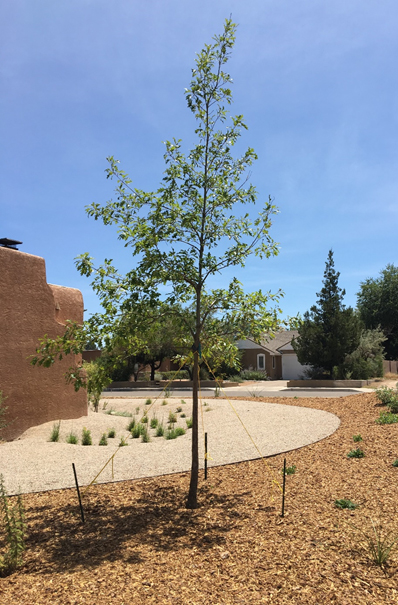
Drip emitters should be placed where the backfill meets the root ball. Larger plants need several higher flow rate emitters to water the transplanted roots plus the backfill. Make sure the water goes deep enough to water the entire root ball plus the soil below the roots.
How do I know what plants to group in my yard?
Plants grouped on the same irrigation valve should have similar water needs.
How often should I water my new plants?
Actual water use varies seasonally and as the plants grow. It makes sense to give plants less water less frequently during cooler weather and more water more frequently during extremely hot, windy weather. To encourage deep roots, water must go deeper into the soil as the plants grow. Deeply rooted native shrubs need water to go down 24 inches once a month. Fruit trees, which have shallow roots, need watering to go to a depth of 18 inches every week while they are producing fruit from mid-April to September.
Plants with very low water needs may be able to survive on rainfall alone, once they are well-rooted in 3 to 5 years. If you want them to be more attractive, water them monthly in the summer, especially if monsoon rains are late or scant.
Plants with medium water need to benefit from watering twice monthly, May through September, but only once a month the rest of the year.
Plants with high water needs should be watered weekly, May through September, twice monthly during March, April, and October, and monthly the rest of the year.
As roots start to go deeper into the soil, it's usually best to water less often but for longer cycles so the roots continue to go down further into the soil. But here are a couple of things to keep in mind!
Watering for more than a 3 or 4-hour cycle in well-drained soil will put the water deeper than roots will grow.
In poorly drained soil, water that goes too deep could inhibit the rooting of arid-adapted plants.
As plants root out, they will become more resilient and need less observation.
Author: Judith Phillips, owner of Design Oasis, landscape designer, and garden writer with 30 years of experience designing arid-adapted and native gardens in the high desert. Have a question about the article? AskAnExpert@abcwua.org
Water-Wise Vegetable Gardening
With our hot summers and low precipitation, growing vegetables in NM can be challenging. This talk will provide strategies and recommendations for growers to cultivate a thriving vegetable harvest in the region. Discussion will include irrigation and infrastructure suggestions, as well as selection of vegetable varieties that are well-adapted to the area.
Instructor:Stephanie Walker, PhD. Professor and Vegetable Specialist, New Mexico State University, Extension Plant Sciences Department.
Maintaining Tree Health During Drought
Learn from Albuquerque’s leading tree expert how to identify drought stress in trees, understand their responses to drought, and implement strategies to keep them alive and thriving in hot, dry weather.
Instructor:Joran Viers, Board Certified Master Arborist and Municipal Specialist, International Society of Arboriculture (ISA). Senior Arborist, Legacy Tree Company, Albuquerque. Former City Forester, City of Albuquerque
Creating a Drought-Tolerant Refuge for Yourself and Wildlife
Instructor:Laurel Ladwig, M.S. She is the ABQ Backyard Refuge Program Director for the Friends of Valle de Oro National Wildlife Refuge, a part-time faculty member in the Department of Geography and Environmental Studies, and Associate Director of the R.H. Mallory Center for Community Geography at the University of New Mexico and is enthusiastic about all opportunities to encourage people to develop a relationship with our wild neighbors.
Designing Resilient Landscapes: Plant Adaptations, Communities, and Selection for Arid Environments
Instructor:Maria Thomas is the Curator of Plants at the ABQ BioPark where she manages the botanical exhibits, plant collections, horticultural staff, and related programs for the 150-acre public park and garden. Additionally, Maria is an Adjunct Professor at the University of New Mexico in the Landscape Architecture department.
Climate-Ready Trees- Planting for a Warmer and (Hopefully) Shadier Future
Instructor:Marisa Y. Thompson, PhD Extension Urban Horticulture Specialist. New Mexico State University Department of Extension Plant Sciences, Los Lunas Agricultural Science Center, Think Trees NM, President of the Board (2023-current).
Plant Adaptations to Heat & Drought
Noticing the Ways Plants Thrive in our Yards and Natural Areas Learn how to Recognize Drought-Adapted Traits in Everyday Plants all Around Us.
Instructor:Marisa Y. Thompson, PhD Extension Urban Horticulture Specialist. New Mexico State University Department of Extension Plant Sciences, Los Lunas Agricultural Science Center, Think Trees NM, President of the Board (2023-current).
Hose Bib Tree Irrigation System for Your Trees: Simple Systems for Thriving Trees!
Instructor:Richard Perce has twenty years’ experience working with trees and irrigation here in New Mexico. He is a former certified arborist and currently holds the Irrigation Association’s Landscape Irrigation Auditor certification and is a certified QWEL irrigation instructor. He worked as a landscape contractor for more than a decade and is the Water Authority’s former Irrigation Efficiency Specialist. He also has a Masters of Community and Regional Planning from UNM and currently works at Anthropopulus Design + Planning.
Passive Rainwater Harvesting
This workshop introduces participants to the principles and practices of passive rainwater harvesting. Attendees will learn how to capture, slow, spread, and infiltrate rainwater into the landscape using simple, low-cost methods such as swales, berms, and basins. The workshop emphasizes working with the natural flow of water to reduce runoff, prevent erosion, and support healthy soil and plant life. By implementing passive rainwater harvesting, participants can conserve water, and create more resilient, self-sustaining landscapes.
Instructors:Anthony Luketich, Natural Resource Scientist, Anthony Luketich is a Natural Resources Scientist for Bernalillo County where he is focused on water conservation and water-wise landscape practices. He received a degree in Watershed Management and Ecohydrology from the University of Arizona where he studied the relationship between trees and water. Anthony has worked across the Southwest US as a research scientist as well as a water harvesting field technician where he became a certified water harvesting practitioner.
Bobby Mullin, Natural Resource Scientist, Bernalillo County Stormwater Quality Program Bobby Mullin is a Natural Resource Scientist for Bernalillo County in the Stormwater Quality Program. He focuses on improving stormwater quality in the Middle Rio Grande Watershed and promoting sustainable and resilient landscapes using Green Stormwater Infrastructure and rainwater harvesting. Bobby received his Bachelor of Science in Environmental Science from Bucknell University in 2011. Before joining Bernalillo County, he had worked as an environmental consultant remediating contaminated soil and groundwater and as a Research Scientist studying the impacts of climate change, drought and plant mortality in New Mexico ecosystems.
Xeriscape: The Desert Friendly Yard
Join us for learning all of the tips, and benefits of our Xeriscape program!
3 Steps to Landscape Success
Service, Settings, and Selection are the keys to landscape success!
