
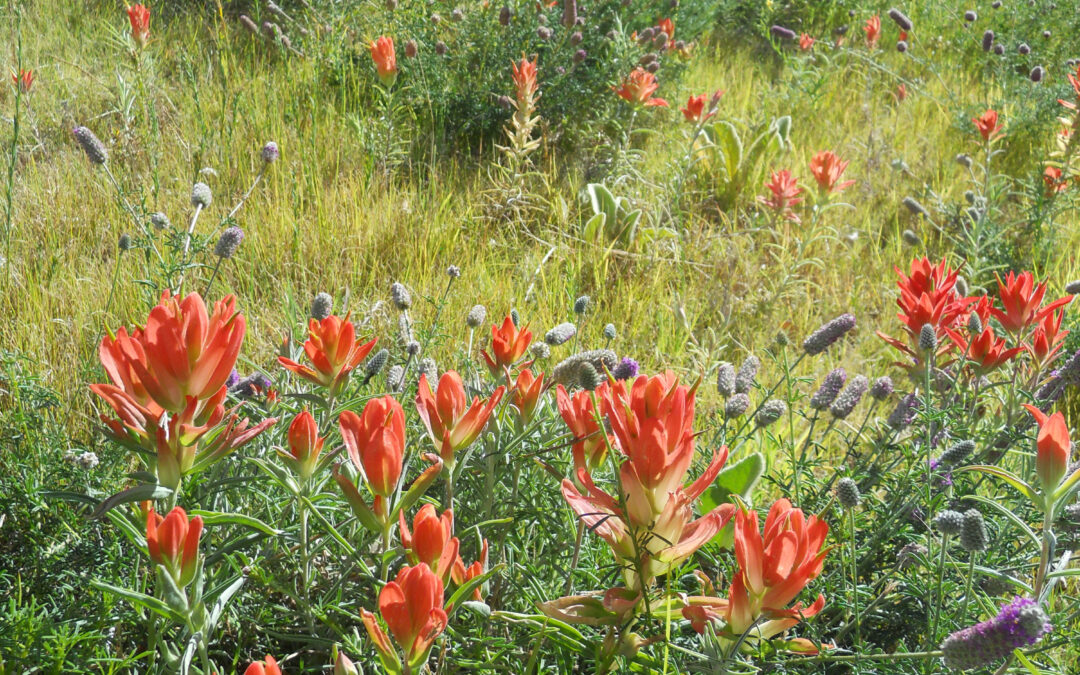
Being someone so immersed in planting design in my daily life and someone who is so plainly in love with plants, both wild and cultivated, it can be difficult to narrow my focus and play favorites. I owe this relationship with plants unequivocally to my grandmother the rosarian, who, when asked which rose was her favorite, would always reply, “The one that’s in front of me right now.” Therefore, I shall restrain myself for the purpose of this article to the seeded meadow in the high desert. I hope you will find the selections mentioned compelling enough to consider them and possibly experiment a little!
It was actually at my grandmother’s house that, in 2009, a friend and I, fresh out of the landscape architecture program at the University of New Mexico, germinated our first meadow from seed. We had stabilized 99% of the site’s steep grades with retaining walls, but a pesky little 300-square-foot sliver of dead sod at about a 30% slope seemed forever destined to erode out the driveway and down the storm sewer — rats!
There was an existing sprinkler system in place, and we were therefore able to provide timed irrigation to the surface of the soil without having to dig a bunch of new trenches and put a bunch of new plastic piping in the ground. A little idea sparked: Why not just seed a meadow! The cost of ingredients would be relatively low, and, given how cooked our bodies were from the work we’d already invested, a little bit of (somewhat) instant gratification sounded downright appealing.
On a late spring day, we bounced a springy roll of burlap out of the truck bed and onto our shoulders, then tossed the following in a large paper grocery bag:
2 lbs. blue grama grass (Bouteloua gracilis)
1 lb. little bluestem (Schizachyrium scoparium)
1 oz. purple prairie clover (Dalea purpurea)
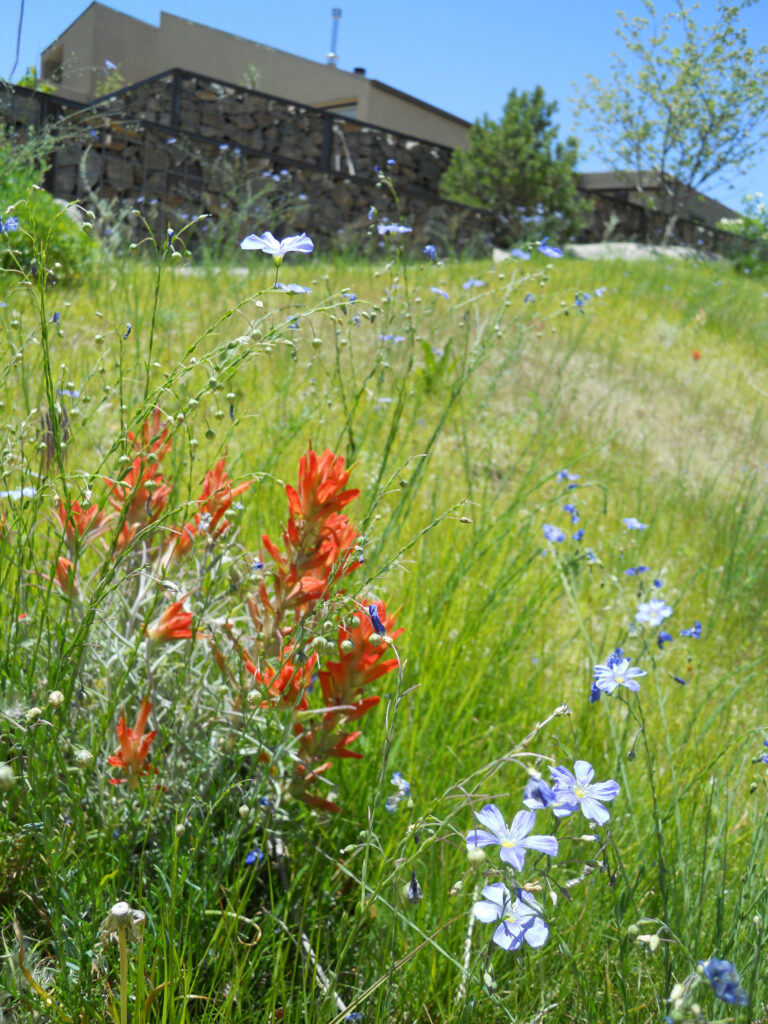
1 oz. Lewis prairie flax (Linum perenne lewisii)
2 small packets of Indian paintbrush (Castileja lanata)
2 small packets of mullein (Verbascum thapsis)
A couple of handfuls of grape hyacinth (Muscari armeniacum) and species tulip bulbs collected from excavation on site
We prepared the soil minimally for the seed mix, scuffing a couple of 2-cubic-foot bags of compost into the top inch or two of soil with a hard rake. We then hand-broadcasted the seed atop the loose dirt, east-west and then north-south, followed by lightly raking the seed and soil together to mix the two. Lastly, using a generous fistful of (100-ish) sod staples, we tightly pinned a single layer of burlap to the surface. The burlap serves as the secret ingredient in the concoction of a high desert meadow, especially on a slope. It serves a couple of purposes: First, it secures the soil and seed mixture, ensuring it doesn’t wash away in rivulets from the sprinklers or get blown away by the wind; it also holds onto a little moisture while allowing the emerging cotyledons — the plants’ first leaves — enough elbow room to squeeze into the sunlight.
Straightening up and drying our foreheads, both a bit chuffed at how easy that’d all been, we started taking wagers. “Which of the wildflower seeds do you think will bloom first?” I asked. “My money’s on the Indian paintbrush,” said my friend, fully aware that Indian paintbrush is hemi-parasitic and relies on blue grama to survive. I cracked up. He cracked up! If there seemed to be a clear underdog in the race, that was it!
We set the sprinklers to run for five minutes twice a day and after a couple weeks had passed, we teased the burlap from the surface, revealing a uniform green carpet. At the margins of the sliver of meadow there was a distinct green border of sprouts ceasing right where the burlap was cut. Neither of us had expected it.
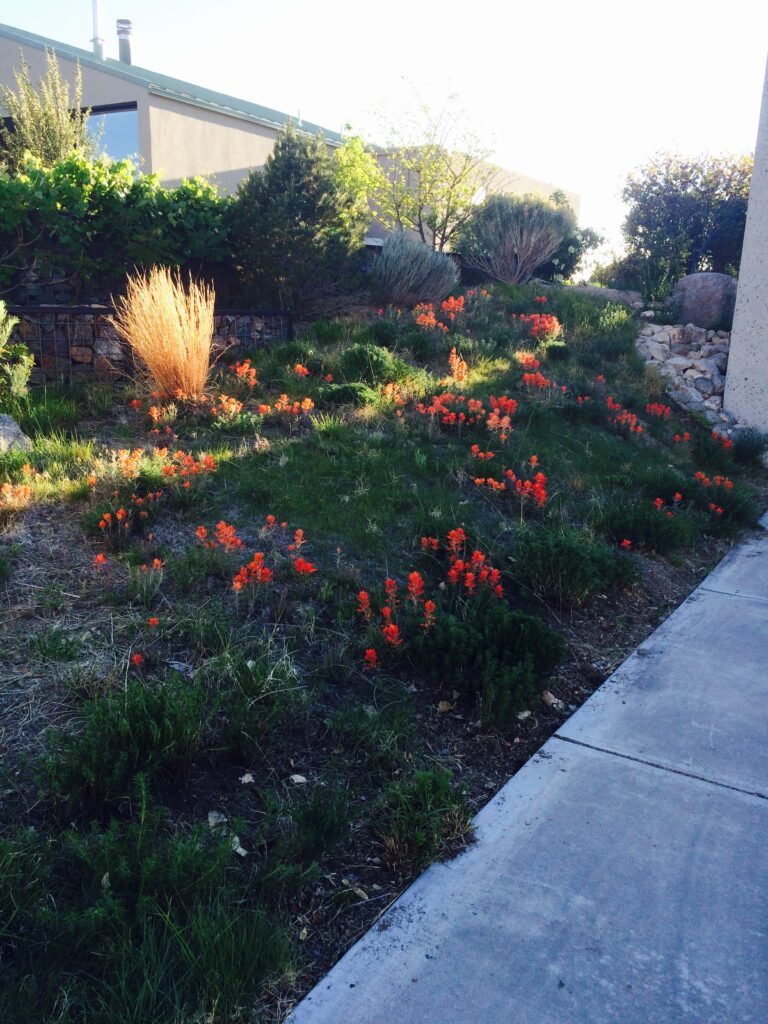
By the end of that summer, we had nearly weaned the meadow off irrigation. The grasses and perennial wildflowers had come in marvelously. Now, as we near the spring season of 2024, and the first winter jasmine shrubs and daffodils are blooming, I drive by that yard in the Sandia foothills and think to myself how one of the best performing landscapes I ever had a hand in was also one of the easiest and least expensive.
Each year, there continues to be a succession of blooms. In springtime, grape hyacinth emerges first, followed by a flush of Indian paintbrush and then purple prairie clover. The grasses green up in May and mature through August, and the little bluestem holds a warm, russet color through the winter.
While the flax initially performed well and provided early color, it has had the least longevity of any of the wildflowers. The mullein seeds germinated well and formed soft rosettes, but the current residents of the property sadly weeded it out of the meadow for aesthetic reasons. The purple prairie clover flowers profusely every summer with irrigation once or twice a week. But, the real star of the show, from that first year until this day is — I never thought I’d say it — the underdog, Indian paintbrush.
Learn more about specific types of gardening here:
Simple Steps to Get Started Designing Your Yard
Basics about Turf Grasses for New Mexico
Water Harvesting for Residential Landscapes
