
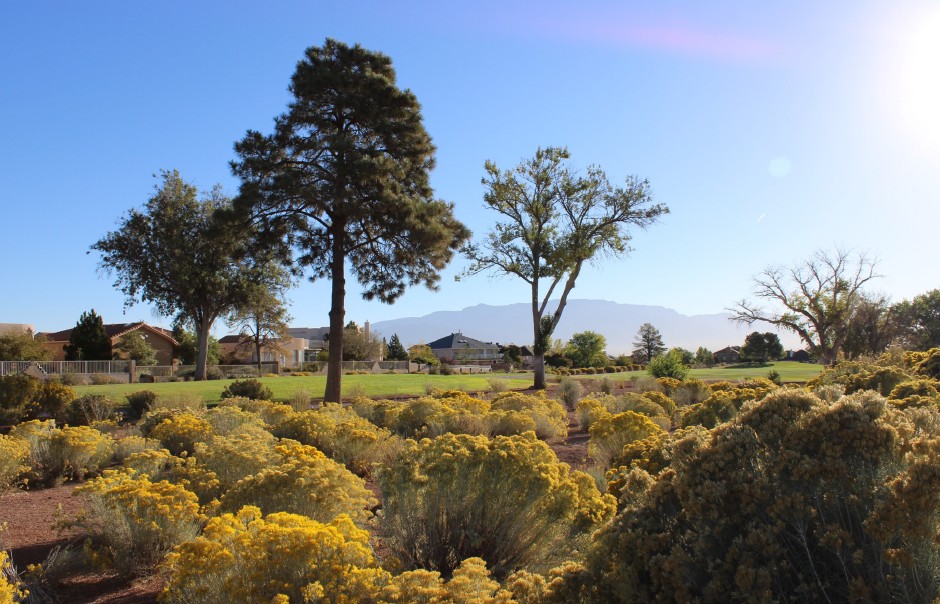
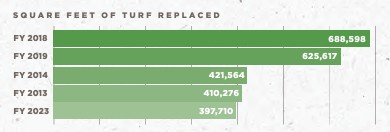
The Water Authority’s xeriscape rebate program, and predecessor programs run by the city of Albuquerque, have seen about 12 million square feet of turf replaced over the past 25 or so years. Since 2009, the top five years for program participation were:
This has contributed to a reduction in daily per capita water consumption from 250+ gallons in the mid-1990s to about 124 today. Replacement of turf with desert-friendly landscapes has always been a key component of Albuquerque’s multidecade conservation drive and of the Water Authority’s 100-year management plan, WATER 2120, which was adopted in 2016. Now, we’ve joined other Western water utilities in committing to pursue removal of 30% of remaining “non-functional” turf in our respective service areas over the next several years. That does NOT mean the wholesale removal of cherished green spaces in the name of saving water. Parks, ballfields and children’s backyard play areas are great places to have grass. Parking lots, median strips and emerald-green front yards are often a different story — and their owners may be able to save water and money by voluntarily exploring xeric alternatives.

To qualify for rebates, those alternatives must include landscape plans that are rich in climate appropriate trees, shrubs and plants. The idea isn’t to just pave over a patch of grass, replace it with gravel or let it revert to unsightly weeds. Plants and trees aren’t just pretty to look at: They create shade that reduces the “heat sink” effect — and the demand for water. So, yes, we want to “get off the lawn.” Doing so will help us meet important conservation goals. But we can do it in a way that preserves the benefits that functional turf and green spaces can offer.

Check out some of our recent projects:
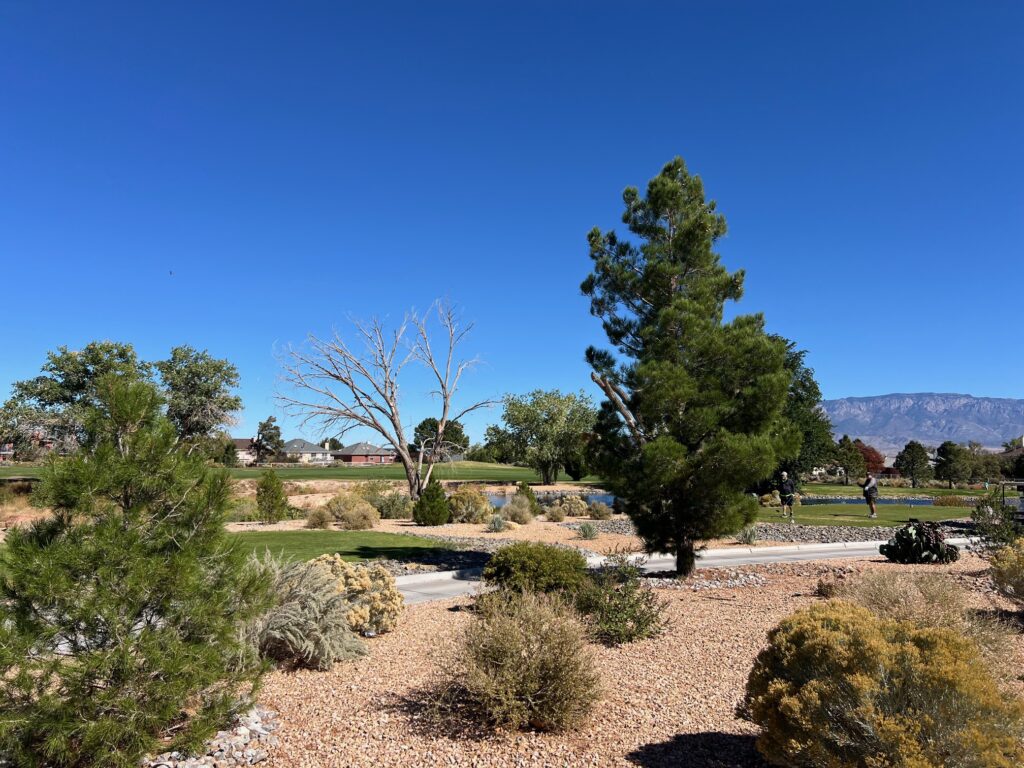
Paradise Hills Golf Course

Project timeline: 2011-2022

Total landscape transformation: 1.4 million sq. ft.

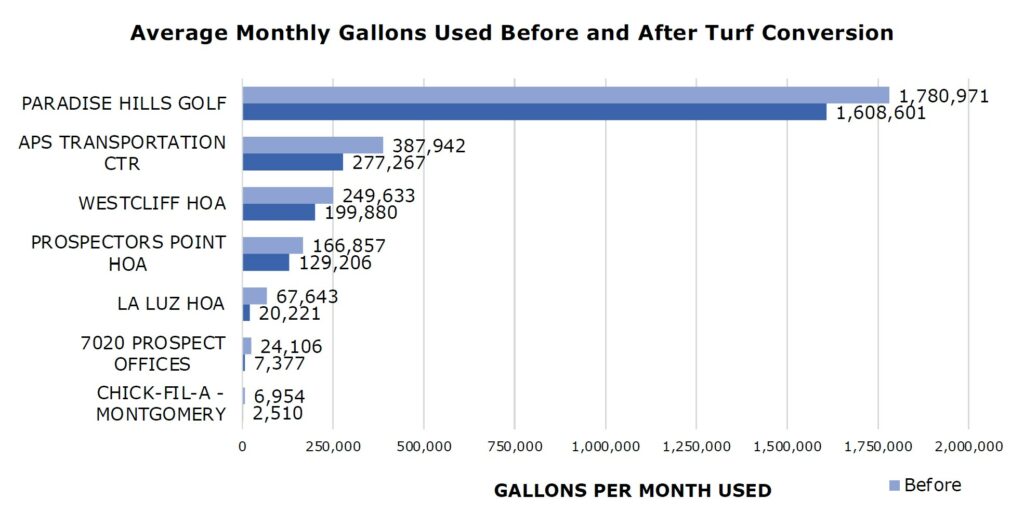
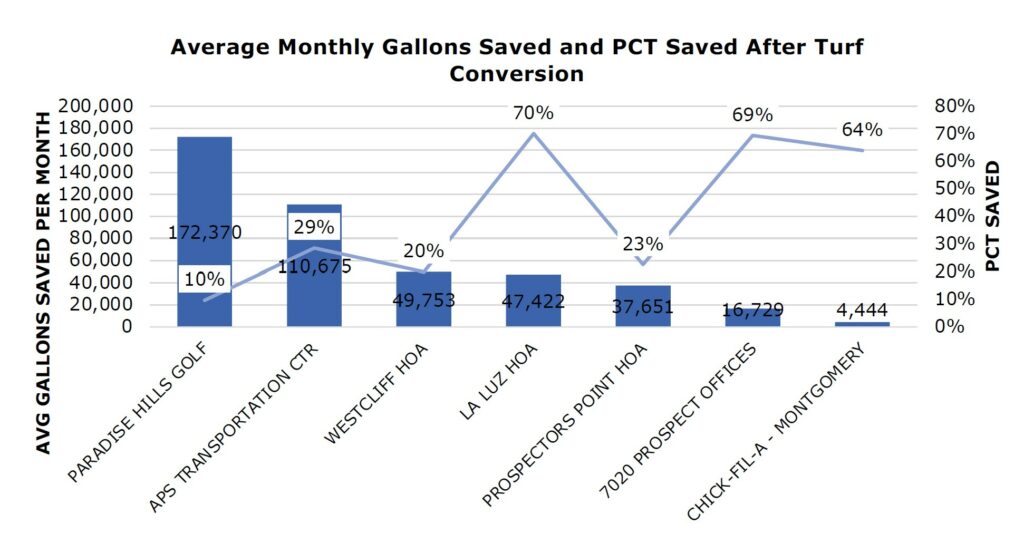
Water savings to date: 350 million gallons

Rebate amount: $1.4 million

Total plants: Over 10,000

Plant types: Turpentine bush, Afghan pine, chaste tree, sand sage, desert willow, chamisa, Apache plume, yellow yucca, threadgrass

Paradise Hills Golf Course (formerly known as Desert Greens Golf Course), a private country club on Albuquerque’s northwest side, had been served since its construction in 1962 by a private water utility charging artificially low, subsidized rates. When the Water Authority acquired the private utility in 2009 and began charging ordinance-based rates, the course’s operating costs increased significantly. With its business model no longer tenable, Desert Greens was in danger of shutting down. Fortunately, help arrived in the form of the Water Authority’s xeriscape rebate program, which Desert Greens used to finance the removal of turf from non-playable irrigated areas. By 2021, the golf course had transformed nearly 1.4 million square feet of turf into xeric landscapes, conserved more than 350 million gallons of water, and — key to the course’s survival — saved over $2 million in water bills. The end result is an aesthetically pleasing, targeted-play course that patrons love — and which can continue to operate at a profit.
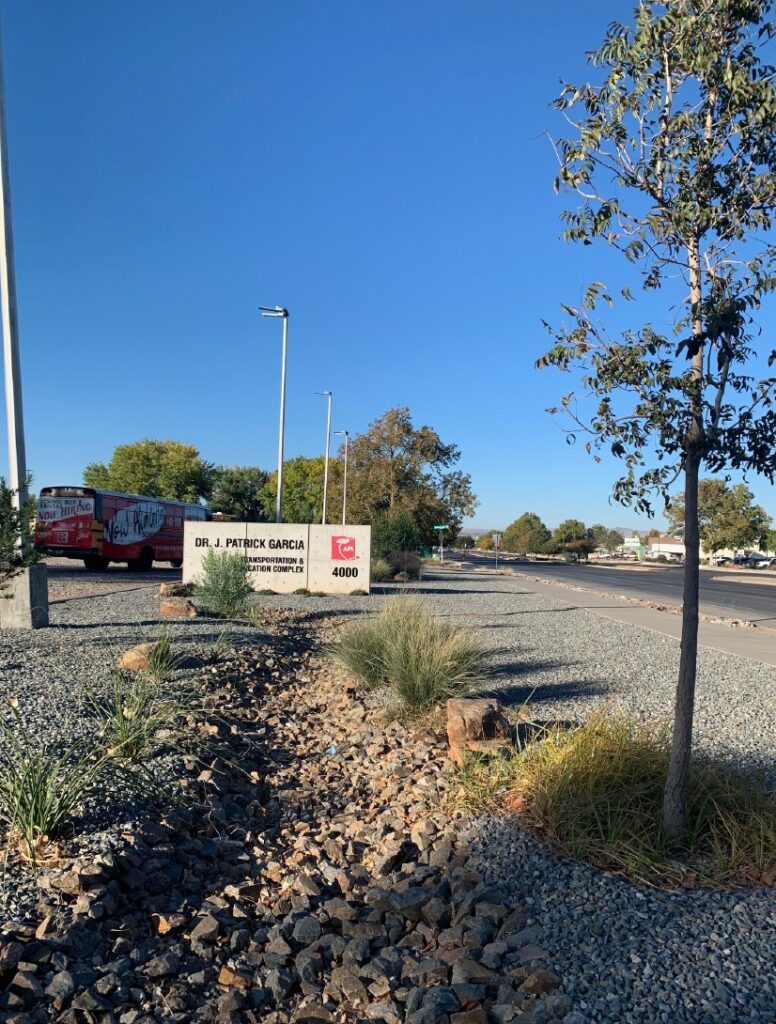
Dr. J. Patrick Garcia (APS) Transportation/Education Complex

Project timeline: 2022

Total landscape transformation: 15,670 sq. ft.

Water savings to date: 996,072 gallons

Rebate amount: $31,340

Total plants: 246

Plant types: Lacebark elm, Afghan pine, Chinese pistache, crabapple, desert willow, skyrocket oak, juniper trees, beargrass, valley cottonwood, pinon pine, wall germander, banana yucca
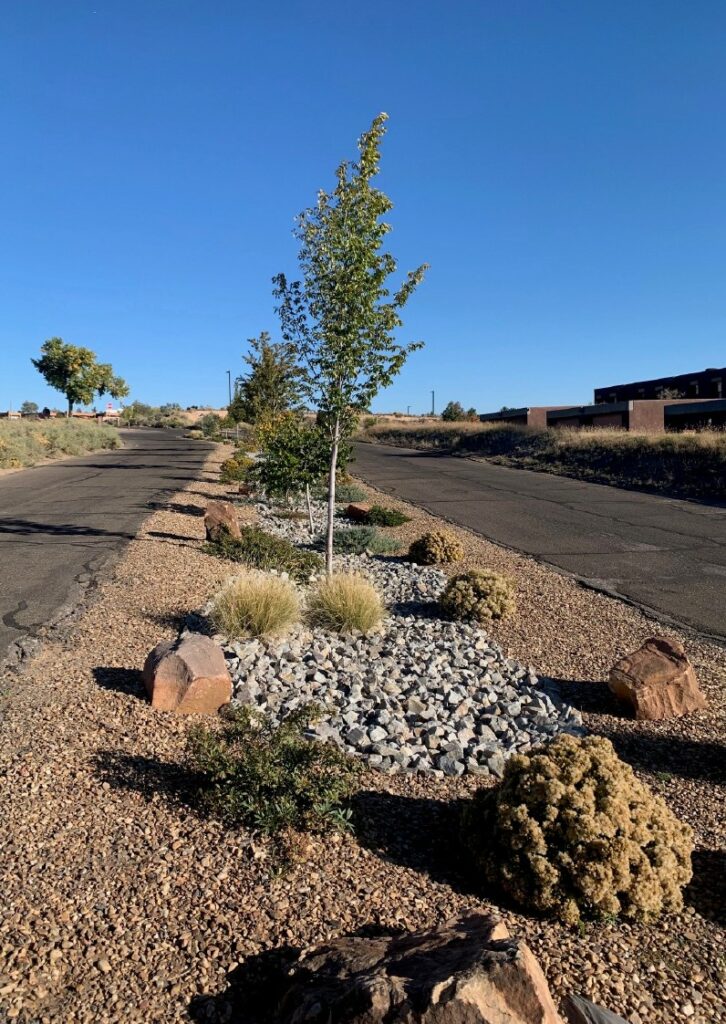
La Luz HOA Medians

Project timeline: 2021-2022

Total landscape transformation: 9,000 sq. ft.

Water savings to date: 1,043,287 gallons

Rebate amount: $13,500

Total plants: 162

Plant types: Lacebark elm, escarpment live oak, frontier elm, Oklahoma redbud, crape myrtle, turpentine bush, blue grama, Chinese pistache, catmint
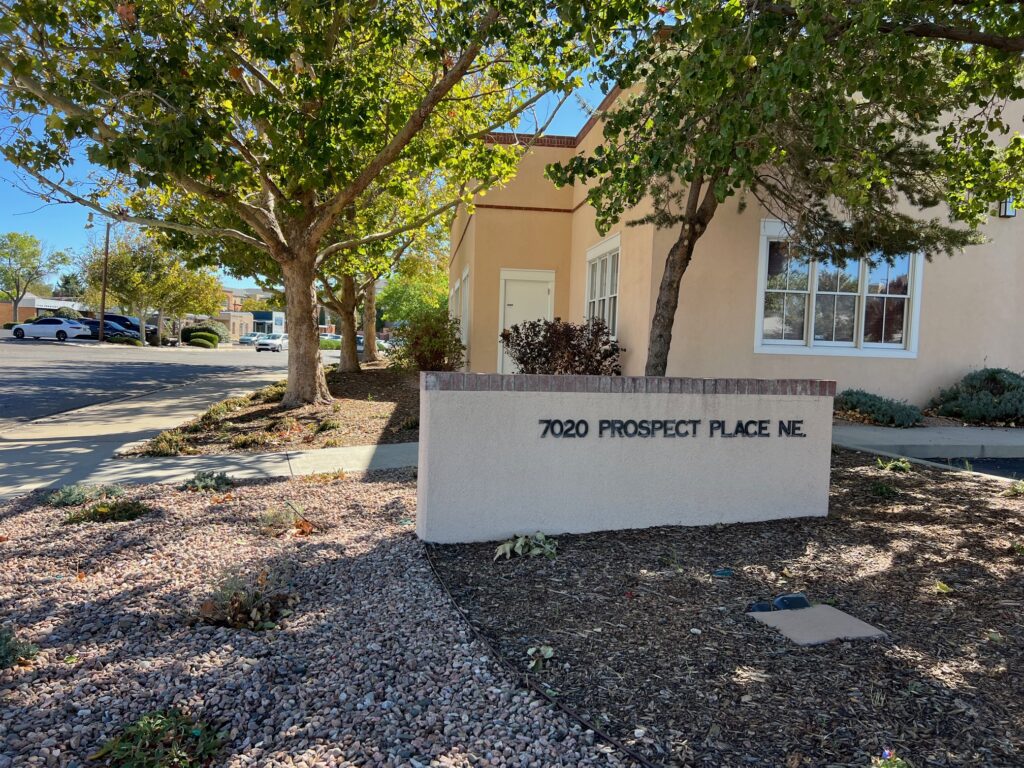
Commercial Office Park

Project timeline: 2023

Total landscape transformation: 1,540 sq. ft.

Water savings to date: 83,645 gallons

Rebate amount: $3,080

Total plants: 134

Plant types: Creeping germander, dwarf plumbago, golden columbine, turpentine bush, little bluestem, English lavender, ornamental pear, London plane tree
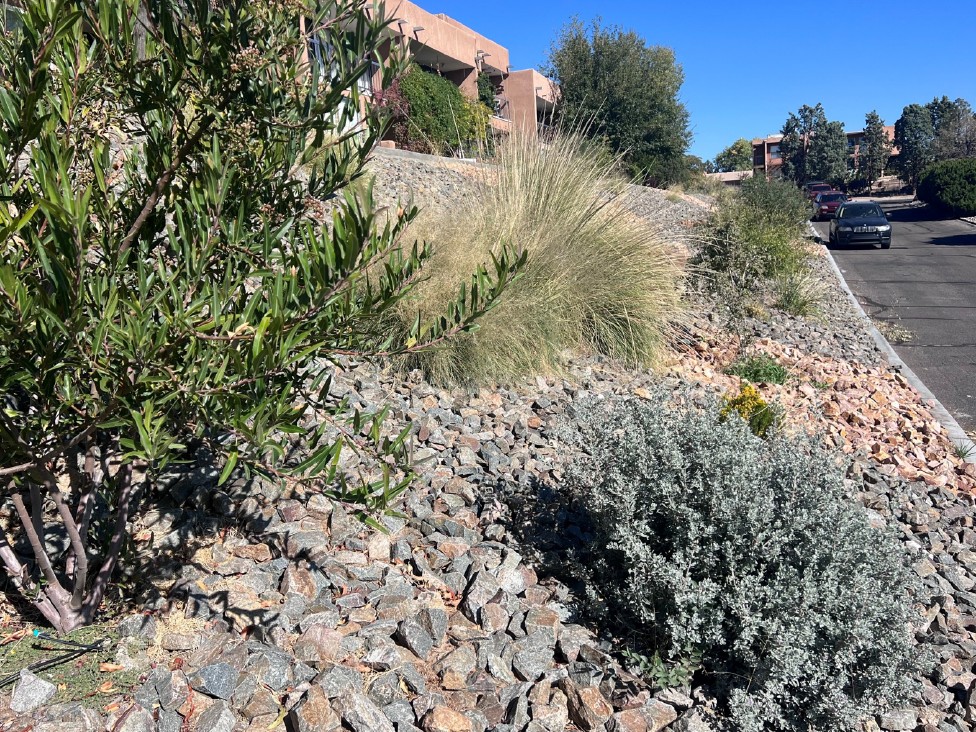
Westcliffe HOA

Project timeline: 2020-2021

Total landscape transformation: 7,558 sq. ft.

Water savings to date: 2,189,127 gallons

Rebate amount: $15,651

Total plants: 24

Plant types: Crape myrtle, gray lavender, Texas ranger, turpentine bush, Apache plume, chamisa
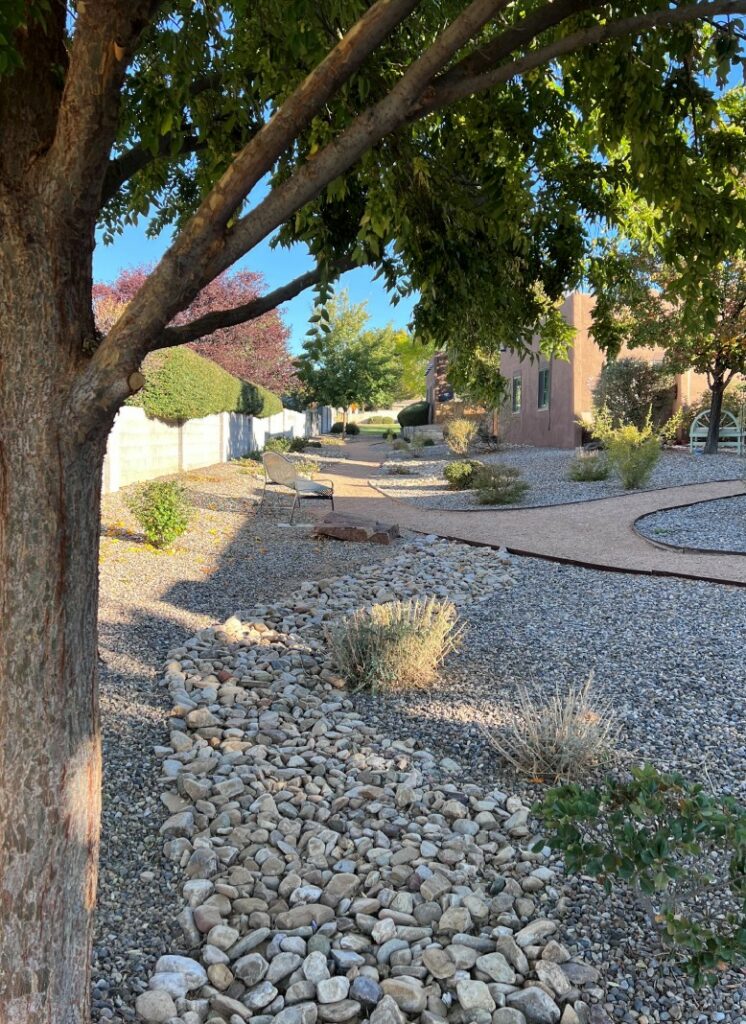
Prospectors Ridge HOA

Project timeline: 2018-2023

Total landscape transformation: 34,440 sq. ft.

Water savings to date: 2,823,830 gallons

Rebate amount: $62,063

Total plants: 700

Plant types: Cherry sage, Allee elm, Modesto ash, butterfly bush, rose of Sharon, golden rain tree, bird of paradise, winter jasmine, rosemary, catmint, mesquite (honey and screwbean)
Have a question about the article? AskAnExpert@abcwua.org

Water-Wise Vegetable Gardening

With our hot summers and low precipitation, growing vegetables in NM can be
challenging. This talk will provide strategies and recommendations for growers to
cultivate a thriving vegetable harvest in the region. Discussion will include irrigation and infrastructure suggestions, as well as selection of vegetable varieties that are well-adapted to the area.

Instructor: Stephanie Walker, PhD. Professor and Vegetable Specialist, New Mexico
State University, Extension Plant Sciences Department.

Maintaining Tree Health During Drought

Learn from Albuquerque’s leading tree expert how to identify drought stress in trees,
understand their responses to drought, and implement strategies to keep them alive and thriving in hot, dry weather.

Instructor: Joran Viers, Board Certified Master Arborist and Municipal Specialist,
International Society of Arboriculture (ISA). Senior Arborist, Legacy Tree Company,
Albuquerque. Former City Forester, City of Albuquerque

Creating a Drought-Tolerant Refuge for Yourself and Wildlife

Instructor: Laurel Ladwig, M.S. She is the ABQ Backyard Refuge Program Director for the Friends of Valle de Oro National Wildlife Refuge, a part-time faculty member in the Department of Geography and Environmental Studies, and Associate Director of the R.H. Mallory Center for Community Geography at the University of New Mexico and is enthusiastic about all opportunities to encourage people to develop a relationship with our wild neighbors.

Designing Resilient Landscapes: Plant Adaptations, Communities, and Selection for Arid Environments

Instructor: Maria Thomas is the Curator of Plants at the ABQ BioPark where she manages the botanical exhibits, plant collections, horticultural staff, and related programs for the 150-acre public park and garden. Additionally, Maria is an Adjunct Professor at the University of New Mexico in the Landscape Architecture department.

Climate-Ready Trees- Planting for a Warmer and (Hopefully) Shadier Future

Instructor: Marisa Y. Thompson, PhD Extension Urban Horticulture Specialist. New Mexico State University Department of Extension Plant Sciences, Los Lunas Agricultural Science Center, Think Trees NM, President of the Board (2023-current).

Plant Adaptations to Heat & Drought

Noticing the Ways Plants Thrive in our Yards and Natural Areas Learn how to Recognize Drought-Adapted Traits in Everyday Plants all Around Us.

Instructor: Marisa Y. Thompson, PhD Extension Urban Horticulture Specialist. New Mexico State University Department of Extension Plant Sciences, Los Lunas Agricultural Science Center, Think Trees NM, President of the Board (2023-current).

Hose Bib Tree Irrigation System for Your Trees: Simple Systems for Thriving Trees!

Instructor: Richard Perce has twenty years’ experience working with trees and irrigation here in New Mexico. He is a former certified arborist and currently holds the Irrigation Association’s Landscape Irrigation Auditor certification and is a certified QWEL irrigation instructor. He worked as a landscape contractor for more than a decade and is the Water Authority’s former Irrigation Efficiency Specialist. He also has a Masters of Community and Regional Planning from UNM and currently works at Anthropopulus Design + Planning.

Passive Rainwater Harvesting

This workshop introduces participants to the principles and practices of passive rainwater harvesting. Attendees will learn how to capture, slow, spread, and infiltrate rainwater into the landscape using simple, low-cost methods such as swales, berms, and basins. The workshop emphasizes working with the natural flow of water to reduce runoff, prevent erosion, and support healthy soil and plant life. By implementing passive rainwater harvesting, participants can conserve water, and create more resilient, self-sustaining landscapes.

Instructors: Anthony Luketich, Natural Resource Scientist, Anthony Luketich is a Natural Resources Scientist for Bernalillo County where he is focused on water conservation and water-wise landscape practices. He received a degree in Watershed Management and Ecohydrology from the University of Arizona where he studied the relationship between trees and water. Anthony has worked across the Southwest US as a research scientist as well as a water harvesting field technician where he became a certified water harvesting practitioner.

Bobby Mullin, Natural Resource Scientist, Bernalillo County Stormwater Quality Program Bobby Mullin is a Natural Resource Scientist for Bernalillo County in the Stormwater Quality Program. He focuses on improving stormwater quality in the Middle Rio Grande Watershed and promoting sustainable and resilient landscapes using Green Stormwater Infrastructure and rainwater harvesting. Bobby received his Bachelor of Science in Environmental Science from Bucknell University in 2011. Before joining Bernalillo County, he had worked as an environmental consultant remediating contaminated soil and groundwater and as a Research Scientist studying the impacts of climate change, drought and plant mortality in New Mexico ecosystems.

Xeriscape: The Desert Friendly Yard

Join us for learning all of the tips, and benefits of our Xeriscape program!

3 Steps to Landscape Success

Service, Settings, and Selection are the keys to landscape success!
