
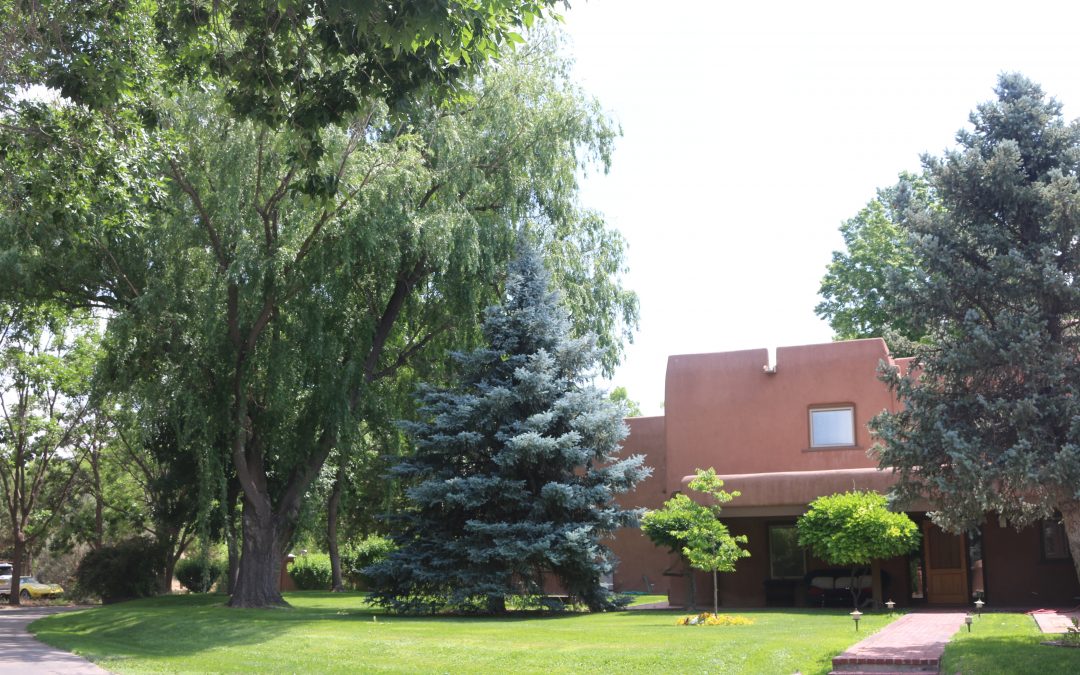
Nothing adds the same quality and value to a landscape as a healthy mature tree. Trees are so important to our community now and for future generations. The benefits include cooler outdoor spaces and homes, aesthetic appeal, carbon capture, stormwater mitigation, and more. There are some key things to think about when it comes to keeping your tree happy.
The two best things we can do for our trees are simple. We can reasonably and regularly irrigate the trees and apply a layer of organic mulch over the root zone.
The roots of our trees lie in the dry desert soil, waiting for water. In the arid Southwest, our soil also lacks living and dead organic matter. The water that falls on our land falls either infrequently, too little or too much all at once. Still, the plants and trees persist. It is up to us, the human caretakers of these places and trees, to do whatever we reasonably can to provide them with what they need to survive.
Watering Trees:
- Newly planted trees (planted within one to three years) are more susceptible to damage from dry conditions and should be watered more frequently than established trees. Aim to water them to a depth of 24 inches three times a month in the fall and twice a month in the winter.
- Evergreen trees lose water through their needles in the dry winter air. They need more stored water going into the winter season to make up for that. In addition, cold dry winds can strip water from evergreens faster than their roots can absorb it. That’s why it is especially important to provide enough water in the fall and during dry, warm spells in the winter. Water evergreen trees to a depth of 24 inches twice a month during the fall and once a month in the winter.
- Even though they lose their leaves, deciduous trees also should not get too dry in the fall and winter. Water acts as an insulator for both the tree and soil. Soil that stays moist will be warmer. Likewise, plant cells that are plump with water will be less susceptible to damage from the cold. Water deciduous trees to a depth of 24 inches twice a month during the fall and once a month in the winter.
- When watering any tree, remember to apply water out to the edge of the tree’s canopy drip line. Most established trees have a root spread equal to their height and beyond. Watering to the right depth depends on your specific soils, so you will want to measure how much water it takes to reach 24 inches deep in your soils.
- Since every tree in every yard is different, how often you’ll need to water your trees largely depends on how quickly water moves through the soil. In sandy and gravelly areas (Westside and Foothills), the water passes through the soil quickly, moving past the tree roots. These types of soil need watering more often but with less water each time. On the other hand, the best way to water soil that has more clay in it is to irrigate less often but with more water. This kind of soil holds more water, but that water moves slowly. Be careful not to overwater, especially near the trunk.
How cany you tell how deeply you are watering your trees? After a day, when the water has soaked in, the soil should be moistened about 16-24 inches deep. Poke a thin piece of metal (a long screwdriver or something similar will work) into the ground and see how deep you can push it in. That will tell you approximately how deep the water penetrated the soil.
Adding Organic Mulch to Trees:
- Shredded wood chips, which can be obtained from a tree service or a local vendor, are the ideal mulch. No matter what soil type and irrigation pattern you have, putting approximately 3 inches of shredded wood chip mulch directly on the soil does wonders for your trees. As with any mulch, wood chips cover and cool the soil and reduce evaporation. They also reduce weed growth. As the chips decay, they foster the development of a forest-like soil ecosystem with minerals and soil fungi, which is just what tree roots really benefit from. Think of the ground surface in a forest — bits and pieces of old trees, slowly decaying at the surface. Adding a thick layer of organic mulch is the only way to replicate those forest conditions in our urban environments.
What harms a tree? Things that harm the root system (soil compaction, drought, heat, chemicals), things that damage the root flare (stem girdling roots, mowers, construction), things that damage the living rind (wire girdling, kids with hatchets, vehicles) and things that damage leaves (over pruning, certain herbicides, heat). There are feedback loops, especially between the roots and the leaves. Root damage that reduces water uptake leads to leaves making less sugar which means fewer resources to grow new roots. Herbicide damage that deforms leaves leads to less sugar feeding root function as well as less pull on the water, both leading to less water and nutrient uptake going back to the leaves. The life for a tree in Albuquerque is difficult and just one of the aforementioned insults can be the small push which sends a tree into a slow death spiral.
How to Avoid Harming Your Tree:
- Protect roots by covering the soil with 3 or 4 inches of shredded wood chips. Avoid cutting roots over one inch when possible; when absolutely necessary, use a sharp, sterilized pruning saw to make a clean cup, cut as few as possible and cut as far from the trunk as possible. Don’t compact soil by dumping gravel or parking on the root zone. Don’t apply herbicides to the root zone, which is larger than the canopy above.
- Protect the leaves by avoiding over pruning. Most mature trees don’t need regular pruning, and, in fact, that should be avoided. Pruning takes away energy sources (leaves) and creates energy sinks (wounds that must be dealt with). Excessive pruning can send a tree into a starvation spiral. Prune for specific goals. Avoid herbicides like those found in weed-and-feed fertilizers.
- Protect the living rind by taking away Junior’s hatchet. More seriously, don’t tie wires, ropes, and holiday lights around the trunk or branches unless you check them every year to make sure they aren’t girdling the tree.
Check out other great articles:
Fall Landscape Maintenance Best Practices
Maintaining and Improving Mature Tree Health
