

1. Too many different plants spread out like polka dots

Often when homeowners begin to design their yard, they get excited by the variety of plants in our Xeriscape Guide. Similarly, going to a well-stocked nursery in the spring can be like going to a candy store — you might say to yourself, ‘I’ll take one of everything!’ However, it’s good advice to resist that urge and instead attempt a more cohesive ensemble of plants and trees. Grouping plants, especially smaller ones or perennials that have less dense forms, can maximize their effect by creating masses of various sizes and contribute to the feeling of a more natural landscape. 
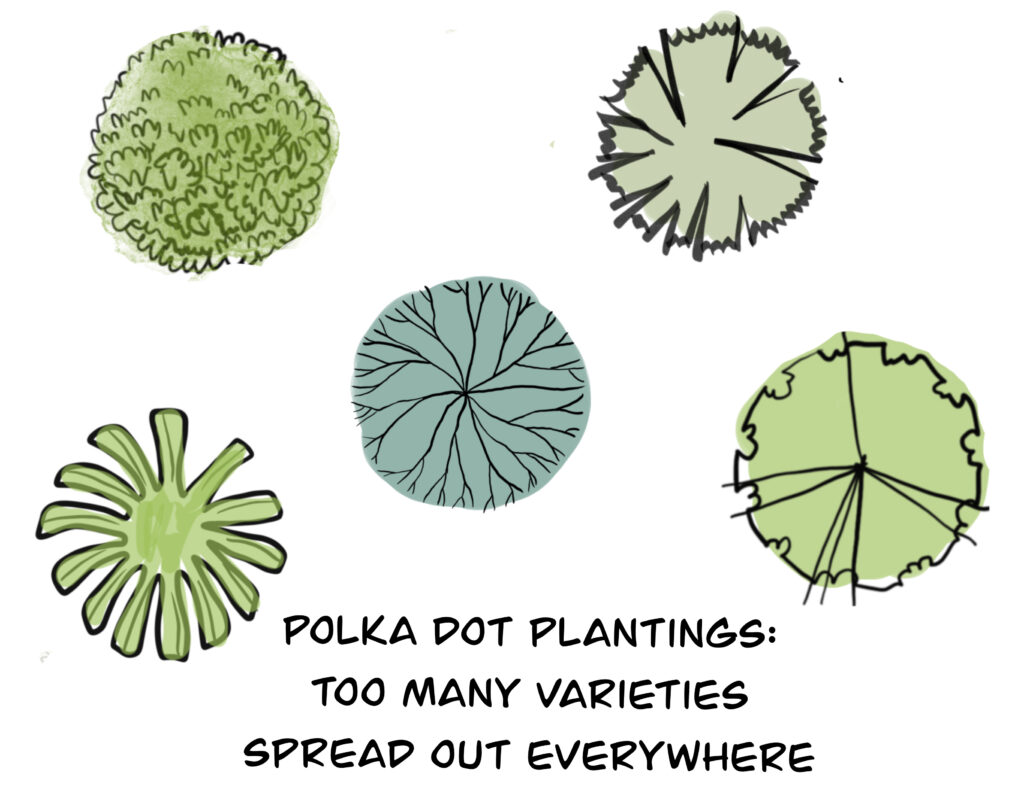
In these instances, you can pair plants that have widely different leaf shapes, like the agave and ephedra pictured below. The effect is something you wouldn’t appreciate if there was a large gap between the plants. A lot of flora have distinctive attributes like bark patterns, seedheads, dried flowers or an overall shape that allow them to stand out when accompanied by contrasting plants.
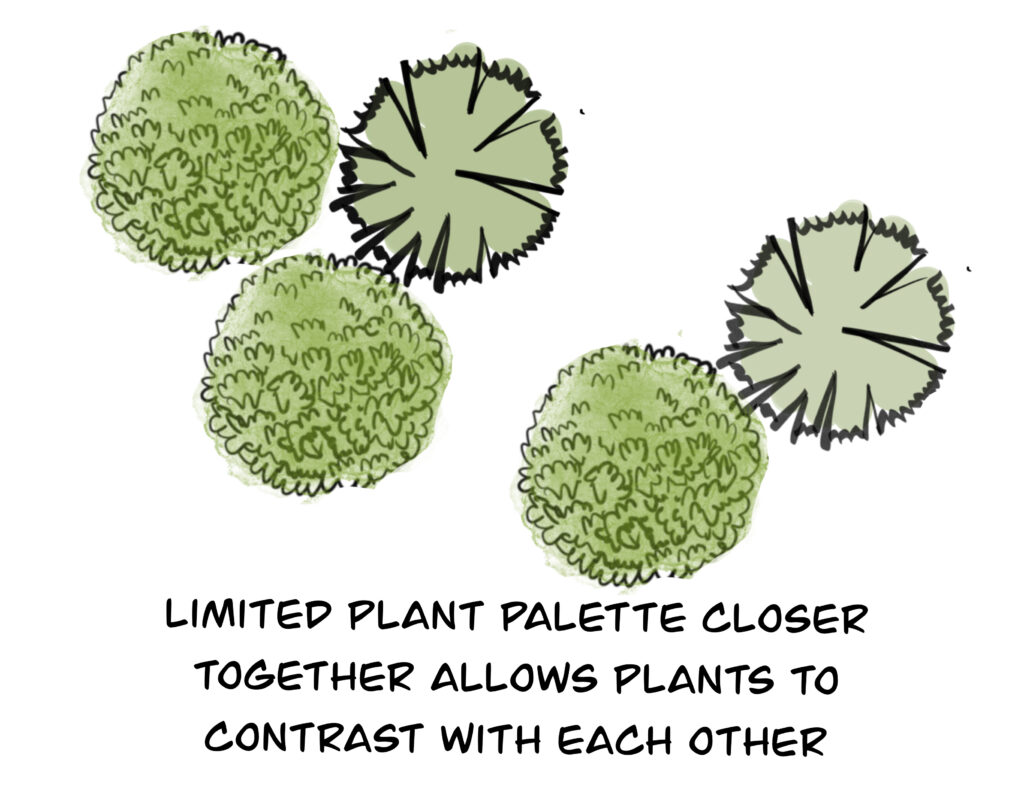
If you’re not sure where to start on your own yard design, check out our landscape templates here. You’ll notice there is a lot of variety in each design, but the same plant symbols appear next to each other throughout the yards. The three landscape architects and designers who contributed these templates have tons of combined experience designing beautiful and sustainable landscapes in New Mexico, and their templates are worth checking out!

Benefits of installing multiple plants of the same variety

  • Visual impact: Let’s take a really great flowering perennial like Gaura or whirling butterflies (Oenothera lindheimeri) as an example. It has airy small white (or light pink) flowers less than an inch wide atop thin branches that sway in the breeze — visually it doesn’t stand out unless you’re right in front of it. If you were to plant a single specimen of Gaura in the middle of a yard it could almost disappear.  Instead, we suggest a group of three in a triangle or row closer to paths or windows to maximize their impact — just like they’ve done in this photo taken at Presbyterian Rust Medical Center on the West Side.
  • Attracting pollinators: Grouping flowering plants that attract pollinators can really make it worth the effort for them to visit. Perennials bloom at different times from spring to fall, and in a small yard you may have only one type of plant flowering at a given time. A group of at least three of the same perennial will be hard for pollinators to miss as they go about their business of collecting pollen and nectar. Then they’ll be able to save their energy for building nests and breeding.
  • Reduced maintenance: If you’re new to xeriscaping or gardening, having fewer varieties of plants in groups can make maintaining them (and learning names and growth habits) less overwhelming. Instead of starting out with a mishmash of plants installed everywhere, you’ll be able to get your head around the maintenance more easily because the yard is divided into manageable areas. Also, if you pay someone for yard care, you may need to explain to them when, how (and if) to do the work. A smaller plant palette grouped by variety can help simplify the job. You could say to them: “This year for all the woody evergreen shrubs next to the sidewalk, don’t use hedge trimmers but do remove one-third of the oldest branches at the base.” 

So if you head to the nursery to buy 10 plants this spring, consider coming home with just two or three varieties that together will make a real impression.

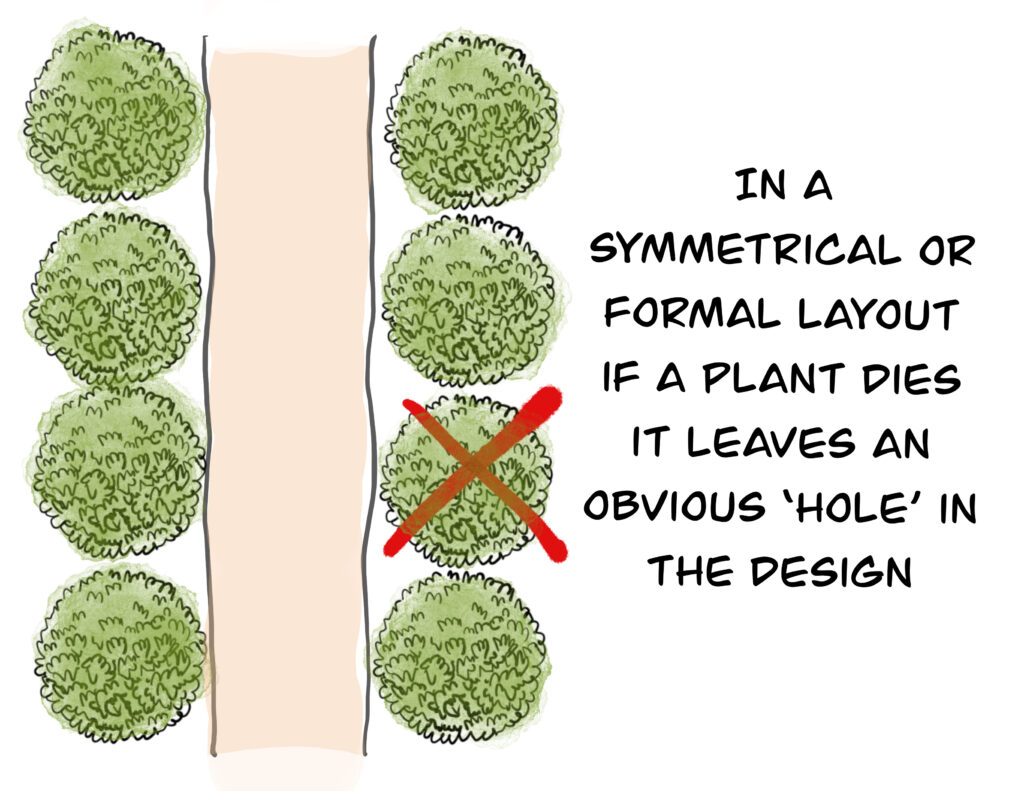
2. Symmetrical vs. informal plant layout

Another mistake DIYers sometimes make when designing landscapes is opting for a symmetrical layout for the new plants. For instance, they will have corresponding rows of evergreen shrubs on either side of a path as shown below. There are a couple of reasons why this is less than ideal. One is that an unhealthy plant (or worse, one that is dead) is immediately noticeable. Also, in a formal layout, you’re anticipating that the plants will grow to a uniform size and shape. However, this is not the case with native and xeric-adapted plants (and most plants, really). Once in the ground, they’ll be responding to all sorts of different conditions. Too much shade from a nearby tree limits a plant’s mature size, or extra water from the roof causes one to get larger than the others, for example. And if you did need to replace one plant in a formal layout, it could take a while for the new one to catch up to the others (assuming you able to find the same variety as the originals).  
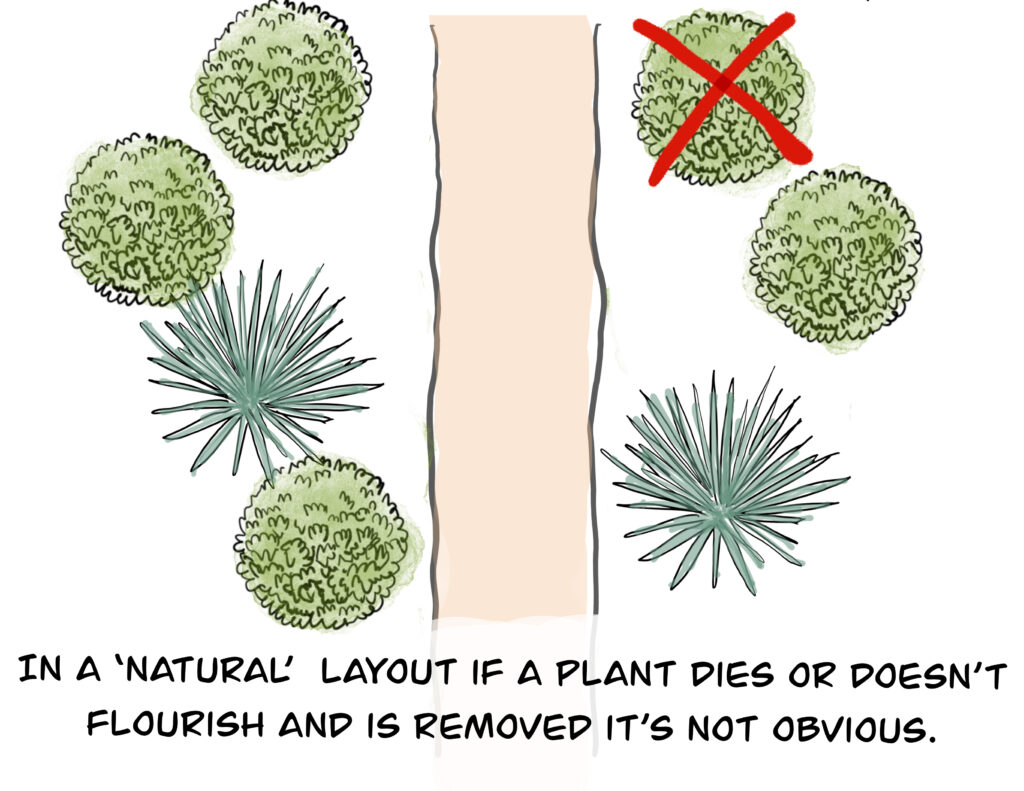
In an informal or “naturalistic” layout, a missing plant is not an issue because there’s not an expectation for that space to be filled. It also allows flexibility in the design — shade-loving plants near the tree, plants that can handle more water under the downspout. If a particular plant isn’t doing well, you can transplant it to another location. Using an informal or naturalistic planting design allows you to add to your garden over time as it matures and changes for years to come. 
Selecting plants for your yard can feel overwhelming to a new gardener. We hope these tips help you avoid common mistakes, and remember that we're always here to support you. If you have questions about plant selection, feel free to send photos and details of your yard to askanexpert@abcwua.org — we’ll be happy to help.

Learn more here:

Let’s Plant Albuquerque

Simple Steps to Get Started Designing your Yard

Desert Friendly Design Templates

Author: Carl Christensen, Xeriscape Inspector. Have a question about the article or anything else? AskAnExpert@abcwua.org

Water-Wise Vegetable Gardening

With our hot summers and low precipitation, growing vegetables in NM can be
challenging. This talk will provide strategies and recommendations for growers to
cultivate a thriving vegetable harvest in the region. Discussion will include irrigation and infrastructure suggestions, as well as selection of vegetable varieties that are well-adapted to the area.

Instructor: Stephanie Walker, PhD. Professor and Vegetable Specialist, New Mexico
State University, Extension Plant Sciences Department.

Maintaining Tree Health During Drought

Learn from Albuquerque’s leading tree expert how to identify drought stress in trees,
understand their responses to drought, and implement strategies to keep them alive and thriving in hot, dry weather.

Instructor: Joran Viers, Board Certified Master Arborist and Municipal Specialist,
International Society of Arboriculture (ISA). Senior Arborist, Legacy Tree Company,
Albuquerque. Former City Forester, City of Albuquerque

Creating a Drought-Tolerant Refuge for Yourself and Wildlife

Instructor: Laurel Ladwig, M.S. She is the ABQ Backyard Refuge Program Director for the Friends of Valle de Oro National Wildlife Refuge, a part-time faculty member in the Department of Geography and Environmental Studies, and Associate Director of the R.H. Mallory Center for Community Geography at the University of New Mexico and is enthusiastic about all opportunities to encourage people to develop a relationship with our wild neighbors.

Designing Resilient Landscapes: Plant Adaptations, Communities, and Selection for Arid Environments

Instructor: Maria Thomas is the Curator of Plants at the ABQ BioPark where she manages the botanical exhibits, plant collections, horticultural staff, and related programs for the 150-acre public park and garden. Additionally, Maria is an Adjunct Professor at the University of New Mexico in the Landscape Architecture department.

Climate-Ready Trees- Planting for a Warmer and (Hopefully) Shadier Future

Instructor: Marisa Y. Thompson, PhD Extension Urban Horticulture Specialist. New Mexico State University Department of Extension Plant Sciences, Los Lunas Agricultural Science Center, Think Trees NM, President of the Board (2023-current).

Plant Adaptations to Heat & Drought

Noticing the Ways Plants Thrive in our Yards and Natural Areas Learn how to Recognize Drought-Adapted Traits in Everyday Plants all Around Us.

Instructor: Marisa Y. Thompson, PhD Extension Urban Horticulture Specialist. New Mexico State University Department of Extension Plant Sciences, Los Lunas Agricultural Science Center, Think Trees NM, President of the Board (2023-current).

Hose Bib Tree Irrigation System for Your Trees: Simple Systems for Thriving Trees!

Instructor: Richard Perce has twenty years’ experience working with trees and irrigation here in New Mexico. He is a former certified arborist and currently holds the Irrigation Association’s Landscape Irrigation Auditor certification and is a certified QWEL irrigation instructor. He worked as a landscape contractor for more than a decade and is the Water Authority’s former Irrigation Efficiency Specialist. He also has a Masters of Community and Regional Planning from UNM and currently works at Anthropopulus Design + Planning.

Passive Rainwater Harvesting

This workshop introduces participants to the principles and practices of passive rainwater harvesting. Attendees will learn how to capture, slow, spread, and infiltrate rainwater into the landscape using simple, low-cost methods such as swales, berms, and basins. The workshop emphasizes working with the natural flow of water to reduce runoff, prevent erosion, and support healthy soil and plant life. By implementing passive rainwater harvesting, participants can conserve water, and create more resilient, self-sustaining landscapes.

Instructors: Anthony Luketich, Natural Resource Scientist, Anthony Luketich is a Natural Resources Scientist for Bernalillo County where he is focused on water conservation and water-wise landscape practices. He received a degree in Watershed Management and Ecohydrology from the University of Arizona where he studied the relationship between trees and water. Anthony has worked across the Southwest US as a research scientist as well as a water harvesting field technician where he became a certified water harvesting practitioner.

Bobby Mullin, Natural Resource Scientist, Bernalillo County Stormwater Quality Program Bobby Mullin is a Natural Resource Scientist for Bernalillo County in the Stormwater Quality Program. He focuses on improving stormwater quality in the Middle Rio Grande Watershed and promoting sustainable and resilient landscapes using Green Stormwater Infrastructure and rainwater harvesting. Bobby received his Bachelor of Science in Environmental Science from Bucknell University in 2011. Before joining Bernalillo County, he had worked as an environmental consultant remediating contaminated soil and groundwater and as a Research Scientist studying the impacts of climate change, drought and plant mortality in New Mexico ecosystems.

Xeriscape: The Desert Friendly Yard

Join us for learning all of the tips, and benefits of our Xeriscape program!

3 Steps to Landscape Success

Service, Settings, and Selection are the keys to landscape success!