Now that the weather is colder, curl up with a book and
learn more about our global and local water resources.
Here are a few of my favorites to get you started. If you’ve
got a water book to recommend for future newsletters, please email me at kyuhas@abcwua.org
For a thought-provoking read about the effect of rising sea
levels throughout the world, pick up The Water Will Come: Rising Seas,
Sinking Cities And The Remaking Of The Civilized World by Jeff Goddell. He
uses a blend of science and first-person accounts to create an engaging and
informative read. This book made many top book lists when it was released in
2017.
Replenish: The Virtuous Cycle of Water and Prosperity by
Sandra Postel explores many projects, including some in New Mexico, that work
with nature to enhance and preserve the earth’s water resources. Ms. Postel is
a world-renowned water expert we’re lucky to have living with us here in New
Mexico.
Another New Mexico book is A Song for the River by
Philip Connors. This is beautiful, meditative exploration of his time in the
Gila National Forest and of the Gila River. Those who want more of Mr. Connors’
writing on the Southwest should also pick up the multiple award-winning Fire
Season: Field Notes from a Wilderness Lookout.
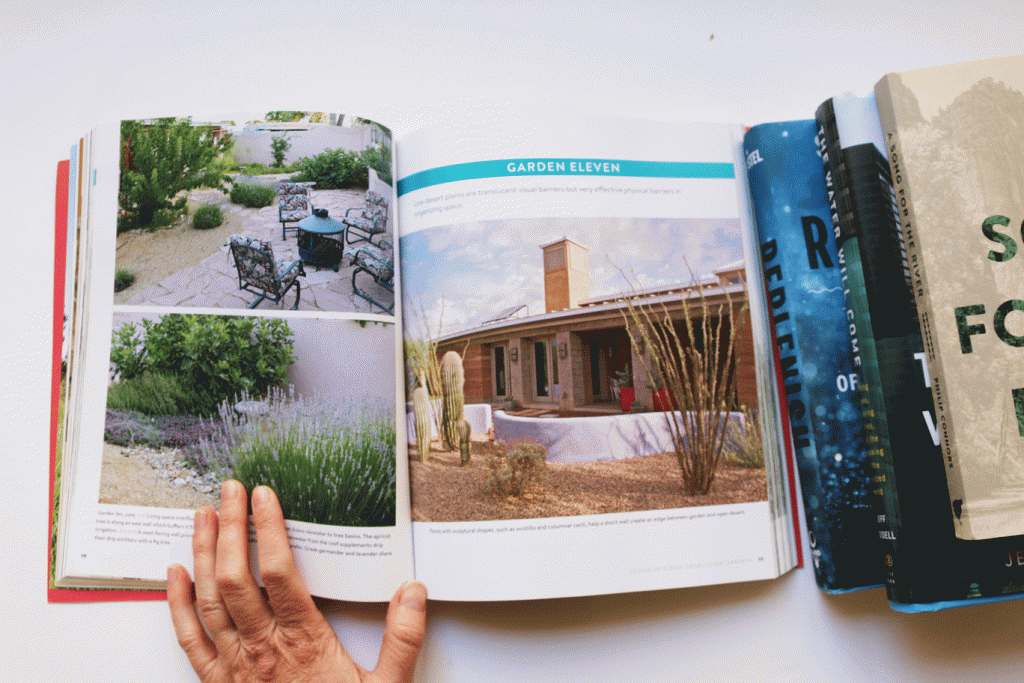
Finally, for those who want to get started dreaming about their
spring garden, try Growing the Southwest Garden: Regional Ornamental
Gardening or any of the other gorgeous, picture-laden titles by Judith
Phillips, another author we are lucky to call our own. Her beautiful books can
be found at local bookstores and libraries.
Author: Katherine Yuhas, Water Resources Division Manager with Albuquerque Bernalillo Water Utility Authority
One of the
great advantages of desert-adapted plants is the wealth of colorful flowers
they produce, a boon to gardeners and pollinators alike. Plants that bloom in
autumn offer pollen and nectar for insects and, if the seed heads are left to
ripen, a late season food source for birds.
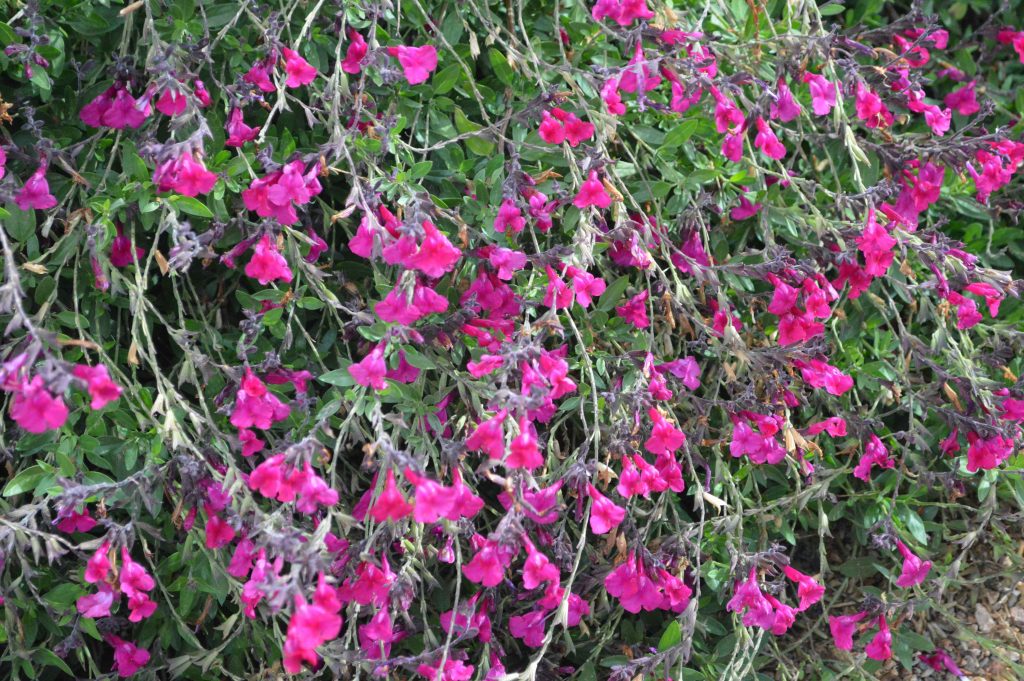
After a long hot summer, some plants think the cool of fall means it’s spring again and burst into bloom with renewed vibrance. Salvia greggii is commonly called autumn sage because, even though it flowers brilliantly in spring and lightly all summer, fall brings on another strong show. Responding to the cooler, longer nights in autumn, Salvia’s late season color becomes even more intense. Autumn sage is a compact shrub that grows 2-feet tall and 3-feet wide, with small dark green leaves and spikes of flowers in red, rose pink, coral, purple or white. Hummingbirds and bees are frequent visitors. Autumn sage prefers well-drained soil and deep watering (24 to 30 inches) every week or two while blooming, monthly or less in winter.
Autumn sage, Salvia greggii
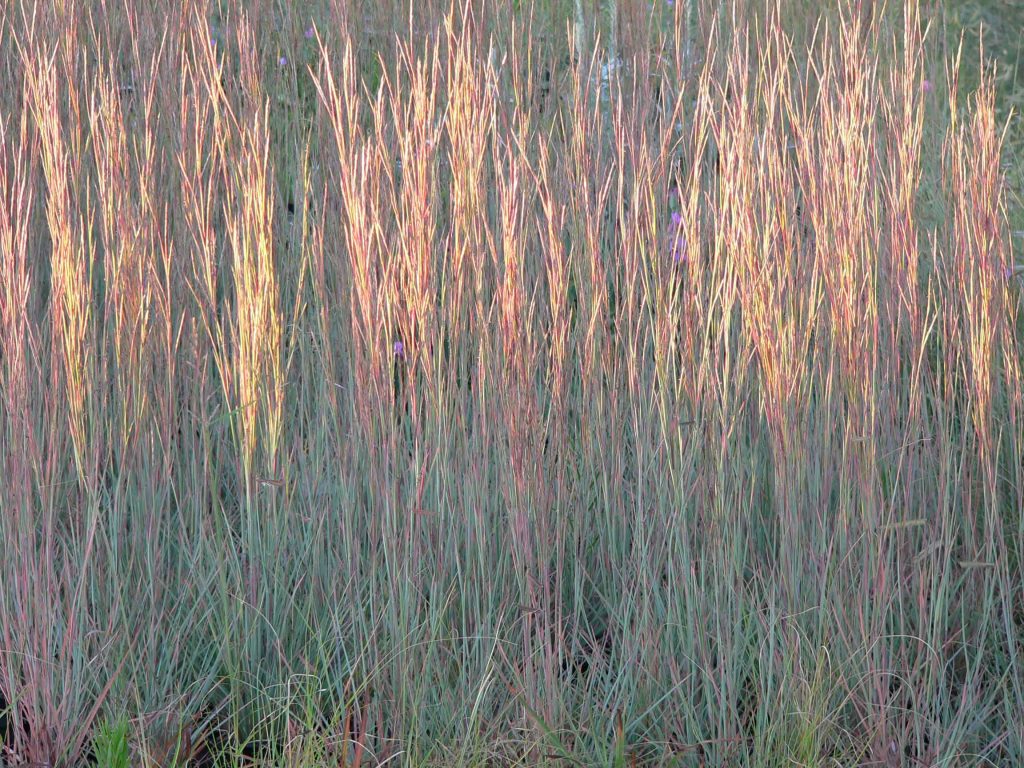
Many ornamental grasses are their showiest in autumn, too. There are several varieties of little bluestem Schizachryium scoparium with 12-inch wide clumps of narrow blue-green leaves and 24-inch tall slender stems bearing fuzzy seed heads. ‘Blaze’ little bluestem turns scarlet in fall and ‘The Blues’ turns a beautiful pink. Both keep their color into winter when they fade to a rich bronzy brown. The color is our reward for supplying the little extra water these grasses need.
Native grasses are also important larval food for butterflies and produce nutritious seeds for songbirds, bringing color on wings to the garden. Since the seed heads are a large part of the reason they are planted, ornamental grasses should be left uncut until early spring. Then, trim them a few inches from the ground so the new growth is not stymied by having to push through old stubble to reach sunlight.
Little bluestem Schizachryium scoparium
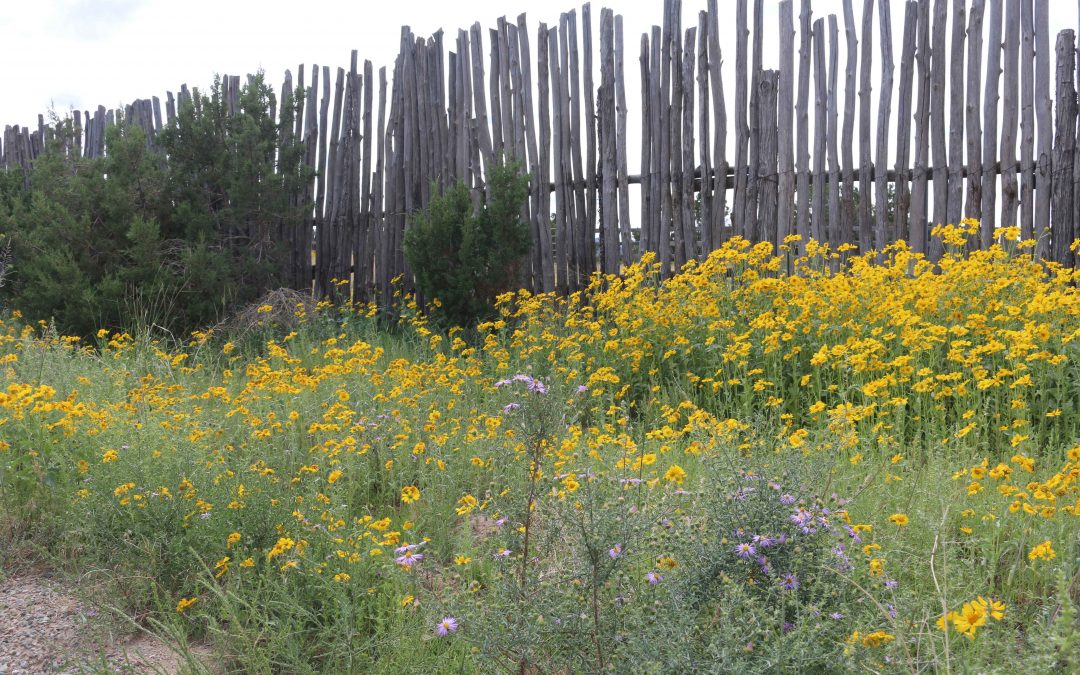
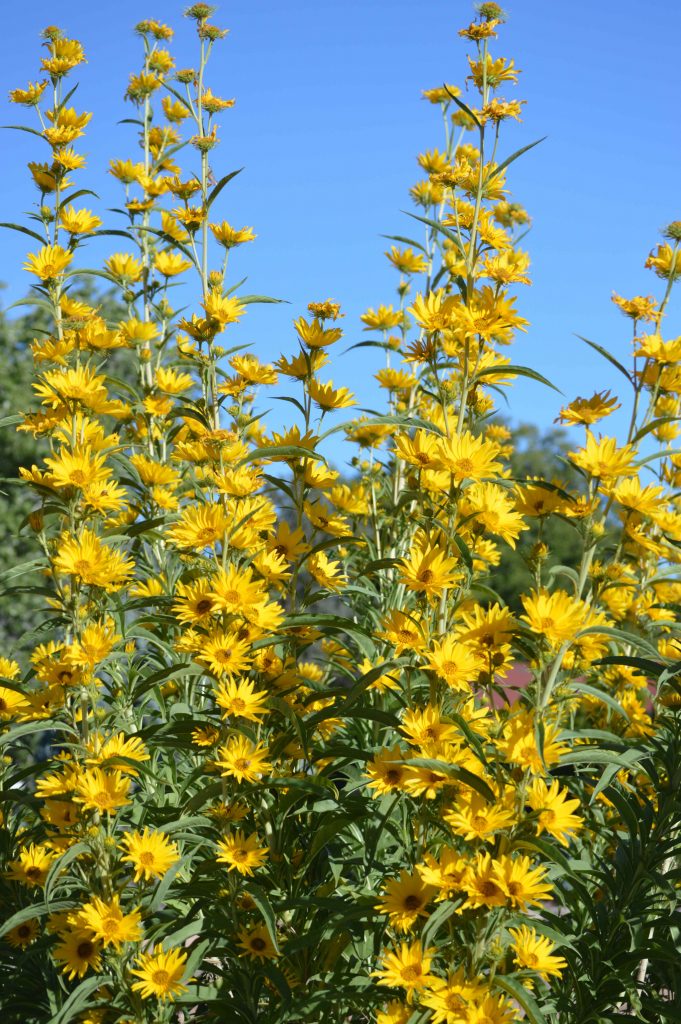
Perhaps the most spectacular late blooming perennial is the Maximilian sunflower Helianthus maximiliani. By early autumn, its flower stems are 5 to 7-feet tall. Established plants can spread 4 or more feet wide, shooting up dozens of flower stems. The top few feet of the stems are covered in 2-inch wide yellow sunflowers with yellow centers abuzz with bees. The show can last for several weeks in September or October, but after the flowers fade the plants become a bird buffet of seeds well into winter. Maximilian sunflowers grow best in soils that hold water well and produce the best show when watered to a depth of 2 feet weekly during the growing season, every two weeks in spring and fall and monthly or less in winter.
Maximilian sunflower, Helianthus maximiliani
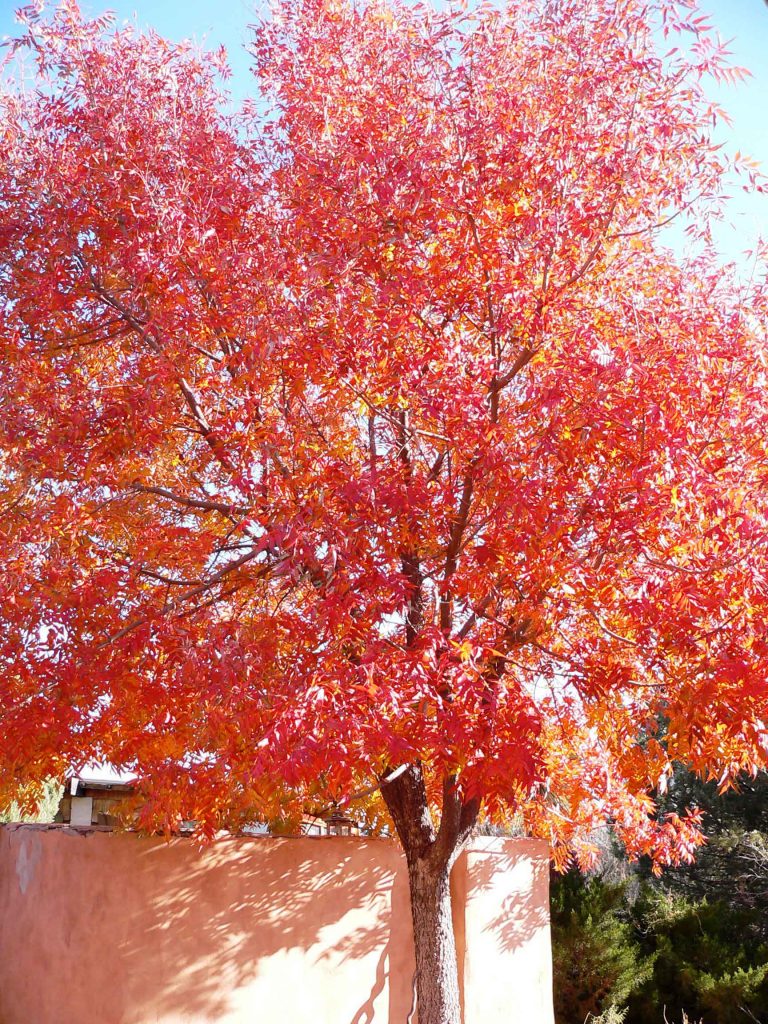
Flowers aren’t the only source of fall color, either, but red leaves in fall are not the norm in New Mexico. Cottonwoods in the Bosque and aspens in the mountains are our autumn gold. Chinese pistache Pistacia chinensis has become one of the most dependable heat and drought tolerant shade trees and adds splashes of red fall foliage in the ABQ metro area. A great shade tree that is 20 to 30-feet tall at maturity with a canopy spread of 20-feet, Chinese pistache benefits from structural pruning while it is young to assure strong branching. Once well rooted, it should be watered at the edge of the branch canopy to a depth of 2 to 3 feet every few weeks during the growing season and monthly or less depending on winter moisture.
Chinese pistache, Pistacia chinensis
Author: Judith Phillips, owner of Design Oasis, landscape designer and garden writer with 30 years experience designing arid-adapted and native gardens in the high desert.
While it is fantastic living in the Southwest
where the sun shines over 310 days a year, sometimes landscapes and homeowners
alike crave shade. Large trees provide great shade but may take a long time to
grow. So to create fast shade for patios and windows, choose vines. Luckily
many vines grow well in Albuquerque, including evergreen vines, flowering
vines, fruiting vines and many more. Below are four favorites of 505Outside for
the Albuquerque area.
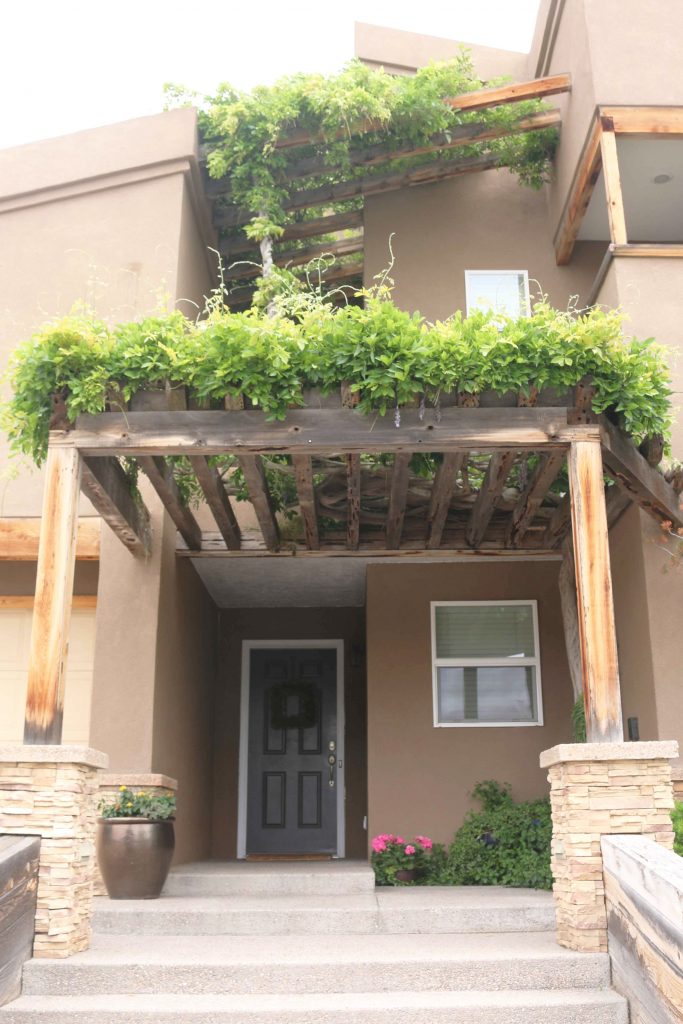
1. Wisteria, Wisteria sinensis: The pendulous lavender flowers of this vine are some of the first to bloom in the spring. Bright green leaves follow shortly thereafter, filling up the plant and creating lots of dappled shade below. Once the flowers fade, the leaves fill in to provide dense shade in the summer. Prepare for wisteria vines to get woody over time. Strategic training of the stems is also recommended. Wisteria grows well in sun, shade and part shade. Mature height and spread are 25’ to 30’ x 25’ to 40’.
Wisteria growing over a front door trellis.
2. Lady Banks Rose, Rosa banksiae: Rarely do you find a plant that is fast growing, evergreen and long-lived. Lady Banks Rose is all those things, and it produces a beautiful if brief show of flowers in spring. And it uses surprisingly little water. This plant grows large and, unlike most roses, blooms on old wood.
3. Trumpet Vine, Campsis radicans: Orange and yellow trumpet-like flowers grace this beautiful deciduous vine. Train it to grow onto a shade structure. It is a fast grower but you must provide a strong enough support and enough space for this vigorous rambler.
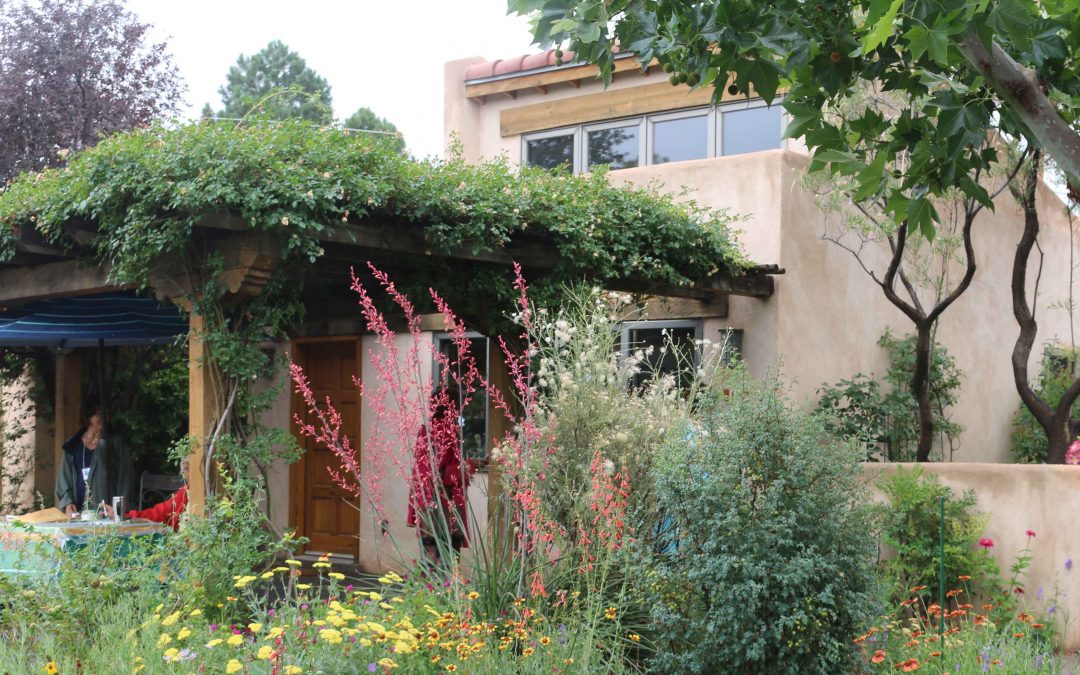
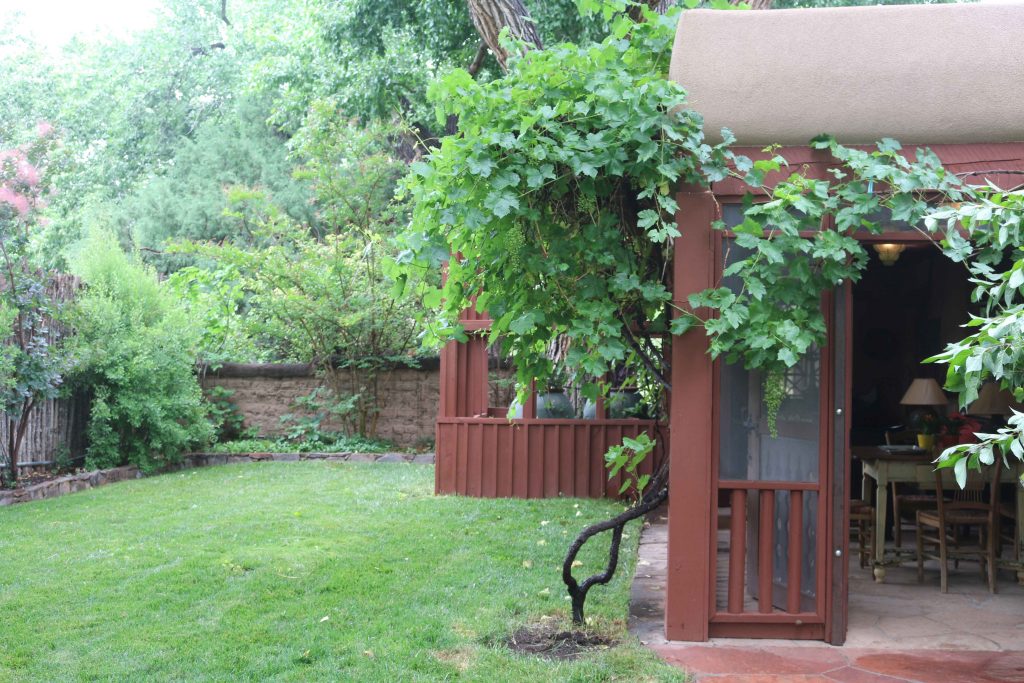
4. Grape vines, multiple varieties: New Mexico is one of the oldest grape growing regions in North America. For covering a trellis or arbor look for vigorous growers. Grape vines like to have moist feet during the first year of establishment. Grapes will grow wild and crazy if not trained and strategically pruned during the winter months. They also need constant redirecting, so tie the vines to the trellis with twine, checking on it every other week during the growing season. These are deciduous so be prepared for a sculptural woody vista throughout the winter months.
Grape vines growing next to an outdoor patio.
Try growing any of these vines on open lattice ramadas, arbors and pergolas. While wood is the most often used material for these structures because it is simple and easy to build, in the Albuquerque climate steel is an ideal choice. Steel structures are strong, long lasting and maintenance free. No matter what material you choose, creating living shade with vines can be rewarding.
Author: Jill Brown, ASLA Landscape Architect and owner of My Landscape Coach in Albuquerque, NM. Resources: Down to Earth, A Gardener’s Guide to the Albuquerque Area by Albuquerque Area Extension Master Gardeners. Growing the Southwest Garden and New Mexico’s Gardener’s Guide by Judith Phillips.
A lot goes into designing a landscape, hence there’s an entire profession called landscape architecture devoted to designing outdoor spaces. We won’t be able to make you a landscape architect today, but we’re sharing six steps to get you started on a great landscape design.
Brainstorm what you want in your yard.
Think of this as a “brain dump,” which simply means you’ll transfer to paper all the things you are considering, imagining, and dreaming of for your yard. First, find a window that looks out onto a part of your yard. Set up a chair there, grab a pen, clear your mind and set a timer for five minutes. Now write down anything and everything that comes into your head that involves your yard. Ready, set, go.
Make a plan.
As the old saying goes, “All good things start with a plan.” It’s true! Think about how you approach your job; more than likely you have a general strategy about the steps you are going to take to perform the tasks on your to-do list. It’s the same with your yard: Developing a plan will save you time and money, and is more likely to result in a successful end product.
What is a plan? When it comes to landscapes, a plan is a scaled drawing showing your yard from a top-down perspective. To make sure the dimensions are accurate, it’s helpful to start with a “map” of your existing yard. You can use either a scaled aerial photograph or a surveyor’s plat drawing of the lot on which your house sits, or both.
Scaled aerial photograph. Numerous websites provide free aerial photography. Google Earth Pro, which can be downloaded for free, allows you to measure distances and save snapshots of satellite photography with a scale bar included. Though this next step will be a challenge, the aerial photograph can then be opened in a program like Microsoft Paint where you can change the size of the photo and get it to a standard scale (like 1”=10’). Resizing the aerial photograph to a larger-than-normal page size, like 11”x17”, may make it possible to fit your entire property onto one sheet at the desired scale. Don’t forget that you can print large pages at a commercial print shop.
Surveyor’s plat drawing.What is a plat? It’s a map, drawn to scale, showing the divisions of a piece of land. This should be included in the huge pack of documents you received when you bought your home. It should show overall property boundaries, and basic dimensions of the home. It sometimes includes existing features such as driveways, and exterior structures like sheds. If it does not show these, you can use a tape measure to measure the structures and hardscape areas such as patios, driveways or sidewalks then note them in pencil on the survey plat.
Once you’ve got your aerial photograph or surveyor’s plat, you may want to buy a book of tracing paper, which is see-through and will enable your next steps.
Take stock of what’s in your yard now
You’ve written down what you want to have in your yard, and you’ve got a photo or drawing showing the actual size of your landscape. Now you are ready to take stock of what’s already in your yard. Put a piece of tracing paper on top of your aerial photograph or plat plan, and head outside. You’ll want to populate your tracing paper with information on existing conditions like plant locations and names, patio positions, roof downspouts, and drainage patterns. Be sure to locate any special site features, identify problems such as erosion, excess runoff, ugliness and decline, and identify positive attributes such as a good view, a nice specimen plant or typical travel patterns.
You’ll want to note compass directions on your drawings, since we experience large temperature swings in New Mexico it’s important to note the different levels of sun exposure in your yard. Typically, the south side of your house will receive sun all day long. Compare this with the north side of your house, or northern exposure, where the ground is shaded most of the day. Once you understand the different microclimates of your yard you’ll be able to choose plants that grow best in those conditions.
It may be helpful to use multiple sheets of tracing paper that can be layered to create a full picture of your yard’s existing conditions. For help identifying underground utilities (like water lines) in your yard, call 811 (See https://www.pnm.com/call-before-you-dig1 for more information).
Analyze your landscape — do you have enough space for what you want?
Now that you have identified all the existing elements in your yard, you can reflect on how well those elements are working. Take some time to walk around your yard and think through all your existing elements and spaces. Keep these questions in mind: Why is this located here? How does this space relate to the others? What are the pros and cons of my existing spaces?
These questions will help you analyze your yard. Through that process you’ll discover constraints and opportunities for improvement.
Research other landscape designs to get ideas for your yard
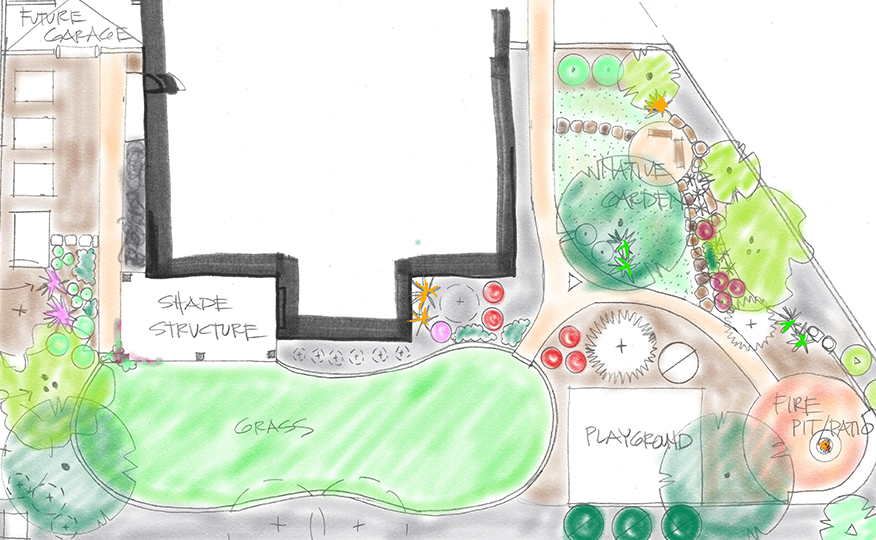
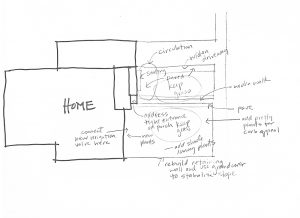
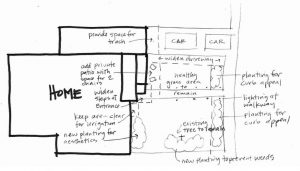
Now that you’ve done the hard work above it’s time to look at other people’s designs for some inspiration. The templates provided here were designed for the Water Authority by local landscape designer Judith Phillips, and landscape architects George Radnovich and David Cristiani. These templates can serve as thought-starters to guide homeowners in creating beautiful waterwise landscapes with color, logic, beauty and purpose.
You’ll want to read through each design and note the aspects of each that you like. Circle your favorite plants, materials and how they shape certain spaces. All of this will help inform your landscape design.
George Radnovich orchestrates an elegant, simple mixture of ornamental plants and features for north-facing xeriscapes.
Draw out your own design
Now it’s time to try this for yourself. Grab your list of wants from your “brain dump,” pull out your plans with all your notes, and lay out the design templates in front of you. A pen, pencil, rule or scale bar, and some tracing paper will be everything you need to start marking up your plan with your new design ideas.
This is the fun part, all the stuff you just brainstormed, inventoried, analyzed and learned can all come together to help you design a really great landscape. Draw out as many ideas as you like and have fun with it. You are now on your way to a beautiful yard!
Author: Jill Brown, ASLA Landscape Architect and owner of My Landscape Coach in Albuquerque, NM.
These free desert friendly designs were designed for the Water Authority by local landscape professionals Judith Phillips, George Radnovich and David Cristiani. These templates can serve as blueprints and thought-starters to guide residential and business property owners in creating spectacular desert friendly with color, logic, beauty and purpose.