
Everyone should consider planting fruit trees in their yard. Because of our climate, fruit trees grow really well in our area. Besides the joy they bring when we harvest delicious fruit, they put on a beautiful show with spring flowers, create shade, and provide shelter and food for wildlife and pollinators. The Water Authority encourages the planting of fruit and shade trees by providing a generous annual rebate (click here for more information). Thinking of planting a new fruit tree? Check out our blog post about the proper way to plant trees here.
All trees require some amount of pruning, especially when young, in order to set up good structure. Fruit trees have a few special considerations related to our intense sunlight, specific pests, and where on the tree the fruit is produced.
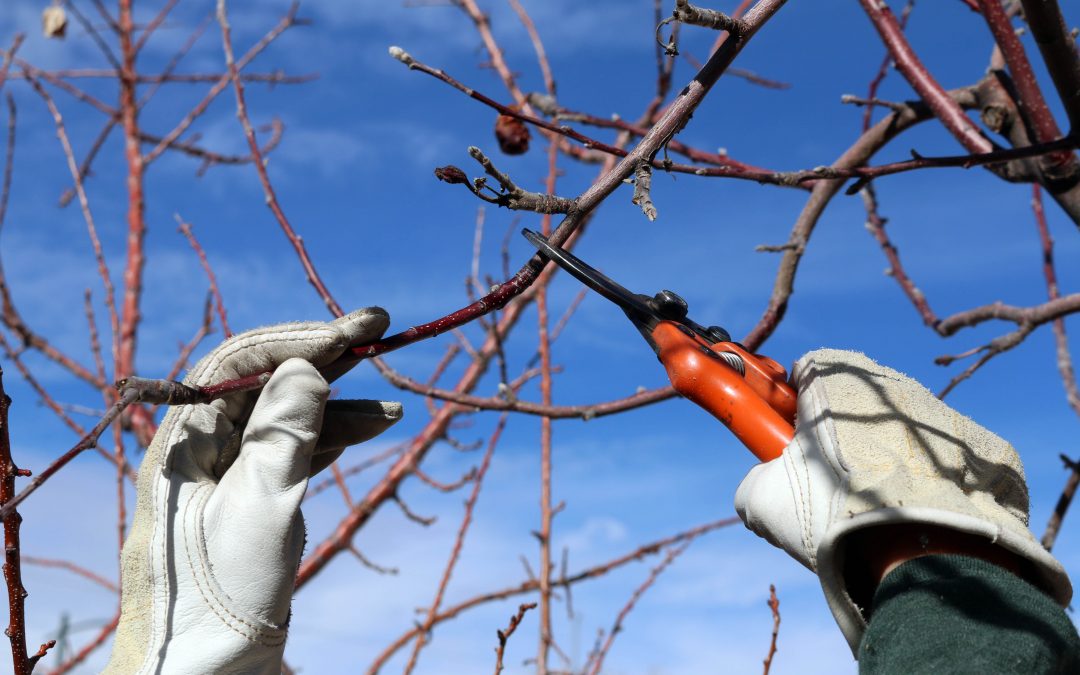
Pruning has been called “one of the best, worst practices for trees,” because removing branches and leaves limits the tree’s ability to produce energy. Pruning wounds also create a place for decay to enter the tree. You should always have a reason for pruning a tree and understand why you are making specific cuts – not just because it’s a nice day and you remember reading somewhere that you should prune your fruit tree. Pruning is good because it reduces the length of branches to prevent breakage from heavy fruit years; removes dead or diseased branches; and/or reduces limbs to keep them from rubbing against a wall.
There is a ton of great information available online and in books about how to prune specific types of fruit trees. Below are a few resources. But remember that the way you care for your fruit tree will be a bit different than that of a commercial orchard. Besides producing fruit, the tree in your yard will also provide shade and beauty, so keep this in mind when studying resources about fruit trees and deciding which cuts to make.
- NMSU Basic Fruit Tree Pruning: Fruit Trees for the Home Orchard, Pruning the Home Orchard.
- “Holistic Orchard” by Michael Phillips
- Tree Owner’s Manual
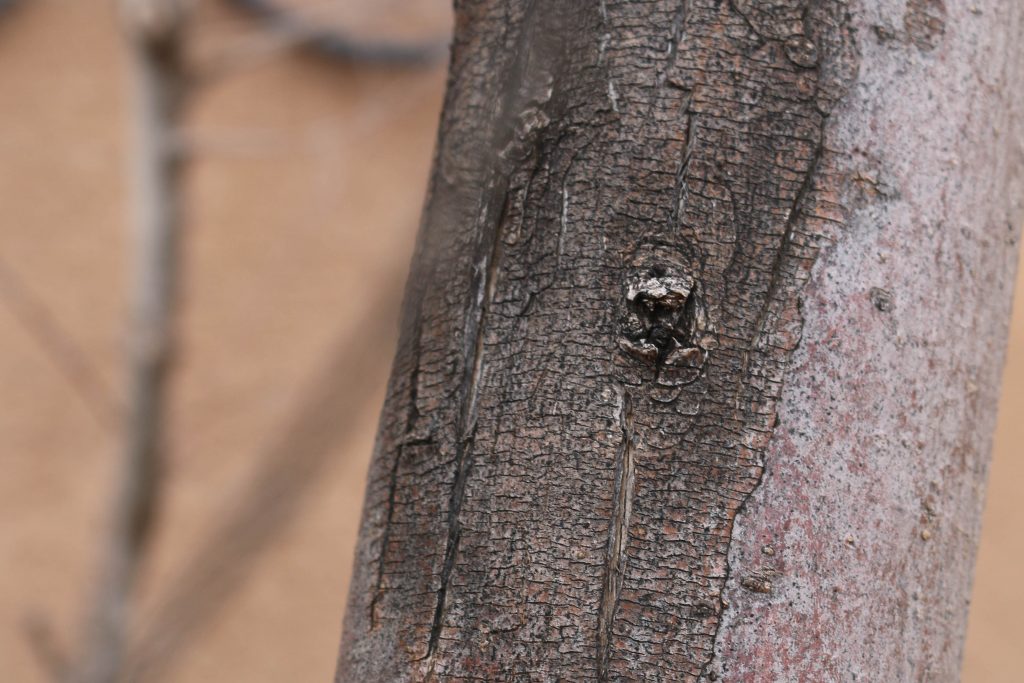
Unlike in many other climates, our intense sunlight means that over-pruning can to lead to sunscald. This occurs when a branch is suddenly exposed to bright sunlight, causing areas of the bark to become burned and crack, exposing them to disease and rot. In order to avoid this, be careful about removing too many branches from the top, south and west sides of the tree. This exposes remaining branches to intense sunlight, causing sunscald.
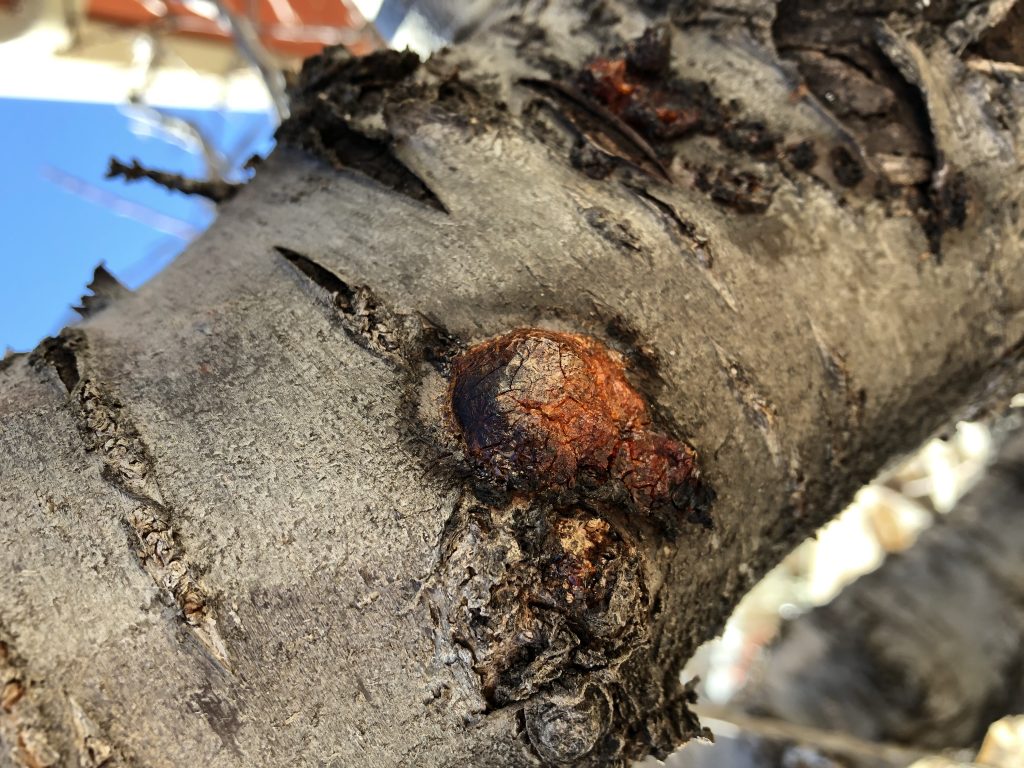
Stone fruit trees such as apricots, peaches, and cherries thrive in our area and can be really rewarding to grow. Unfortunately, there is also a pest called a borer (often referred to as a peach borer) that loves other fruit trees, too. This pest is very common and many feel that it is not a matter of if but when your stone fruit tree will get borers. Luckily a healthy tree can resist this pest on its own through natural defenses.
You can support and keep your tree healthy by doing the following three things:
- Selecting an appropriate irrigation system ensuring that it is properly watered (see our seasonal plant watering guide here)
- Adding mulch (see information about treebates for irrigation improvements and mulch)
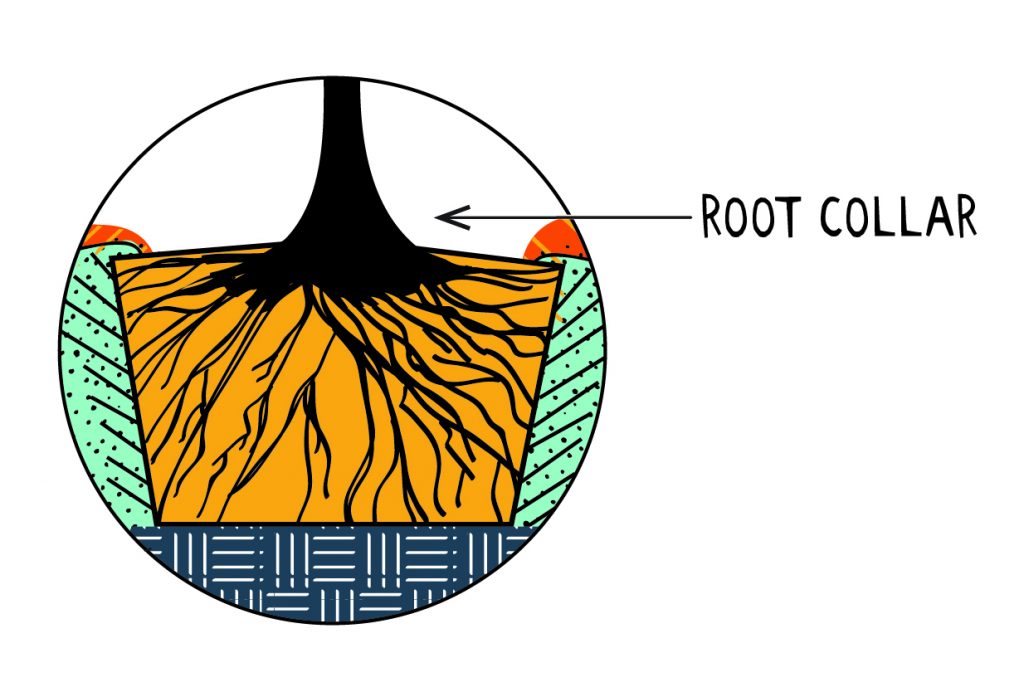
- Keeping the root collar of the tree exposed. (see tree detail)
Even trees that have borers can continue to live and produce fruit for more than a decade if they are well taken care of. Drought-stressed trees which have borers, on the other hand, often die within a few years.
If you think that you have borers in your stone fruit tree, there are several treatment options. These range from predatory soil nematodes to plant-derived and chemical pesticides that are sprayed, injected, or applied as a root drench. As with any plant pest treatment, the timing is critical. This is especially true with borers. If done at the incorrect time during the borer’s lifecycle, your effort will be completely wasted and you may kill beneficial insects that help your fruit tree. Resources or more information about borers here.
Fruit trees are usually pruned in late winter (February – early March) to adjust the tree’s structure. Summer pruning can also be done, but this is typically used to control or slow down growth. Removing dead, diseased, or dying branches can be done at any time of the year. It is important to remove dead branches so you can determine later if more branches are dying, and thus judge the general health and vigor of the tree. For young trees, it is especially important to leave as many small branches as possible. These help to produce energy for the tree as it is getting established, and can be removed later if they are not desirable for the mature tree structure. It is extremely important to never prune living branches if the tree is stressed by drought conditions.
Most fruit trees bear flower buds, then fruit, on specialized branch structures called fruit spurs. Fruit spurs will look different depending on the type of tree. Although variable, these usually occur on parts of the branch that are at least two years old, and individual fruit spurs can last for up to 10 years. In general, flower buds located on fruit spurs are fat, fuzzy and plump, as opposed to leaf buds which are pointed and flat. It’s important to know how to recognize these so you don’t prune off the coming year’s fruit harvest.
Because of how damaging bad pruning can be, and how valuable trees are, it may be worthwhile to hire an expert. Be sure that they have experience with fruit tree pruning in our area and are certified arborists by the International Society of Arboriculture (ISA). To find a local certified arborist, visit this site.

Author: Amos Arber, ASLA, ISA Xeriscape Incentive Inspector for Albuquerque Bernalillo County Water Utility Authority