
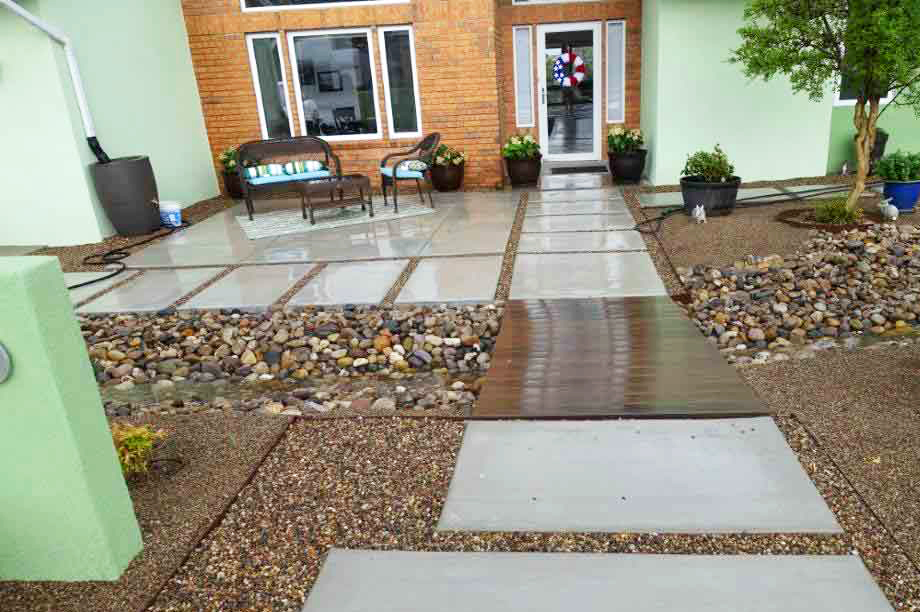
505Outside sat down with local landscape contractor Hunter Ten Broeck, owner of WaterWise Landscapes Incorporated, to chat about Water Harvesting in Albuquerque.  

There are two categories of water harvesting techniques: passive water harvesting and active water harvesting. Passive water harvesting is the practice of slowing water down and encouraging it to soak into the ground. Water is collected from the source (roof, canale, downspout, or sloped earth) and directed to the landscape where the water can be immediately used by the plants. Active water harvesting uses rain barrels, cisterns, and other types of containers to store rainwater for later distribution. These typically hold as few as 200 gallons of water up to 10,000 gallons. A good calculation to remember is 1” of rain on a 1000 sq. ft. roof equals about 600 gallons of water.

Hunter says the key to any type of water harvesting system, whether active or passive, is to incorporate it into the landscape design. Thinking through how the rain water will interact with your landscape and designing for that should be first and foremost.

When asked what a homeowner could easily do to start water harvesting in their yard, Hunter recommended starting small and trying passive water harvesting. Passive systems can be as simple as a swale, a French drain (or rock burrito, as nicknamed by his staff), or more complicated systems that include building an underground soil sponge area. He says to start by finding the roof’s downspouts and canals, then provide a catch area underneath them. A catch area could be a concrete splash block or cobbles. Then direct that water away from the home via a cobble swale that runs into a planting area. This can be done easily by digging down a few inches and creating a slope away from the house into the planting area. Once the swale is dug, add cobble on top to stabilize the soil and prevent erosion.
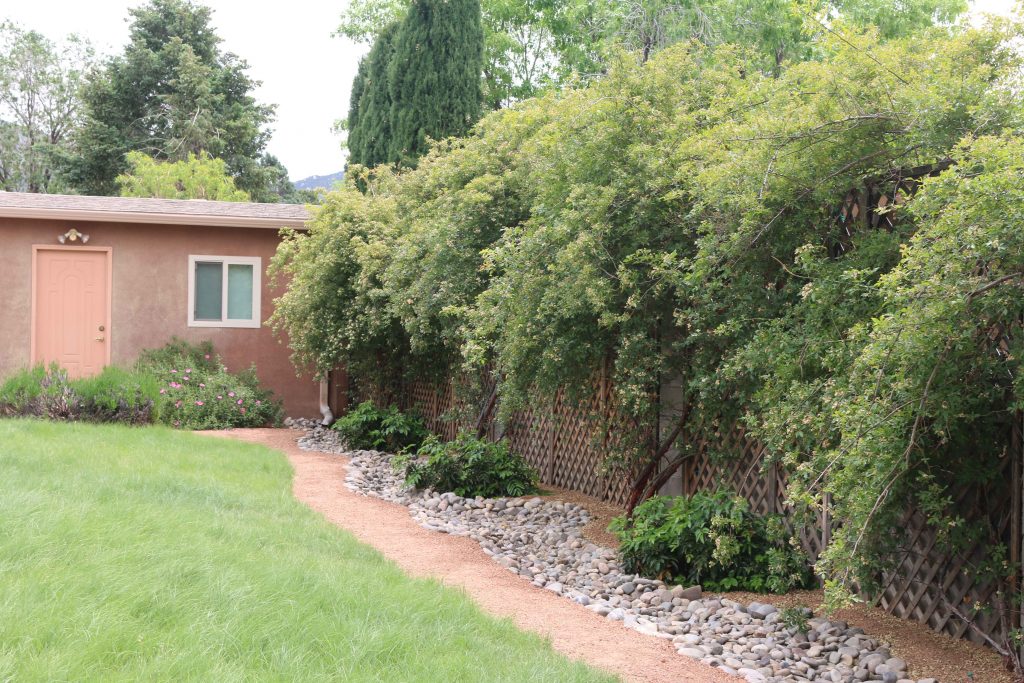
Cobble swale located at downspout next to house.

To make Hunter’s “rock burrito” simply dig an 8” wide trench at least 12” deep and as long as necessary for the space. Slope the bottom of the trench toward the drainage area. Layer the trench with filter fabric followed by cobble or rocks. Roll the fabric over the rocks then backfill with soil. This will provide an underground collection area for water. Water will slowly soak into the ground providing moisture to adjacent planting areas.
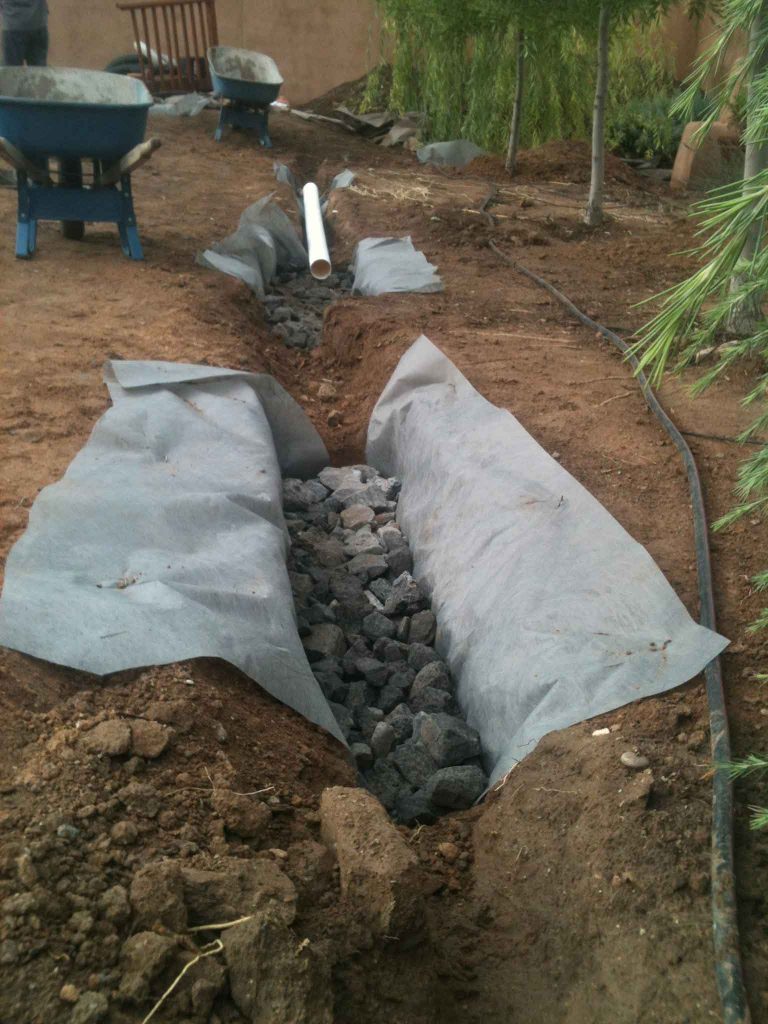
"Rock Burrito" French drain under construction in an Albuquerque landscape.

For homeowners who are ready to tackle an active water harvesting system like a rain barrel or cistern, Hunter recommends adding a passive water harvesting system next to the active one for when the container overflows.
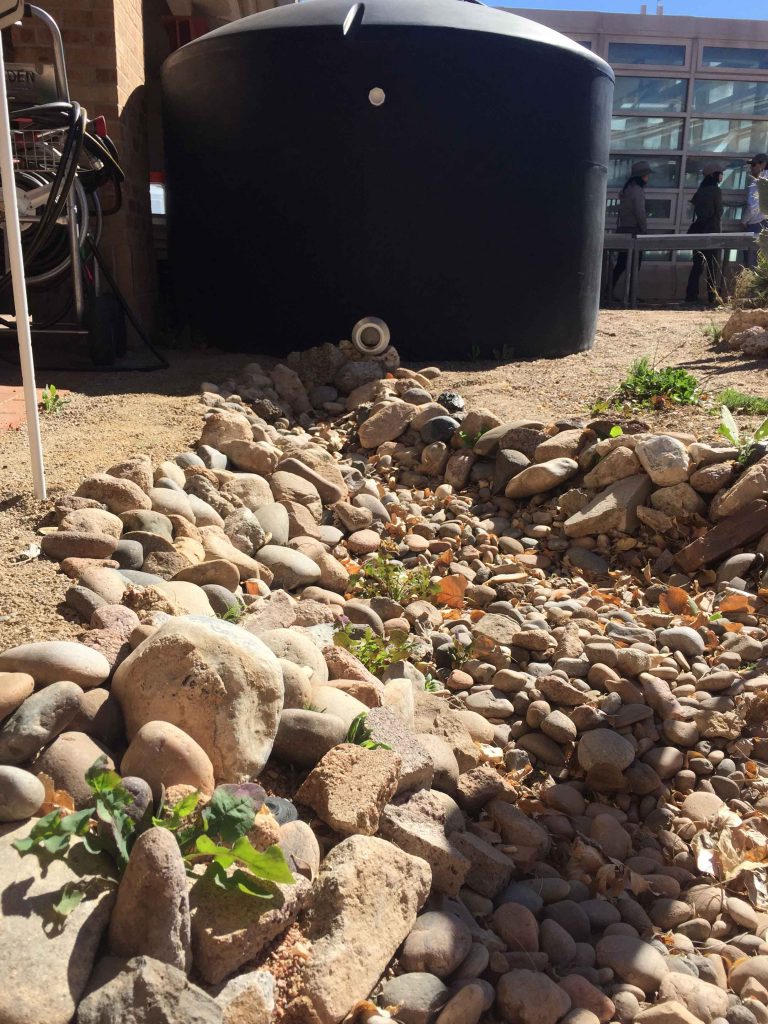
Passive water harvesting swale next to active water harvesting cistern.

Using every drop of water through water harvesting is an important feature Hunter incorporates into all his landscape designs.

Local Expert: Hunter Ten Broeck, Landscape Contractor and owner of WaterWise Landscapes Incorporated in Albuquerque, NM.
Author: Jill Brown, ASLA Landscape Architect and owner of My Landscape Coach in Albuquerque, NM.

Water-Wise Vegetable Gardening

With our hot summers and low precipitation, growing vegetables in NM can be
challenging. This talk will provide strategies and recommendations for growers to
cultivate a thriving vegetable harvest in the region. Discussion will include irrigation and infrastructure suggestions, as well as selection of vegetable varieties that are well-adapted to the area.

Instructor: Stephanie Walker, PhD. Professor and Vegetable Specialist, New Mexico
State University, Extension Plant Sciences Department.

Maintaining Tree Health During Drought

Learn from Albuquerque’s leading tree expert how to identify drought stress in trees,
understand their responses to drought, and implement strategies to keep them alive and thriving in hot, dry weather.

Instructor: Joran Viers, Board Certified Master Arborist and Municipal Specialist,
International Society of Arboriculture (ISA). Senior Arborist, Legacy Tree Company,
Albuquerque. Former City Forester, City of Albuquerque

Creating a Drought-Tolerant Refuge for Yourself and Wildlife

Instructor: Laurel Ladwig, M.S. She is the ABQ Backyard Refuge Program Director for the Friends of Valle de Oro National Wildlife Refuge, a part-time faculty member in the Department of Geography and Environmental Studies, and Associate Director of the R.H. Mallory Center for Community Geography at the University of New Mexico and is enthusiastic about all opportunities to encourage people to develop a relationship with our wild neighbors.

Designing Resilient Landscapes: Plant Adaptations, Communities, and Selection for Arid Environments

Instructor: Maria Thomas is the Curator of Plants at the ABQ BioPark where she manages the botanical exhibits, plant collections, horticultural staff, and related programs for the 150-acre public park and garden. Additionally, Maria is an Adjunct Professor at the University of New Mexico in the Landscape Architecture department.

Climate-Ready Trees- Planting for a Warmer and (Hopefully) Shadier Future

Instructor: Marisa Y. Thompson, PhD Extension Urban Horticulture Specialist. New Mexico State University Department of Extension Plant Sciences, Los Lunas Agricultural Science Center, Think Trees NM, President of the Board (2023-current).

Plant Adaptations to Heat & Drought

Noticing the Ways Plants Thrive in our Yards and Natural Areas Learn how to Recognize Drought-Adapted Traits in Everyday Plants all Around Us.

Instructor: Marisa Y. Thompson, PhD Extension Urban Horticulture Specialist. New Mexico State University Department of Extension Plant Sciences, Los Lunas Agricultural Science Center, Think Trees NM, President of the Board (2023-current).

Hose Bib Tree Irrigation System for Your Trees: Simple Systems for Thriving Trees!

Instructor: Richard Perce has twenty years’ experience working with trees and irrigation here in New Mexico. He is a former certified arborist and currently holds the Irrigation Association’s Landscape Irrigation Auditor certification and is a certified QWEL irrigation instructor. He worked as a landscape contractor for more than a decade and is the Water Authority’s former Irrigation Efficiency Specialist. He also has a Masters of Community and Regional Planning from UNM and currently works at Anthropopulus Design + Planning.

Passive Rainwater Harvesting

This workshop introduces participants to the principles and practices of passive rainwater harvesting. Attendees will learn how to capture, slow, spread, and infiltrate rainwater into the landscape using simple, low-cost methods such as swales, berms, and basins. The workshop emphasizes working with the natural flow of water to reduce runoff, prevent erosion, and support healthy soil and plant life. By implementing passive rainwater harvesting, participants can conserve water, and create more resilient, self-sustaining landscapes.

Instructors: Anthony Luketich, Natural Resource Scientist, Anthony Luketich is a Natural Resources Scientist for Bernalillo County where he is focused on water conservation and water-wise landscape practices. He received a degree in Watershed Management and Ecohydrology from the University of Arizona where he studied the relationship between trees and water. Anthony has worked across the Southwest US as a research scientist as well as a water harvesting field technician where he became a certified water harvesting practitioner.

Bobby Mullin, Natural Resource Scientist, Bernalillo County Stormwater Quality Program Bobby Mullin is a Natural Resource Scientist for Bernalillo County in the Stormwater Quality Program. He focuses on improving stormwater quality in the Middle Rio Grande Watershed and promoting sustainable and resilient landscapes using Green Stormwater Infrastructure and rainwater harvesting. Bobby received his Bachelor of Science in Environmental Science from Bucknell University in 2011. Before joining Bernalillo County, he had worked as an environmental consultant remediating contaminated soil and groundwater and as a Research Scientist studying the impacts of climate change, drought and plant mortality in New Mexico ecosystems.

Xeriscape: The Desert Friendly Yard

Join us for learning all of the tips, and benefits of our Xeriscape program!

3 Steps to Landscape Success

Service, Settings, and Selection are the keys to landscape success!