
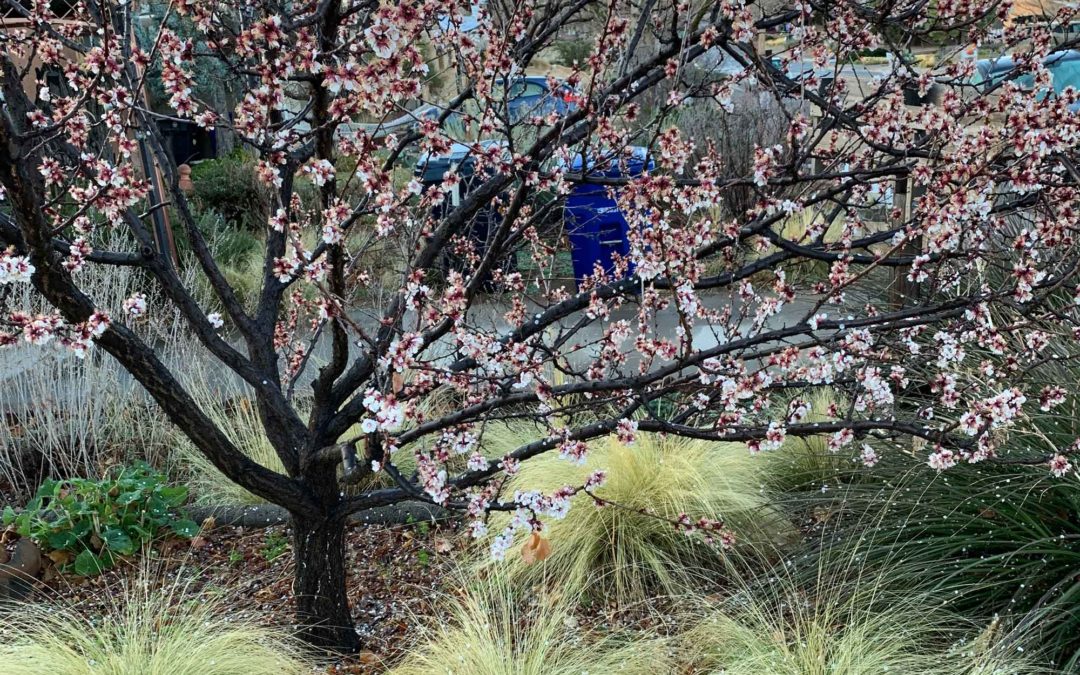
Thinking of putting some trees in your landscape but also concerned about making good use of the water, space and time? Some people like to plant fruit trees around the home landscape.

The obvious reason to grow fruit trees is the fruit! Just like there is no tomato as good as the ripe one picked right off the garden vine, there is no peach like the tree-ripened peach just outside your door. Growing fruit is not without challenges. Some people discover that the work required for a good harvest is more than they are up for. However, for others it is part of the gardening challenge that keeps us coming back for more.

Just like any other tree, fruit trees can play an aesthetic role in the landscape. They can be highlighted, or they can hide the blight beyond your fence. They can provide shade, cooling the outdoor spaces. They also can provide some level of wildlife habitat, whether it’s for the native bees that might pollinate the flowers or the little brown dickie birds pecking divots out of my ripening peaches. Well, they gotta eat too, I guess.

Fruit trees need all the things that any tree needs, which is sufficient rooting volume (it’s wider and shallower than you think), consistent moisture into that rootable soil and a mulch of some sort that covers and protects the soil. When they are grown for production in a commercial orchard, fruit trees also receive regular fertilization that may not be needed for a well-grown home tree usually producing more fruit than is needed. If you have fruit trees that produce more than you can use and give away, considering contacting a gleaning organization like Food is Free Albuquerque. They can bring volunteers to your property to pick the fruit, which is distributed through food banks to the local community. Fruit trees also benefit from regular annual pruning to maintain shape and size.

A large number of fruit species will grow well in our area. With peaches, one down side to them and other stone fruit species is their relatively short life spans, maybe 15-25 years in most urban settings. Other stone fruit species that do well for us are plums and cherries. Apricots grow well here but their early blooming often leads to last-frost crop death. Don’t worry, the tree is still fine. Of all the fruit trees, apricot may be the best for shading.

Apples also do well and are longer-lived than stone fruits. However, the fruit is more susceptible to insect damage, most notably the codling moth caterpillar (the infamous worm in the apple core). These can be controlled, with varying degrees of success, by trapping with pheromone traps. Timing is critical for that, and control may be incomplete, but more apples will be worm-free than without trapping. Codling moth also attacks pear fruit but to a much lesser degree.  Fruiting pears can do well for us, though in some cases fire blight bacterial disease may cause a lot of damage and even death. Jujubes, Asian pears, Japanese persimmons and figs are all good choices as well.

There are several sources where you can buy your new fruit trees.  I’m partial to online ordering from established mail-order nurseries. This approach offers the combination of variety choice and cost effectiveness. Keep in mind that mail-order trees are young and shipped out in later winter as dormant bare-root sticks. For a few reasons, this is an ideal type of plant to start working with if you have the patience to wait a few more years before getting fruit. Buying from local nurseries is fine as well, though it really pays to inspect the root ball condition carefully. If you’re very careful, even the big box stores can have good specimens.


Read up on proper planting techniques and early structural pruning approaches. For a tree, the transition from potted (or bare-root) conditions to fully in the soil is critical. Tree growth and longevity can be made or broken at this point. In a nutshell: Dig a shallow and wide hole, have the highest root at the top of the soil and mulch well. As the young tree grows, prune for strong attachments, ease of access and to help control total fruit load that can break branches in a bumper crop year. Early and aggressive thinning of the fruit can really help to prevent branch failure and also produces larger pieces of ripened fruit.
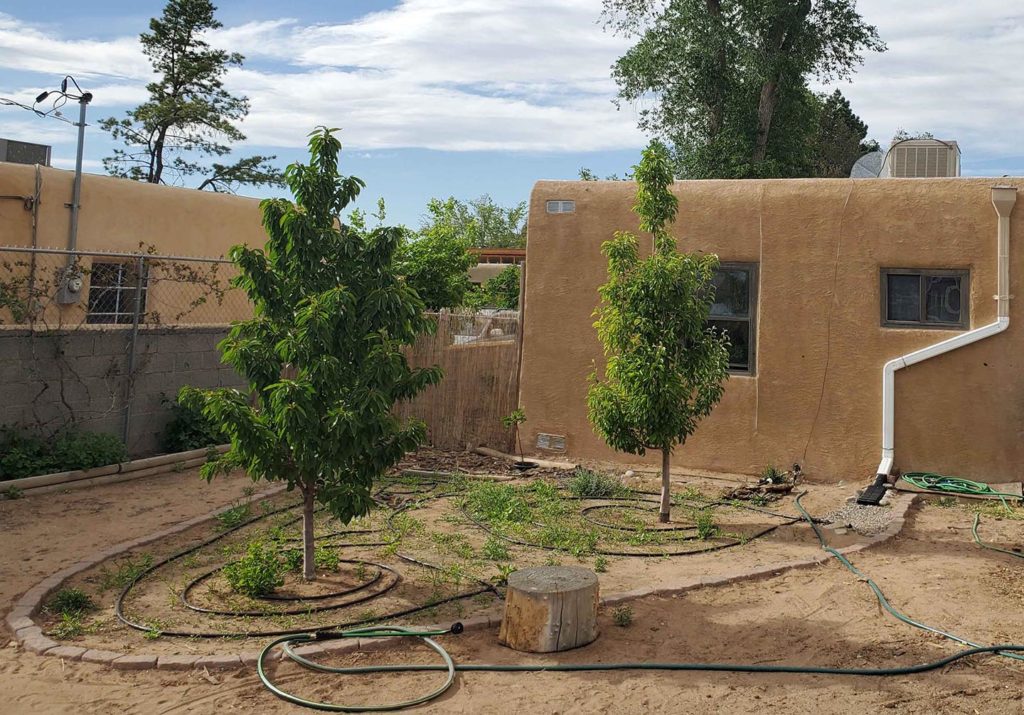
Un-mulched fruit trees showing inline dripline and roof runoff as watering system.

Learn more about gardening here:

Tree Watering System

The Basics of Fruit Tree Pruning

Easy Edible Plants for First-Time Growers

Author: Joran Viers, Senior Partner at Root to Shoot Urban Forestry, Inc. find him at joran@root2shooturbanforestry.com  Have a question about the article? AskAnExpert@abcwua.org

Water-Wise Vegetable Gardening

With our hot summers and low precipitation, growing vegetables in NM can be
challenging. This talk will provide strategies and recommendations for growers to
cultivate a thriving vegetable harvest in the region. Discussion will include irrigation and infrastructure suggestions, as well as selection of vegetable varieties that are well-adapted to the area.

Instructor: Stephanie Walker, PhD. Professor and Vegetable Specialist, New Mexico
State University, Extension Plant Sciences Department.

Maintaining Tree Health During Drought

Learn from Albuquerque’s leading tree expert how to identify drought stress in trees,
understand their responses to drought, and implement strategies to keep them alive and thriving in hot, dry weather.

Instructor: Joran Viers, Board Certified Master Arborist and Municipal Specialist,
International Society of Arboriculture (ISA). Senior Arborist, Legacy Tree Company,
Albuquerque. Former City Forester, City of Albuquerque

Creating a Drought-Tolerant Refuge for Yourself and Wildlife

Instructor: Laurel Ladwig, M.S. She is the ABQ Backyard Refuge Program Director for the Friends of Valle de Oro National Wildlife Refuge, a part-time faculty member in the Department of Geography and Environmental Studies, and Associate Director of the R.H. Mallory Center for Community Geography at the University of New Mexico and is enthusiastic about all opportunities to encourage people to develop a relationship with our wild neighbors.

Designing Resilient Landscapes: Plant Adaptations, Communities, and Selection for Arid Environments

Instructor: Maria Thomas is the Curator of Plants at the ABQ BioPark where she manages the botanical exhibits, plant collections, horticultural staff, and related programs for the 150-acre public park and garden. Additionally, Maria is an Adjunct Professor at the University of New Mexico in the Landscape Architecture department.

Climate-Ready Trees- Planting for a Warmer and (Hopefully) Shadier Future

Instructor: Marisa Y. Thompson, PhD Extension Urban Horticulture Specialist. New Mexico State University Department of Extension Plant Sciences, Los Lunas Agricultural Science Center, Think Trees NM, President of the Board (2023-current).

Plant Adaptations to Heat & Drought

Noticing the Ways Plants Thrive in our Yards and Natural Areas Learn how to Recognize Drought-Adapted Traits in Everyday Plants all Around Us.

Instructor: Marisa Y. Thompson, PhD Extension Urban Horticulture Specialist. New Mexico State University Department of Extension Plant Sciences, Los Lunas Agricultural Science Center, Think Trees NM, President of the Board (2023-current).

Hose Bib Tree Irrigation System for Your Trees: Simple Systems for Thriving Trees!

Instructor: Richard Perce has twenty years’ experience working with trees and irrigation here in New Mexico. He is a former certified arborist and currently holds the Irrigation Association’s Landscape Irrigation Auditor certification and is a certified QWEL irrigation instructor. He worked as a landscape contractor for more than a decade and is the Water Authority’s former Irrigation Efficiency Specialist. He also has a Masters of Community and Regional Planning from UNM and currently works at Anthropopulus Design + Planning.

Passive Rainwater Harvesting

This workshop introduces participants to the principles and practices of passive rainwater harvesting. Attendees will learn how to capture, slow, spread, and infiltrate rainwater into the landscape using simple, low-cost methods such as swales, berms, and basins. The workshop emphasizes working with the natural flow of water to reduce runoff, prevent erosion, and support healthy soil and plant life. By implementing passive rainwater harvesting, participants can conserve water, and create more resilient, self-sustaining landscapes.

Instructors: Anthony Luketich, Natural Resource Scientist, Anthony Luketich is a Natural Resources Scientist for Bernalillo County where he is focused on water conservation and water-wise landscape practices. He received a degree in Watershed Management and Ecohydrology from the University of Arizona where he studied the relationship between trees and water. Anthony has worked across the Southwest US as a research scientist as well as a water harvesting field technician where he became a certified water harvesting practitioner.

Bobby Mullin, Natural Resource Scientist, Bernalillo County Stormwater Quality Program Bobby Mullin is a Natural Resource Scientist for Bernalillo County in the Stormwater Quality Program. He focuses on improving stormwater quality in the Middle Rio Grande Watershed and promoting sustainable and resilient landscapes using Green Stormwater Infrastructure and rainwater harvesting. Bobby received his Bachelor of Science in Environmental Science from Bucknell University in 2011. Before joining Bernalillo County, he had worked as an environmental consultant remediating contaminated soil and groundwater and as a Research Scientist studying the impacts of climate change, drought and plant mortality in New Mexico ecosystems.

Xeriscape: The Desert Friendly Yard

Join us for learning all of the tips, and benefits of our Xeriscape program!

3 Steps to Landscape Success

Service, Settings, and Selection are the keys to landscape success!