
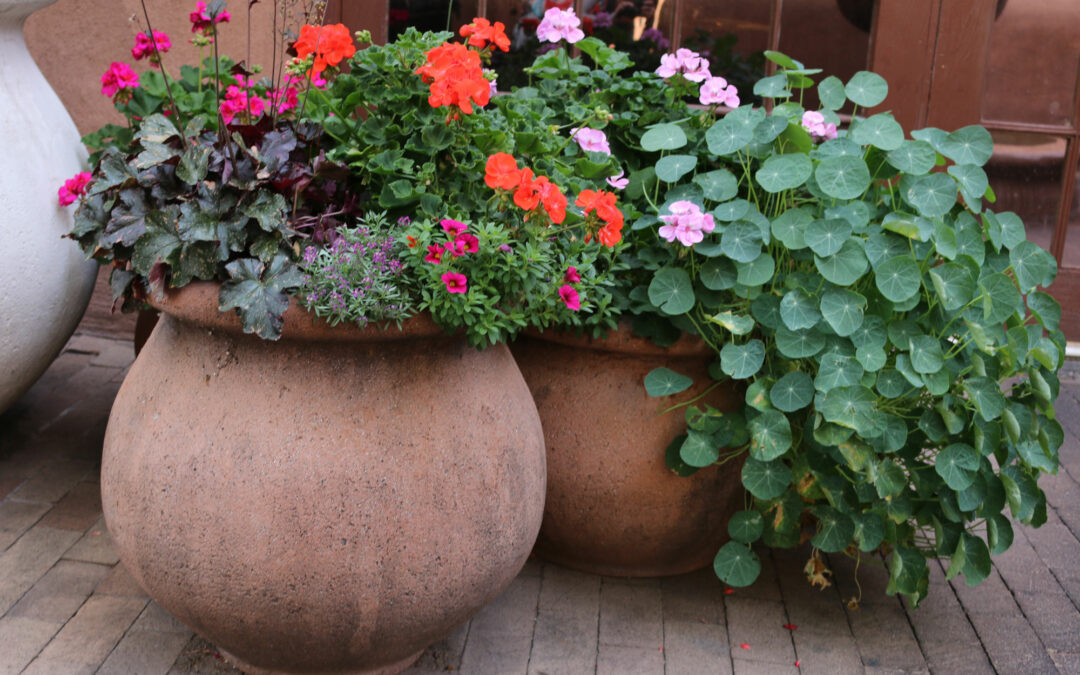
One of our favorite things to do at Bennu Organics is design container gardens. We like to talk about the “wow factor,” and containers are a fantastic way to add stunning, season-long color to our landscapes without digging a single hole in our hard, unforgiving soil.

Here are six helpful hints for creating your own successful container designs:

1) Location: Will the containers be in full sun, partial sun or full shade? In most cases, full sun containers in New Mexico require daily watering. If you don’t want to water every day, consider selecting plants that require less water, like succulents, cacti or perennials. Placing containers in partial shade will also save water. It’s important to know the amount of sunlight you will have available for each container prior to purchasing plants.

2) Size: What size are the containers, or what size do you want them to be if you’re purchasing them? You’ll need plenty of soil to fill or refresh the containers, and you want to make sure you have enough plant material to give your containers a nice, full look.

3) Design: Well-designed containers require three types of plants: thrillers, fillers and spillers. The thriller is something tall and showy, while fillers are shorter plants that fill in the spaces. Spillers are those low vining-type plants that spill gracefully over the sides of the container.

4) Color theme: I like picking a color palette and then selecting different plants within that palette. I don’t want my containers to be identical, but I do want them to complement each other. Also, depending on the locations of the containers, I will often do a “mirror image” design if the containers are on either side of an entry way, for example.

5) Lighting and water: Select plants that have similar lighting and water requirements. You don’t want to put a cactus as a thriller and wave petunias as your filler. One or both will suffer from too much or a lack of water.

6) Maintenance: Besides watering consistently, you will want to trim and deadhead your designs frequently. Petunias and calibrachoa (classified both as fillers and spillers) need regular deadheading to keep the blooms going strong. Trim them heavily when they get “leggy.” They respond well to a really good haircut. If you are consistent with your maintenance and watering, the containers should keep their “wow factor” all season long. Also, regular fertilizing is crucial to maintaining season-long blooms. In the active growing season, we fertilize our containers every two weeks.
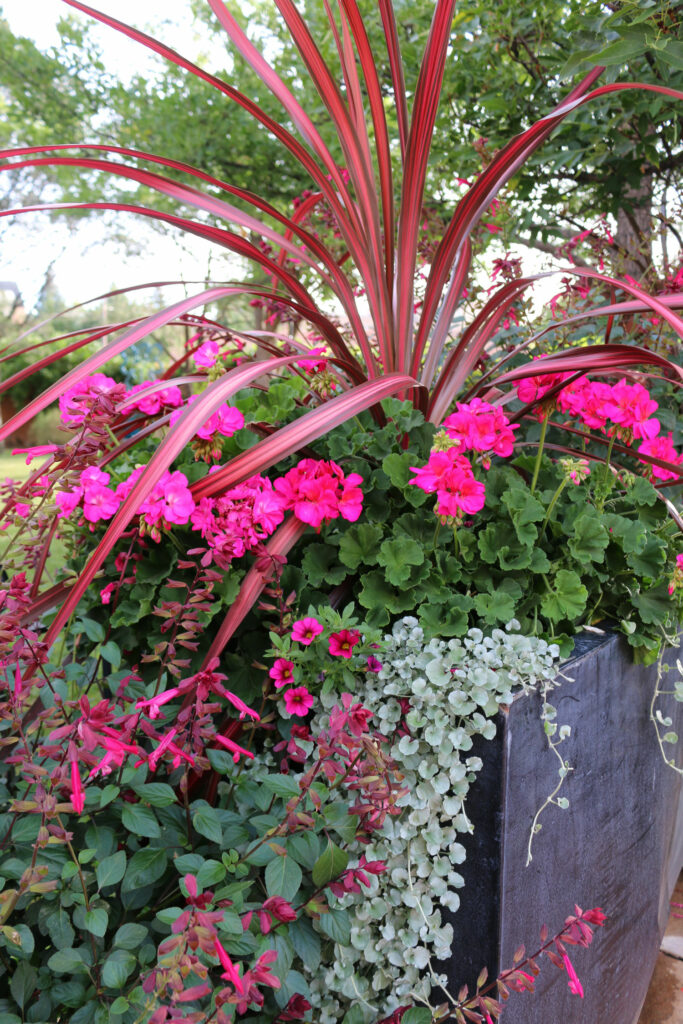
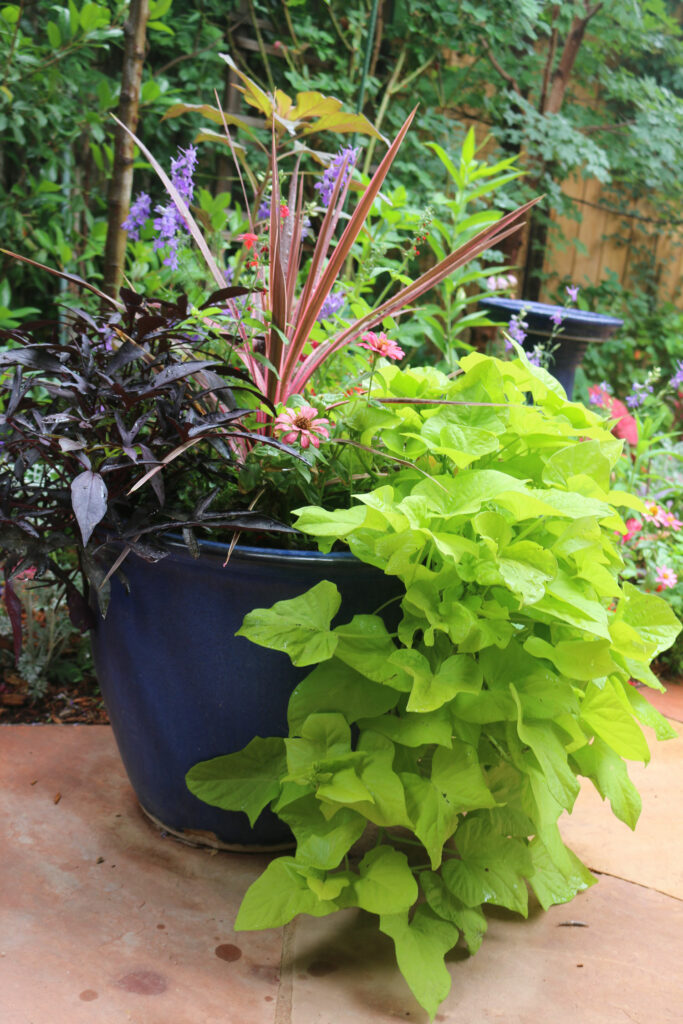
While the following list of possible plants you can use in containers is hardly comprehensive, it should help get your creative juices flowing:

Shade/Part Shade

Thrillers: caladium, alocasia, sansevieria/dracaena, colocasia, cordyline, etc.

Fillers: bacopa, begonias, Boston fern, caladium, coleus, begonias, dusty miller, impatiens, etc.

Spillers: asparagus fern, tradescantia, creeping wire vine, dichondra ‘Silver Falls’, helichrysu, ‘Licorice Vine’, ivy geranium, variegated lamium, lobelia, Tahitian bridal veil, vinca major/minor, (vine), etc.

Full Sun/Partial Sun

Thrillers: lantana, papyrus, pentas, purple fountain grass, dracaena spikes, small topiaries and trees, etc.

Fillers: nemesia, nierembergia, osteospermum, pentas, petunia, calibrachoa, salvia, etc.

Spillers: plectranthus, portulaca, trailing petunia, vinca (vine), verbena, and sweet potato vine (Ipomoea batatas), etc
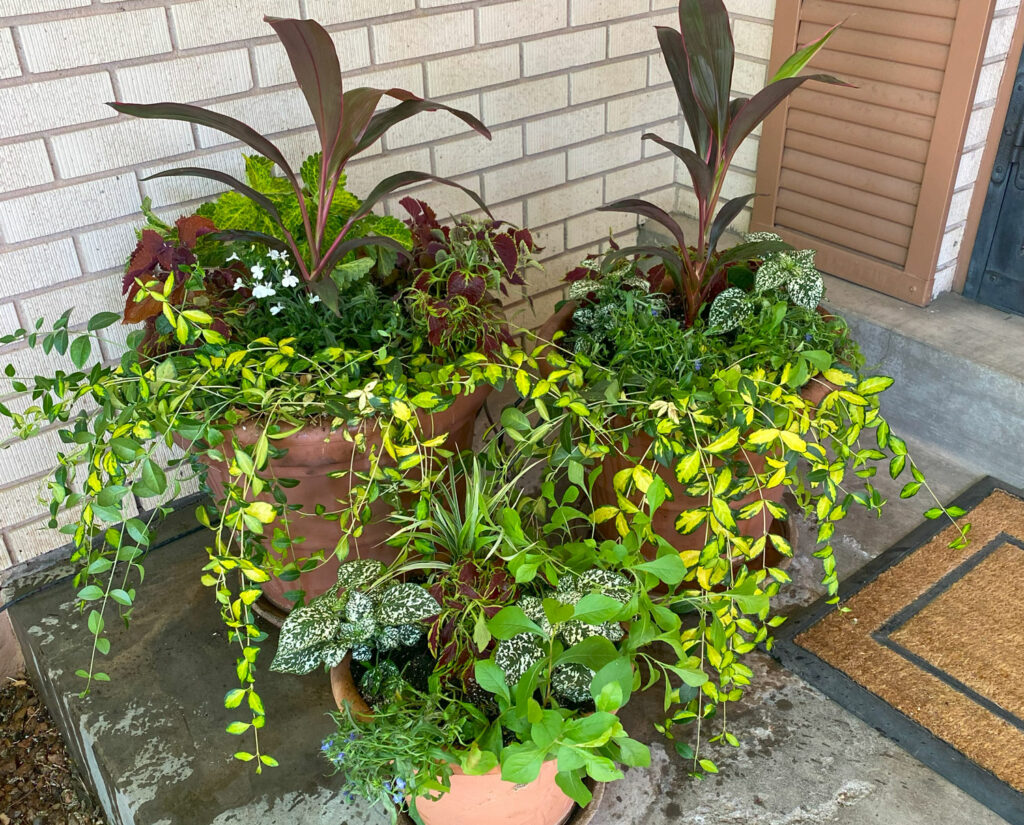
Finally, your container designs should bring you joy, so get creative! What do you love? What are your goals? Do you want to attract hummingbirds and butterflies? Do you want fragrance? Do you want a color explosion, or are you looking for something more subdued? Your containers should reflect their designer, so pick things that you really enjoy — not just the plants you see on Pinterest or in magazines, although if you love the ones you see in those places, imitation is the sincerest form of flattery! Some people like to use all annuals, some like a combination of annuals and perennials and some even add edible plants into their designs. The sky is the limit!

As with all things related to plants, design and gardening, remember that everything we do is a grand experiment. Don’t feel guilty if you mistakenly combine a low-water plant and a high-water plant in the same container and one of them dies. Learn from your experience and simply replace the dead plant with something more suitable.

Learn more about gardening here:

Easy pollinator gardening

Easy Edible Plants for First Time Growers

Water Harvesting for Residential Landscapes

5 Steps to Stunning Fall Container Gardens

Author: Rae Bennu, Bennu Organics, BennuOrganics.com Have a question about the article? AskAnExpert@abcwua.org

Water-Wise Vegetable Gardening

With our hot summers and low precipitation, growing vegetables in NM can be
challenging. This talk will provide strategies and recommendations for growers to
cultivate a thriving vegetable harvest in the region. Discussion will include irrigation and infrastructure suggestions, as well as selection of vegetable varieties that are well-adapted to the area.

Instructor: Stephanie Walker, PhD. Professor and Vegetable Specialist, New Mexico
State University, Extension Plant Sciences Department.

Maintaining Tree Health During Drought

Learn from Albuquerque’s leading tree expert how to identify drought stress in trees,
understand their responses to drought, and implement strategies to keep them alive and thriving in hot, dry weather.

Instructor: Joran Viers, Board Certified Master Arborist and Municipal Specialist,
International Society of Arboriculture (ISA). Senior Arborist, Legacy Tree Company,
Albuquerque. Former City Forester, City of Albuquerque

Creating a Drought-Tolerant Refuge for Yourself and Wildlife

Instructor: Laurel Ladwig, M.S. She is the ABQ Backyard Refuge Program Director for the Friends of Valle de Oro National Wildlife Refuge, a part-time faculty member in the Department of Geography and Environmental Studies, and Associate Director of the R.H. Mallory Center for Community Geography at the University of New Mexico and is enthusiastic about all opportunities to encourage people to develop a relationship with our wild neighbors.

Designing Resilient Landscapes: Plant Adaptations, Communities, and Selection for Arid Environments

Instructor: Maria Thomas is the Curator of Plants at the ABQ BioPark where she manages the botanical exhibits, plant collections, horticultural staff, and related programs for the 150-acre public park and garden. Additionally, Maria is an Adjunct Professor at the University of New Mexico in the Landscape Architecture department.

Climate-Ready Trees- Planting for a Warmer and (Hopefully) Shadier Future

Instructor: Marisa Y. Thompson, PhD Extension Urban Horticulture Specialist. New Mexico State University Department of Extension Plant Sciences, Los Lunas Agricultural Science Center, Think Trees NM, President of the Board (2023-current).

Plant Adaptations to Heat & Drought

Noticing the Ways Plants Thrive in our Yards and Natural Areas Learn how to Recognize Drought-Adapted Traits in Everyday Plants all Around Us.

Instructor: Marisa Y. Thompson, PhD Extension Urban Horticulture Specialist. New Mexico State University Department of Extension Plant Sciences, Los Lunas Agricultural Science Center, Think Trees NM, President of the Board (2023-current).

Hose Bib Tree Irrigation System for Your Trees: Simple Systems for Thriving Trees!

Instructor: Richard Perce has twenty years’ experience working with trees and irrigation here in New Mexico. He is a former certified arborist and currently holds the Irrigation Association’s Landscape Irrigation Auditor certification and is a certified QWEL irrigation instructor. He worked as a landscape contractor for more than a decade and is the Water Authority’s former Irrigation Efficiency Specialist. He also has a Masters of Community and Regional Planning from UNM and currently works at Anthropopulus Design + Planning.

Passive Rainwater Harvesting

This workshop introduces participants to the principles and practices of passive rainwater harvesting. Attendees will learn how to capture, slow, spread, and infiltrate rainwater into the landscape using simple, low-cost methods such as swales, berms, and basins. The workshop emphasizes working with the natural flow of water to reduce runoff, prevent erosion, and support healthy soil and plant life. By implementing passive rainwater harvesting, participants can conserve water, and create more resilient, self-sustaining landscapes.

Instructors: Anthony Luketich, Natural Resource Scientist, Anthony Luketich is a Natural Resources Scientist for Bernalillo County where he is focused on water conservation and water-wise landscape practices. He received a degree in Watershed Management and Ecohydrology from the University of Arizona where he studied the relationship between trees and water. Anthony has worked across the Southwest US as a research scientist as well as a water harvesting field technician where he became a certified water harvesting practitioner.

Bobby Mullin, Natural Resource Scientist, Bernalillo County Stormwater Quality Program Bobby Mullin is a Natural Resource Scientist for Bernalillo County in the Stormwater Quality Program. He focuses on improving stormwater quality in the Middle Rio Grande Watershed and promoting sustainable and resilient landscapes using Green Stormwater Infrastructure and rainwater harvesting. Bobby received his Bachelor of Science in Environmental Science from Bucknell University in 2011. Before joining Bernalillo County, he had worked as an environmental consultant remediating contaminated soil and groundwater and as a Research Scientist studying the impacts of climate change, drought and plant mortality in New Mexico ecosystems.

Xeriscape: The Desert Friendly Yard

Join us for learning all of the tips, and benefits of our Xeriscape program!

3 Steps to Landscape Success

Service, Settings, and Selection are the keys to landscape success!