
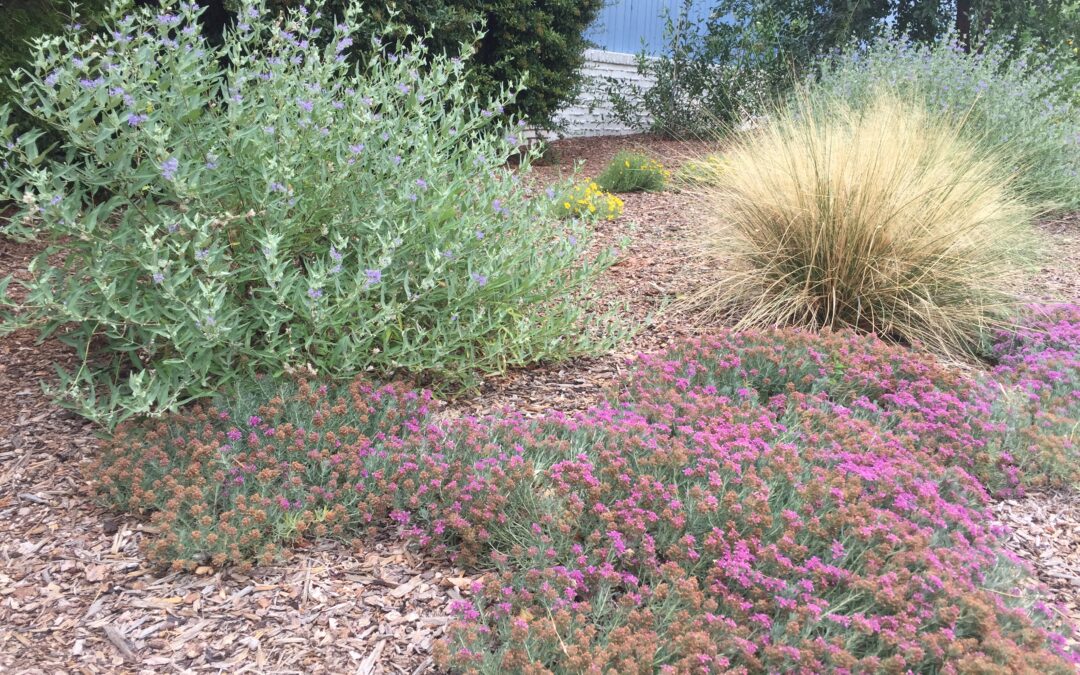
The word Mediterranean may bring to mind rows of lavender in southern France, an Italian villa or maybe a Spanish courtyard or Greek olive orchard. These areas around the Mediterranean Sea all share unique plants and garden design methods that are part of their allure in movies, marketing and as tourist destinations. Luckily for residents of the Albuquerque area, the mediterranean climate is similar enough to that of our high desert home that many mediterranean plants can be successfully grown here. (Note: There are other coastal areas of the world that are climatically so similar to the area around the Mediterranean Sea that they are also known as having mediterranean climates. These areas include parts of South Africa, Australia, Chile and California. A capital “M” is used for the Mediterranean place in the world, while a lowercase “m” refers to the climate that includes all five regions.)

Albuquerque has hot and increasingly dry summers, just like the Mediterranean. This means that plants from both places do best with deep watering to reach their deep, drought-adapted roots and a good layer of organic mulch to keep moisture in the soil. Most mediterranean plants prefer full sun, although a few can tolerate some shade. Mediterranean places tend to have soils with good drainage, so make sure to keep mediterranean plants away from any areas with clay or caliche. 

There are, however, a few very important differences between Albuquerque and mediterranean climates. The most significant of these differences is temperature: As coastal areas, mediterranean climates don’t get very cold. It is rare to have snow or anything other than a light freeze. Many mediterranean plants are not cold hardy enough to grow in the high desert. Others may require a protected area in a courtyard or along a south-facing wall for extra warmth. The mediterranean plants that are more cold hardy and generally do well here can still be killed by the combination of freezing temperatures and wet soil. So, as temperatures drop in the fall, stop watering your mediterranean plants and don’t start again until the chance of frost has passed in spring. 

While selecting mediterranean plants for your landscape, you can also incorporate a few simple Mediterranean garden design strategies. The starting point for any Mediterranean garden is evergreen trees and shrubs. Think olive trees, Italian cypress and statuesque pines. However, since olive trees are not cold hardy in Albuquerque, instead try an escarpment live oak. Their glossy dark green leaves are a great substitute for an olive, and they are an important species for pollinators. Although Italian cypress can grow in Albuquerque (and was planted profusely in the 1970s), it is not particularly well-adapted here. A better choice is an upright juniper cultivar, such as Keteleeri. And while a Mediterranean stone pine or Aleppo pine would do well in a protected courtyard, Afghan pine is another option with better cold hardiness. Arizona rosewood, turpentine bush and manzanita hybrids are a few evergreen shrubs that will give your landscape a Mediterranean flavor. 

Next, include some plants with light silvery-blue leaves to contrast with the evergreens suggested above. Silvery-blue foliage is a plant adaptation to intense solar radiation, so many mediterranean and locally native plants share this quality. Mediterranean natives with this striking color include lavender, gopher spurge and grey lavender cotton (which actually has yellow flowers), while silver-leafed native plants include sand sage, germander sage and chamisa. There are also many locally native plants with silvery leaves that provide contrasting shape as well as color: Agaves, desert spoon, blue Nolina and yuccas all can accent your landscape beautifully. Of course, these locally native plants will be easier to grow and will provide better pollinator habitat than mediterranean imports. 

Edible plants and herbs have always been another important part of Mediterranean gardens. Rosemary, lavender, oregano, thyme, chives and culinary sage all hail from the Mediterranean and do well in Albuquerque. Mediterranean fruit trees, such as fig, pomegranate and apricot can flourish but do require a little extra water. This water need can be met by roof runoff if you plant them in a well-drained rainwater harvesting basin or swale. Fruits and herbs all provide flowers in addition to food. However, if you’re looking for an extra splash of color, red hot poker, moonshine yarrow and Bowle’s mauve are all mediterranean options. 


Whatever mediterranean plants you choose, just remember to keep their roots dry when it’s cold out, make sure the soil drains well and give them a nice layer of wood mulch. They will repay you with a beautiful and low water use landscape for years to come.
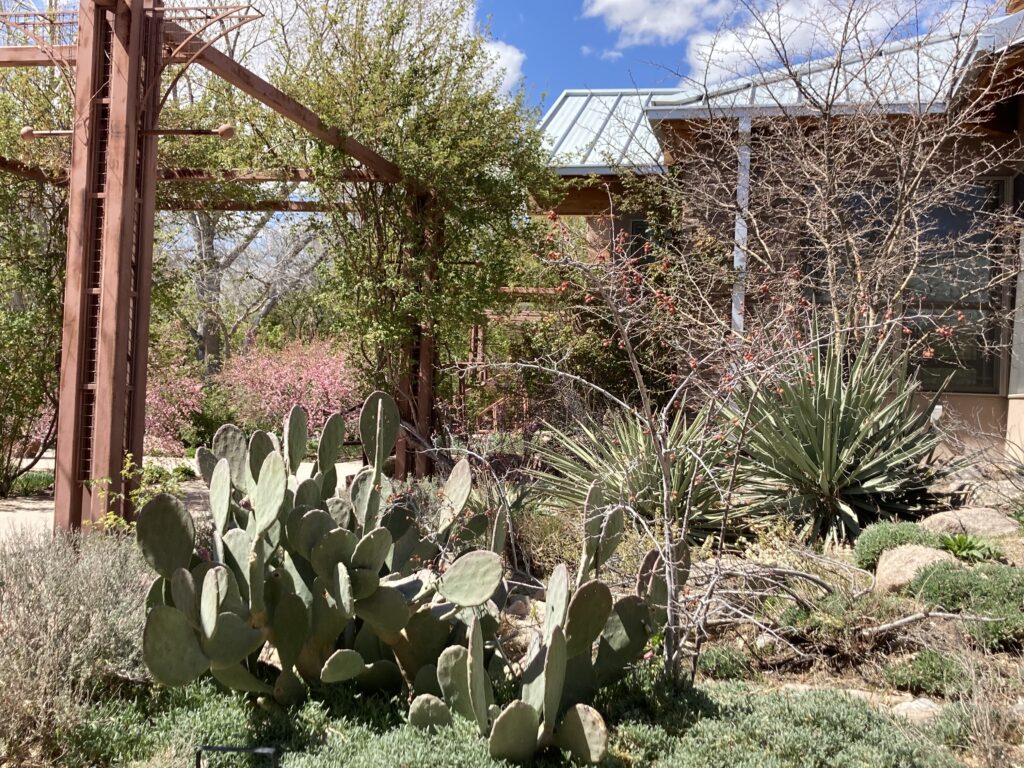
Mediterranean plant options

Shade tree: Japanese pagoda                                              

Evergreen trees: Keteleeri juniper, escarpment live oak                                          

Small flowering trees: Vitex, crape myrtle                                                    

Large plants (5-8' tall/wide): Fernbush, blue Nolina, evergreen sumac                       

Medium plants (3-5' tall/wide): Rosemary, large agave (americana, ovata, havardiana), lavender, red hot poker, pink muhly grass                                                    

Small plants (1-2' tall/wide): Moonshine yarrow, catmint, yucca pallida, Greek yarrow, oregano

Groundcovers (less than 2' tall, spreading more than 3' wide): Gray creeping germander, santolina (grey and green), gopher spurge                                                   

Vines: Trumpet vine (aggressive) or crossvine (not aggressive)                                          
Learn more about specific types of gardening here:

Simple Steps to Get Started Designing Your Yard

Basics about Turf Grasses for New Mexico

Easy Pollinator Gardening

Water Harvesting for Residential Landscapes

Author: Tess Houle, Landscape Architect at Pland Collaborative. Have a question about the article? AskAnExpert@abcwua.org

Water-Wise Vegetable Gardening

With our hot summers and low precipitation, growing vegetables in NM can be
challenging. This talk will provide strategies and recommendations for growers to
cultivate a thriving vegetable harvest in the region. Discussion will include irrigation and infrastructure suggestions, as well as selection of vegetable varieties that are well-adapted to the area.

Instructor: Stephanie Walker, PhD. Professor and Vegetable Specialist, New Mexico
State University, Extension Plant Sciences Department.

Maintaining Tree Health During Drought

Learn from Albuquerque’s leading tree expert how to identify drought stress in trees,
understand their responses to drought, and implement strategies to keep them alive and thriving in hot, dry weather.

Instructor: Joran Viers, Board Certified Master Arborist and Municipal Specialist,
International Society of Arboriculture (ISA). Senior Arborist, Legacy Tree Company,
Albuquerque. Former City Forester, City of Albuquerque

Creating a Drought-Tolerant Refuge for Yourself and Wildlife

Instructor: Laurel Ladwig, M.S. She is the ABQ Backyard Refuge Program Director for the Friends of Valle de Oro National Wildlife Refuge, a part-time faculty member in the Department of Geography and Environmental Studies, and Associate Director of the R.H. Mallory Center for Community Geography at the University of New Mexico and is enthusiastic about all opportunities to encourage people to develop a relationship with our wild neighbors.

Designing Resilient Landscapes: Plant Adaptations, Communities, and Selection for Arid Environments

Instructor: Maria Thomas is the Curator of Plants at the ABQ BioPark where she manages the botanical exhibits, plant collections, horticultural staff, and related programs for the 150-acre public park and garden. Additionally, Maria is an Adjunct Professor at the University of New Mexico in the Landscape Architecture department.

Climate-Ready Trees- Planting for a Warmer and (Hopefully) Shadier Future

Instructor: Marisa Y. Thompson, PhD Extension Urban Horticulture Specialist. New Mexico State University Department of Extension Plant Sciences, Los Lunas Agricultural Science Center, Think Trees NM, President of the Board (2023-current).

Plant Adaptations to Heat & Drought

Noticing the Ways Plants Thrive in our Yards and Natural Areas Learn how to Recognize Drought-Adapted Traits in Everyday Plants all Around Us.

Instructor: Marisa Y. Thompson, PhD Extension Urban Horticulture Specialist. New Mexico State University Department of Extension Plant Sciences, Los Lunas Agricultural Science Center, Think Trees NM, President of the Board (2023-current).

Hose Bib Tree Irrigation System for Your Trees: Simple Systems for Thriving Trees!

Instructor: Richard Perce has twenty years’ experience working with trees and irrigation here in New Mexico. He is a former certified arborist and currently holds the Irrigation Association’s Landscape Irrigation Auditor certification and is a certified QWEL irrigation instructor. He worked as a landscape contractor for more than a decade and is the Water Authority’s former Irrigation Efficiency Specialist. He also has a Masters of Community and Regional Planning from UNM and currently works at Anthropopulus Design + Planning.

Passive Rainwater Harvesting

This workshop introduces participants to the principles and practices of passive rainwater harvesting. Attendees will learn how to capture, slow, spread, and infiltrate rainwater into the landscape using simple, low-cost methods such as swales, berms, and basins. The workshop emphasizes working with the natural flow of water to reduce runoff, prevent erosion, and support healthy soil and plant life. By implementing passive rainwater harvesting, participants can conserve water, and create more resilient, self-sustaining landscapes.

Instructors: Anthony Luketich, Natural Resource Scientist, Anthony Luketich is a Natural Resources Scientist for Bernalillo County where he is focused on water conservation and water-wise landscape practices. He received a degree in Watershed Management and Ecohydrology from the University of Arizona where he studied the relationship between trees and water. Anthony has worked across the Southwest US as a research scientist as well as a water harvesting field technician where he became a certified water harvesting practitioner.

Bobby Mullin, Natural Resource Scientist, Bernalillo County Stormwater Quality Program Bobby Mullin is a Natural Resource Scientist for Bernalillo County in the Stormwater Quality Program. He focuses on improving stormwater quality in the Middle Rio Grande Watershed and promoting sustainable and resilient landscapes using Green Stormwater Infrastructure and rainwater harvesting. Bobby received his Bachelor of Science in Environmental Science from Bucknell University in 2011. Before joining Bernalillo County, he had worked as an environmental consultant remediating contaminated soil and groundwater and as a Research Scientist studying the impacts of climate change, drought and plant mortality in New Mexico ecosystems.

Xeriscape: The Desert Friendly Yard

Join us for learning all of the tips, and benefits of our Xeriscape program!

3 Steps to Landscape Success

Service, Settings, and Selection are the keys to landscape success!