
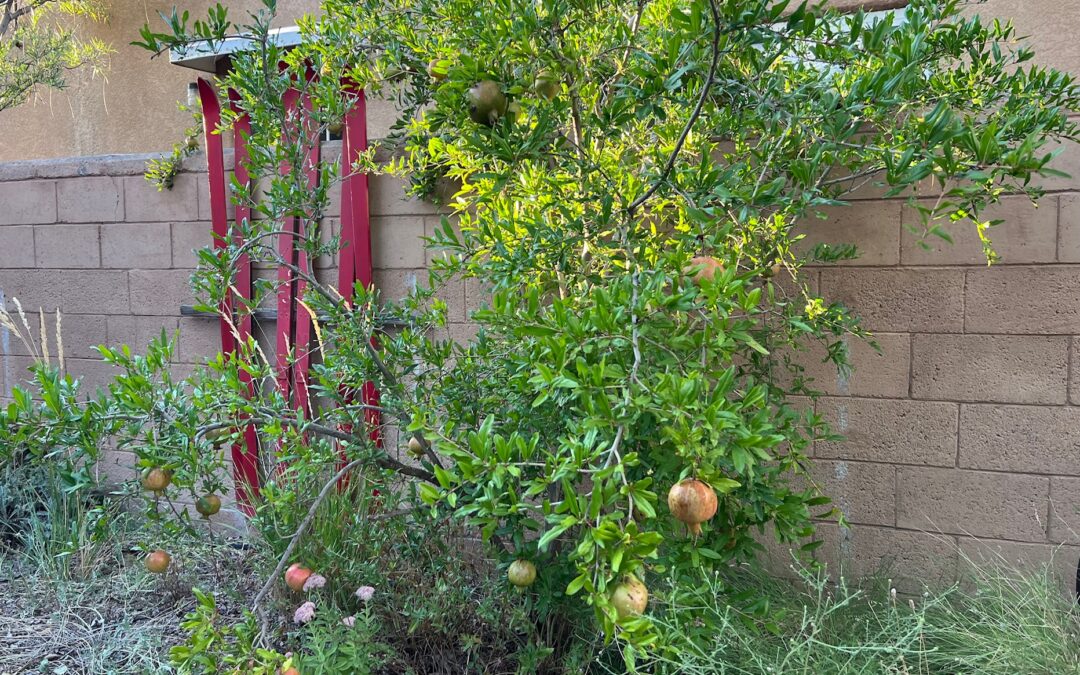
As one might guess, the subtropics are a great place to grow fruit trees and a particularly good place to find plants that are heat and drought tolerant — sort of a prerequisite for plant selection in a hot, dry place like New Mexico, or at least it should be!

The term subtropical refers to a climatic region, defined by latitude, that lies between the tropical and temperate zones. This region experiences warm to hot summers and mild winters with overall annual temperature variation more significant than in tropical regions but less extreme than in temperate zones. There is also plenty of rainfall variation across the subtropics, with climates ranging from arid to humid. Subtropical regions often experience seasonal rainfall patterns such as monsoons or wet and dry seasons.

The problem with growing heat and drought tolerant subtropical plants in our high desert is that we have anything but mild winters. Much like another inhabitant of the subtropical/mediterranean climate of Greece, the hero Achilles known for his one weakness, these plants have a very specific vulnerability — cold.

I love to grow plants, fruit in particular. But as irrigation access has become harder to come by and the summer heat seems to last longer than it used to, I have become more and more attracted to plants that thrive in the hot and dry. Navigating the puzzle of a changing climate while planting trees and shrubs is challenging. Long-lived perennials need to be appropriate for today's climate as well as the climate 20 years from now and even the climate 250 years from now if you are a real optimist.

It's tempting to just plant a zone or more higher than the current USDA Plant Hardiness Zone Map (which has itself been updated to reflect higher temperatures twice since 2012), but our weakening jet stream means more chance of Arctic air slipping in and spoiling the fun as we experienced to the extreme in the winter of 2011. The way things are headed has, in many cases, led us to exchange one set of growing problems — namely, heat and drought stress — with another — cold damage.

Two fruiting shrubs from the subtropics, pomegranates and figs, have proven to have the right combination of fruiting characteristics and cold tolerance to work in our moving-target-Goldilocks-growing-zone of Central New Mexico.

The fig is extremely adaptable. I imagine this has something to do with why they have evolved and been grown by humans for thousands of years. They perform well in Albuquerque, particularly because of all the heat that gets banked into concrete, asphalt and structures during the day. This heat radiates back out at night, keeping figs at much warmer temperatures than they would otherwise experience during winter in a more exposed area. Figs are tolerant of abuse and relatively content with our intense sunlight, extended droughts and alkaline soils. They can take temperatures down to the low teens, but need to be protected, buried or even brought inside if temperatures fall below that.
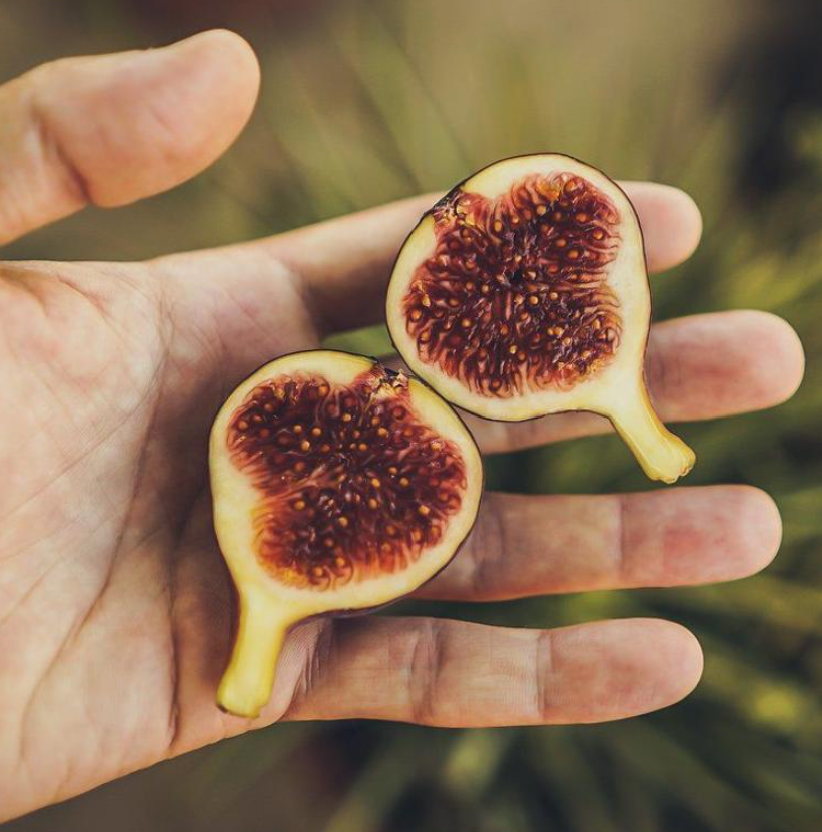
There are plenty of examples around town of figs without protection that rarely, if ever, freeze to the ground. Even so, freezing to the ground does not mean death for a fig — a winter-killed fig of an early ripening variety can easily end up fruiting by the end of the summer. That's because figs often come up from the roots and fruit their main crop on the current season's growth. Given an early enough ripening variety, that once-frozen fig can still yield fruit in the same year!

Pomegranates, I have found to be a bit more cold-hardy than figs — although they, too, benefit from a protected, south-facing location to improve winter survival. Optimal conditions for the wild pomegranate exist in high sunlight, hot climates with minimum temperatures not lower than 10 degrees. Although, with the protective care of a thoughtful gardener, lower temperatures are negotiable. There is also significant variation in cold-hardiness among pomegranate varieties, with dwarf varieties experiencing damage at 19 degrees, many soft-seeded varieties at 10-12 degrees and hard-seeded varieties at 0-3 degrees.
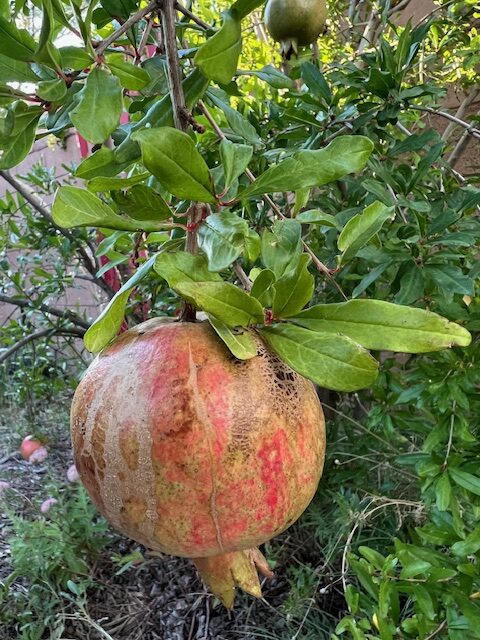
For both pomegranates and figs, young plants are more frost sensitive to cold than mature plants. So if you have trouble the first year or two with losing branches to cold, remember that these plants get more frost resistant with time. These are both wonderful subtropical fruiting shrubs that are worth the extra trouble during our high desert winter to experience their summertime beauty and bounty.

Learn more about specific types of gardening here:

Food Forests a Prehistoric Agroecosystem for your Backyard

A Valuable Bosque Understory Shrub Clove Currants for the Birds, Bees and ButterflesFruit Trees for the Homeowner

Author: Graeme Davis is an ISA certified arborist and the owner of Flora Fauna Farm, a nursery that focuses on plants that grow well in the high desert. Flora Fauna Farm grows a diversity of edible trees and shrubs, useful native plants and unique landscape plants curiously underrepresented in the urban canopy of Albuquerque. You can see its offerings at www.florafauna.farm. Have a question about the article? AskAnExpert@abcwua.org


Water-Wise Vegetable Gardening

With our hot summers and low precipitation, growing vegetables in NM can be
challenging. This talk will provide strategies and recommendations for growers to
cultivate a thriving vegetable harvest in the region. Discussion will include irrigation and infrastructure suggestions, as well as selection of vegetable varieties that are well-adapted to the area.

Instructor: Stephanie Walker, PhD. Professor and Vegetable Specialist, New Mexico
State University, Extension Plant Sciences Department.

Maintaining Tree Health During Drought

Learn from Albuquerque’s leading tree expert how to identify drought stress in trees,
understand their responses to drought, and implement strategies to keep them alive and thriving in hot, dry weather.

Instructor: Joran Viers, Board Certified Master Arborist and Municipal Specialist,
International Society of Arboriculture (ISA). Senior Arborist, Legacy Tree Company,
Albuquerque. Former City Forester, City of Albuquerque

Creating a Drought-Tolerant Refuge for Yourself and Wildlife

Instructor: Laurel Ladwig, M.S. She is the ABQ Backyard Refuge Program Director for the Friends of Valle de Oro National Wildlife Refuge, a part-time faculty member in the Department of Geography and Environmental Studies, and Associate Director of the R.H. Mallory Center for Community Geography at the University of New Mexico and is enthusiastic about all opportunities to encourage people to develop a relationship with our wild neighbors.

Designing Resilient Landscapes: Plant Adaptations, Communities, and Selection for Arid Environments

Instructor: Maria Thomas is the Curator of Plants at the ABQ BioPark where she manages the botanical exhibits, plant collections, horticultural staff, and related programs for the 150-acre public park and garden. Additionally, Maria is an Adjunct Professor at the University of New Mexico in the Landscape Architecture department.

Climate-Ready Trees- Planting for a Warmer and (Hopefully) Shadier Future

Instructor: Marisa Y. Thompson, PhD Extension Urban Horticulture Specialist. New Mexico State University Department of Extension Plant Sciences, Los Lunas Agricultural Science Center, Think Trees NM, President of the Board (2023-current).

Plant Adaptations to Heat & Drought

Noticing the Ways Plants Thrive in our Yards and Natural Areas Learn how to Recognize Drought-Adapted Traits in Everyday Plants all Around Us.

Instructor: Marisa Y. Thompson, PhD Extension Urban Horticulture Specialist. New Mexico State University Department of Extension Plant Sciences, Los Lunas Agricultural Science Center, Think Trees NM, President of the Board (2023-current).

Hose Bib Tree Irrigation System for Your Trees: Simple Systems for Thriving Trees!

Instructor: Richard Perce has twenty years’ experience working with trees and irrigation here in New Mexico. He is a former certified arborist and currently holds the Irrigation Association’s Landscape Irrigation Auditor certification and is a certified QWEL irrigation instructor. He worked as a landscape contractor for more than a decade and is the Water Authority’s former Irrigation Efficiency Specialist. He also has a Masters of Community and Regional Planning from UNM and currently works at Anthropopulus Design + Planning.

Passive Rainwater Harvesting

This workshop introduces participants to the principles and practices of passive rainwater harvesting. Attendees will learn how to capture, slow, spread, and infiltrate rainwater into the landscape using simple, low-cost methods such as swales, berms, and basins. The workshop emphasizes working with the natural flow of water to reduce runoff, prevent erosion, and support healthy soil and plant life. By implementing passive rainwater harvesting, participants can conserve water, and create more resilient, self-sustaining landscapes.

Instructors: Anthony Luketich, Natural Resource Scientist, Anthony Luketich is a Natural Resources Scientist for Bernalillo County where he is focused on water conservation and water-wise landscape practices. He received a degree in Watershed Management and Ecohydrology from the University of Arizona where he studied the relationship between trees and water. Anthony has worked across the Southwest US as a research scientist as well as a water harvesting field technician where he became a certified water harvesting practitioner.

Bobby Mullin, Natural Resource Scientist, Bernalillo County Stormwater Quality Program Bobby Mullin is a Natural Resource Scientist for Bernalillo County in the Stormwater Quality Program. He focuses on improving stormwater quality in the Middle Rio Grande Watershed and promoting sustainable and resilient landscapes using Green Stormwater Infrastructure and rainwater harvesting. Bobby received his Bachelor of Science in Environmental Science from Bucknell University in 2011. Before joining Bernalillo County, he had worked as an environmental consultant remediating contaminated soil and groundwater and as a Research Scientist studying the impacts of climate change, drought and plant mortality in New Mexico ecosystems.

Xeriscape: The Desert Friendly Yard

Join us for learning all of the tips, and benefits of our Xeriscape program!

3 Steps to Landscape Success

Service, Settings, and Selection are the keys to landscape success!