Joint-Fir, Ephedra species

Joint-Fir, Ephedra species

Full Sun
Rainwater Only

Mature Size: 2-6’X 3-5’
Blooming Season: Spring
Flower Color: Yellow

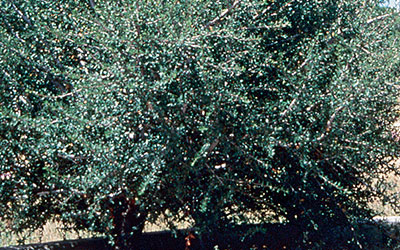
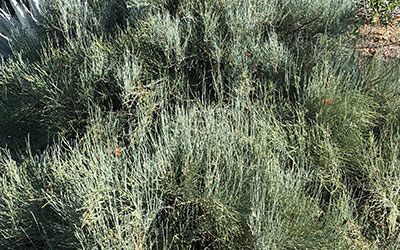
Joint-firs are grown for the color of their broomy evergreen stems which, depending upon the species, may be pale blue (Ephedra equisetina), blue-gray (Ephedra nevadensis) or bright green (Ephedra viridis). All add year-round color and interesting texture to gardens and require minimal water once established. Joint-firs native to the Southwest have brown papery seed-cones while the Asian species have pea-sized red fruits that are quite showy.
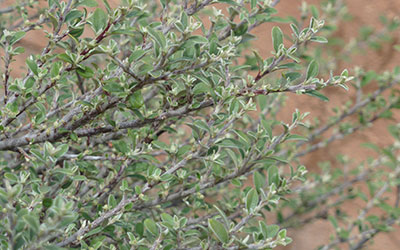

Grayleaf Cotoneaster, Cotoneaster buxifolius

Grayleaf Cotoneaster, Cotoneaster buxifolius

Full Sun, Part Shade
Medium Water

Mature Size: 2’X 4-6’
Blooming Season: Spring-Summer
Flower Color: Pink

Grayleaf Cotoneaster, like most species of Cotoneaster, is a low-spreading shrub that is sometimes used as an informal groundcover. Can be pruned back to create a more formal hedge shape. The small pink flowers become red berries that persist throughout fall. Its small gray leaves clothe 3- to 6-foot arching stems year-round. Grows well in moderately fertile soil.

Curlleaf Mountain Mahogany, Cercocarpus ledifolius

Curlleaf Mountain Mahogany, Cercocarpus ledifolius

Full Sun
Low Water

Mature Size: 10’X 6’
Blooming Season: Early Spring
Flower Color: Yellowish

A shrub-like tree that’s native to dry mountain slopes between 4,000 and 9,000 feet in elevation. Because it is very slow growing, it can make an excellent hedge or small character tree. Small flowers appear briefly in spring, then yield to seeds with 2- to 3-inch-long plumes. The bark is light gray, almost white, and the small leathery leaves are dark green above and fuzzy white below. Water to establish, then the tree can go unirrigated except in the hottest, driest weather.

Cliff Fendlerbush, Fendlera rupicola

Cliff Fendlerbush, Fendlera rupicola

Full Sun, Part Shade
Low Water

Mature Size: 6’ X 4’
Blooming Season: Spring
Flower Color: White

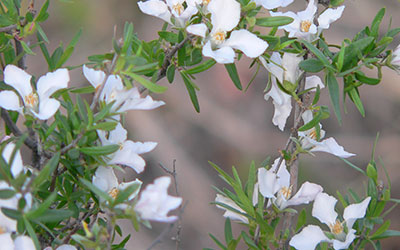
Cliff Fendlerbush grows wild in rock outcrops where it is a pleasantly compact shrub with small pale green leaves. Plant it near a window or patio where you can observe its pink buds as they open to pure white flowers. It is an elegant complement to summer flowering plants. Some plants shout out their presence, but Cliff Fendlerbush whispers that it’s finally spring.

Autumn Sage, Salvia greggii

Autumn Sage, Salvia greggii

Full Sun, Part Shade
Low Water

Mature Size: 24”X 36”
Blooming Season: May-September
Flower Color: Red

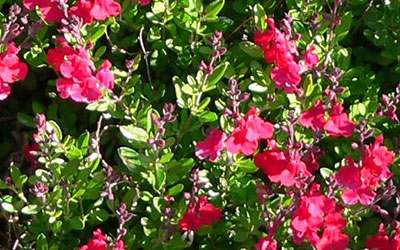
Autumn Sage (sometimes called Cherry Sage for its cherry-red blossoms) is a valued xeric plant for its twiggy mounded form and its profusion of flowers that begin in early summer. Culturally undemanding, Autumn Sage tolerates a wide range of soils as long as they are quick draining. Just a bit of extra water during dry spells encourages more flowers.