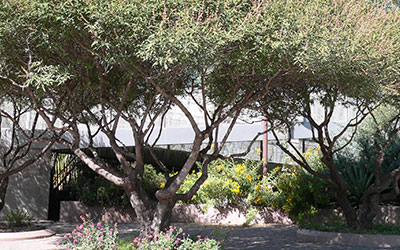
Velvet Mesquite, Prosopis velutina

Velvet Mesquite, Prosopis velutina

Full Sun
Rainwater Only

Mature Size: 15-30’X 10-25’
Blooming Season: May-June
Flower Color: Yellow

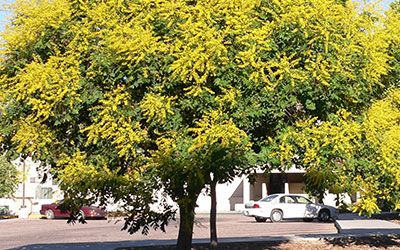
The various species of mesquite are trees synonymous with the desert Southwest. All are slow to leaf out in the spring, but they make up for their tardiness with fragrant yellow flowers. Small, blue-green leaflets give Velvet Mesquite a soft, lacy appearance. Flat, narrow bean pods hang from the tree throughout the summer. Its limited cold-hardiness makes it a good choice where average annual minimum temperatures stay above 5 degrees F; other mesquites found in the Plant List are about 5 degrees F more cold hardy.

New Mexico olive, Forestiera Neomexicana

New Mexico olive, Forestiera Neomexicana

Full Sun, Part Shade
Medium Water

Mature Size: 12-18’X 10-15’
Blooming Season: Early Spring
Flower Color: Yellow-Green

Depending upon your landscape needs and preferences, this native species can be pruned upward to form an attractive small tree or left in its natural, rounded shrub-like shape. The bark of its multiple trunks is a smooth pale gray, and its branches fork at odd, interesting angles. Clusters of small yellowish green flowers appear early in spring; female plants produce small fruits that attract song-birds. Tolerates drought, but does best when roots receive a deep soaking once or twice a month.

Netleaf Hackberry, Celtis reticulata

Netleaf Hackberry, Celtis reticulata

Full Sun
Low Water

Mature Size: 25’X 25’

A young Netleaf Hackberry passes through a rather ungainly adolescence, but with a little pruning, like a butterfly from a chrysalis, it emerges as a sculptural small shade tree that provides habitat for butterflies and songbirds as well as cooling our patios and decks on a very modest water budget. Deep roots allow its use close to walls and paving without risk.

Lady Banks Rose, Rosa banksiae

Lady Banks Rose, Rosa banksiae

Full Sun, Part Shade
Low Water

Mature Size: Climbing X 40’
Blooming Season: Spring
Flower Color: Pale yellow or white

Rarely do you find a plant that is fast growing, evergreen and long-lived. Lady Banks Rose is all those things and it produces a beautiful if brief show of flowers in spring using surprisingly little water. This plant grows large and, unlike most roses, blooms on old wood. It produces the best flower show when pruned sparingly, removing a few of the oldest canes every few years.

Coral Honeysuckle, Lonicera sempervirens

Coral Honeysuckle, Lonicera sempervirens

Full Sun, Part Shade
Medium Water

Mature Size: Climbing X 8’
Blooming Season: Spring into Summer
Flower Color: Coral orange

If the sweet scent and rampant growth of honeysuckle are too much of a good thing in your opinion, Coral Honeysuckle may be the vine for you. It is unscented and one of the least aggressive members of the family, yet its brilliant flowers pro- vide plenty of nectar for hummingbirds. If you’d like a smaller sized but fragrant vine, try the hybrid Lonicera x heckrottii, Goldflame Honeysuckle, which differs in having clusters of scented gold and coral-pink blossoms.