One of the
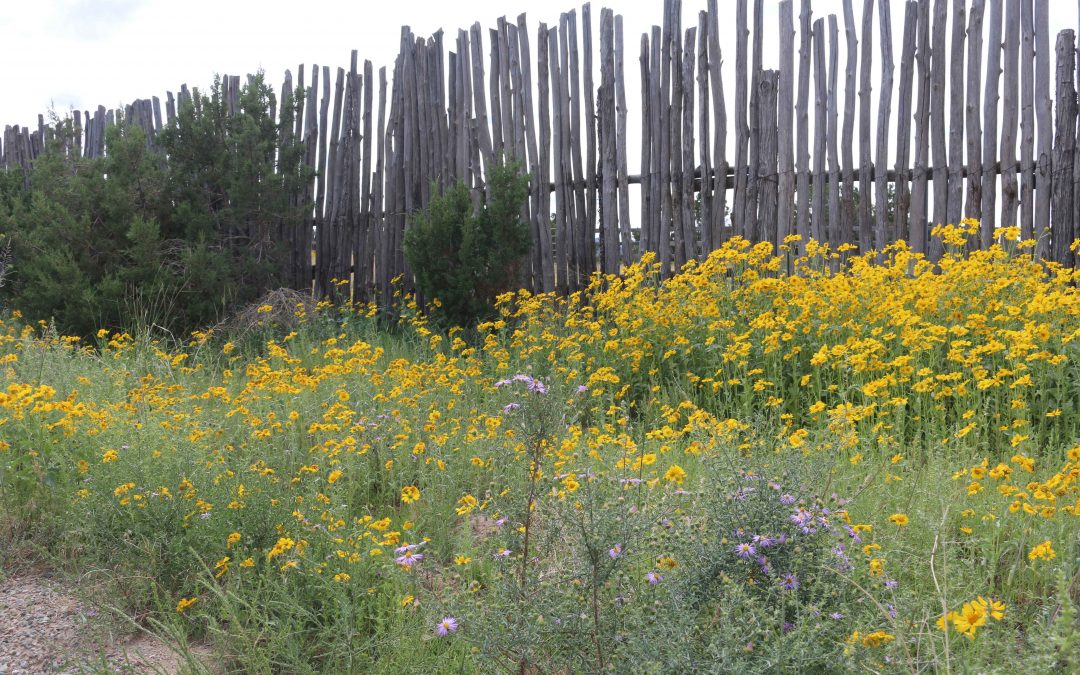
great advantages of desert-adapted plants is the wealth of colorful flowers
they produce, a boon to gardeners and pollinators alike. Plants that bloom in
autumn offer pollen and nectar for insects and, if the seed heads are left to
ripen, a late season food source for birds.
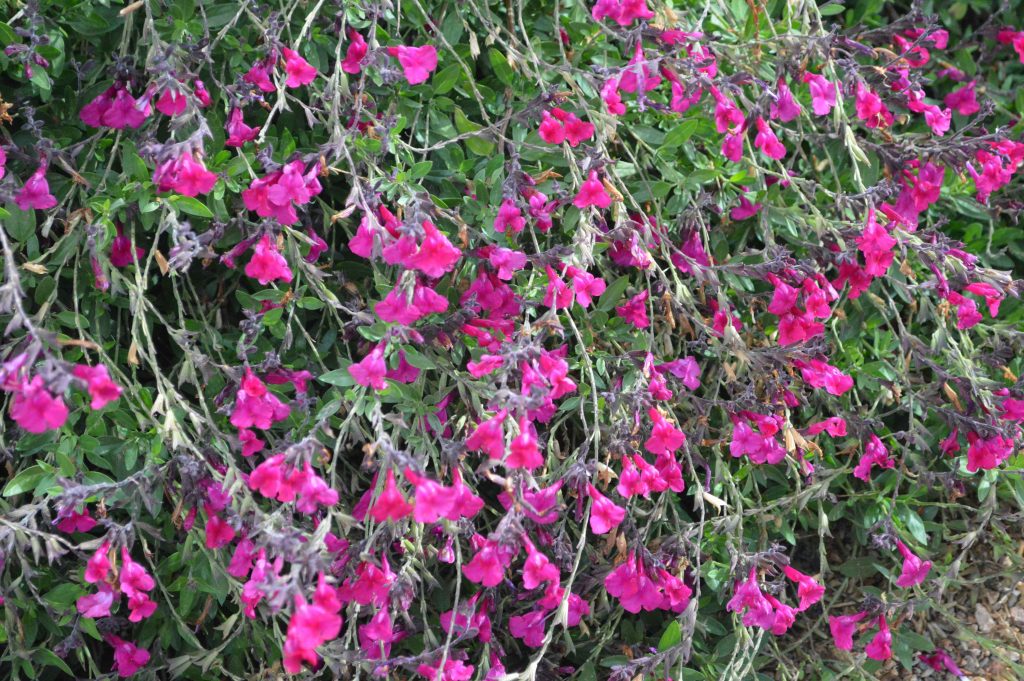
After a long hot summer, some plants think the cool of fall means it’s spring again and burst into bloom with renewed vibrance. Salvia greggii is commonly called autumn sage because, even though it flowers brilliantly in spring and lightly all summer, fall brings on another strong show. Responding to the cooler, longer nights in autumn, Salvia’s late season color becomes even more intense. Autumn sage is a compact shrub that grows 2-feet tall and 3-feet wide, with small dark green leaves and spikes of flowers in red, rose pink, coral, purple or white. Hummingbirds and bees are frequent visitors. Autumn sage prefers well-drained soil and deep watering (24 to 30 inches) every week or two while blooming, monthly or less in winter.
Autumn sage, Salvia greggii
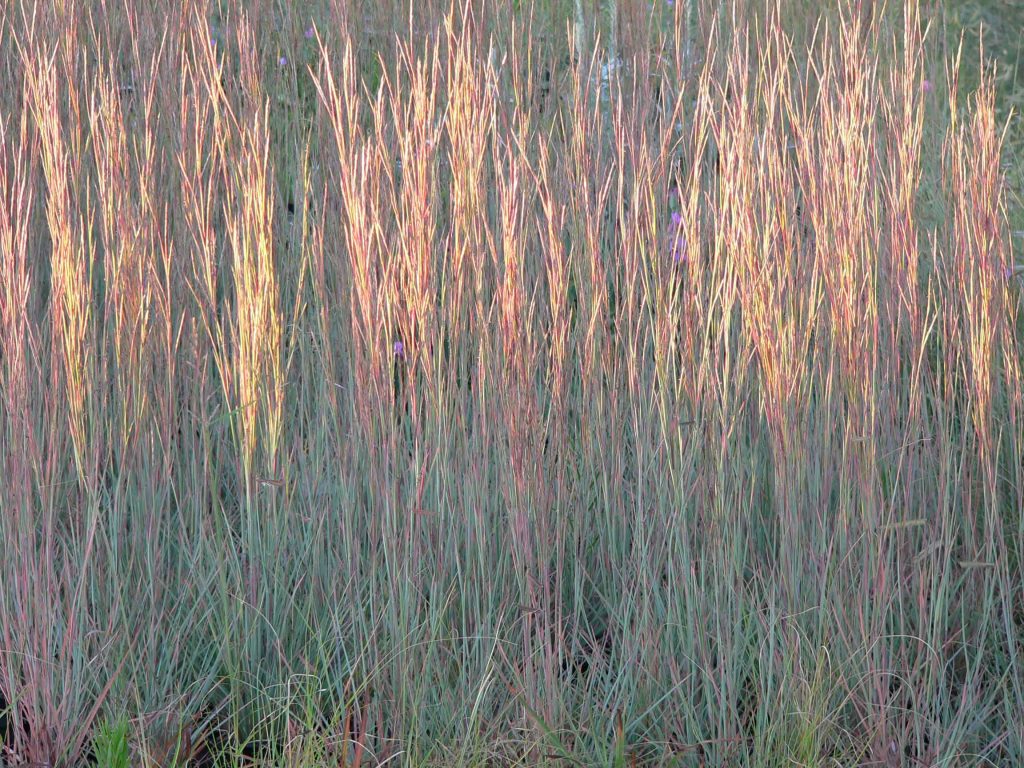
Many ornamental grasses are their showiest in autumn, too. There are several varieties of little bluestem Schizachryium scoparium with 12-inch wide clumps of narrow blue-green leaves and 24-inch tall slender stems bearing fuzzy seed heads. ‘Blaze’ little bluestem turns scarlet in fall and ‘The Blues’ turns a beautiful pink. Both keep their color into winter when they fade to a rich bronzy brown. The color is our reward for supplying the little extra water these grasses need.
Native grasses are also important larval food for butterflies and produce nutritious seeds for songbirds, bringing color on wings to the garden. Since the seed heads are a large part of the reason they are planted, ornamental grasses should be left uncut until early spring. Then, trim them a few inches from the ground so the new growth is not stymied by having to push through old stubble to reach sunlight.
Little bluestem Schizachryium scoparium
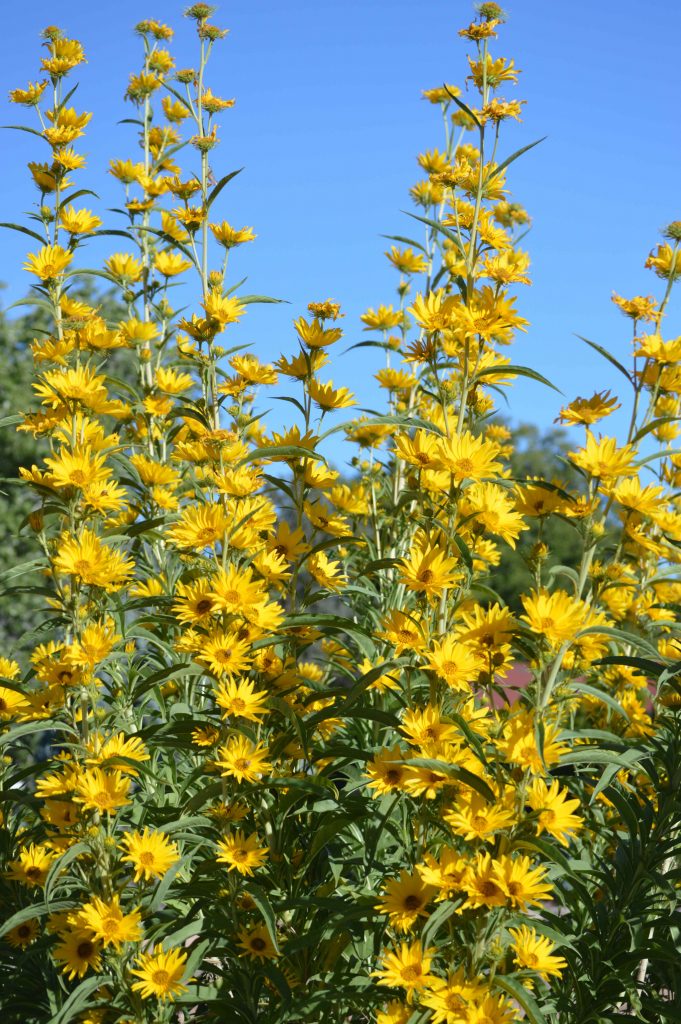
Perhaps the most spectacular late blooming perennial is the Maximilian sunflower Helianthus maximiliani. By early autumn, its flower stems are 5 to 7-feet tall. Established plants can spread 4 or more feet wide, shooting up dozens of flower stems. The top few feet of the stems are covered in 2-inch wide yellow sunflowers with yellow centers abuzz with bees. The show can last for several weeks in September or October, but after the flowers fade the plants become a bird buffet of seeds well into winter. Maximilian sunflowers grow best in soils that hold water well and produce the best show when watered to a depth of 2 feet weekly during the growing season, every two weeks in spring and fall and monthly or less in winter.
Maximilian sunflower, Helianthus maximiliani
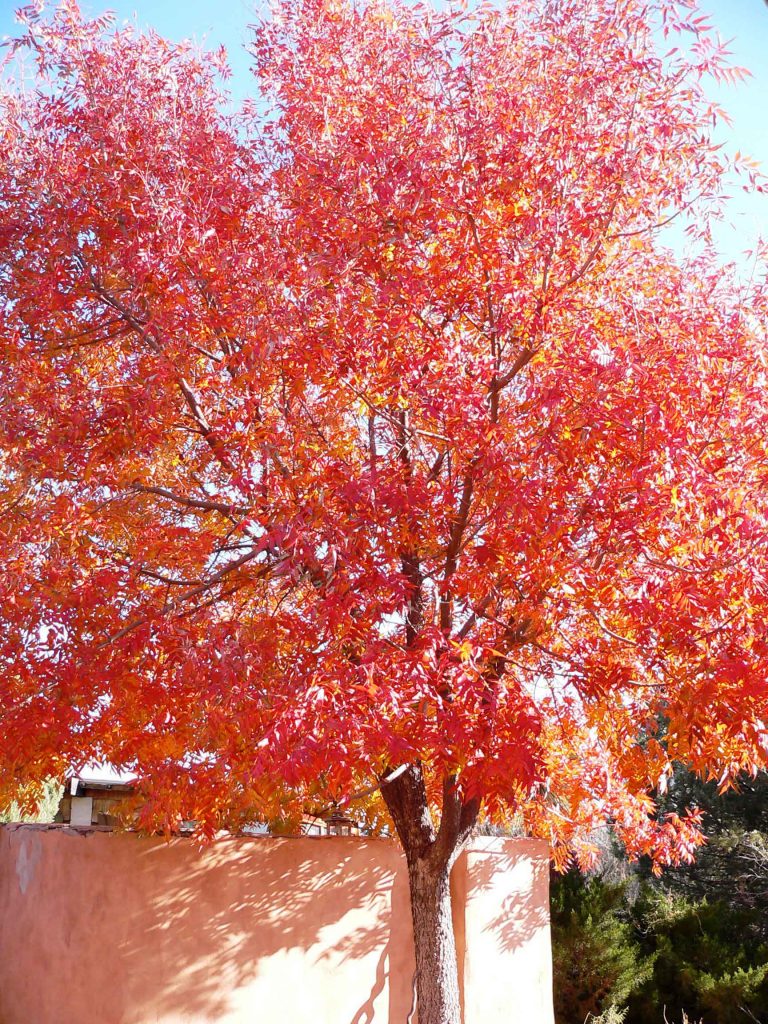
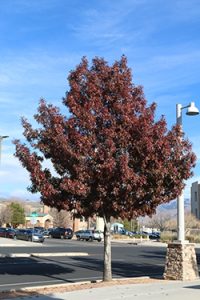
Flowers aren’t the only source of fall color, either, but red leaves in fall are not the norm in New Mexico. Cottonwoods in the Bosque and aspens in the mountains are our autumn gold. Chinese pistache Pistacia chinensis has become one of the most dependable heat and drought tolerant shade trees and adds splashes of red fall foliage in the ABQ metro area. A great shade tree that is 20 to 30-feet tall at maturity with a canopy spread of 20-feet, Chinese pistache benefits from structural pruning while it is young to assure strong branching. Once well rooted, it should be watered at the edge of the branch canopy to a depth of 2 to 3 feet every few weeks during the growing season and monthly or less depending on winter moisture.
Chinese pistache, Pistacia chinensis
Author: Judith Phillips, owner of Design Oasis, landscape designer and garden writer with 30 years experience designing arid-adapted and native gardens in the high desert.
While it is fantastic living in the Southwest
where the sun shines over 310 days a year, sometimes landscapes and homeowners
alike crave shade. Large trees provide great shade but may take a long time to
grow. So to create fast shade for patios and windows, choose vines. Luckily
many vines grow well in Albuquerque, including evergreen vines, flowering
vines, fruiting vines and many more. Below are four favorites of 505Outside for
the Albuquerque area.
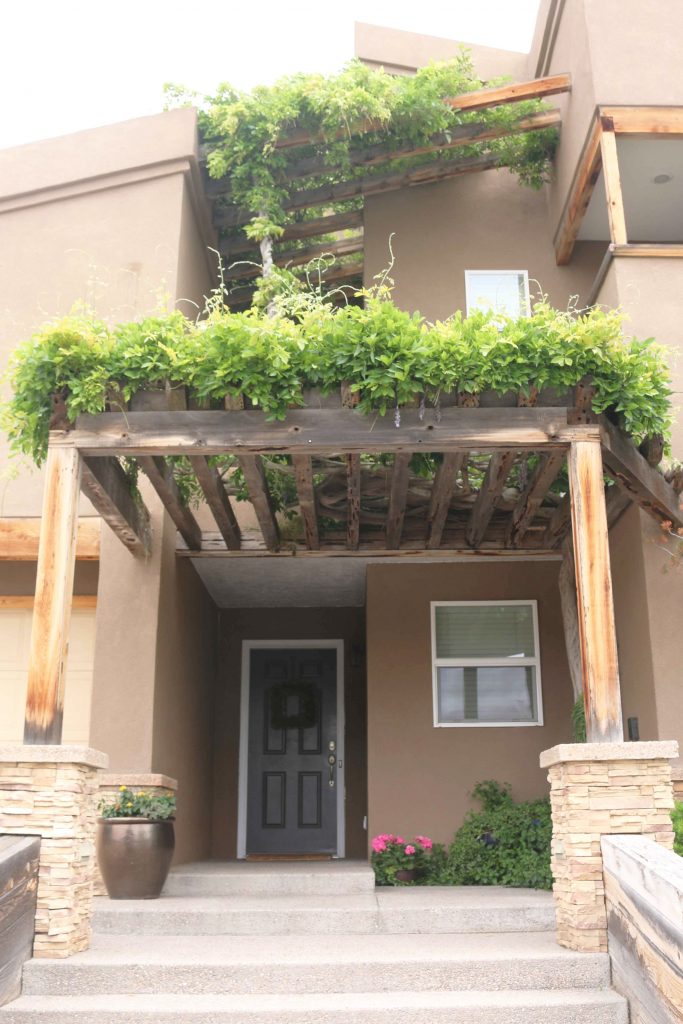
1. Wisteria, Wisteria sinensis: The pendulous lavender flowers of this vine are some of the first to bloom in the spring. Bright green leaves follow shortly thereafter, filling up the plant and creating lots of dappled shade below. Once the flowers fade, the leaves fill in to provide dense shade in the summer. Prepare for wisteria vines to get woody over time. Strategic training of the stems is also recommended. Wisteria grows well in sun, shade and part shade. Mature height and spread are 25’ to 30’ x 25’ to 40’.
Wisteria growing over a front door trellis.
2. Lady Banks Rose, Rosa banksiae: Rarely do you find a plant that is fast growing, evergreen and long-lived. Lady Banks Rose is all those things, and it produces a beautiful if brief show of flowers in spring. And it uses surprisingly little water. This plant grows large and, unlike most roses, blooms on old wood.
3. Trumpet Vine, Campsis radicans: Orange and yellow trumpet-like flowers grace this beautiful deciduous vine. Train it to grow onto a shade structure. It is a fast grower but you must provide a strong enough support and enough space for this vigorous rambler.
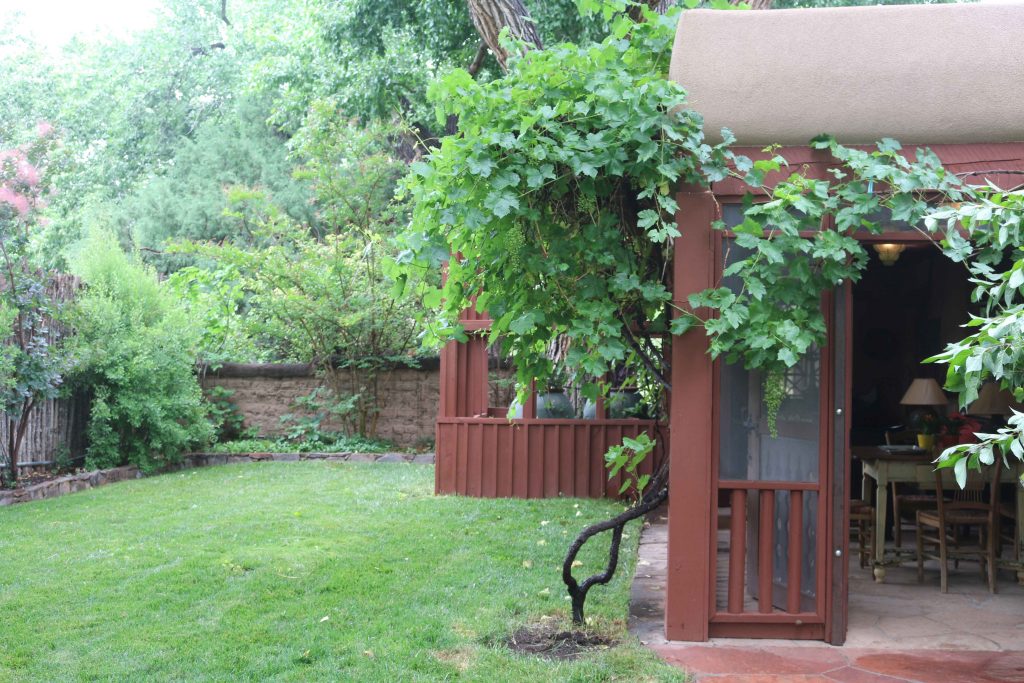
4. Grape vines, multiple varieties: New Mexico is one of the oldest grape growing regions in North America. For covering a trellis or arbor look for vigorous growers. Grape vines like to have moist feet during the first year of establishment. Grapes will grow wild and crazy if not trained and strategically pruned during the winter months. They also need constant redirecting, so tie the vines to the trellis with twine, checking on it every other week during the growing season. These are deciduous so be prepared for a sculptural woody vista throughout the winter months.
Grape vines growing next to an outdoor patio.
Try growing any of these vines on open lattice ramadas, arbors and pergolas. While wood is the most often used material for these structures because it is simple and easy to build, in the Albuquerque climate steel is an ideal choice. Steel structures are strong, long lasting and maintenance free. No matter what material you choose, creating living shade with vines can be rewarding.
Author: Jill Brown, ASLA Landscape Architect and owner of My Landscape Coach in Albuquerque, NM. Resources: Down to Earth, A Gardener's Guide to the Albuquerque Area by Albuquerque Area Extension Master Gardeners. Growing the Southwest Garden and New Mexico's Gardener's Guide by Judith Phillips.
Everything in nature is
connected. Fostering the connections keeps ecosystems and gardens vital. And weaving
pollinator essentials together into a beautiful garden is a fun process. Start
by thinking about where you will view the garden from as well as how you’ll
move through the space to view pollinator activity without disrupting your
winged guests. Organize the largest and thirstiest plants around rainwater
harvesting opportunities such as gutters or canales, and use pathways to divide
larger spaces into smaller planting areas like herb gardens, wildflower beds
and native shrub borders. Include the essentials of food, shelter and water in
your garden and your pollinators will thrive.
Among the insects and
birds that pollinate plants, bees are the primary work force. There are 1000+ kinds
of native bees in New Mexico, as well as honey bees that assist plants in
producing seeds. Butterflies and moths are less efficient pollinators than
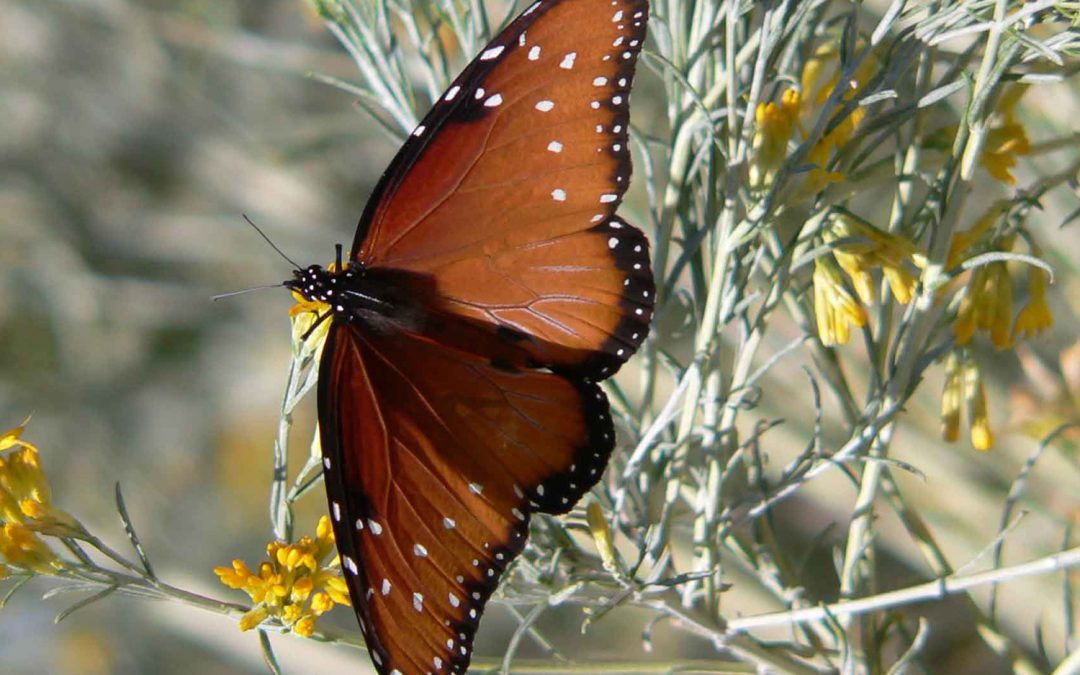
bees, and many have key relationships with specific plants: Monarchs
butterflies with milkweeds and hawkmoths with evening primroses. Beetles, bats
and hummingbirds are also nectar drinkers and pollinators.
Plants expend energy to
produce showy flowers to attract pollinators. In exchange for distributing the
pollen needed to fertilize the flowers so the plants can reproduce, the
pollinator feeds on the energy-rich nectar. The shapes and colors of flowers
determine who will pollinate them. Butterflies can’t hover to feed, so they
need open-faced flowers with places to land, like daisies and roses.
Hummingbirds and hawkmoths are able to hover while they probe tubular flowers
for their nectar and pollen. Plants with inconspicuous flowers are often
wind-pollinated, like native grasses, but are still part of the pollinator
support system. Their leaves feed many larval stage insects.
If you are new to the
neighborhood, survey plants nearby for pollinator activity and plant some of
the busiest ones. If you already have plants in your garden that are abuzz with
pollinators, think about replacing any plants that are shirking their habitat
role with ones that are better hosts. Choose plants that are rich in nectar and
well-adapted and watch your garden become a surprise party buzzing with energy.
Food sources include flower nectar for sugar and essential amino
acids, pollen for protein, and leaves as larval food. Native grasses are
especially valuable as caterpillar food. Plan to include food sources
throughout the seasons that pollinators are active.
Shelter includes layers of canopy from taller
trees, mid-height shrubs and groundcovers (knee high and shorter). Leave some
dead snags as hummingbird roosts and for bee nesting. Leave leaf litter in some
places and keep some open soil in out of the way areas for ground nesting
insect habitat. Cluster plants in masses of varied heights and densities as cover.
Plans for bee hotels and ready-made bee and bat nesting boxes are easy to find and
build. Check nature center gift shops and online for ready-made nesting boxes.
A
small, trickling water feature as a
source of drinking and bathing water for insects and birds should have shallow
edges to avoid drowning bees. An extra drip emitter in fine stone mulch or bare
ground is a good water source for bees and puddling place for butterflies.
Eliminate
pesticides and herbicides. You don’t wan to attract pollinators just to poison
them! Your health will benefit, too.
The greater the variety of plants, the greater diversity of pollinators will visit. Plant for a seasonal progression of blooms. It takes at least 100 sq. ft. of the same flower to consistently attract pollinators (think a 5-foot-tall and wide fernbush or butterfly bush or a 10-foot x 10-foot wildflower or herb bed space). So if your neighbor has a swath of red valerian, plant a few but use more of your space for sunflowers, mistflower, yarrow, beebalm, salvias, penstemon, oregano, fennel, whorled butterfly weed or native buckwheats. Pollinators don’t recognize property lines so the more neighbors who garden for pollinators, the richer your neighborhood will become in pollinators. Avoid hybrid flowers, especially varieties with double flowers since those plants may produce little or no nectar or pollen.
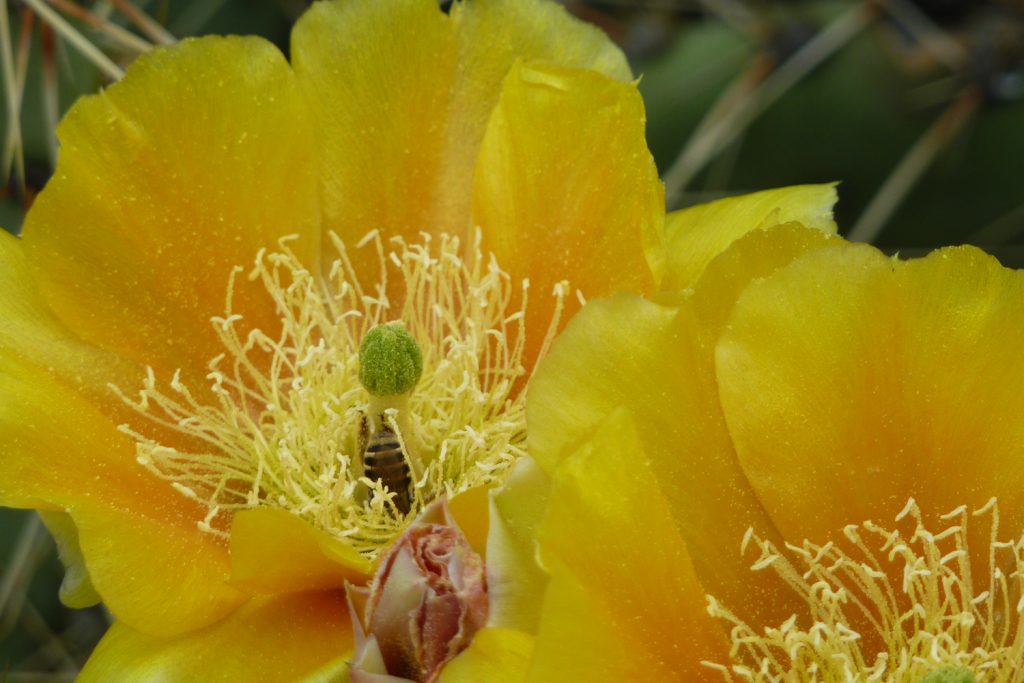
Opuntia englemannii with bee. Photo by Judith Phillips
There are
public pollinator gardens in Albuquerque:
Rio Grande Botanic Gardens on Central Ave at New York NW
El Oso Grande Pollinator Habitat at the east end of El Oso Grande Park on Osuna Road @ Morris NE
Albuquerque Garden Clubs Garden Center in Los Altos Park on Lomas just west of Eubank
Author: Judith Phillips, owner of Design Oasis, landscape designer and garden writer with 30 years experience designing arid-adapted and native gardens in the high desert.
Many homeowners would like a turf grass lawn, but might feel
irresponsible watering a lawn in the arid Southwest. The key to choosing a turf
grass is to determine the one most suited to the specific needs of your
landscape.
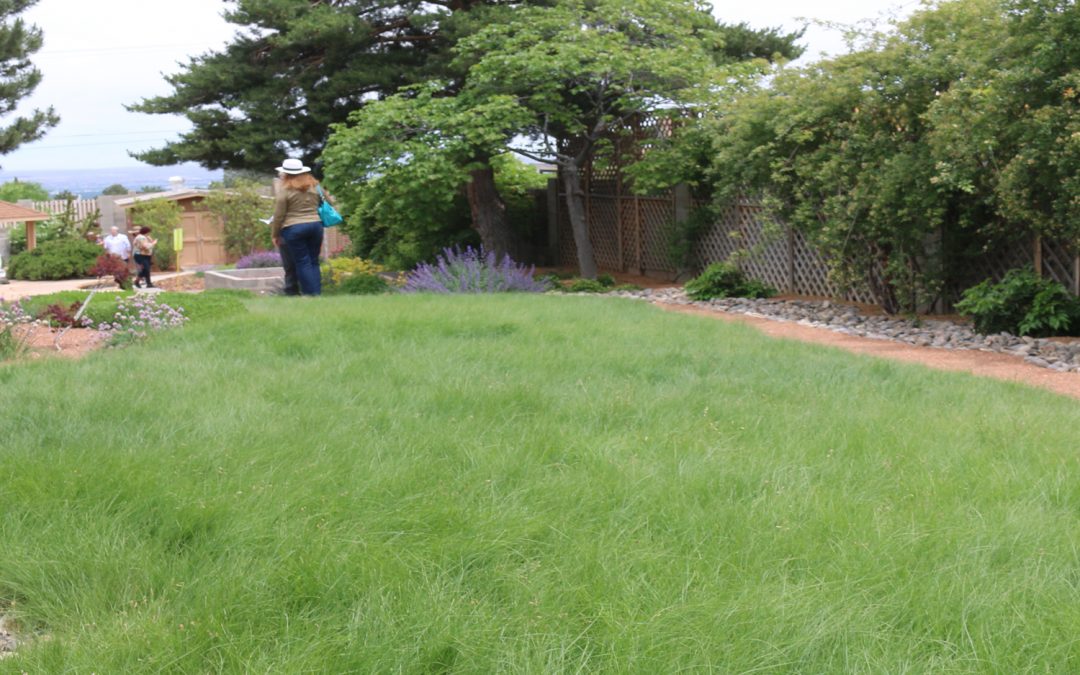
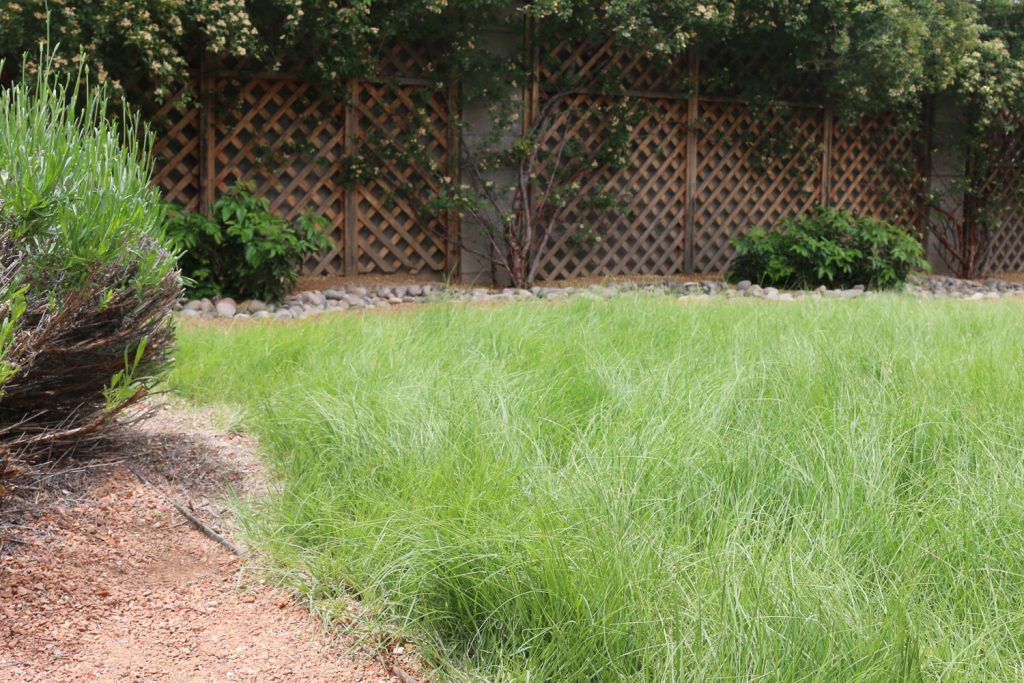
There are two different categories of turf grasses: cool season and warm season. Cool season grasses are Kentucky bluegrass, perennial ryegrass and tall fescue. These are cold tolerant, green most of the year, and hold up to extensive amounts of foot traffic. But they use a lot of water. Warm season grasses are Bermuda grass, blue grama, and buffalo grass. Warm season grasses have a shorter growing season. This means they green up in mid Spring, are low maintenance, and require less water than cool season grasses. But blue grama and buffalo grass can’t take extensive foot traffic.
Grasses should not be selected solely on perceived water use. Depending on the purpose and function of the turf area, traffic tolerance, recuperative ability, maintenance and aesthetic appearance should also be considered.
Four Turf Grasses for Albuquerque
Park Blend grass, a combination of Kentucky bluegrass, perennial ryegrass, and tall fescue
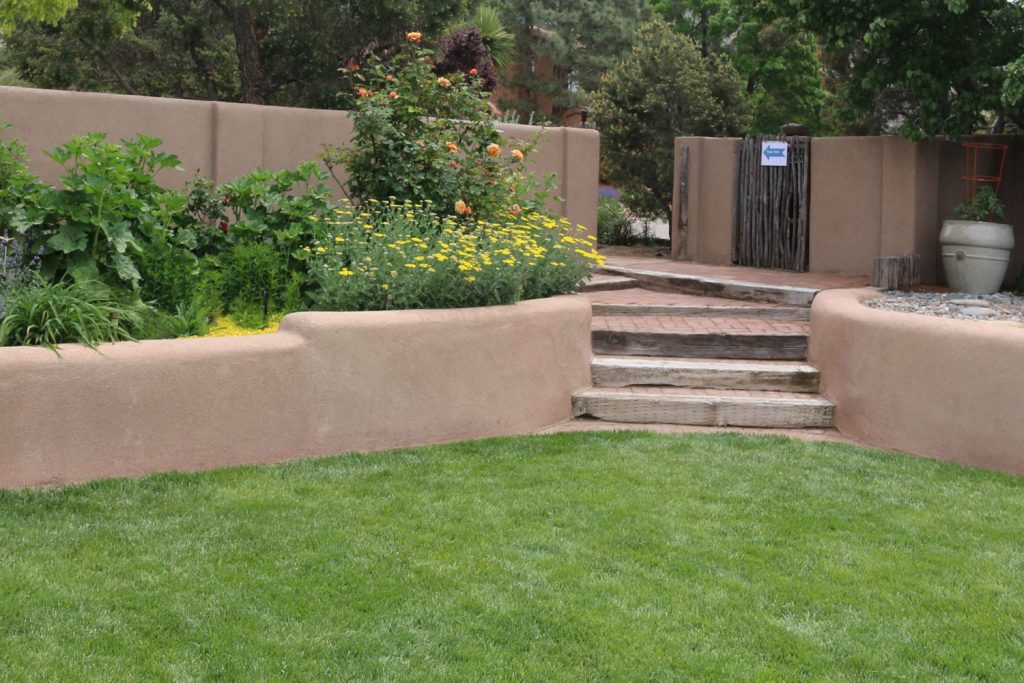
PARK BLEND: The most popular turf grass lawn here, used by the City of Albuquerque and homeowners alike, is Park Blend. Park Blend combines all the cool season grasses into a blend of Kentucky bluegrass, ryegrass and tall fescue, taking advantage of the positive attributes of all three grasses in one turf. Park Blend performs beautifully through warm summers and is especially well-suited to New Mexico's growing conditions. While it does need about 37"- 41" inches of water a year, this is a great choice for a lawn that will receive a lot of traffic. It does require regular mowing and weed control.
Buffalo grass, Bouteloua dactyloides
BUFFALO GRASS: Choose warm season buffalo grass for a beautiful low growing, low water and low maintenance grass. It will handle light traffic, rarely requires mowing and uses around 24" - 28" inches of water a year.
Bermuda grass, Cynodon ‘PWIN04S’ Dog Tuff
BERMUDA GRASS: Bermuda grass is a great choice for a low water, low maintenance grass with medium foot traffic. The downside is that it does spread prolifically via runners. It is best to surround this grass with an 8-inch-wide and deep edger to keep it in check. Bermuda grass uses about 22 - 26 inches of water a year and requires a few mowings a year.
Blue grama grass, Bouteloua gracilis
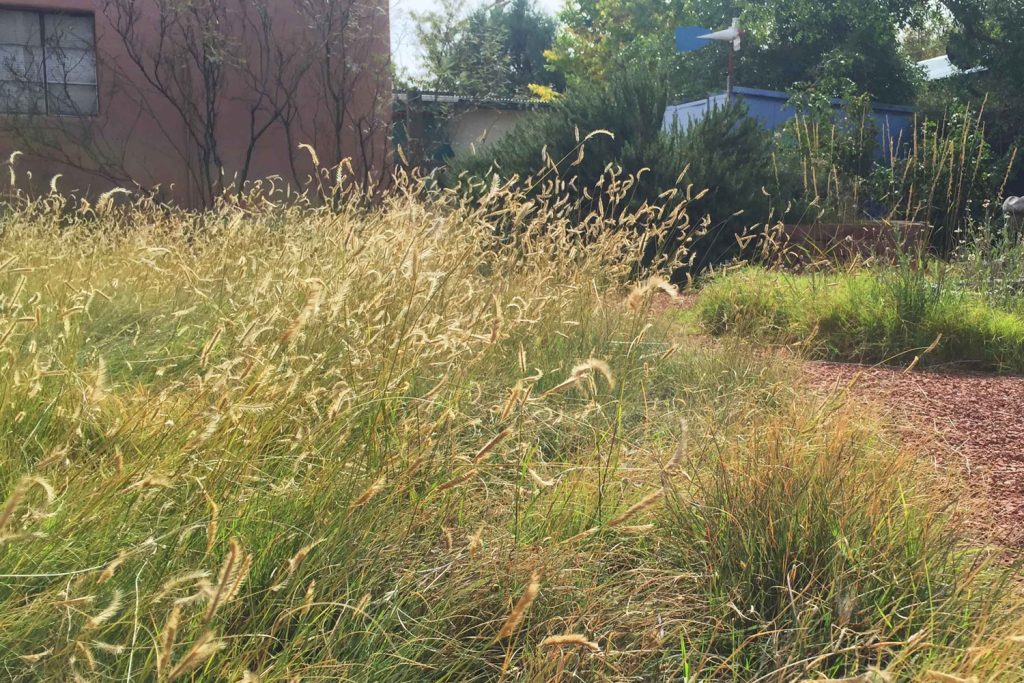
BLUE GRAMA GRASS: Choose blue grama grass for a stunning native meadow look. It can be seeded with wildflowers for a beautiful spring and summer appearance. Keep the eyelash like seed heads on the grass through the fall and winter for both aesthetics and wildlife appeal. This grass uses about 18 - 20 inches of water a year. Trim and dethatch once in late winter for best appearance.
PRO TIPS: prepare the soil well before planting turf grasses, water early in the morning or late evening, keep grasses to a mow height of 3-4" so the soil stays cooler, service the irrigation system regularly to check for efficiency.
Author: Jill Brown, ASLA Landscape Architect and owner of My Landscape Coach in Albuquerque, NM. Resources: Turfgrass irrigation Circular 660 Bernd Leinauer, Professor and Extension Turfgrass Specialist NM State University, Growing the Southwest Garden by Judith Phillips, High Country Gardens, Plants of the Southwest. Even more resources about turfgrasses can be found over at NMSU.
A correctly planted tree will grow more quickly, will be healthier and more attractive, and will live longer than an incorrectly planted one. A healthy tree will also have a stronger and larger root system better able to draw moisture from the soil. This allows it to better withstand the periodic droughts of arid New Mexico.
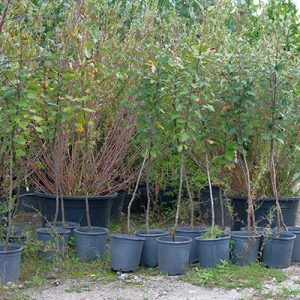
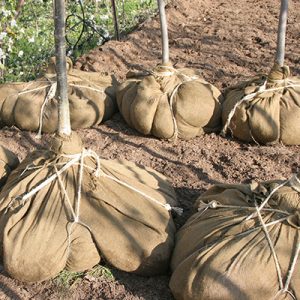
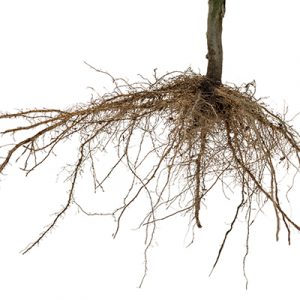
When you purchase a new tree from a nursery, it will come one of three ways: As a container tree, a ball and burlapped tree, or a bare-root tree. A containerized tree is simply a tree in a container (usually a plastic pot). Balled-and-burlapped trees are usually larger specimens that have been dug out of the field. After the tree is dug up, its root ball is wrapped in burlap fabric and covered with a wire cage. A bare-root tree, as the name implies, has no covering on the roots at all. This is often the case with fruit trees.
Container tree
Balled-and-burlapped tree
Bare-root tree
To plant a containerized tree, follow the steps below:
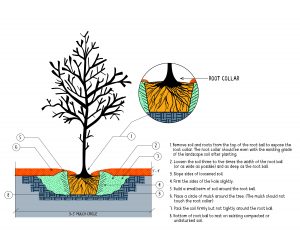
Remove soil and roots from the top of the root ball to expose the root collar. Carefully remove the root ball from the container and set the tree on undisturbed soil in the center of the hole. The root collar should be even with the existing grade of the landscape soil after planting. (see sketch for more information.)
Loosen the soil three to five times the width of the root ball (or as wide as possible) and as deep as the root ball. Tree roots grow best in loosened soil that has pore spaces for water and oxygen. The walls of the hole should be tapered away from the hole.
Trim back roots that have begun to circle the root ball.
Partially fill the hole with soil and firm it slightly. Water thoroughly and finish backfilling the hole with soil. Pack the soil firmly but not tightly around the root ball.
Build a small berm of soil around the root ball. Fill the berm with water two or three times to make sure the soil is completely moist. Thereafter, begin a regular watering schedule.
Place a protective circle of mulch, three feet wide or wider, around the tree. The mulch should not touch the root collar and should be installed at a depth of 3 to 4 inches for best results.
To plant a balled-and-burlapped (B&B) tree, follow the steps below:
Remove soil and roots from the top of the root ball to expose the root collar. Carefully set the tree on undisturbed soil in the center of the hole. The root collar should be even with the existing grade of the landscape soil after planting. (see sketch for more information.)
Loosen the soil three to five times the width of the root ball (or as wide as possible) and as deep as the root ball. Tree roots grow best in loosened soil that has pore spaces for water and oxygen. The walls of the hole should be tapered away from the hole.
Carefully place the root ball in the center of the hole. The top of the root ball or bottom of the root collar (see photo) should be even with the soil level. Take note of the tree flair in the sketch.
Remove twine or string, burlap, and if the root ball is surrounded by a wire basket, cut and remove the wire basket. Be careful to avoid breaking up the root ball.
Partially fill the hole with soil and firm it slightly. Water thoroughly and finish backfilling the hole with soil. Pack the soil firmly but not tightly around the root ball.
Build a small berm of soil around the root ball. Fill the berm with water two or three times to make sure the soil is completely moist. Thereafter, begin a regular watering schedule.
Place a protective circle of mulch, three feet wide or wider, around the tree. The mulch should not touch the root collar and should be installed at a depth of 3 to 4 inches for best results.
PRO TIP: If possible, plant trees in valleys and depressions in the landscape so rainwater will naturally collect and give the tree a good soaking. Direct roof downspouts and canals towards trees.
Newly planted trees do, however, need water. Do a thorough watering at planting. Water again about 3 days after the first planting. Then water once a week for the next four weeks. Continue watering once a month for the rest of the winter. Every time you water, make sure it is a deep soak. That means watering to a depth of 24 inches. See how deep am I watering for instructions on how to measure watering depth.
Be sure to add mulch around your new trees. We recommend using an organic mulch installed to a depth of 3 inches around the tree, keeping mulch a few inches away from the trunk of the tree.
Staking a tree is not necessary unless your tree is located in a super windy spot. If you do stake the tree be sure the tie is not too tight. Promptly remove it one year after planting the tree.
Soil amendments are not necessary if you choose the right tree for the native soil conditions in your yard.
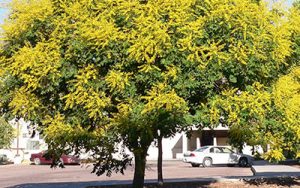
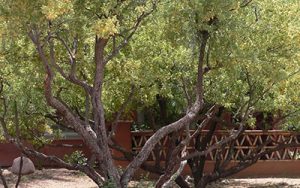
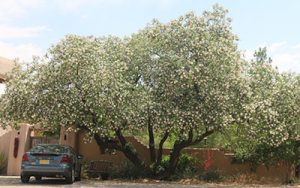
There are so many types of trees to choose from. We don’t blame you for being confused. Here are some of our favorites, just a small list of the many trees available here in New Mexico. Before you head out to buy your tree, though, let’s chat a little bit about them.
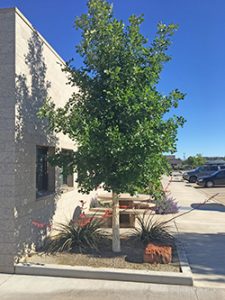
As you look around town, you’ll notice trees come in all shapes and sizes. The key to choosing the perfect tree for your yard is picking the right tree for the right place. In fact, this phrase is popular among arborists.
When deciding what tree to plant, think about the tree size now and at maturity. It may look small now, but how big will it grow once it’s mature? Make sure you provide enough room for future growth. No one wants branches growing into power lines, roots disrupting your foundation or leaves blocking the solar panels on your neighbor’s house.
Learn about the rate of growth of the tree, too, so you know how long it will take to get to mature height. Other key factors in choosing the perfect tree are understanding what sun exposure the tree likes. Does it like full sun all day? If so, plant it on the south side of the house or in a location where buildings will not block its access to sunlight. Cold hardiness, heat tolerance, soil preference and irrigation needs should all be considered when choosing a tree species.
Trees are also a long-term investment. Take the time now to choose the right tree for the right place and you’ll save money in the long run.
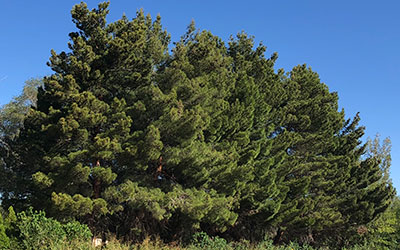
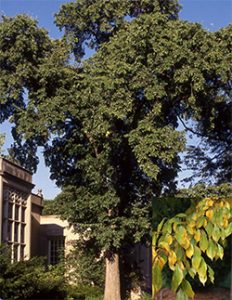
This list of recommended trees is broken into deciduous and evergreen trees.
A deciduous tree loses its leaves annually in the fall.
Evergreen trees shed their leaves or needles periodically, but usually remain green throughout the year.
Large Deciduous Trees
‘Accolade’ Elm, Ulmus japonica x wilsoniana ‘Morton’