
In a June article in 505Outside, we covered Plants for Passive Rainwater Harvesting. Now we will discuss Passive Rainwater Techniques for the Homeowner.
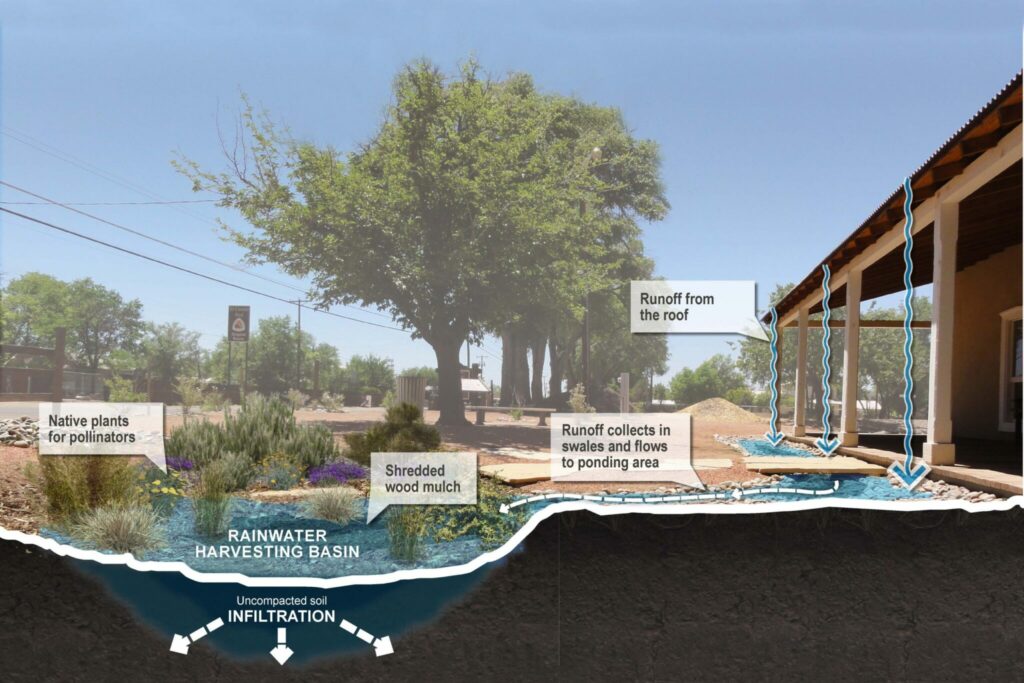
Passive rainwater harvesting allows you to collect rainwater runoff from roofs, patios and driveways as well as the overflow from rain barrels and cisterns (active rainwater harvesting sources) and direct it into the landscape. The water then gets stored in the soil where plants can take advantage of the moisture.
Several rainwater harvesting techniques can turn potential problems (i.e. erosion, flooding or excess moisture near foundations) into water for your plants. Rainwater contains extra nutrients not always found in potable water, so the plants receive additional benefits. Passive rainwater harvesting also helps filter out pollutants, increase infiltration to the aquifer and provide healthier ecosystem habitat.
The Bernalillo County Field Guide for Passive Rainwater Harvesting provides an excellent and comprehensive step-by-step guide to designing, installing and maintaining a system for your home.
Start by calculating the amount of water that flows from your potential runoff sources. For every 1,000 square feet of hard surface, 1 inch of rain will generate approximately 600 gallons of water. It’s easy to see why rain barrels or cisterns can quickly fill during medium to larger rain events, so a passive collection system for overflow is always a good idea. You want to make sure whatever system you create will be able to handle a
good-sized rain event (refer to the link above). It’s very important to create a directed overflow so that when there is a large rainstorm, the excess water will flow into a basin or other feature onsite or into the street (if your capacity is limited) without creating erosion.
There are many different techniques, and some can be used together to enhance the benefits. These techniques include rain gardens, swales, basins, soil sponges, curb cuts, French drains and pumice wicks, check dams and gabions. Study your site and these techniques to determine the best option for your garden. Watch your site during a rain to see where the runoff comes from and where it goes. You may want to take advantage of existing patterns.
Rain gardens are depressions to catch surface runoff from slopes and are best planted with native plants that can take occasional flooding.
Swales are sloped depressions that convey water into basins or rain gardens from canales, downspouts or other drains. Make sure the slopes consistently move the water downhill and are large enough to not get overwhelmed. Swales are usually lined with large gravel or cobble to prevent erosion. If you have extra material onsite, this is a great recycling solution. Make sure that swales are designed to catch the slow drip of a light rain as well as the powerful flow of a heavy downpour.
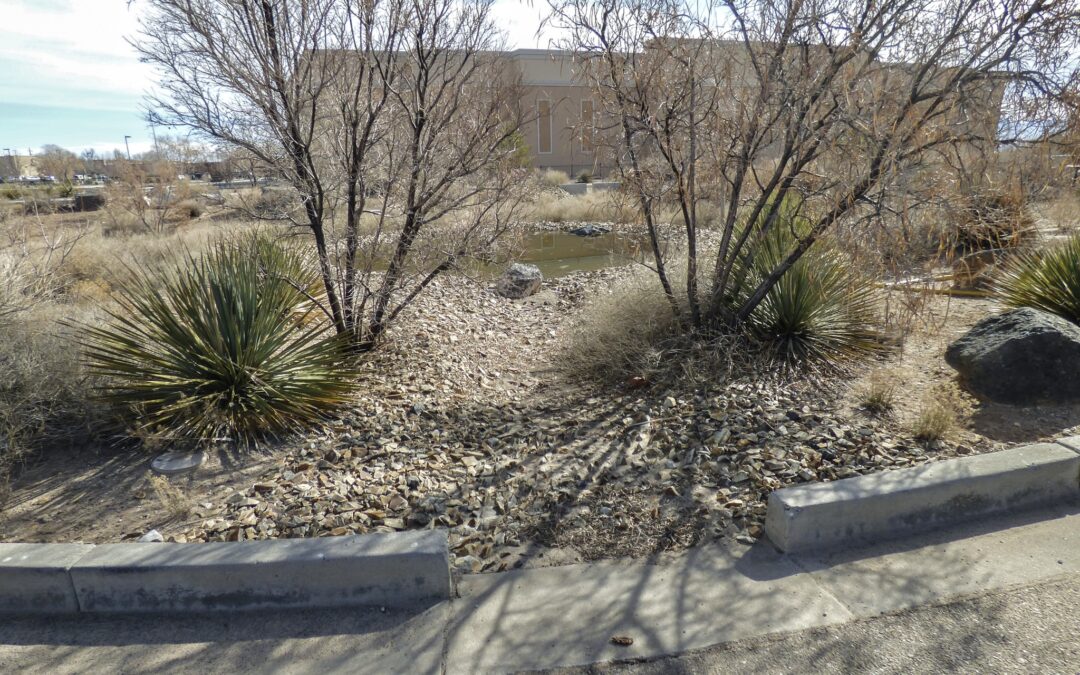
Basins are catchment ponds designed to handle large rain events and provide a great place to plant trees and larger shrubs or heavy water use plants that can benefit from the extra water. Calculating the size to match your runoff is vital here. The area where the runoff from your swale(s) enters the basin will need gravel to dissipate the erosive forces. Shredded wood mulch works best in the bottom of the basin. The capacity of the basin and the health of the plants can be further enhanced by installing soil sponges (see below) in the low points. In larger yards, you may want to create a series of basins to increase capacity and opportunities for plantings.
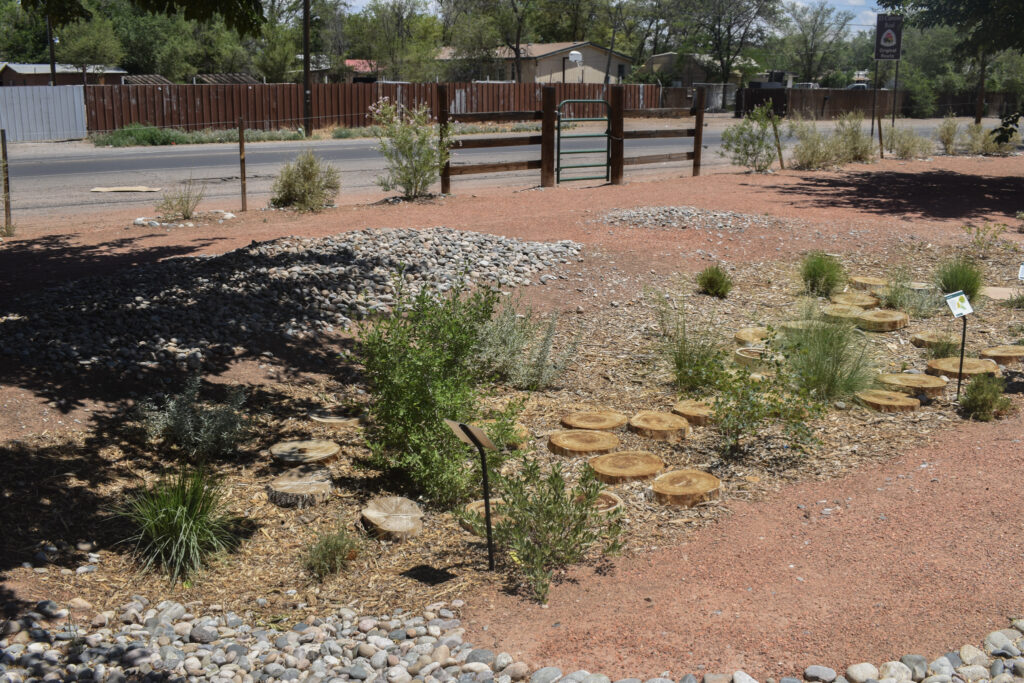
Soil sponges are post holes dug and filled with a soil mix containing compost to increase infiltration and introduce organic matter and beneficial microbes to the soil sponge and surrounding soil. These also provide an avenue for plant roots to quickly grow deeper, improving health and drought tolerance.
Curb cuts are made with a concrete saw to channel runoff into a basin. This can be done on your own property, but permission is needed to cut into a public curb to direct excess water into the street.
French drains and pumice wicks are progressively deeper trenches lined with geotextile fabric (to prevent silting up) and filled with gravel or pumice. These are best used when you have existing trees or large shrubs and the base of those plants is on the same level or higher than where your runoff originates. Aim them directly at the tree or shrub to minimize root damage while still providing additional water to the plants’ root zone. The open space in pumice provides additional water capacity.
Check dams and gabions are small dams used in areas where existing runoff has started to erode and cut deeply into the soil. These small dams slow down the water so it infiltrates and lessens erosion. Gabions are a type of check dam constructed of riprap (oversize gravel/cobble) held together with a wire basket. Generally, both have an area of cobble below to prevent erosion.
Passive rainwater harvesting is a great way to lessen your use of potable water, reduce erosion and provide a supplemental water source for your garden. Remember, you still will need to water your plants (through irrigation or hand watering) to establish them and, in most cases, to maintain their health.
For more detailed information on passive rainwater harvesting, check out these great resources, including “A Field Guide to Passive Rainwater Harvesting” and companion instructional videos.
Learn more below:
Simple Steps to Get Started Designing Your Yard
Plants for Passive Rainwater Harvesting
Water Harvesting for Residential Landscapes
