Some of our best landscaping practices can be learned from Mother
Nature. Every autumn, leaves fall to the ground, sheltering the soil and beneficial
organisms, returning organic matter back to the ground, and perpetuating the nutrient
cycling essential for good plant health. This year we want you to think about leaving
those leaves in your garden. When we allow leaves to follow their natural life cycle,
we can enjoy a colorful tapestry on our landscape as well as all the benefits provided
by an organic mulch.
With these tips, you can spend less time raking leaves into plastic
bags and enjoy more fall fun:
When designing your landscape, make your pathways
and hardscapes above the level of your planting areas. The wind will naturally blow
leaves into the low spots where they will support soil and plant health. This also
happens to be a great water harvesting strategy.
Use organic mulches instead of gravel. Organic mulches
such as wood mulch are visually accommodating to leaf litter (meaning you won’t
notice them as much), allow for the leaves to decompose into the porous spaces and
build soil. Leaves break down to virtually nothing in this environment. If you prefer
a tidy look, follow up with a light topdressing of mulch for a finished appearance.
If the leaf load is too much to manage directly under
your trees, rake the leaves a little off the top and distribute them throughout
your yard – ideally to a compost heap where the leaf litter will become an excellent
soil amendment for your spring garden. Note: if you have chickens, they will turn
your leaves into next to nothing in a matter of days.
If you have a lawn, run your lawn mower over the
leaves and let the crumbled litter work its way back into the soil. The addition
of organic material to your lawn in the fall will give a boost to your lawn when
it wakes up in the spring.
There are a few instances when you should remove fall
leaf litter. Leaves from diseased plants – particularly fruit trees and roses -
should be taken to a compost facility to be recycled. While you can try to compost
them yourself, be advised that most backyard compost piles do not reach a high enough
temperature to kill pathogens. Also, xeric plants that grow naturally in rocky terrain
will be susceptible to crown rot if organic material is piled up around their bases.
Leaving fall leaves has another great benefit – it is carbon neutral. Carbon is sequestered in the soil, leaf blowers and plastic bags are removed from the equation, leaves don’t end up in a landfill or produce methane gas, and no transport to the landfill is required. It’s a win-win when we let Mother Nature be our guide.
Author: Paulina Aguilera-Eaton, Water Conservation Specialist with Albuquerque Bernalillo Water Utility Authority
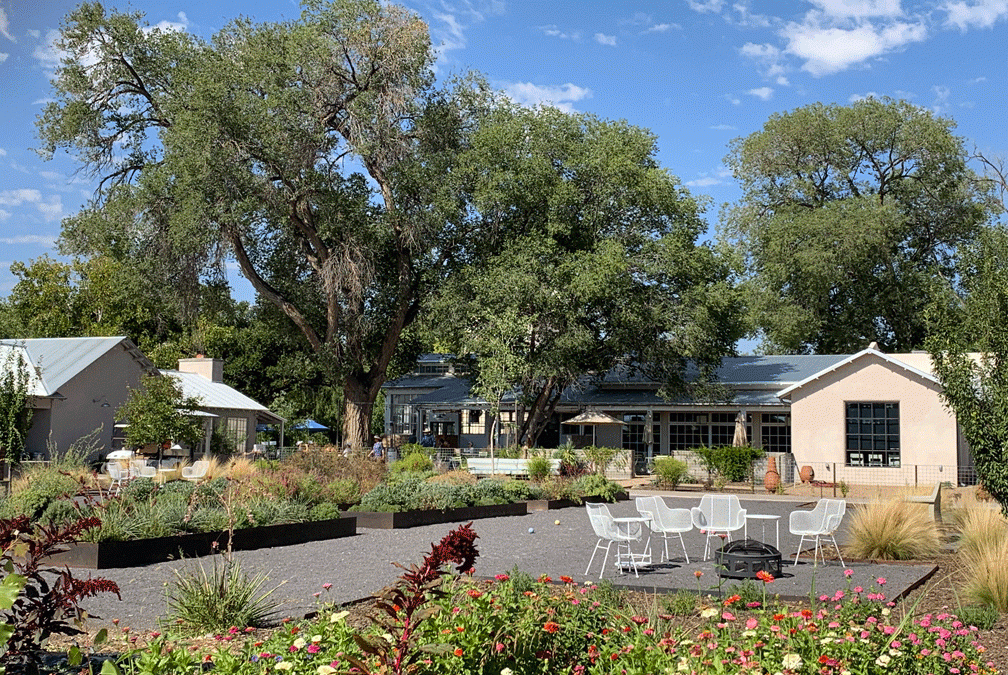
505Outside sat down with local landscape expert Wes Brittenham, Farm and
Landscape Manager at Los Poblanos Historic
Inn & Organic Farm, to chat about Fall
maintenance tasks for Albuquerque gardens. At Los Poblanos, Wes oversees
all growing things on their 25 acres, from the historic gardens to the newer
more xeric and multi-functional landscapes, as well as the kitchen garden and the
fields of lavender.
Wes has noticed many homeowners with traditional landscaped yards
keep them highly pruned with perfectly trimmed rounded plants free and clear of
leaf litter and debris. Over the last 15 years, as homeowners have made the
shift to xeriscape landscapes (aka desert friendly) he’s noticed they haven’t
shifted their maintenance regimens. They should.
Xeriscape landscapes don’t require the rigorous maintenance that
traditional landscapes do, so he’s been teaching homeowners to “get over the
tidiness!” He wants homeowners to embrace the shape of native plants and, in
general, do less yard work. Especially in the Fall.
When asked what homeowners can do to prepare their landscapes
for winter, he gave us a short list of surprisingly simple to-dos:
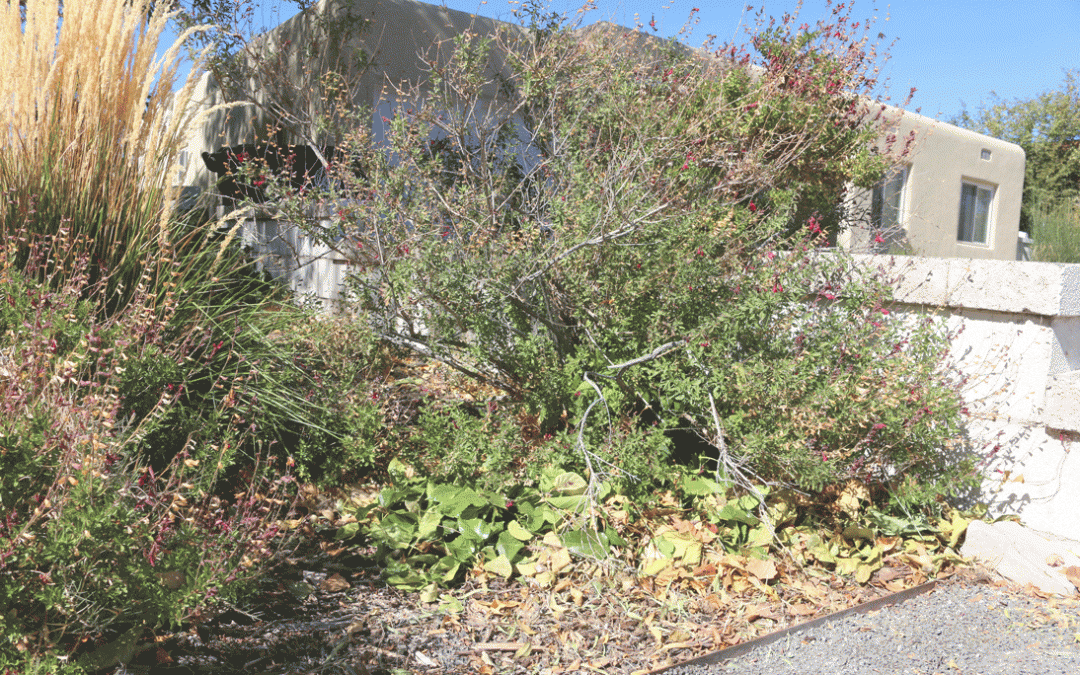
Leave it natural. There is no need to prune! So leave stems with seed heads in
place. This includes grasses, perennials and shrubs. The dead stems, leaves and
seed heads provide natural habitats for wildlife all winter. They also give the
garden good structure over the winter. When Albuquerque gets a blanket of snow,
the wispy seed heads of the grasses create a beautiful silhouette. Leaving dead
foliage insulates the plants from winter freeze damage, too.
Do clean up fruit and
vegetable debris from gardens. This helps reduce bug
populations and prevents fungus problems.
Leave the leaves. When the trees start losing their leaves, rake them around
the base of plants to provide habitat, retain moisture, and create natural
mulch under the plant.
With over four decades of experience, Wes’s advice is extremely useful for local homeowners. Efficiency is key, so use his three simple tips for a great fall and winter landscape and minimal yard work this Fall.
Your landscape needs a lot less water in September than it did in the summertime. About 35 percent less on average. The days may still be warm, but shorter days and cooler nights in the months of September, October and November means less evaporation, which means less irrigation is required. Adjust your irrigation controller following the Fall Season Watering Recommendations to save water and money this Fall.
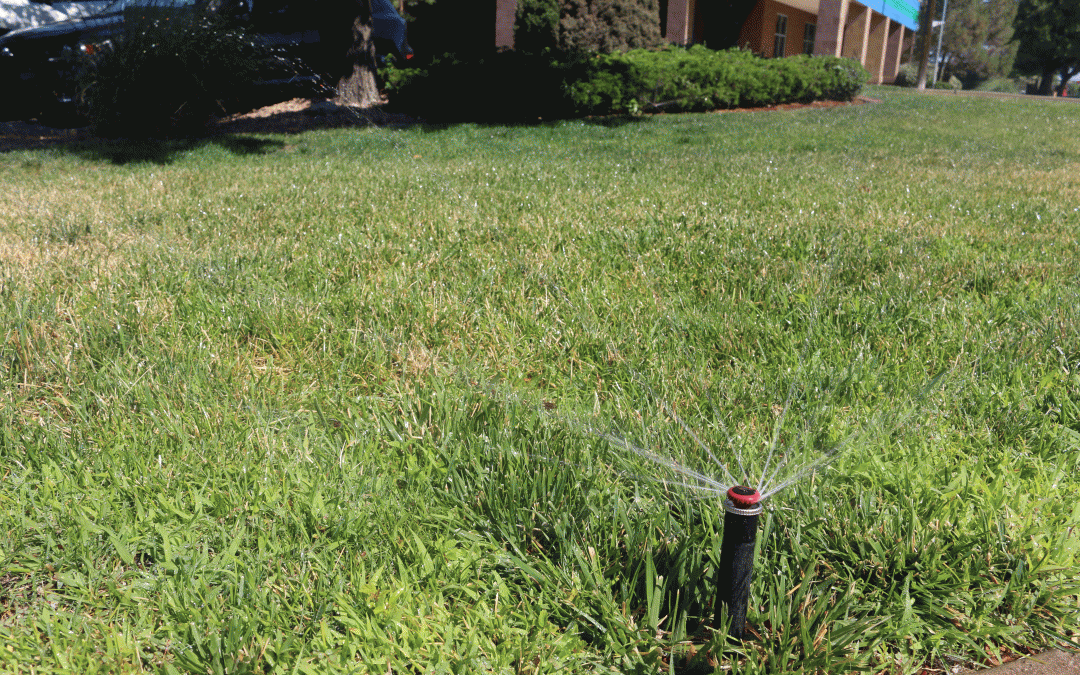
Ramping down your landscape irrigation does not mean you
need to stop watering all together. If you have a lawn, cut back to two days
per week. Cut back to two to four days a month for trees. Fall is when trees,
shrubs and other perennial plants get busy growing their roots, and proper watering
supports this activity. After spending the summer putting energy into growing
leaves, flowers and fruit producing plants take advantage of the fall season by
anchoring their root system to the earth. It’s important to fortify root systems
during the Fall so they have a stronger trunk and stem during the winter
season.
Fall season is also a great time to put in new plants, for the
same reason – they spend their time growing their root system instead of leaves
and flowers. But new plants need more frequent watering to help them get established.
Keep in mind that new plants need at least a month to anchor in the ground before
the first freeze, so don’t plant too late in the season to avoid damage.
And remember it is not necessary to irrigate when it rains, or on days following a good rain event (or about a 1/2" of rain). Using nature as your source of water encourages a desert friendly landscape.
Want to know how much your landscape really needs? Call 505-289-3003 to schedule a free, efficient irrigation consultation with a Water Authority expert.
One of the
great advantages of desert-adapted plants is the wealth of colorful flowers
they produce, a boon to gardeners and pollinators alike. Plants that bloom in
autumn offer pollen and nectar for insects and, if the seed heads are left to
ripen, a late season food source for birds.
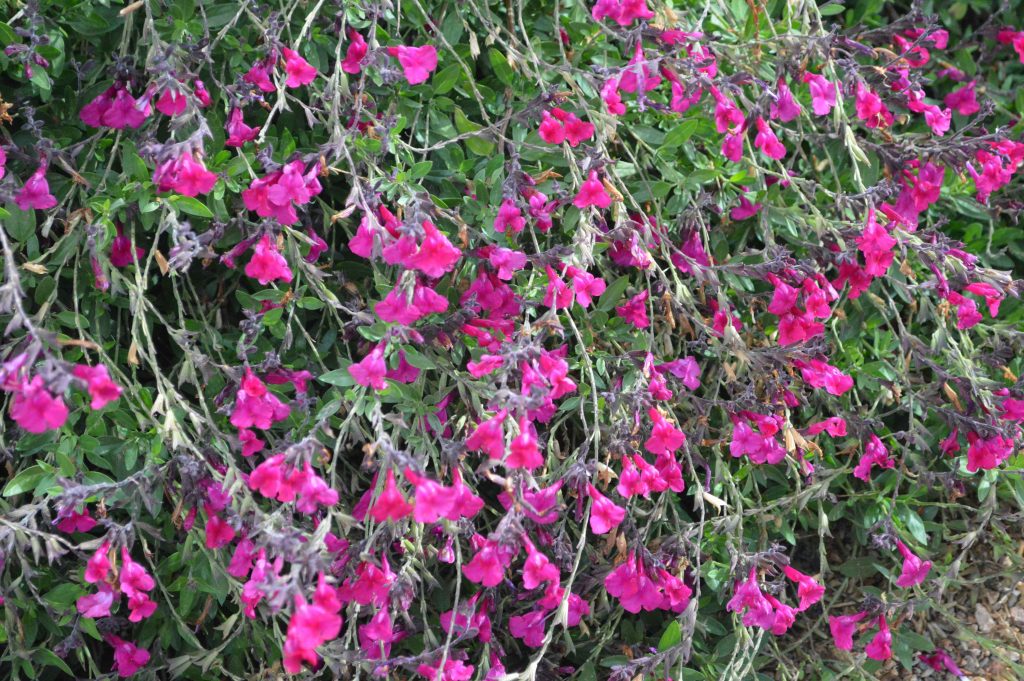
After a long hot summer, some plants think the cool of fall means it’s spring again and burst into bloom with renewed vibrance. Salvia greggii is commonly called autumn sage because, even though it flowers brilliantly in spring and lightly all summer, fall brings on another strong show. Responding to the cooler, longer nights in autumn, Salvia’s late season color becomes even more intense. Autumn sage is a compact shrub that grows 2-feet tall and 3-feet wide, with small dark green leaves and spikes of flowers in red, rose pink, coral, purple or white. Hummingbirds and bees are frequent visitors. Autumn sage prefers well-drained soil and deep watering (24 to 30 inches) every week or two while blooming, monthly or less in winter.
Autumn sage, Salvia greggii
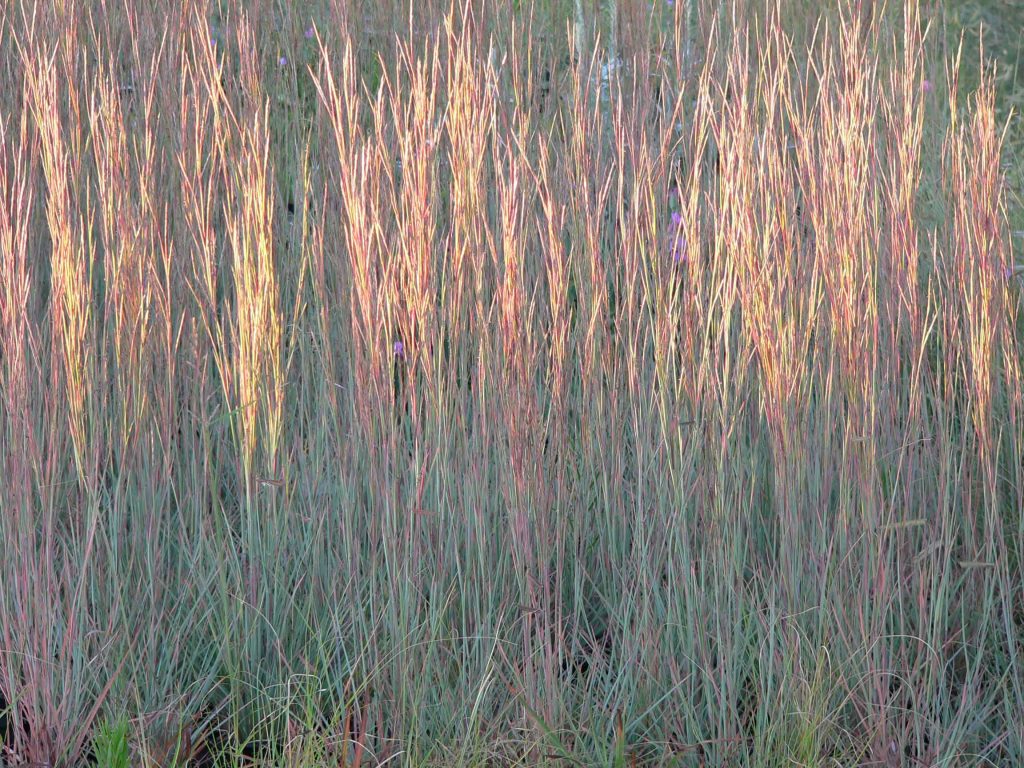
Many ornamental grasses are their showiest in autumn, too. There are several varieties of little bluestem Schizachryium scoparium with 12-inch wide clumps of narrow blue-green leaves and 24-inch tall slender stems bearing fuzzy seed heads. ‘Blaze’ little bluestem turns scarlet in fall and ‘The Blues’ turns a beautiful pink. Both keep their color into winter when they fade to a rich bronzy brown. The color is our reward for supplying the little extra water these grasses need.
Native grasses are also important larval food for butterflies and produce nutritious seeds for songbirds, bringing color on wings to the garden. Since the seed heads are a large part of the reason they are planted, ornamental grasses should be left uncut until early spring. Then, trim them a few inches from the ground so the new growth is not stymied by having to push through old stubble to reach sunlight.
Little bluestem Schizachryium scoparium
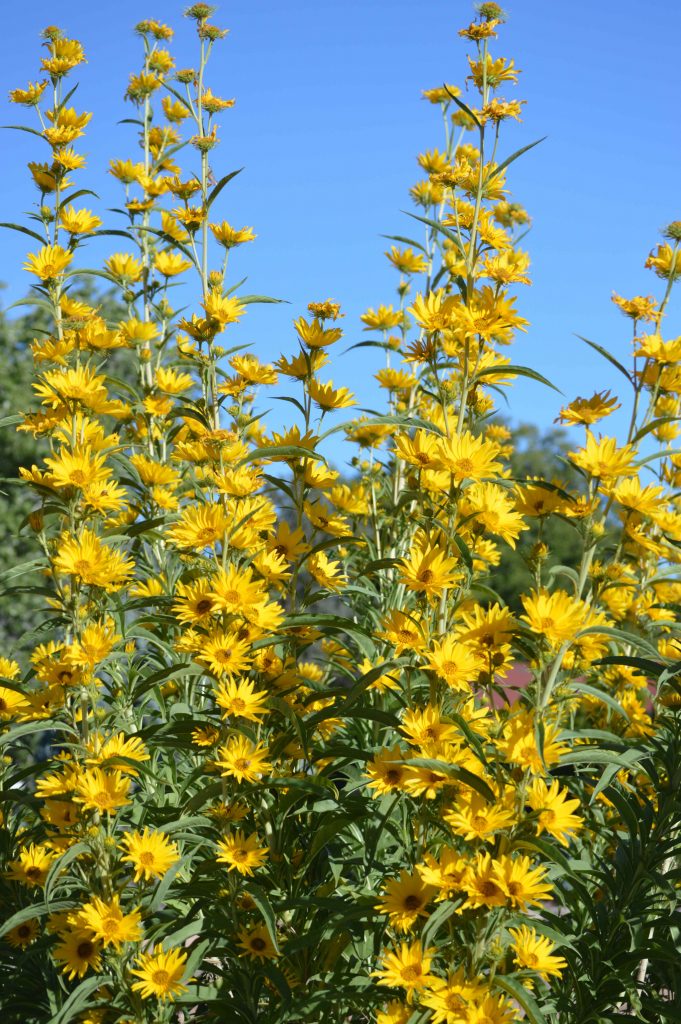
Perhaps the most spectacular late blooming perennial is the Maximilian sunflower Helianthus maximiliani. By early autumn, its flower stems are 5 to 7-feet tall. Established plants can spread 4 or more feet wide, shooting up dozens of flower stems. The top few feet of the stems are covered in 2-inch wide yellow sunflowers with yellow centers abuzz with bees. The show can last for several weeks in September or October, but after the flowers fade the plants become a bird buffet of seeds well into winter. Maximilian sunflowers grow best in soils that hold water well and produce the best show when watered to a depth of 2 feet weekly during the growing season, every two weeks in spring and fall and monthly or less in winter.
Maximilian sunflower, Helianthus maximiliani
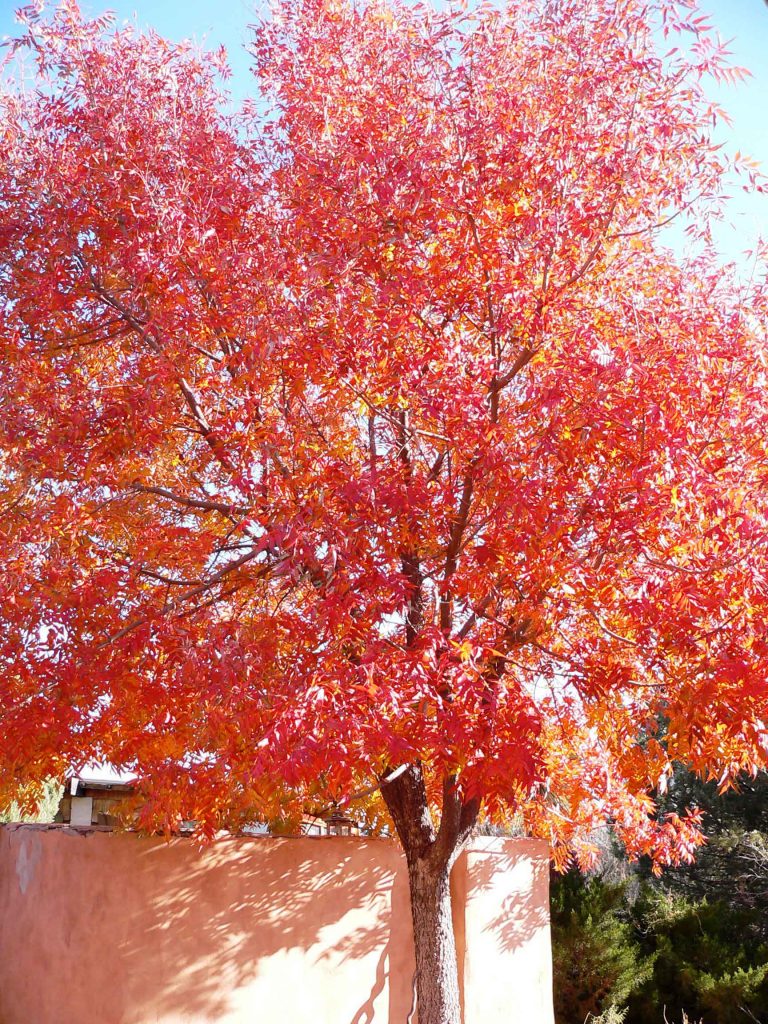
Flowers aren’t the only source of fall color, either, but red leaves in fall are not the norm in New Mexico. Cottonwoods in the Bosque and aspens in the mountains are our autumn gold. Chinese pistache Pistacia chinensis has become one of the most dependable heat and drought tolerant shade trees and adds splashes of red fall foliage in the ABQ metro area. A great shade tree that is 20 to 30-feet tall at maturity with a canopy spread of 20-feet, Chinese pistache benefits from structural pruning while it is young to assure strong branching. Once well rooted, it should be watered at the edge of the branch canopy to a depth of 2 to 3 feet every few weeks during the growing season and monthly or less depending on winter moisture.
Chinese pistache, Pistacia chinensis
Author: Judith Phillips, owner of Design Oasis, landscape designer and garden writer with 30 years experience designing arid-adapted and native gardens in the high desert.
Three reasons why fall is a great time to plant trees:
Trees planted in the fall perform better come spring, compared to those planted in the summer, because tree roots are still active over the winter. This winter root development of newly planted trees, prepares it for spring, allowing its roots to spread out and then help the tree become established faster when temperatures begin to warm again.
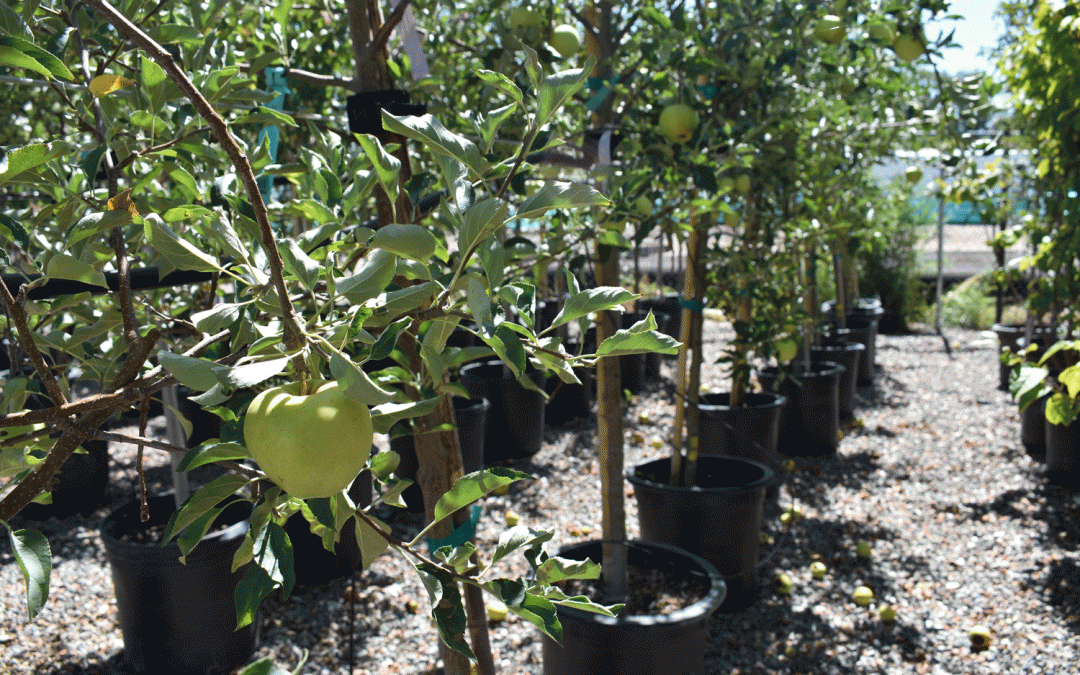
If planting a large ‘ball and burlap’ tree, fall offers the best choice for getting the tree species you want. This is when local tree nurseries dig up their trees from the fields and get them ready for sale. If planting a smaller containerized tree (nursery pot), be careful about selecting a tree that has been drought stressed all summer or has been in a container for too long and is too root bound. See this handy cue card for more information about selecting a good quality tree from your local nursery. https://www.urbantree.org/pdf/treequalityonsheet.pdf
Less watering is required in the fall because the soil retains more moisture than in the summer, due to lower temperature, shorter days, and the fact that plants are not transpiring as much water. For tips on watering and caring for a newly planted fall tree, check out our other articles on trees.
Take advantage of our TREEBATES! The Water Authority offers money back on the purchase of new trees and for the care of existing trees such as professional pruning or mulch. Learn more here.