As the landscape irrigation season gets under way, inspect your irrigation system for leaks and clogged, broken or missing sprinkler heads and emitters.
Use a pressure gauge to verify that sprinkler heads are operating at recommended pressures, and check and clean all system filters.
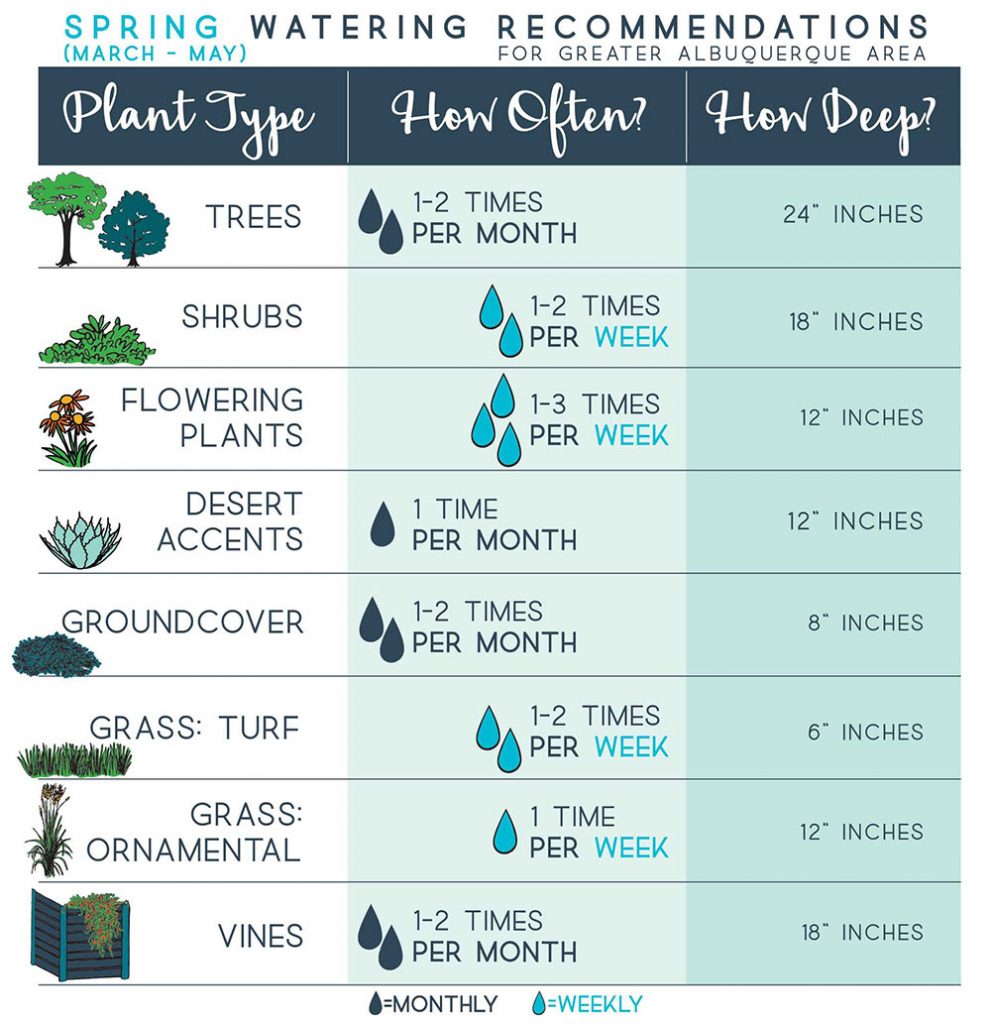
Time to follow our Spring Watering Recommendations.
Time to follow our spring watering recommendations. Remember, if it rains more than a half inch you can skip your next scheduled watering time as there is no need for supplemental irrigation.
Turn on your irrigation system after the last chance of freezing temperatures has passed (typically late March in the greater Albuquerque area, but possibly as late as mid-April). This will prevent damage to your irrigation system.
1. Turn on your irrigation system. Then observe and listen.
If you turned off the main valve for your irrigation system over the winter to prevent freezing, turn it back on slowly, only part way. Then wait a few minutes until the system is fully pressurized. If it is not leaking, turn it fully on.
Caution: turning it too fast can create a water-hammer which could break pipes.
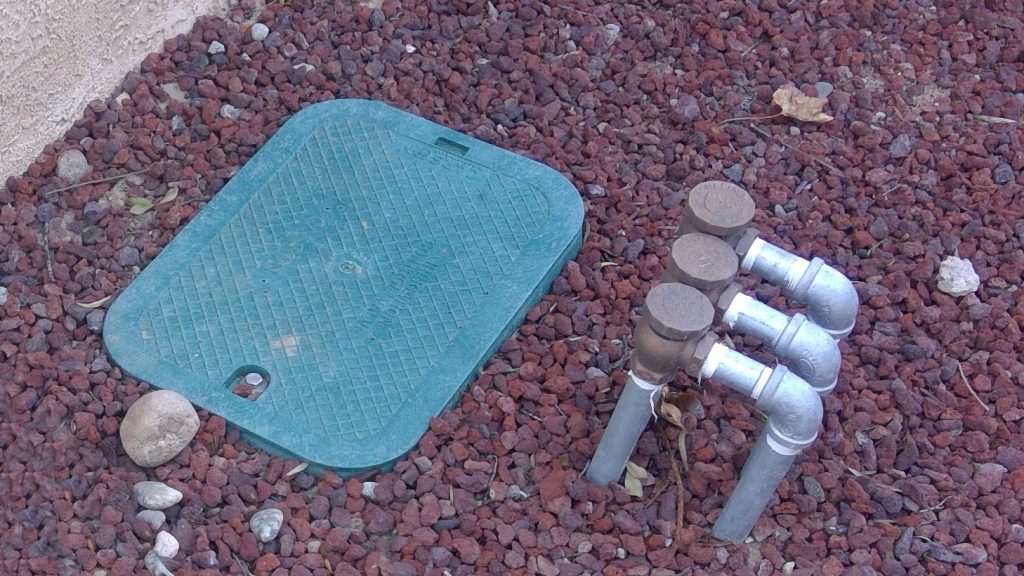
Irrigation valve box with backflow preventers.
Check the backflow preventer for leaks by inspecting it and checking for wetness.
Open the valve box (it usually has a green cover) and make sure there is no water in the box itself. Look for leaks in the valves, connections, filters and pressure reducers.
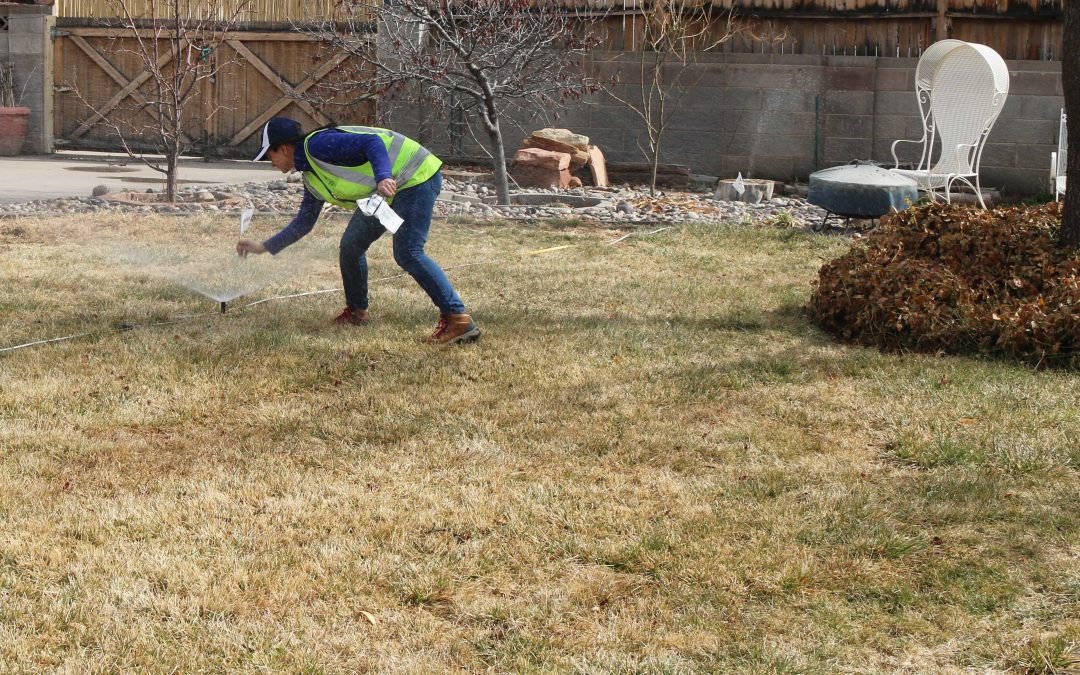
Run each zone for several minutes (long enough to see every part of it up close). Walk along each irrigation system pipe and inspect all sprinkler, bubbler and/or drip zones.
For sprinklers:
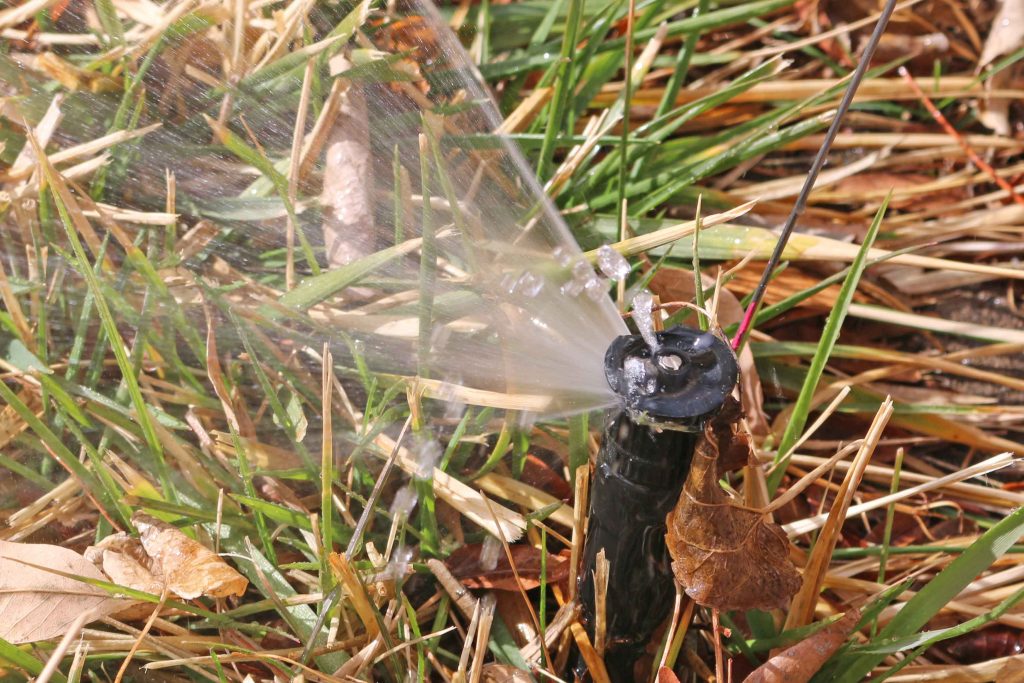
Look for signs of a leak, such as at the risers to the heads, the heads themselves, the emitter lines, or the pipes.
Look for heads not spraying correctly, such as spraying in the wrong direction, spraying too low, or other signs of breakage or misalignment. It is very common for them to go out of alignment when the system was turned off for the winter.
Spray head with minor leak
For drip and bubbler systems:
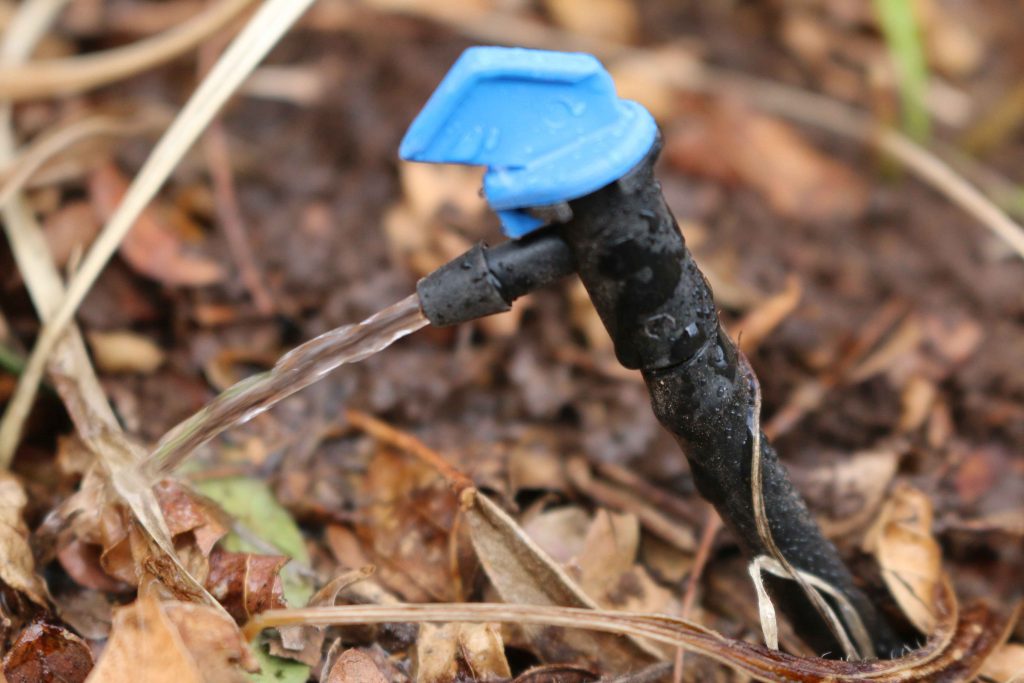
Look for missing emitters and/or bubblers. Emitters or bubblers may be hard to see due to plant coverage so listen carefully. Hearing a whooshing sound means an emitter or emitter line has blown off.
Drip emitter
2. Re-check the valve boxes again for water leaks now that the system has been on for testing.
3. Perform any necessary repairs and re-check for leaks after repairs are complete.
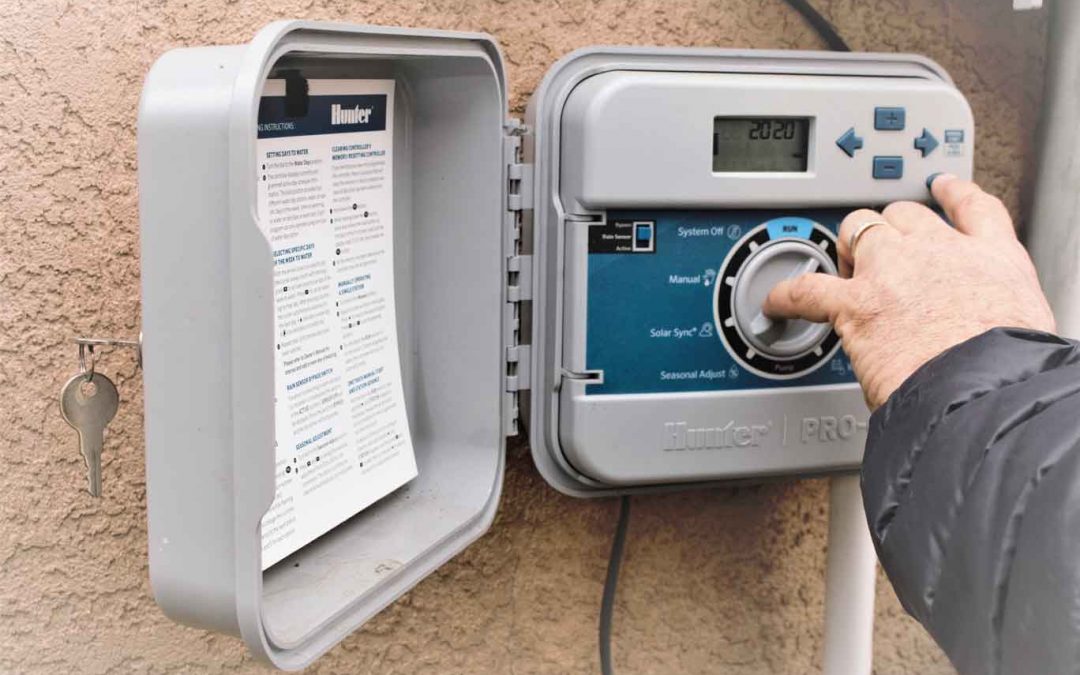
4. Set the timer.
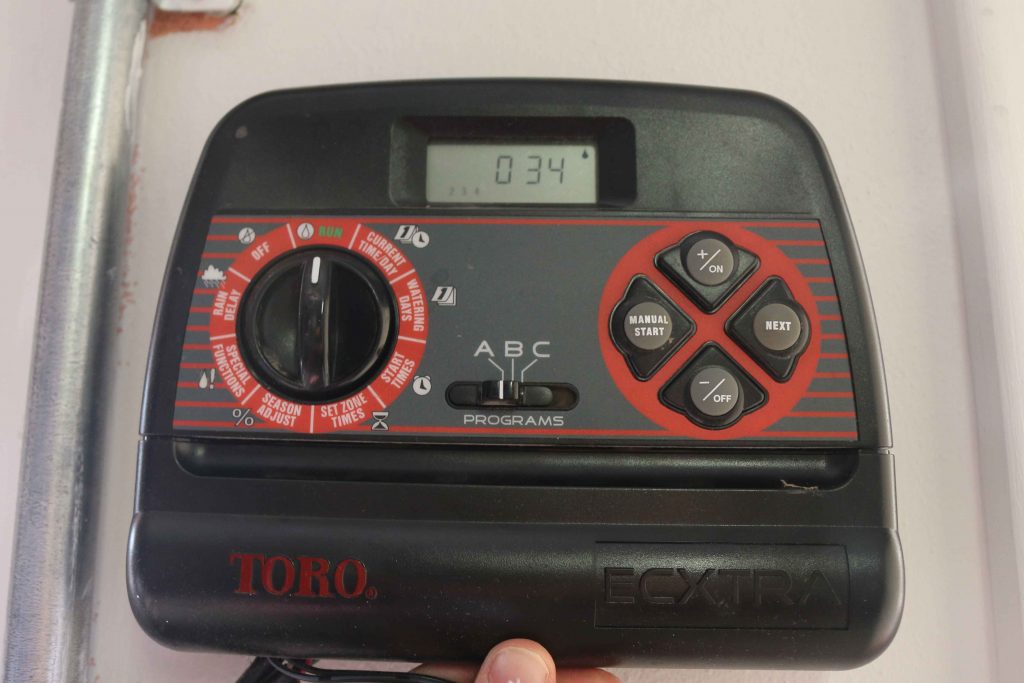
Typical Irrigation Timer
The key to irrigation is to supply enough water to replace evaporative
losses from the ground root areas and from the leaves or stems. Too much or too
little water can harm your plants. It
is important that you set the timer correctly.
Follow the water recommendations guide to help you set your timer. Mixed zones like lawns and desert friendly landscapes are hard to water together. They usually need different run times. Large trees do not do as well being watered as if they were a lawn. Lawns have shallow roots (1” to 6” is typical) so usually need less water per application than trees with their deep roots (up to 24”). They require longer, deeper watering. Sign up for a FREE Efficient Irrigation Consultation at 505-289-3003 for help with your timer settings.
Do not confuse start times with zone numbers. Remember that every start time (4 am, 11 am, 5 pm….) on a program (A, B, C…) will run all your zones in series for the program you are running.
Attach a written copy of your schedule showing programs, zone number and corresponding location to the inside of your controller box.
Sprinkler heads or emitters vary greatly as to how much water comes out per minute. A slow watering head may need 2 to 4 times the watering time of traditional faster water delivery heads. For example, emitters can be as low as ½ gallon per hour but could be as high as 14 gallons per hour. The same watering time will not work for all zones or all emitter types.
Bubblers typically deliver 1 or 2 gallons per minute, compared to emitters that can be 1 or 2 gallons per hour. Many people over water when using bubblers for small plants. If you see pooling, run-off or recognize the flow is too fast, then replace the bubbler with a smaller one.
After watering, test to see if you provided enough, too little, or about right amount of water to the plants. Use a soil probe or a long screwdriver to test soil moisture. Push the screwdriver into the soil about an hour after you’ve watered your plants. It will go easily into moist soil. Mark and measure how far it went into the ground. That will tell you how deep you have watered that plant. Every yard is different, but once you figure out how long it takes your watering system to water to certain depths, you’ll be set.
If your controller is getting old, you would be wise to install an up to date one. There are lots of options. Some are “smart” controllers and can do many irrigation tasks well and can be operated from your phone or home computer, allowing you anywhere, anytime control. Check out the Irrigation Efficiency Rebates here to help you with the cost.
5. Observe your irrigation system the first month of the season.
We suggest the run times for the first few weeks should be during times of day where you can observe the operation of the system. When you are sure everything is running well, then you can have the system run at times you would not normally be observing. However, we suggest manually running the system zones for a few minutes every two months just to stay on top of any problems that may occur.
Many homeowners want to put a lot of water on at the beginning of the year to make sure the dry roots from the winter get thoroughly soaked. This makes some sense for the first watering of the year. Once the roots are soaked, you can go to shorter run times and number of runs per week to adequately irrigate your plants.
If you are uncertain about the any of the start-up tips, or need help, contact us for FREE Irrigation Efficiency Consultations at 505-289-3003. Or consider hiring a landscape contractor to help you get your system up and running correctly.
Author: Richard Chapman of Smart Use in Albuquerque, NM.
March is the perfect time to clean up your landscape to prepare for the spring growing season. In fact late March is the best time because new growth hasn’t completely emerged, making it easier to see the structure of the plants.
For the same reason, this is also the best time of year to check the irrigation system. Once freezing temperatures are no longer a threat, get the irrigation system back up and working to support new spring growth. The greater Albuquerque area occasionally gets a freeze as late as the middle of April. So although you may be eager to crank on the irrigation system and begin automatic irrigation, don’t forget that pipes may be susceptible to bursting if there is water in them and we receive a late frost.
One of the first steps to Spring
landscape cleanup is to walk around your yard and observe your plants and how they
grew last year and how they will continue to grow this year. Based on the success
of those plants consider if you’d like to:
Remove: Cut back or
dig out dead or dying plants or plants that have outgrown their space.
Replace: If the plant
has not been successful, think about what factors made it this way. Replace plant
material with an alternative better suited to the location.
Divide: Break up one
plant into multiple plants for distribution in other places in the garden or share
with friends and neighbors. This is a great chance for you and your neighbors to
try new plants.
7 Basic Spring Landscape Tasks
1. Cut Back Perennials and Flowering Plants
It is good practice to leave perennials intact over the winter, leaving stems, dried leaves, and seed heads on the plant. This helps insulate the plant over the winter, can be aesthetically pleasing, and provide forage for wildlife. Come Spring, it is time to cut back the perennials and clean up the debris around and underneath them. Pruning shears, a wire rake and gloves are good tools for this task. An example of a typical perennial is listed below.
Valerian (typical of many flowering plants and perennials): prune dry stalks just above any live growth to allow the new leaves and stems greater access to energy-producing sunlight.
2. Trim Ornamental Grasses and Rake Out Turf Grasses.
Ornamental Grasses – Spring Trimming:
Most ornamental grasses are deciduous and
produce new growth each spring. These grasses should be cut back around this time
of year for best aesthetics and to allow new growth to emerge unencumbered. Most
grasses fall into this category.
Other grasses and grass-like plants will
respond negatively to being cut back in the spring. These include yucca, bear
grass (nolina), and sotol. Selectively
remove tattered or dead leaves from these grass-like plants. Due to the density
of blue avena and regal mist grass, these should not be trimmed down. Instead selectively
remove dead material from these plants.
For
deciduous grasses, follow these steps:
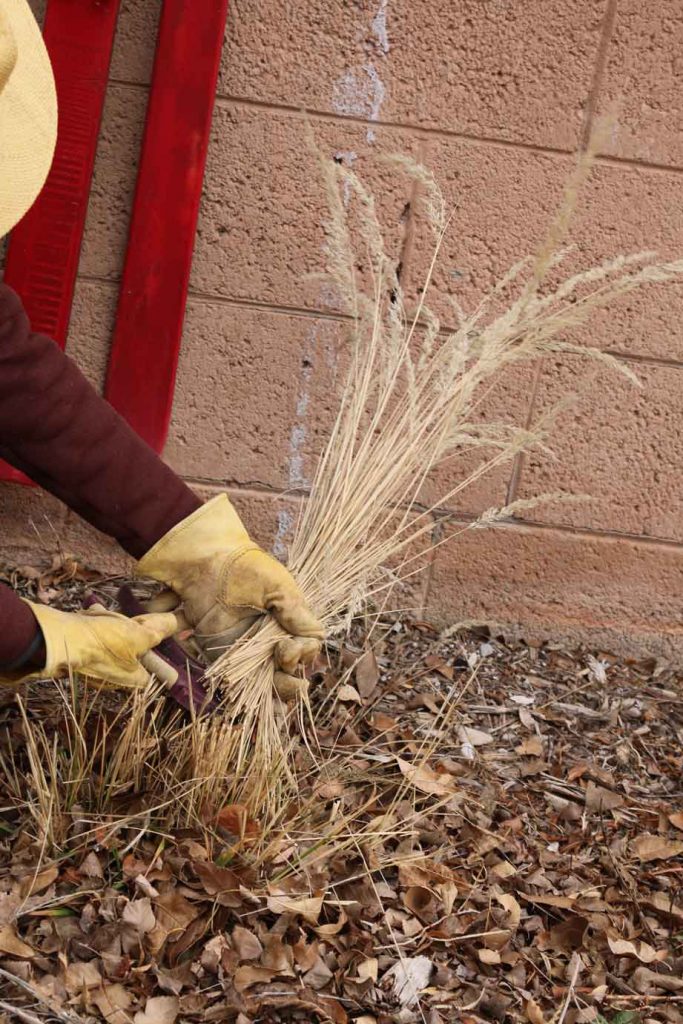
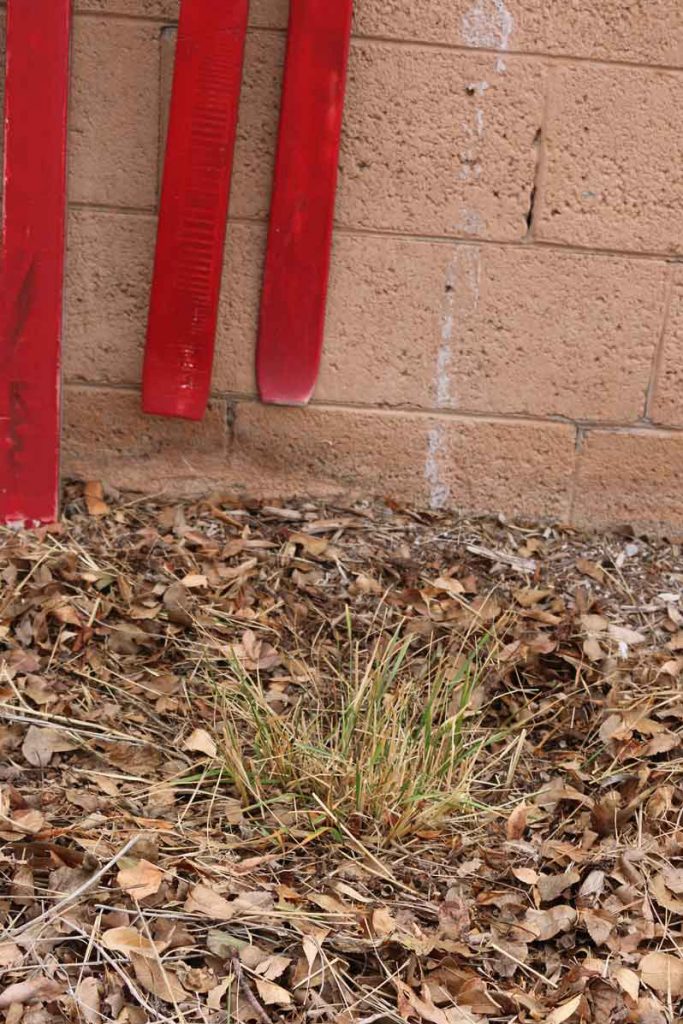
Cut back last year’s growth to the main mass of the grass (typically 3”-6” above the ground) with pruners or scissors, without scalping the top of the new growth.
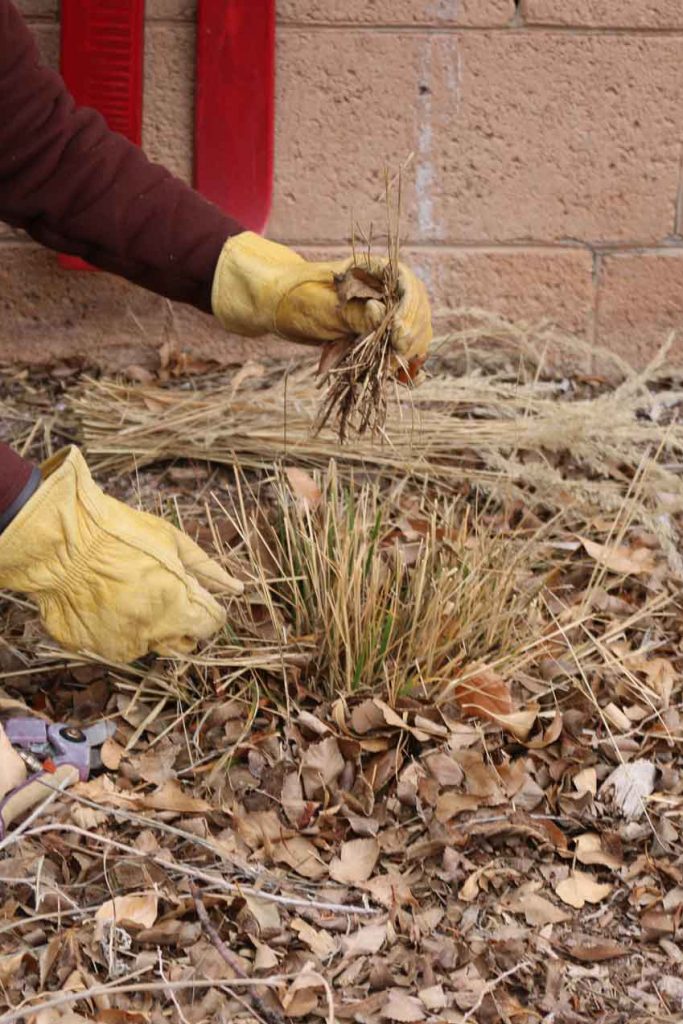
By hand, remove any of last year’s brown foliage and stems remaining in the middle of the grass.
For turf
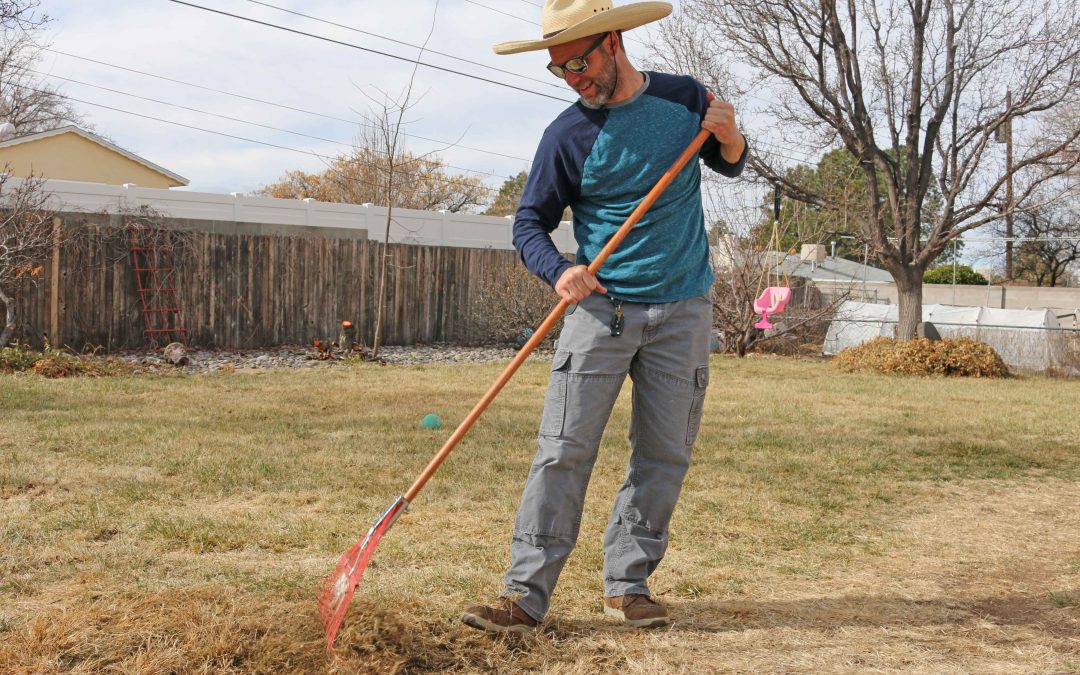
grasses, rake out and dethatch with a wire rake. For native lawn grasses such as
buffalo and blue grama grass, line trim them then rake out and dethatch.
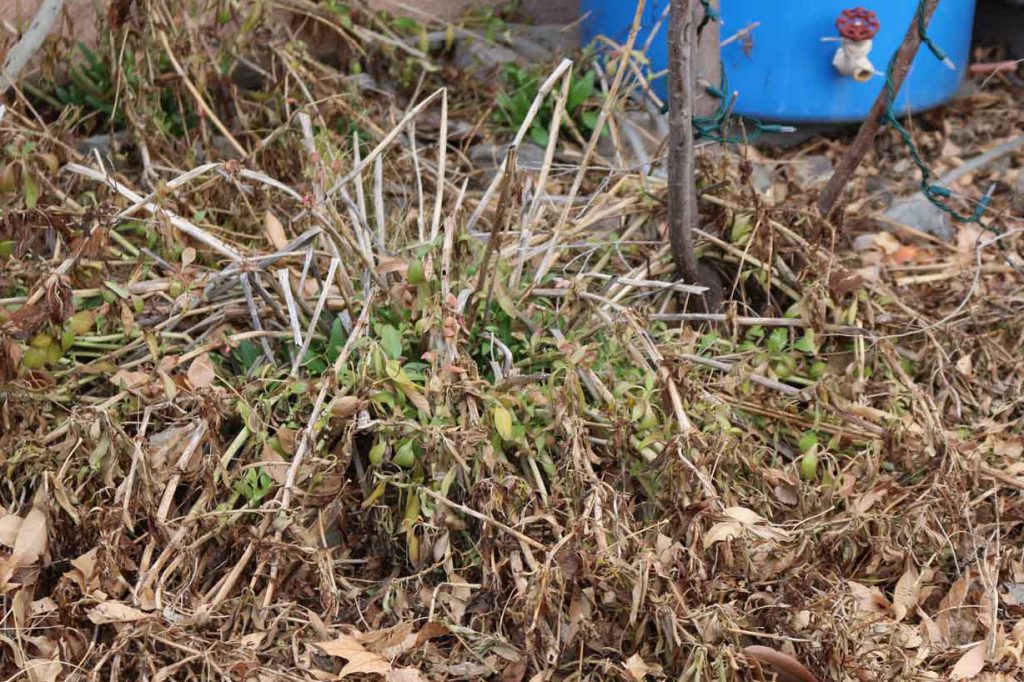
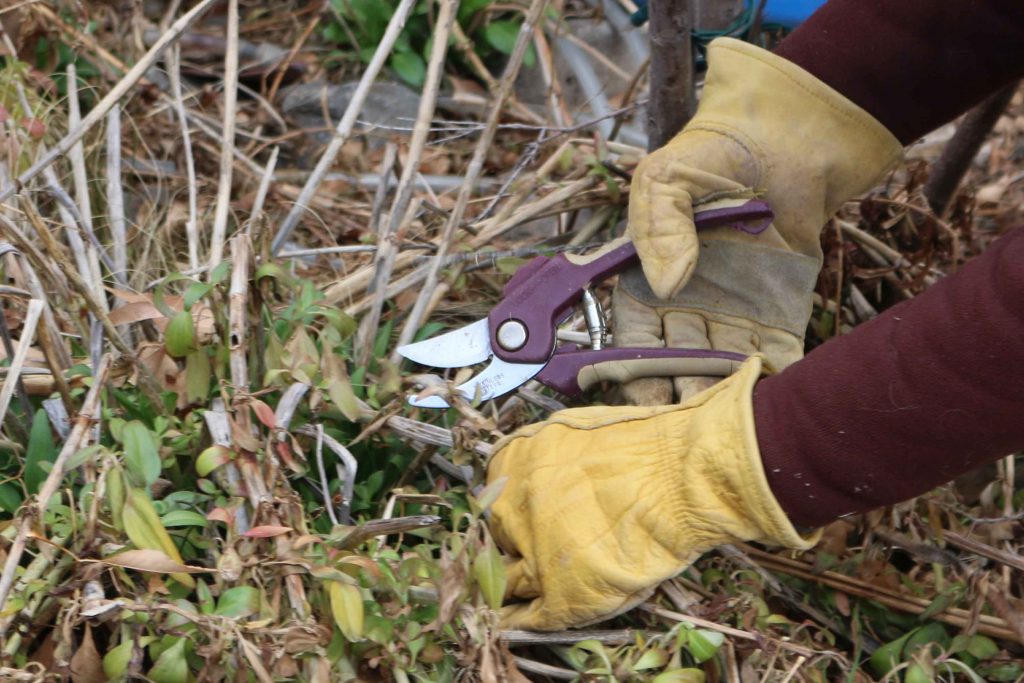
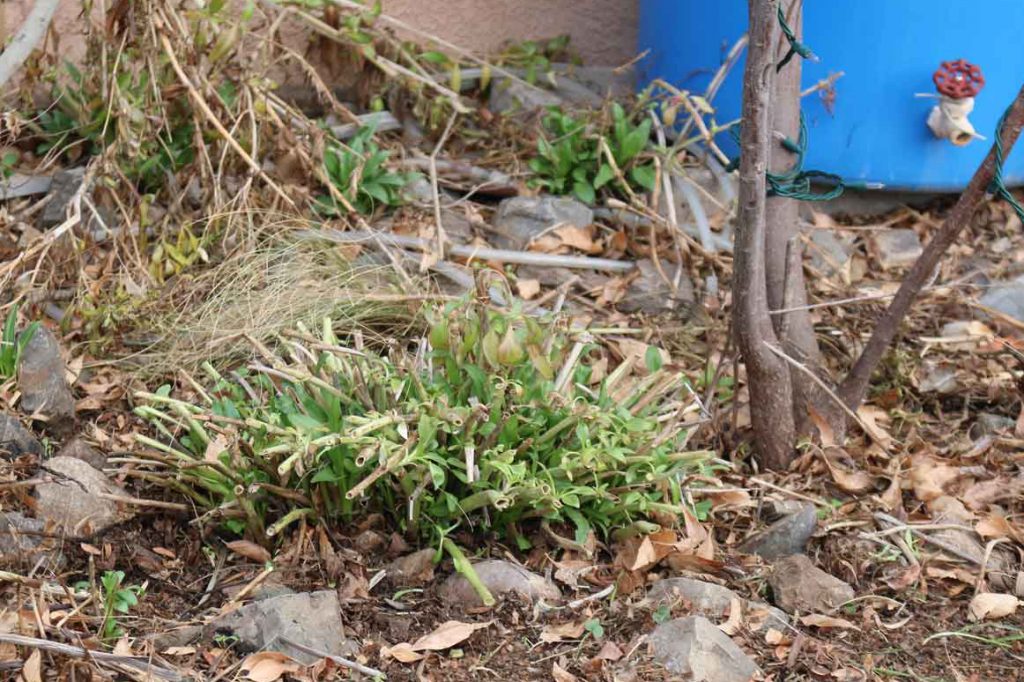
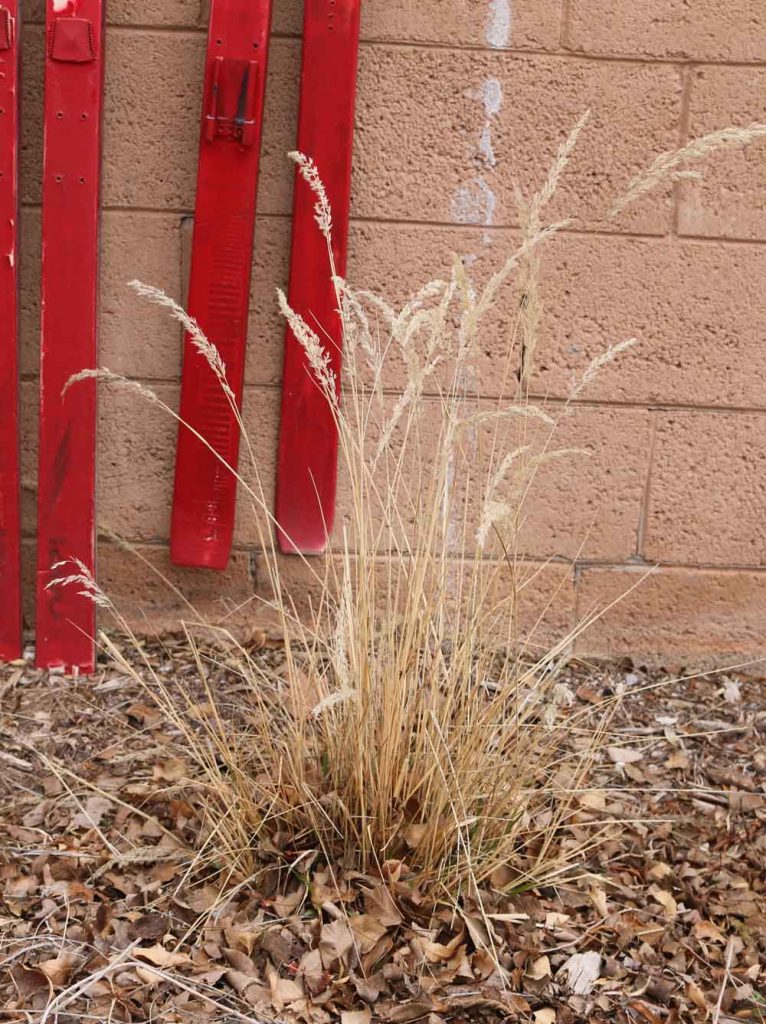
Ornamental Grass before pruning (Karl Foerster Grass, Calamagrostis x acutiflora 'Karl Foerster' ) Ornamental Grass being pruned (Karl Foerster Grass, Calamagrostis x acutiflora 'Karl Foerster' ) Ornamental Grass being de-thatched (Karl Foerster Grass, Calamagrostis x acutiflora 'Karl Foerster' ) Ornamental Grass after pruning (Karl Foerster Grass, Calamagrostis x acutiflora 'Karl Foerster' )
3. Prune Shrubs When Necessary
Many native shrubs do not require annual
pruning but some respond well to what is called renewal pruning.
Renewal pruning is not
as drastic as cutting the whole plant back but it does result in a plant with less
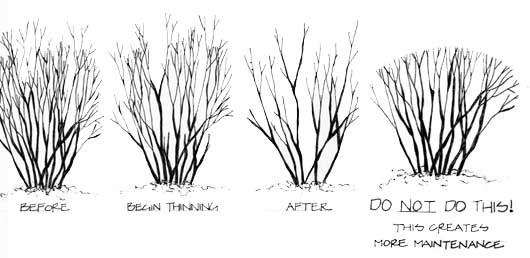
old, leggy growth. For renewal pruning,
use the rule of thirds. Cut back to near ground level
about one-third of the oldest stems each year to encourage new healthy growth. This
is recommended for shrubs such as lilac, forsythia,
cherry sage and butterfly bush.
Renewal pruning also will
benefit shrubs that become dense with a lot of dead wood on the inside, such as
Spanish broom. Roses however are unique and require special methods for pruning.
Example plant: Cherry sage: look for the
oldest growth and trim off old growth to about 6” above the ground. This will encourage
new growth in the spring.
Example of appropriate pruning of a shrub. (Photo courtesy of natureswayinc.com)
Another method of pruning is to formally shear a shrub. Formally shearing or hedging of plants should only be done if the intent is to create a hedge. Typical plants used as hedges are boxwood, laurel, photinia, etc. Most plants used in the landscapes do not need to be hedged or trimmed formally, unless there is a clear reason to limit their growth. After pruning, the plant should look like it does in nature, not a box, ball or cylinder.
5. Check Irrigation System. See the Spring Irrigation Start Up Post
6. Restore Organic Mulch.
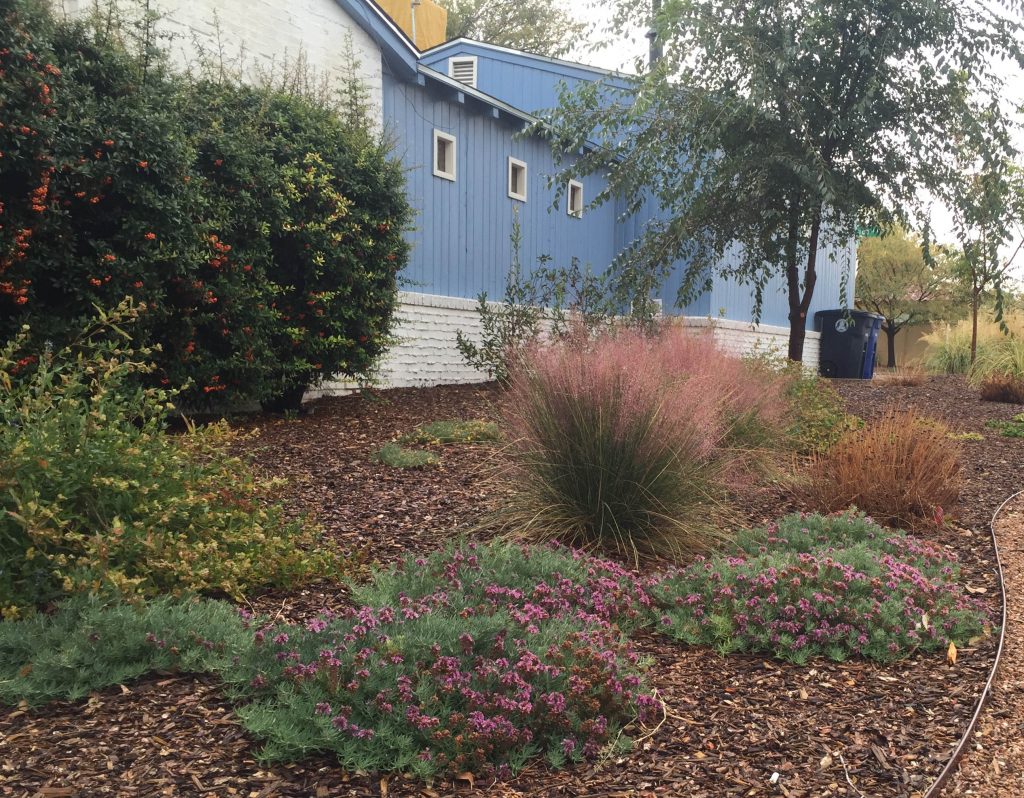
Organic mulch is a natural covering, and includes such material as straw, chipped wood, shredded wood, or pecan shells. (The phrase organic refers to material relating to or derived from living matter. In this context it’s not related to the food or farming method of food production without the use of chemicals.) Organic mulch spread on the ground around plants has the added benefit of retaining moisture in the soil. Certain types of organic mulch will also enrich the soil as it breaks down. A depth of 4 inches of organic mulch will inhibit weed growth by preventing sunlight from reaching weed seeds. The Water Authority offers a rebate for mulch when used around trees – check out our Treebate here or get information on converting lawn to desert friendly landscape.
Organic mulch in a landscape.
7. Recycle Green Yard Waste. There are a few places to take green yard waste.
Local composting facility (commercial, industrial, municipal).
City of Albuquerque free green waste pick up days. This is typically the last week of April and the first week of May.
Compost green waste at home.
Author: Jill Brown, ASLA Landscape Architect and owner of My Landscape Coach in Albuquerque, NM. Resources: Growing the Southwest Garden by Judith Phillips, Down to Earth: A Gardener's Guide to the Albuqueque Area, Fourth Edition by Albuquerque Area Extension Master Gardeners, Curtis Smith formerly of NM Extension Service. Consultations with: Chad Peterson, local native plan maintenance expert.