Most Albuquerque homes have an irrigation box below ground in the yard that contains automatic valves, pressure reducers, and filters with backflow preventers next to the box. The automatic valves are wired to an irrigation controller that’s often in the garage, laundry room or an outside wall. Different variations of these controllers have been around since the 1960s and allow homeowners to adjust when and how long to water different zones. However in the early 2000s the proliferation of wireless technology and the internet ushered in the ‘Smart’ controller.
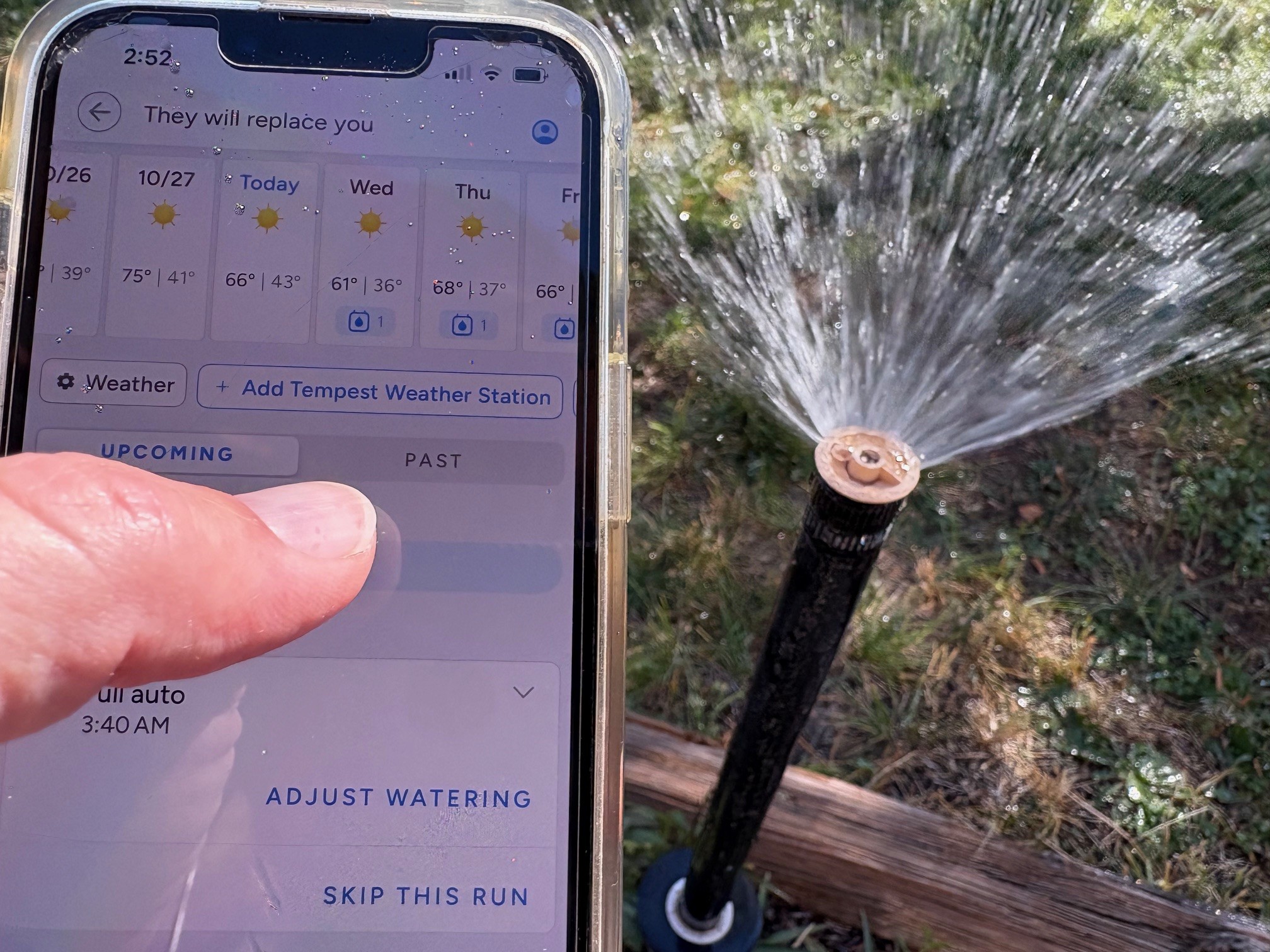
Smart controllers use WiFi and connect wirelessly to the local weather station. They will not water on days when it’s too windy or it has already rained. Most will also determine what your landscape’s water needs are and create a schedule based on data added during setup plus the information it receives from local weather stations. They connect to your smartphone or tablet so you have easy control over your system no matter where you are. Irrigation Designer Richard Perce says, “A smart controller adjusts your watering based on the local weather conditions which saves you money and water. But what I love the most is that you can turn your system on and off from the phone as you walk the line to find leaks. No more needing to run back and forth to the garage."
Smart Controllers allow you to turn your system on and off without running back to the irrigation controller in the garage.
What is a smart irrigation controller?
Smart controllers use current and/or historic weather data to create a custom irrigation schedule.
Our study shows residents with traditional landscaping saved about $150 per year, or about 20% in landscape irrigation costs by installing a smart irrigation controller.
Popular models cost around $150, and with a 25% rebate on qualifying models, your investment pays for itself in less than a year-thanks to water savings alone!
Nearly all smart controllers use an intuitive phone app, making it easier for you to set up and to check for issues - no back & forth to your garage!
The Water Authority’s offers a smart controller rebate. The rebate is a 25% rebate, up to $100.00 and includes the purchase and professional installation of a smart controller.Installing a Smart controller provides the following benefits:
A healthy, beautiful landscape: Smart controllers help landscapes flourish and remain healthy by providing the right amount of water for each plant zone. Underwatered or overwatered landscapes can be unhealthy, unattractive and wasteful.
Savings of both water and money: These controllers help eliminate overwatering, so they may lower water-use expenses and conserve water particularly for high water users.
Convenience: Properly programmed smart controllers save end-users the time required to continuously monitor and adjust irrigation schedules in response to changing weather and seasons (If you’re installing your new smart controller in an outbuilding or detached garage you may need to verify that your wi-fi signals are strong enough to reach the smart controller.)
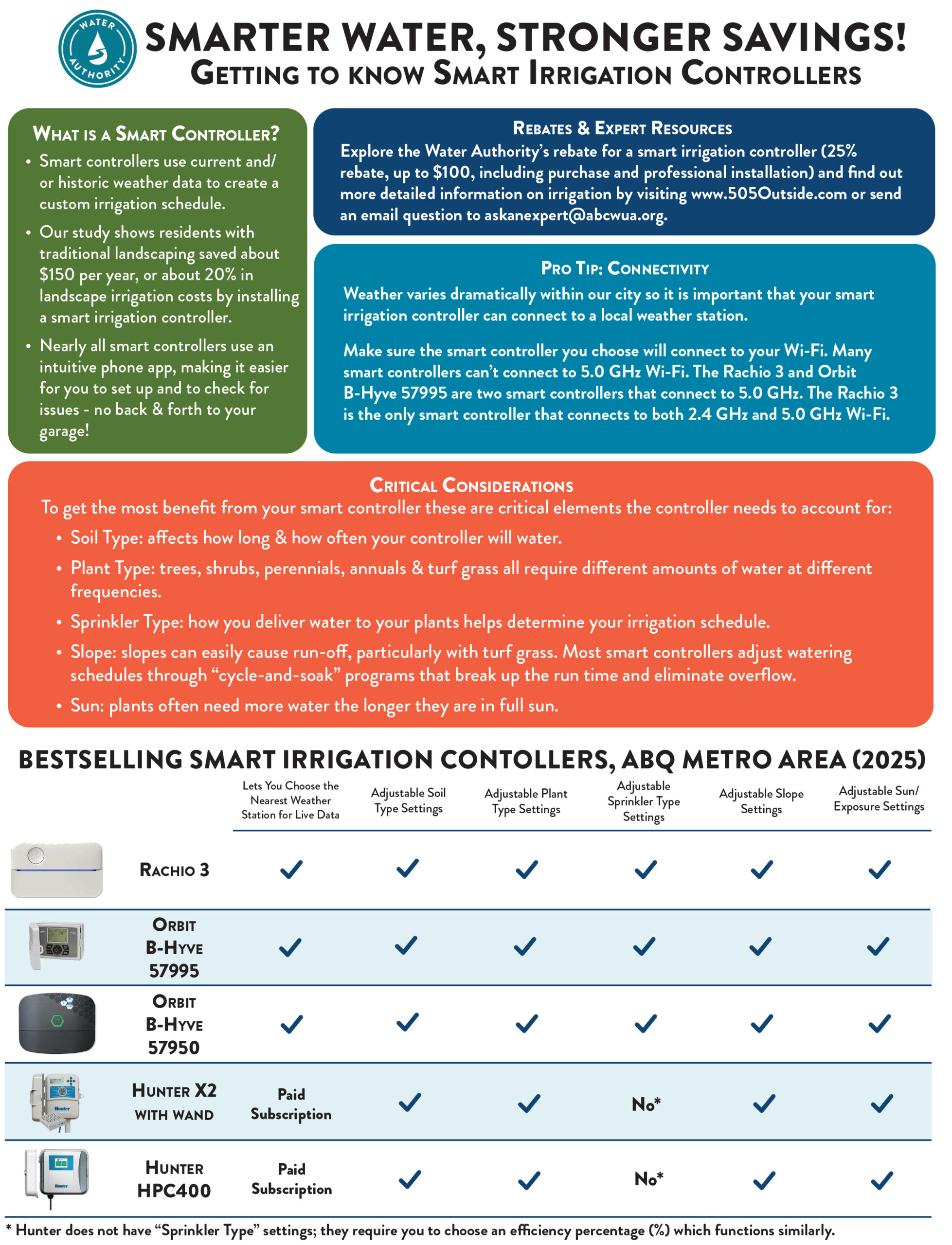
BESTSELLING SMART IRRIGATION CONTROLLERS, ABQ METRO AREA (2025)
Features: 8 and 16 zones options, inexpensive, connects to local weather stations, works with all modems, easy to use, robust water schedules based on plant type, soil type, sun exposure; and rebates are available. This controller must be controlled by an smartphone since it does not come with a screen on the controller itself. Costs around $200-$250) Integrates with Amazon Alexa and other smart home devices. Supports dual-band Wi-Fi (2.4 GHz & 5 GHz)
Features: 6 and 12 zone options, inexpensive, connects to local weather stations, easily controlled via your smartphone, can be mounted indoors or outdoors, works with all internet modems (2.4gh and 5gh), long-range Bluetooth radio, can adjust both at the controller and on your phone, easy to use, rebates available. Costs around ($125-$200) Integrates with Amazon Alexa. Model 57950 has a screen, dial and physical buttons you can use to adjust the settings (in addition to the smartphone app). Model 57995 does show the date time and weather you’ll need to use your smartphone to adjust the settings.
Features: If you have an existing Hunter X2 controller you can add WAND. It is a simple plug-in Wi-Fi option for any X2 controller model for online irrigation management from anywhere with an internet connection. Costs about $100 for the wand on your existing controller (costs between $80-$150), connects to local weather stations, easily controlled via your smartphone, can be mounted indoors or outdoors, works with only (2.4gh) internet modem, can adjust both at the controller and on your phone, easy to use, rebates available. Compatable with amazon alexa, control4 and homeseer home automation technology.
Features: 4 station base model but HPCs can go up to 23 zones, runs about $200, connects to local weather stations, easily controlled via your smartphone, can be mounted indoors or outdoors, works with only (2.4gh) internet modem, can adjust both at the controller and on your phone, easy to use, rebates available.
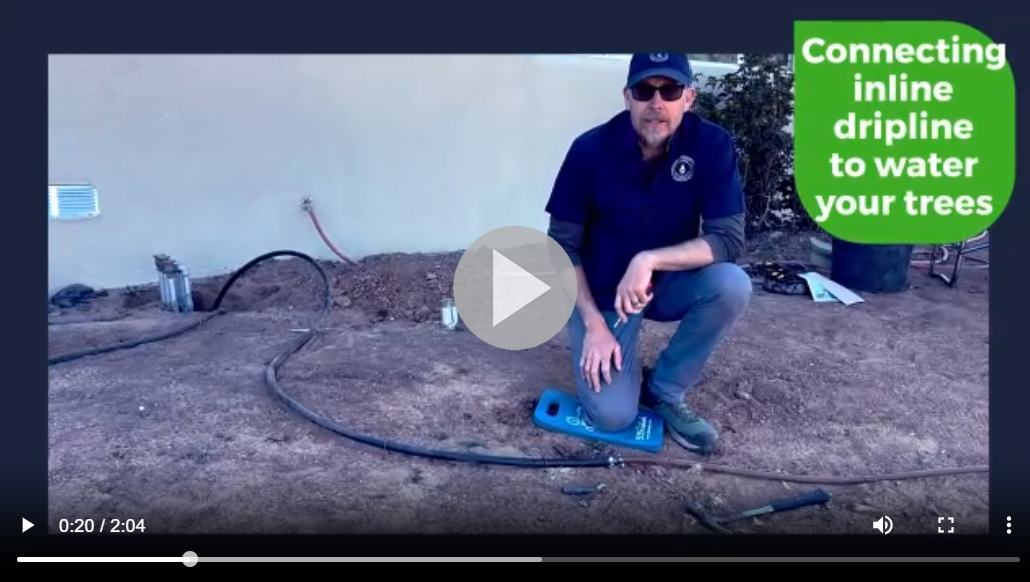
The Water Authority offers residential rebates of 25% up to $100, and commercial rebates of 25% up to $500, for Smart Controllers. The rebate can be used for both purchase of the controller and the cost of professional installation. Installation is quite easy and is a great weekend DIY project with a high return of investment. Before purchasing your new controller, make sure to visit the list of qualified WaterSense controllers located in the rebate section.
Growing vegetables successfully in the hot, arid climate of New Mexico can be tough. My partner and I have extensive farming experience and education in permaculture from the mid-west and we found that it took us several seasons of observations, learning and adjustment before we could have a thriving food garden in Albuquerque.
Success came when we stopped fighting the environmental conditions and started working with them. Instead of forcing plants to survive in habitat they weren’t adapted to, we began focusing on supporting natural systems that already exist in the Southwest. Observing the flow of energy across the land — the movement of sun, wind, water and heat — taught us a great deal. We started paying attention to where water naturally collected, where afternoon shade formed, how soil stayed cooler under plant cover, and how native plants thrived with little care.
It is important to begin not by digging in (literally or metaphorically) but by observing what is already happening in the area where you want your garden. Some questions to ask yourself are Where do I get sun? How does water flow in the garden? How can I get the best energy storage in my garden? How is my soil? What plants do I want to grow? What other things might affect them (animals, wind, etc.)?
SUN: Look out for the sun!
The Southwestern sun is not only harsh but ever present in the landscape. Always observe how sunlight enters your garden, areas that have full sun, partial shade or full shade. This will be very helpful in designing where to grow specific plants or vegetables. Have a dedicated notebook for this and make your observations by seeing where other plants are already growing. Ask your neighbors what works for them!
Observing sun patterns and learning from native plants — many of which grow beneath partial shade or alongside rocks and shrubs — can help guide crop placement and shading strategies. While most vegetable crops require six to eight hours of sunlight, prolonged afternoon sun in the Southwest can be damaging. Timing is critical. Heat- and drought-adapted crops benefit from being planted early enough to establish deep root systems before peak summer temperatures or timed to take advantage of late-summer monsoon moisture.
Reduce heat stress with shade.
If your observation diary is telling you that you have almost full sun in most of the garden, then it may be time to think about how you can use simple solutions to add shade.
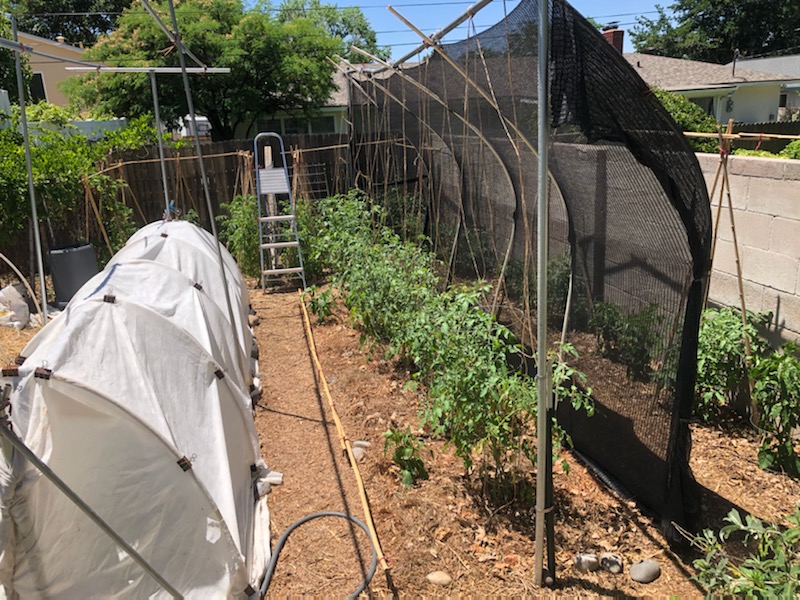
A shade cloth rated between 30% and 50% lowers temperatures while still allowing sufficient light for photosynthesis. When installed over beds during the hottest months, shade cloth helps prevent sun scalding, reduces moisture loss and minimizes flower and fruit drop.
Create shade with native plants like ocotillo, mesquite and rabbitbrush. Living fences can also be used to create beneficial microclimates by providing afternoon shade, reducing drying winds and moderating temperature extremes.
Creating shade for tomato plants.
SOIL: Essentially, all life depends upon the soil. It is the home for your seeds.
Healthy soil is the foundation of any successful vegetable garden. In the Southwest soil is usually low in organic matter and exposed to intense heat along with not having any cover during the harsh summer months. Living soils — those rich in organic matter and biological activity — retain moisture more effectively, cycle nutrients efficiently and buffer plants against temperature extremes.
To get living soil, start by saving your food scraps from the kitchen! They have nutrients that your soil needs. Building organic matter through compost (made from your kitchen scraps), mulch (from dried fallen leaves, straw, etc.) and continuous root growth (from growing cover crops like winter wheat, rye or barley) supports fungi, bacteria and other organisms in your soil that make nutrients available to plants.
Many native Southwestern plants thrive in undisturbed soils, offering a useful model for garden management. Soil, when protected and undisturbed, can be naturally rich in nutrients, living organisms and living roots. This creates soil that stores water longer, resists erosion and supports plants through heat and drought. Tilling or digging deep can expose these living organisms to the harsh sun, killing all the healthy parts of the soil. Reducing tillage helps preserve soil structure, fungal networks and pore spaces, allowing water to infiltrate deeply rather than evaporating or running off. Most vegetables prefer soil that drains well while still retaining moisture. Improving soil aggregation through organic matter allows soil to hold water like a sponge while maintaining adequate airflow to plant roots.
How to keep your soil full of nutrients and moisture.
Heavy mulching: In urban areas, we have the bad habit of raking all our leaves into plastic bags, but that is quite counterproductive. These leaves actually serve a very important function: They provide natural mulch and keep the soil from getting too hot or losing too much moisture. They also provide homes to bees and other insects that burrow in them for the winter. Heavy mulching is central to water conservation, weed suppression and living-soil management. A thick mulch layer — typically 3-4 inches — keeps soil covered, reduces evaporation and moderates soil temperatures. Use organic mulches such as straw, shredded leaves, wood chips, compost and grass clippings. Mulch can be easily attainable for free. Grab the neighbors’ bags of fall leaves, ask local tree pruning companies for their woodchips, or use your backyard compost. Other options are corn and rice husks and straw waste from mushroom growers.
High-density plantings: Planting really close together protects soil by shading the surface and reducing moisture loss. As plants transpire, they release moisture into the surrounding air, creating a cooler, more humid microclimate near the soil surface that benefits both crops and soil life.
Continuous soil cover: Don’t leave your soil bare; after a harvest, plant a cover crop. It could be something that helps give different nutrients to the soil in winter such as winter wheat or barley or let the skeletons of the previous plants stay. Try the chop and drop method which uses the unused part of the plant harvest as cover during non-planting months.
Ultimately, it is important to remember that feeding the soil food web with a variety of materials/food and rotating what you grow in that soil is important. When they break down, they improve soil structure and fertility over time.
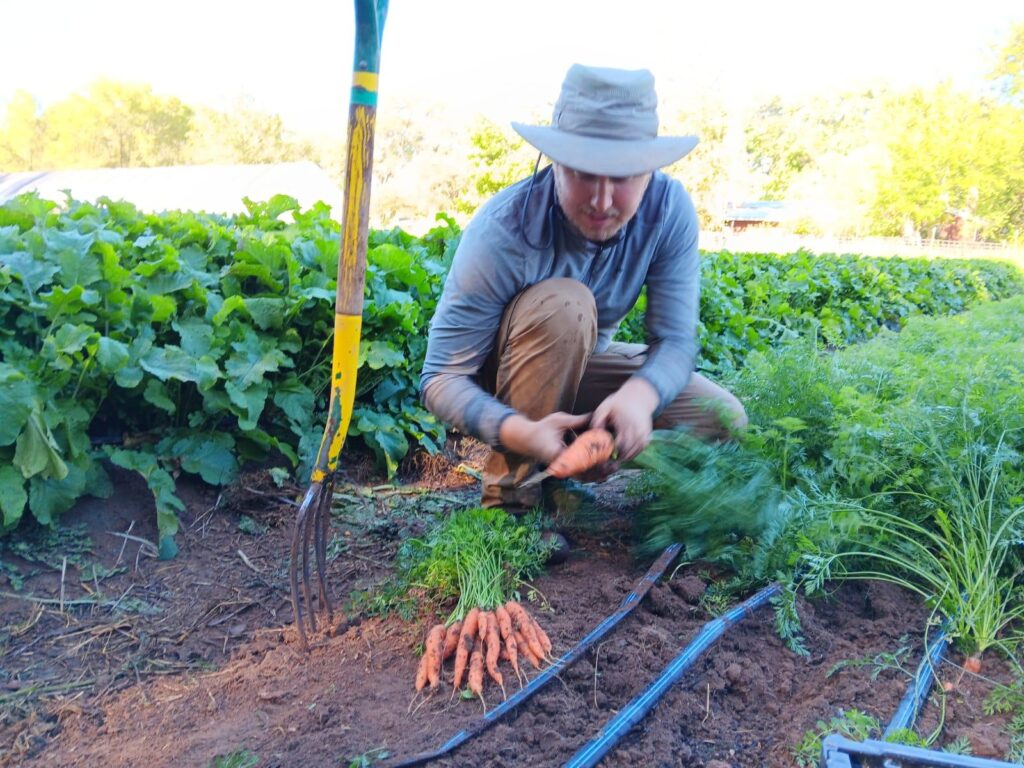
Harvesting carrots from nutrient rich soil.
WATER: Oh Water! What would we do without you?
Water is one of the most important elements and energy systems that you need to plan for in your garden. Water might feel like a renewable, ever-present resource, but we know it is limited in the Southwest. Efficient irrigation is essential for vegetable production in water-limited environments.
Three Types of Watering Methods
Drip irrigation systems are widely recommended because they deliver water directly to the root zone, minimizing evaporation and runoff. ¼-inch in-line drip tubing is particularly well suited for vegetable beds. These lines feature evenly spaced 6” or 12” emitters that provide consistent moisture along plant rows. When installed beneath mulch, they offer precise water delivery while keeping foliage dry, reducing the risk of fungal disease.
Olla means “pot” in Spanish, but the concept of using ollas as an irrigation system goes back thousands of years in many cultures. An olla watering system is basically any type of unglazed clay pot that is buried beneath the soil with only a small amount sticking up above the surface and filled with water. You can tell that a pot is unglazed because it will be that classic terracotta red color with no shiny finish or paint. The water then leeches out of tiny holes or pores in the clay and is pulled through the soil to the roots of your thirsty plants using a process called soil moisture tension. This functions much the same way as osmosis in that the water is trying to equalize to a certain level of moisture within the soil. This means your soil will never become overwatered either — if the soil is moist, the water stays in the pot until it is needed.
Other irrigation options include soaker hoses, overhead sprinklers and hand watering. Soaker hoses are affordable but clog, degrade in the sun and use more water, while sprinklers tend to waste water and increase disease pressure by wetting leaves. Hand watering is flexible but time-consuming and often inconsistent. For most gardens, a hose attached irrigation system combining a 3/4-inch main line with ¼-inch drip tubing offers the best balance of efficiency and control. Learn how to make one here.
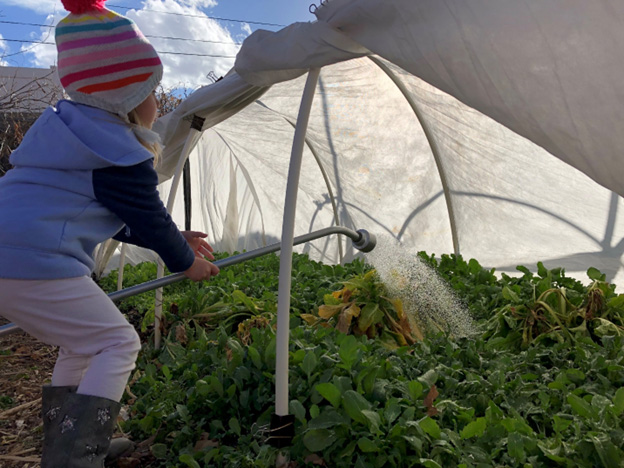
Hand watering a winter vegetable garden.
BIODIVERSITY: Beneficial insects and ecological balance
A healthy vegetable garden is supported not only by sun, soil and water, but by insects that help regulate pest populations naturally. When gardens provide habitat for beneficial insects — such as lady bugs, spiders, green lacewings, parasitic wasps, native bees and predatory beetles — many common garden pests never reach damaging levels. And larger species like lizards and birds can minimize pests such as grasshoppers.
Diverse plantings of varying flowering herbs, native plants, mulch and undisturbed soil create food and shelter for these beneficial species. In a balanced ecosystem, predators and parasitoids feed on aphids, caterpillars, mites and other pests, preventing outbreaks before they occur. Rather than eliminating insects entirely, successful gardens support a web of life where no single species dominates.
Avoid broad-spectrum chemical pesticides. These products often kill beneficial insects before controlling pests and will harm your health, the soil's health and anything that feeds from your garden. When the right insects are present and the ecosystem is healthy, troublesome pests are rarely a serious problem and intervention is often unnecessary.
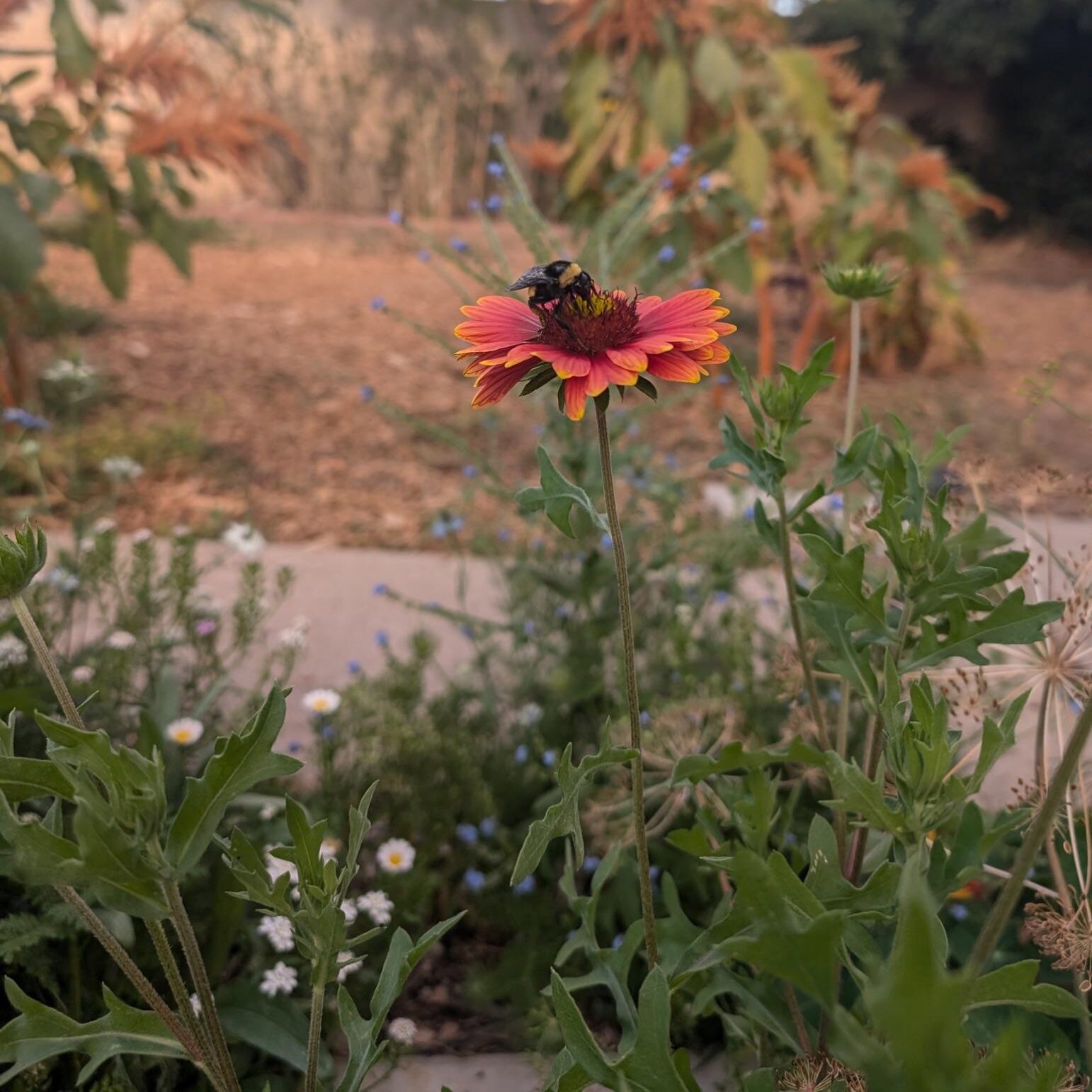
Pollination in action.
RESILIENT CROPS: Some crops and seed to consider
Heirloom and regionally adapted crops are especially well suited to the Southwest’s heat and low-water conditions. Chiles such as Chimayo, Española Improved, and New Mexico No. 9 tolerate high temperatures and are ideal for roasting or drying. Beans including tepary, Zuni gold and Anasazi are extremely drought-tolerant and improve soil fertility through nitrogen fixation.
Squash and pumpkins, including calabacita and Navajo pumpkin, require minimal care once established and naturally shade the soil, helping conserve moisture. Onions such as New Mexico 6-4 handle heat well and are a flavorful staple in Southwestern kitchens. Hopi red, golden and yellow amaranth is an ancient grain that is nutrient dense, and you can eat its leaves and seeds that are high in calcium and iron. These plants require less water and fertilizer than modern hybrids and form the backbone of resilient, climate-adapted gardens.
Buy non-GMO seed that supports organic farmers. Then plan to save your own seeds and grow your collection. There is a beautiful sense of accomplishment that comes not only from harvesting what you grew from seed, but also saving your best harvest’s seed so those plants can grow next year and the year after. Seeds pass on what they learned about their surroundings to the next generation, so if you save your seed, your plants will be stronger, happier and more adapted.
By observing local environmental patterns, managing the sun, building healthy soil, conserving water, fostering biodiversity and choosing resilient crops, you can grow a thriving vegetable garden even in the tough conditions of the Southwest.
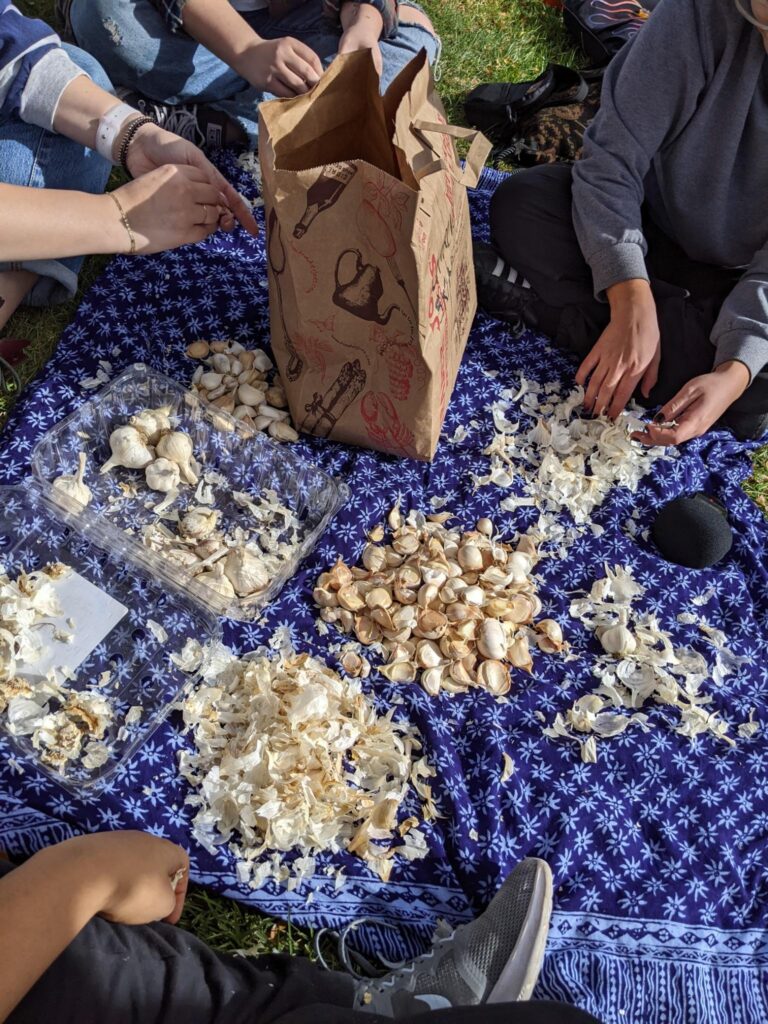
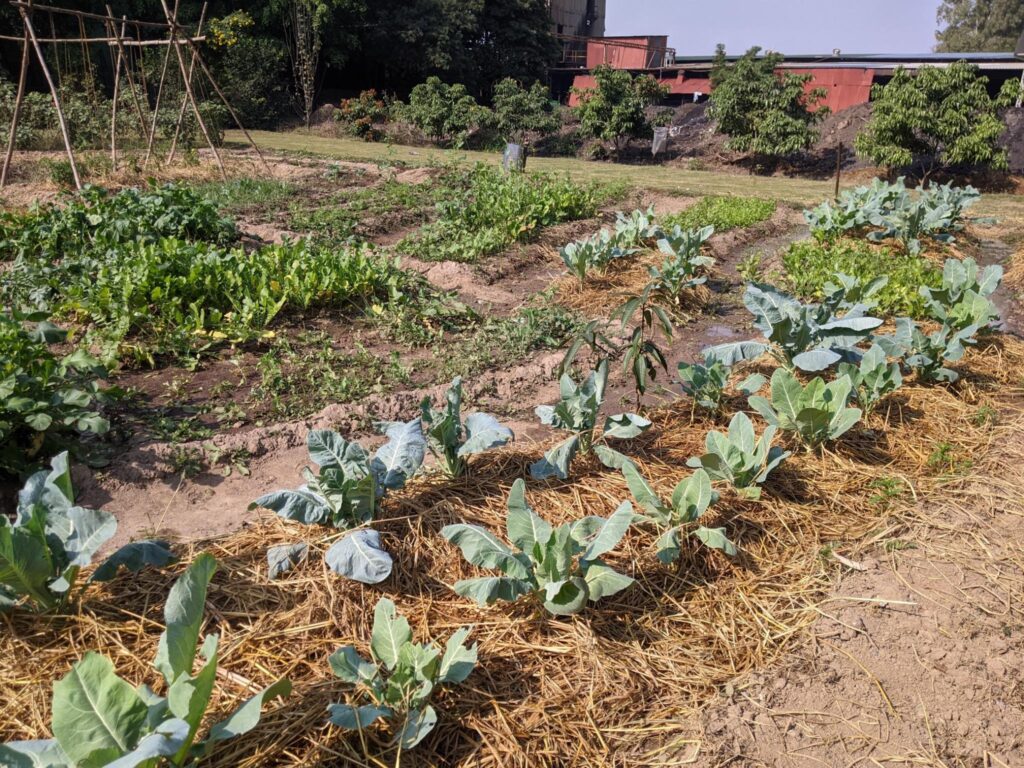
Prepping garlic for planting.Healthy garden bed with straw mulch.
Water-Wise Vegetable Gardening Webinar
With our hot summers and low precipitation, growing vegetables in NM can be challenging. This talk will provide strategies and recommendations for growers to cultivate a thriving vegetable harvest in the region. Discussion will include irrigation and infrastructure suggestions, as well as selection of vegetable varieties that are well-adapted to the area.
Instructor: Stephanie Walker, PhD. Professor and Vegetable Specialist, New Mexico State University, Extension Plant Sciences Department.
Authors: Sachika Goel and Cody Louscher, Water Conservation Specialist with the Water Authority. Have a question about the article or anything else? AskAnExpert@abcwua.org
Trees play a vital role in the plant palette for Albuquerque gardens. They provide cooling shade, screening, and habitat for birds, pollinators and other wildlife. Trees take more time to establish than shrubs or smaller plants. They live longer but are more expensive than other plants, so it is vital to select a tree that will thrive and provide the most benefit over its lifespan.
Often people select trees based on what they see in their neighborhood or what is most readily available at the nurseries. Unfortunately, when too many of one species are planted, the possibility of pest issues rises greatly, and entire swaths of trees can die off at the same time. (For example, Dutch elm disease and emerald ash borers have killed millions of trees in other areas of the U.S.) Planting a diverse selection of trees minimizes the possibility of mass species extinction. Trees are generally resilient, and varying the species planted protects against a variety of harmful conditions.
Oaks
Oak trees (Quercus) tend to be very long-lived and tough trees, well adapted to the climate conditions in Albuquerque. There are about 30 species of oaks native to New Mexico. They vary greatly in size, form, foliage and growth rate. Some are deciduous while others are evergreen. There is an oak suitable for almost any place in your landscape.
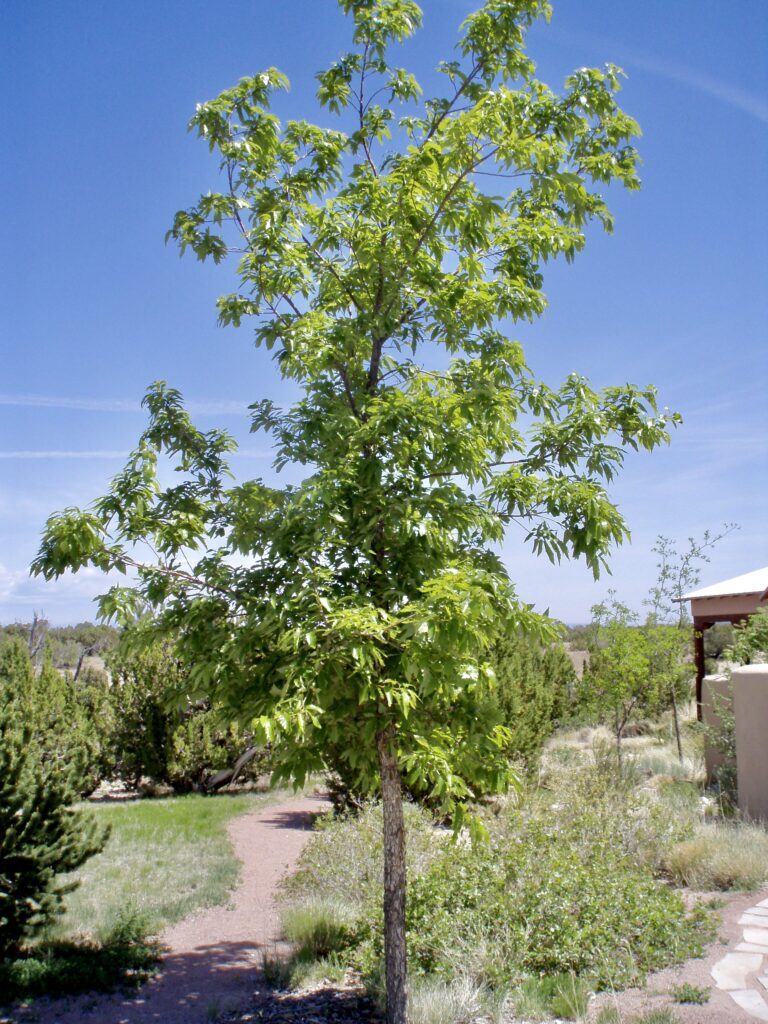
Chinkapin (aka Chinquapin) oak — Quercus muehlenbergii — is a faster growing, larger oak for our area. They can grow from 25’ to 50’ tall . It produces large acorns which wildlife relish and were an important food source for Native Americans. They are an excellent shade tree with subtle color in the fall. This tree is both very heat and cold tolerant and prefers well-drained soil. Water to 24" depth twice a month once established at around three years. Tree establishment rule of thumb is the first year the tree sleeps, second year the tree creeps and the third year it is established and ready to leap.
Chinkapin Oak
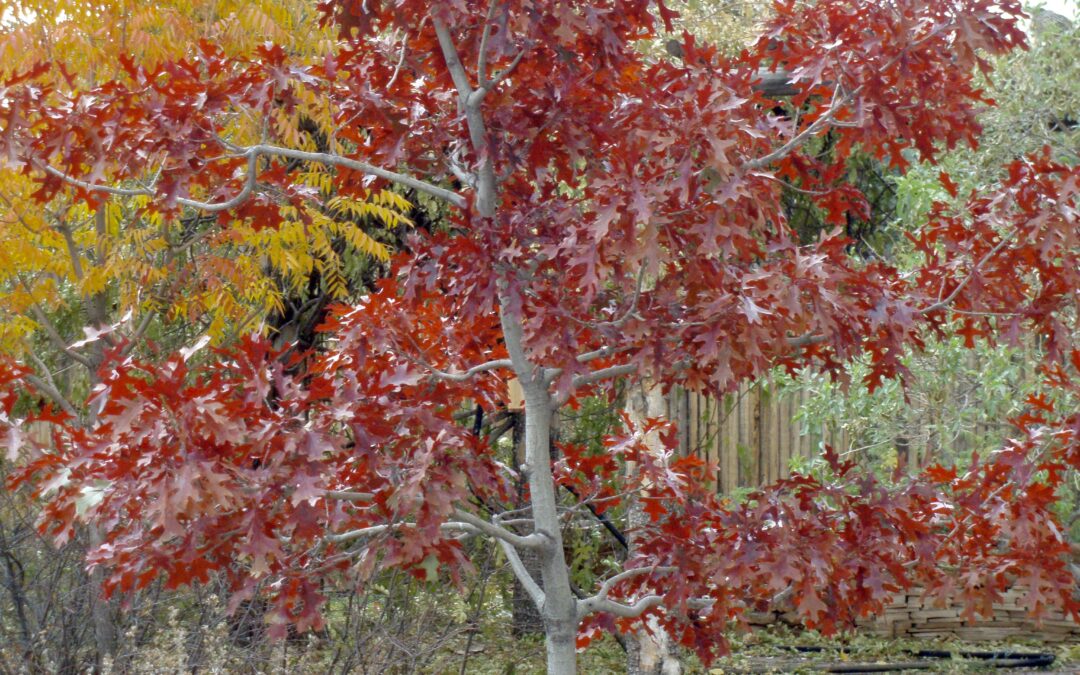
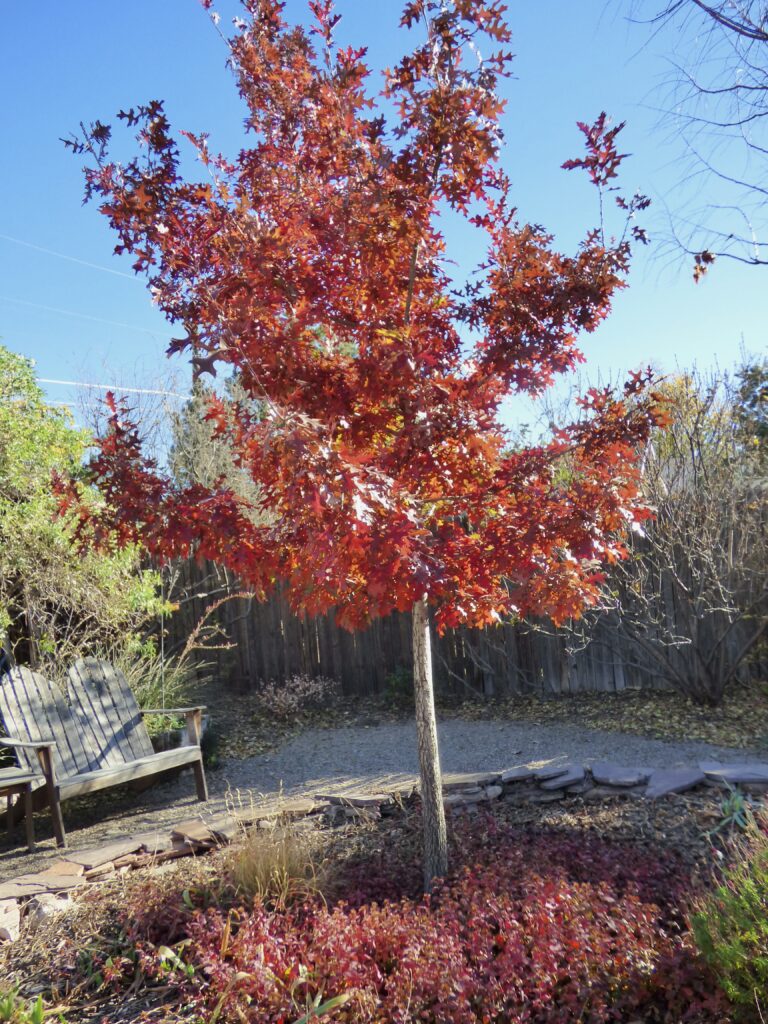
Texas red oak — Quercus texana — is another large deciduous shade tree, growing to about 35’ in Albuquerque. This beauty has long-lasting, spectacular red to maroon fall foliage that will become a focal point in your garden. This tree prefers to be planted in cooler areas surrounded by wood chip mulch.
Texas Red Oak
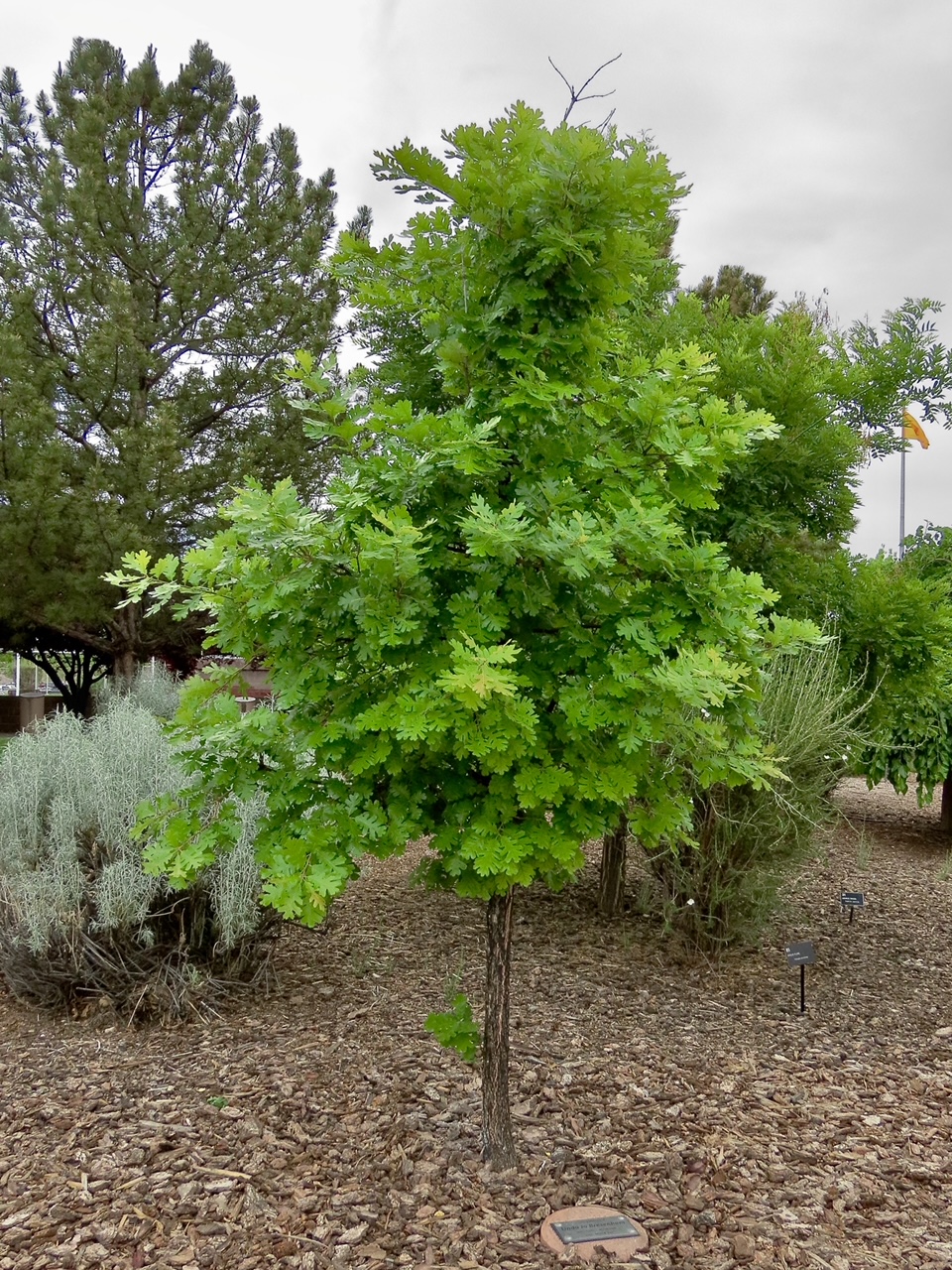
Gambel oak — Quercus gambelii — is an adaptable, native deciduous tree whose shape can vary from a large shrubby cluster to a single-trunk tree. It grows 10’ to 30’ tall in groups and is found at both higher and lower elevations of our local mountains. It provides food and shelter to many wildlife species. Depending on its form and how it’s pruned, Gambel oak can be used as a informal hedge or as an individual shade tree. The red to maroon fall foliage gradually turns brown and persists well into winter, which can provide extended screening.
Quercus gambelii (Photo by @BrandtMagic)
Another native, shrub live oak — Quercus turbinella — has small, holly-like silvery green leaves. This slow grower should be considered more of a shrub and is found locally in the foothills. It is very long-lived (hundreds of years) and grows into a thick trunked form when fully mature.
Escarpment live oak — Quercus fusiformus — is a regionally native tree that can grow 25’ to 30’ tall and 25’ wide in Albuquerque. Its oblong evergreen leaves provide both shade and year-round screening with the benefit of minimal fall cleanup. Make sure to plant the escarpment and the shrub live oak from late spring to the end of summer as cold season planting tends to stunt their establishment and growth.
Escarpment Live Oak
Mesquites
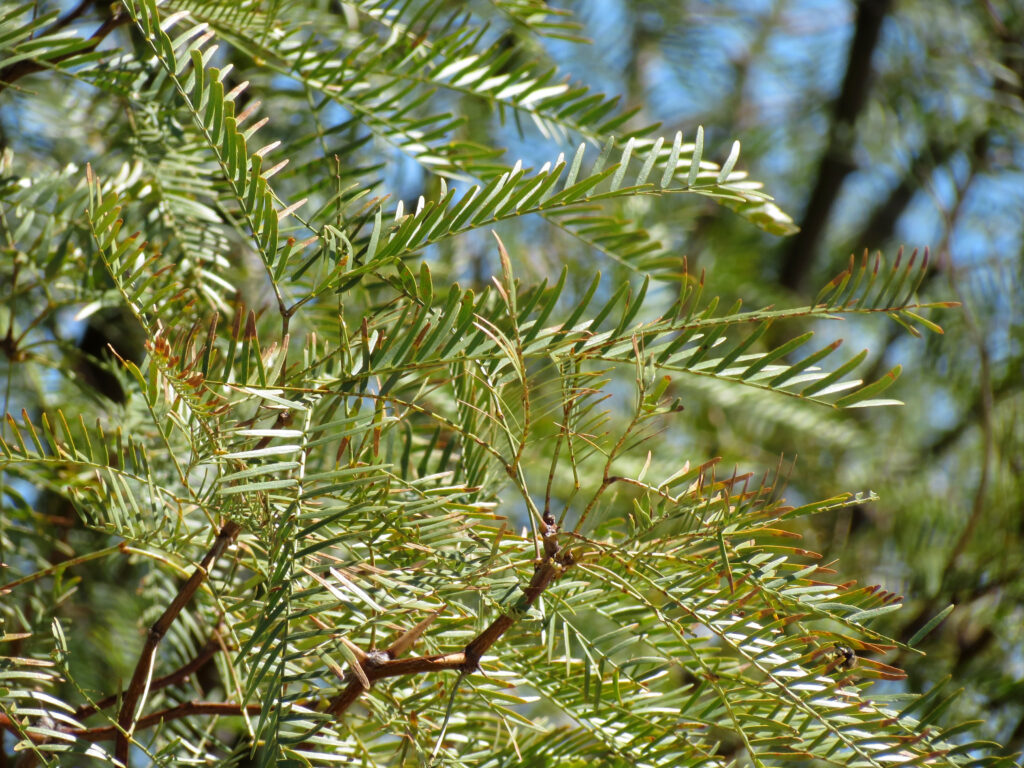
Mesquites are native trees well adapted to extreme heat and drought conditions. Some are not very cold hardy so are best planted in warm or protected microclimates (courtyards or against south or west facing walls). Their spring flowers provide a great resource for pollinators, and their beans can be ground into a sweet flour for baking.
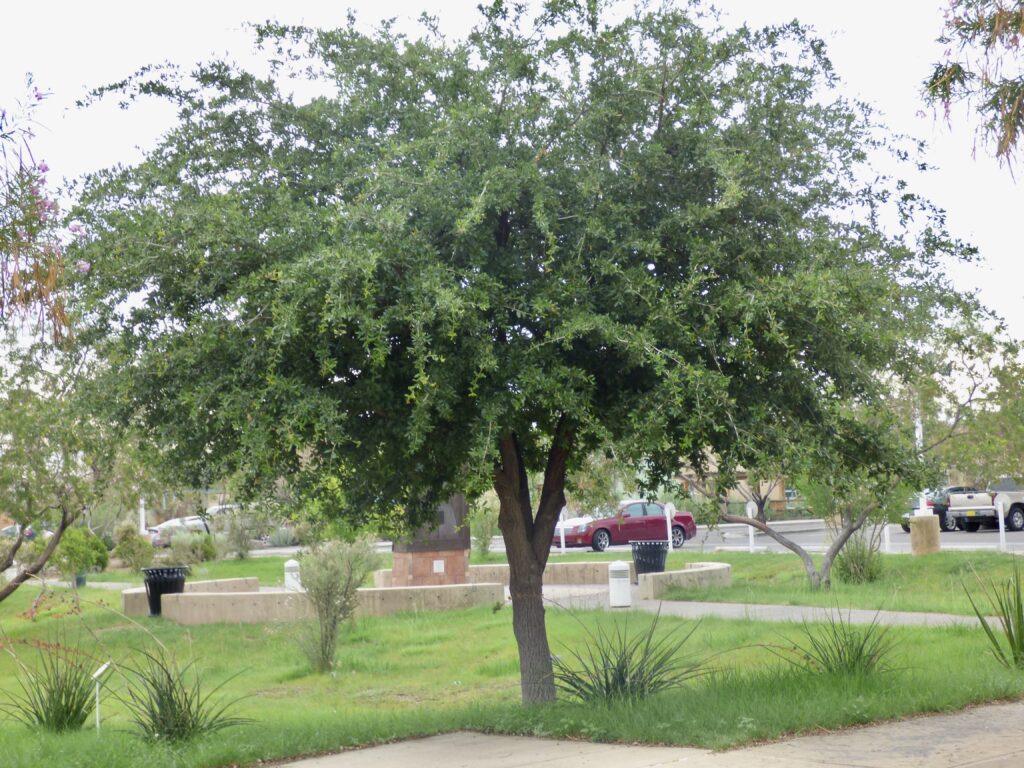
Honey mesquite — Prosopis glandulosa — is a great, tough, small to medium sized tree that can eventually be completely removed from irrigation. 'Maverick' mesquite is a thornless cultivar that is more user friendly in an urban landscape but is not as cold hardy. 'Maverick' can accommodate heavily trafficked courtyards and along pathways. Unlike the regular honey mesquite the 'Maverick' cultivar may need continued watering over its lifetime. Both these trees do better in warmer areas south of Albuquerque.
Honey Mesquite
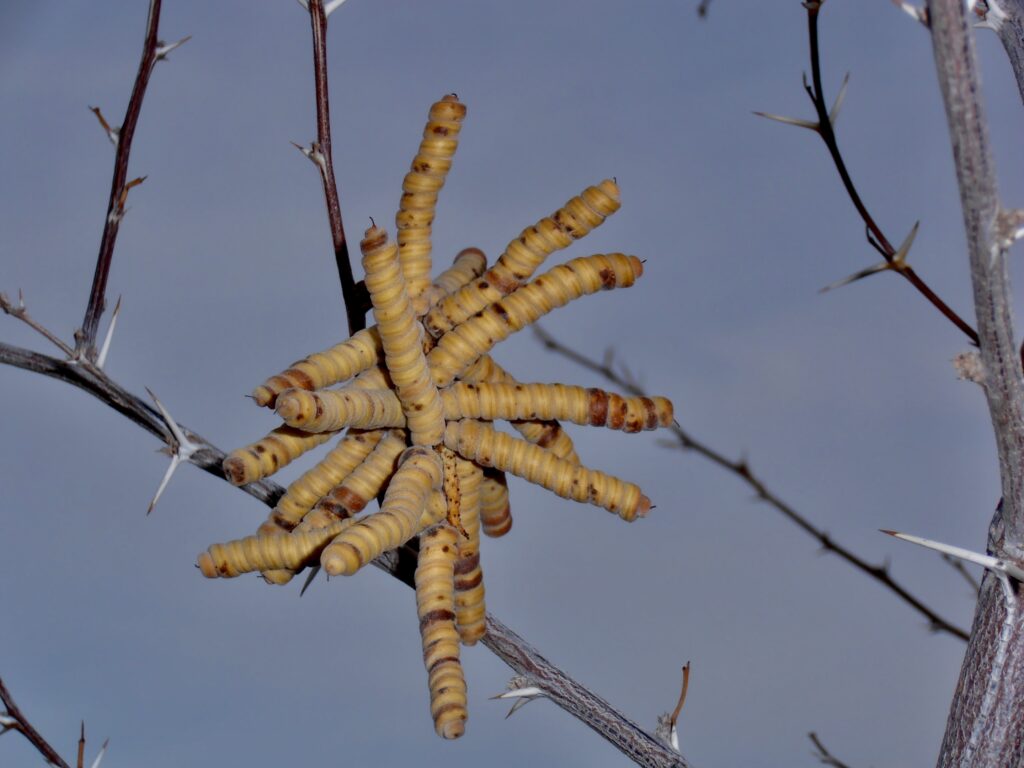
Screwbean mesquite — Prosopis pubescens — is a very drought tolerant multi-trunk tree. It grows up to 20’ tall. As it can handle periods of extra water (flooding), it works well in a rainwater harvesting basin. Locally you will find it growing in the bosque near Socorro. Its unique seed pods look like wonderful mini sculptures. This tree may take some work to find in nurseries, but it is well worth the search.
Screwbean Mesquite Pods
Fundamentally, when selecting trees for your landscape, it’s crucial to find a tree that will thrive in the space and micro-climate where you want to plant it. Oaks and mesquites can provide a variety of options in an Albuquerque garden.
Author: Hunter Ten Broeck, landscape contractor and owner of WaterWise Landscapes Inc. in Albuquerque. Have a question about the article or anything else? AskAnExpert@abcwua.org
What is an ornamental grass? Most often, that term is used to describe cultivars of grasses that are used for specific visual appeal such as color, texture, form, movement, seed heads or other structural characteristics that give interest to our landscapes. Grass-like plants such as sedges and rushes are often included in this category. Most are clump-forming rather than spreading. They can be used as tall background screening, dramatic individual vertical forms or low clumping groundcovers. There is a grass or grass-like plant for virtually any spot in the landscape or garden.
Full sun, upright and mounding grasses
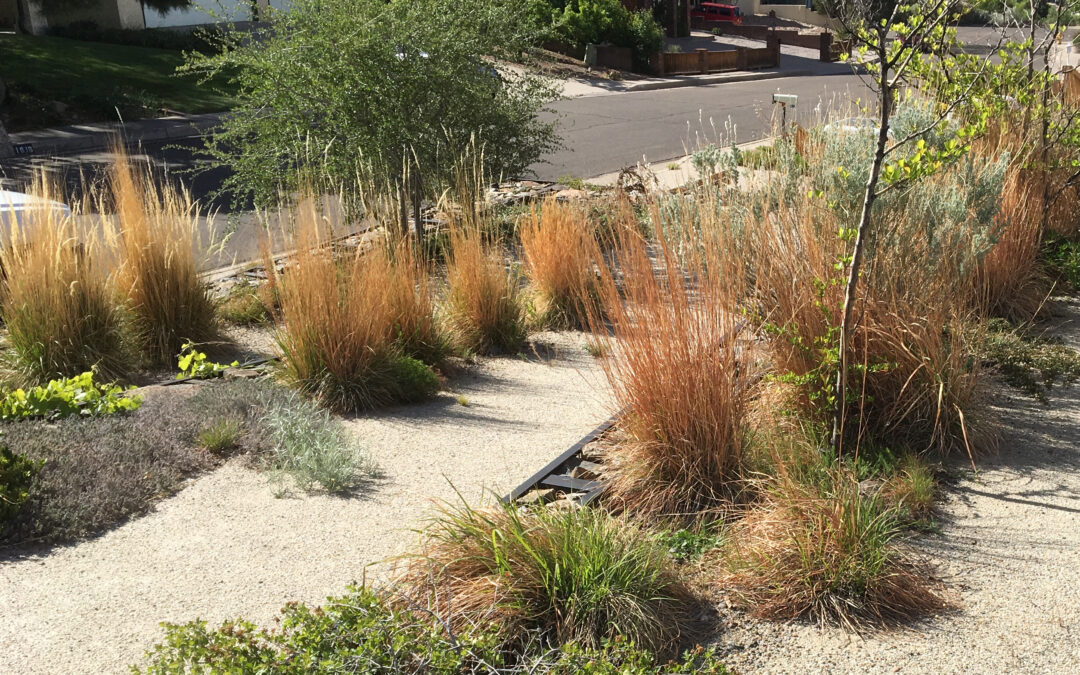
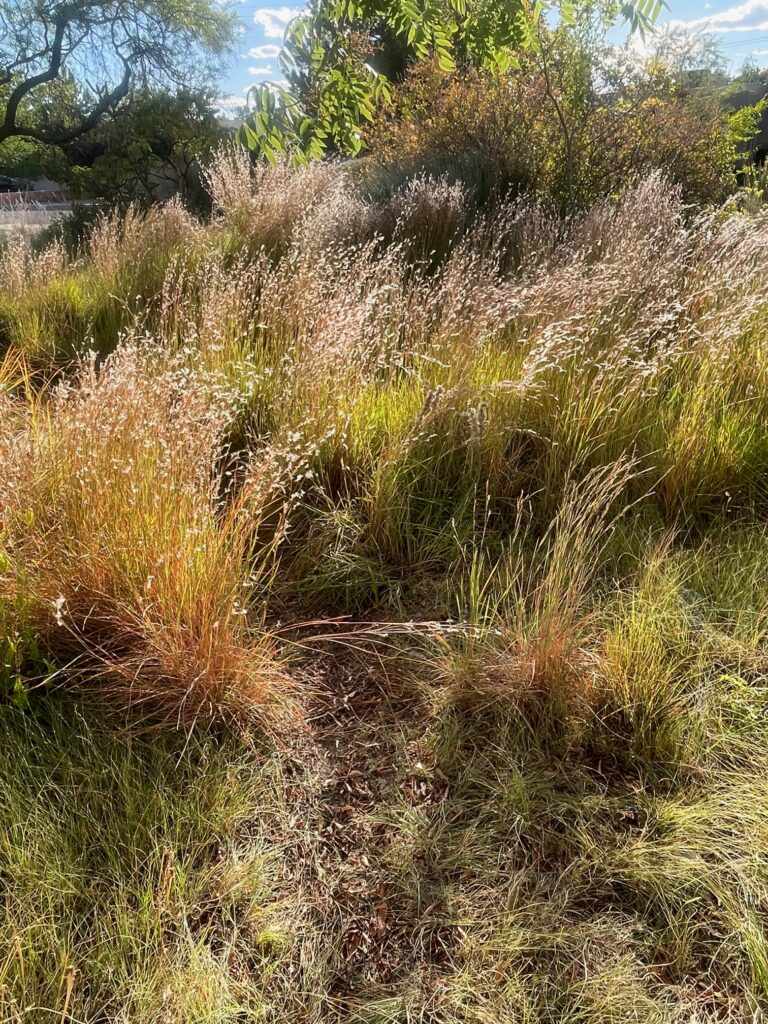
Little bluestem (Schizachyrium scoparium) is one of our most beautiful native grasses! Tall, growing 2-3 feet, this grass is narrow — just a foot or more wide — deep rooted and drought tolerant. This indispensable exclamation point stands upright in the landscape. It is medium green to icy blue in spring and summer months. When autumn and winter temperatures turn most grasses the color of dry straw, little bluestem shines subtly in shades of bronze, ochre and rust. Interspersed in a meadow with blue gramma and side oats grama, little bluestem punctuates the monochromatic tapestry. Standing alone, or in groupings, this grass produces autumn seed heads of silken silver fuzz that shine and shimmer when backlit by the rising or setting sun. Best in full sun and poor to moderate good draining soil. Reseeds easily. Cut once a year, to a low and rounded mound of about 3 inches in early spring, late February-mid March.
Little Bluestem Grass
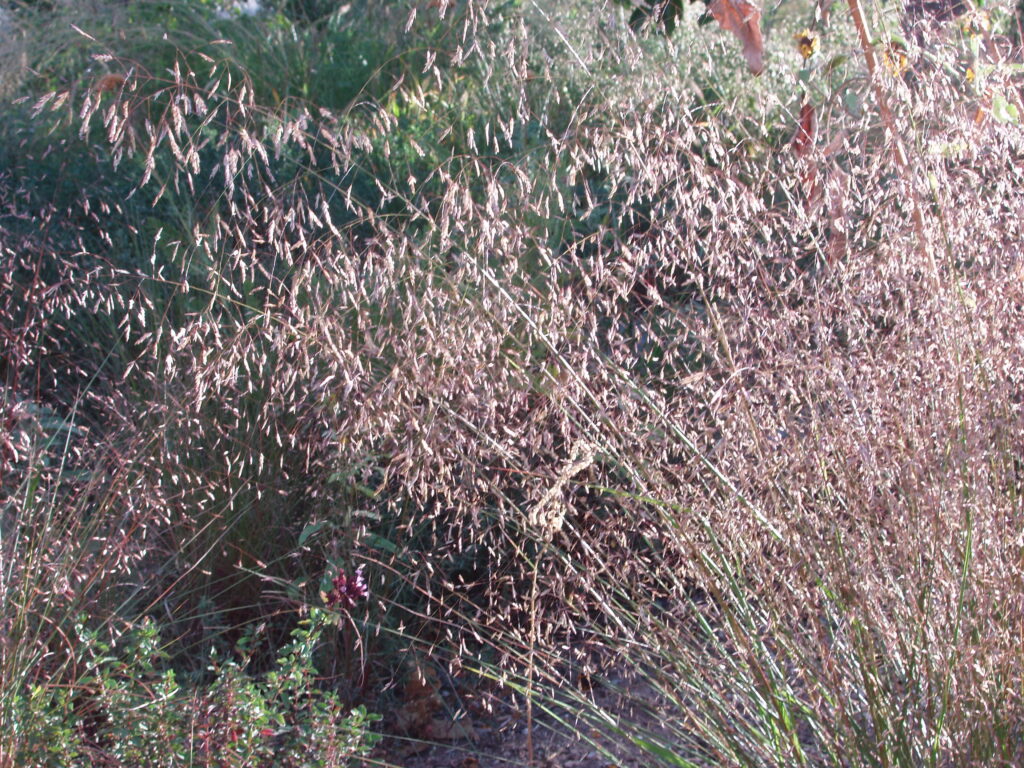
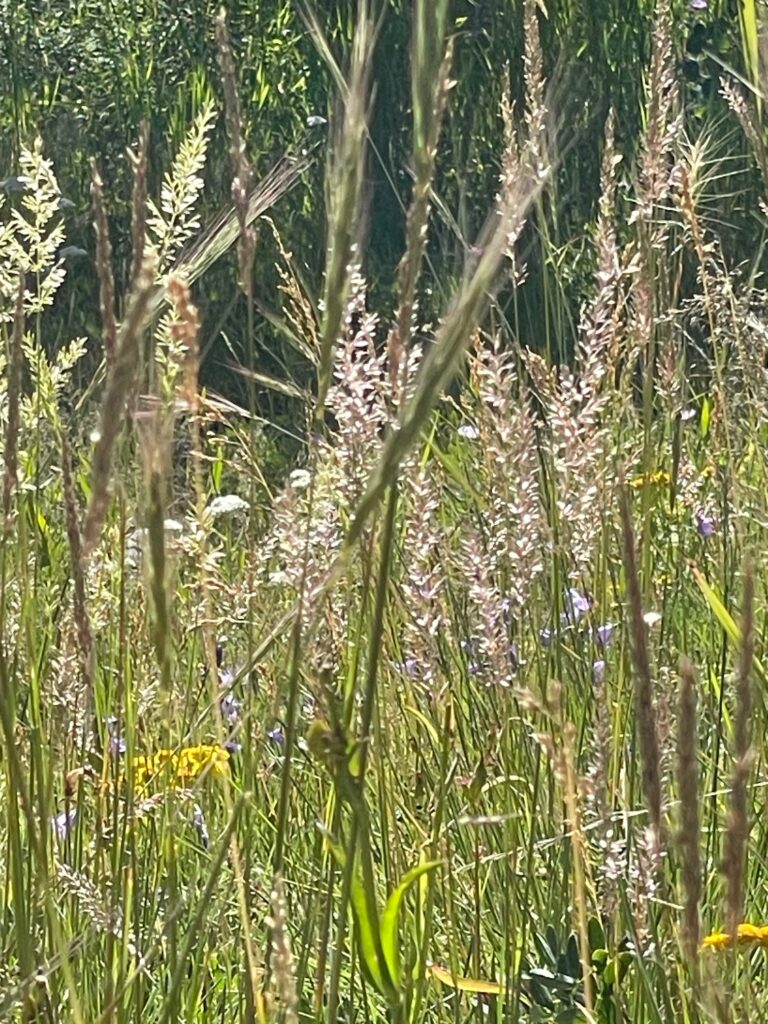
Sand lovegrass (Eragrostis trichoides) is a wiry, fine bladed native grass tolerant of sandy to poor soils, full sun, drought, wind and heat. It forms a wide (2-3 feet), rounded mound. From late summer to autumn, seed heads appear on burgundy tinged panicles floating above the foliage. Airy and elegant, the seed heads are distinctive and lovely in dried arrangements. An individual showpiece, this grass looks great when planted in masses, too. Another light catcher that reseeds well. Cut once a year in early spring, to about 2-3 inches high.
Sand Lovegrass
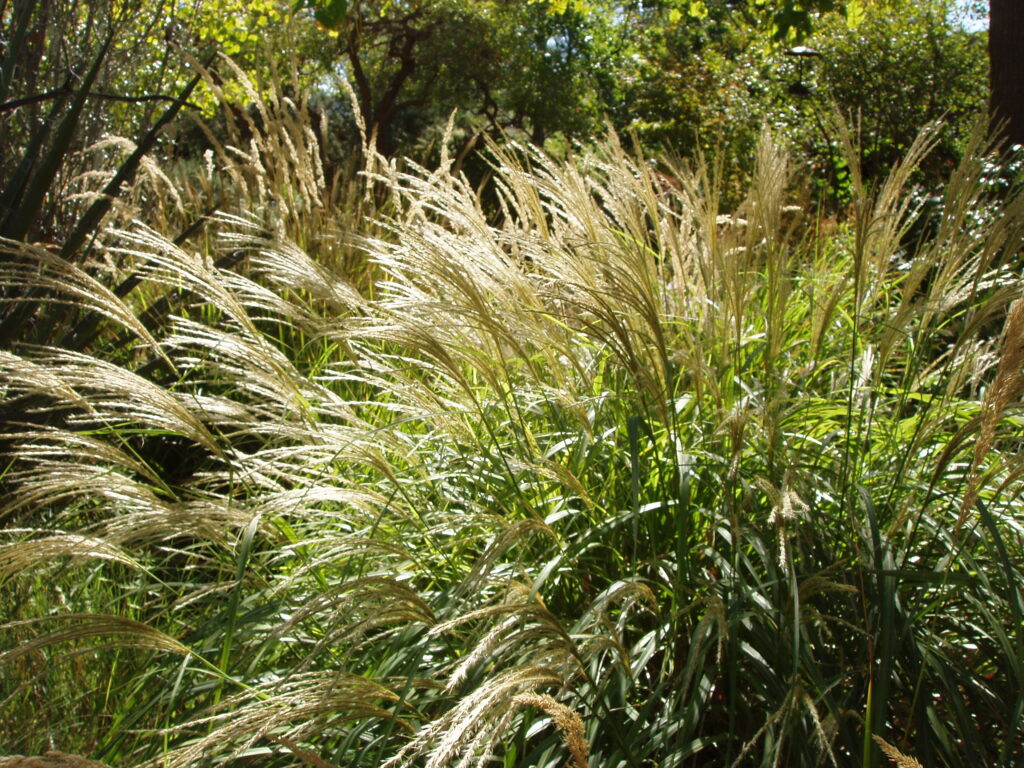
Maiden grass (Miscanthus sinensis) is a non-native thatgrows 4-5 feet tall. Dwarf varieties are available that are 2-3 feet tall. The form is upright with the top of the plant spreading wider than the base. This grass can be 3-plus feet wide at the top and 2 feet wide at the base. A specimen grass, it’s not for meadows except as an accent or background and works well in groupings. Seed heads form mid to late season, at first appearing like narrow fingers, sometimes with coloration from pink to burgundy, all eventually drying to a blond fluffy appearance like golden clouds over the straw-like blades curling up and out. When backlit by the sun, this can be stunning. Moderate water for this grass is better than low water. Maiden grass does not reseed successfully in our area now but can be thinned and transplanted by division. Cut back once a year in spring, when new green becomes visible at the base. A cut at around 6-8 inches of height can be good for this large grass.
Maiden Grass
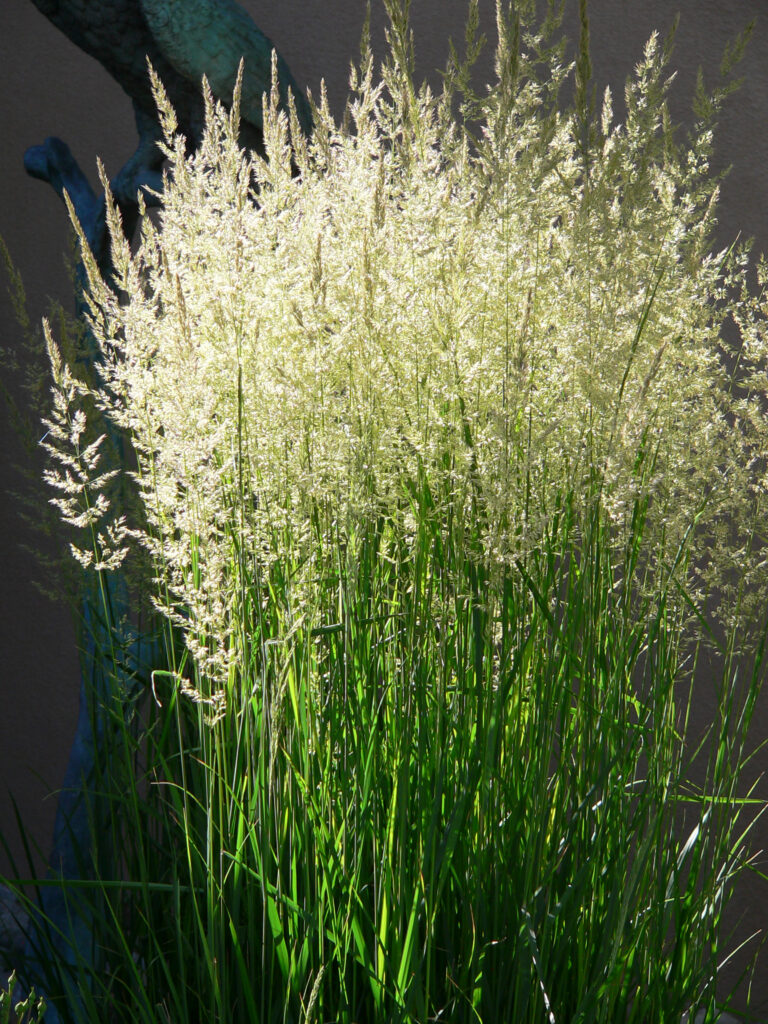
Karl Foerster or feather reed grass (Calamagrostis x acutiflora ‘Karl Foerster’) is a non-native, low maintenance vertical grass that produces seeds early, unlike most grasses which produce seed heads later in the season. Like Miscanthus, green and variegated (striped) cultivars are available. This grass likes full sun and moderate water and grows 3-4 feet tall and 1-2-plus feet wide. It makes a statement as a single plant and is great in groups or rows for a contemporary take on plant placement. Does not reseed. Cut back to a height of 3-5 inches once a year in early spring.
Karl Forester
Full sun to part shade grasses
June grass (Koeleria macrantha) is a native that can be found growing in our mountains in full sun to part shade. Narrow blue green blades 12-18 inches tall push up in early spring, soon followed by spiky seed heads. The seed heads flush out into narrow, pointed silky bottle brush shapes, catching morning and afternoon light that makes them appear illuminated. Not fussy about soil, except when heavy and wet, this tough grass is drought tolerant and deer resistant. As a cool season grass, it may go dormant in hot dry summers, especially at lower elevations. So while appealing, this plant does not flourish in a hot and dry xeriscape.
June grass
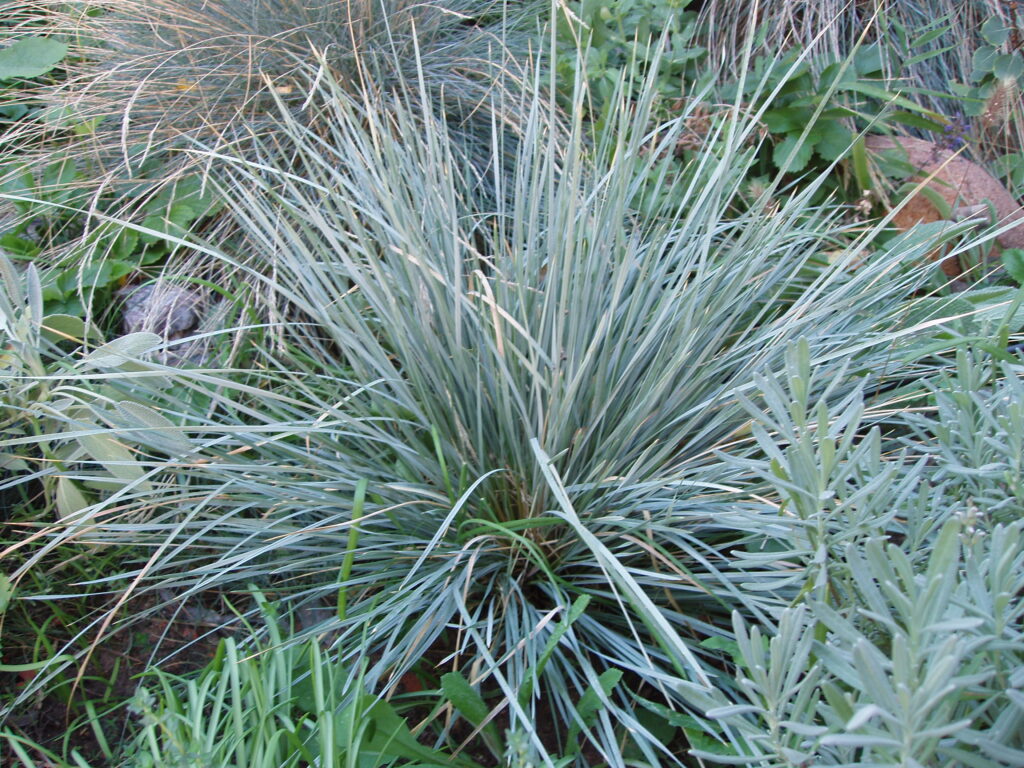
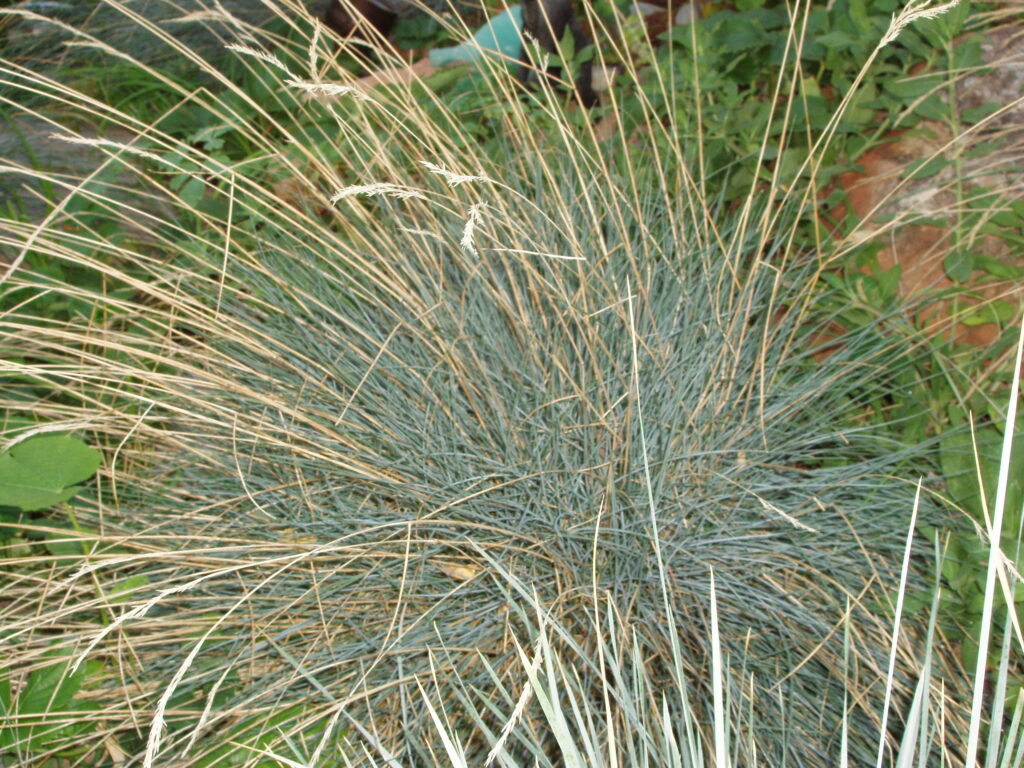
Blue avena (Helictotrichon sempervirens), also called blue oat grass, has wiry ice blue blades that form a low, rounded mound around 18-30 inches tall and wide. Narrow seed heads push up, and the seeds soon turn straw colored and give an oat like appearance. This cool season grass is not fussy about soil and is drought tolerant when established. Does not reseed. Cut back once a year in early spring to a rounded 2- to 4-inch mound.
Blue Avena
Blue fescue (Festuca ovina glauca) is a blue green form of native sheep’s fescue (Festuca ovina). Fine, needlelike blades and wiry, thin, straw colored seed heads make this small (6-8 inch) grass perfect for small areas, borders and rock gardens. Often keeping color through the winter, this grass is drought tolerant when established. Straight species can reseed while named cultivars like Elijah Blue do not reseed well. Cut back once a year to a height of 2 inches. Requires shade to do well.
Blue Fescue
Maintenance and selection tips:
Most grasses benefit from having old dry growth thinned out of the center every few years at the time they are cut back. Many grasses can be used in containers or large pots. Grass trimmings can be used as mulch in the landscape (careful with seeds if you don’t want seedlings) or added to your compost.
Some ornamental grasses like pampas grass and Ravenna grass have become invasive here, particularly in the Rio Grande Bosque, so are no longer recommended. Large native grasses like giant sacaton (Sporobolus wrightii) and switch grasses (Panicum species) are good substitutes. There are many species of native grasses that are tough, ornamental, easy to care for and beneficial to native insects, birds and other wildlife, thus being wise selections for our landscapes and gardens.
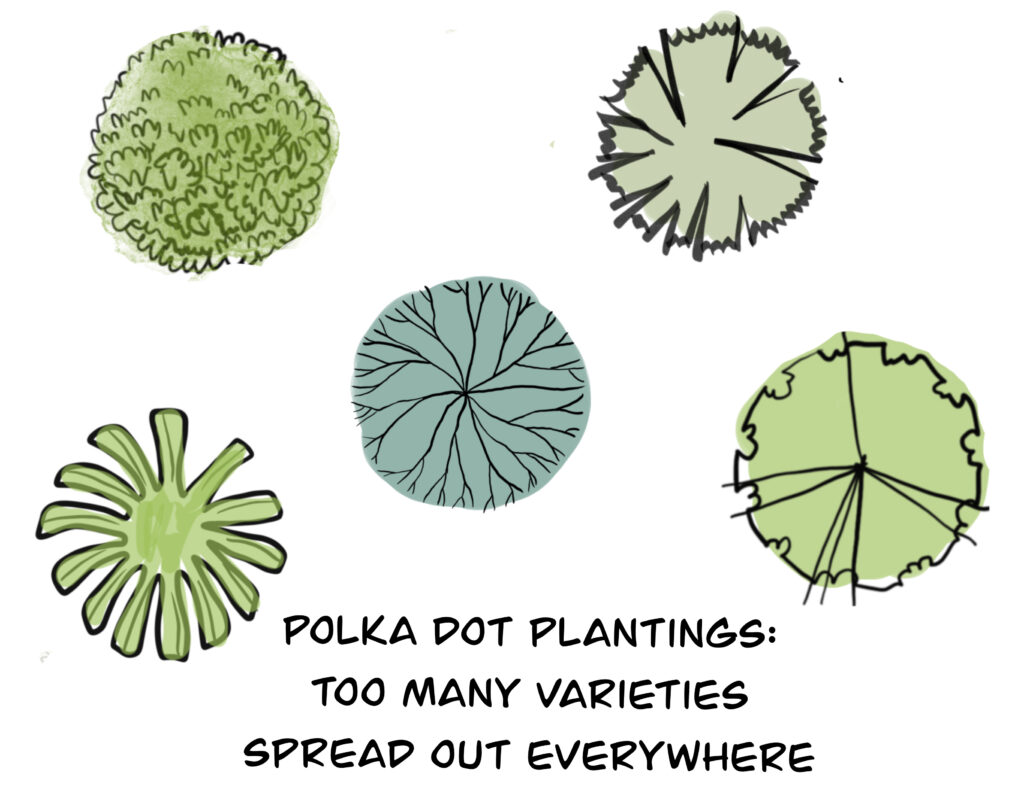
1. Too many different plants spread out like polka dots
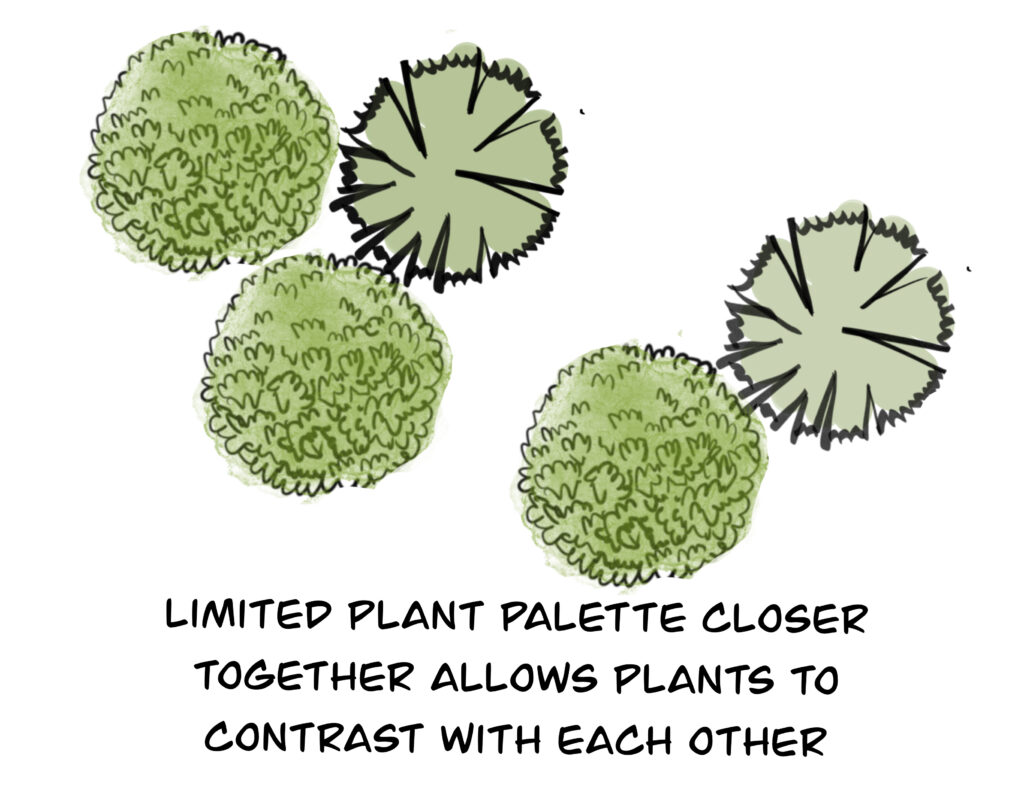
Often when homeowners begin to design their yard, they get excited by the variety of plants in our Xeriscape Guide. Similarly, going to a well-stocked nursery in the spring can be like going to a candy store — you might say to yourself, ‘I’ll take one of everything!’ However, it’s good advice to resist that urge and instead attempt a more cohesive ensemble of plants and trees. Grouping plants, especially smaller ones or perennials that have less dense forms, can maximize their effect by creating masses of various sizes and contribute to the feeling of a more natural landscape.
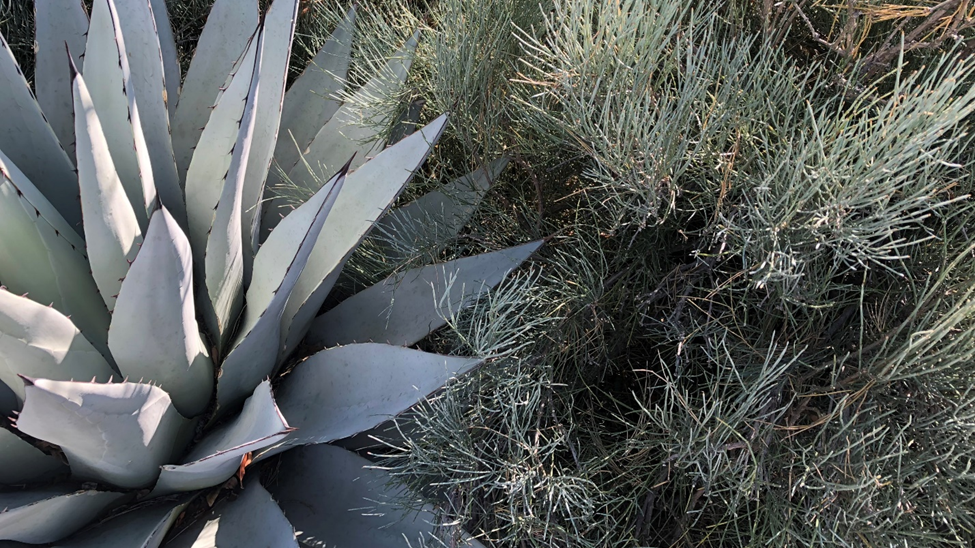
In these instances, you can pair plants that have widely different leaf shapes, like the agave and ephedra pictured below. The effect is something you wouldn’t appreciate if there was a large gap between the plants. A lot of flora have distinctive attributes like bark patterns, seedheads, dried flowers or an overall shape that allow them to stand out when accompanied by contrasting plants.
If you’re not sure where to start on your own yard design, check out our landscape templates here. You’ll notice there is a lot of variety in each design, but the same plant symbols appear next to each other throughout the yards. The three landscape architects and designers who contributed these templates have tons of combined experience designing beautiful and sustainable landscapes in New Mexico, and their templates are worth checking out!
Benefits of installing multiple plants of the same variety
Visual impact: Let’s take a really great flowering perennial like Gaura or whirling butterflies (Oenothera lindheimeri) as an example. It has airy small white (or light pink) flowers less than an inch wide atop thin branches that sway in the breeze — visually it doesn’t stand out unless you’re right in front of it. If you were to plant a single specimen of Gaura in the middle of a yard it could almost disappear. Instead, we suggest a group of three in a triangle or row closer to paths or windows to maximize their impact — just like they’ve done in this photo taken at Presbyterian Rust Medical Center on the West Side.
Attracting pollinators: Grouping flowering plants that attract pollinators can really make it worth the effort for them to visit. Perennials bloom at different times from spring to fall, and in a small yard you may have only one type of plant flowering at a given time. A group of at least three of the same perennial will be hard for pollinators to miss as they go about their business of collecting pollen and nectar. Then they’ll be able to save their energy for building nests and breeding.
Reduced maintenance: If you’re new to xeriscaping or gardening, having fewer varieties of plants in groups can make maintaining them (and learning names and growth habits) less overwhelming. Instead of starting out with a mishmash of plants installed everywhere, you’ll be able to get your head around the maintenance more easily because the yard is divided into manageable areas. Also, if you pay someone for yard care, you may need to explain to them when, how (and if) to do the work. A smaller plant palette grouped by variety can help simplify the job. You could say to them: “This year for all the woody evergreen shrubs next to the sidewalk, don’t use hedge trimmers but do remove one-third of the oldest branches at the base.”
So if you head to the nursery to buy 10 plants this spring, consider coming home with just two or three varieties that together will make a real impression.
2. Symmetrical vs. informal plant layout
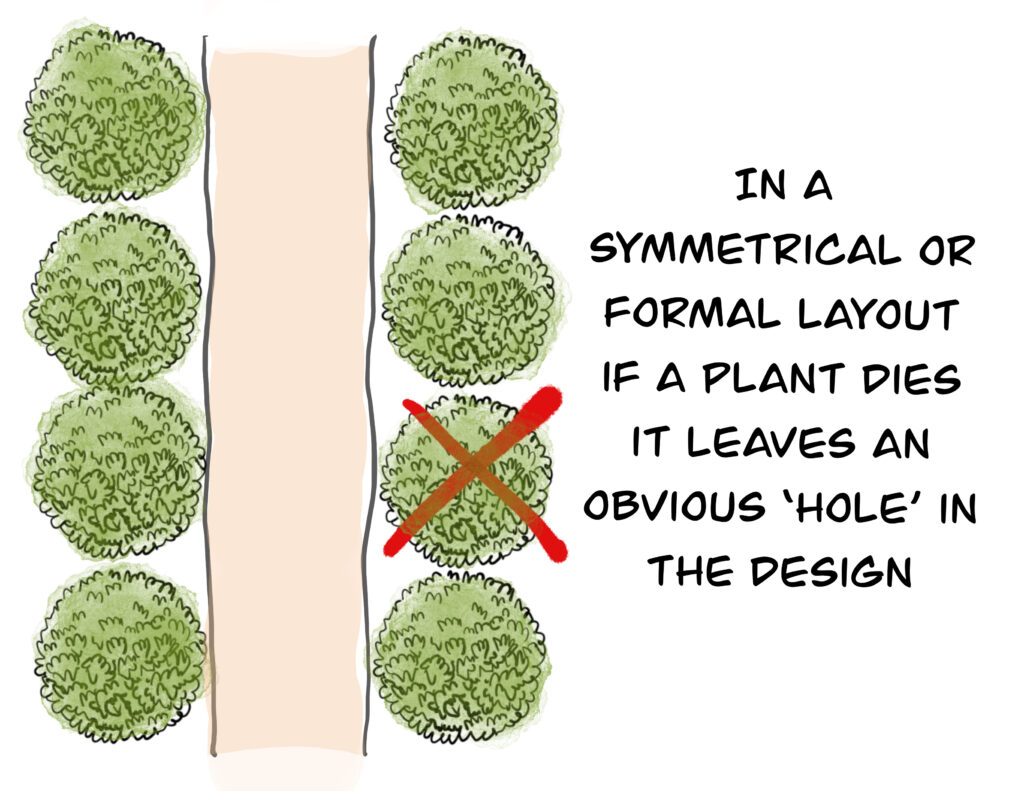
Another mistake DIYers sometimes make when designing landscapes is opting for a symmetrical layout for the new plants. For instance, they will have corresponding rows of evergreen shrubs on either side of a path as shown below. There are a couple of reasons why this is less than ideal. One is that an unhealthy plant (or worse, one that is dead) is immediately noticeable. Also, in a formal layout, you’re anticipating that the plants will grow to a uniform size and shape. However, this is not the case with native and xeric-adapted plants (and most plants, really). Once in the ground, they’ll be responding to all sorts of different conditions. Too much shade from a nearby tree limits a plant’s mature size, or extra water from the roof causes one to get larger than the others, for example. And if you did need to replace one plant in a formal layout, it could take a while for the new one to catch up to the others (assuming you able to find the same variety as the originals).
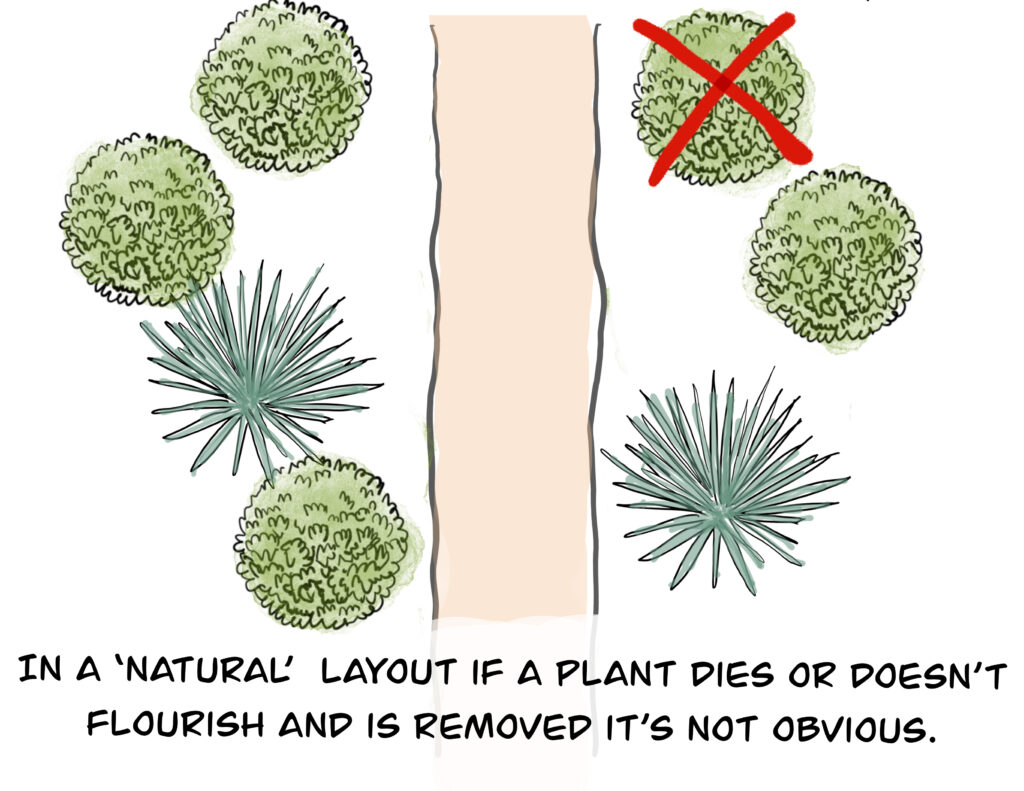
In an informal or “naturalistic” layout, a missing plant is not an issue because there’s not an expectation for that space to be filled. It also allows flexibility in the design — shade-loving plants near the tree, plants that can handle more water under the downspout. If a particular plant isn’t doing well, you can transplant it to another location. Using an informal or naturalistic planting design allows you to add to your garden over time as it matures and changes for years to come.
Selecting plants for your yard can feel overwhelming to a new gardener. We hope these tips help you avoid common mistakes, and remember that we're always here to support you. If you have questions about plant selection, feel free to send photos and details of your yard to askanexpert@abcwua.org — we’ll be happy to help.