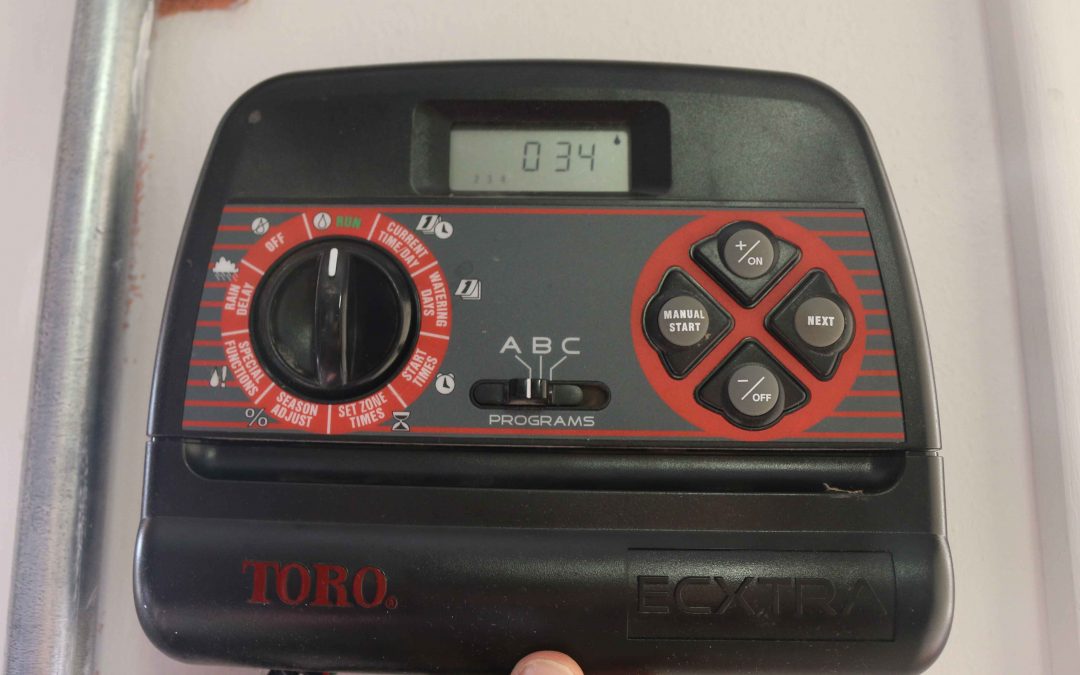
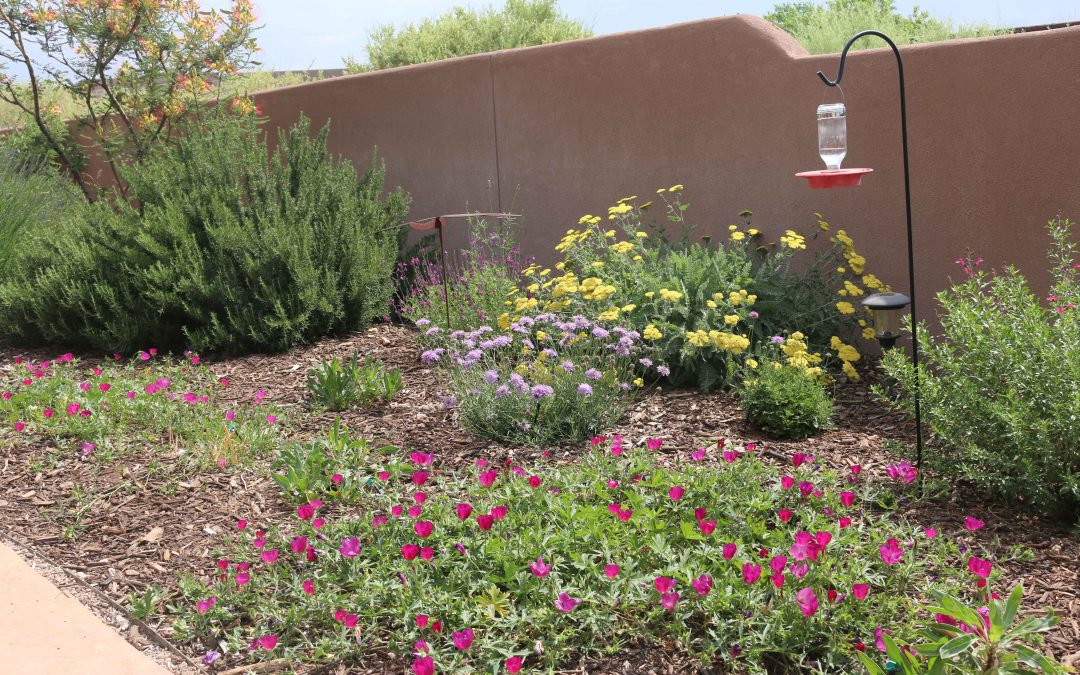
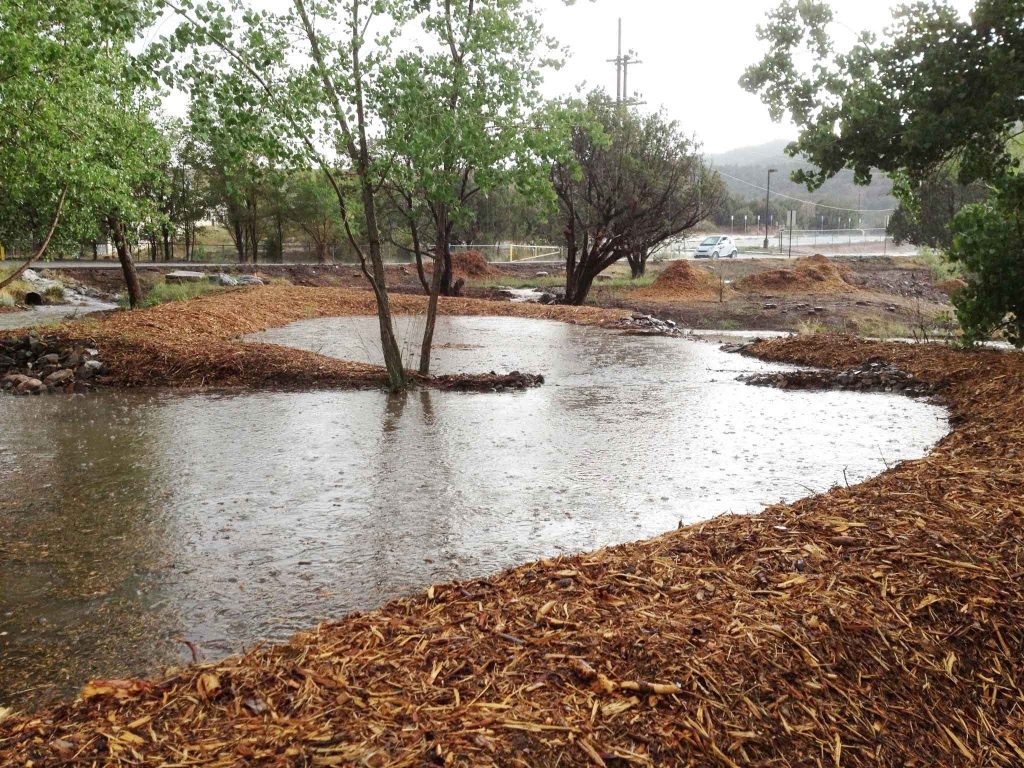
Your landscape needs a lot less water in September than it did in the summertime. About 35 percent less on average. The days may still be warm, but shorter days and cooler nights in the months of September, October and November means less evaporation, which means less irrigation is required. Adjust your irrigation controller following the Fall Season Watering Recommendations to save water and money this Fall.
Ramping down your landscape irrigation does not mean you
need to stop watering all together. If you have a lawn, cut back to two days
per week. Cut back to two to four days a month for trees. Fall is when trees,
shrubs and other perennial plants get busy growing their roots, and proper watering
supports this activity. After spending the summer putting energy into growing
leaves, flowers and fruit producing plants take advantage of the fall season by
anchoring their root system to the earth. It’s important to fortify root systems
during the Fall so they have a stronger trunk and stem during the winter
season.
Fall season is also a great time to put in new plants, for the
same reason – they spend their time growing their root system instead of leaves
and flowers. But new plants need more frequent watering to help them get established.
Keep in mind that new plants need at least a month to anchor in the ground before
the first freeze, so don’t plant too late in the season to avoid damage.
And remember it is not necessary to irrigate when it rains, or on days following a good rain event (or about a 1/2" of rain). Using nature as your source of water encourages a desert friendly landscape.
Want to know how much your landscape really needs? Call 505-289-3003 to schedule a free, efficient irrigation consultation with a Water Authority expert.
The Water Authority encourages efficient outdoor water use for beautiful landscapes. With some 40 percent of our drinking water going to landscaping, improving outdoor water use efficiency is now the main focus of the Water Authority’s conservation efforts. But irrigation efficiency doesn't mean you can't have a beautiful, desert friendly yard. Below is your three-step plan for a beautiful, desert friendly yard.
1. Service your irrigation system by checking for leaks and malfunctions.
Low-maintenance landscapes are great, but there’s no such thing as a “no-maintenance” irrigation system. A single broken sprinkler head flowing at 15 gallons per minute will waste 900 gallons in one hour of use. Service your system regularly, and check it often for leaks and malfunctions.
2. Set your turf irrigation timer to water by the numbers.
Adjust your irrigation timer according to the season. For turf, water by the numbers: One day per week in March, two days per week in April and May, three days per week in the summer, and ramp down in the Fall. For other landscapes, follow the Seasonal watering recommendations. Call today for a free irrigation consultation.
3. Select desert friendly plants that thrive in our dry climate.
There are literally hundreds of plant options to choose
from that will thrive in our desert climate. And there are rebates available for
replacing turf with a desert friendly landscape.
If you follow this three-step plan, you’re sure to have
landscape success.
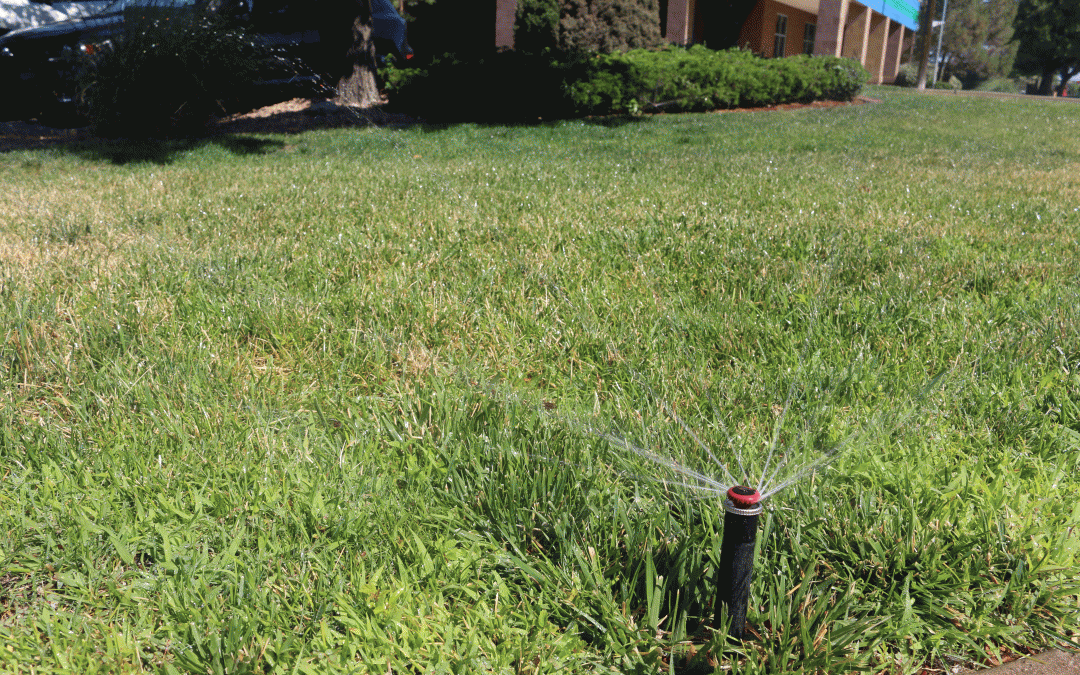
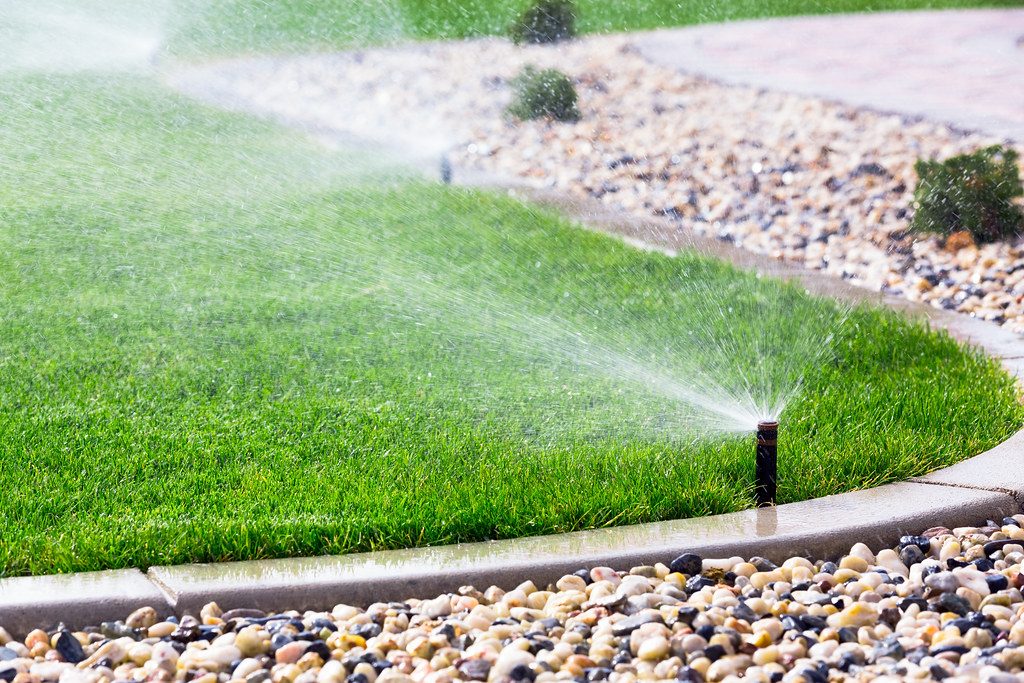
Grass lawns in the greater Albuquerque area require supplemental irrigation in order to survive our high desert climate. Most residential landscapes are watered by pop up spray heads with conventional nozzles, as pictured below.
Pop up spray head
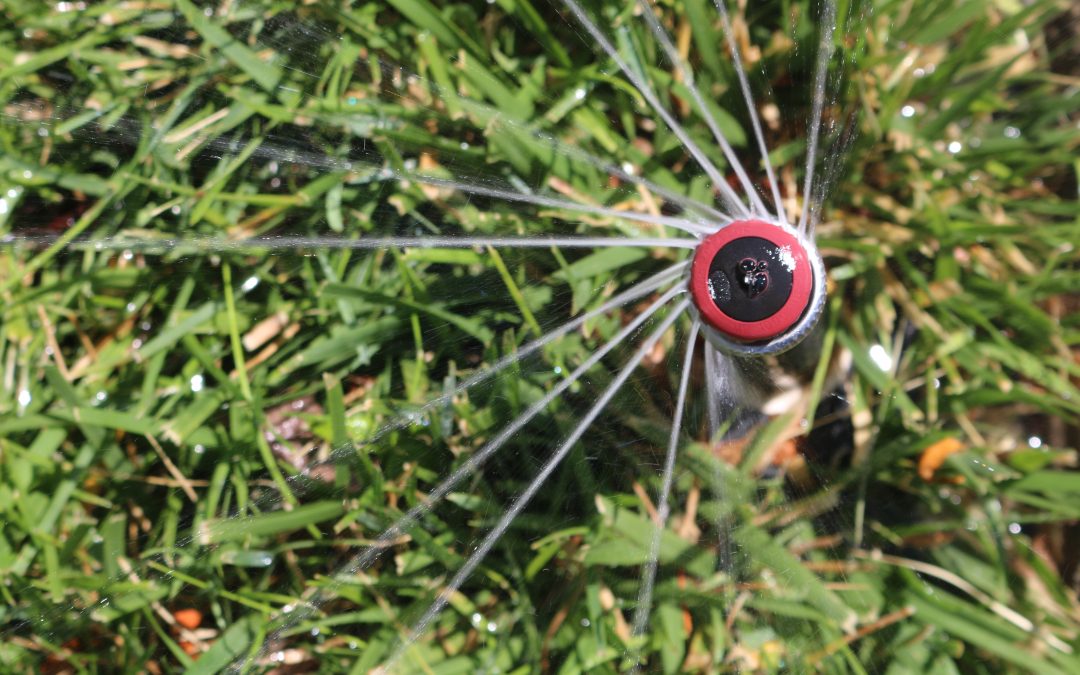
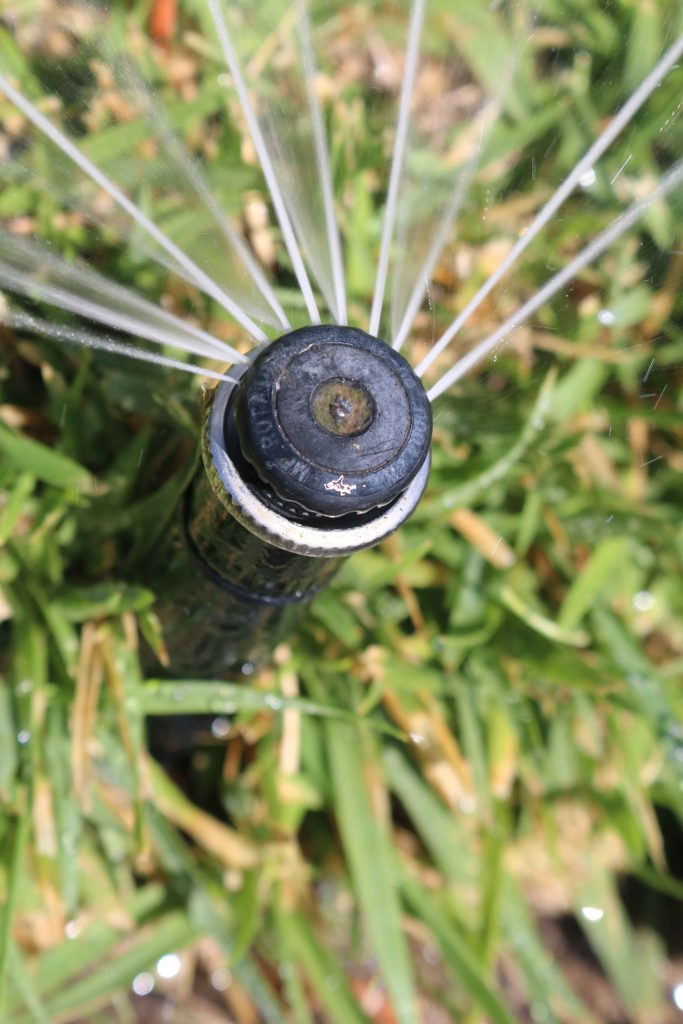
But did you know that water waste from these conventional spray nozzles can be reduced by simply swapping the nozzle out for high efficiency rotary nozzles? And for just a few dollars per head. Rotary nozzles improve irrigation efficiency by delivering water more slowly. That prevents runoff by giving soil time to absorb the water and allows the water to reach the root zone of the plant. These nozzles also deliver water in a larger droplet size, making the spray less susceptible to being carried off by the wind. This is all accomplished via their distinctive multiple rotating streams of water, pictured below.
High efficiency rotary nozzle
505Outside visited local irrigation supply stores to find out their most
frequently asked questions about these nozzles.
Can I replace my existing spray nozzles with these high efficiency rotary nozzles?
Yes. In most cases it’s as simple as unscrewing the existing nozzle and
dropping in the rotary nozzle and filter basket. These are available at any
local irrigation supply store. If you bring in your existing spray head, the
staff can recommend the best solution for you. Water Authority has rebates
available for the purchase of rotary nozzles, too. Visit the link here.
Sounds too good to be true. Are there any negatives?
They tend to clog with the hard water typically found in Albuquerque.
Make sure the brand you select comes with an inline filter basket, so you can
easily flush out and unclog your spray head.
What else should I know about high efficiency rotary nozzles?
They require longer run times. This is where most homeowners get confused. Wouldn’t
a longer run time mean I’m using more water? The answer is no, because rotary
nozzles deliver water at a slower rate than typical spray nozzles. Therein lies
the efficiency: water saturates deep into the root zone rather than running off
and evaporating. This can also help reduce the frequency of runs, thereby
saving water.
They work best at 30-40 psi. If the pressure running through your irrigation
system is too high, the rotary nozzle will spin out of control and break. The
average pounds per inch (psi) in Albuquerque ranges between 40 and 70 psi, so
you may need a pressure regulator on your system to avoid damage. Check with
your local supplier to figure out if you need to regulate the pressure on your
system, and how.
They are adjustable. Most rotary nozzle brands provide matched precipitation rates across radius, arcs, and pattern types, making it easy to install a system with even distribution. Nozzles can be easily adjusted by tool or by hand while the heads are running, to avoid water waste through overspray.
Stop by your local irrigation supplier and learn all about these high efficiency rotary nozzles.
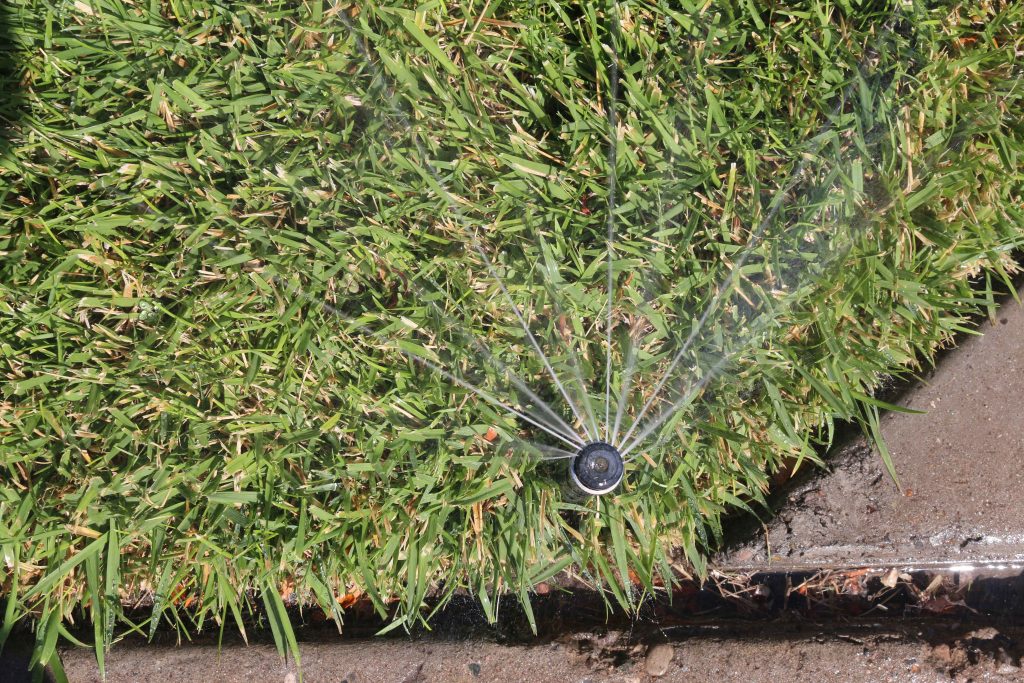
High efficiency rotary nozzle watering a 135 degree angle.
505Outside sat down with local landscape contractor Hunter Ten Broeck, owner of WaterWise Landscapes Incorporated, to chat about Water Harvesting in Albuquerque.
There are two categories of water harvesting techniques: passive water harvesting and active water harvesting. Passive water harvesting is the practice of slowing water down and encouraging it to soak into the ground. Water is collected from the source (roof, canale, downspout, or sloped earth) and directed to the landscape where the water can be immediately used by the plants. Active water harvesting uses rain barrels, cisterns, and other types of containers to store rainwater for later distribution. These typically hold as few as 200 gallons of water up to 10,000 gallons. A good calculation to remember is 1” of rain on a 1000 sq. ft. roof equals about 600 gallons of water.
Hunter
says the key to any type of water harvesting system, whether active or passive,
is to incorporate it into the landscape design. Thinking through how the rain
water will interact with your landscape and designing for that should be first
and foremost.
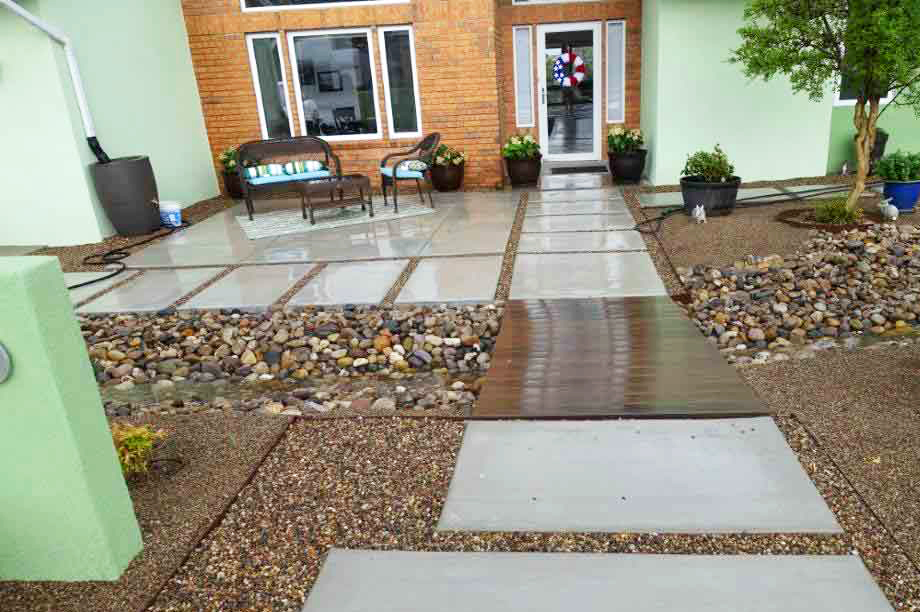
When asked what a homeowner could easily do to start water harvesting in their yard, Hunter recommended starting small and trying passive water harvesting. Passive systems can be as simple as a swale, a French drain (or rock burrito, as nicknamed by his staff), or more complicated systems that include building an underground soil sponge area. He says to start by finding the roof’s downspouts and canals, then provide a catch area underneath them. A catch area could be a concrete splash block or cobbles. Then direct that water away from the home via a cobble swale that runs into a planting area. This can be done easily by digging down a few inches and creating a slope away from the house into the planting area. Once the swale is dug, add cobble on top to stabilize the soil and prevent erosion.
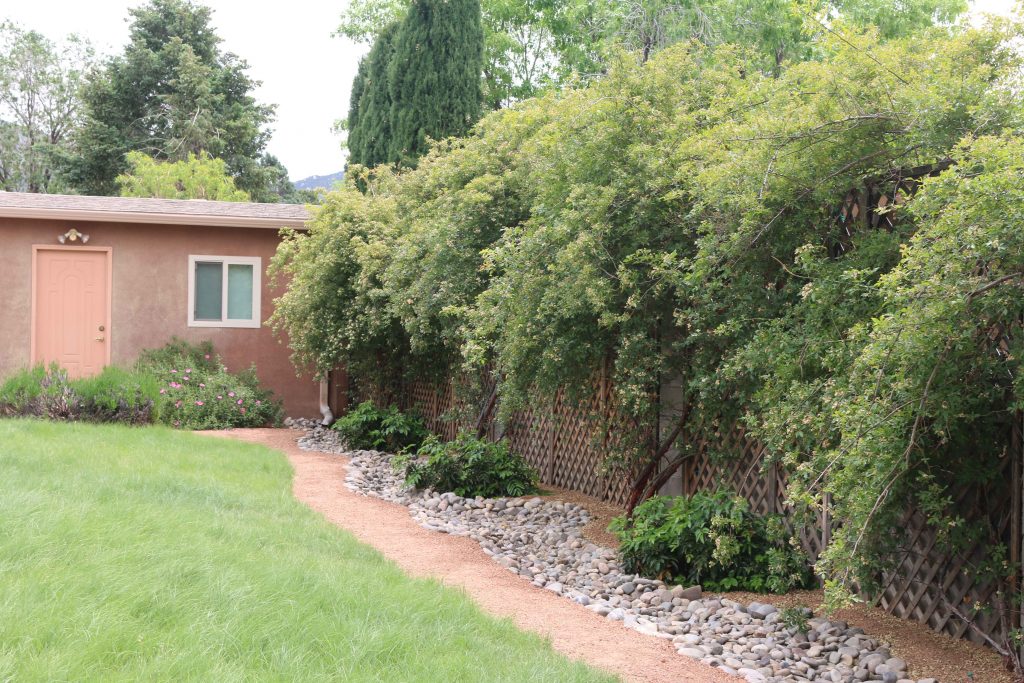
Cobble swale located at downspout next to house.
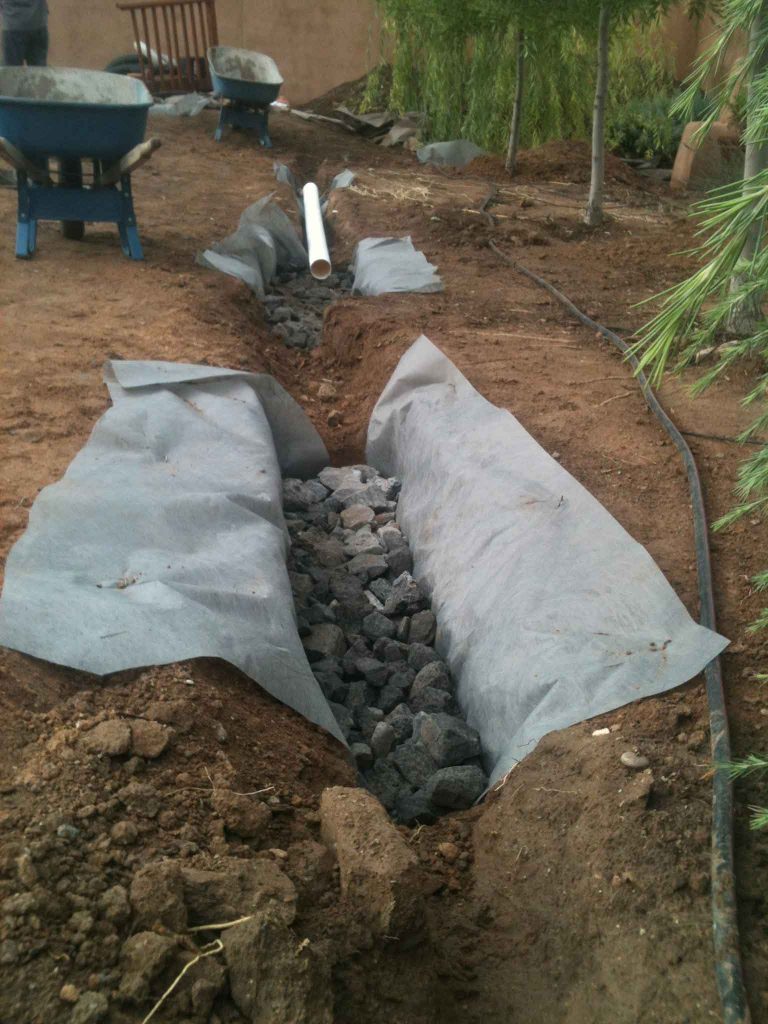
To make Hunter’s “rock burrito” simply dig an 8” wide trench at least 12” deep and as long as necessary for the space. Slope the bottom of the trench toward the drainage area. Layer the trench with filter fabric followed by cobble or rocks. Roll the fabric over the rocks then backfill with soil. This will provide an underground collection area for water. Water will slowly soak into the ground providing moisture to adjacent planting areas.
"Rock Burrito" French drain under construction in an Albuquerque landscape.
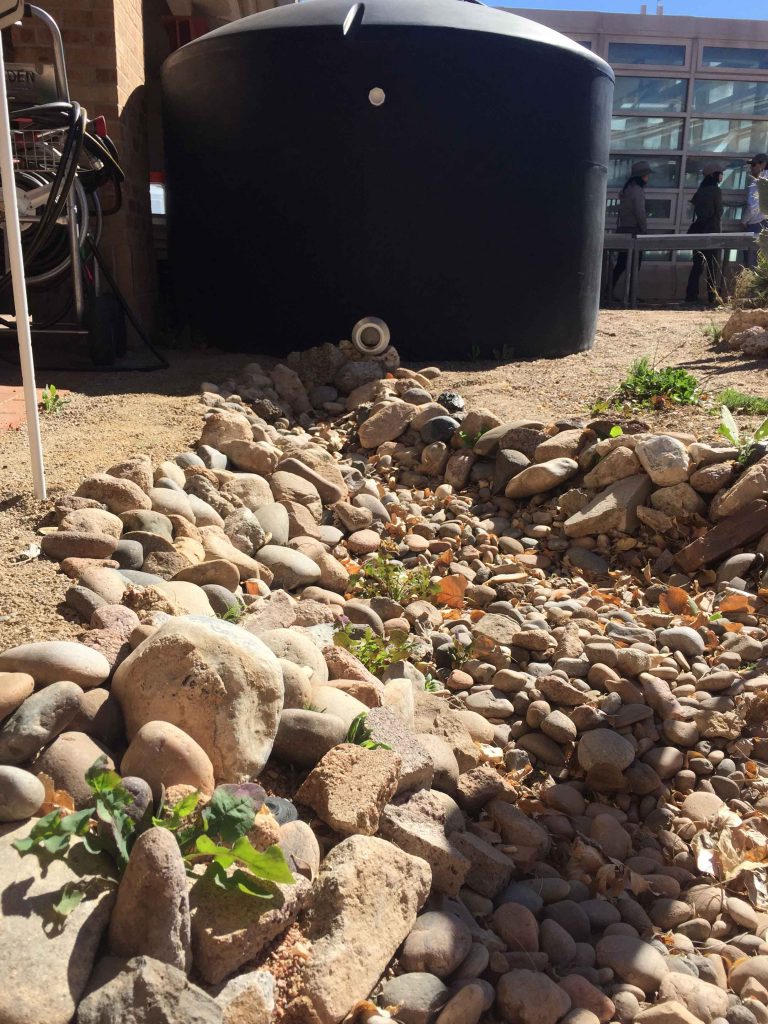
For homeowners who are ready to tackle an active water harvesting system like a rain barrel or cistern, Hunter recommends adding a passive water harvesting system next to the active one for when the container overflows.
Passive water harvesting swale next to active water harvesting cistern.
Using every drop of water through water harvesting is an important feature Hunter incorporates into all his landscape designs.
Local Expert: Hunter Ten Broeck, Landscape Contractor and owner of WaterWise Landscapes Incorporated in Albuquerque, NM. Author: Jill Brown, ASLA Landscape Architect and owner of My Landscape Coach in Albuquerque, NM.
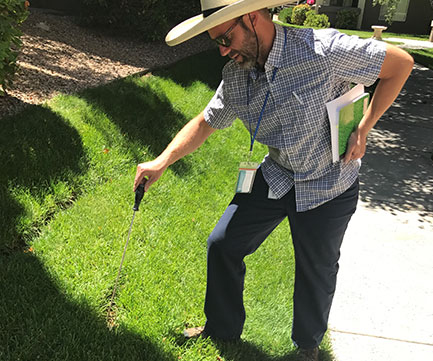
Testing the soil moisture with a long screwdriver.
Use a soil probe or a long screwdriver to test soil moisture. Push the screwdriver into the soil 24 hours after you’ve watered your plants. It will go easily into moist soil. Mark and measure how far it went into the ground. That will tell you how deep you have watered that plant. Every yard is different, but once you figure out how long it takes your watering system to water to certain depths, you’ll be set.
Experienced gardeners in New Mexico know that the key to
success is in the soil. Soils in our climate are highly erosive and without
care will blow away with spring winds or wash out during summer monsoons.
Covering bare soil with mulch is an essential gardening practice with benefits like
reducing moisture loss through evaporation, suppressing weeds, and giving
landscapes a finished appearance. When you use organic mulches (as opposed to a
gravel type mulch), there are even more benefits. Like keeping the soil cool, improving
soil structure, and feeding the soil microbiology that supports plant health.
Despite the benefits, organic mulches continue to be passed
over for gravel in our area. This is due in part to our tendency to mimic the
practices we see around us. But those are not always best practices! This is
also a consequence of several myths that we’d like to dispel.
Before digging into these myths, let’s take a moment to
define the term “organic mulch.” A mulch is a layer of material placed on top
of the soil. An organic mulch is
one that is derived from living matter. The term “organic” in this context has
no relationship to the standards followed to generate the material. Examples of
locally available organic mulches are wood mulch, bark mulch, pecan shell
mulch, and straw. Because organic mulches were once alive, they contain
essential nutrients, minerals, and energy that nourish the soil ecosystem as
they decompose. An important consideration when using organic mulches is to
skip the landscape fabric, which prevents the rich organic matter created by
decomposition from working its way back into the soil.
Myth #1: Organic
mulches rob your soil of nitrogen
This is a common misconception that is easily dispelled.
Organics decompose via microorganisms that use nitrogen as they undergo
explosive reproduction in response to a new food source. This is why we say
that nitrogen gets “tied up” in the soil when unaged composts are integrated.
But therein lies the key. Mulches are not integrated into the soil - they lie
on top of it! By definition, decomposition only occurs on the surface area of
the material being decomposed. Therefore, plant roots do not compete for
nutrients with the microorganisms that are slowly breaking down the organic
mulch to feed the soil below.
Myth #2: You’re going
to attract all kinds of insects and vermin
The cool, moist environment created by organic mulches is
ideal for promoting plant health. Gravel mulches increase the reflective heat
in a landscape and compact the soil, contributing to plant stress. Heat also creates
higher water demand. The cool, moist layer that is so good for plant health
also provides a hospitable environment for insects. But mulch itself is not a
beacon for the insects in the neighborhood to colonize your yard. It simply
provides a more favorable habitat for
what is already there. But this environment also benefits insects and
vertebrates that predate on the undesirable ones. This creates a healthier
ecosystem that supports your plantings. If you have concerns about termites,
rest assured that a mulch layer does not provide the necessary habitat for a
termite colony. A one-foot bare space between organic mulches and your house
will discourage insects from finding their way into your home.
Myth #3: It will all
wash or blow away
If you use the wrong kind of organic mulch in the wrong
place it can migrate. But with a little understanding of different mulch types, this can be avoided. Most wood mulches
available on the market are chipped flat and consistent in shape in size. These
are great in areas that will receive some foot traffic as they compact down to
a firm surface. However, in areas of higher wind exposure or periodic
inundation with water, use a mulch that is more irregularly shaped and sized as
the pieces will hold together better. Mulches made from recycled yard waste and
tree trimmings typically fit this description. Mulches made from bark tend to
be lighter and can have a tendency to migrate more readily. Above all, pay
attention to grades when using organic mulch. Design landscapes so that the finished
grade of mulched areas is below hard surfaces like sidewalks and patios. If you
use organic mulch on a slope make a small berm on top of the slope and dig in
contour swales to prevent the mulch from washing down.
Myth #4: Organic
mulches are more difficult to maintain
Anyone who has wheelbarrowed out a graveled landscape,
sifted it to remove dirt and weeds, and shoveled it back in can tell you that
gravel is not inherently easier to maintain. Gravel landscapes with filter
fabric are designed to be maintained with a regime of consistent weed
management and treatment. If spraying chemicals in your landscape is not your thing, then invest in the right
tools to make weed
management simple. A 3-4” layer of organic mulch is effective in preventing
sunlight from reaching annual weed seeds, thereby preventing weed germination.
The beauty of organic mulches is that they can visually
accommodate a little bit of leaf litter, reducing the need for constant raking
and blowing. A thin top coat of mulch added every other year will keep your
landscape looking fresh and replace the material that has broken down to
sustain the soil. Organic mulches are light weight, too, making them easy to
wheelbarrow and rake around.
Organic mulches are available in bags from most local garden centers, and are available in bulk from several retailers in the Albuquerque area. When you buy from local bulk retailers, you are supporting the recycling of local organic materials that may otherwise end up wasting away in a landfill and contributing to greenhouse gas emissions. Buying bulk also means less plastic! Organic mulches are a renewable resource that will improve your landscape health and help you conserve water.