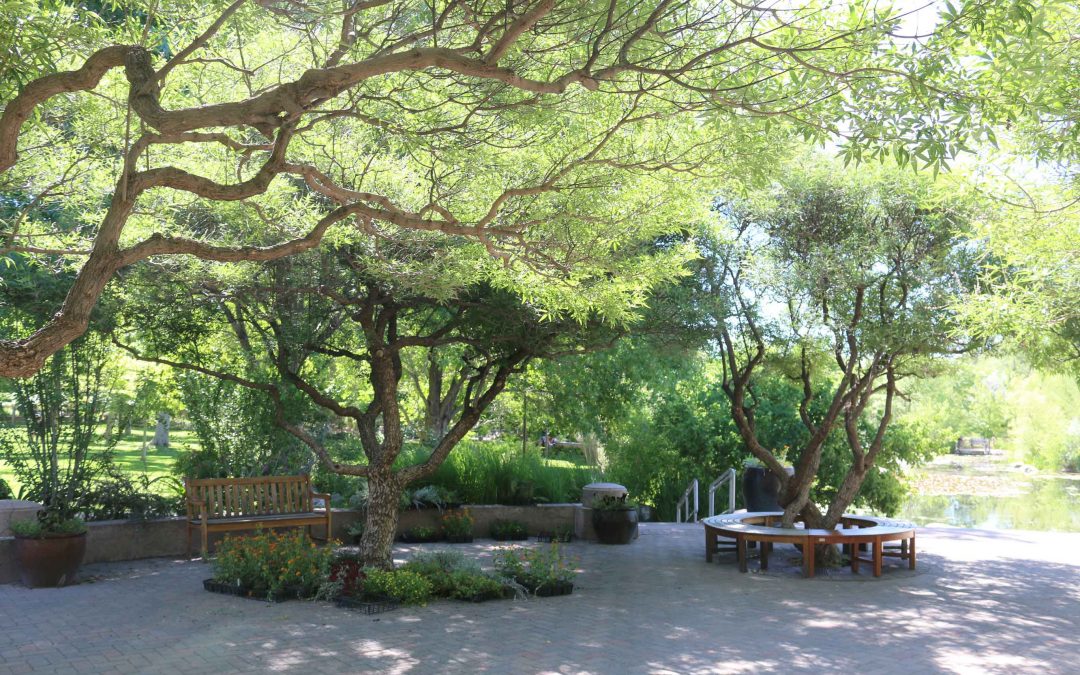
Our urban forest (yes, the trees in your landscape are part of a forest) provides so many benefits too us – cooling, increased home values, beauty, and better mental health just to name a few.
Here’s what you can do to help keep your members of our urban forest as healthy as possible.
1. Water your trees to a depth of about two feet, because 95% of the tree’s roots are in the first two feet of soil. To check if you are getting down to that two-foot optimum, insert a long screwdriver or soil probe into the soil around your tree a day after watering to determine the depth the water has reached. Adjust your watering time, if needed, to reach that two-foot goal.
2. Water your trees a little inside and outside of the canopy edge (the outer ring of the tree’s leaves) because that is where the roots that take in water are located.
4. Check your trees for signs that they aren’t getting enough water: wilted leaves early in the morning, scorched leaf edges, twig die-back from the top down or a sparse leaf canopy.
5. Take advantage of rainwater by directing downspouts or canales toward existing trees. Consider planting new trees in lower areas to take advantage of captured moisture.
6. Surround your trees with 4-6 inches of organic mulch. Organic mulch helps to retain soil moisture, keeps soil temperatures more consistent, and keeps weeds out. Additionally, over time it loosens compacted soil, adds organic matter, and slowly adds nutrients to the soil. Note: organic mulch does not include bark (sometimes called ‘bark nuggets’ or ‘deco bark”). Use actual wood chips like what comes out of an arborist’s woodchipper. Many tree services offer wood chips for free and several local businesses sell wood chip mulches in bulk.
Author: Amos Arber, ASLA, ISA Xeriscape Incentive Inspector with the Water Resources Division for the Water Authority. Have a question about the article [email protected]
The amount of water needed and where that water should be applied changes as woody plants (such as trees, shrubs and vines) get larger. Woody plant material has two types of roots, stabilizing roots and feeder roots. Both types of roots do just what their name implies. Stabilizing roots are thick and dense to keep the plant in place and support its weight. Feeder roots are super fine and grow more like a net to take in water and nutrients. Feeder roots expand out as the plant grows.
Some woody plants require more water as they mature, but more desert-friendly species may not require extra water or may even be able to survive without supplemental irrigation once established. Perennials normally do not need to have expanded watering the same way woody plants do as they mature.
Some examples of this:
Plant Type
Plant
1st summer
2nd summer
3rd summer
Tree
Desert Willow (Chilopsis linearis)
60 gallon per month
120 gallons per month
400 gallons per month
Shrub
Butterfly Bush (Buddleia davidii)
60 gallon per month
70 gallon per month
100 gallon per month
Desert-Friendly Shrub
Chamisa (Ericameria nauseosa)
20-30 gallons per month
20-30 gallons per month
Usually possible to remove from irrigation
Vine
Trumpet Vine (Campsis radicans)
40 gallons per month
60 gallons per month
100 gallons per month
Woody Groundcover
Prostrate Sumac (Rhus trilobata)
20-30 gallons per month
40 gallons per month
60 gallons per month
For those plants that do have increased irrigation needs as they mature here are three easy ways to apply the right amount of water in the right place depending on the type of irrigation you are using.
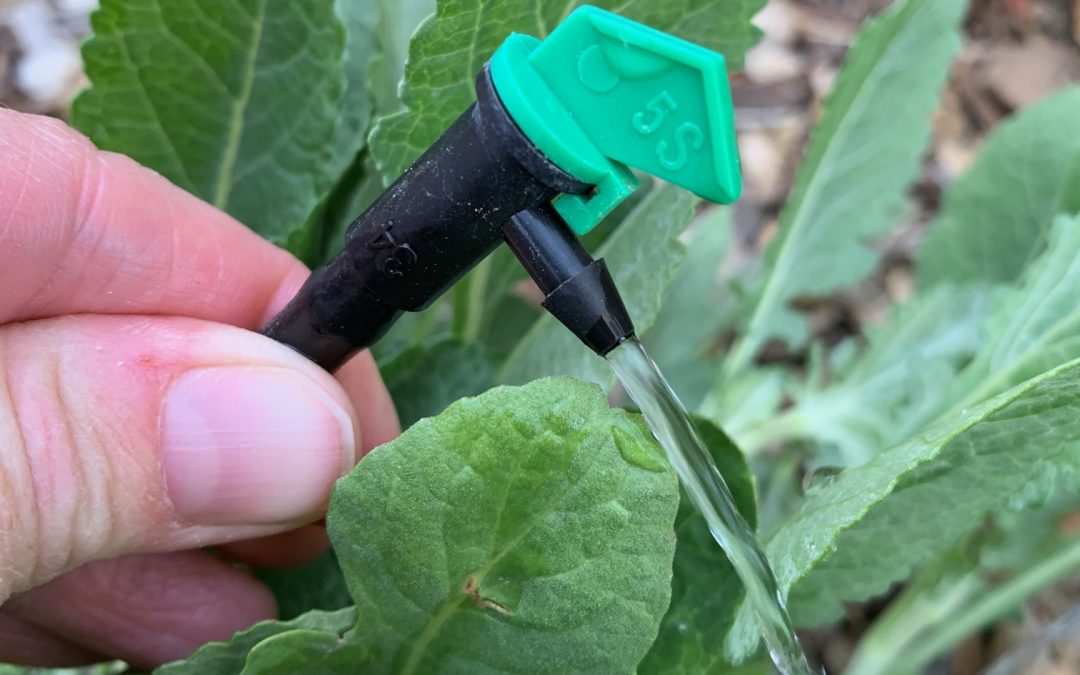
Drip Emitters – Move the drip emitters out to stay in line with the outer edge of the plants leaves where the feeder roots will be. Increase the number of emitters watering the plant too, placing them evenly around the outer perimeter of the plant.
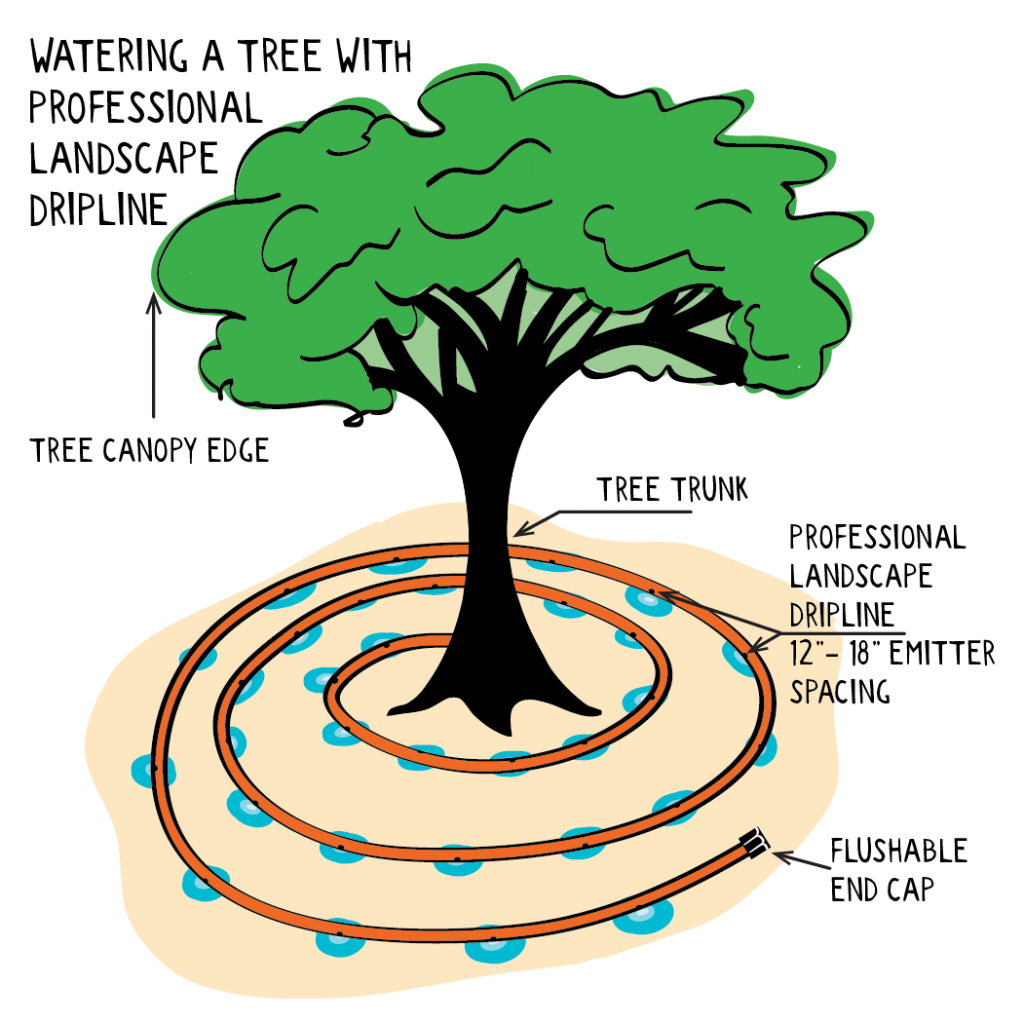
Netafim (in-line professional drip line) – this is typically installed in rings around the plant and additional rings can be added as the plant grows larger. Netafim can also be laid out in a grid pattern, particularly when being installed around an already established plant.
Hand-watering – Build and maintain a watering well at the outer edge of the plant perimeter. As the plant grows, increase the size of the well.
Author: Richard Perce, Irrigation Efficiency Specialist with the Water Resources Division for the Water Authority. Have a question about the article [email protected]
Trees are incredibly valuable and provide a wide array of
benefits, from increasing home values to improving mental health.
Unfortunately, Albuquerque has suffered large losses of trees in the past
decade. It’s more important now than ever to take care of your existing trees.
A common sight on spring evenings is seeing people with
their thumb on the hose, spraying the trunk of a tree. While it’s great to see
people caring for their trees, there is a better way to water them.
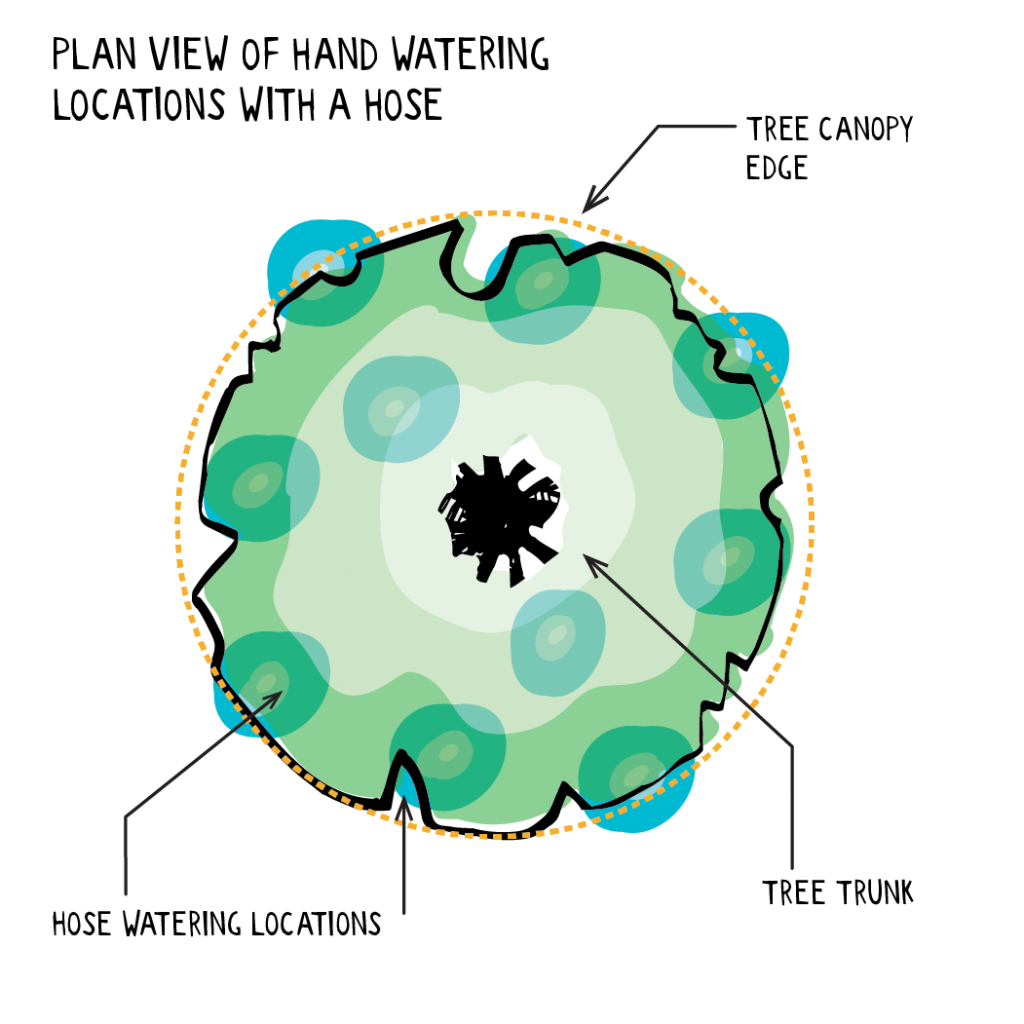
Trees have several different types of roots that serve different functions. Fine hair feeder roots are responsible for taking up water. Because these feeder roots are generally located near the tree’s canopy edge, this is where you want to apply water: a little inside and a little outside of the canopy edge.
TREE WATERING TIPS:
1. Hand watering
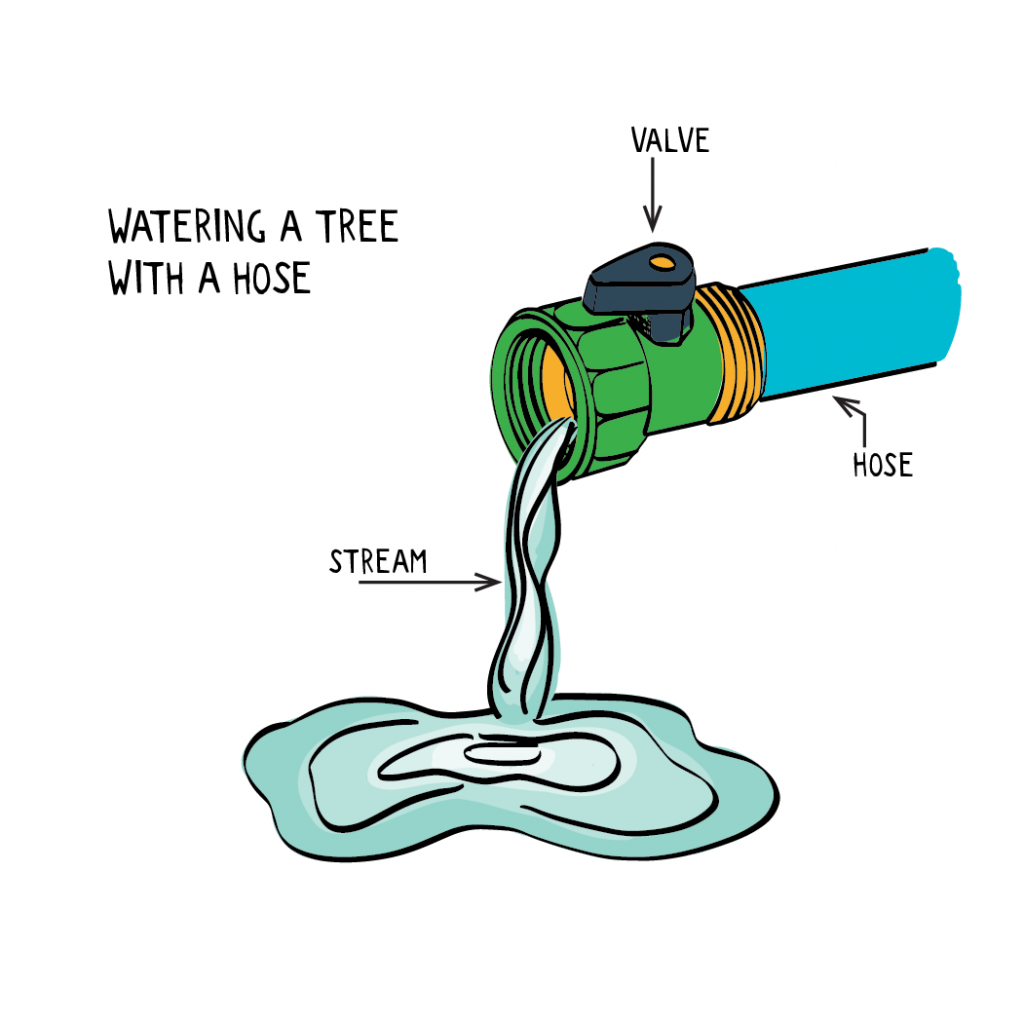
Turn your hose to a low flow or fast drip, so the water soaks into the soil before running off (try a hose end shut off valve). Set a timer and move the hose to different locations every 20 minutes starting 5 feet from the trunk to just outside the canopy edge. Small to medium trees will require watering at between 12 and 20 locations. Larger trees may need to be watered in sections over a few days.
2. Drip irrigation on desert friendly xeriscape
Growing healthy trees in a desert friendly xeriscape is possible using drip irrigation such as flag emitters. As trees grow, they require more resources in the form of soil rooting space and water. That means that as trees become established, drip irrigation emitters need to be shifted away from the original rootball (at the time of planting) out to the edge of the tree’s canopy. Additionally, the number and size (volume) of emitters needs to be increased as the tree grows. Most people don’t make these adjustments. Consider these strategies instead:
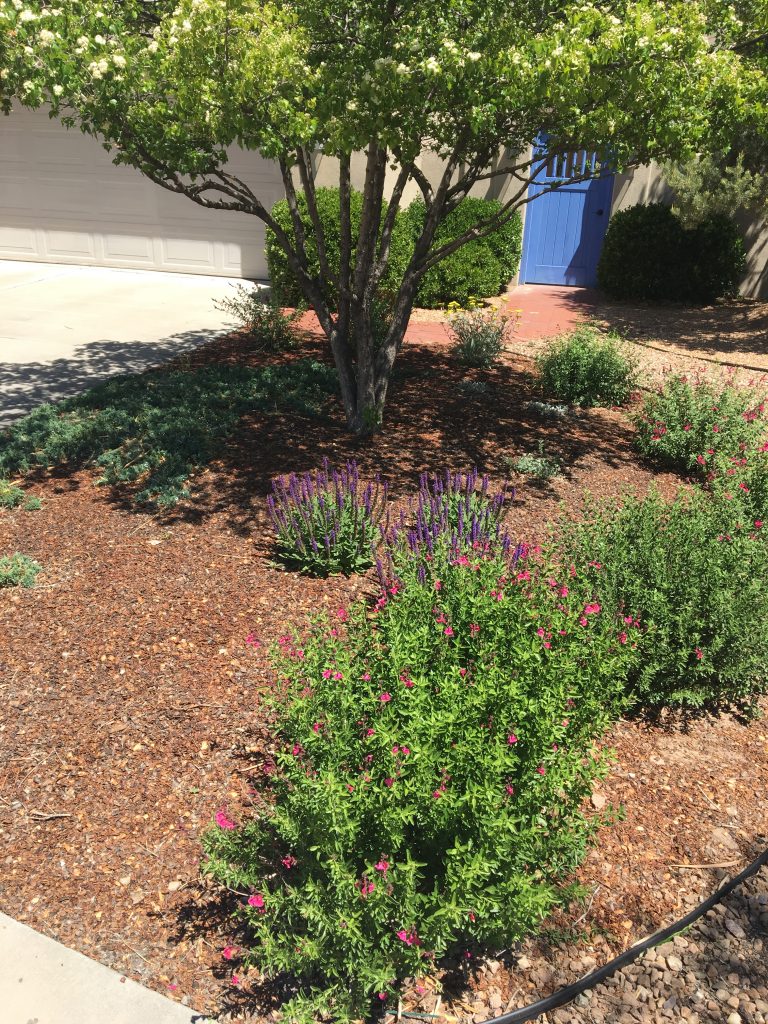
Plant an understory of groundcovers or flowering perennials within and beyond the tree’s canopy. The emitters used to water the groundcover plants will, in turn, water the tree. As the tree becomes larger it may eventually shade out the groundcovers, but the emitters should be kept in place to continue watering the tree.
Consider supplemental watering by hand in dry areas of your yard that are not covered by the drip irrigation system.
A similar strategy is to use professional landscape drip line (often referred to as netafim) in a grid or spirals in and outside of the tree’s canopy. This irrigation material requires less frequent maintenance and can be installed under mulch. As the tree matures, the drip line can be expanded and shifted to support the increasing needs of the tree. Understory plantings can also be used with this type of irrigation material.
3. Using sprinkler irrigation to water trees in a grass lawn
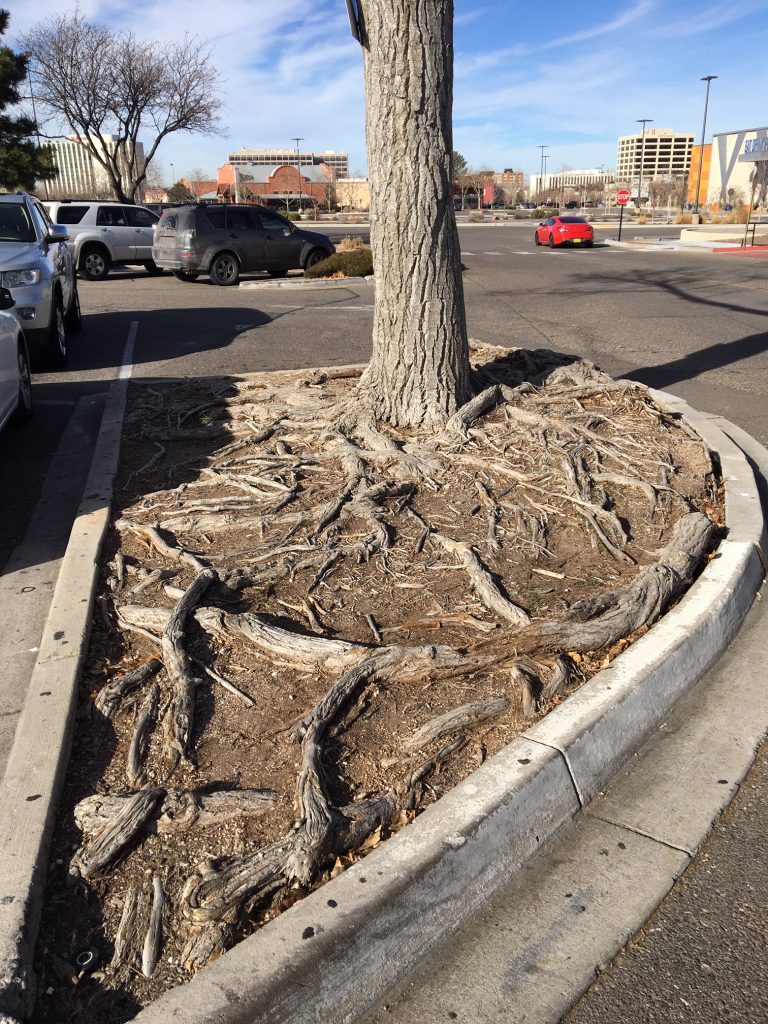
Most lawns in our area require nearly 40 inches of yearly irrigation to look good. So, it makes sense to plant a tree in the lawn to take advantage of all that water. Most of the large, beneficial trees in our city parks are grown like this. However, some species (like cottonwoods) respond to the shallow and frequent lawn irrigation by making shallow roots that protrude above the surface. These surface roots create tripping hazards. Damage to the tree can result from lawn mowers, too. Shallow roots also make the tree more susceptible to drought stress. Encourage tree roots to go deeper by occasionally (one-two times per month) running the lawn sprinklers for three or more cycles for a longer period. This will help to get water down deep, where it will remain in the soil longer and encourage roots to move deeper. Occasional deep watering in lawns also has the added benefit of flushing out salts accumulated from hard water and fertilizer.
Example of exposed surface roots. Author: Amos Arber, ASLA, ISA Xeriscape Incentive Inspector with the Water Resources Division for the Water Authority. Have a question about the article [email protected]
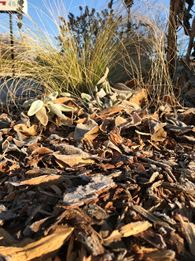
Shredded woodchip mulch helps soil hold moisture and insulates plant roots on a frosty November morning. Photo credit M. Thompson.
One of the most frequent questions we get at NMSU Extension is, “Should I add fertilizer or amendments to the soil when planting?” The short answer is no. And the long-term answer is an even stronger no.
Soil amendments are materials that are
worked into the soil with the intention of improving soil physical qualities. But
it’s just not that simple. As City of Las Cruces Community Forester Jimmy
Zabriskie said when I asked if he ever recommends using soil amendments when
planting a tree, “Save your money for mulch.” Organic
mulch is
material that sits on top of the soil, providing an insulation layer that helps
control soil temperature, retain moisture, and suppress weeds.
When planting ornamental plants, the
recommended species are the ones with roots that are well adapted to our native
soils. They’re more likely to live long, sustainable lives in our native soils
without amendments. The bottom line: Always put the same soil you dug up right
back into the hole with the new plant, and top dress with a thick layer of
mulch.
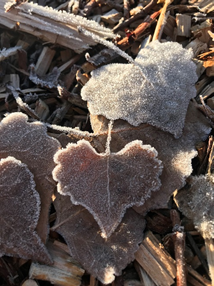
Frosty cottonwood leaves add a nice layer on top of several inches of shredded woodchip mulch. Photo credit M. Thompson
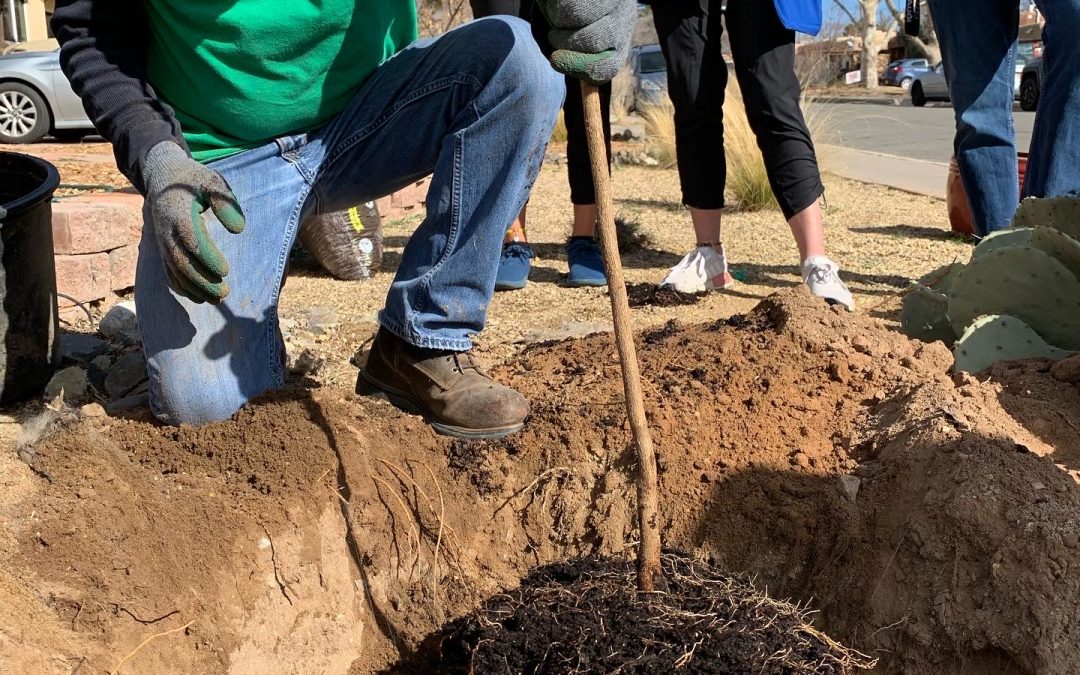
As for fertilizers, slow and steady wins this race. As Albuquerque City Forester Joran Viers said recently at a tree planting demo put on by Tree New Mexico and The Nature Conservancy, it helps to think of our trees (and other plants) as marathoners, not sprinters. When fertilizer is applied to trees, they can grow too fast for their own good and are more likely to develop structural problems and other issues. Fertilizers are not recommended at the time of planting perennial plants, either, because we want the plant’s energy to go into root establishment at a healthy rate to support the aboveground growth. The growth hormones necessary for healthy root development are found in the root tips and are made by the plant itself, so adding root stimulator to living roots is not necessary or even helpful. (Side note: Rooting hormone is potentially useful when you’re trying to get roots to grow quickly from cuttings where the roots have been removed completely.) So hold off on fertilizing for at least a few years while your plants are setting down roots.
Research on all sorts of landscape plants has shown that by adding amendments (like organic matter or perlite) to your soil backfill, the initial, short-term results are good. But the interface between the amended soil and the native soil is bad news. Water doesn’t move well across the interface, and neither do roots. With time, the roots may be inclined to stay in the original planting hole and spiral around, so you end up with essentially a potted tree or plant with reduced growth rate, constant water and nutrient stress (because lateral roots never fully developed), heightened vulnerability to pests and diseases, and even an increased falling hazard (think root ball in socket).
Author: Marisa Thompson, PhD, is the Extension Horticulture Specialist for New Mexico State University and is based at the Agricultural Science Center at Los Lunas. For more gardening information, including decades of archived Southwest Yard & Garden weekly columns, visit the NMSU Extension Horticulture page (https://desertblooms.nmsu.edu/), , follow us on social media (@NMDesertBlooms), or contact your County Cooperative Extension office (https://aces.nmsu.edu/county).
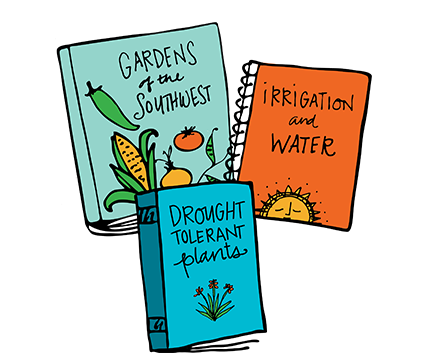
We scoured the internet, met
with local experts, and pulled together a great educational resource list for you.
When you’re ready to dig into all there is to know about landscaping in New
Mexico, these resources are ready for you.
Agaves, Yuccas and Related Plants. Mary Irish, Portland
Oregon: Timber Press, 2000.
A Field Guide to the Plants and Animals of the
Middle Rio Grande Bosque. Jean-Luc Cartron, David Lightfoot, Jane
Mygatt, Sandra Brantley and Timothy Lowrey, Albuquerque, New Mexico: University
of New Mexico Press, 2008.
Landscaping with Native Plants of the
Southwest. George
Oxford Miller, Minneapolis, MN: Voyageur Press, 2007
Native Plants for High-Elevation Western
Gardens. Janice
Busco and Nancy R. Morin, Golden, Colorado: Fulcrum Publishing, 2003.
Natural by Design. Judith Phillips, Santa
Fe, NM: Museum of New Mexico Press, 1995.
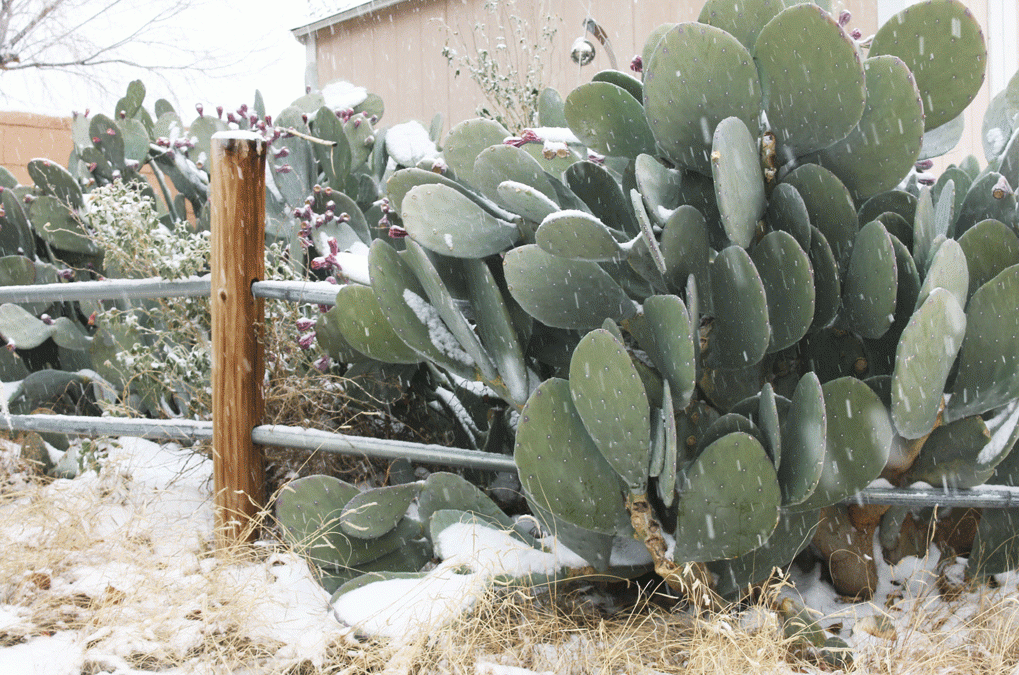
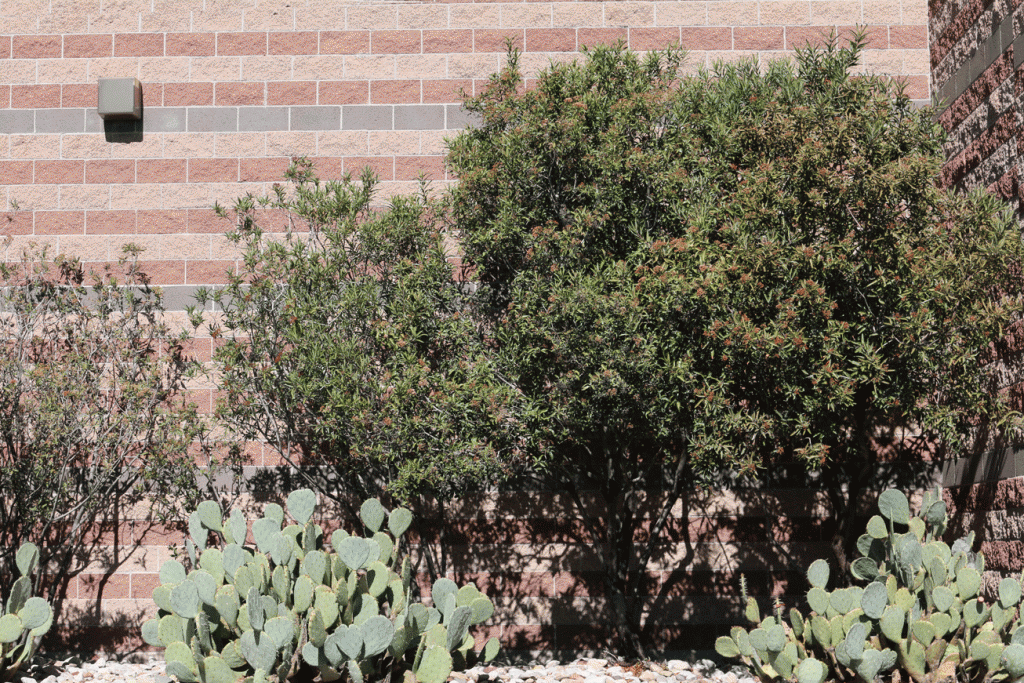
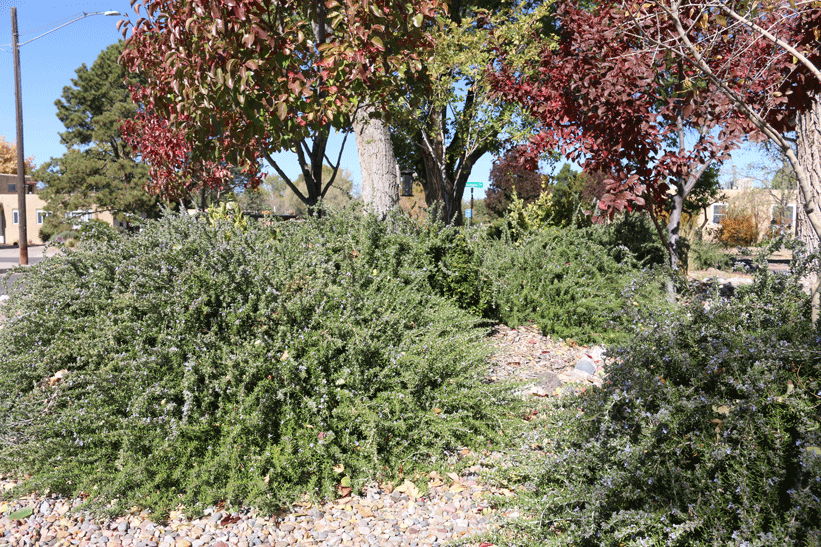
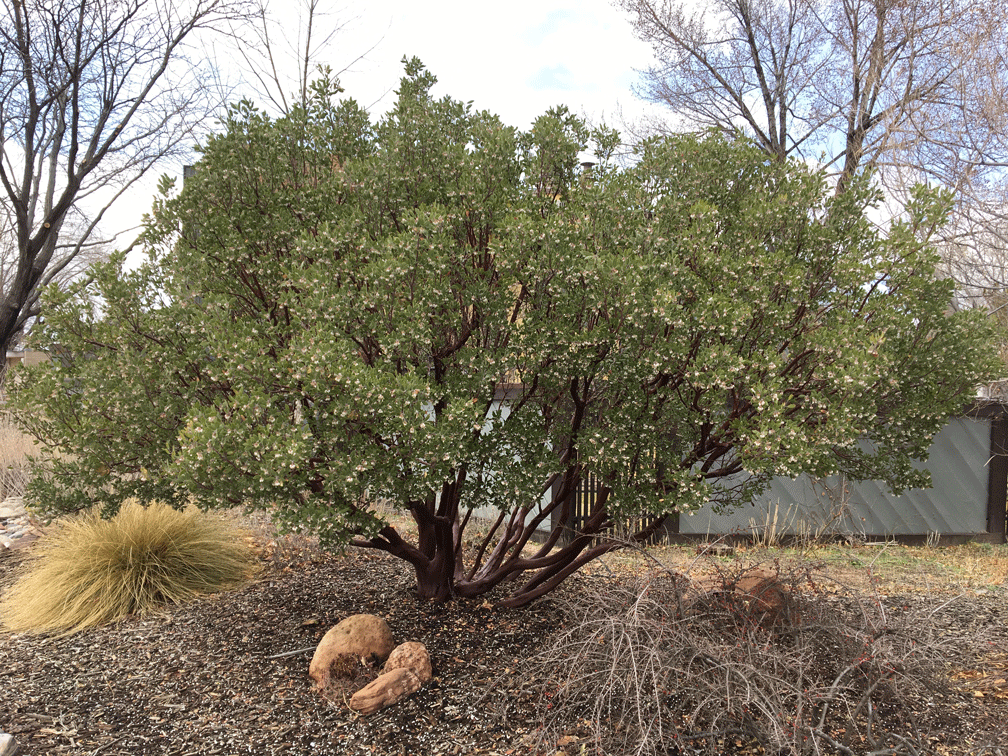
When we think of the word evergreen, many of us think about pine trees, cedars and junipers. However, an evergreen is simply any plant that remains green all year long. These plants are welcome fixtures in our winter landscapes, too. 505Outside highlights these essential elements of the greater Albuquerque area landscape by asking local plant experts which ones they love. Below are some of their favorites.
When the last of the yellow and purple perennial colors fade away in the fall, these (and other) evergreen plants provide the structure that holds landscapes together through the winter months. Don’t forget to include evergreen plants in your landscape for year-round interest.