Having a healthy and functional (and desert friendly) landscape is about making smart horticultural and irrigation decisions. Burqueños know that water conservation is a way of life -- and an important responsibility in this beautiful high-desert region. By working together, we can continue to ensure a reliable water supply and keep Albuquerque landscapes colorful and beautiful.
Watering your yard efficiently is one of the
best and easiest ways to conserve water. More importantly, proper watering will
keep your plants healthy throughout the year. The trick is to give your plants
enough water – but not too much.. Fortunately, improvements in irrigation
system technology are making it easier to do just that – and the Water Authority is
rolling out new rebates in April to help you add the latest in irrigation tech:
WaterSense Smart Irrigation Controllers
WaterSense-labeled controllers allow watering schedules to better match plants' water needs.
A WaterSense labeled controller can automatically or
manually reduce watering times or the number of days when the system operates.
That means less water is delivered to the plants during cooler months or when
it has rained recently. As outdoor temperatures increase or rainfall decreases,
WaterSense labeled controllers increase irrigation systems’ watering run times
or schedule to compensate. Some of these controllers are equipped with smartphone
friendly irrigation technology that allows the user to set watering times
remotely. Replacing a standard irrigation timer with a WaterSense labeled
irrigation controller can save up to 30% in outdoor watering. Customers can choose from a list of pre-qualified
controllers.
Smart Water Application Technology Irrigation Flow Sensors
Irrigation flow sensors measure the speed
at which water travels through an irrigation system and sends that information
to the Smart Irrigation Controller. This helps detect issues and conserves
water. For example, if water is flowing at an unusually high rate (because of a
line break or broken sprinkler), a flow sensor works with the controller to
take corrective action. Such action could include stopping the water flow or
sending alert messages to your device. Additionally, some flow sensors can
quantify how much water is used in a landscape, making it easier to stick to a
landscape water budget.
Smart Water Application Technology Pressure Regulators
Pressure regulation devices
increase the efficiency and performance of your sprinkler and drip system by
reducing the water pressure to a set, optimal rate. This is important to
improve water distribution uniformity and avoid underwatering or overwatering.
The three most common pressure regulating devices are pressure reducing valves,
flow control valves and pressure sustaining valves.
These devices provide pressure regulation at each individual spray head. The sprinkler body is the exterior shell that connects to the irrigation system piping and houses the spray nozzle that applies water on the landscape. WaterSense labeled spray sprinkler bodies with internal pressure regulation can reduce water waste by providing a consistent flow at the sprinkler nozzle. When the sprinkler body maintains pressure near its optimal operating pressure, the connected nozzle is better able to generate the right amount of water spray and coverage for more uniform distribution of water across the landscape. Customers can choose from a list of pre-qualified spray sprinkler bodies.
We scoured the internet, met
with local experts, and pulled together a great educational resource list for you.
When you’re ready to dig into all there is to know about landscaping in New
Mexico, these resources are ready for you.
Agaves, Yuccas and Related Plants. Mary Irish, Portland
Oregon: Timber Press, 2000.
A Field Guide to the Plants and Animals of the
Middle Rio Grande Bosque. Jean-Luc Cartron, David Lightfoot, Jane
Mygatt, Sandra Brantley and Timothy Lowrey, Albuquerque, New Mexico: University
of New Mexico Press, 2008.
Landscaping with Native Plants of the
Southwest. George
Oxford Miller, Minneapolis, MN: Voyageur Press, 2007
Native Plants for High-Elevation Western
Gardens. Janice
Busco and Nancy R. Morin, Golden, Colorado: Fulcrum Publishing, 2003.
Natural by Design. Judith Phillips, Santa
Fe, NM: Museum of New Mexico Press, 1995.
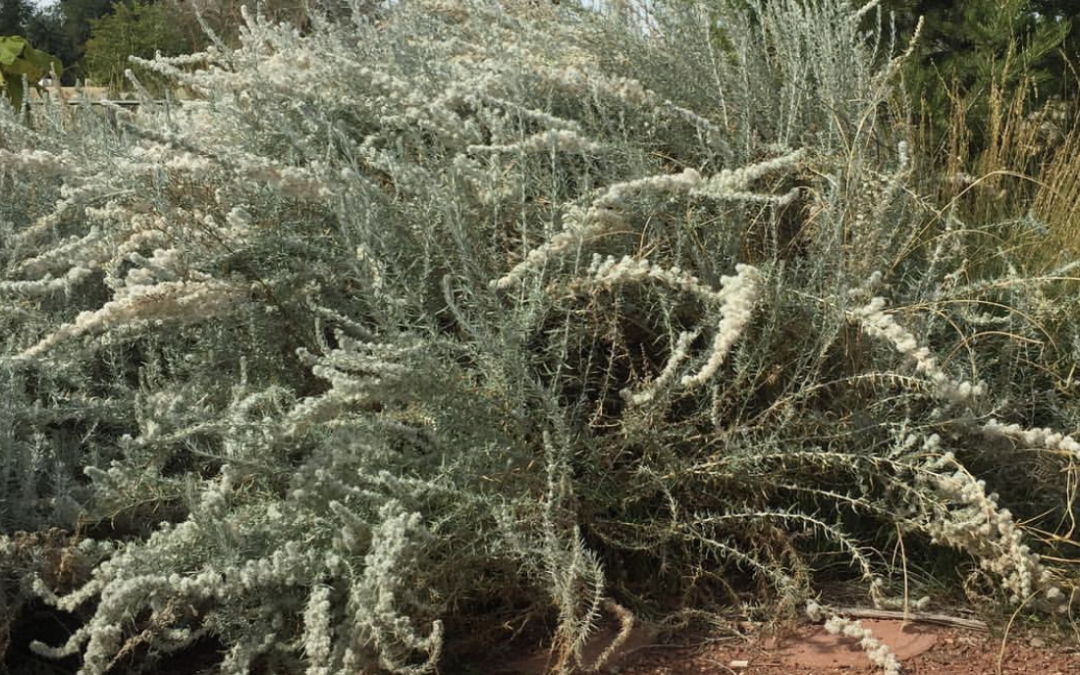
This native,
evergreen shrub has a fibrous root system with a deep penetrating taproot which
makes it a good choice for erosion control. Winterfat attracts birds and its
ornamental seed heads are a point of interest in dried arrangements. Male and
female flowers grow on the same plant but are arranged separately and bloom
from mid-spring to summer.
When warmer days set in, you
may be inclined to water your landscape, but this winter continues to
bring much needed precipitation to meet the needs of your landscape. No need to
water this month!
Per our Winter Watering Recommendations, your yard is still getting enough water to meet your plant’s needs. Remember, if it rains more than a half inch or snows more than 6 inches at least once per month during winter season, there’s no need for supplemental irrigation.
Monthly Service Tip:
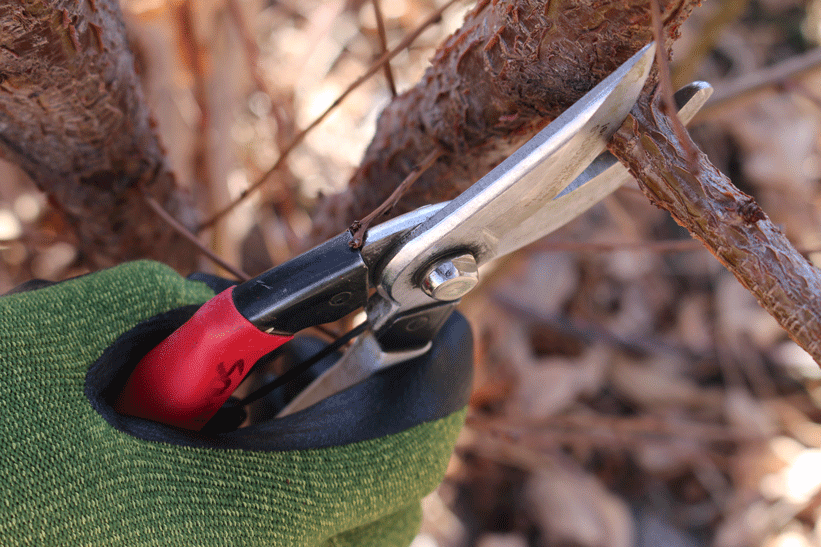
Late winter is the best time to prune trees, Treebates available. They’re dormant and it’s easier to identify which branches need trimming (no leaves). Tree pruning cuts don’t heal like cuts on our skin, though. Tree cuts seal naturally both internally and externally, as long as the cut is well made and doesn’t nick the branch collar. Cuts made flush against the trunk are bad because they cut into the branch collar, making the plant unable to seal the wound on its own. Pruning sealants are no longer recommended because they keep the wound moist underneath and increase the chances of rot by trapping pathogens there.
Recommended pruning techniques
continue to change with new research. Keeping up with the newest guidelines
translates to better tree care. The late Dr. Al Shigo, biologist and plant
pathologist with the U.S. Forest Service, once said, “People who prune the
old-fashioned way should be made to go to an old-fashioned dentist.”
Using the right tools for pruning is key. How do you know if you’re using the wrong tool? If you’re using two hands to squeeze your pruning shears as hard as you can, or your thigh to brace one arm of long-handled loppers, you’re using the wrong tool! Move up to a larger size implement. Here’s a literal rule of thumb: if the branch diameter is the size of your thumb or smaller, hand pruners with a sharp blade will work. Lopping pruners are great for making cuts on branches up to 2 inches in diameter. For anything larger than 2 inches, it’s time to pull out the pruning saw.
Author: Marisa Thompson, PhD, is the Extension Horticulture Specialist for New Mexico State University and is based at the Agricultural Science Center at Los Lunas.
For more gardening information, including decades of archived Southwest Yard & Garden weekly columns, visit the NMSU Extension Horticulture page (https://desertblooms.nmsu.edu/), follow us on social media (@NMDesertBlooms), or contact your County Cooperative Extension office (https://aces.nmsu.edu/county).
In the past 20 years, 14 of those years have been drier than normal, and six years wetter than normal.
Temperature
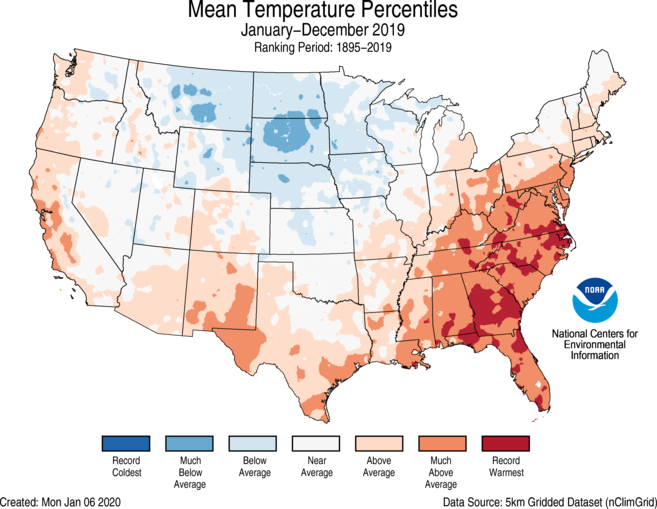
In 2019 New Mexico was warmer and drier than normal! 1.6 degrees above normal. This ranked in the 20th warmest on record for New Mexico.
The
average temperature for Albuquerque was
57.5°, which was 0.4° above the 30 years (1981-2010) normal of 57.1°.
The average contiguous U.S. temperature was 52.7°F, 0.7°F above normal. This ranked in the warmest third of the 125-year period of record.
Precipitation
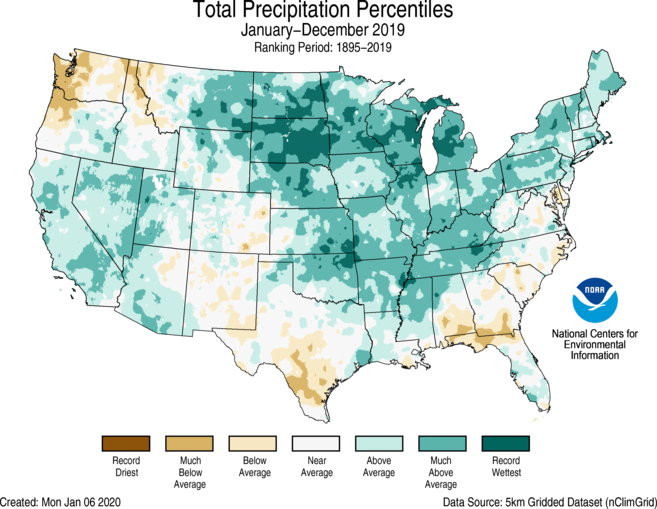
Average precipitation for New Mexico was 0.52 inches below normal for the year but the 2.2” of rainfall in November made it the 2nd wettest November ever recorded.
In Albuquerque, the range of rainfall by zip
code is between 8-12 inches. The total precipitation for the Albuquerque area in all zip codes was
10.8” in 2019. A good year for Albuquerque and it shows in conservation efforts!
Above-average annual precipitation was observed across much of the nation. Many northern states had their wettest year on record, with much of the central U.S., northeast and parts of the west experiencing above- to much-above-average precipitation.
Conservation Highlights
How did Water Authority customers do this year to conserve our most precious resource? Excellent!
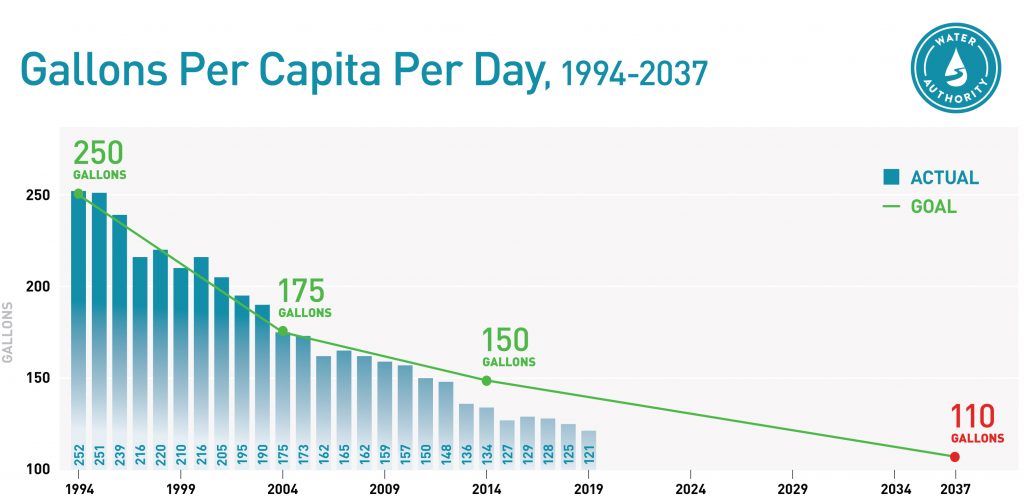
In 2019, customers used approximately 700 million fewer gallons than last year. 2019 per capita usage is 121 GPCD (Gallons Per Capita Per Day), that’s 4 GPCD less than last year (125 GPCD in 2018). Thank you for your continued action in helping us make progress toward reaching our conservation goal of 110 GPCD by 2037.
Customer Incentives (Rebates)
In
2019, the Water Authority returned $700,000 to customers through the rebate
programs. Just over half of that went to customers who replaced 450,000 square
feet of high-water use turf with a desert friendly xeriscape. To find out more
about rebates, visit https://www.505outside.com/rebates/residential/.
Adding Trees
Trees are a priority for
the Water Authority conservation program because of their many environmental
benefits and the unique role they play in landscapes. In 2019, customers planted
approximately 1,000 trees with the “Tree-Bate” program, which also helps
customers pay for tree care. Albuquerque customers have planted more than 3,500
trees in just three years! Additionally, the Water Authority Conservation
Program provided $60,000 for tree planting in city and county parks and open
spaces. That’s enough to plant an additional 225 trees per year.
Water Use Compliance
Water waste continues to improve from previous years! In 2019 the conservation department issued 732 Water Waste Warnings that resulted in only 77 violations. Thank you for servicing your irrigation system!