Water flowing from the Southside Water Reclamation Plant is so clear that a person can see rocks at the bottom of the riverbed, and the Albuquerque Bernalillo County Water Utility Authority is trying to make that outflow a better habitat for fish and more accessible to hikers, joggers, bikers and anglers.
The water reclamation plant is where Albuquerque’s wastewater comes to be treated for reuse. Some is used as reuse water in sprinkler systems, while some is thoroughly cleaned and released into the Rio Grande. The outflow puts about 55 million gallons per day into the river, said Diane Agnew, water rights program manager with the Water Authority.
The water has low sediment and a nice temperature — so fish really like to swim there, she said. As a result, fisherman come to enjoy it, too.
“People love to fish right here,” Agnew said. But the outflow could be better. That’s the idea behind the treatment plant outflow restoration project, which aims to improve water quality, increase community and maintenance access, and rehabilitate the flood plain. The design is complete, and the restoration project is permitted but still needs $2.5 million in additional funding to build.
The total cost for planning, permitting, design and construction will be $6.6 million, and the project has already received some funding from the state Legislature, the Office of Natural Resources Trustee and the Water Trust Board.
“We designed this using historical flow data in the Rio Grande, so we know that with the designed flows, we will get the number of days that the fish need for spawning,” Agnew said.
The project is trying to make the outflow a better habitat for fish, especially the endangered Rio Grande silvery minnow.
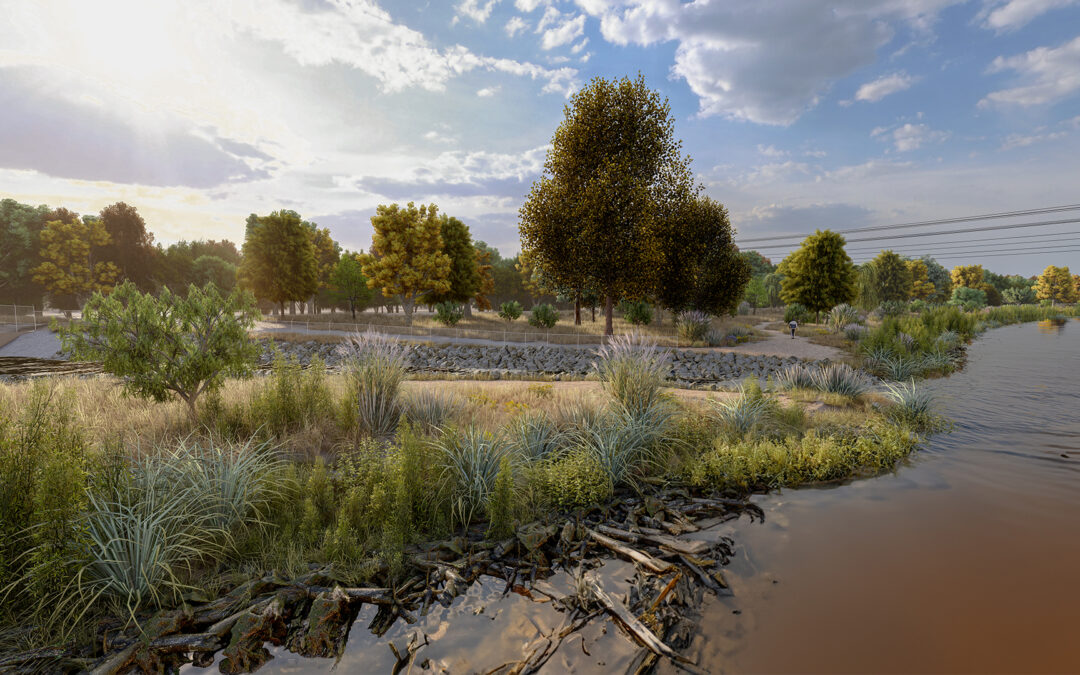
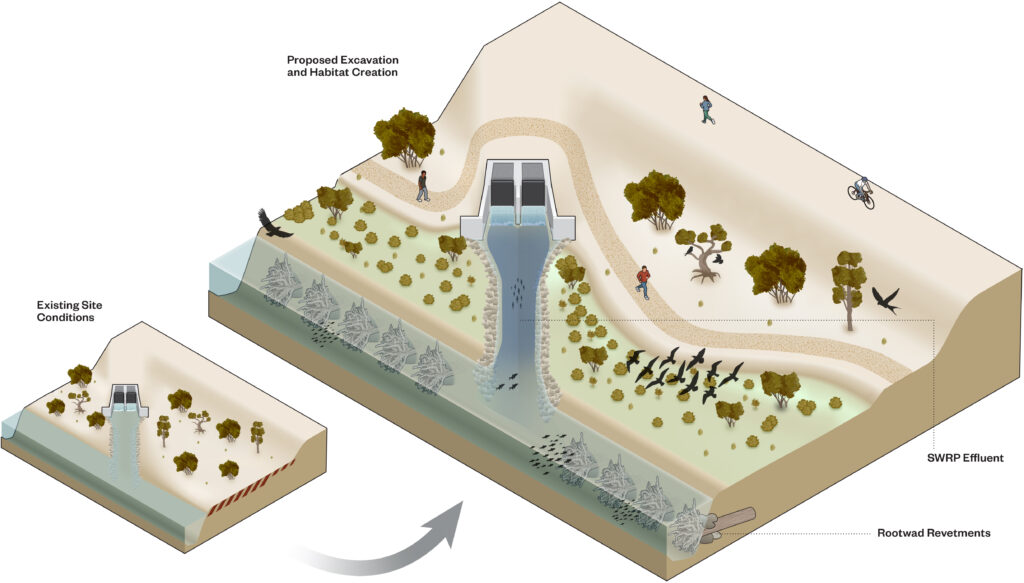
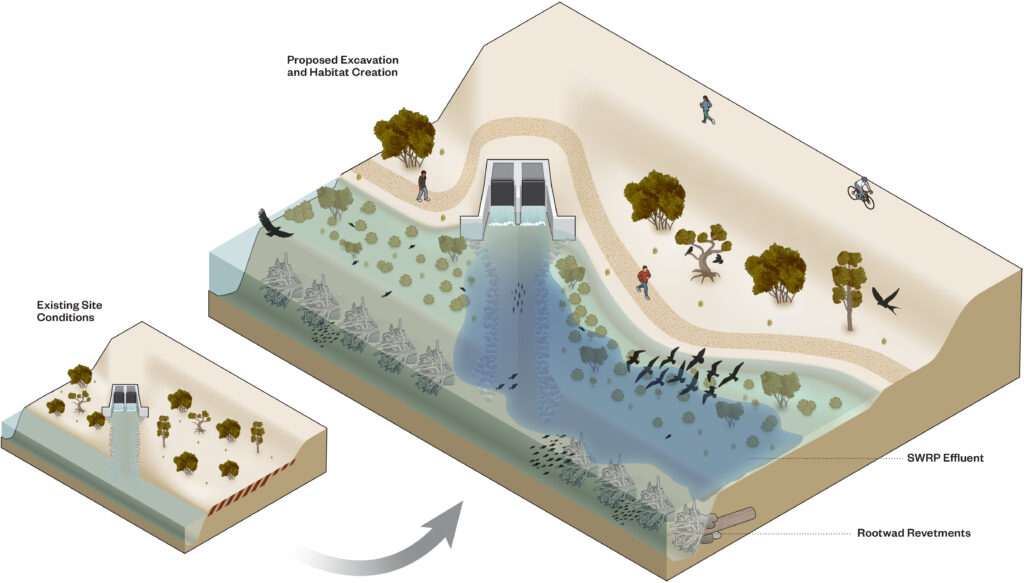
At present, the bank is steep with a roughly 2-foot drop to the river. The restoration project will turn the bank back into a flood plain, where water can wash over the bank, depositing ground water, watering native plants and making the space more appealing to fish and safer for anglers.
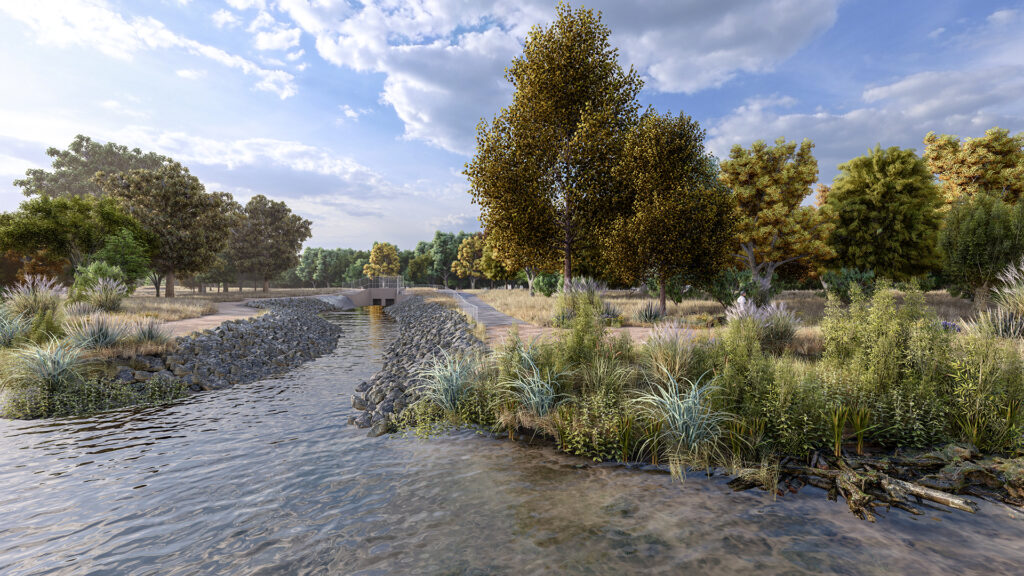
“Not only are we creating a flood plain terrace where the water will come up onto it, we’re putting in these bioengineering features called rootwad revetments. So, we’re taking trees that were already dead, and we’re going to cut them and turn them around so their roots stick out into the stream. And that creates stream stability, so that we won’t get as much erosion and we’ll get less sediment in the water, which is good for the fish. And, create little nooks and crannies for the fish to spawn in and hang out in until the eggs hatch,” Agnew said.
The restoration project would include 1,100 feet of rootwad revetments and calls for removing invasive species like salt cedar and ravenna grass and replacing them with native plant species over 18 acres. The native plant species will create a tiered habitat, with grasses, bushes and trees.
“That allows the different animals to have habitat, and those root systems are all individually different, too, so it helps increase the stability of the flood plain overall. Whereas out here, and as you see all over the Rio Grande, there’s increased sedimentation and a lot of erosion that occurs in this area. The river has to get to a pretty high level before it floods. This spring, the river got to 4,000 CFS (cubic feet per second) and this area did not flood,” Agnew said.
After the project, she said, the area should start flooding at 900 CFS.
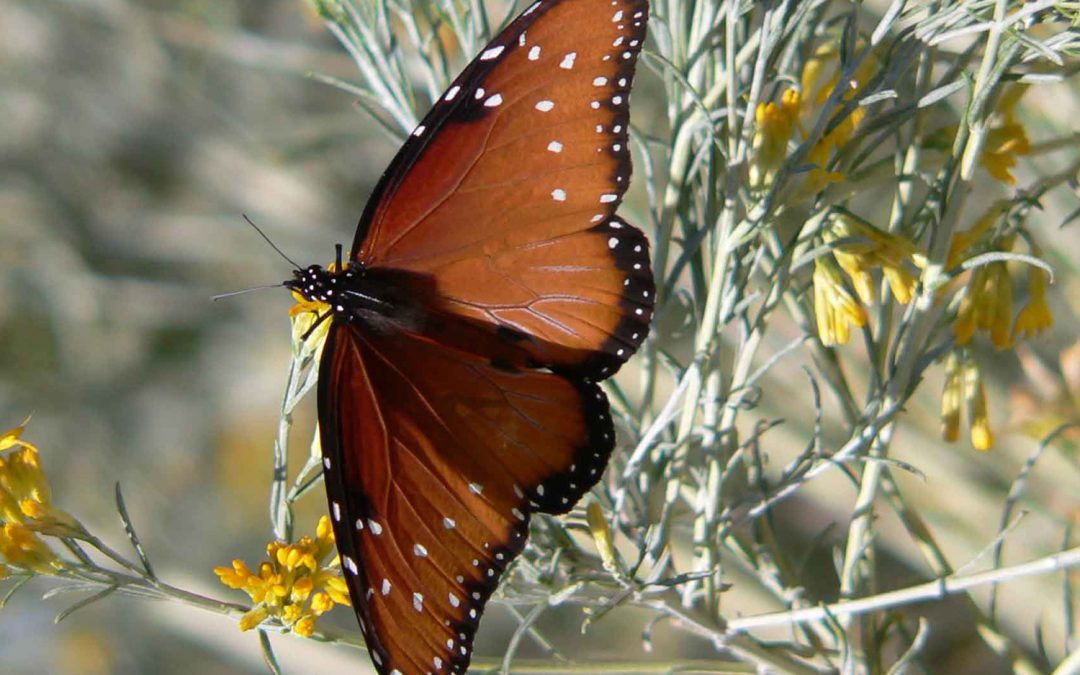
The project should benefit the yellow-billed cuckoo and the Southwestern willow flycatcher, two protected birds, by creating more spots where they can nest. Planting milkweed will benefit the monarch butterfly.
The work should make the area more accessible to the public by connecting two bosque trail systems on either side of the outflow. The project would create 4,800 feet of new trails. Crews also will be removing 198 jetty jacks.
The Legislature has provided about $1.2 million for planning and design, but District 26 Sen. Antonio “Moe” Maestas, a Democrat, is advocating for more investment in bosque restoration because he believes the bosque is underused.
“We’re one of the only cities in the country that doesn’t utilize its river for recreation or economic purposes,” Maestas said. “Given the fires that happened last spring, it’s imperative that we deal with the fuels and the underbrush.”
There’s not a city with a comparable river, Maestas said, but the San Antonio River Walk does offer an example of a river becoming central to a city’s tourism.
“Because we want to protect it, we do nothing with it,” Maestas said. “That’s not consistent with what we’re capable of.”
Additional funding from the state likely would have to come from capital outlay appropriations, Maestas said. He’s on the lookout for other project proposals that would restore or enhance the bosque.
“We have the financial resources to turn the bosque in Bernalillo County into a beautiful state park that we can all be proud of, that increases environmental protections and will add to our quality of life and build the city we want to build, which is a city that climbs out of poverty and keeps future generations from moving away,” Maestas said.
Construction should begin in August 2024 due to a $3 million dollar federal grant from the Bureau of Reclamation. Once construction starts, the project is expected to be finished in eight months. This important project will improve the riparian habitat for endangered species and make the outfall area more attractive to hikers and bikers in this section of the Bosque.
Author: Cathy Cook is a news reporter for the Albuquerque Journal. Reach her via email at [email protected]. Reprinted with permission from the Albuquerque Journal.
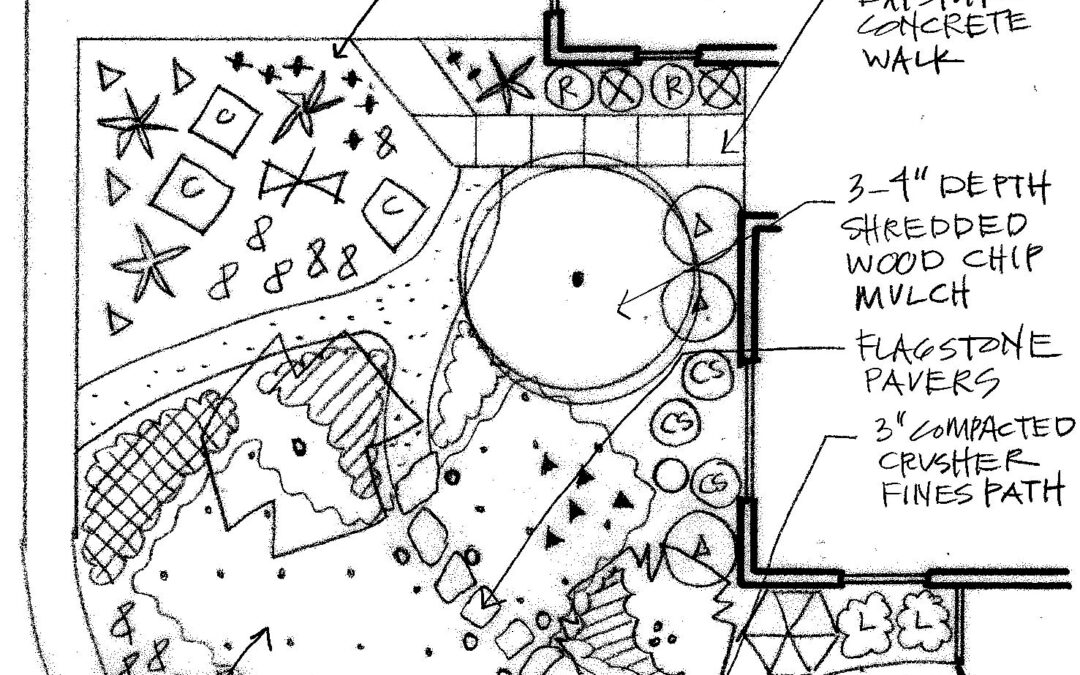
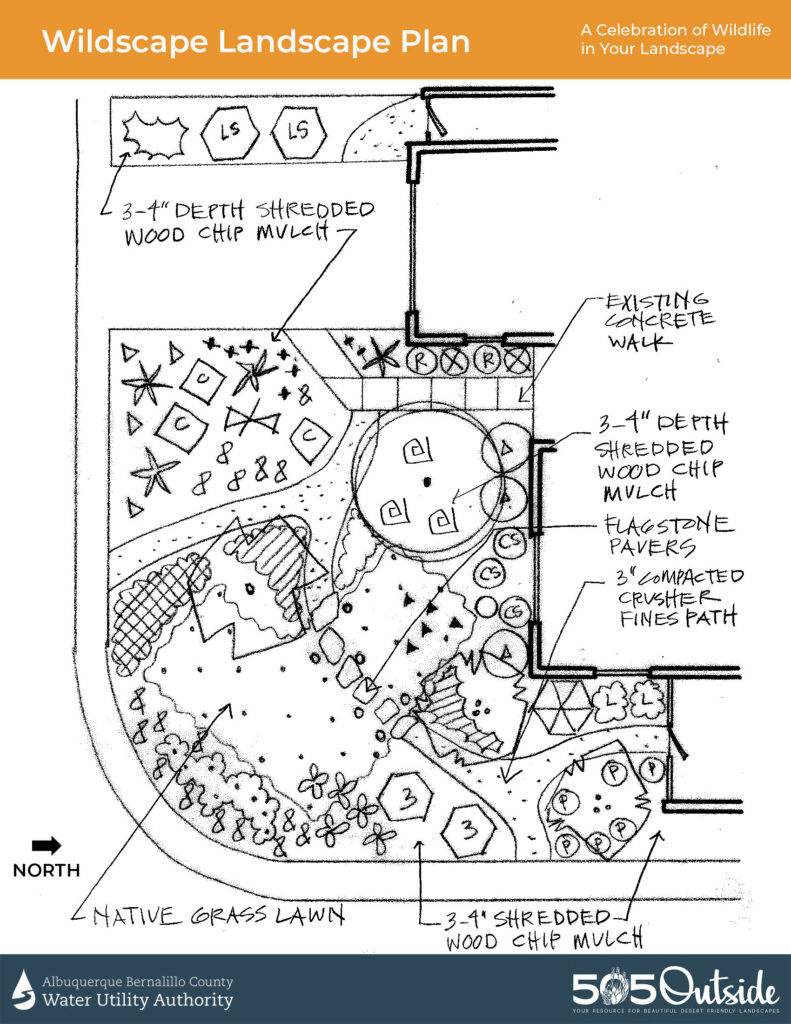
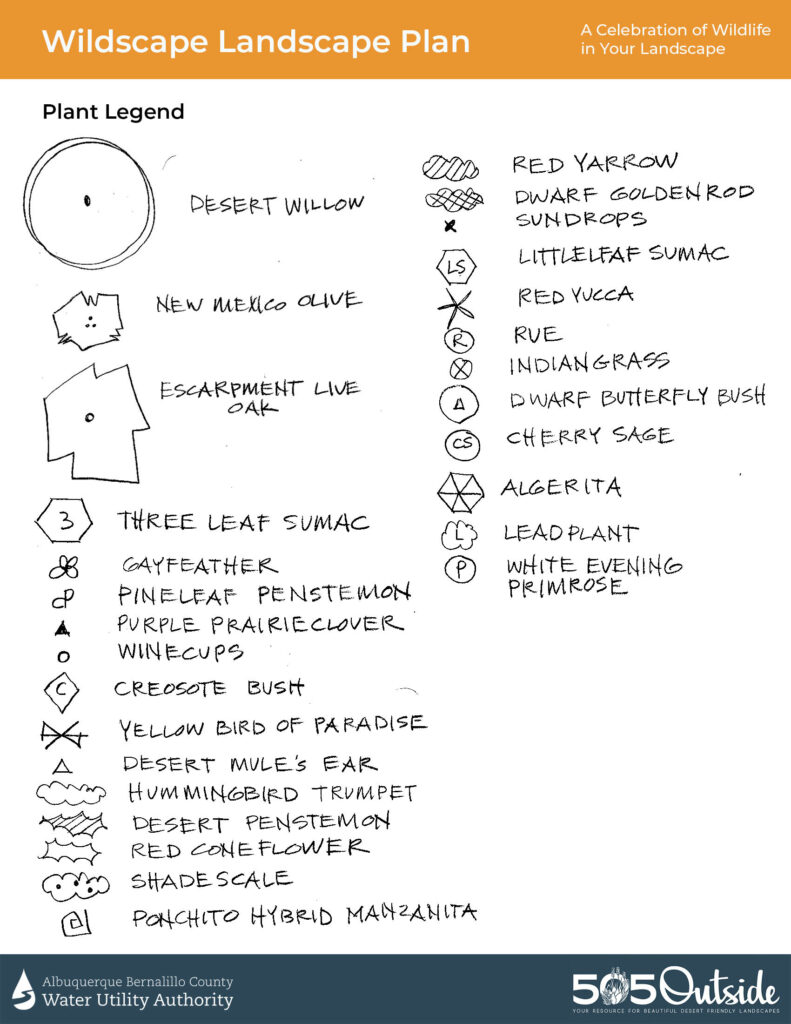
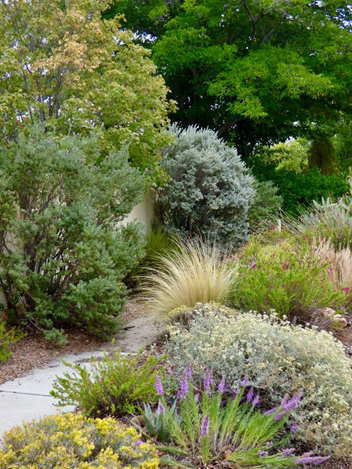
A lot goes into designing a landscape; hence, there’s an entire profession called landscape architecture devoted to designing outdoor spaces. We won’t be able to make you a landscape architect today, but we’re sharing a unique landscape plan designed by New Mexico landscape designer Judith Phillips to get you inspired with ideas for designing your own yard. We’ll be sharing five more landscape plans in future issues of 505Outside.
Plant for wildlife and you will host a never-ending garden party. Wildscapes should have tiers of canopy to provide shelter and food for a wide variety of wildlife, including birds, hummingbirds, bees and butterflies. Tall trees provide shade and shelter. Dense thickets of middle-height shrubs provide spaces for roosting and nesting and also give the landscape a sense of enclosure. Open areas with low-growing groundcovers provide areas for nesting and foraging, and the colorful flowers and berries appeal to people as well as winged visitors. A mix of evergreen plants for cover, brilliant flowers for nectar and pollen, and fruits and seeds ripening through the seasons will keep your wildlife friends fat and happy. In this wildscape, the gayfeather, dwarf goldenrod, leadplant, yarrow, rue, grasses and dwarf butterfly bush are lures for butterflies. Hummingbirds are drawn to plants with nectar-rich tubular flowers, such as desert willow, penstemons, cherry sage, coral honeysuckle and red yucca. Local songbirds and quail will be attracted by New Mexico olive, sumacs, creosote bush, desert mule’s ear, coneflowers, shadscale, gayfeather and algerita.
Designed by Judith Phillips, author of Plants for Natural Gardens
Learn more about specific types of gardening here:
All species are in constant need of habitat in which to dwell that gives the next generation a chance to thrive. It is easy to share your space with wildlife and provide crucial habitat for birds. If you have a yard with non-native grass (or one full of gravel), you have a blank slate for making your yard a bird and pollinator paradise. By planting xeric and native plants and using natural mulch, you can make your yard cooler, reduce water usage and actively care for birds.
If the thought of converting an entire yard seems daunting, dig out the grass (or pull back the rocks and weed cloth) from one section at a time. Adding pollinator plants to a sunny patch is a great way to start. Many pollinator plants produce fruits or seeds for birds.
Providing both food and cover is important for birds. If you already have mature shrubs and trees, you can focus on adding food sources. If your yard is bare, plan to add different levels of habitat with trees, shrubs, perennial flowering plants and native grasses. Plant wildflowers in clusters of three or more so that birds and pollinators will notice them when flying by and be able to have a hearty meal once they find the food source. For information about the size and needs of each plant you want to put in your yard as well as its habitat value, search for “bird” in The ABQ Backyard Refuge plant list.
In the desert, providing a clean water source is beneficial to birds. A dinner plate with fresh water will be as welcome as a fancy bird bath!
Another easy way to make a bird-friendly yard is by employing these simple practices:
Keep birds safe by trimming trees after nesting season ends in late September. Bird nests are inconspicuous by design and can be easily overlooked. Trees with dead or diseased branches also provide perches, food, shelter, and nesting sites. If they don’t pose a safety risk, consider leaving dead branches for the birds.
Plants that provide seeds for birds can only do so if you leave the dried seed heads over winter instead of cutting them off in autumn. Leave them standing until spring and then remove last year’s stalks to make room for new growth.
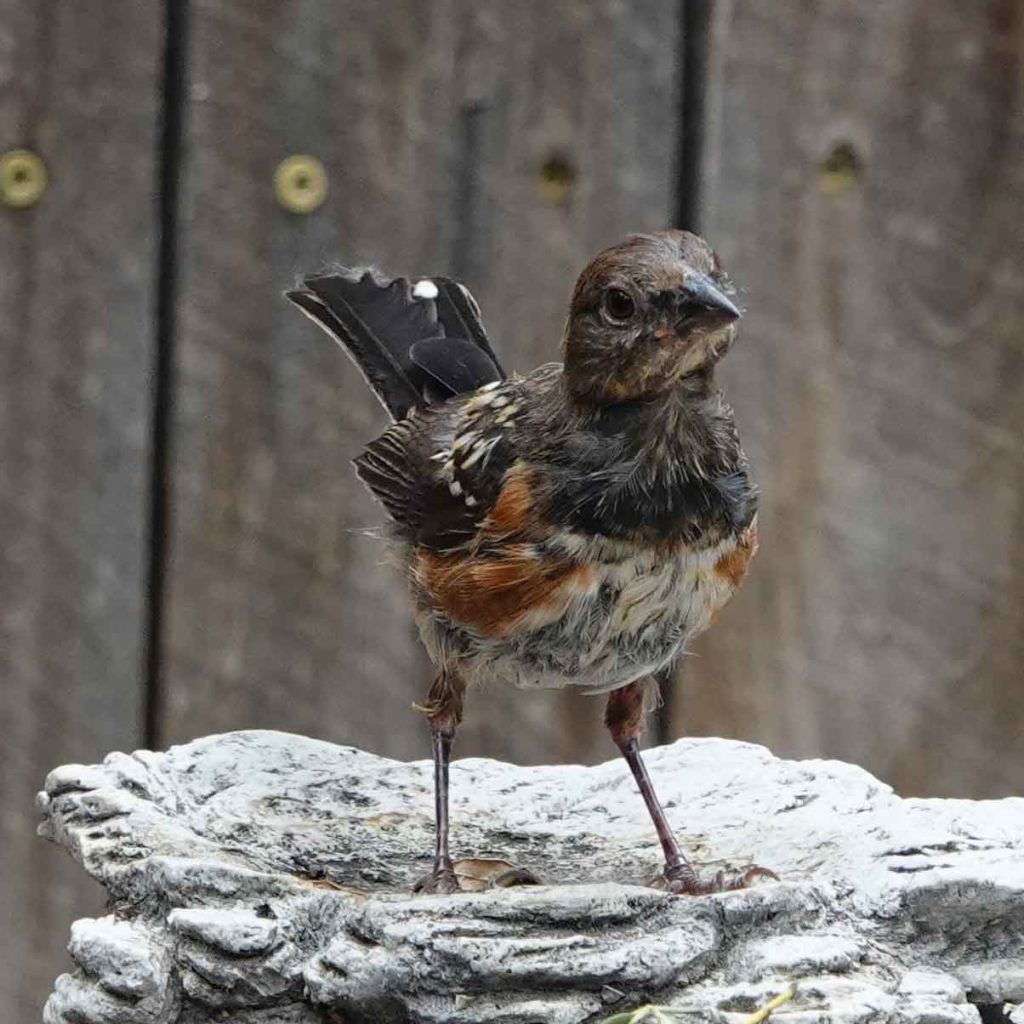
Leaving even just a small patch of leaves where they fall supports insects and the birds, like Spotted Towhees, that rely on them.
Challenge yourself to develop a tolerance for “pests." Insects are the primary food source for many species of birds. Hummingbirds use spider webs to build nests that hold fast to branches and expand around their growing nestlings. Avoid using chemical controls so you do not harm the wildlife you’ve invited into your yard.
Love your dandelions! In addition to supporting pollinators, hummingbird mamas use aster fluff to build cozy nests.
Owls and other raptors keep rodent populations in check and die if they eat a poisoned rat or mouse. Never use rodenticides! If you have a suitable tree, consider installing an owl box as well.
Domestic cats are part of the ecosystem when outdoors. They are both predators and prey, killing millions of birds and mammals each year, and in danger of being eaten by a coyote or owl. Keeping your cat indoors, or in a catio, will protect your cat and wildlife at the same time.
The ABQ Backyard Refuge Program introductory guide, workbook and plant list can be very helpful in designing a habitat that includes all the necessary habitat elements (food, shelter, water), or you can simply begin by managing your yard in bird-friendly ways.
Supporting birds in our urban area starts with focusing care and attention on our wild neighbors and taking their well-being into consideration when managing our yards. By supporting birds you will have opportunities for observing how our wild neighbors live and discovering new ways of sharing your space. Sharing our resources and growing habitat that benefits both you and wildlife can make our city a better place for the entire living community.
Building a refuge for wildlife in our yards is a way to nurture habitat on a personal scale and actively care for our wild neighbors. By intentionally creating spaces we can share with other urban species, Albuquerque can be a refuge for both people and wildlife.
There is a wonderful program set up for Albuquerque residents called the ABQ Backyard Refuge Program. It helps residents establish a habitat that supports a mixture of wildlife. The ABQ Backyard Refuge Program, which is managed by the Friends of Valle de Oro National Wildlife Refuge, was developed by more than forty partners including local government agencies, university departments, and conservation organizations. The program provides resources for residents, including an introductory guide that features a list of plants that both thrive in the Albuquerque area and attract different kinds of wildlife as well as a workbook for building and documenting your refuge. The goal of the ABQ Backyard Refuge Program is to create a mosaic of habitat across the city to provide resources for both resident and migrating wildlife. In addition to recruiting residents to build a habitat in their yards, we are working with our partners to increase green space in the communities most affected by our changing climate.
It is easy to make your yard more friendly for wildlife! Here are three tips:
~Leave a few dead branches in your yard, as long as they don’t pose a safety hazard. They can provide great perches for birds and food sources or potential nesting sites for woodpeckers.
~Allow some leaves to stay on the ground in the fall so more butterflies are attracted to your property in the spring.
~Leave dried sunflowers and grasses in your yard because they provide food for wildlife during the winter.
Whether you have a balcony or a patio (where you can put potted pollinator plants) or acreage at your home, you can make changes that benefit wildlife. Check out becoming a member of our ABQ Backyard Refuge Certification Program! When you certify your space as an ABQ Backyard Refuge, you are helping to encourage neighbors and other members of the community to build wildlife habitats. As a member of the certification program, you will receive a metal sign with stickers that show your certification level. The sign can be a conversation starter with your neighbors and help the program grow. Learn more about the ABQ Backyard Refuge Program by attending a virtual 90-minute workshop on Friday, June 11. The workshop normally costs $10, but scholarships are available. For more information and to register for the workshop, visit https://friendsofvalledeoro.org/abq-backyard-refuge/
Author: Laurel Ladwig, Backyard Refuge Partnership Coordinator, Friends of Valle de Oro National Wildlife Refuge. Visit www.abqbackyardrefuge.org and follow us on Facebook & Instagram @ABQbackyardrefuge, and Twitter ABQbrp Have a question about the article? [email protected]
Everything in nature is
connected. Fostering the connections keeps ecosystems and gardens vital. And weaving
pollinator essentials together into a beautiful garden is a fun process. Start
by thinking about where you will view the garden from as well as how you’ll
move through the space to view pollinator activity without disrupting your
winged guests. Organize the largest and thirstiest plants around rainwater
harvesting opportunities such as gutters or canales, and use pathways to divide
larger spaces into smaller planting areas like herb gardens, wildflower beds
and native shrub borders. Include the essentials of food, shelter and water in
your garden and your pollinators will thrive.
Among the insects and
birds that pollinate plants, bees are the primary work force. There are 1000+ kinds
of native bees in New Mexico, as well as honey bees that assist plants in
producing seeds. Butterflies and moths are less efficient pollinators than
bees, and many have key relationships with specific plants: Monarchs
butterflies with milkweeds and hawkmoths with evening primroses. Beetles, bats
and hummingbirds are also nectar drinkers and pollinators.
Plants expend energy to
produce showy flowers to attract pollinators. In exchange for distributing the
pollen needed to fertilize the flowers so the plants can reproduce, the
pollinator feeds on the energy-rich nectar. The shapes and colors of flowers
determine who will pollinate them. Butterflies can’t hover to feed, so they
need open-faced flowers with places to land, like daisies and roses.
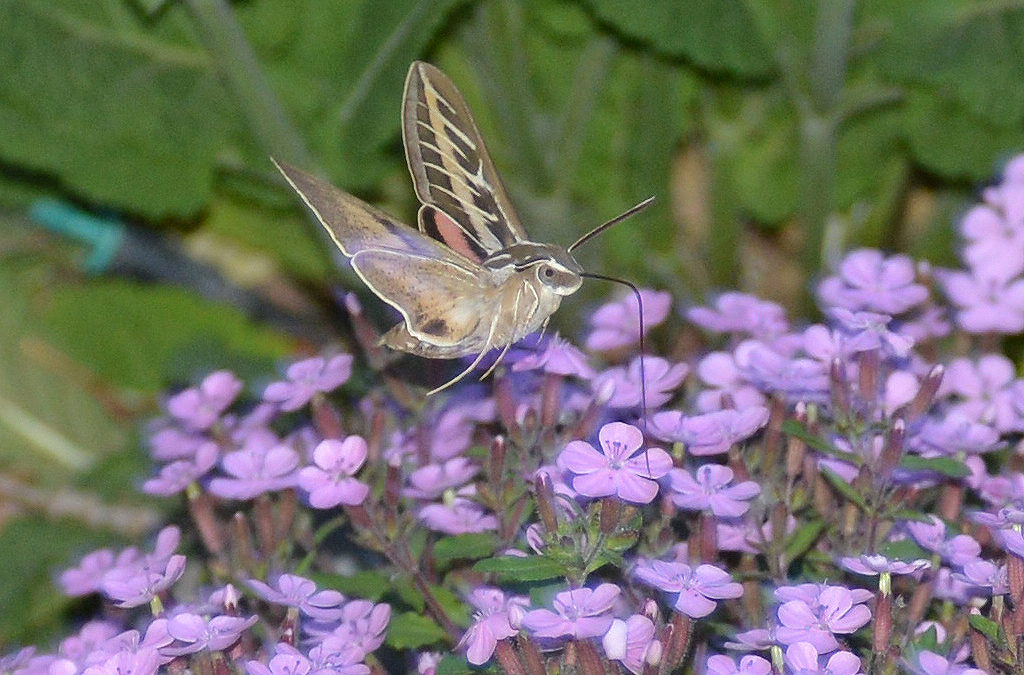
Hummingbirds and hawkmoths are able to hover while they probe tubular flowers
for their nectar and pollen. Plants with inconspicuous flowers are often
wind-pollinated, like native grasses, but are still part of the pollinator
support system. Their leaves feed many larval stage insects.
If you are new to the
neighborhood, survey plants nearby for pollinator activity and plant some of
the busiest ones. If you already have plants in your garden that are abuzz with
pollinators, think about replacing any plants that are shirking their habitat
role with ones that are better hosts. Choose plants that are rich in nectar and
well-adapted and watch your garden become a surprise party buzzing with energy.
Food sources include flower nectar for sugar and essential amino
acids, pollen for protein, and leaves as larval food. Native grasses are
especially valuable as caterpillar food. Plan to include food sources
throughout the seasons that pollinators are active.
Shelter includes layers of canopy from taller
trees, mid-height shrubs and groundcovers (knee high and shorter). Leave some
dead snags as hummingbird roosts and for bee nesting. Leave leaf litter in some
places and keep some open soil in out of the way areas for ground nesting
insect habitat. Cluster plants in masses of varied heights and densities as cover.
Plans for bee hotels and ready-made bee and bat nesting boxes are easy to find and
build. Check nature center gift shops and online for ready-made nesting boxes.
A
small, trickling water feature as a
source of drinking and bathing water for insects and birds should have shallow
edges to avoid drowning bees. An extra drip emitter in fine stone mulch or bare
ground is a good water source for bees and puddling place for butterflies.
Eliminate
pesticides and herbicides. You don’t wan to attract pollinators just to poison
them! Your health will benefit, too.
The greater the variety of plants, the greater diversity of pollinators will visit. Plant for a seasonal progression of blooms. It takes at least 100 sq. ft. of the same flower to consistently attract pollinators (think a 5-foot-tall and wide fernbush or butterfly bush or a 10-foot x 10-foot wildflower or herb bed space). So if your neighbor has a swath of red valerian, plant a few but use more of your space for sunflowers, mistflower, yarrow, beebalm, salvias, penstemon, oregano, fennel, whorled butterfly weed or native buckwheats. Pollinators don’t recognize property lines so the more neighbors who garden for pollinators, the richer your neighborhood will become in pollinators. Avoid hybrid flowers, especially varieties with double flowers since those plants may produce little or no nectar or pollen.
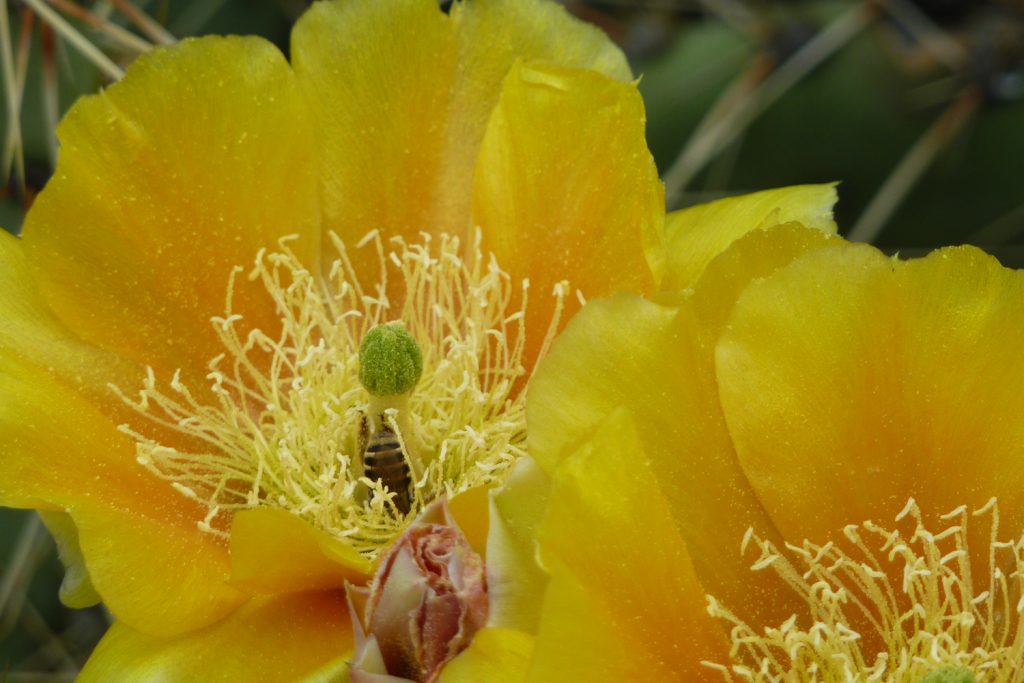
Opuntia englemannii with bee. Photo by Judith Phillips
There are
public pollinator gardens in Albuquerque:
Rio Grande Botanic Gardens on Central Ave at New York NW
El Oso Grande Pollinator Habitat at the east end of El Oso Grande Park on Osuna Road @ Morris NE
Albuquerque Garden Clubs Garden Center in Los Altos Park on Lomas just west of Eubank
Author: Judith Phillips, owner of Design Oasis, landscape designer and garden writer with 30 years experience designing arid-adapted and native gardens in the high desert.
The genus Lavandula is a favorite group of ornamental herbs native to southern Europe and the Mediterranean. These are sun-loving plants that thrive in hot weather and grow well in the West in a wide range of soils, even compost-enriched garden loams, as long as they are well drained. Heavy, poorly drained clay soils can be fatal to lavenders.
In spring, before the plants begin to show signs of new growth, cut back the old stems by one-third to
re-invigorate the plant and encourage a good show of summer flowers. Lavender plants require two to three growing seasons to reach mature size.
The two major groups of Lavenders include the English Lavenders (L. angustifolia varieties) and the Lavandins (L. x intermedia varieties), which are hybrids between English lavender and another species, Lavandula latifolia. Generally speaking, the English lavenders have the deepest flower color, while the Lavandins are taller plants with larger flowers and longer flower stems.
The English lavenders are often preferred as a source of dried flowers while the Lavandins are typically used for oil production, potpourris and lavender wands.