Trees are incredibly valuable and provide a wide array of
benefits, from increasing home values to improving mental health.
Unfortunately, Albuquerque has suffered large losses of trees in the past
decade. It’s more important now than ever to take care of your existing trees.
A common sight on spring evenings is seeing people with
their thumb on the hose, spraying the trunk of a tree. While it’s great to see
people caring for their trees, there is a better way to water them.
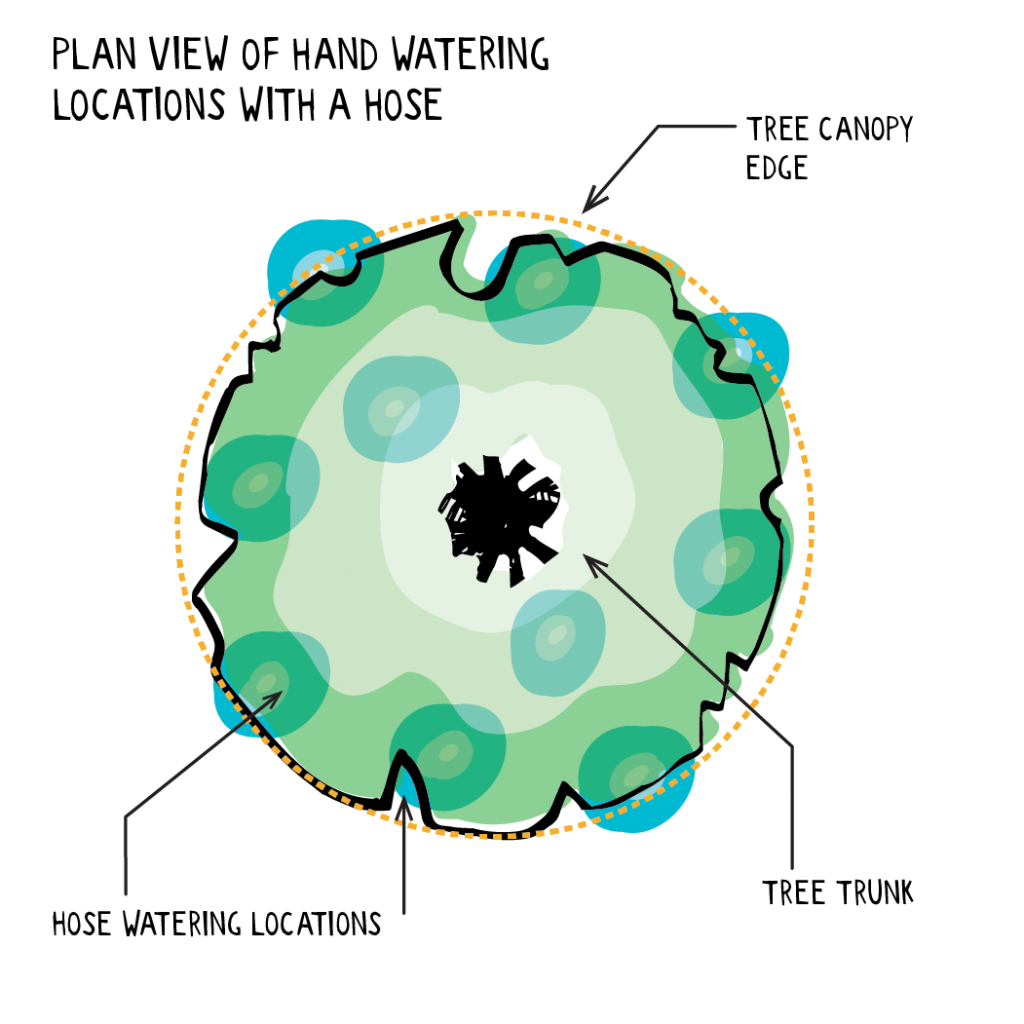
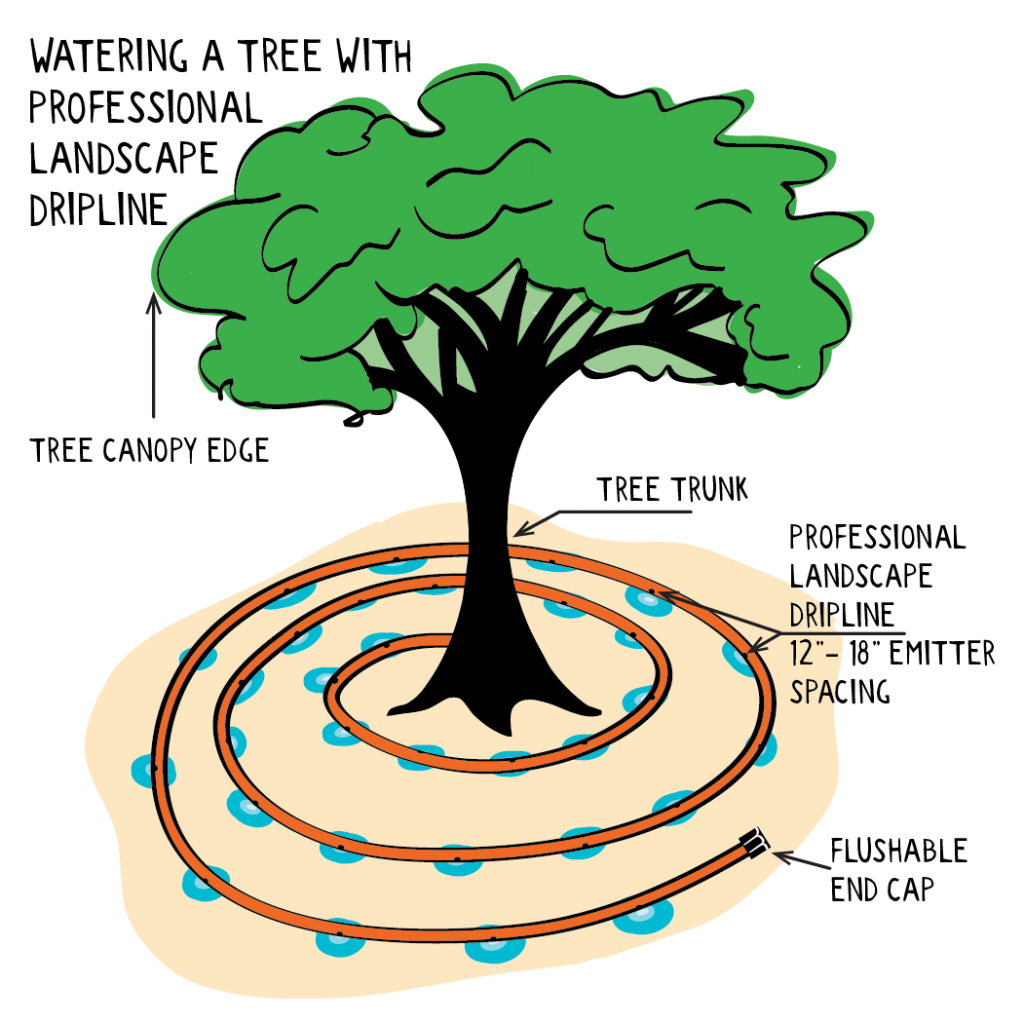
Trees have several different types of roots that serve different functions. Fine hair feeder roots are responsible for taking up water. Because these feeder roots are generally located near the tree’s canopy edge, this is where you want to apply water: a little inside and a little outside of the canopy edge.
TREE WATERING TIPS:
1. Hand watering
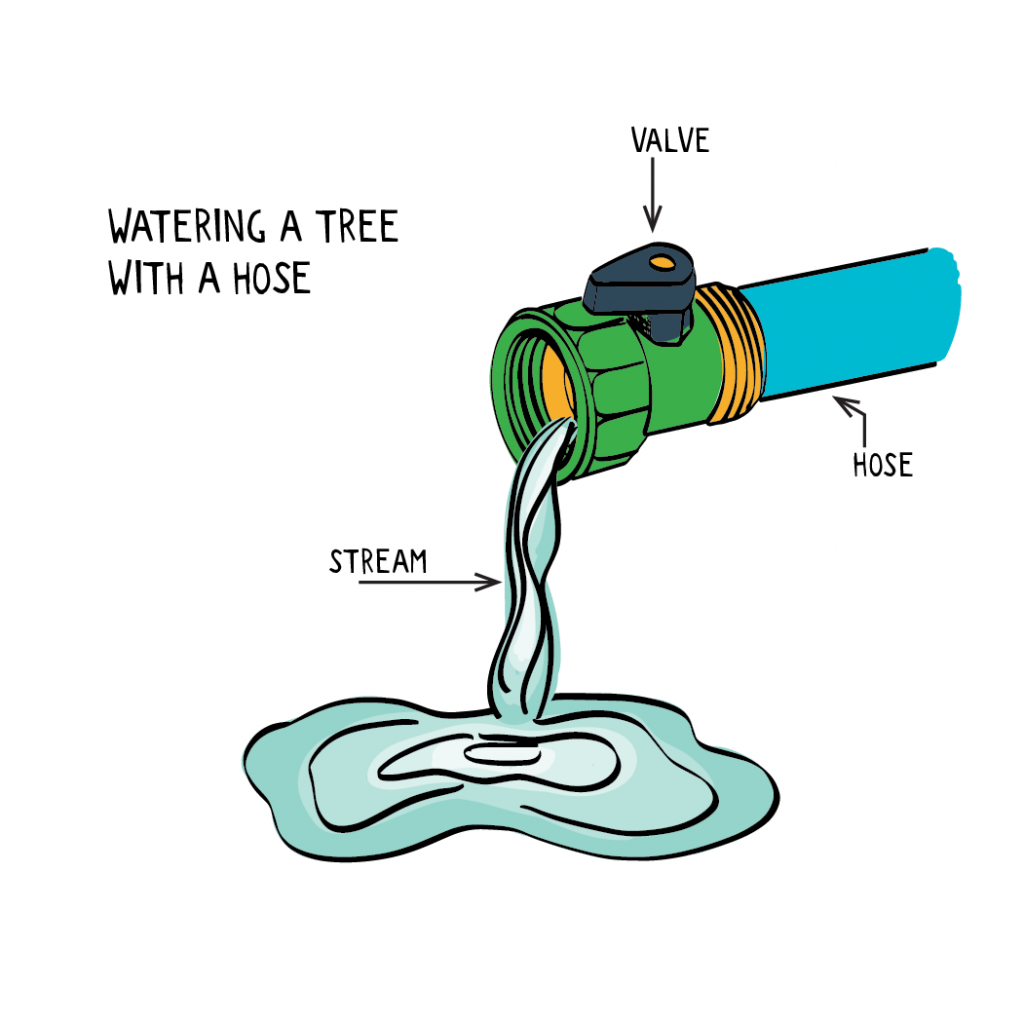
Turn your hose to a low flow or fast drip, so the water soaks into the soil before running off (try a hose end shut off valve). Set a timer and move the hose to different locations every 20 minutes starting 5 feet from the trunk to just outside the canopy edge. Small to medium trees will require watering at between 12 and 20 locations. Larger trees may need to be watered in sections over a few days.
2. Drip irrigation on desert friendly xeriscape
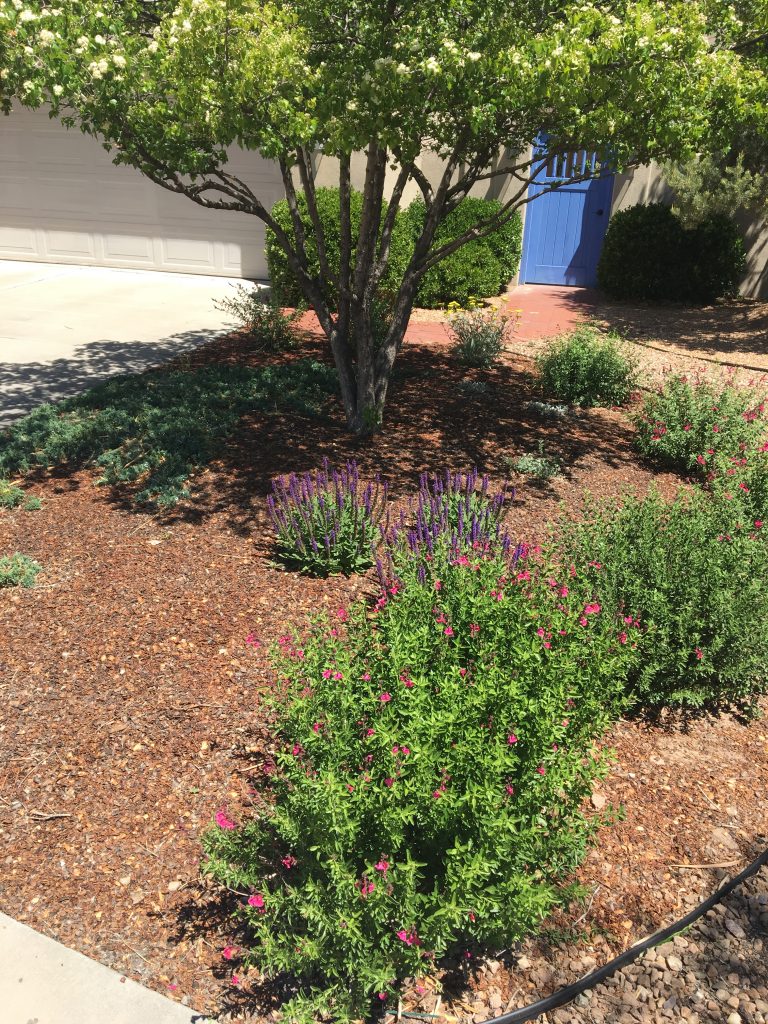
Growing healthy trees in a desert friendly xeriscape is possible using drip irrigation such as flag emitters. As trees grow, they require more resources in the form of soil rooting space and water. That means that as trees become established, drip irrigation emitters need to be shifted away from the original rootball (at the time of planting) out to the edge of the tree’s canopy. Additionally, the number and size (volume) of emitters needs to be increased as the tree grows. Most people don’t make these adjustments. Consider these strategies instead:
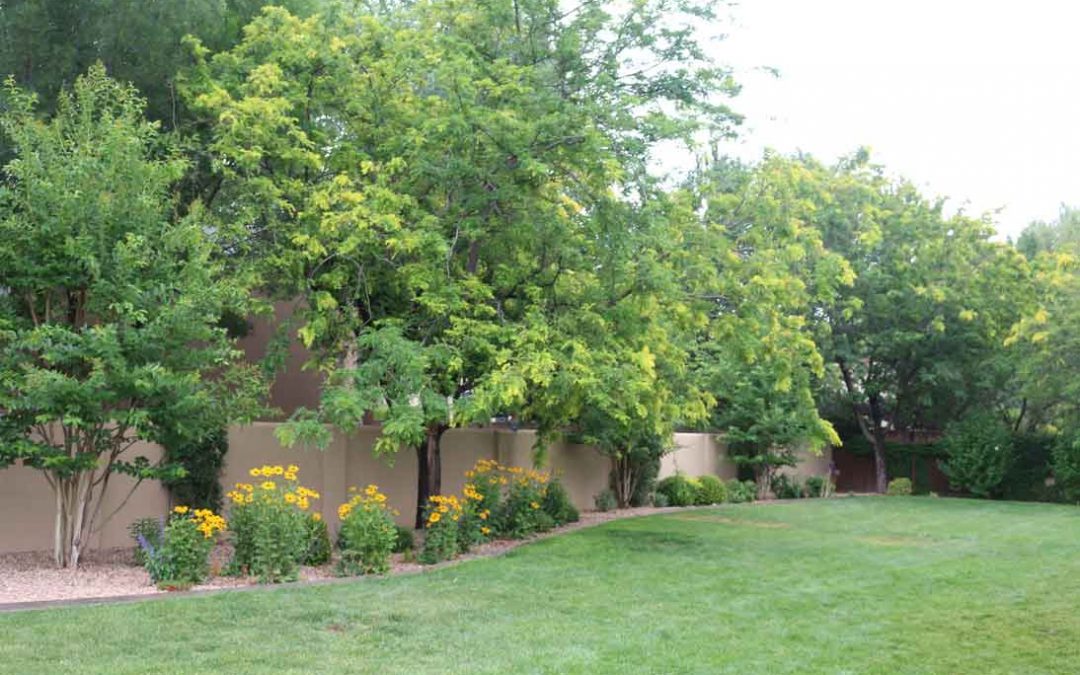
Plant an understory of groundcovers or flowering perennials within and beyond the tree’s canopy. The emitters used to water the groundcover plants will, in turn, water the tree. As the tree becomes larger it may eventually shade out the groundcovers, but the emitters should be kept in place to continue watering the tree.
Consider supplemental watering by hand in dry areas of your yard that are not covered by the drip irrigation system.
A similar strategy is to use professional landscape drip line (often referred to as netafim) in a grid or spirals in and outside of the tree’s canopy. This irrigation material requires less frequent maintenance and can be installed under mulch. As the tree matures, the drip line can be expanded and shifted to support the increasing needs of the tree. Understory plantings can also be used with this type of irrigation material.
3. Using sprinkler irrigation to water trees in a grass lawn
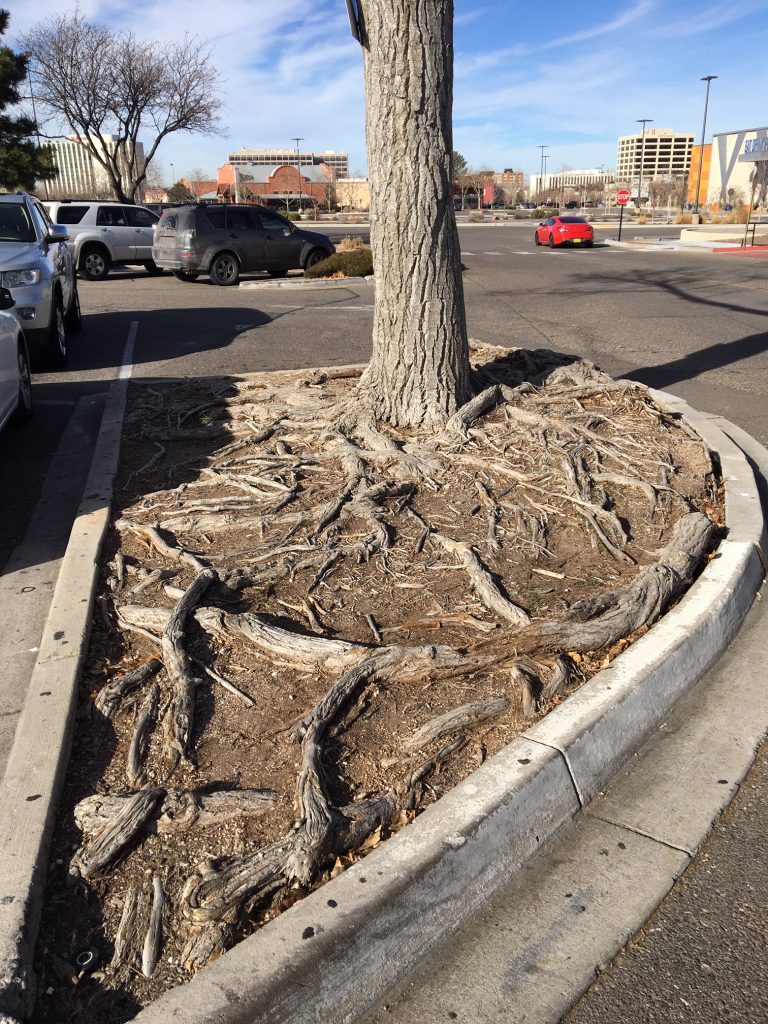
Most lawns in our area require nearly 40 inches of yearly irrigation to look good. So, it makes sense to plant a tree in the lawn to take advantage of all that water. Most of the large, beneficial trees in our city parks are grown like this. However, some species (like cottonwoods) respond to the shallow and frequent lawn irrigation by making shallow roots that protrude above the surface. These surface roots create tripping hazards. Damage to the tree can result from lawn mowers, too. Shallow roots also make the tree more susceptible to drought stress. Encourage tree roots to go deeper by occasionally (one-two times per month) running the lawn sprinklers for three or more cycles for a longer period. This will help to get water down deep, where it will remain in the soil longer and encourage roots to move deeper. Occasional deep watering in lawns also has the added benefit of flushing out salts accumulated from hard water and fertilizer.
Example of exposed surface roots. Author: Amos Arber, ASLA, ISA Xeriscape Incentive Inspector with the Water Resources Division for the Water Authority. Have a question about the article [email protected]
Do you want to walk barefoot across cool, soft grass? Especially on those hot summer days? We’d love for you to do that! We also want you to take care of your lawn in a healthy way that saves the most water.
One might assume that proper lawn care begins in the spring
but creating that beautiful lawn can start at any time. Sometimes it’s even better
to start in the fall. Either way, you need to begin with good soil, full of
organic material that will both provide nutrition and help hold in that
moisture. But if you don’t already have that, how do you get it?
First, dethatch your lawnonce a year. Most lawns need this done when the layer of thatch reaches roughly ½” thick. Cool season grasses, such as bluegrass, need to be dethatched in the fall, whereas warm season grasses, such as Bermudagrass, need to be dethatched in the spring.
Aeratingis the second step needed to keep your lawn as healthy and water efficient as possible. If you have an older lawn, or have highly compacted soil, you should aerate twice a year -- once in the spring and again in the fall. If you are aerating, or hiring someone else to do it, run the irrigation first and flag all your spray heads or rotors. This prevents inadvertently creating the need for sprinkler repairs! Aerate the whole lawn one direction and then again perpendicular to the first pass.
Also, regularly sharpen the blades on your mower and set it up as a mulching mower. Your mowing height should be as high as possible to help maintain a healthy lawn and conserve water.
Watering correctly is most important, so maintain your irrigation system year-round, and follow the Water by the Seasons watering recommendations. Check all the filters on each of your spray heads or rotors, then run your system to ensure that all of your spray nozzles or rotors are aligned and aren’t clogged. Repair or replace anything that isn’t working properly. Also check the base of each spray head to make sure you don’t have a leak at the base. The ground will probably be soft and squishy if there is one. To improve efficiency of your system, choose high efficiency sprinkler nozzles (rebates of $2 are available).
One last thing. Kick those shoes off and go enjoy that lawn!
Author: Richard Perce, Irrigation Efficiency Specialist with the Water Resources Division for the Water Authority. Have a question about the article [email protected]
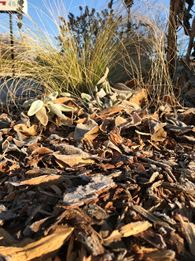
Shredded woodchip mulch helps soil hold moisture and insulates plant roots on a frosty November morning. Photo credit M. Thompson.
One of the most frequent questions we get at NMSU Extension is, “Should I add fertilizer or amendments to the soil when planting?” The short answer is no. And the long-term answer is an even stronger no.
Soil amendments are materials that are
worked into the soil with the intention of improving soil physical qualities. But
it’s just not that simple. As City of Las Cruces Community Forester Jimmy
Zabriskie said when I asked if he ever recommends using soil amendments when
planting a tree, “Save your money for mulch.” Organic
mulch is
material that sits on top of the soil, providing an insulation layer that helps
control soil temperature, retain moisture, and suppress weeds.
When planting ornamental plants, the
recommended species are the ones with roots that are well adapted to our native
soils. They’re more likely to live long, sustainable lives in our native soils
without amendments. The bottom line: Always put the same soil you dug up right
back into the hole with the new plant, and top dress with a thick layer of
mulch.
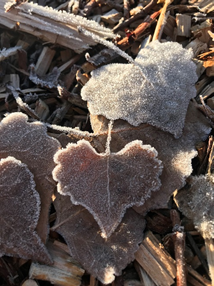
Frosty cottonwood leaves add a nice layer on top of several inches of shredded woodchip mulch. Photo credit M. Thompson
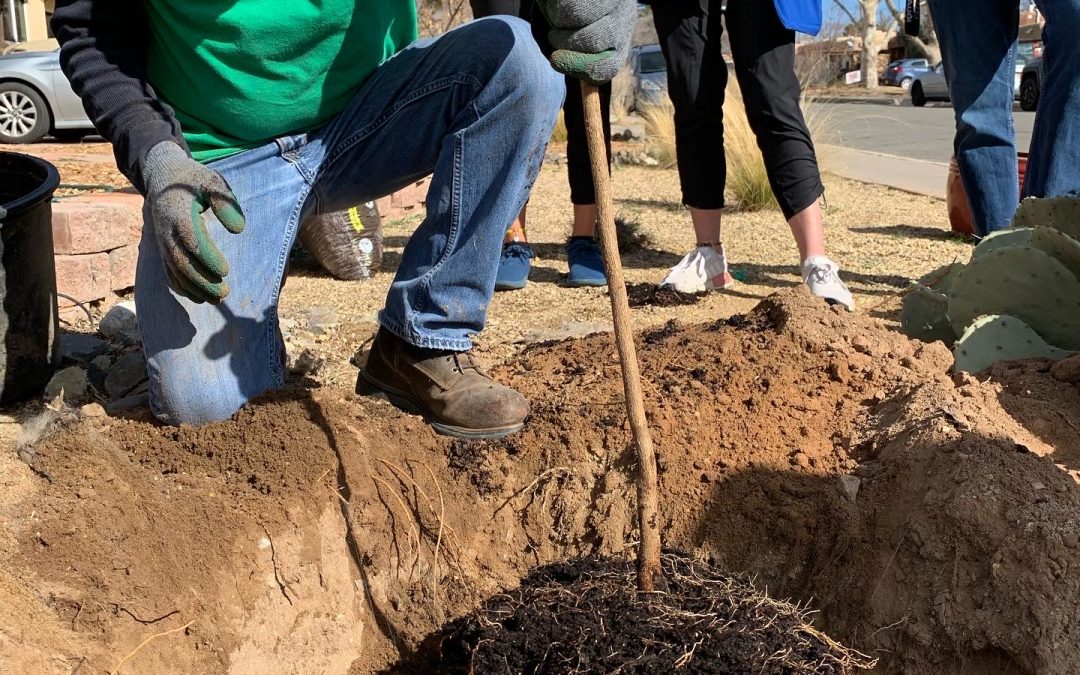
As for fertilizers, slow and steady wins this race. As Albuquerque City Forester Joran Viers said recently at a tree planting demo put on by Tree New Mexico and The Nature Conservancy, it helps to think of our trees (and other plants) as marathoners, not sprinters. When fertilizer is applied to trees, they can grow too fast for their own good and are more likely to develop structural problems and other issues. Fertilizers are not recommended at the time of planting perennial plants, either, because we want the plant’s energy to go into root establishment at a healthy rate to support the aboveground growth. The growth hormones necessary for healthy root development are found in the root tips and are made by the plant itself, so adding root stimulator to living roots is not necessary or even helpful. (Side note: Rooting hormone is potentially useful when you’re trying to get roots to grow quickly from cuttings where the roots have been removed completely.) So hold off on fertilizing for at least a few years while your plants are setting down roots.
Research on all sorts of landscape plants has shown that by adding amendments (like organic matter or perlite) to your soil backfill, the initial, short-term results are good. But the interface between the amended soil and the native soil is bad news. Water doesn’t move well across the interface, and neither do roots. With time, the roots may be inclined to stay in the original planting hole and spiral around, so you end up with essentially a potted tree or plant with reduced growth rate, constant water and nutrient stress (because lateral roots never fully developed), heightened vulnerability to pests and diseases, and even an increased falling hazard (think root ball in socket).
Author: Marisa Thompson, PhD, is the Extension Horticulture Specialist for New Mexico State University and is based at the Agricultural Science Center at Los Lunas. For more gardening information, including decades of archived Southwest Yard & Garden weekly columns, visit the NMSU Extension Horticulture page (https://desertblooms.nmsu.edu/), , follow us on social media (@NMDesertBlooms), or contact your County Cooperative Extension office (https://aces.nmsu.edu/county).
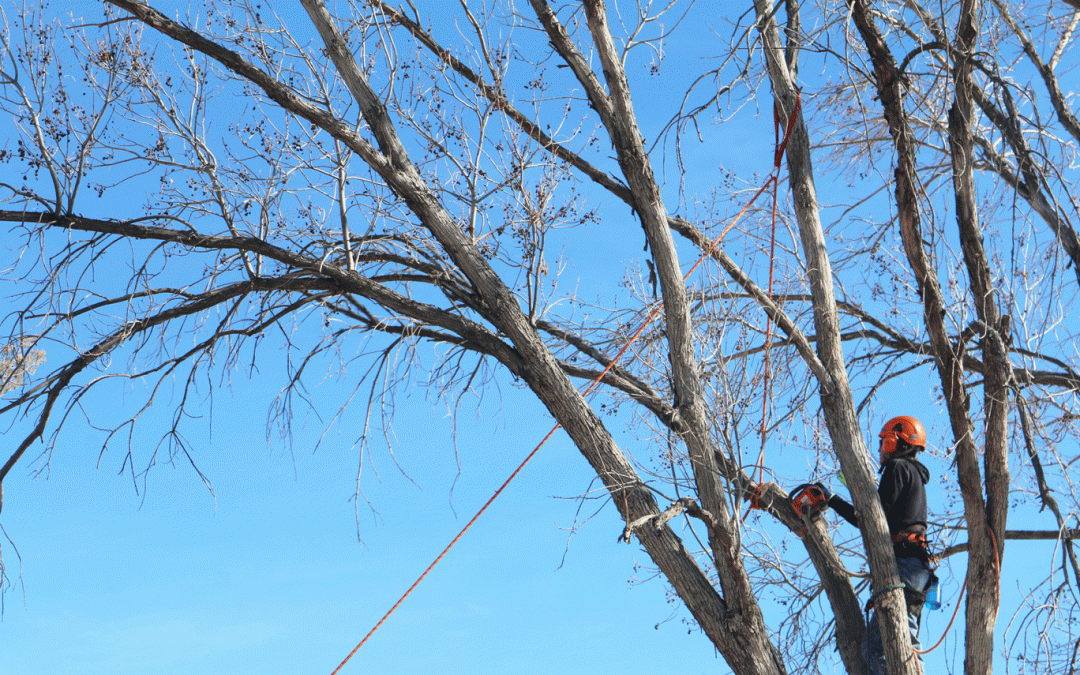
The winter is best time of year to prune trees. The Water Authority recommends hiring an arborist to prune them because arborists specialize in the care of individual trees. They are knowledgeable about the needs of trees and are trained and equipped to provide the proper care.
Arborists can provide the following services:
Pruning
Tree removal
Emergency tree care
Planting
Plant health care
Other services such as
consulting, tree risk assessment, cabling and bracing of trees.
How do you find a professional arborist to take care of your trees? We recommend to ask the following questions when looking for an arborist:
Are they certified? Certified
arborists have achieved a level of knowledge in the art and science of tree care
through experience. They have passed a
comprehensive examination developed by some of the nation’s leading tree care experts.
There is an online resource called Find an Arborist to help you locate one in
your area.
Do they have insurance? Check
that they have a certificate of insurance that includes proof of liability for
personal and property damage, including workers’ compensation.
Do they offer a contract? Get
a written contract of the work to be completed from the arborist. It should
include the estimate for the services, a start date, and estimate of how long the
work will take.
Do they have references? Ask
the tree company to provide a few names of past customers, and ask friends and neighbors for local references, too.
Some of our best landscaping practices can be learned from Mother
Nature. Every autumn, leaves fall to the ground, sheltering the soil and beneficial
organisms, returning organic matter back to the ground, and perpetuating the nutrient
cycling essential for good plant health. This year we want you to think about leaving
those leaves in your garden. When we allow leaves to follow their natural life cycle,
we can enjoy a colorful tapestry on our landscape as well as all the benefits provided
by an organic mulch.
With these tips, you can spend less time raking leaves into plastic
bags and enjoy more fall fun:
When designing your landscape, make your pathways
and hardscapes above the level of your planting areas. The wind will naturally blow
leaves into the low spots where they will support soil and plant health. This also
happens to be a great water harvesting strategy.
Use organic mulches instead of gravel. Organic mulches
such as wood mulch are visually accommodating to leaf litter (meaning you won’t
notice them as much), allow for the leaves to decompose into the porous spaces and
build soil. Leaves break down to virtually nothing in this environment. If you prefer
a tidy look, follow up with a light topdressing of mulch for a finished appearance.
If the leaf load is too much to manage directly under
your trees, rake the leaves a little off the top and distribute them throughout
your yard – ideally to a compost heap where the leaf litter will become an excellent
soil amendment for your spring garden. Note: if you have chickens, they will turn
your leaves into next to nothing in a matter of days.
If you have a lawn, run your lawn mower over the
leaves and let the crumbled litter work its way back into the soil. The addition
of organic material to your lawn in the fall will give a boost to your lawn when
it wakes up in the spring.
There are a few instances when you should remove fall
leaf litter. Leaves from diseased plants – particularly fruit trees and roses -
should be taken to a compost facility to be recycled. While you can try to compost
them yourself, be advised that most backyard compost piles do not reach a high enough
temperature to kill pathogens. Also, xeric plants that grow naturally in rocky terrain
will be susceptible to crown rot if organic material is piled up around their bases.
Leaving fall leaves has another great benefit – it is carbon neutral. Carbon is sequestered in the soil, leaf blowers and plastic bags are removed from the equation, leaves don’t end up in a landfill or produce methane gas, and no transport to the landfill is required. It’s a win-win when we let Mother Nature be our guide.
Author: Paulina Aguilera-Eaton, Water Conservation Specialist with Albuquerque Bernalillo Water Utility Authority
505Outside sat down with local landscape expert Wes Brittenham, Farm and
Landscape Manager at Los Poblanos Historic
Inn & Organic Farm, to chat about Fall
maintenance tasks for Albuquerque gardens. At Los Poblanos, Wes oversees
all growing things on their 25 acres, from the historic gardens to the newer
more xeric and multi-functional landscapes, as well as the kitchen garden and the
fields of lavender.
Wes has noticed many homeowners with traditional landscaped yards
keep them highly pruned with perfectly trimmed rounded plants free and clear of
leaf litter and debris. Over the last 15 years, as homeowners have made the
shift to xeriscape landscapes (aka desert friendly) he’s noticed they haven’t
shifted their maintenance regimens. They should.
Xeriscape landscapes don’t require the rigorous maintenance that
traditional landscapes do, so he’s been teaching homeowners to “get over the
tidiness!” He wants homeowners to embrace the shape of native plants and, in
general, do less yard work. Especially in the Fall.
When asked what homeowners can do to prepare their landscapes
for winter, he gave us a short list of surprisingly simple to-dos:
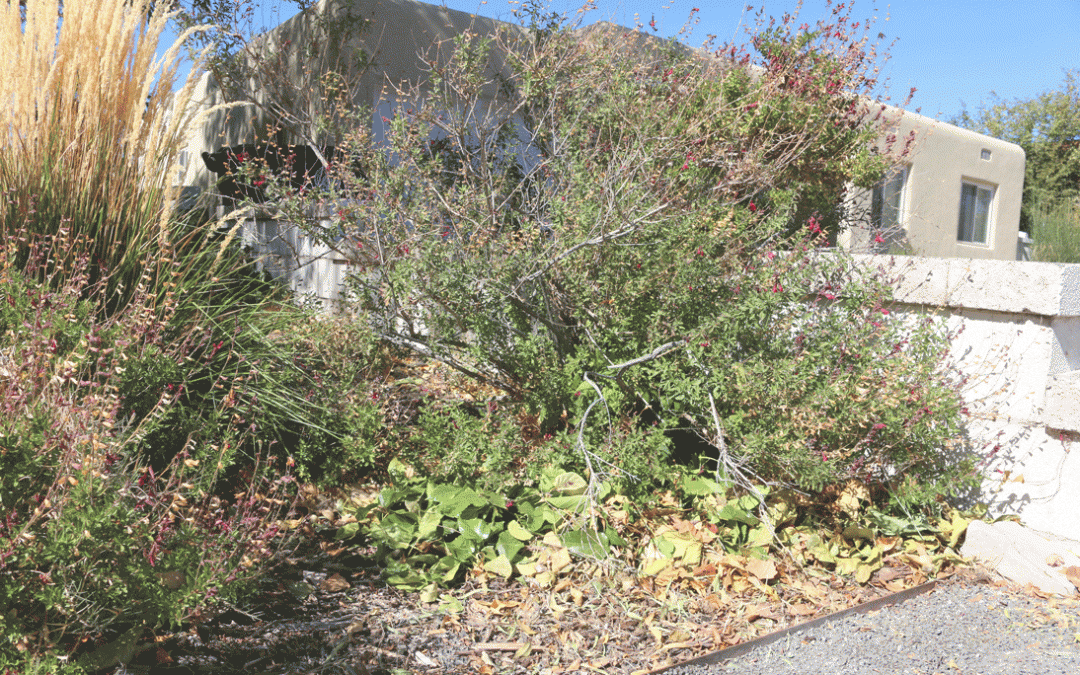
Leave it natural. There is no need to prune! So leave stems with seed heads in
place. This includes grasses, perennials and shrubs. The dead stems, leaves and
seed heads provide natural habitats for wildlife all winter. They also give the
garden good structure over the winter. When Albuquerque gets a blanket of snow,
the wispy seed heads of the grasses create a beautiful silhouette. Leaving dead
foliage insulates the plants from winter freeze damage, too.
Do clean up fruit and
vegetable debris from gardens. This helps reduce bug
populations and prevents fungus problems.
Leave the leaves. When the trees start losing their leaves, rake them around
the base of plants to provide habitat, retain moisture, and create natural
mulch under the plant.
With over four decades of experience, Wes’s advice is extremely useful for local homeowners. Efficiency is key, so use his three simple tips for a great fall and winter landscape and minimal yard work this Fall.