September is still hot
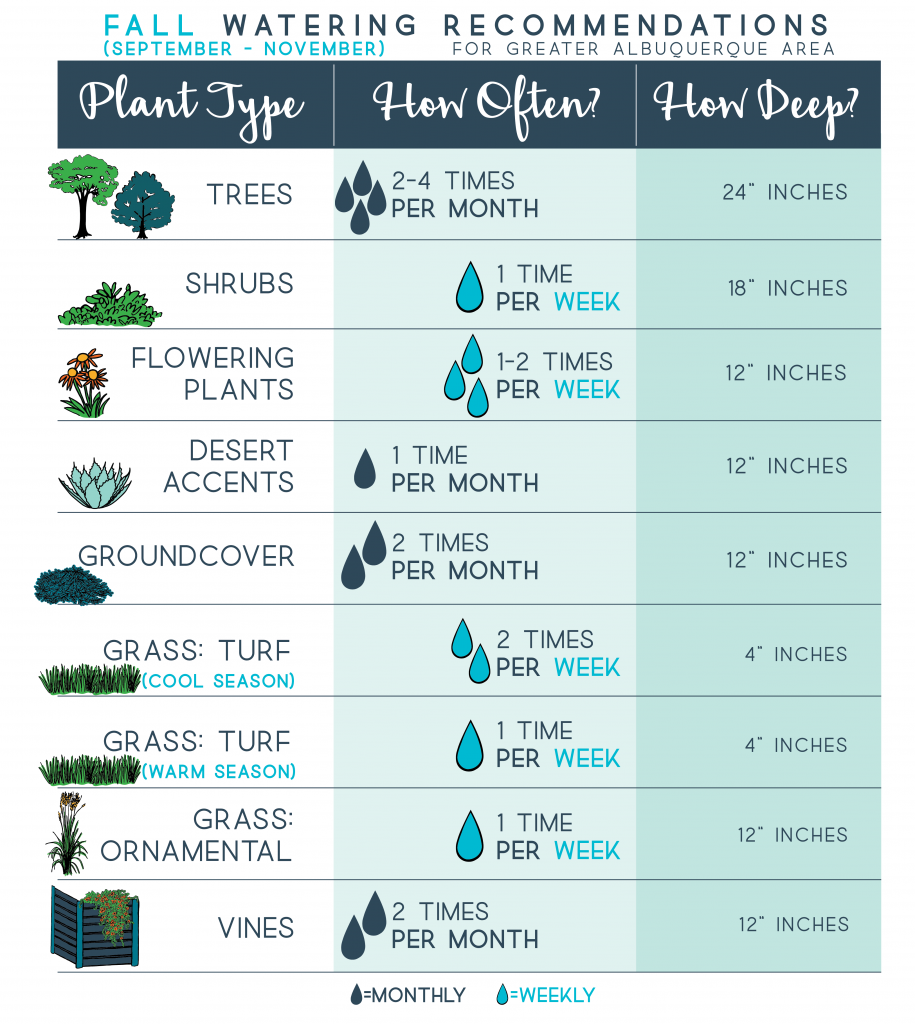
but the days are getting shorter. Follow the Fall watering recommendations
below. Remember that if it rains more than a half inch, count that day as one
of your watering days and cut back on supplemental irrigation.
Follow the Fall Watering Recommendations below for your landscape.
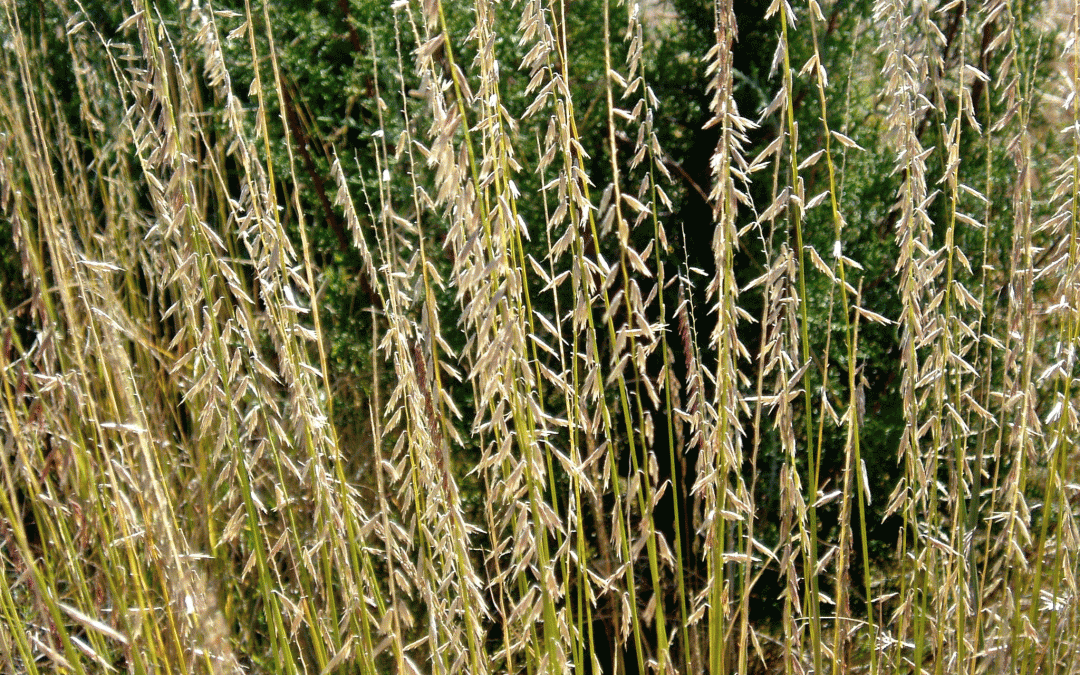
This long, wispy, coarse, medium blue-green grass looks lovely in late
summer when it sends out tall seed heads. These are little seeds that dangle
side-by-side on a stiff stalk. This plant is perfect to mix in and among a
meadow area, for use on slopes to control erosion or as accents in a perennial
bed. It is very heat tolerant, needing only a soaking twice a month in the heat
of the summer. This grass should be mowed 6 inches high or higher once a year
in the late winter.
Your landscape needs a lot less water in September than it did in the summertime. About 35 percent less on average. The days may still be warm, but shorter days and cooler nights in the months of September, October and November means less evaporation, which means less irrigation is required. Adjust your irrigation controller following the Fall Season Watering Recommendations to save water and money this Fall.
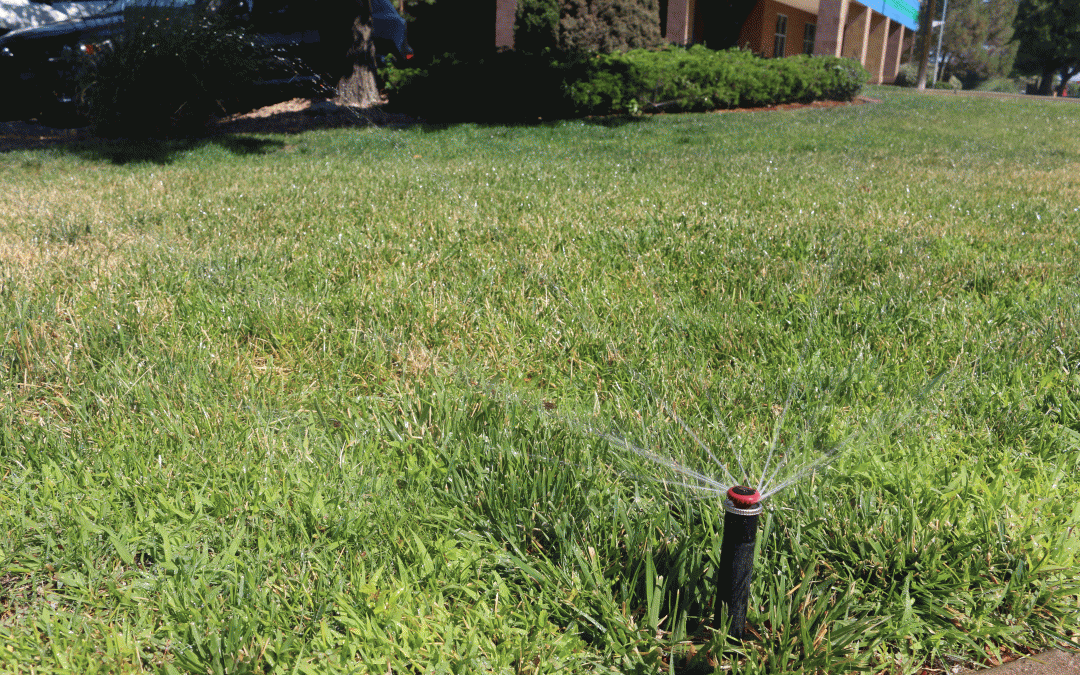
Ramping down your landscape irrigation does not mean you
need to stop watering all together. If you have a lawn, cut back to two days
per week. Cut back to two to four days a month for trees. Fall is when trees,
shrubs and other perennial plants get busy growing their roots, and proper watering
supports this activity. After spending the summer putting energy into growing
leaves, flowers and fruit producing plants take advantage of the fall season by
anchoring their root system to the earth. It’s important to fortify root systems
during the Fall so they have a stronger trunk and stem during the winter
season.
Fall season is also a great time to put in new plants, for the
same reason – they spend their time growing their root system instead of leaves
and flowers. But new plants need more frequent watering to help them get established.
Keep in mind that new plants need at least a month to anchor in the ground before
the first freeze, so don’t plant too late in the season to avoid damage.
And remember it is not necessary to irrigate when it rains, or on days following a good rain event (or about a 1/2" of rain). Using nature as your source of water encourages a desert friendly landscape.
Want to know how much your landscape really needs? Call 505-289-3003 to schedule a free, efficient irrigation consultation with a Water Authority expert.
The Water Authority encourages efficient outdoor water use for beautiful landscapes. With some 40 percent of our drinking water going to landscaping, improving outdoor water use efficiency is now the main focus of the Water Authority’s conservation efforts. But irrigation efficiency doesn't mean you can't have a beautiful, desert friendly yard. Below is your three-step plan for a beautiful, desert friendly yard.
1. Service your irrigation system by checking for leaks and malfunctions.
Low-maintenance landscapes are great, but there’s no such thing as a “no-maintenance” irrigation system. A single broken sprinkler head flowing at 15 gallons per minute will waste 900 gallons in one hour of use. Service your system regularly, and check it often for leaks and malfunctions.
2. Set your turf irrigation timer to water by the numbers.
Adjust your irrigation timer according to the season. For turf, water by the numbers: One day per week in March, two days per week in April and May, three days per week in the summer, and ramp down in the Fall. For other landscapes, follow the Seasonal watering recommendations. Call today for a free irrigation consultation.
3. Select desert friendly plants that thrive in our dry climate.
There are literally hundreds of plant options to choose
from that will thrive in our desert climate. And there are rebates available for
replacing turf with a desert friendly landscape.
If you follow this three-step plan, you’re sure to have
landscape success.
One of the
great advantages of desert-adapted plants is the wealth of colorful flowers
they produce, a boon to gardeners and pollinators alike. Plants that bloom in
autumn offer pollen and nectar for insects and, if the seed heads are left to
ripen, a late season food source for birds.
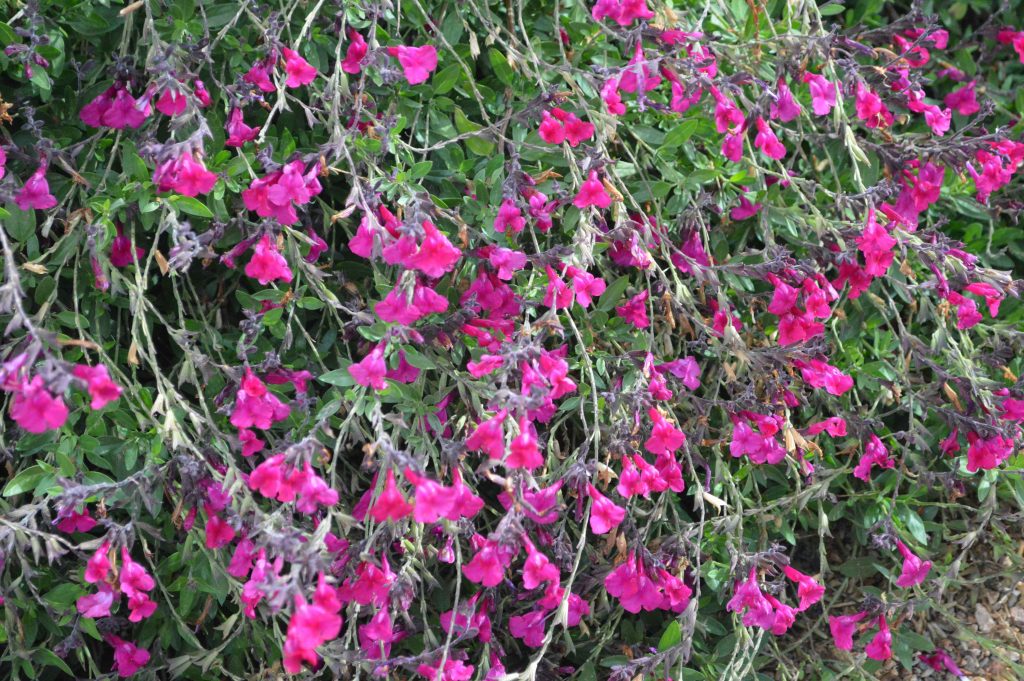
After a long hot summer, some plants think the cool of fall means it’s spring again and burst into bloom with renewed vibrance. Salvia greggii is commonly called autumn sage because, even though it flowers brilliantly in spring and lightly all summer, fall brings on another strong show. Responding to the cooler, longer nights in autumn, Salvia’s late season color becomes even more intense. Autumn sage is a compact shrub that grows 2-feet tall and 3-feet wide, with small dark green leaves and spikes of flowers in red, rose pink, coral, purple or white. Hummingbirds and bees are frequent visitors. Autumn sage prefers well-drained soil and deep watering (24 to 30 inches) every week or two while blooming, monthly or less in winter.
Autumn sage, Salvia greggii
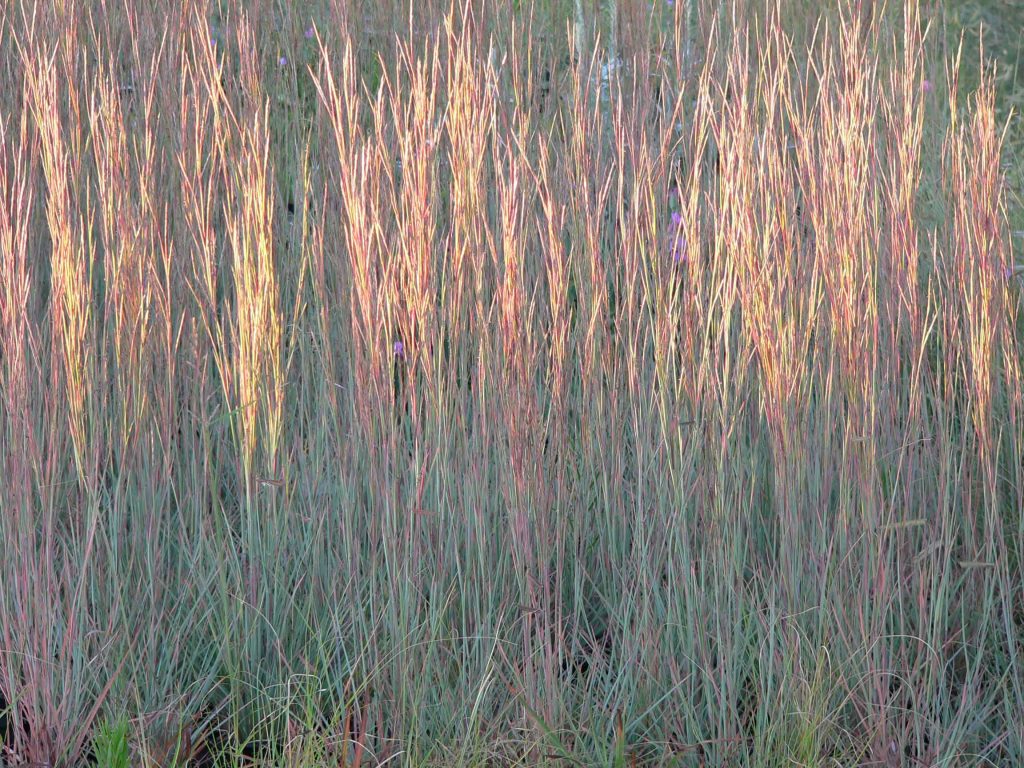
Many ornamental grasses are their showiest in autumn, too. There are several varieties of little bluestem Schizachryium scoparium with 12-inch wide clumps of narrow blue-green leaves and 24-inch tall slender stems bearing fuzzy seed heads. ‘Blaze’ little bluestem turns scarlet in fall and ‘The Blues’ turns a beautiful pink. Both keep their color into winter when they fade to a rich bronzy brown. The color is our reward for supplying the little extra water these grasses need.
Native grasses are also important larval food for butterflies and produce nutritious seeds for songbirds, bringing color on wings to the garden. Since the seed heads are a large part of the reason they are planted, ornamental grasses should be left uncut until early spring. Then, trim them a few inches from the ground so the new growth is not stymied by having to push through old stubble to reach sunlight.
Little bluestem Schizachryium scoparium
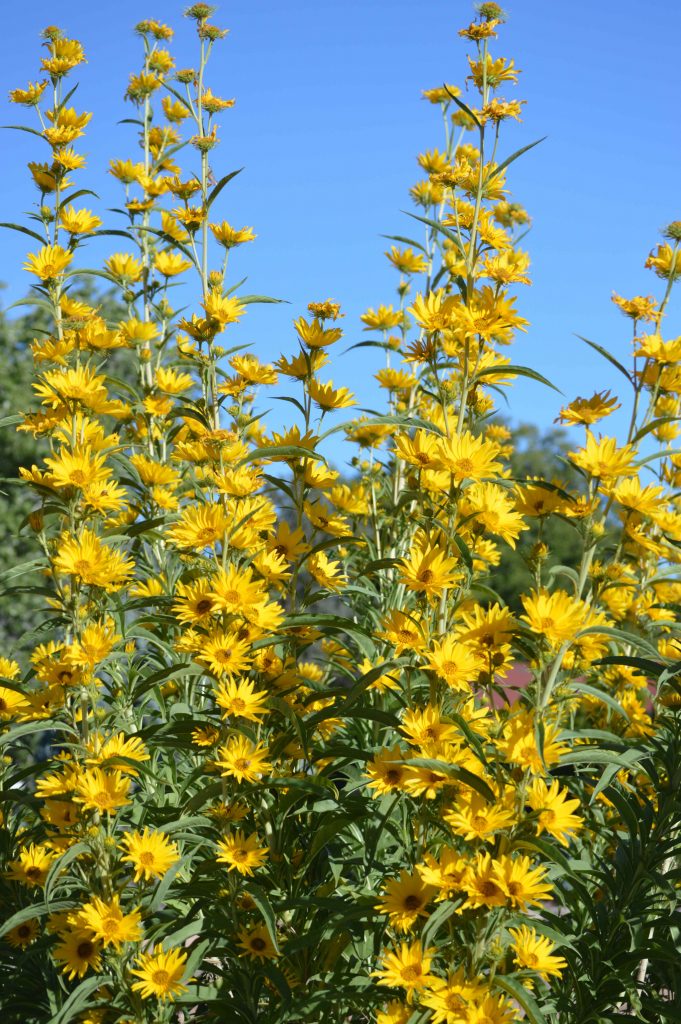
Perhaps the most spectacular late blooming perennial is the Maximilian sunflower Helianthus maximiliani. By early autumn, its flower stems are 5 to 7-feet tall. Established plants can spread 4 or more feet wide, shooting up dozens of flower stems. The top few feet of the stems are covered in 2-inch wide yellow sunflowers with yellow centers abuzz with bees. The show can last for several weeks in September or October, but after the flowers fade the plants become a bird buffet of seeds well into winter. Maximilian sunflowers grow best in soils that hold water well and produce the best show when watered to a depth of 2 feet weekly during the growing season, every two weeks in spring and fall and monthly or less in winter.
Maximilian sunflower, Helianthus maximiliani
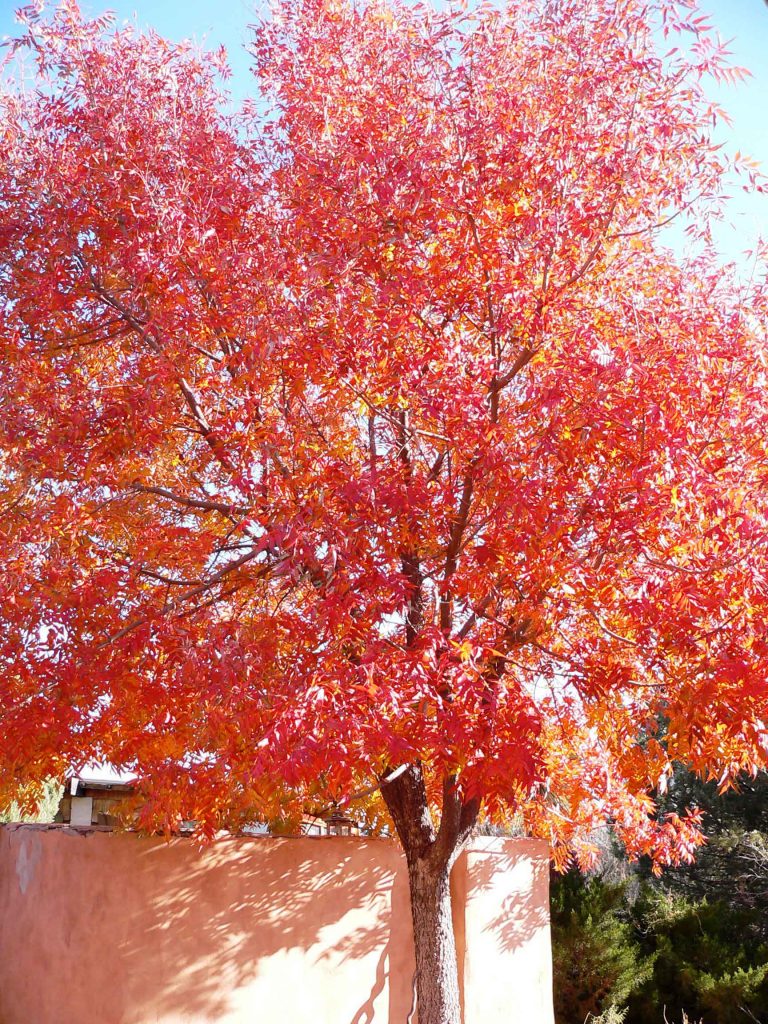
Flowers aren’t the only source of fall color, either, but red leaves in fall are not the norm in New Mexico. Cottonwoods in the Bosque and aspens in the mountains are our autumn gold. Chinese pistache Pistacia chinensis has become one of the most dependable heat and drought tolerant shade trees and adds splashes of red fall foliage in the ABQ metro area. A great shade tree that is 20 to 30-feet tall at maturity with a canopy spread of 20-feet, Chinese pistache benefits from structural pruning while it is young to assure strong branching. Once well rooted, it should be watered at the edge of the branch canopy to a depth of 2 to 3 feet every few weeks during the growing season and monthly or less depending on winter moisture.
Chinese pistache, Pistacia chinensis
Author: Judith Phillips, owner of Design Oasis, landscape designer and garden writer with 30 years experience designing arid-adapted and native gardens in the high desert.