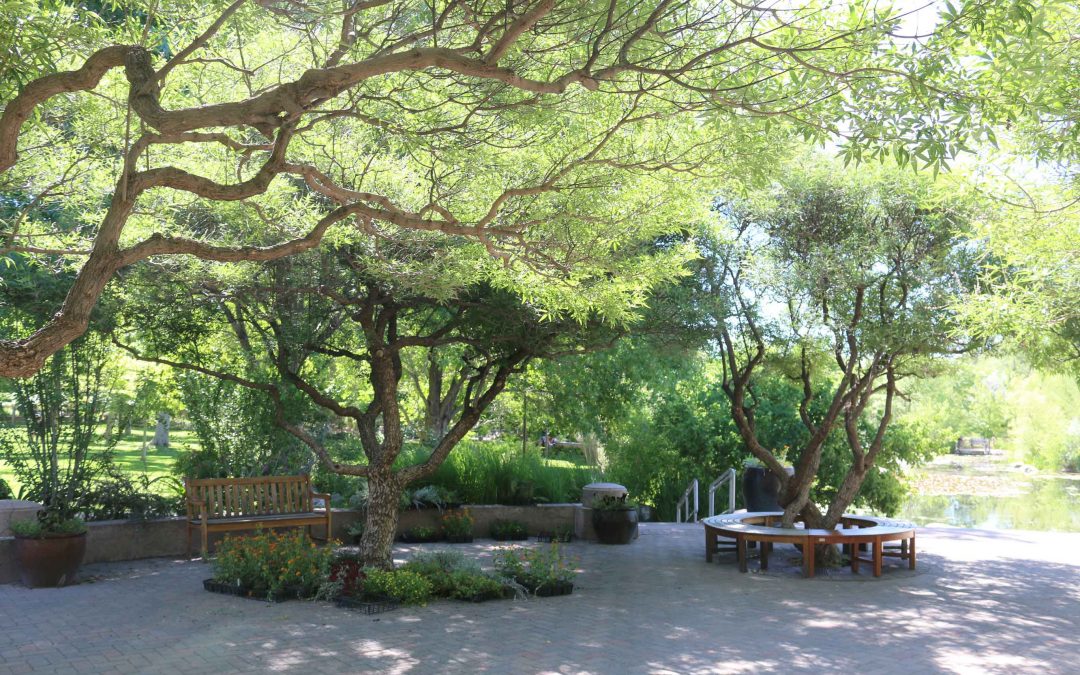
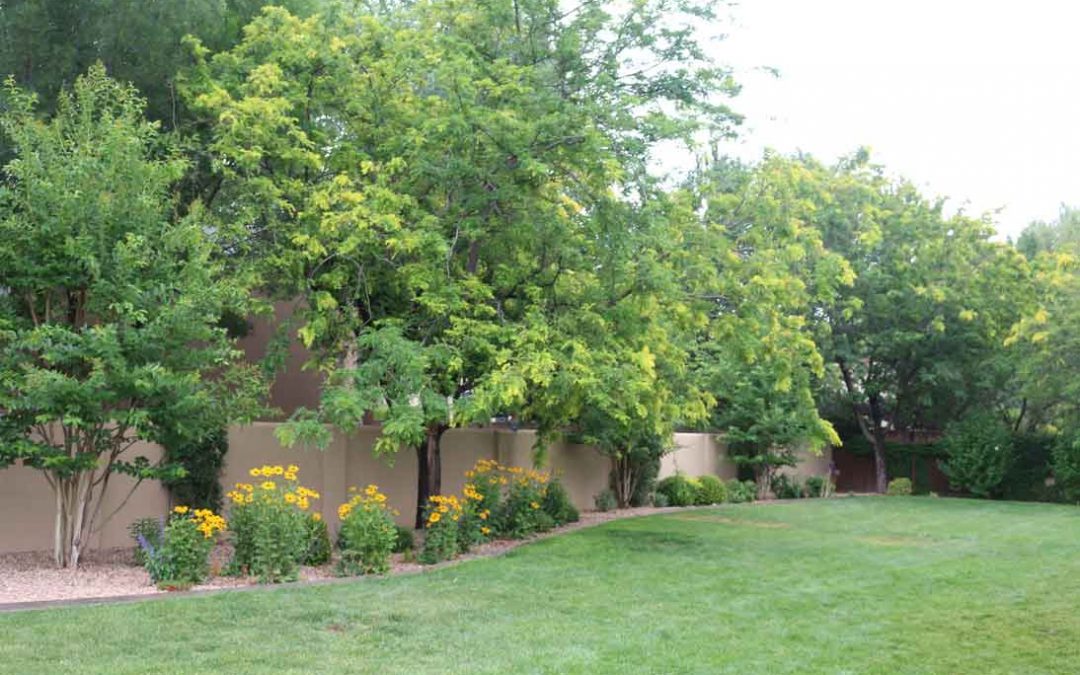
Our urban forest (yes, the trees in your landscape are part of a forest) provides so many benefits too us – cooling, increased home values, beauty, and better mental health just to name a few.
Here’s what you can do to help keep your members of our urban forest as healthy as possible.
1. Water your trees to a depth of about two feet, because 95% of the tree’s roots are in the first two feet of soil. To check if you are getting down to that two-foot optimum, insert a long screwdriver or soil probe into the soil around your tree a day after watering to determine the depth the water has reached. Adjust your watering time, if needed, to reach that two-foot goal.
2. Water your trees a little inside and outside of the canopy edge (the outer ring of the tree’s leaves) because that is where the roots that take in water are located.
4. Check your trees for signs that they aren’t getting enough water: wilted leaves early in the morning, scorched leaf edges, twig die-back from the top down or a sparse leaf canopy.
5. Take advantage of rainwater by directing downspouts or canales toward existing trees. Consider planting new trees in lower areas to take advantage of captured moisture.
6. Surround your trees with 4-6 inches of organic mulch. Organic mulch helps to retain soil moisture, keeps soil temperatures more consistent, and keeps weeds out. Additionally, over time it loosens compacted soil, adds organic matter, and slowly adds nutrients to the soil. Note: organic mulch does not include bark (sometimes called ‘bark nuggets’ or ‘deco bark”). Use actual wood chips like what comes out of an arborist’s woodchipper. Many tree services offer wood chips for free and several local businesses sell wood chip mulches in bulk.
Author: Amos Arber, ASLA, ISA Xeriscape Incentive Inspector with the Water Resources Division for the Water Authority. Have a question about the article AskAnExpert@abcwua.org
The amount of water needed and where that water should be applied changes as woody plants (such as trees, shrubs and vines) get larger. Woody plant material has two types of roots, stabilizing roots and feeder roots. Both types of roots do just what their name implies. Stabilizing roots are thick and dense to keep the plant in place and support its weight. Feeder roots are super fine and grow more like a net to take in water and nutrients. Feeder roots expand out as the plant grows.
Some woody plants require more water as they mature, but more desert-friendly species may not require extra water or may even be able to survive without supplemental irrigation once established. Perennials normally do not need to have expanded watering the same way woody plants do as they mature.
Some examples of this:
Plant Type
Plant
1st summer
2nd summer
3rd summer
Tree
Desert Willow (Chilopsis linearis)
60 gallon per month
120 gallons per month
400 gallons per month
Shrub
Butterfly Bush (Buddleia davidii)
60 gallon per month
70 gallon per month
100 gallon per month
Desert-Friendly Shrub
Chamisa (Ericameria nauseosa)
20-30 gallons per month
20-30 gallons per month
Usually possible to remove from irrigation
Vine
Trumpet Vine (Campsis radicans)
40 gallons per month
60 gallons per month
100 gallons per month
Woody Groundcover
Prostrate Sumac (Rhus trilobata)
20-30 gallons per month
40 gallons per month
60 gallons per month
For those plants that do have increased irrigation needs as they mature here are three easy ways to apply the right amount of water in the right place depending on the type of irrigation you are using.
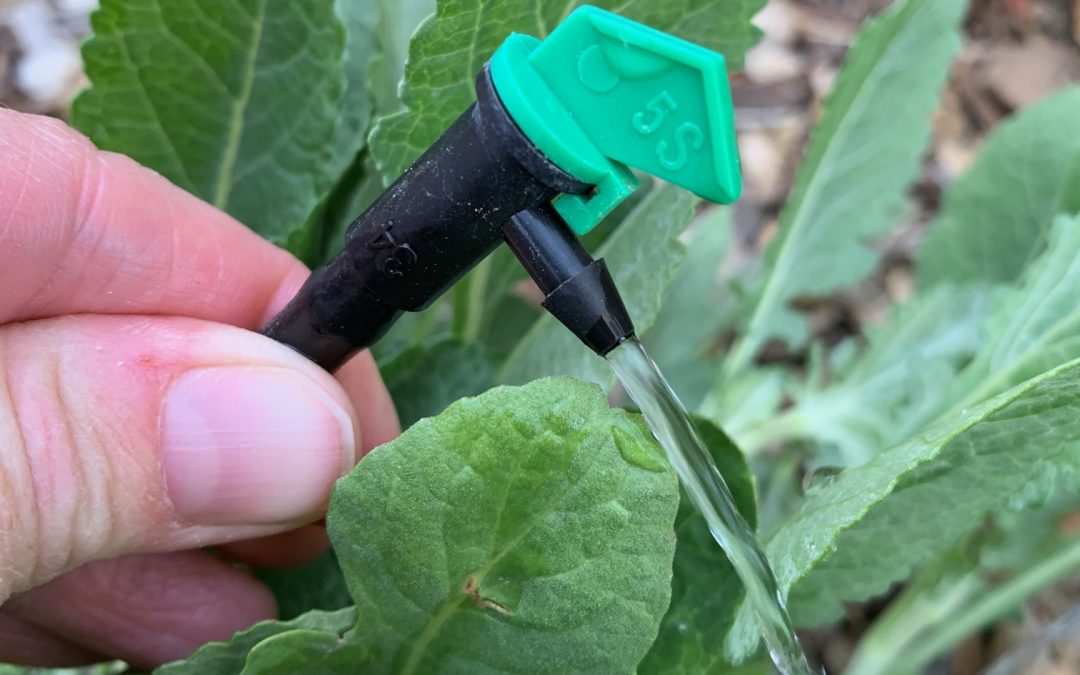
Drip Emitters – Move the drip emitters out to stay in line with the outer edge of the plants leaves where the feeder roots will be. Increase the number of emitters watering the plant too, placing them evenly around the outer perimeter of the plant.
Netafim (in-line professional drip line) – this is typically installed in rings around the plant and additional rings can be added as the plant grows larger. Netafim can also be laid out in a grid pattern, particularly when being installed around an already established plant.
Hand-watering – Build and maintain a watering well at the outer edge of the plant perimeter. As the plant grows, increase the size of the well.
Author: Richard Perce, Irrigation Efficiency Specialist with the Water Resources Division for the Water Authority. Have a question about the article AskAnExpert@abcwua.org
Service: April’s freeze
may have damaged your irrigation system, so make sure to inspect it for leaks,
or broken sprinkler heads and emitters!
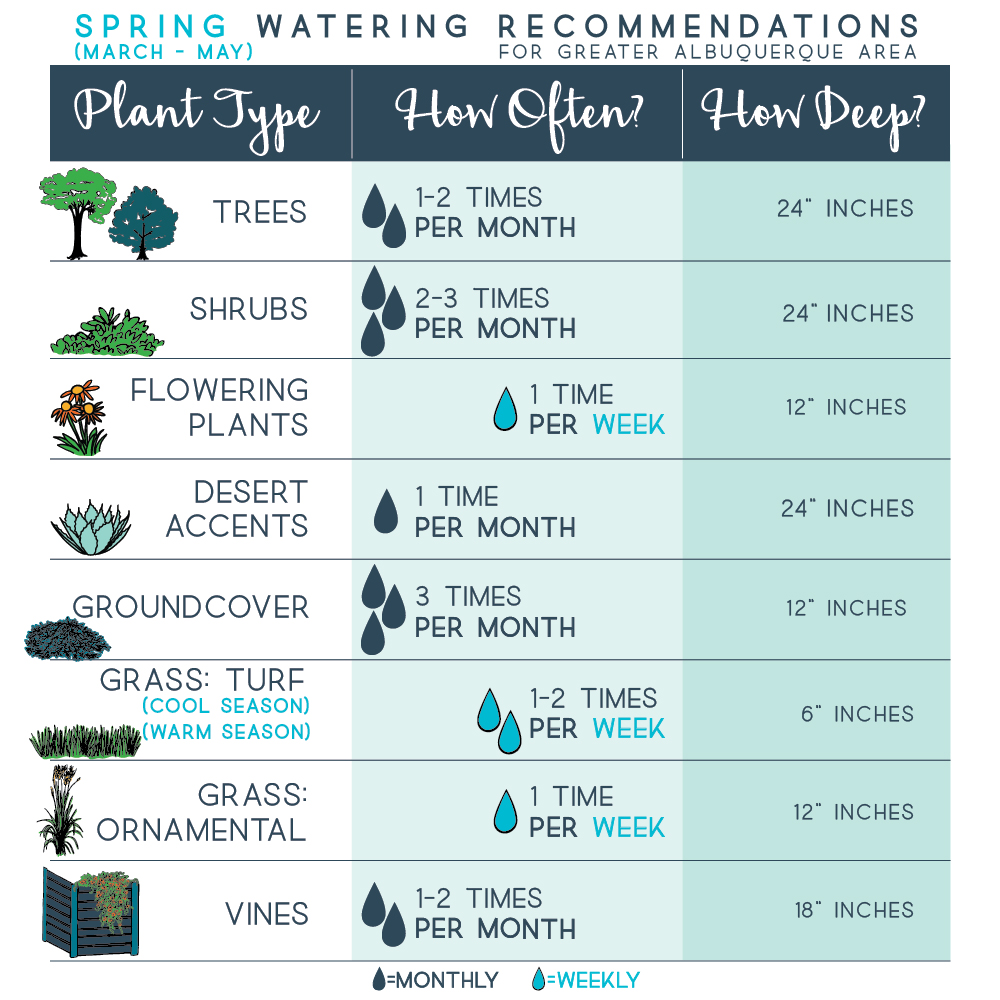
Watering Recommendations: Spring rains are benefitting established landscapes! Follow these watering recommendations to keep your yard looking healthy: for grass (turf), water one-two times per week and for your trees water one-two times per month. To know how much to water, follow our Water by the Seasons spring watering recommendations. Remember, if it rains more than a half inch you can skip your next scheduled watering time as there is no need for supplemental irrigation.
Trees are incredibly valuable and provide a wide array of
benefits, from increasing home values to improving mental health.
Unfortunately, Albuquerque has suffered large losses of trees in the past
decade. It’s more important now than ever to take care of your existing trees.
A common sight on spring evenings is seeing people with
their thumb on the hose, spraying the trunk of a tree. While it’s great to see
people caring for their trees, there is a better way to water them.
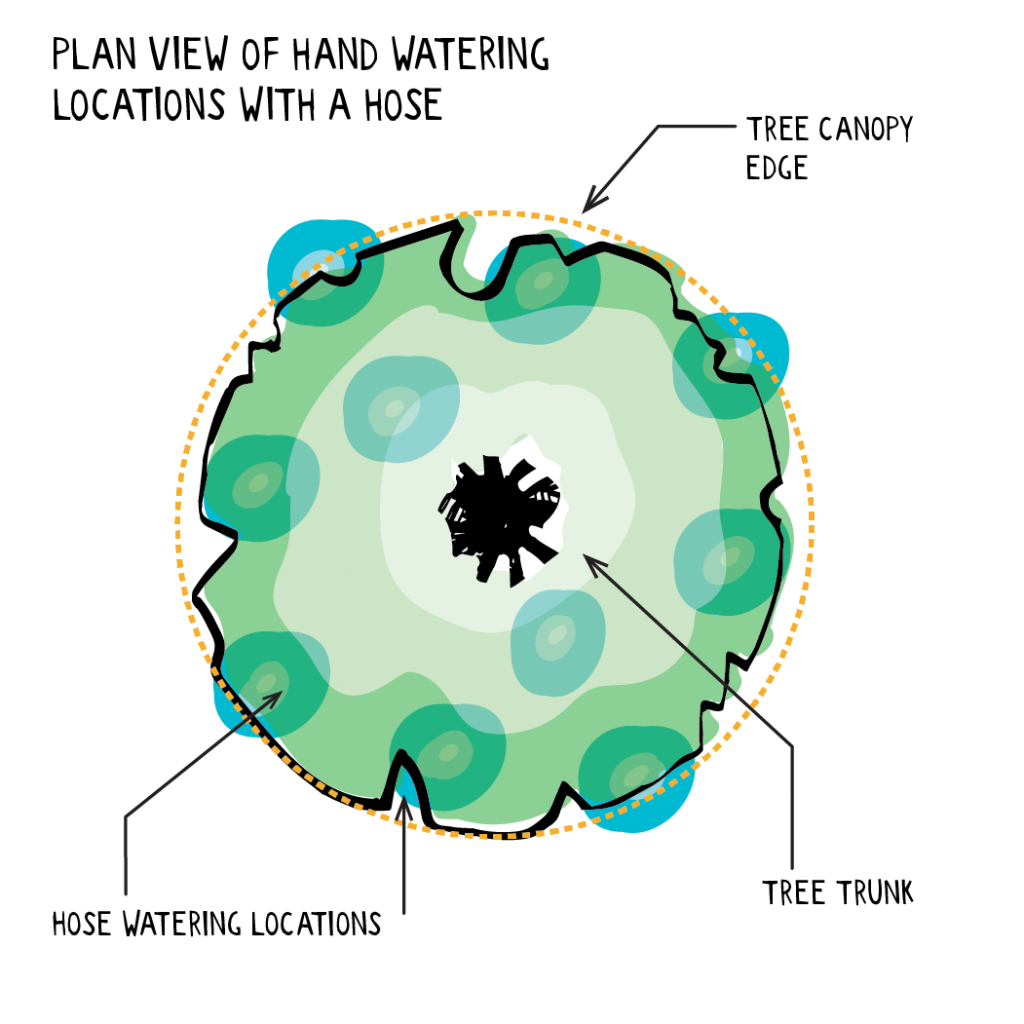
Trees have several different types of roots that serve different functions. Fine hair feeder roots are responsible for taking up water. Because these feeder roots are generally located near the tree’s canopy edge, this is where you want to apply water: a little inside and a little outside of the canopy edge.
TREE WATERING TIPS:
1. Hand watering
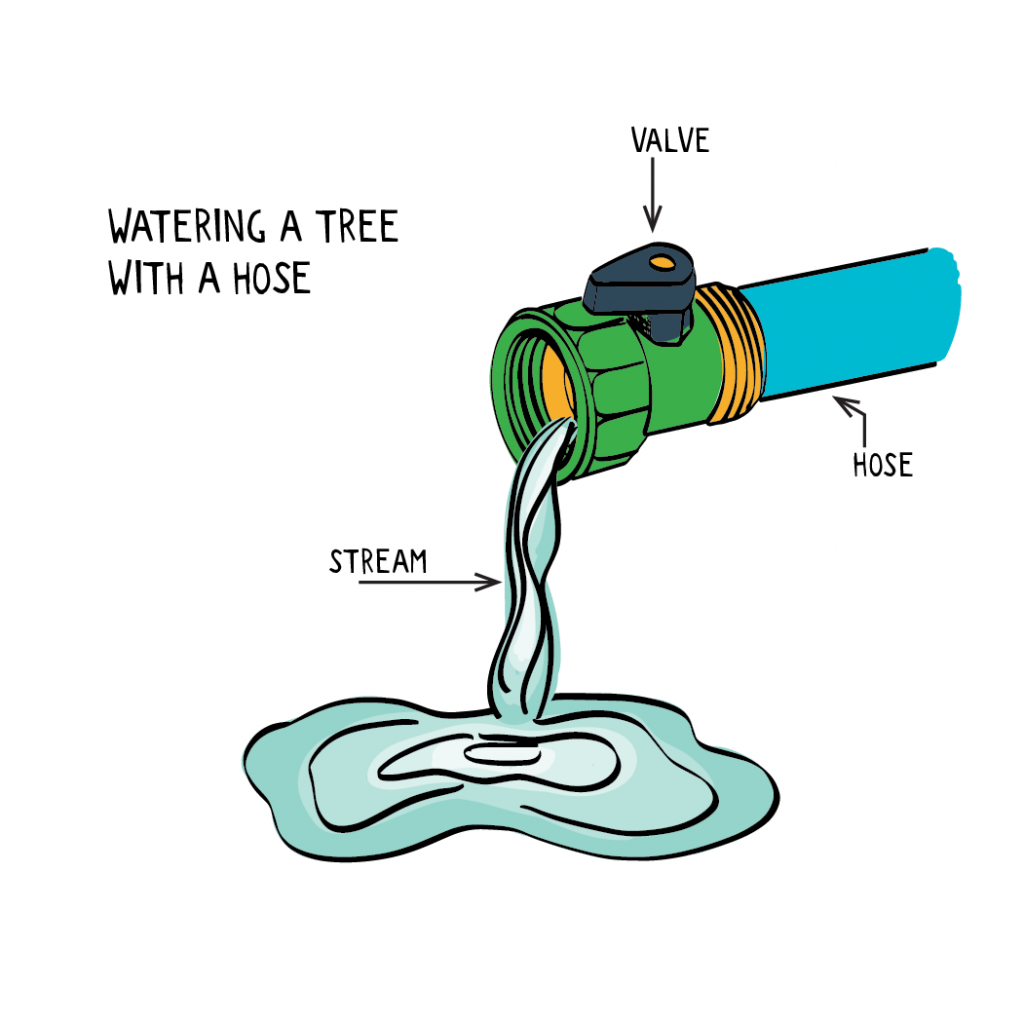
Turn your hose to a low flow or fast drip, so the water soaks into the soil before running off (try a hose end shut off valve). Set a timer and move the hose to different locations every 20 minutes starting 5 feet from the trunk to just outside the canopy edge. Small to medium trees will require watering at between 12 and 20 locations. Larger trees may need to be watered in sections over a few days.
2. Drip irrigation on desert friendly xeriscape
Growing healthy trees in a desert friendly xeriscape is possible using drip irrigation such as flag emitters. As trees grow, they require more resources in the form of soil rooting space and water. That means that as trees become established, drip irrigation emitters need to be shifted away from the original rootball (at the time of planting) out to the edge of the tree’s canopy. Additionally, the number and size (volume) of emitters needs to be increased as the tree grows. Most people don’t make these adjustments. Consider these strategies instead:
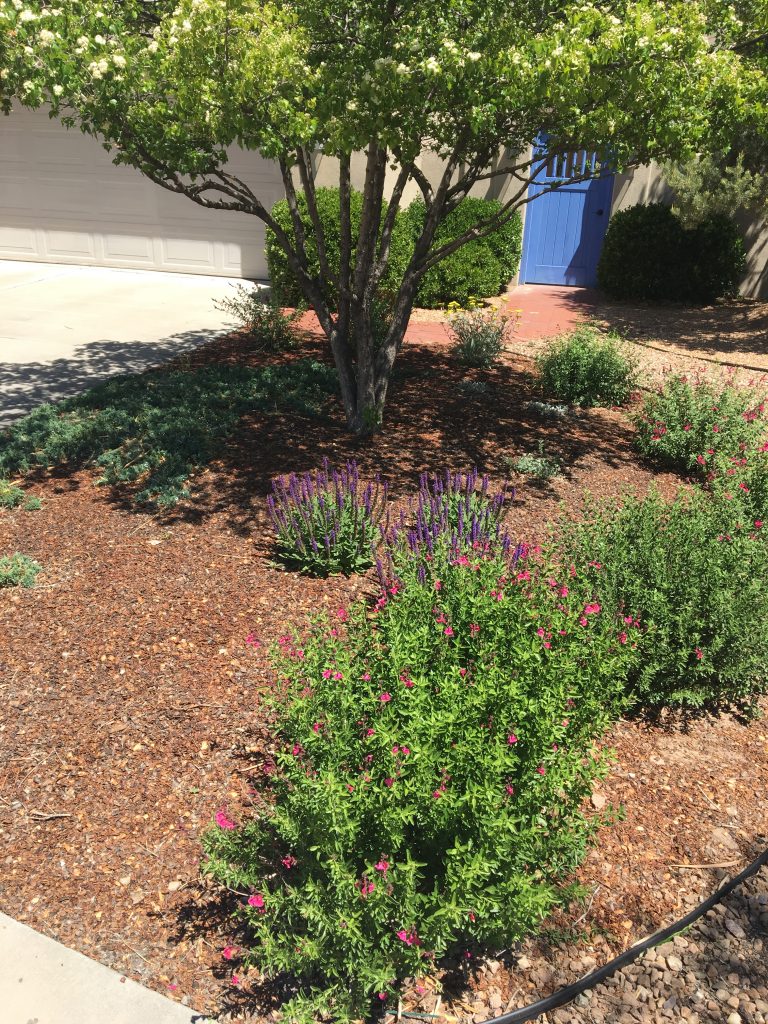
Plant an understory of groundcovers or flowering perennials within and beyond the tree’s canopy. The emitters used to water the groundcover plants will, in turn, water the tree. As the tree becomes larger it may eventually shade out the groundcovers, but the emitters should be kept in place to continue watering the tree.
Consider supplemental watering by hand in dry areas of your yard that are not covered by the drip irrigation system.
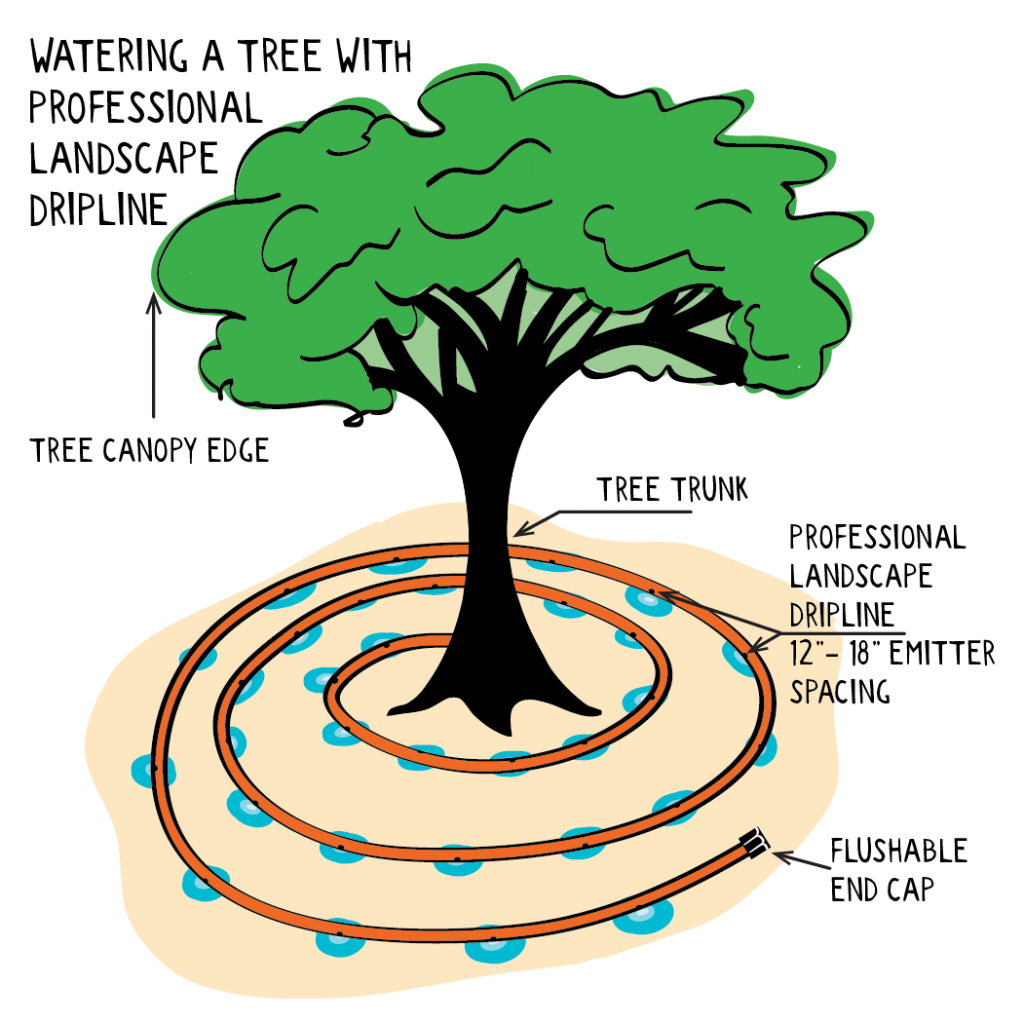
A similar strategy is to use professional landscape drip line (often referred to as netafim) in a grid or spirals in and outside of the tree’s canopy. This irrigation material requires less frequent maintenance and can be installed under mulch. As the tree matures, the drip line can be expanded and shifted to support the increasing needs of the tree. Understory plantings can also be used with this type of irrigation material.
3. Using sprinkler irrigation to water trees in a grass lawn
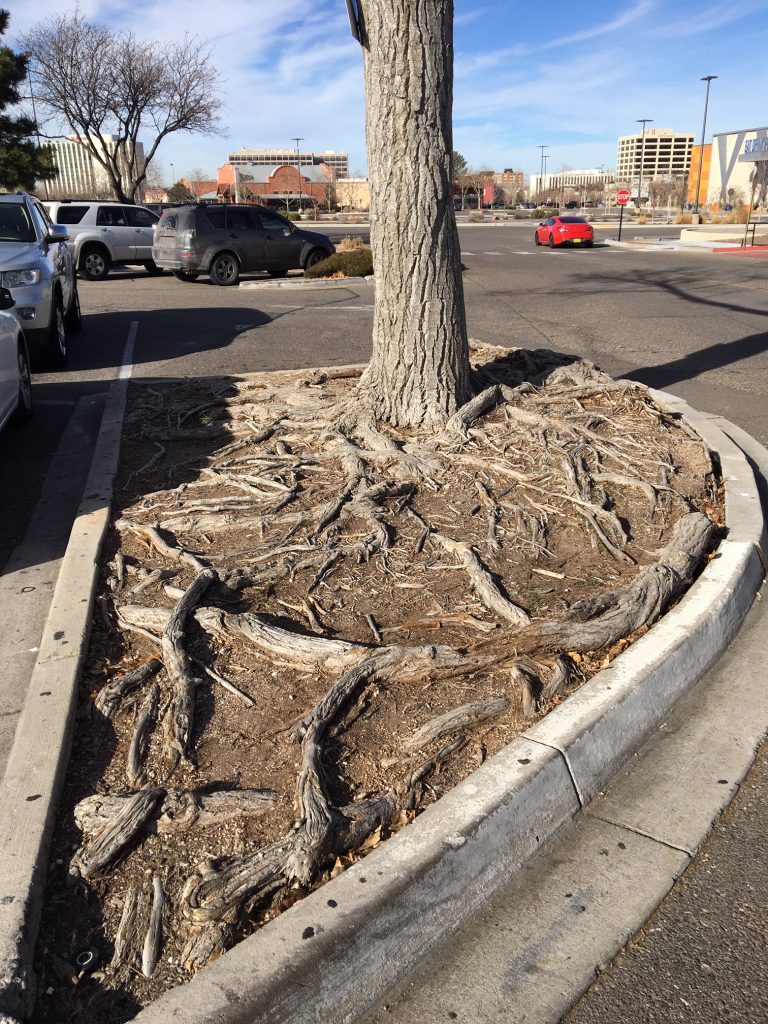
Most lawns in our area require nearly 40 inches of yearly irrigation to look good. So, it makes sense to plant a tree in the lawn to take advantage of all that water. Most of the large, beneficial trees in our city parks are grown like this. However, some species (like cottonwoods) respond to the shallow and frequent lawn irrigation by making shallow roots that protrude above the surface. These surface roots create tripping hazards. Damage to the tree can result from lawn mowers, too. Shallow roots also make the tree more susceptible to drought stress. Encourage tree roots to go deeper by occasionally (one-two times per month) running the lawn sprinklers for three or more cycles for a longer period. This will help to get water down deep, where it will remain in the soil longer and encourage roots to move deeper. Occasional deep watering in lawns also has the added benefit of flushing out salts accumulated from hard water and fertilizer.
Example of exposed surface roots. Author: Amos Arber, ASLA, ISA Xeriscape Incentive Inspector with the Water Resources Division for the Water Authority. Have a question about the article AskAnExpert@abcwua.org
Do you want to walk barefoot across cool, soft grass? Especially on those hot summer days? We’d love for you to do that! We also want you to take care of your lawn in a healthy way that saves the most water.
One might assume that proper lawn care begins in the spring
but creating that beautiful lawn can start at any time. Sometimes it’s even better
to start in the fall. Either way, you need to begin with good soil, full of
organic material that will both provide nutrition and help hold in that
moisture. But if you don’t already have that, how do you get it?
First, dethatch your lawnonce a year. Most lawns need this done when the layer of thatch reaches roughly ½” thick. Cool season grasses, such as bluegrass, need to be dethatched in the fall, whereas warm season grasses, such as Bermudagrass, need to be dethatched in the spring.
Aeratingis the second step needed to keep your lawn as healthy and water efficient as possible. If you have an older lawn, or have highly compacted soil, you should aerate twice a year -- once in the spring and again in the fall. If you are aerating, or hiring someone else to do it, run the irrigation first and flag all your spray heads or rotors. This prevents inadvertently creating the need for sprinkler repairs! Aerate the whole lawn one direction and then again perpendicular to the first pass.
Also, regularly sharpen the blades on your mower and set it up as a mulching mower. Your mowing height should be as high as possible to help maintain a healthy lawn and conserve water.
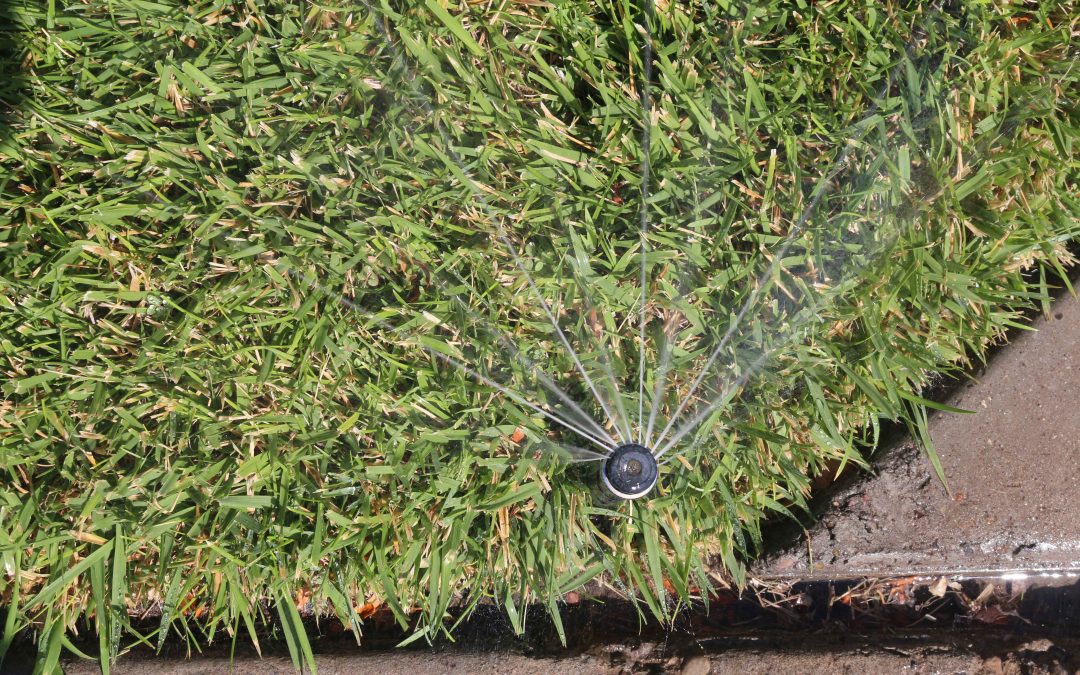
Watering correctly is most important, so maintain your irrigation system year-round, and follow the Water by the Seasons watering recommendations. Check all the filters on each of your spray heads or rotors, then run your system to ensure that all of your spray nozzles or rotors are aligned and aren’t clogged. Repair or replace anything that isn’t working properly. Also check the base of each spray head to make sure you don’t have a leak at the base. The ground will probably be soft and squishy if there is one. To improve efficiency of your system, choose high efficiency sprinkler nozzles (rebates of $2 are available).
One last thing. Kick those shoes off and go enjoy that lawn!
Author: Richard Perce, Irrigation Efficiency Specialist with the Water Resources Division for the Water Authority. Have a question about the article AskAnExpert@abcwua.org
A lot of things have changed since last spring, but at least one thing is the same: April 1 is still the date on which time-of-day watering rules go into effect for Water Authority customers in Albuquerque and Bernalillo County. That means sprinkler and spray irrigation is not allowed between 11 a.m. and 7 p.m. from now until Oct. 31 in order to minimize losses to wind and evaporation.
Using spray irrigation during the hottest, windiest part of
the day is not efficient. Instead, water in the early morning or in the evening
when it’s cooler. Another good way to avoid water waste is by troubleshooting
your irrigation system on a regular basis to identify leaks and make sure water
is directed properly to the plants. Follow these tips for a desert friendly
yard:
For turf, follow the Water by the Numbers program and adjust your watering schedule as the season changes: Two days per week in April and May, three days per week in the summer, and ramp down again in the fall.
Irrigate only when your plants need it, and water them deeply rather than too frequently. Use a long screwdriver or soil probe to check soil moisture.
Add compost to your soil to increase moisture retention and boost soil fertility.
Mulch around plants to help retain moisture and reduce weeds.
Grow strong and healthy trees by watering infrequently, to a depth of at least 24,” in a wide area around the tree’s canopy. Many of our trees only need deep watering 1 -2 times per month (depending on the species and conditions).