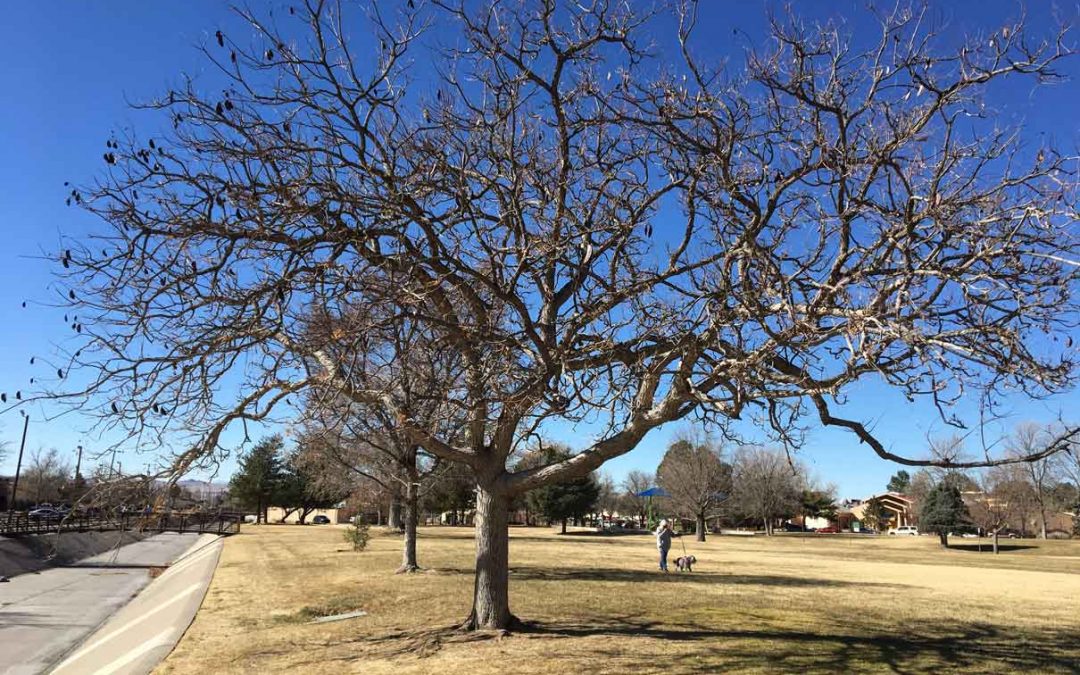
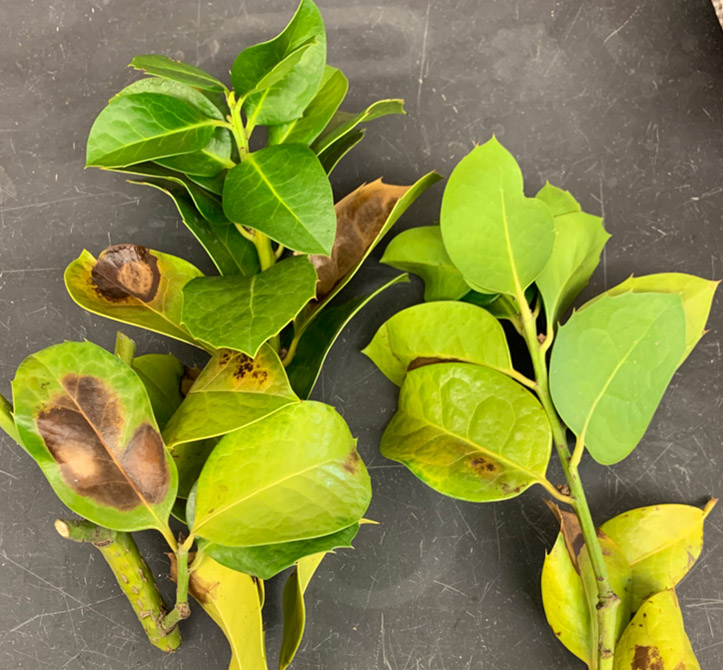
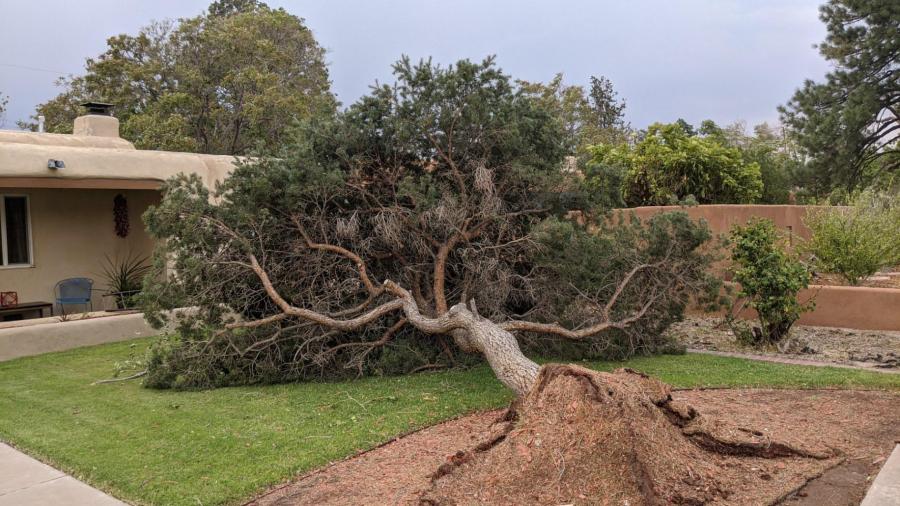
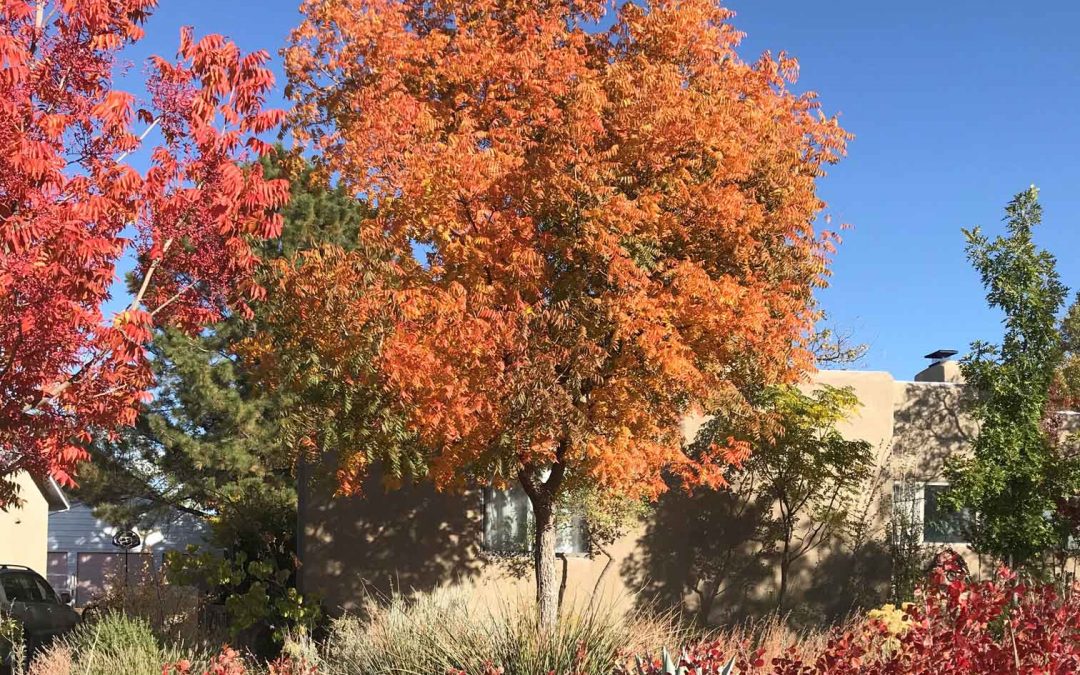
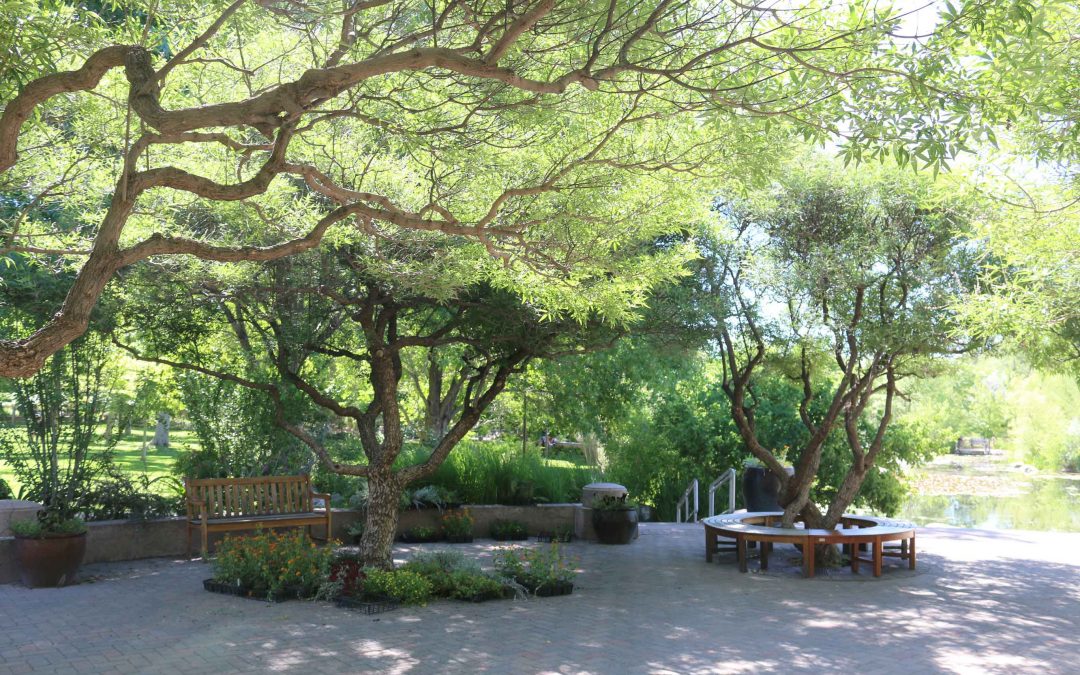
In an arid city like Albuquerque, trees and the urban forest are even more important than in places with more moisture. Trees provide shade and habitat, and help cool the urban landscape. To sustain a healthy canopy trees require special care given the arid climate, ongoing drought, and warming temperatures. This year’s hot, dry conditions highlight the need for New Mexicans to take even more care of their trees – and to plan for which species will grow best in increasingly warm conditions. This was especially true this past September when a windstorm wreaked havoc on trees throughout the city.
In collaboration with Our Land New Mexico, a local environmental show on NMPBS, we are sharing a short (7 minute) episode they did about the urban forest in Albuquerque.
The episode discusses how the vitality of a city can be measured in part by the health of its trees and plant life. There is also evidence that tells us how exposure to nature provides emotional and social benefits, lowers stress levels and encourages more community engagement in residential settings.
We encourage you to take care of your trees to support our urban forest and if you are adding a new tree email [email protected] with questions. Local tree experts around the Southwest, including conservation staff from the Water Authority, with the guidance of the Nature Conservancy, have put together a climate-ready tree list that includes trees that will thrive in our current and future climate.
Author: Water Authority in collaboration with correspondent Laura Paskus of Our Land New Mexico and guest Joran Viers, City Forester, CABQ Parks Management Division. Have a question about the article? [email protected]
We love our trees. Trees have a cooling effect in our yards by providing shade and they increase property value. When our trees do not “look good,” we try to help them, but when that one “magic” application does not solve the issue, we are often discouraged. A proper plant diagnosis will help your trees and save you time, money, and energy when dealing with the problem.
Damage to your tree can be caused by a living organism and/or environmental factors. Fungi, bacteria, viruses, nematodes, mites, insects, and animals fall under the living organism category and these tend to attack specific plants. Environmental factors that could affect trees include drought stress, salt injury, chemical injury, winter damage, improper planting, watering, and growing conditions, among others. Damage caused by living organisms can be similar to the damage caused by environmental factors. Here are a few tips to help you conclude what is causing damage to your tree:
First, identify the tree and how old it is. Knowing this will help you become familiar with the best growing conditions for that tree, and what kinds of insects and diseases are specific to it.
Inspect the tree – take a thorough look at the trunk, branches, and leaves. What abnormalities do you notice? Are the leaves discolored, bite marks, abnormal growth, unusual size, odd branches, or is the trunk oozing? What color is it? Does it smell? Do you notice any injuries or scars? Any holes? What size and shape?
Look at the environment where the tree is growing. How was the tree planted (burlap, chicken wire, planted too deep, girdling roots)? What kind of soil is it planted in (sandy, clay, poor drainage, compaction, etc.)? Is the tree near a foundation, driveway, traffic areas, wall structures, etc.? Any construction or change in the landscape around the tree area?
What watering conditions has the tree been subject to (water at the dripline, how much water, water throughout the year, etc.)? How is the water system checked? What is the soil coverage around the tree (rock, bare soil, lawn, organic mulch, etc.)? Any chemical application (herbicide, fertilizer, insecticide, etc.)?
Gather other information. Pictures help a lot to see how the issues have progressed. Collect any insect samples. Record when the symptoms started to appear.
All this information is crucial because symptoms caused by environmental factors can be like those caused by living organisms. In some cases, a lab analysis might be the best option to confirm or dismiss the presence of a pathogen and will help you develop a treatment plan.
Consider this common scenario: A 15-year-old tree grows next to a paved driveway and a wall, with gravel mulch around the base. Underneath the gravel is a plastic layer of weed fabric.
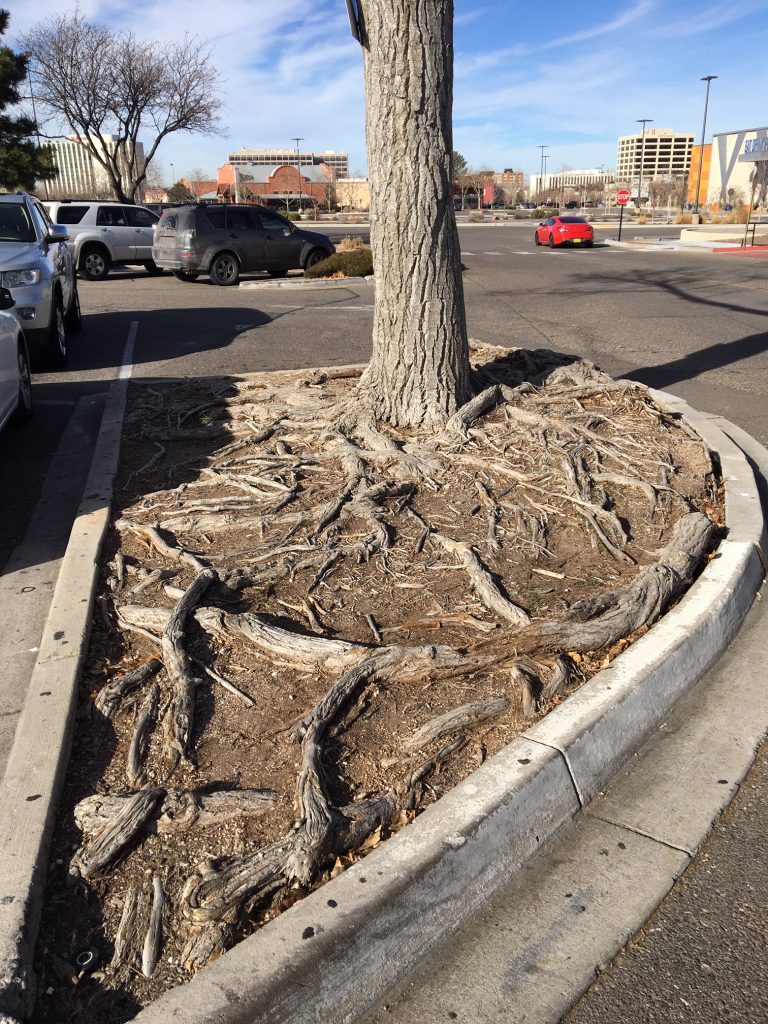
Shallow roots due to heat stress and limited watering. Photography Courtesy of James Vocasek c/o KRQE.com
The tree does not receive enough water for many years and gets no rainwater through the weed fabric. This tree is struggling to develop a good root structure and starts looking unhealthy. Eventually the tree gives up and a strong wind brings it down. In this case, chemical treatment will not improve the tree’s appearance because it is not addressing the true cause of the problem: watering improperly.
Diagnosing what is wrong with your tree will take time, but it is worth it. These local resources can help:
Author: Sara Moran, Extension Horticulture Agent, Bernalillo County, NMSU Cooperative Extension Service. Have a question about the article? [email protected]
The balancing act of watering your trees in the fall and winter is important. Established trees should be watered two to three times a month in the fall season and once a month in the winter season. If not watered properly, trees that get too dry during this time can suffer stress and drought injury. This often does not show up until the heat of the following summer, which then makes trees more susceptible to pests and disease. Fall is the time to set your trees up for winter success.
Other important factors to consider when watering trees:
Newly planted trees (trees planted within 1-3 years), are more susceptible to damage from dry conditions and should be watered more frequently than established trees. Try watering them to a depth of 24 inches three times a month in the fall and twice a month in the winter.
Evergreen trees lose water through their needles in the dry winter air. They need more stored-up water going into the winter season to make up for that. Cold, dry winds can strip water from evergreens faster than their roots can absorb it, too. That is why it is especially important to provide enough water in the fall and during dry, warm spells in the winter.
Even though they lose their leaves, deciduous trees should also not get too dry in the fall and winter. Water acts as an insulator for both the tree and soil. Soil that stays moist will be warmer. Likewise, plant cells that are plump with water will be less susceptible to damage from the cold. Water deciduous trees to a depth of 24 inches twice a month during the fall and once a month in the winter.
When watering any tree, remember to apply water out to the edge of the tree’s canopy drip line. Most established trees have a root spread equal to their height and beyond. Water deeply and avoid spraying foliage. Watering to the right depth depends on your specific soils, so you will want to measure how much water it takes your soils to reach 24 inches deep. Read this article for tips on measuring watering depth.
One of the best things you can do for your trees in the coming months is to add mulch. Layering three to four inches of organic mulch protects the soil from moisture loss and helps regulate soil temperature throughout the winter. Treebates for bulk organic mulch is available.
Pro Tip: "Watering to the right depth and managing the frequency of watering are both very important aspects of keeping our plants healthy throughout the year, but especially in the fall and winter months,” says Patrick Chavez, Trees of Corrales Wholesale Nursery.
Author: Amos Arber, Xeriscape Incentive Inspector, and Certified Arborist with the Water Resources Division for the Water Authority. Photography: Wes Brittenham Pro tip:Trees of Corrales Have a question about the article? [email protected]
Our urban forest (yes, the trees in your landscape are part of a forest) provides so many benefits too us – cooling, increased home values, beauty, and better mental health just to name a few.
Here’s what you can do to help keep your members of our urban forest as healthy as possible.
1. Water your trees to a depth of about two feet, because 95% of the tree’s roots are in the first two feet of soil. To check if you are getting down to that two-foot optimum, insert a long screwdriver or soil probe into the soil around your tree a day after watering to determine the depth the water has reached. Adjust your watering time, if needed, to reach that two-foot goal.
2. Water your trees a little inside and outside of the canopy edge (the outer ring of the tree’s leaves) because that is where the roots that take in water are located.
4. Check your trees for signs that they aren’t getting enough water: wilted leaves early in the morning, scorched leaf edges, twig die-back from the top down or a sparse leaf canopy.
5. Take advantage of rainwater by directing downspouts or canales toward existing trees. Consider planting new trees in lower areas to take advantage of captured moisture.
6. Surround your trees with 4-6 inches of organic mulch. Organic mulch helps to retain soil moisture, keeps soil temperatures more consistent, and keeps weeds out. Additionally, over time it loosens compacted soil, adds organic matter, and slowly adds nutrients to the soil. Note: organic mulch does not include bark (sometimes called ‘bark nuggets’ or ‘deco bark”). Use actual wood chips like what comes out of an arborist’s woodchipper. Many tree services offer wood chips for free and several local businesses sell wood chip mulches in bulk.
Author: Amos Arber, ASLA, ISA Xeriscape Incentive Inspector with the Water Resources Division for the Water Authority. Have a question about the article [email protected]
Trees are incredibly valuable and provide a wide array of
benefits, from increasing home values to improving mental health.
Unfortunately, Albuquerque has suffered large losses of trees in the past
decade. It’s more important now than ever to take care of your existing trees.
A common sight on spring evenings is seeing people with
their thumb on the hose, spraying the trunk of a tree. While it’s great to see
people caring for their trees, there is a better way to water them.
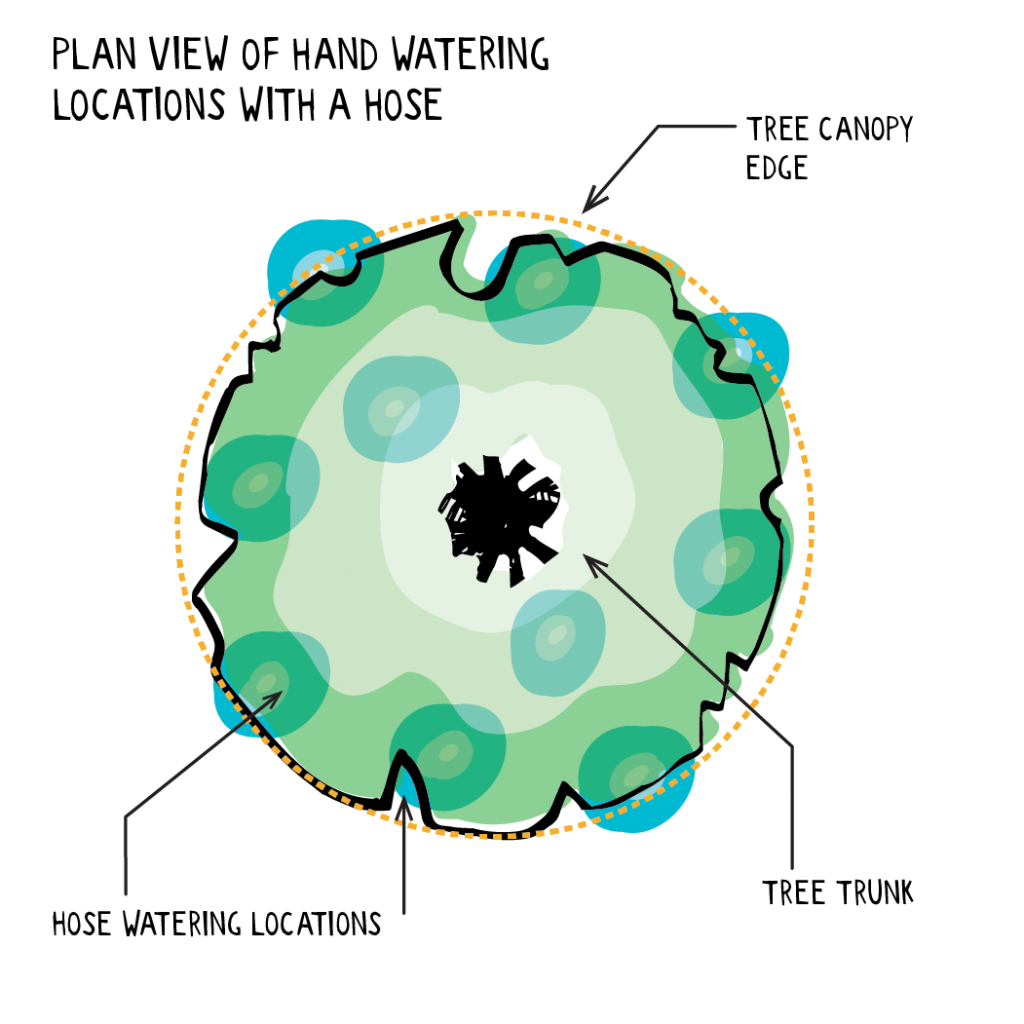
Trees have several different types of roots that serve different functions. Fine hair feeder roots are responsible for taking up water. Because these feeder roots are generally located near the tree’s canopy edge, this is where you want to apply water: a little inside and a little outside of the canopy edge.
TREE WATERING TIPS:
1. Hand watering
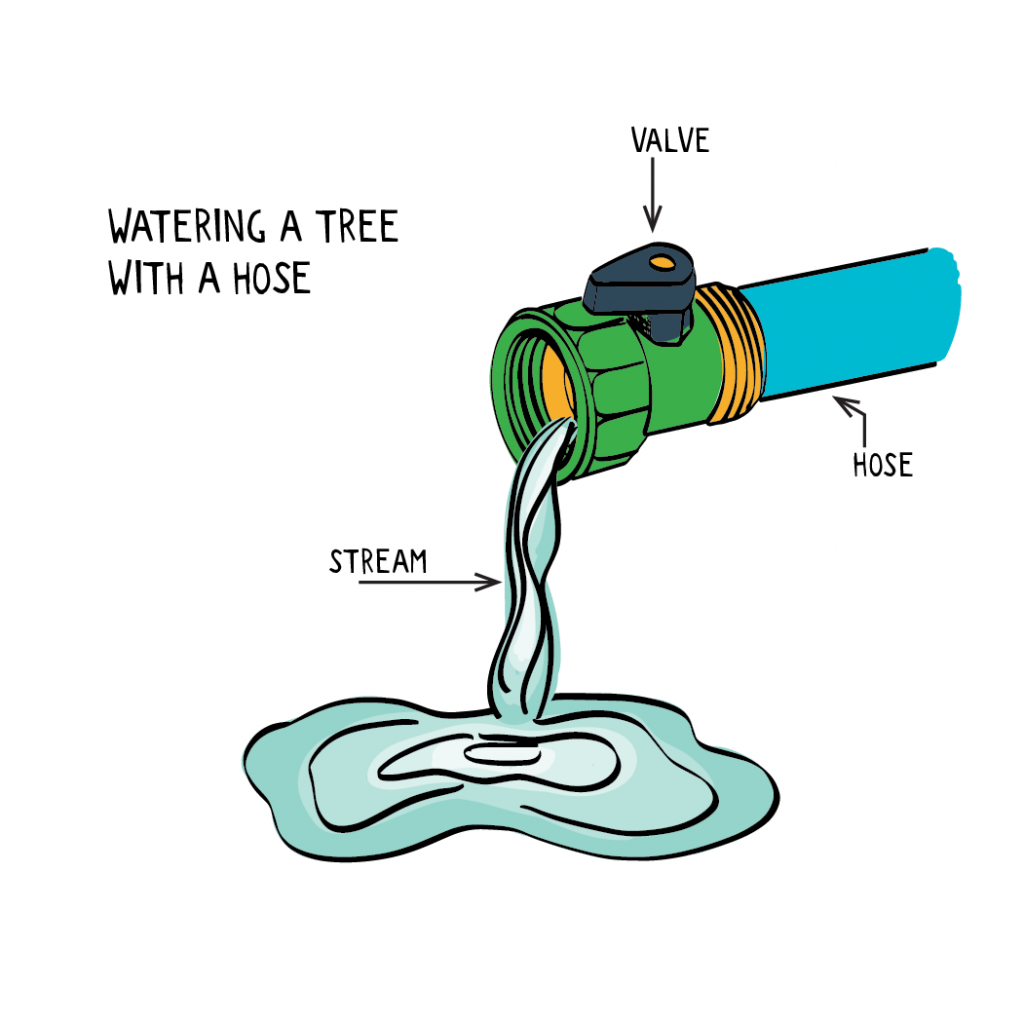
Turn your hose to a low flow or fast drip, so the water soaks into the soil before running off (try a hose end shut off valve). Set a timer and move the hose to different locations every 20 minutes starting 5 feet from the trunk to just outside the canopy edge. Small to medium trees will require watering at between 12 and 20 locations. Larger trees may need to be watered in sections over a few days.
2. Drip irrigation on desert friendly xeriscape
Growing healthy trees in a desert friendly xeriscape is possible using drip irrigation such as flag emitters. As trees grow, they require more resources in the form of soil rooting space and water. That means that as trees become established, drip irrigation emitters need to be shifted away from the original rootball (at the time of planting) out to the edge of the tree’s canopy. Additionally, the number and size (volume) of emitters needs to be increased as the tree grows. Most people don’t make these adjustments. Consider these strategies instead:
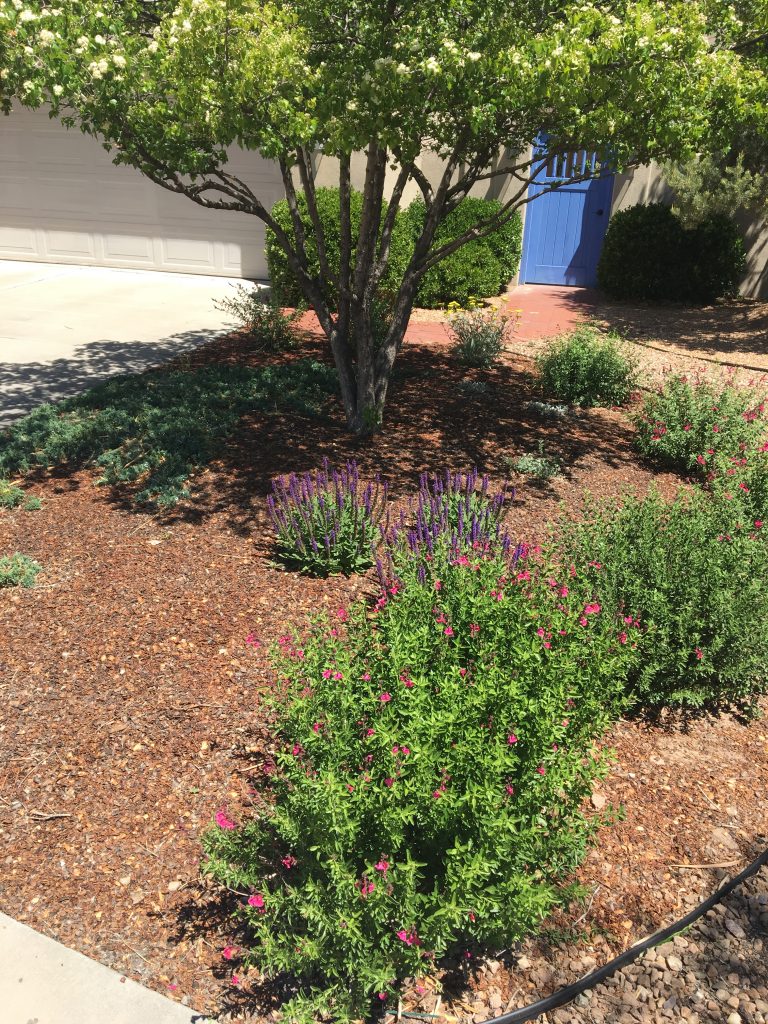
Plant an understory of groundcovers or flowering perennials within and beyond the tree’s canopy. The emitters used to water the groundcover plants will, in turn, water the tree. As the tree becomes larger it may eventually shade out the groundcovers, but the emitters should be kept in place to continue watering the tree.
Consider supplemental watering by hand in dry areas of your yard that are not covered by the drip irrigation system.
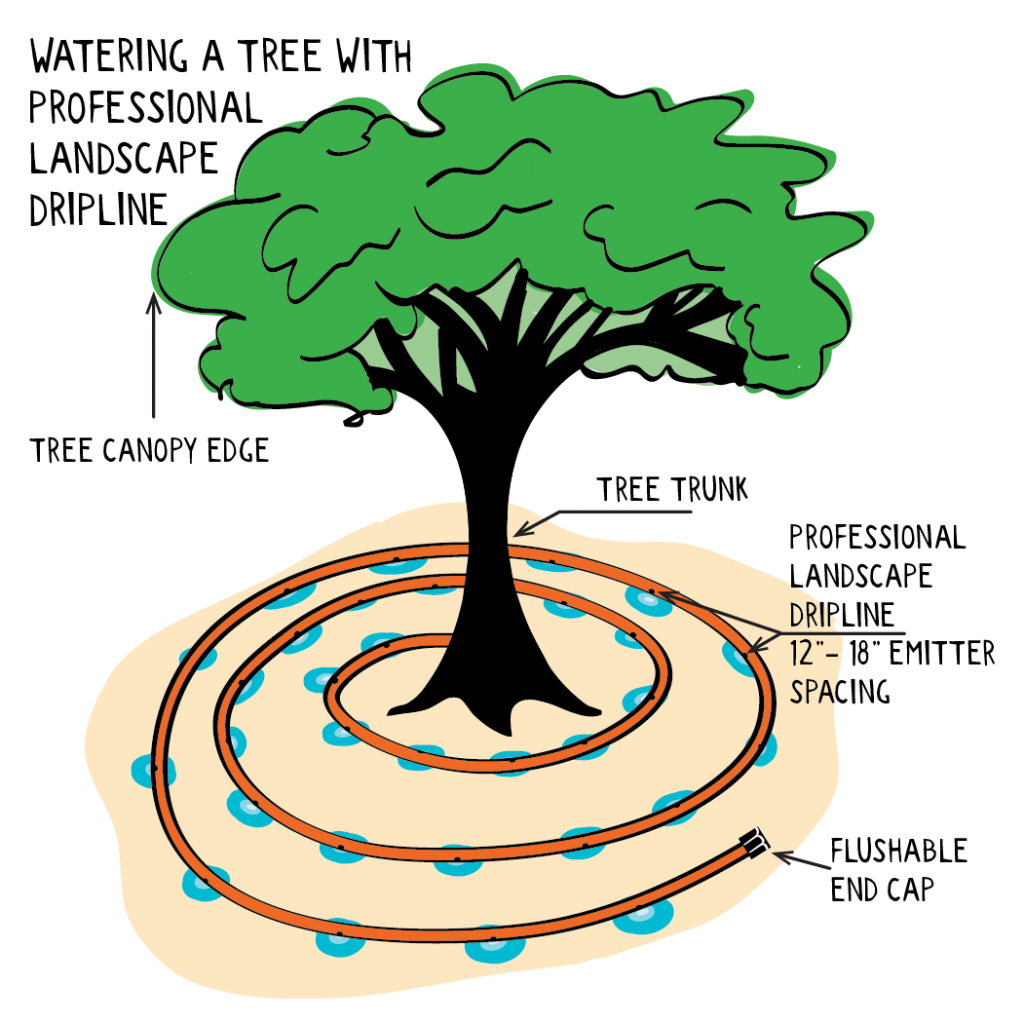
A similar strategy is to use professional landscape drip line (often referred to as netafim) in a grid or spirals in and outside of the tree’s canopy. This irrigation material requires less frequent maintenance and can be installed under mulch. As the tree matures, the drip line can be expanded and shifted to support the increasing needs of the tree. Understory plantings can also be used with this type of irrigation material.
3. Using sprinkler irrigation to water trees in a grass lawn
Most lawns in our area require nearly 40 inches of yearly irrigation to look good. So, it makes sense to plant a tree in the lawn to take advantage of all that water. Most of the large, beneficial trees in our city parks are grown like this. However, some species (like cottonwoods) respond to the shallow and frequent lawn irrigation by making shallow roots that protrude above the surface. These surface roots create tripping hazards. Damage to the tree can result from lawn mowers, too. Shallow roots also make the tree more susceptible to drought stress. Encourage tree roots to go deeper by occasionally (one-two times per month) running the lawn sprinklers for three or more cycles for a longer period. This will help to get water down deep, where it will remain in the soil longer and encourage roots to move deeper. Occasional deep watering in lawns also has the added benefit of flushing out salts accumulated from hard water and fertilizer.
Example of exposed surface roots. Author: Amos Arber, ASLA, ISA Xeriscape Incentive Inspector with the Water Resources Division for the Water Authority. Have a question about the article [email protected]
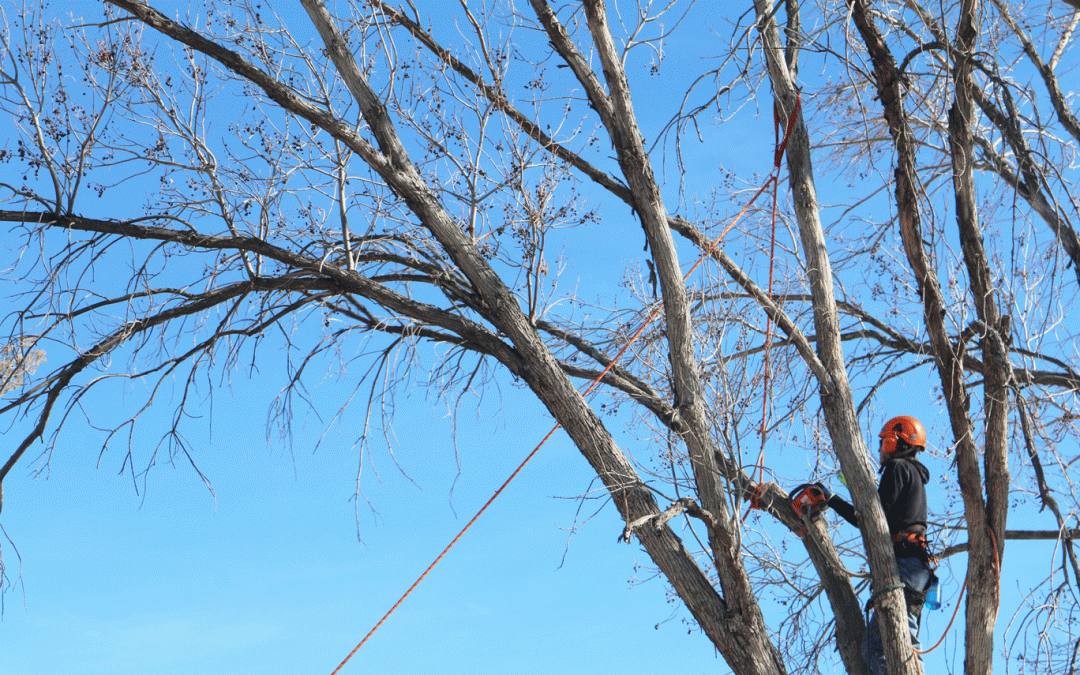
The winter is best time of year to prune trees. The Water Authority recommends hiring an arborist to prune them because arborists specialize in the care of individual trees. They are knowledgeable about the needs of trees and are trained and equipped to provide the proper care.
Arborists can provide the following services:
Pruning
Tree removal
Emergency tree care
Planting
Plant health care
Other services such as
consulting, tree risk assessment, cabling and bracing of trees.
How do you find a professional arborist to take care of your trees? We recommend to ask the following questions when looking for an arborist:
Are they certified? Certified
arborists have achieved a level of knowledge in the art and science of tree care
through experience. They have passed a
comprehensive examination developed by some of the nation’s leading tree care experts.
There is an online resource called Find an Arborist to help you locate one in
your area.
Do they have insurance? Check
that they have a certificate of insurance that includes proof of liability for
personal and property damage, including workers’ compensation.
Do they offer a contract? Get
a written contract of the work to be completed from the arborist. It should
include the estimate for the services, a start date, and estimate of how long the
work will take.
Do they have references? Ask
the tree company to provide a few names of past customers, and ask friends and neighbors for local references, too.