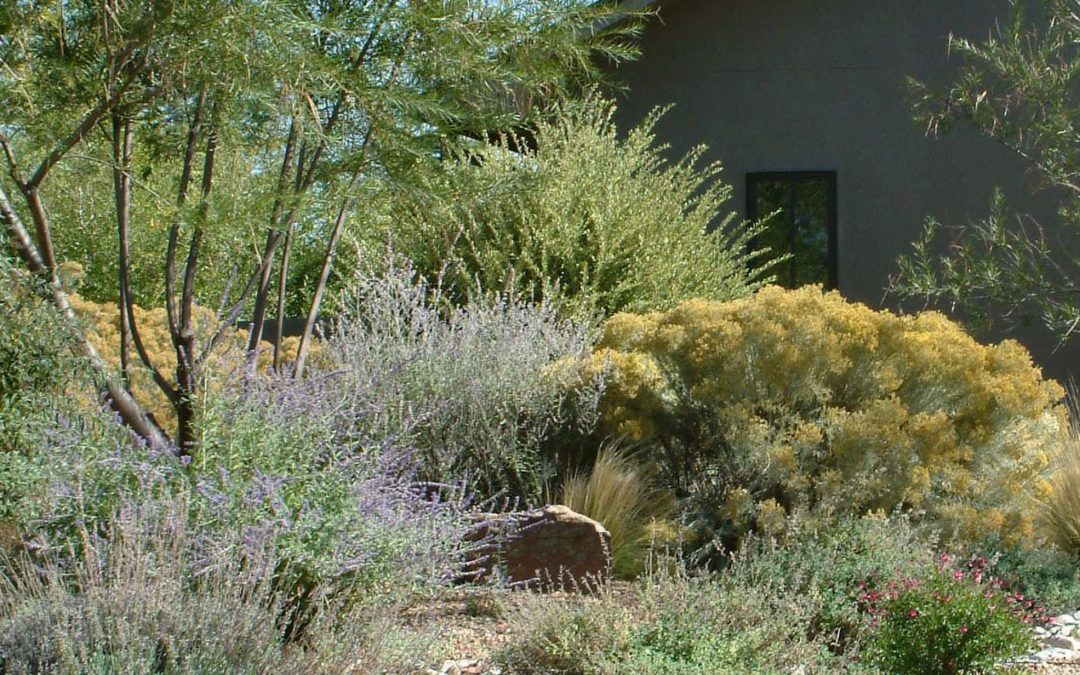
In these long, hot days of summer, especially if the summer rains don’t come, many plants really suffer from a lack of water. By incorporating native and very adapted plants into the landscape, we can still have attractive landscapes that don’t require a lot of irrigation, maybe even none in a good year!
These native plants are sometimes referred to as “luxury consumers." Their evolution, in an arid climate that occasionally has wetter years, has given them the ability to subsist reasonably well on low water. When there is an abundance of water, they take advantage of it and really grow. This kind of luxury growth may happen only every few years. In really dry years, they will lose some outer canopy. This adaptability helps them survive and even thrive in our natural landscape.
Among the plants that fit into this category are trees, shrubs, and native grasses: desert willow, Apache plume, three-leaf sumac, four-wing saltbush, chamisa, turpentine bush, and Mexican thread grass. There are others of a similar nature; native plants that really don’t need regular abundant water. Cactus is another type of plant that is easily over-watered. You might even end up killing it with too much water, as its roots rot away in constantly moist soil. If cacti don’t die, they may end up taking over a space.
One of the great aspects of xeric plants is that they are low maintenance. Small trees and shrubs live happily for years without needing pruning. Single stands of attractive, waving silky-looking grass seed heads don’t become a billowing menace when they quickly spread beyond the designed zone.
These plants should be irrigated regularly the year of planting but should be weaned to a lean water budget before they get too used to luxury living. A luxury level of irrigation should be saved for fruit trees and shade trees — plants that actually need that amount of water and produce fruit and shade.
To help save water, look for water harvesting opportunities in your landscape, especially when deciding where to plant. Where does water come off the roof, and where does it go on the ground? If you can redirect that roof water to a high spot that will flow into the yard — and maybe even contour the yard in shallow, subtle ways to get that water to spread out and slow down and sink in — then you can take advantage of the water by planting strategically along the flow line.
Mulches are a great water-saving step for native trees and shrubs. Rock is too hot for most things, except for ocotillo and some cacti, so use coarse chipped tree waste. Some local tree companies offer free mulch. Keep sunlight off bare ground around the plants and you will slow down evaporation from the soil while reducing the ambient air temperature enough to make a difference to the plants living out there all day, every day.
As far as shearing goes, this kind of pruning creates very tight outer canopies with lots of leaves (the resulting growth that follows previous cutting), usually in a simple geometric shape. Native plants that have less dense outer canopies end up having a higher water budget due to the excess foliage grown by shearing the canopy. A natural form could have the same overall size but with a more open, interesting branching framework supporting a more natural leaf density, and all of that on less water. It’s best to let the plant’s nature express itself through the form it grows without a lot of interference and to prune strategically to highlight well-placed branch systems and balanced mass.
Author: Joran Viers, Senior Partner at Root to Shoot Urban Forestry, Inc. find him at [email protected] Have a question about the article? [email protected]
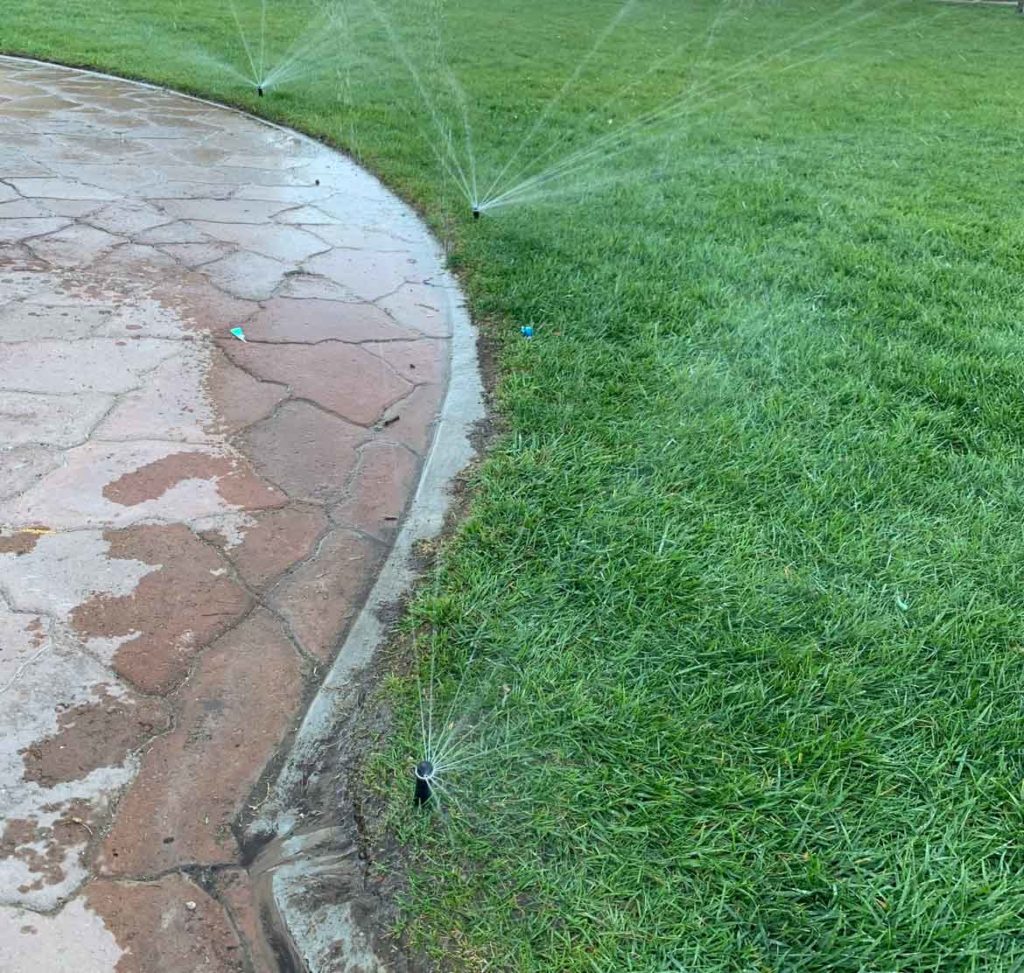
It’s irrigation season. If you have a grass lawn with spray heads, it’s time to check out your system to make sure it is running smoothly. Run a one-minute test program on the controller and visually examine each zone. Look for broken, leaning, or clogged sprinkler heads. Check and adjust for irrigation spraying on sidewalks, driveways, patios, or streets. Look for uneven coverage and sprays that may be blocked by new landscape growth.
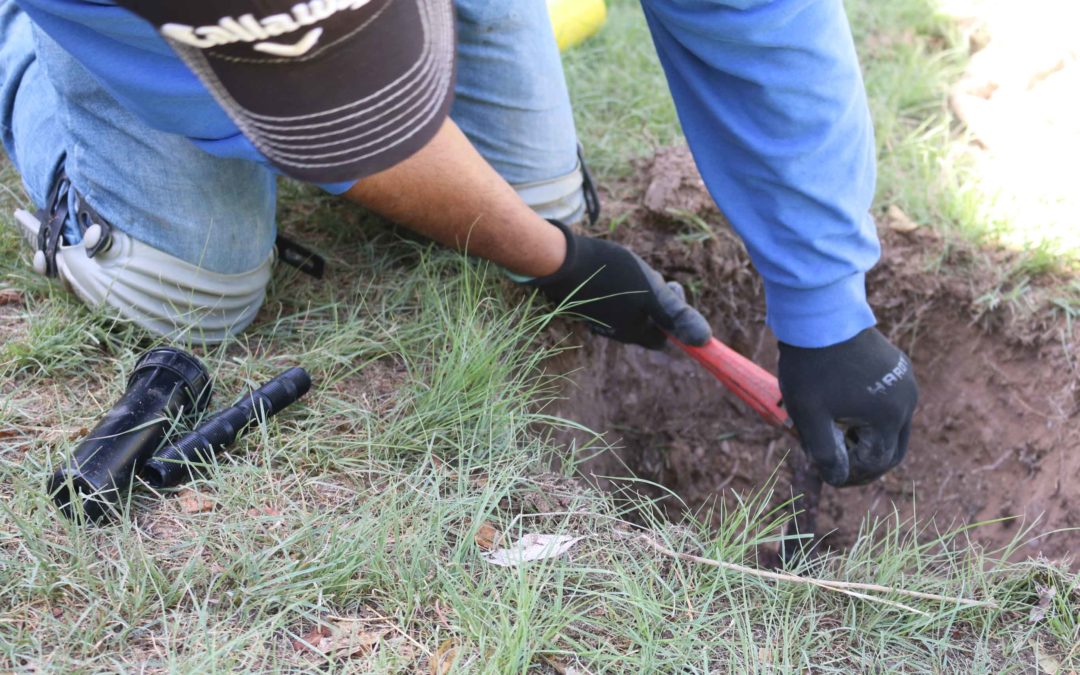
If any of the above issues are happening, you’ll want to go through each spray head and perform the following maintenance tasks:
Flush the sprinkler system by turning on the sprinklers for a few seconds without the nozzle.
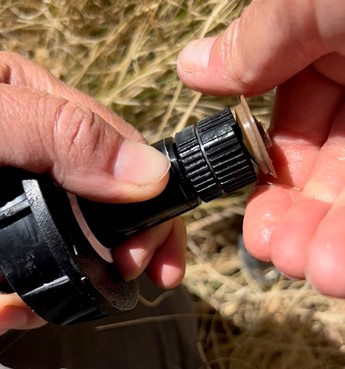
Adjust the arc by turning the sprinkler on. While the sprinkler is watering, look at the right side and see if it is aligned. If it isn’t, you will need to align it by turning the entire riser to the correct position (to the right) as this is the fixed side of the arc. While turning the riser you will hear a noise. This is a ratcheting system that allows you to make an adjustment. Turn it clockwise to reduce the arc and counterclockwise to increase the arc.
Adjust the radius by turning the screw in the middle of the nozzle with a flathead screwdriver, turning clockwise position to reduce, and to reach farther turn opposite direction or counterclockwise.
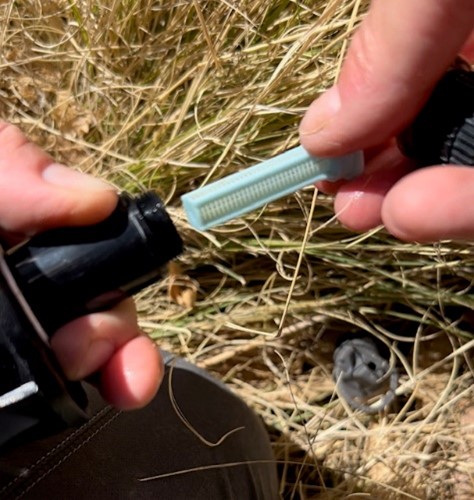
Clean the filter by pulling the riser up and holding it with one hand, while your other hand unthreads the nozzle and pulls the filter out. Clean the filter by dipping it into a bucket of water.
If your spray heads are putting out a very fine mist or fogging, your system may be operating over its design pressure. You’ll need to install a pressure regulator to reduce the water pressure at the irrigation system’s water connection, which is before the backflow and after the meter.
Learn more by checking out these other useful irrigation articles:
Author: Jill Brown, ASLA, is a Landscape Architect and owner of My Landscape Coach in Albuquerque, NM. Contributor: Greg at Sisco Irrigation, Albuquerque, NM. Have A question about the article? [email protected]
The most efficient way to water your yard is by using an automatic system. Hand watering can be problematic because it can lead to inconsistent watering, causing you to overwater, underwater, or forget to water altogether.
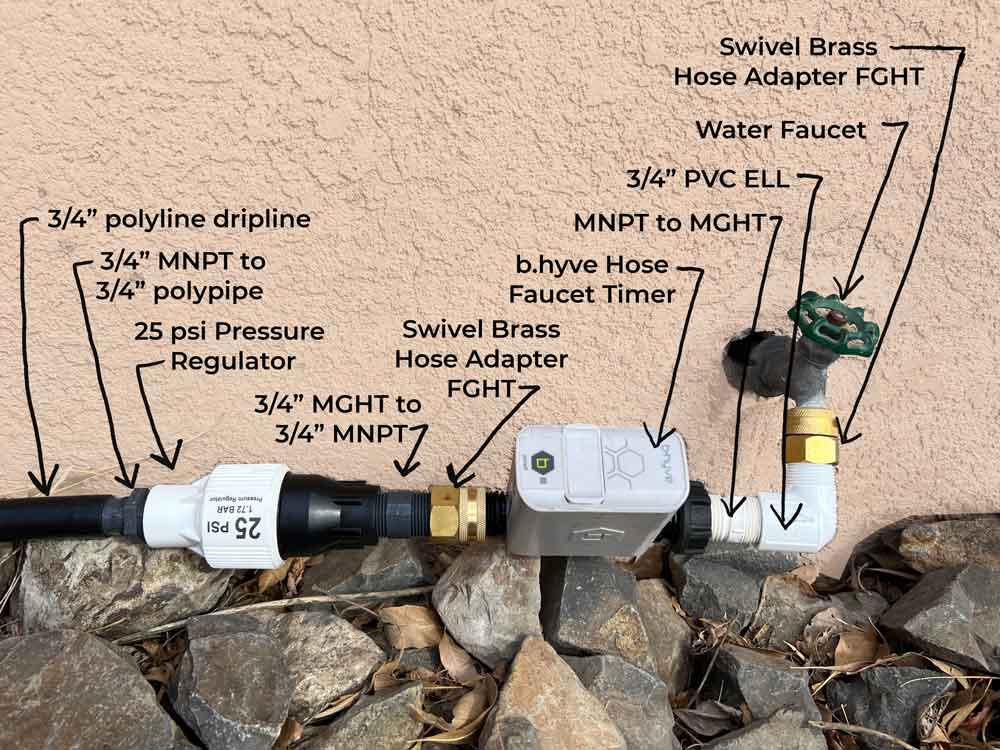
If you are ready to invest in a more efficient irrigation system, a Water Sense Smart hose timer is the way to go. It’s an inexpensive way to get your plants on an automatic irrigation system, allowing you to water your yard on a specific day of the week, time of the day, and for a set number of minutes. You can put it together yourself for under $100.
The hose timer can attach to high-quality irrigation Polypipe with drip emitters or connect to a professional landscape dripline. The irrigation dripline can stay in the ground year-round and is easily connected to an automatic in-ground irrigation system.
There are a variety of products you can use, including smart controllers, easy twist and turn controllers, battery controllers, multi-valve controllers, and more. We offer a rebate on ones that adjust to our weather and your plant’s watering needs.
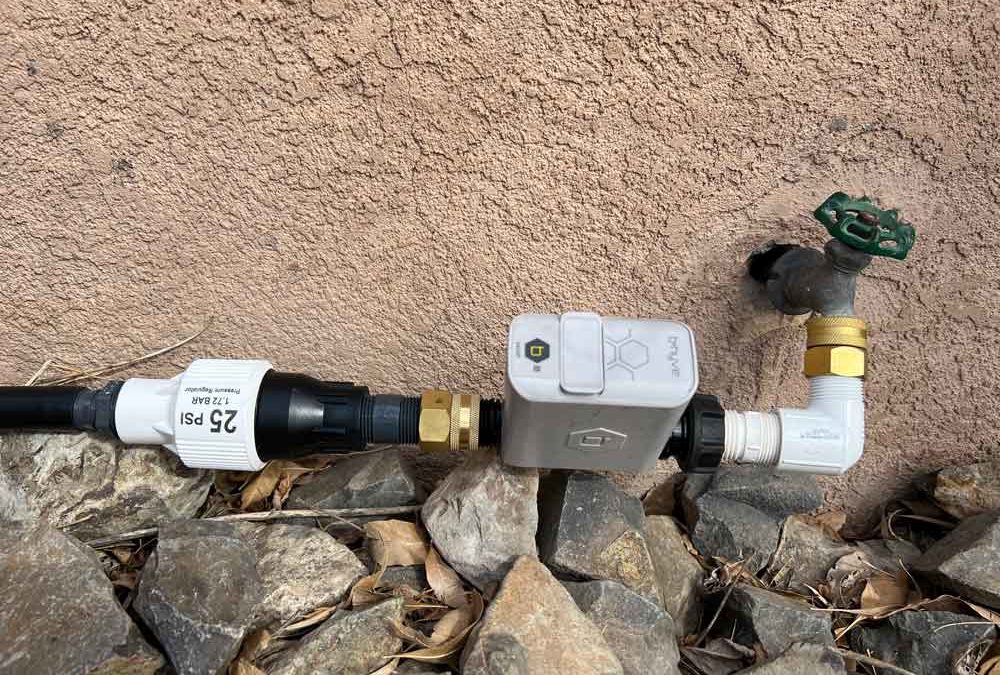
Below is an example of a hose watering system using one of the smart irrigation controllers —in this case, a B-hyve hose faucet controller— included in our rebate program. All the pieces and parts needed for this system are listed below, but if you have any doubts, take this picture to your local irrigation supply store and they’ll help you get everything you need.
Plants thrive on a consistent watering routine that allows the soil to dry out slightly between waterings. Setting up an automatic hose bib system is easy, inexpensive, water smart and the best thing you can do to keep your plants healthy.
Learn more by checking out these other useful irrigation articles:
Author: Jill Brown, ASLA, is a Landscape Architect and owner of My Landscape Coach in Albuquerque, NM. Contributor: Greg at Sisco Irrigation, Albuquerque, NM. Have A question about the article? [email protected]
The most important part of watering is figuring out how deep you need to water your plants. Once you figure that out, you can easily follow our chart that tells you how often to water.
Here are six simple steps to figuring out your watering depth:
Step 1: Water your landscape for the usual amount of time. If it’s the first time you’re watering, start with the number of minutes found in this Irrigation Advice Chart.
Step 2: Wait 24 hours after watering so the water has a chance to percolate into the soil.
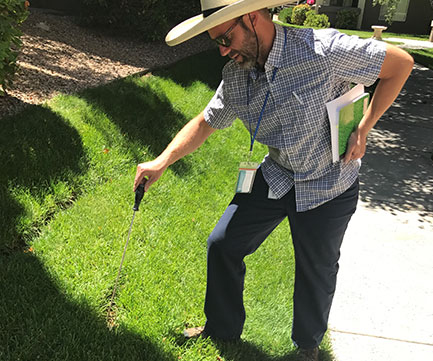
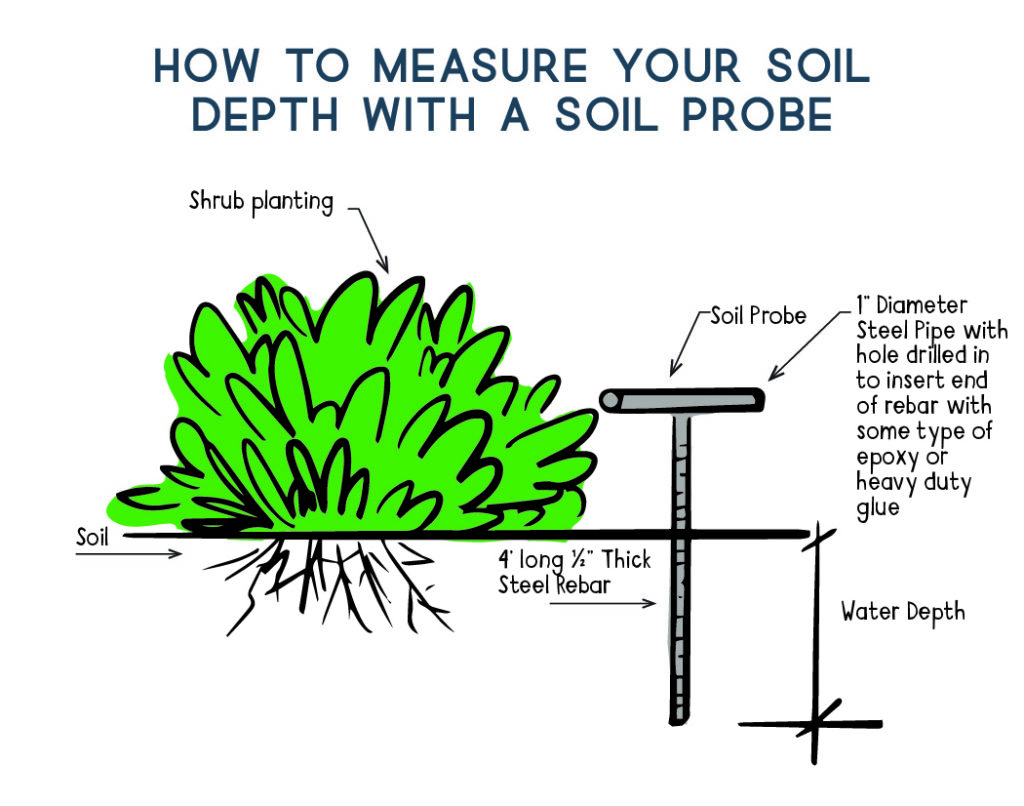
Step 3: Grab a measuring tool, such as an 18” depth screwdriver, soil probe, barbecue skewer or 24” long piece of rebar, and probe your tool into an area you didn’t water to check the soil resistance. Next, go to an area that you watered the day before. Push the probe in until it stops. It should go in fairly easily. Don’t try to push it in further once it stops because you can accidentally break a pipe. Mark the spot it went into with your finger, tape or a permanent marker. Pull out the probe and measure the number of inches. Those inches represent your current watering depth. Using the Seasonal Watering Recommendations chart you can find out the depth you need for your type of plant.
Step 4: Adjust your watering time to correctly determine the watering depth. Did you only water 4” but needed a 12” watering depth? If so, then add more time to your watering schedule and perform the test again. Did you water 24” but only needed 18”? If so, then subtract time from your watering schedule. Water again and wait 24 hours to retest.
Step 5: Once you figure out the amount of time you need to water so the water penetrates to the correct soil depth, you are set.
Step 6: Set your controller for the correct amount of time. Use our handy Seasonal Watering Recommendations chart to see how often you’ll need to water your plants.
Don’t overthink it. Our local, desert-friendly plants (native and adaptive plants typically found in our local nurseries) usually thrive in our native soil.
Learn more by checking out these other useful drip irrigation articles:
Author: Jill Brown, ASLA, is a Landscape Architect and owner of My Landscape Coach in Albuquerque, NM. Have A question about the article? [email protected]
Since the Albuquerque area receives about 9” of rain on average per year and grass lawns can use up to 50” of water per year, the proper design of an irrigation system for a grass lawn is of utmost importance when it comes to water efficiency. Irrigation efficiency can save up to 30% of the water you use by avoiding water waste.
While the Water Authority does not encourage grass lawns, we understand that some homeowners may want to install new lawns or reduce the size of their existing lawns. If you are going to have a turfgrass lawn, we recommend that it’s a lawn you use and not just maintain for curb appeal. Proper irrigation layout and design are key to having a healthy and water-efficient lawn.
When designing your lawn, keep these tips in mind:
1) Lawns smaller than 10’x 10’ are hard to water with a spray irrigation system.
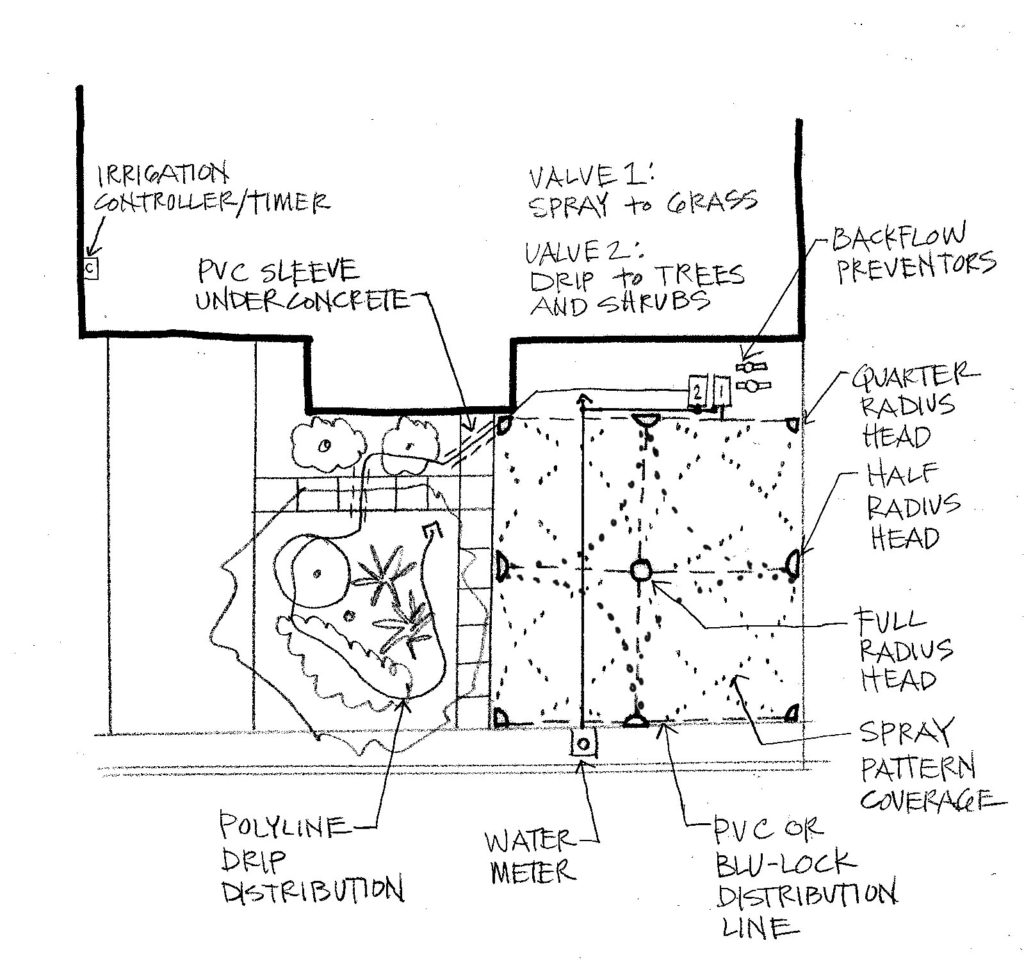
2) To get the most efficient irrigation coverage, design square and rectangular lawns since sprinkler heads spray in fixed patterns-such as a quarter circle, half circle or full circle-but not curves. If curves are necessary, broad curves have the best chance of being irrigated without over spraying, while zigzag narrow curves are the toughest to irrigate effectively.
3) We recommend using WaterSense Pressure Regulating Spray Sprinkler Bodies.
WaterSense labeled spray sprinkler bodies with internal pressure regulation can reduce water waste by providing a consistent flow at the sprinkler nozzle. When the sprinkler body maintains pressure near its optimal operating pressure, the connected nozzle is better able to generate the right amount of water spray and coverage for a more uniform distribution of water across the landscape. Customers can choose from a list of pre-qualified spray sprinkler bodies.
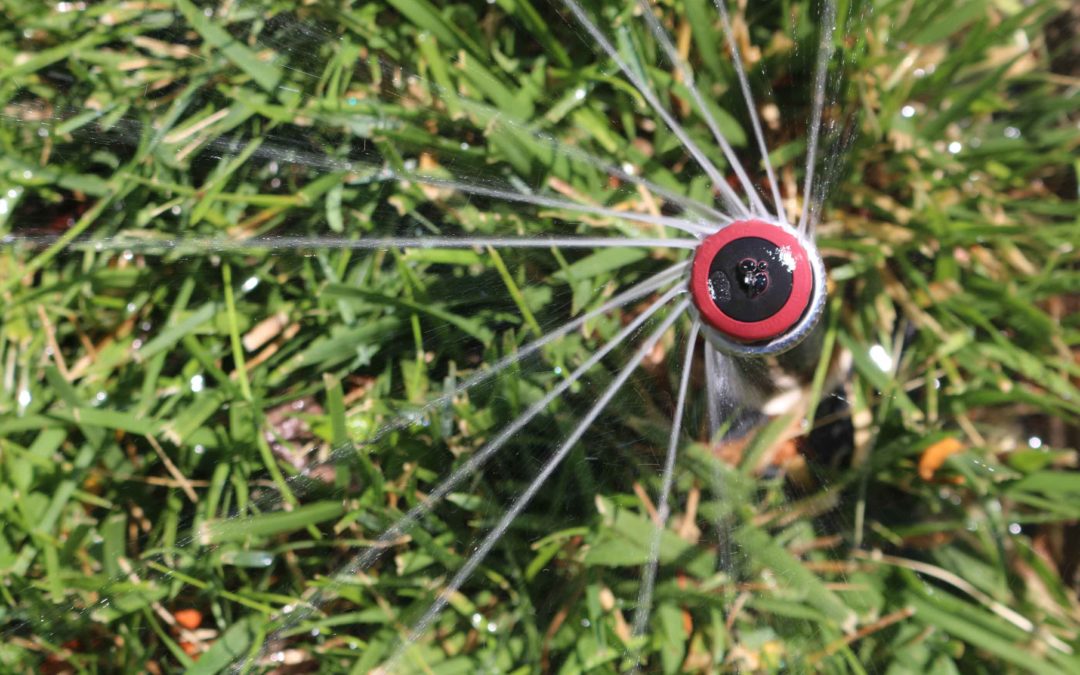
4) We also recommend using High-Efficiency Rotating Sprinkler Nozzles (multi-stream). These nozzles minimize water waste and feature a unique multi-trajectory rotating stream that delivers water at a steady rate. This slower application allows water to gently soak in at rates that soils can absorb. Use these nozzles to replace the sprinkler head on any conventional spray head body or pop up sprinkler. For more information on these nozzles read this post.
5) Irrigation sprinkler nozzles are designed for 100% overlap of watered areas, which means each sprinkle nozzle throws water to the next sprinkler in all directions. If a system is not built this way, there will be dry spots (see the below image).
Designing, reducing and changing the shape of your lawn doesn’t have to be an expensive project but it can save a lot of water. Visit your favorite local irrigation supply store for professional equipment and expert advice.
Learn more by checking out these other useful irrigation articles:
Author: Jill Brown, ASLA, is a Landscape Architect and owner of My Landscape Coach in Albuquerque, NM. Have a question about the article? [email protected]
One of the biggest obstacles holding homeowners back from removing their high-water turfgrass and installing xeriscape is believing that setting up the irrigation system is difficult. Luckily, it is not as hard as you may think.
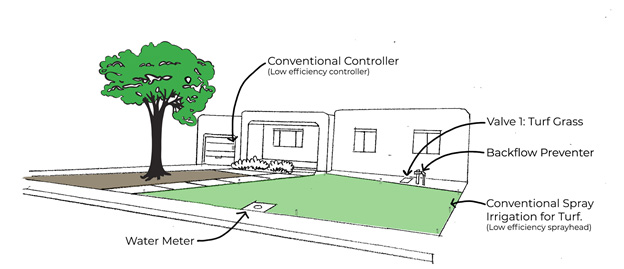
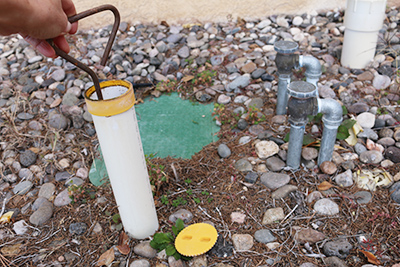
If you have an automatic irrigation spray system, you already have an existing valve and, most likely, an AVB backflow preventer. It may look something like this.
Desert Friendly Xeriscape with spray to drip conversion.
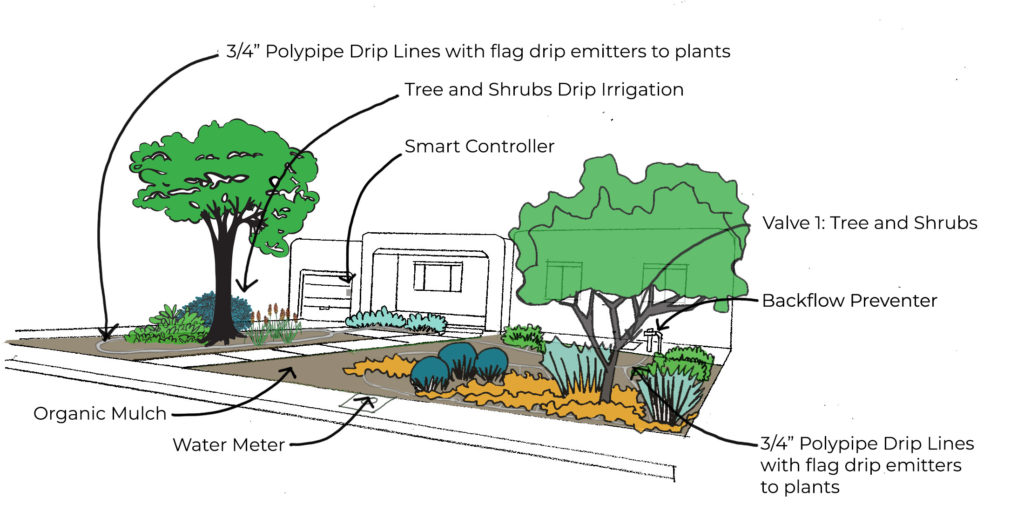
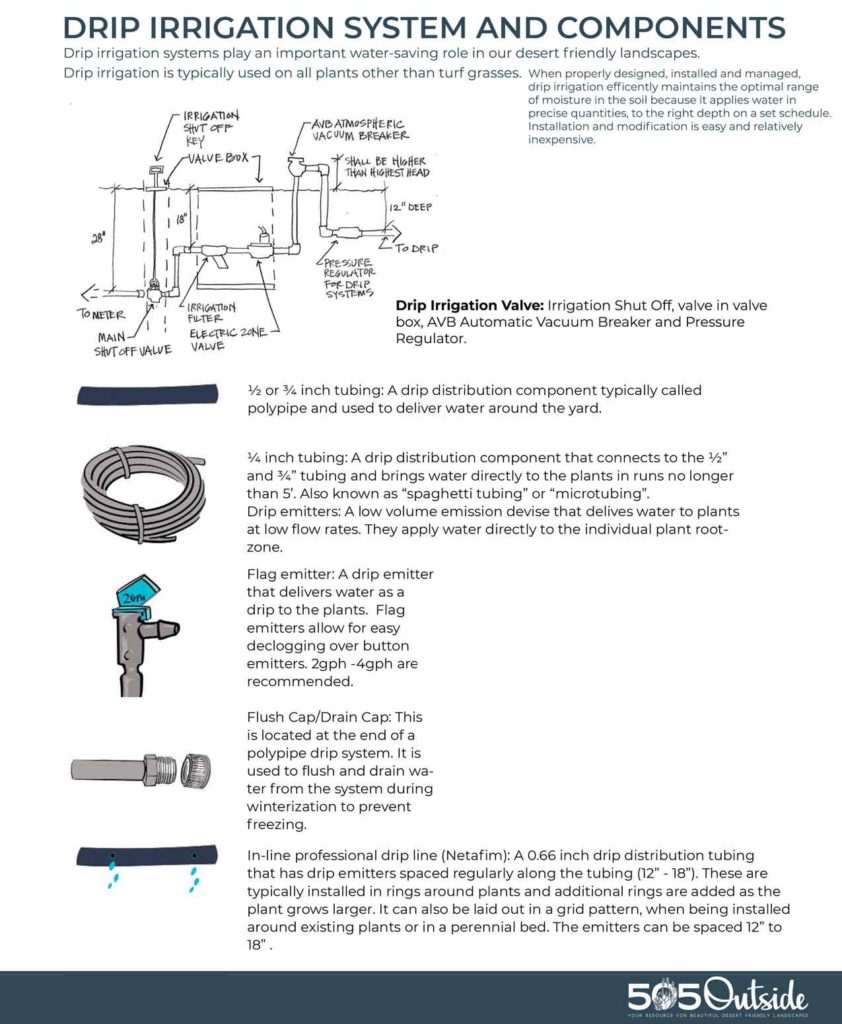
The first thing to do before converting to drip is to get the valves checked out by a professional to make sure they are in working order. When you know they’re fine, add a pressure regulator filter combo just past the existing valve and backflow preventer. Then attach ¾”polyline, snaking it around the yard to the new plants and inserting flag emitters at each plant.
The existing underground piping and spray heads are no longer needed. Simply remove all the existing spray heads. There is no need to dig up any existing pipe.
You may have seen the spray-to-drip retrofit kits locally available and wonder if this is a good approach. We don’t recommend this approach because studies show that nearly half of the water saved from converting a lawn to a healthy xeriscape comes from abandoning leaky underground piping and fittings. A Sprinkler system’s lifespan is less than 20 years. If you are not sure how old your system is, or if it is older than 10 years, it’s best to not rely on old underground piping. Since sprinklers typically run for 8-12 minutes and drip often runs for 45-60 minutes, if you have a leak in your old sprinkler piping and it is now part of the drip system you could be wasting a ton of water – negating the savings from getting rid of your thirsty lawn.
Drip irrigation tubing is very inexpensive per foot and only needs to be in a shallow trench. Properly converting to drip irrigation is not as expensive as many people think, while converting your sprinklers to drip the cheap and easy way with a retrofit kit is likely to cost more in the long run.Contact [email protected] to learn more.
Learn more by checking out these other useful drip irrigation articles:
Author: Amos Arber, Xeriscape Rebate Inspector with the Water Resources Conservation Department for the Water Authority. Have a question about the article? [email protected]