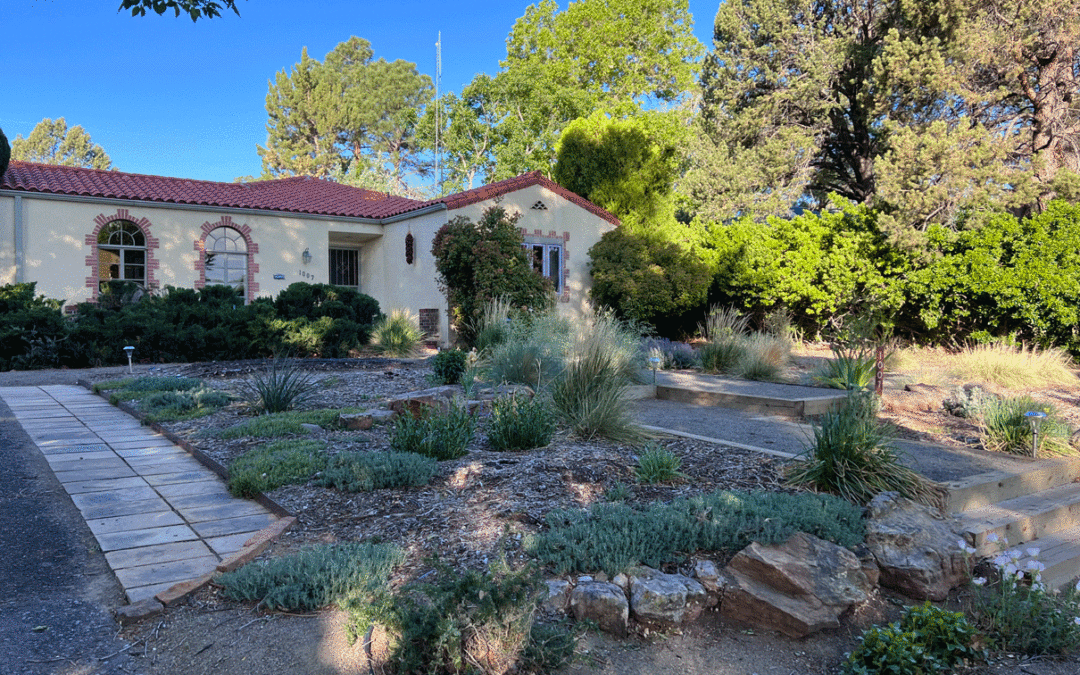
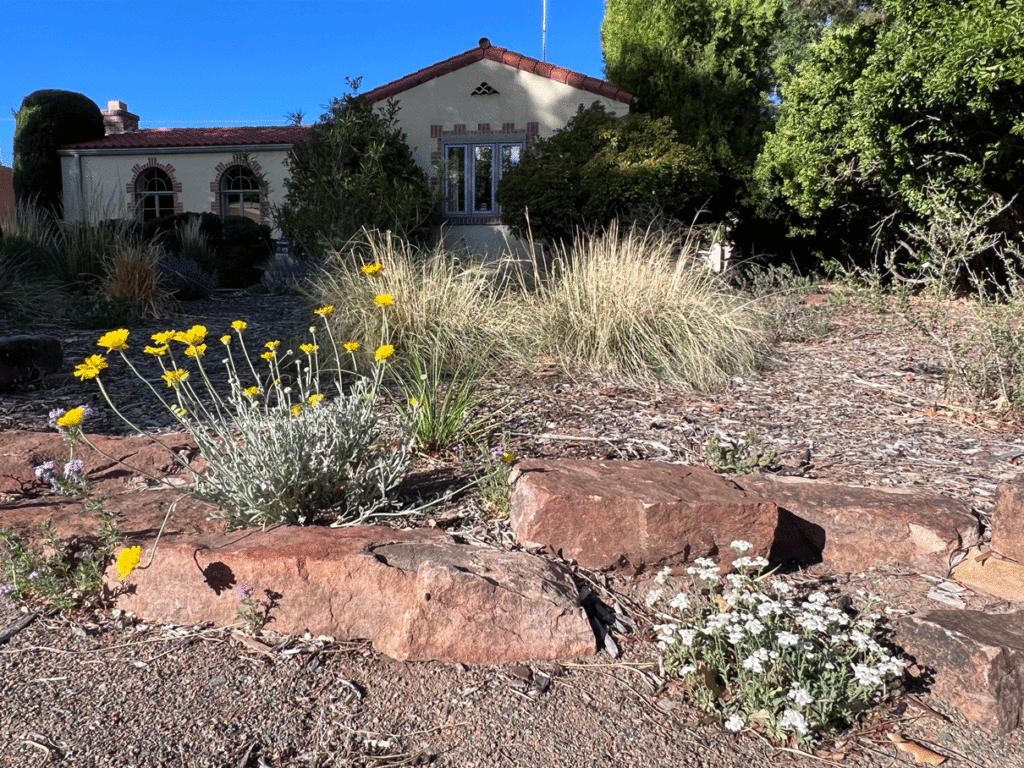
Desert friendly xeriscapes are a great way to replace high-water-use turf grass with something beautiful, low-water-use and wildlife-friendly. Many Albuquerque area homeowners are taking their conversion projects a step further and choosing wood chip mulch over gravel or other aggregate, which can get hot and allow weeds to pop up.
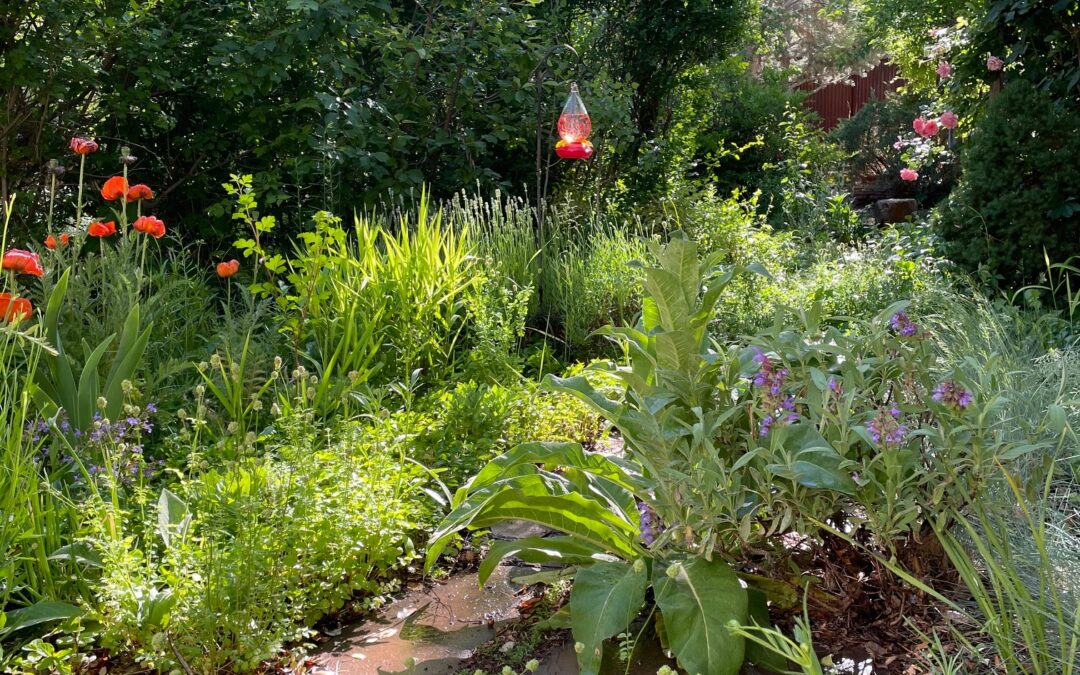
Our featured homeowner replaced 2,000 square feet of high-water-use grass lawn with a xeriscape filled with a variety of local native plants. Their lawn had become too high maintenance to keep up, and they were interested in a more water efficient yard that was pollinator friendly and low maintenance. The shrubs they chose include chamisa, cherry sage and catmint. Flowering plants include Mexican primrose, dwarf plumbago, desert marigold, creeping germander and penstemon. A mix of ornamental grasses such as Karl Forester, blue avena and muhly grass as well as a native desert willow tree round out the landscape.
Additional Facts on Mulches:
Wood chip mulch insulates plant roots from both heat and cold, reducing moisture loss from the soil by evaporation, feeding beneficial soil microorganisms that enhance plant growth and improving soil health. This makes the soil more sponge-like and better able to hold water. By installing 3-4 inches of mulch over bare dirt, weeds are reduced, the soil is enriched and new plants retain more moisture.
Another benefit of organic mulches is that they can visually accommodate a little bit of leaf litter, reducing the need for constant raking and clean-up. A thin top dressing of mulch added every two to three years keeps the landscape looking fresh and replaces the material that has broken down to sustain the soil. Organic mulches are lightweight, making them easy to transport in a wheelbarrow and spread with a rake.
Mulches are available in bags from most local garden centers (avoid the dyed ones as the colors will fade) and in bulk from several retailers in the Albuquerque area. When you buy from local bulk retailers, you are supporting the recycling of local organic materials that may otherwise end up in a landfill and contribute to greenhouse gas emissions. Buying in bulk also means less plastic! Mulch is sometimes available at no cost from local tree trimming companies. In addition, Bernalillo County offers free mulch to residents who load it themselves at the East Mountain Transfer Station. County staff can load the mulch in your vehicle with a tractor for a $5 charge. The county also will deliver 30 cubic yards of mulch for $60, plus $2 a round trip mile for delivery. Mulches are a renewable resource that will improve landscape health and conserve water.
In areas of higher wind exposure or periodic inundation with water, use a wood chip mulch that is irregularly shaped and sized as the pieces will knit together better. This type of mulch can include recycled yard waste and tree trimmings as well as commercially available, locally processed wood products.
Property Data:
Grass converted to desert friendly xeriscape: 2,150 square feet
Total gallons saved in one year since conversion: 10,000 gallons.
Total rebate received: $2,250 (extra $100 bonus for using organic mulch)
Thinking about converting your yard from high-water-use grass to xeriscape? Check out the Desert Friendly Xeriscape Rebate page to learn more about the qualifications, requirements and process to apply for this generous rebate. Additionally, xeriscape rebate participants get 25% off the cost of installing bulk organic mulch, up to $100. If you want to top dress mulch around your trees, take advantage of our Treebates. You are welcome to contact our xeriscape specialist, Carl Christensen, at cwchristensen@abcwua.org or 505-289-3026.
Authors: Amos Arber, Xeriscape Rebate Inspector with the Water Resources Conservation Department for the Water Authority, and landscape architect Jill Brown, ASLA, MyLandscapeCoach.com. Have a question about the article? AskAnExpert@abcwua.or
When I mention black currants while talking fruit trees and shrubs with people in Albuquerque, I have come to expect that we are often starting the conversation thinking about different things. Most commonly, people have experienced or heard about the European black currant, Ribes nigrum.
They recall an earthy, resinous flavor with nice sweetness and a tart finishing kick. European currants are best reserved for cooking. With their strong flavor, they make incredible sauces and condiments and are equally delicious as preserves and in pies and tarts. These black currants have a devoted following. Because the flavor is very distinct, I have found people often have a binary reaction when I mention the fruit: either pleasurable nostalgia or occasionally disinterest or dislike.
The other thing people confuse for black currants are little dried raisins, similarly dark in color and confusingly sold as “currants.” These fruits are made from “raisins de Corinthe,” Greek grapes grown, dried and shipped for hundreds of years from a port of that name. These are not the black currants I am talking about.
While I do like eating and growing the European black currant here in Albuquerque (mostly as a shady understory plant), I am much more excited about our native black currant — Ribes aureum— the clove currant, aka golden or buffalo currant.
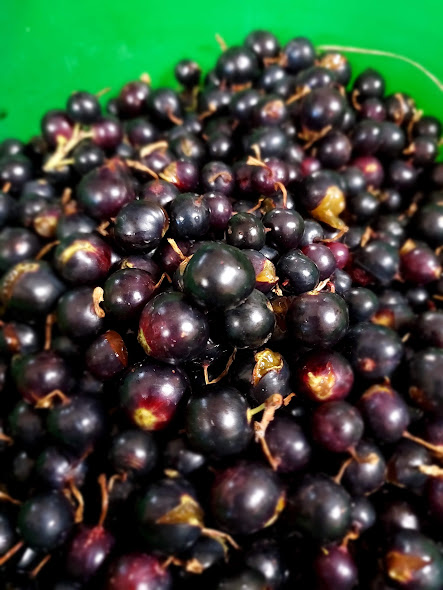
The clove currant is more fruity, less funky and a bit sweeter than its European counterpart. There is still some pleasing complexity and tartness to the fruit, but nothing mouth-puckering. They are perfect for fresh eating — or freeze them so they can be thrown in a smoothie or used as a blueberry replacement in pancakes when the snow flies. The fruits can get nice and large for a currant, from ¼ inch up to ¾ inch in size, with a shiny, blue/black color. Even the shrubs themselves are a bit larger, reaching 5 to 6 feet at maturity.
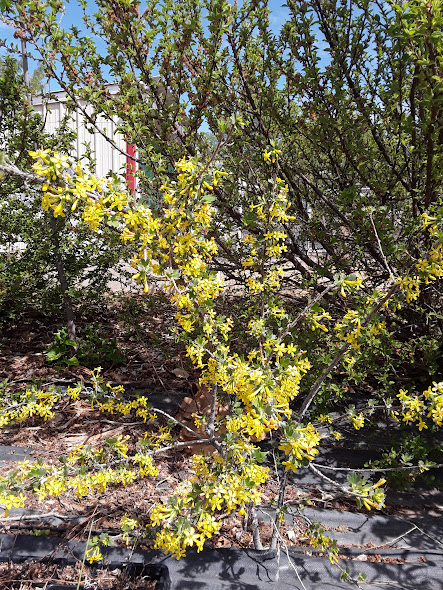
As an ornamental, the clove currant is a bit too floppy for a hedge, and they do send out runners — so consider yourself warned. However, if you give them a little space as a focal point in the garden, you will be rewarded with abundant dangling, bell-shaped yellow flowers in the spring that draw you across the yard with an overpowering vanilla and clove scent and, of course, all the incredible life that visits the flowers for their nectar. You will also get to see them with their dusky-crimson foliage in the fall. For most of the summer, you and the birds can keep eating the fruits as they ripen singly or in small clusters.
Clove currants handle the New Mexico sun and heat with grace, but they are quite adaptable and can do well with partial and even full shade. Along the river, they are only occasionally shaded out by taller thickets. If you’re out wandering in the bosque this spring, keep an eye out (or follow your nose) for these incredible flowers and fruits.
Author: Graeme Davis is an ISA certified arborist and the owner of Flora Fauna Farm, a nursery that focuses on plants that grow well in the high desert. Flora Fauna Farm grows a diversity of edible trees and shrubs, useful native plants and unique landscape plants curiously underrepresented in the urban canopy of Albuquerque. You can see its offerings at www.florafauna.farm.
Food forests and edible landscapes have been around for a very long time. They are what helped ancient humans survive and thrive. Hunter-gatherers likely did not expend precious energy by wandering aimlessly, hoping to find sustenance, but rather they were able to evaluate the landscape around them and learn to harvest food occurring naturally in their habitats.
Forest edges were rich sources of diverse plant species, and ancient humans learned what species were edible, where to find them and even ways to support and encourage the growth of plants useful to them. Food forests or edible landscapes have evolved and adapted over thousands of years as humans’ hands and minds have learned to design them to their nutritional needs and geographic limitations. A food forest will be very different depending on where it is in the world, but all share some common traits that can be adapted to almost any climate.
Food forests are very different from traditional farming or growing a vegetable garden. They are designed to mimic the natural forest edge, where species producing edible fruits, nuts, berries, roots and tubers grow in natural layers. We can imitate this pattern with species of our choosing that will do well in our hardiness zone and climate. There are many references and publications on the subject and a quick internet search is an easy way to begin, as is your local bookstore’s gardening section.
The philosophy of permaculture design, popularized over the last few decades, has brought a new awareness to our landscape and garden design; we have learned to make use of topography, natural water movement, soil structure and amendments, sun and shade patterns over the seasons, and the importance of pollinators and wildlife in our gardens and lives. A food forest is a functional, beautiful and diverse way to garden holistically.
When you imagine your food forest, think about the layers of plant species and the food sources they provide. First, at the outer edge, there is the canopy, the tallest layer of trees. These might be fruit- or nut-bearing deciduous trees or even some conifers here or there, as even a pine tree has edible parts, and the needles make a fine tea.
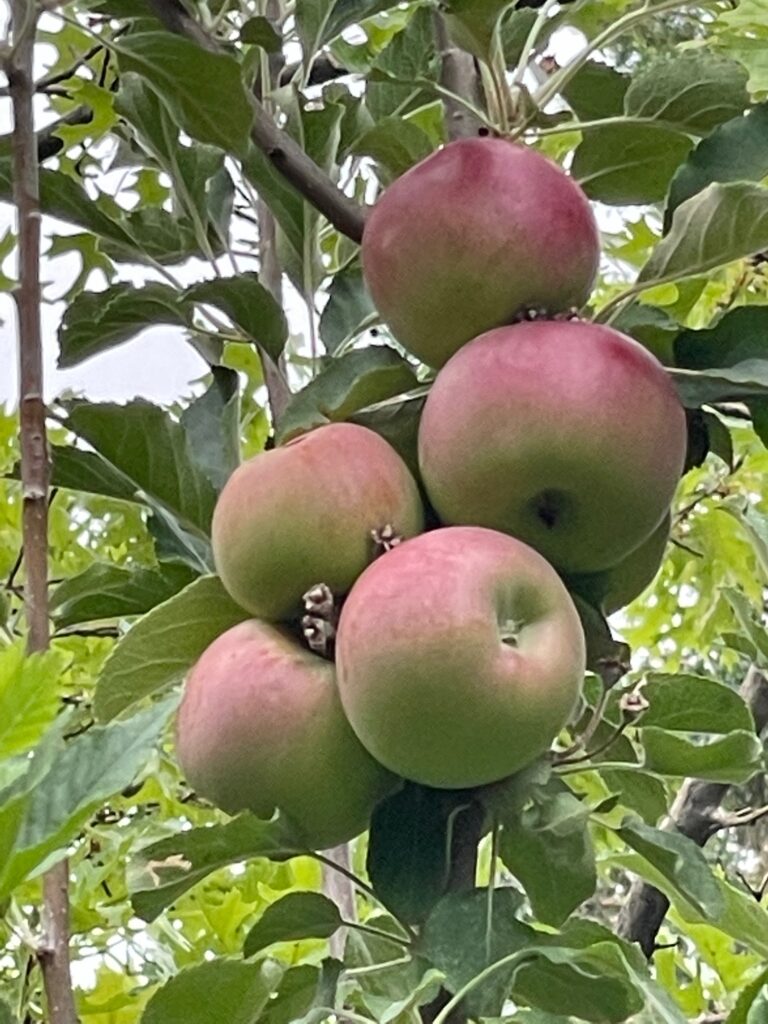
The second story is a mid-level layer of smaller trees, such as semi-dwarf or dwarf apple, peach and plum trees. Under the smaller fruit trees comes the shrub layer. If shaded, it could be currants or gooseberries. If sunnier, perhaps raspberries or blackberries.
After the shrubs comes the herbaceous layer, planted with perennial herbs like rosemary, garden sage and thyme. Ground covers like strawberries can sprawl under and around, followed by root crops like carrots, radishes and more. Vining plants are important, too. Some, like sweet potatoes, can be both root and vine. Others, like grapes, can utilize the structure of the trees to move up through the branches, making harvesting an easy task.
In some environments, you can grow edible mushrooms as part of the lowest layer; they will feed on the decomposing mulch and decaying wood that is part of the forest floor. Mulch is critical in any garden or landscape and a necessity in a healthy food forest. Fallen leaves are an excellent natural mulch as are wood chips. Leaving or intentionally placing dead branches and logs is a great way to recycle nutrients naturally into the soil profile. Having rocks or stones in the mix is also a very good thing as they slowly release minerals as they break down over long periods of time.
Most of the plants in your food forest will be perennials, but as you see, there are places for annual herbs or vegetables anywhere there is room and the proper amount of shade, sunlight and moisture. Companion planting is a great way to decide what goes where, and diversity is the strength of any plant community. A food forest is the oldest, most resilient agroecosystem in the world, whether occurring naturally, enhanced by human hands and minds, or entirely created by intention and design.
Some of the benefits of a food forest are increased harvests based on diversity, nutrient storage and water retention in soil protected by mulch and overstory; healthy soil holding a host of beneficial microorganisms; and less weed and pest populations, again due to density and diversity, and therefore less maintenance and inputs (think fertilizer, weed control). Of course, organic principles are the way to go when growing anything you plan on consuming.
Like any garden or landscape, a food forest can and should reflect the humans who are part of the ecosystem and should be a place where native plants, wildflowers and grasses all have a place in the garden, where beauty, joy and learning from Mother Nature are sources of education, nutrition, comfort and pleasure.
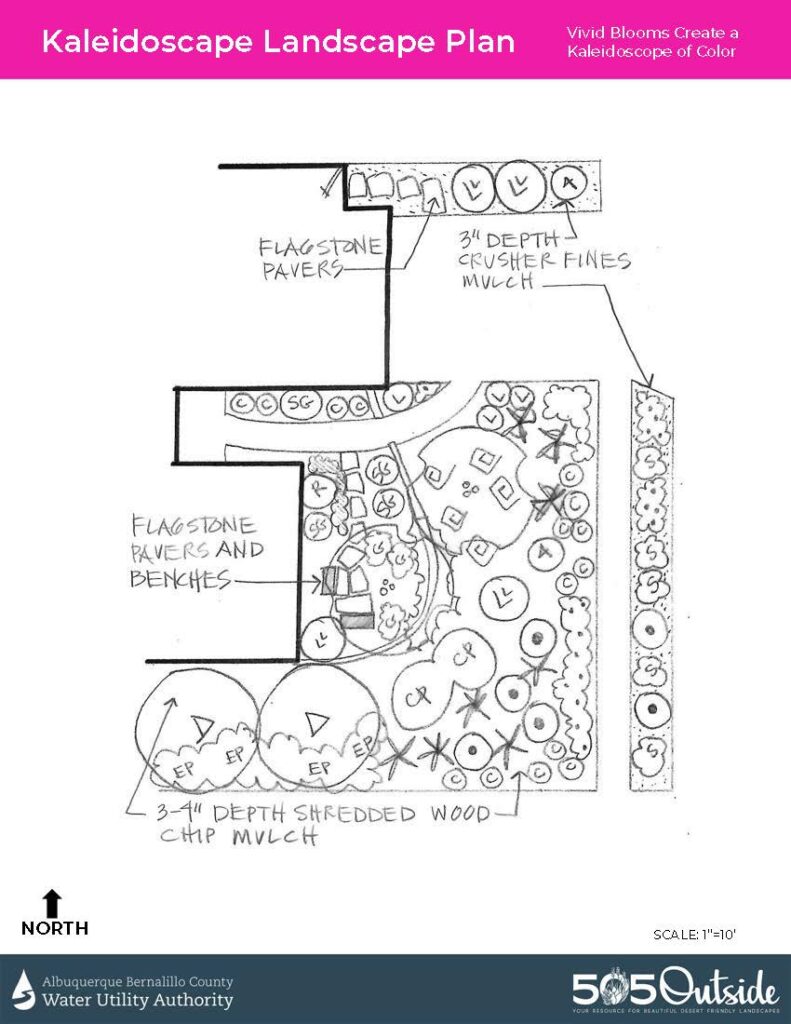
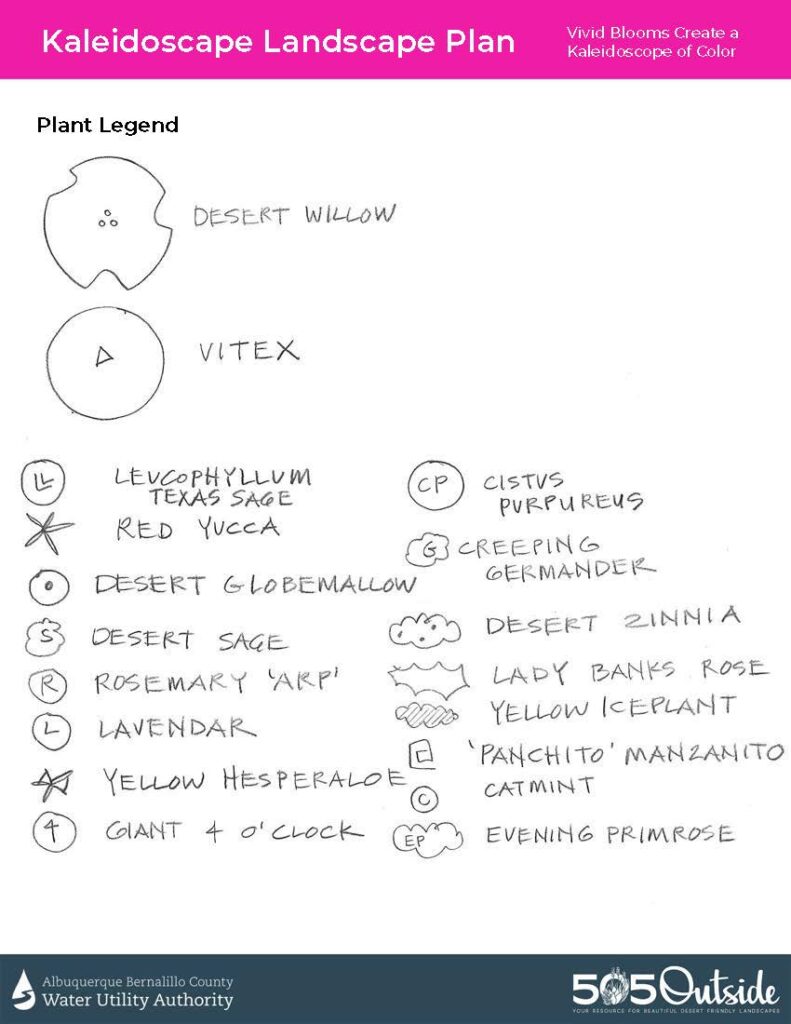
Color has a more dramatic impact in a garden if plants with strong flower colors are juxtaposed against one another. In this Kaleidoscape design by Judith Phillips, the blue-purple blooms of dwarf butterfly bush, desert sage, catmint, lavender and vitex are contrasted with the rose-pink and magenta blooms of desert willow, cherry sage, creeping germander, giant four o’clock, purple ice plant, red yucca and desert globemallow. Yellow tones are provided by desert zinnia, yellow ice plant, yellow yucca and Lady Banks rose.
Using several different plants with similar color palettes prolongs the blooming season and provides unity to the landscape. While vivid color may be the appeal of the garden from spring through autumn, a landscape also needs “good bones” — enough evergreen foliage and shapely plant forms to provide interest when the blooming fireworks are over for the year. rosemary, Lady Banks rose, cliffrose, desert sage, hesperaloes and cotoneaster all contribute seasonal flower color as well as evergreen foliage in a broad range of greens and silvers to carry the garden through the colder winter months. In addition to their colorful warm season blooms, the curving trunks and branches of desert willow and vitex add sculptural value all year.
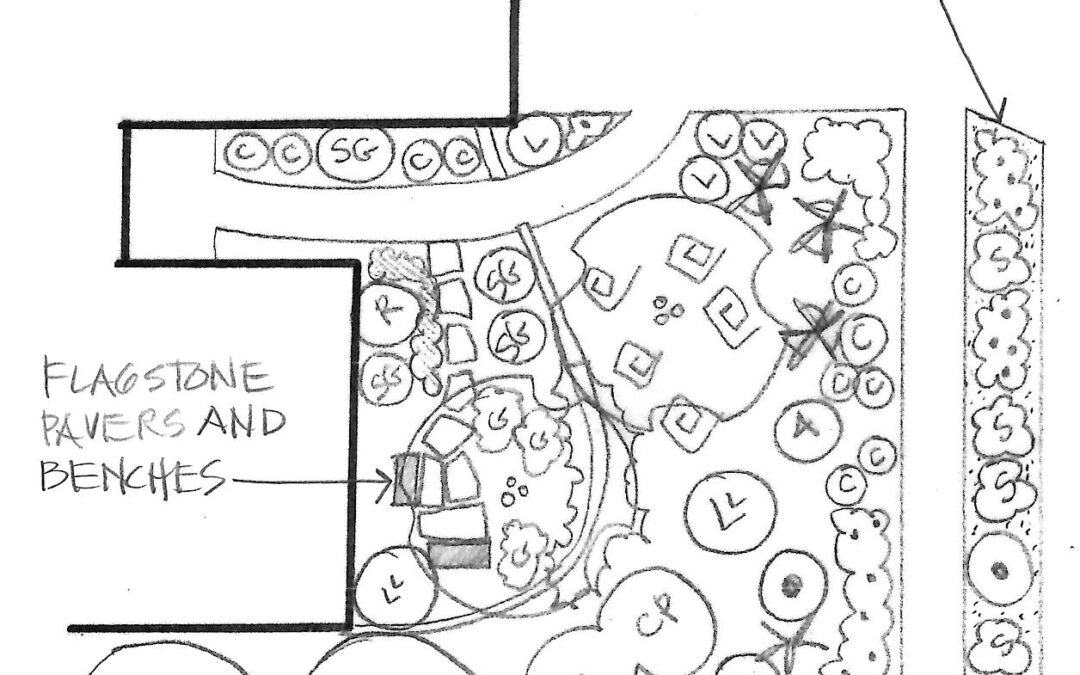
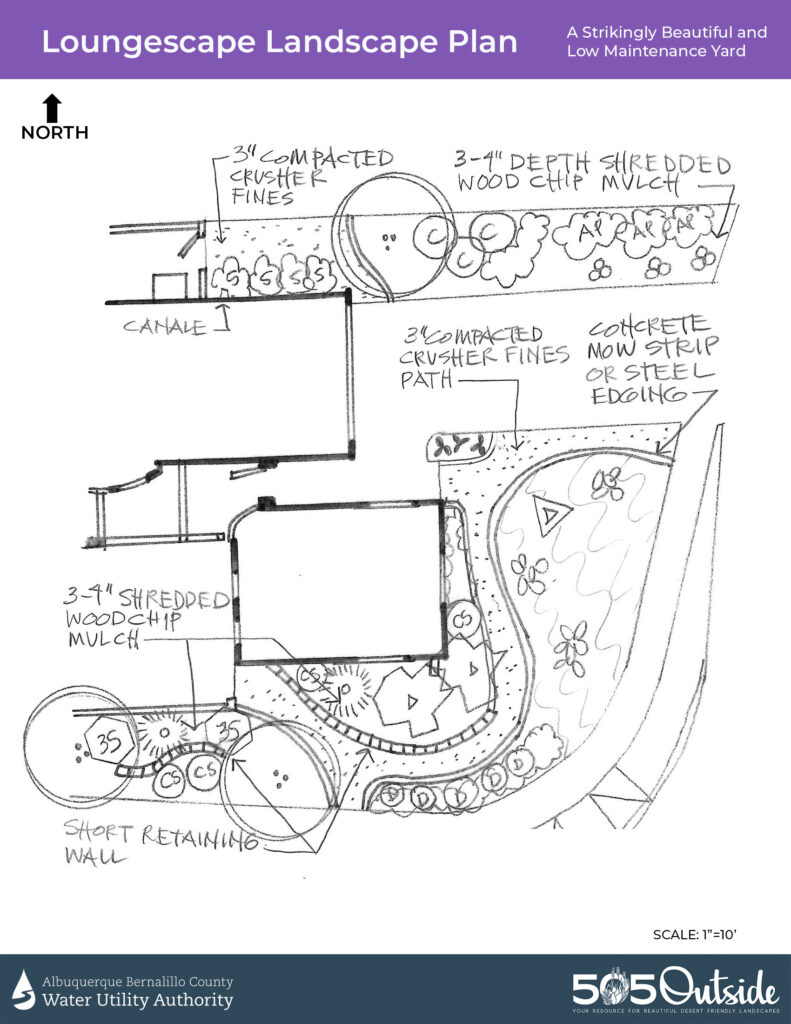
A lot goes into creating a landscape plan, and it helps to have some expert help. Local landscape architect George Radnovich, FASLA, created this design for those opting for a low maintenance yard. You can follow his design right down to each individual plant or customize it to fit your own yard. This is the fourth landscape plan we’ve featured in 505Outside, and we’ll be sharing one more plan in the next issue.
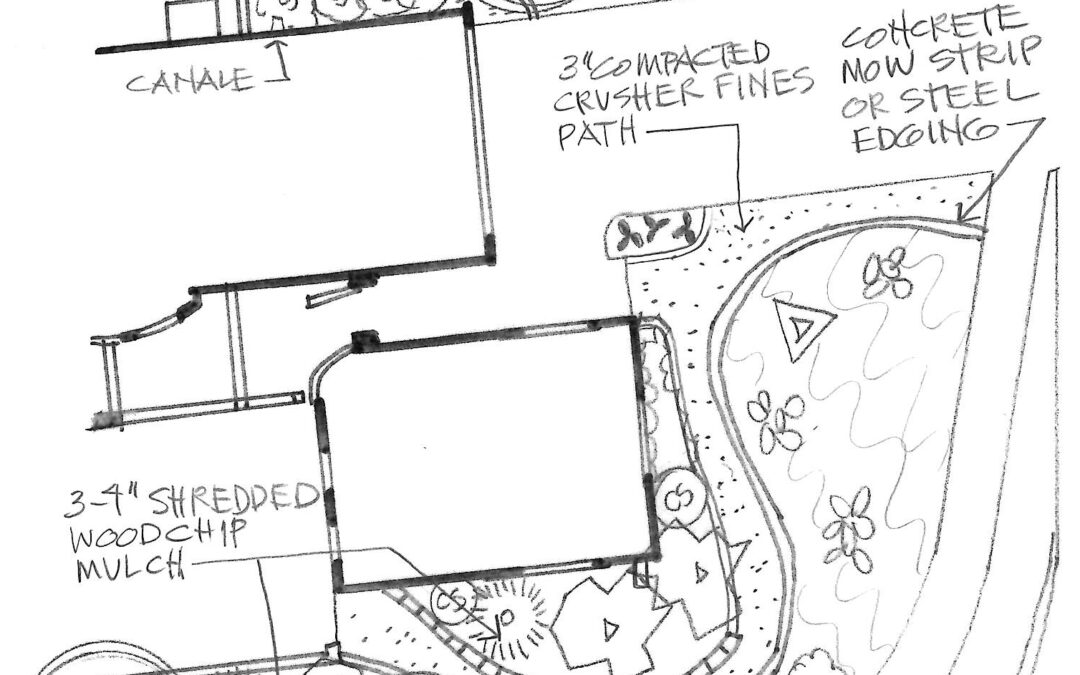
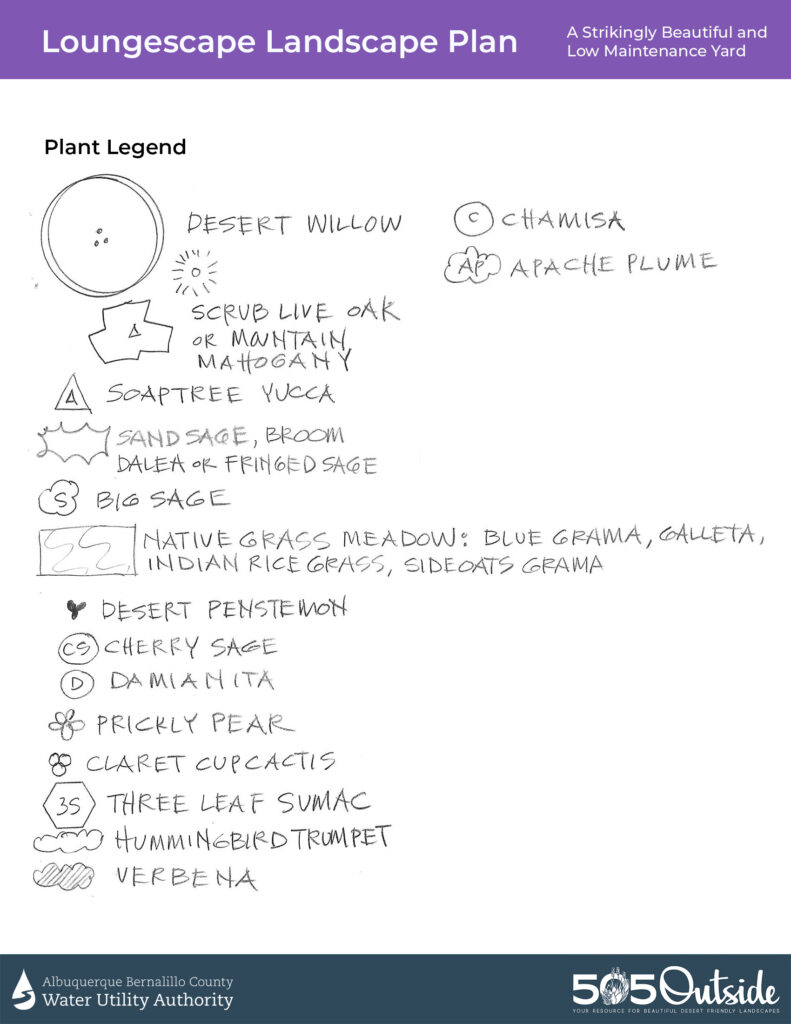
While there is no such thing as a totally maintenance-free landscape, this Loungescape comes as close as possible in Albuquerque. The key to this approach is to mimic the natural environment with the look and feel of New Mexico grasslands and piñon-juniper forests.
Instead of a traditional lawn, native grasses offer a more natural look, accented by a soaptree yucca and desert willows for color and dappled shade. Water-thrifty cacti are used for interest, color and a contrast of textures. Finely crushed gravel (aka crusher fines) is used as a walking path to the rear of the house.
For ease of maintenance, there is a concrete formal edge between the walking path and the foundation plantings next to the house. Rainwater is harvested from the roof and other impermeable surfaces, then directed to plants via canales, weep holes and a short retaining wall. Short evergreen trees such as mountain mahogany provide year-long interest. Three-leaf sumac was added for fall color, cherry sage for summer color and sand sage and fringed sage for winter foliage. Big sage was purposely placed along the eastern side of the house to lessen the exposure to the harsh, hot western sun, which would make the plants more water-thirsty. Lastly, spots of color are added throughout the landscape for interest.
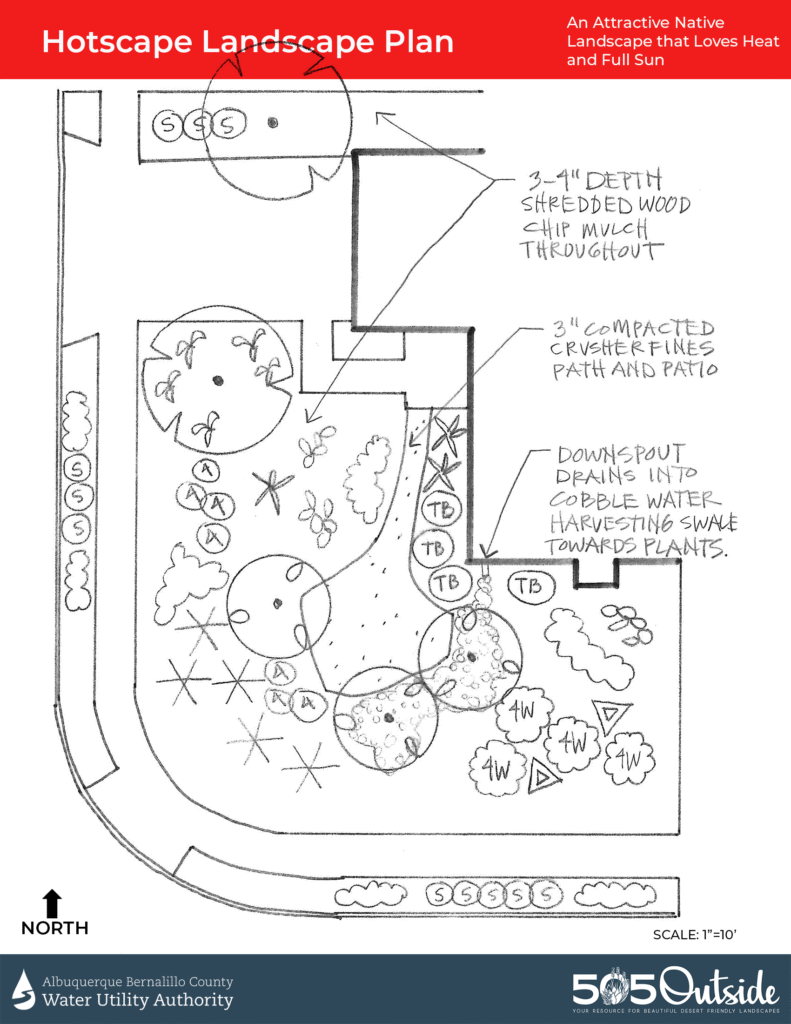
A lot goes into creating a landscape plan, and it helps to have some expert help. Landscape architects specialize in designing outdoor spaces. Today, we’re sharing a plan particularly suited to our climate by New Mexico landscape designer David Cristiani. You can follow this design right down to each individual plant or customize it to fit your own yard. We’ll be sharing two more landscape plans in future issues of 505Outside.
Many plants from higher elevations or moister areas struggle when subjected to the long, torrid summers common in Albuquerque. The plants in this landscape are intended to thrive on heat, limited irrigation and minimal care — while exploding the popular myth that cacti and succulents look stark and don’t belong near our homes.
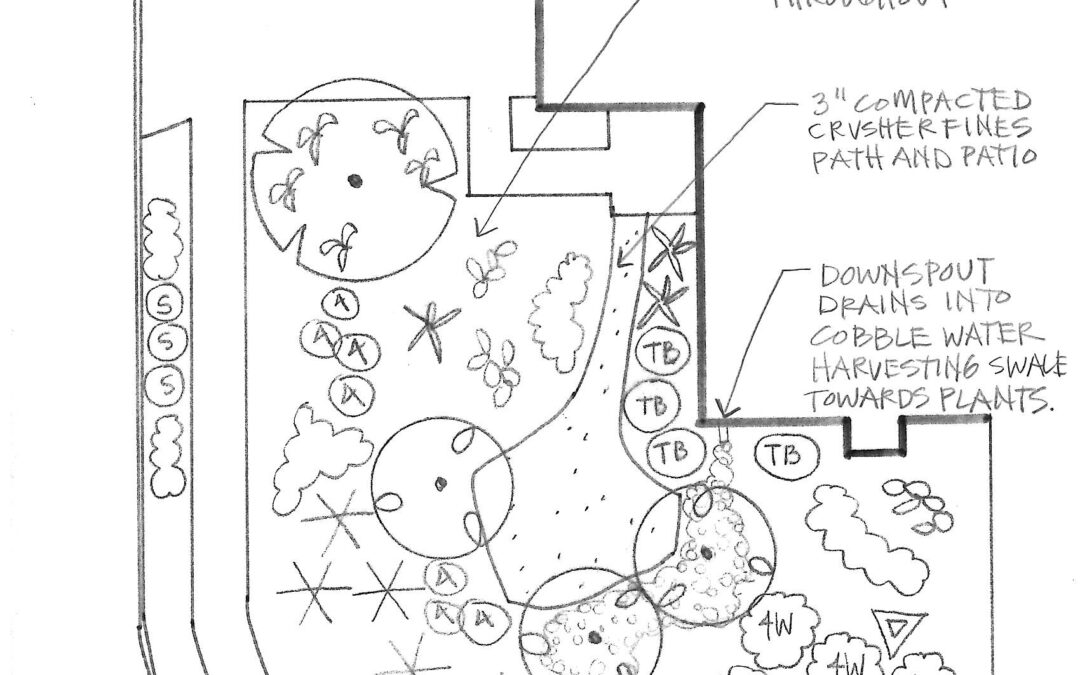
The Hotscape design embraces the environmental and visual qualities of Albuquerque’s high Southwestern desert location. Two areas of compacted crusher fines serve as a combined pathway, informal sitting area and a channel to harvest water from the occasional storm. A low berm provides visual interest, keeping the plants that cannot tolerate much extra moisture dry.
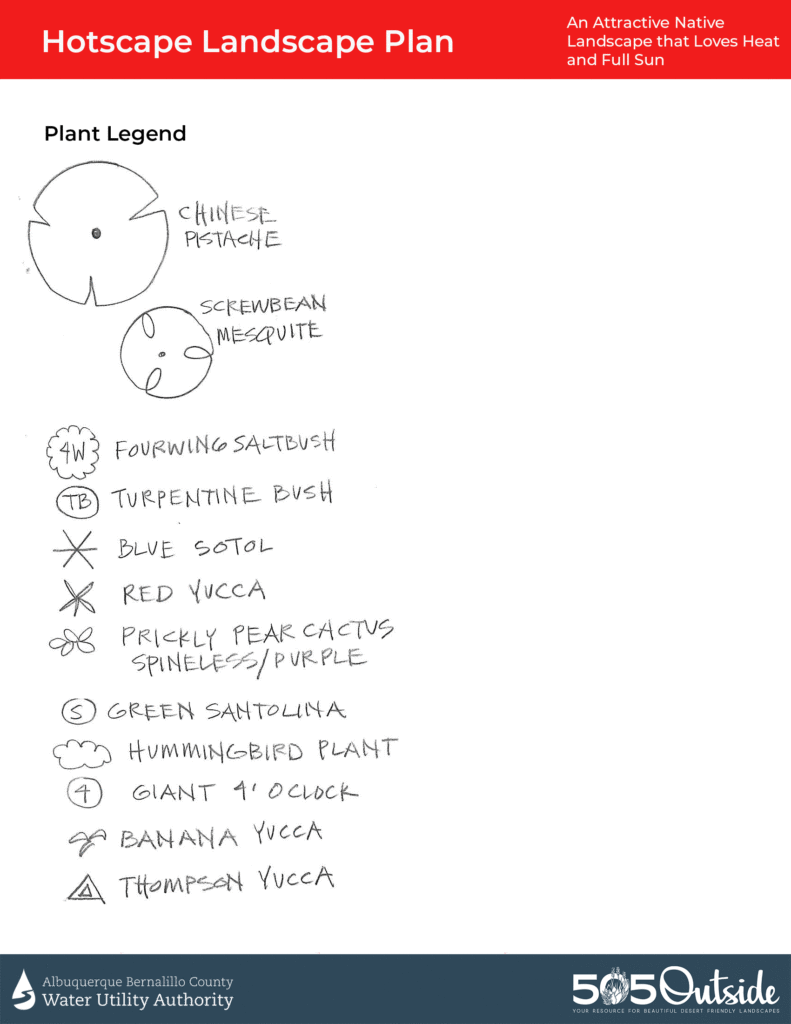
Modeled after the strikingly attractive and often evergreen plant communities native to the edges of Albuquerque, this design provides a great deal of visual interest throughout the year. The open, irregular canopies of Chinese pistache and screwbean mesquite provide filtered shade in summer and warming sunshine in the winter — an effect suggesting a desert arroyo. Fourwing saltbush screens the view to the street, and the dark, compact turpentine bush adds a pleasant fragrance with yellow fall flowers. The last, crucial ingredient to this design is the generous use of native desert accent plants, including the bold, blue-green forms of sotol, desert prickly pear and banana yucca. These local signature plants are accented further with small masses of seasonal color from low perennials and groundcovers, attracting both hummingbirds and passing neighbors!
Learn more about specific types of gardening here: