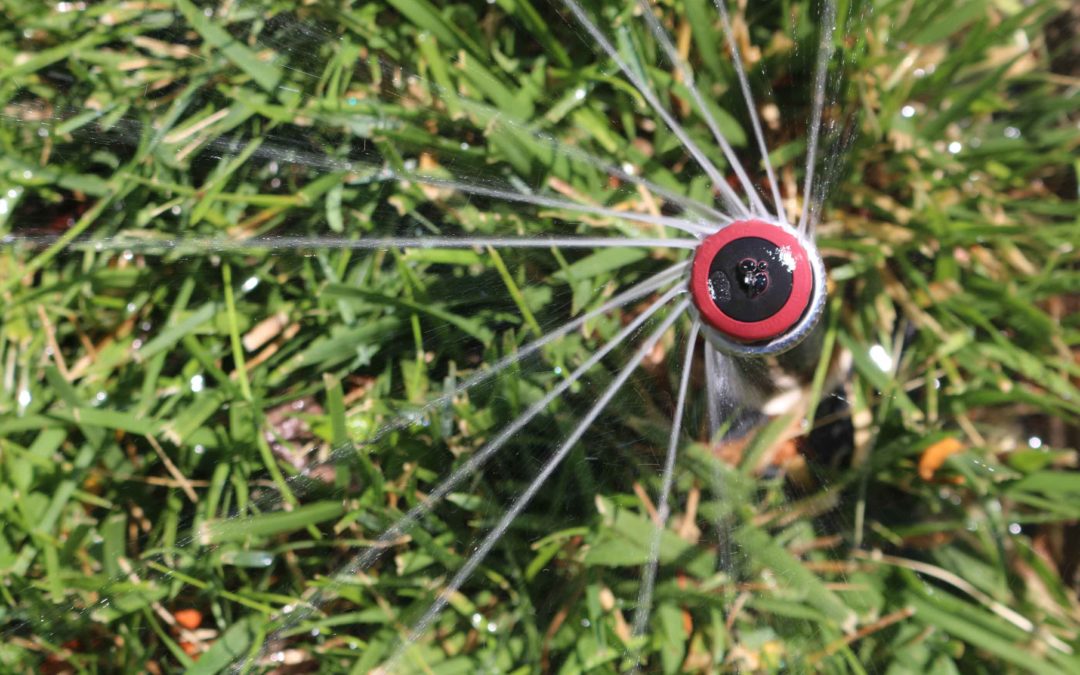
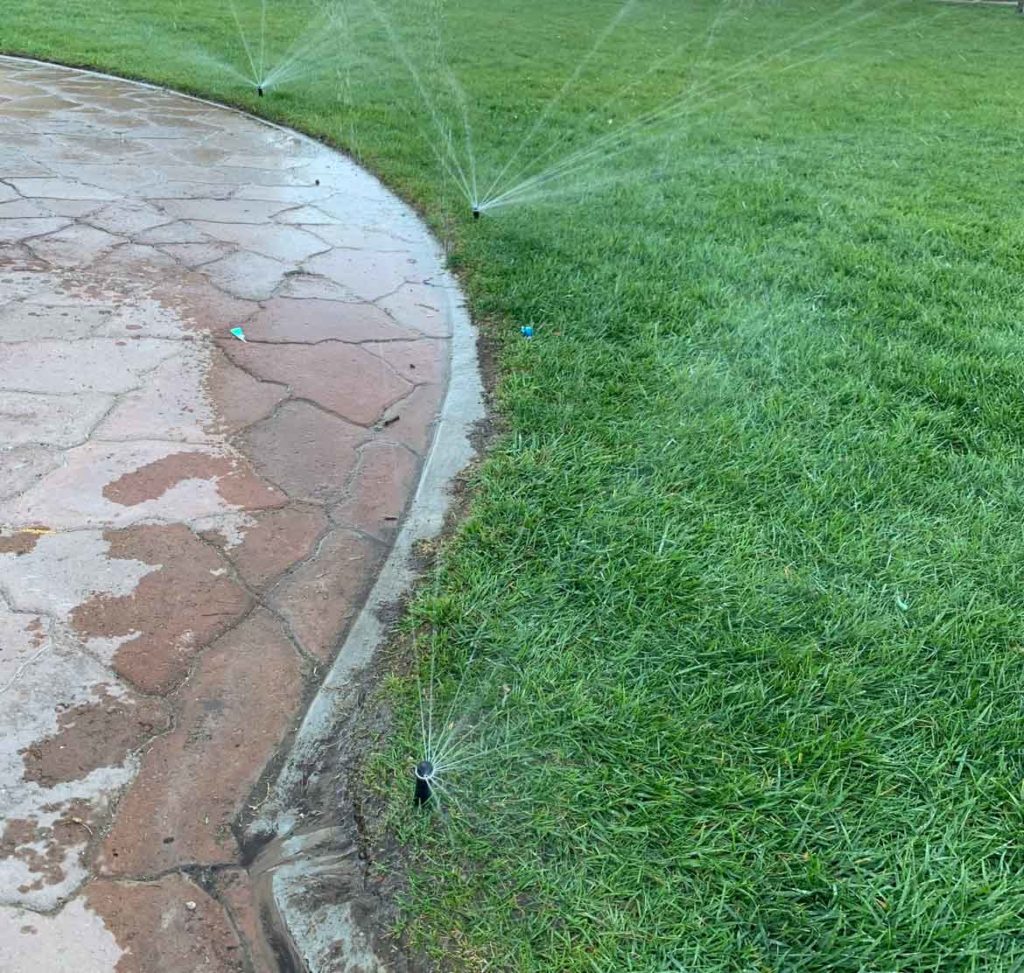
It’s irrigation season. If you have a grass lawn with spray heads, it’s time to check out your system to make sure it is running smoothly. Run a one-minute test program on the controller and visually examine each zone. Look for broken, leaning, or clogged sprinkler heads. Check and adjust for irrigation spraying on sidewalks, driveways, patios, or streets. Look for uneven coverage and sprays that may be blocked by new landscape growth.
If any of the above issues are happening, you’ll want to go through each spray head and perform the following maintenance tasks:
Flush the sprinkler system by turning on the sprinklers for a few seconds without the nozzle.
Adjust the arc by turning the sprinkler on. While the sprinkler is watering, look at the right side and see if it is aligned. If it isn’t, you will need to align it by turning the entire riser to the correct position (to the right) as this is the fixed side of the arc. While turning the riser you will hear a noise. This is a ratcheting system that allows you to make an adjustment. Turn it clockwise to reduce the arc and counterclockwise to increase the arc.
Adjust the radius by turning the screw in the middle of the nozzle with a flathead screwdriver, turning clockwise position to reduce, and to reach farther turn opposite direction or counterclockwise.
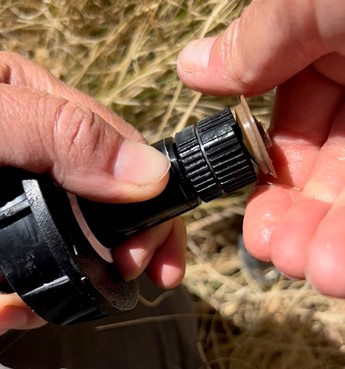
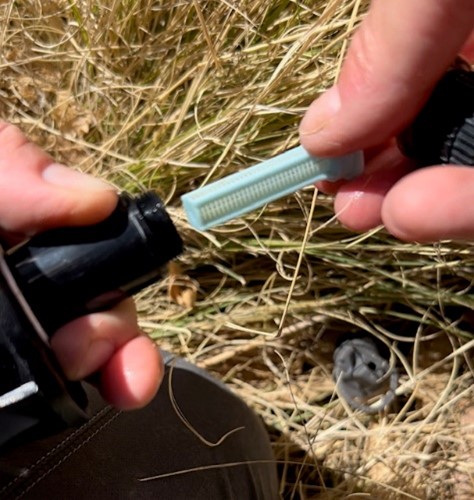
Clean the filter by pulling the riser up and holding it with one hand, while your other hand unthreads the nozzle and pulls the filter out. Clean the filter by dipping it into a bucket of water.
If your spray heads are putting out a very fine mist or fogging, your system may be operating over its design pressure. You’ll need to install a pressure regulator to reduce the water pressure at the irrigation system’s water connection, which is before the backflow and after the meter.
Learn more by checking out these other useful irrigation articles:
Author: Jill Brown, ASLA, is a Landscape Architect and owner of My Landscape Coach in Albuquerque, NM. Contributor: Greg at Sisco Irrigation, Albuquerque, NM. Have A question about the article? [email protected]
The most efficient way to water your yard is by using an automatic system. Hand watering can be problematic because it can lead to inconsistent watering, causing you to overwater, underwater, or forget to water altogether.
If you are ready to invest in a more efficient irrigation system, a Water Sense Smart hose timer is the way to go. It’s an inexpensive way to get your plants on an automatic irrigation system, allowing you to water your yard on a specific day of the week, time of the day, and for a set number of minutes. You can put it together yourself for under $100.
The hose timer can attach to high-quality irrigation Polypipe with drip emitters or connect to a professional landscape dripline. The irrigation dripline can stay in the ground year-round and is easily connected to an automatic in-ground irrigation system.
There are a variety of products you can use, including smart controllers, easy twist and turn controllers, battery controllers, multi-valve controllers, and more. We offer a rebate on ones that adjust to our weather and your plant’s watering needs.
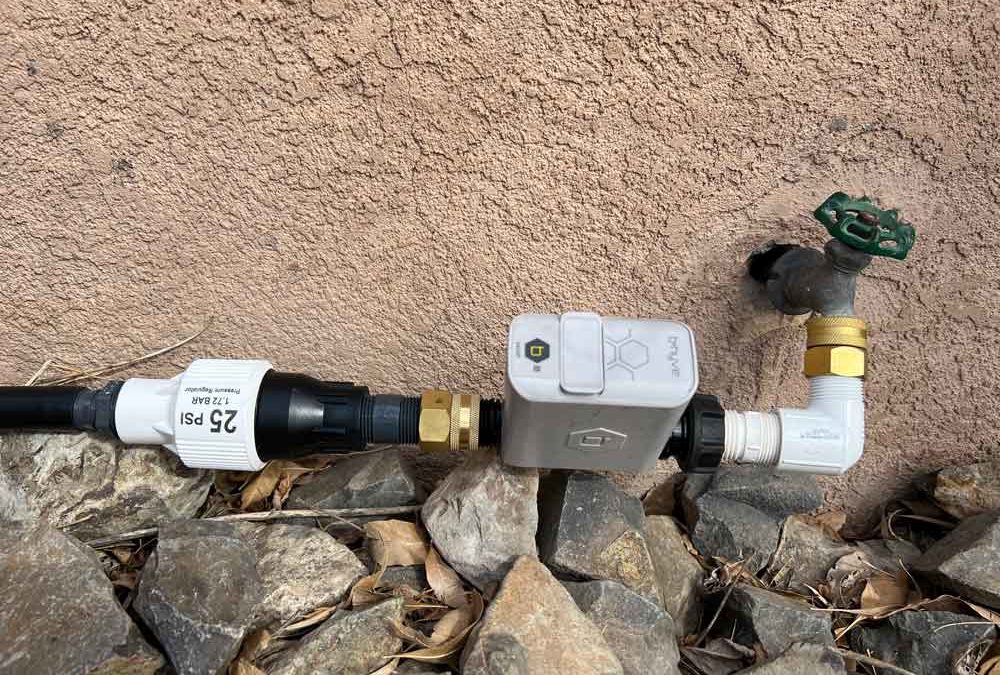
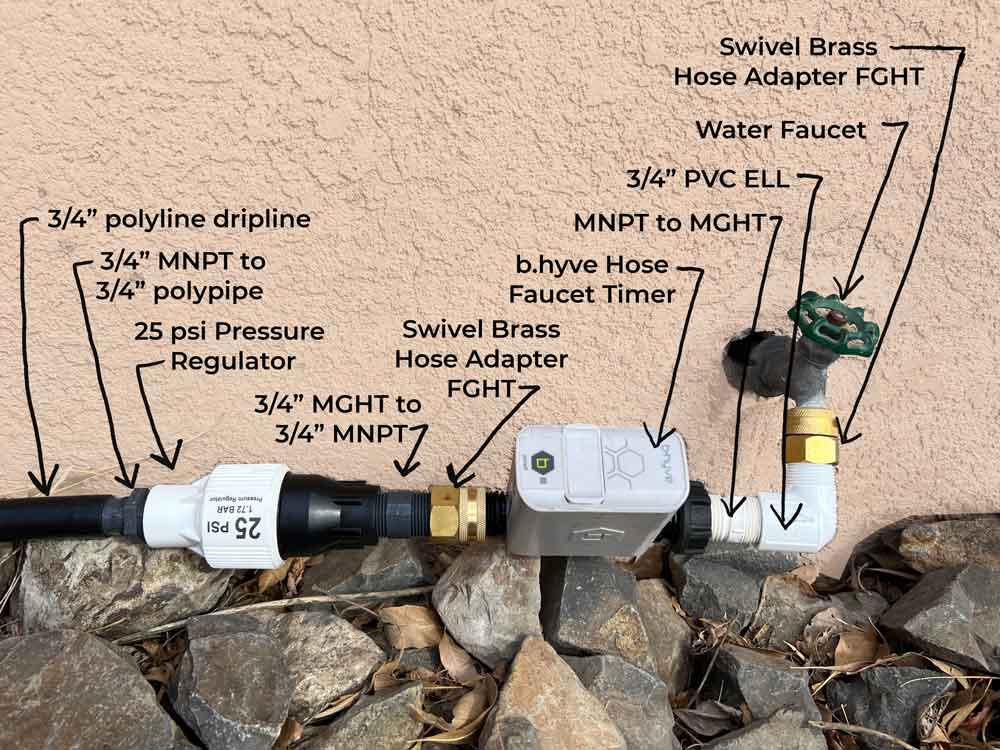
Below is an example of a hose watering system using one of the smart irrigation controllers —in this case, a B-hyve hose faucet controller— included in our rebate program. All the pieces and parts needed for this system are listed below, but if you have any doubts, take this picture to your local irrigation supply store and they’ll help you get everything you need.
Plants thrive on a consistent watering routine that allows the soil to dry out slightly between waterings. Setting up an automatic hose bib system is easy, inexpensive, water smart and the best thing you can do to keep your plants healthy.
Learn more by checking out these other useful irrigation articles:
Author: Jill Brown, ASLA, is a Landscape Architect and owner of My Landscape Coach in Albuquerque, NM. Contributor: Greg at Sisco Irrigation, Albuquerque, NM. Have A question about the article? [email protected]
The most important part of watering is figuring out how deep you need to water your plants. Once you figure that out, you can easily follow our chart that tells you how often to water.
Here are six simple steps to figuring out your watering depth:
Step 1: Water your landscape for the usual amount of time. If it’s the first time you’re watering, start with the number of minutes found in this Irrigation Advice Chart.
Step 2: Wait 24 hours after watering so the water has a chance to percolate into the soil.
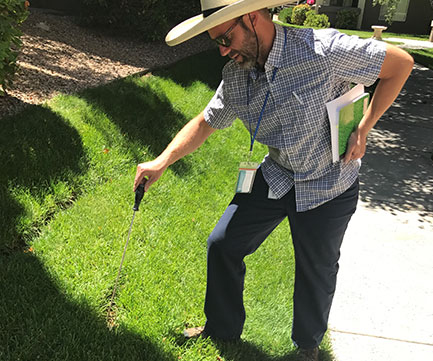
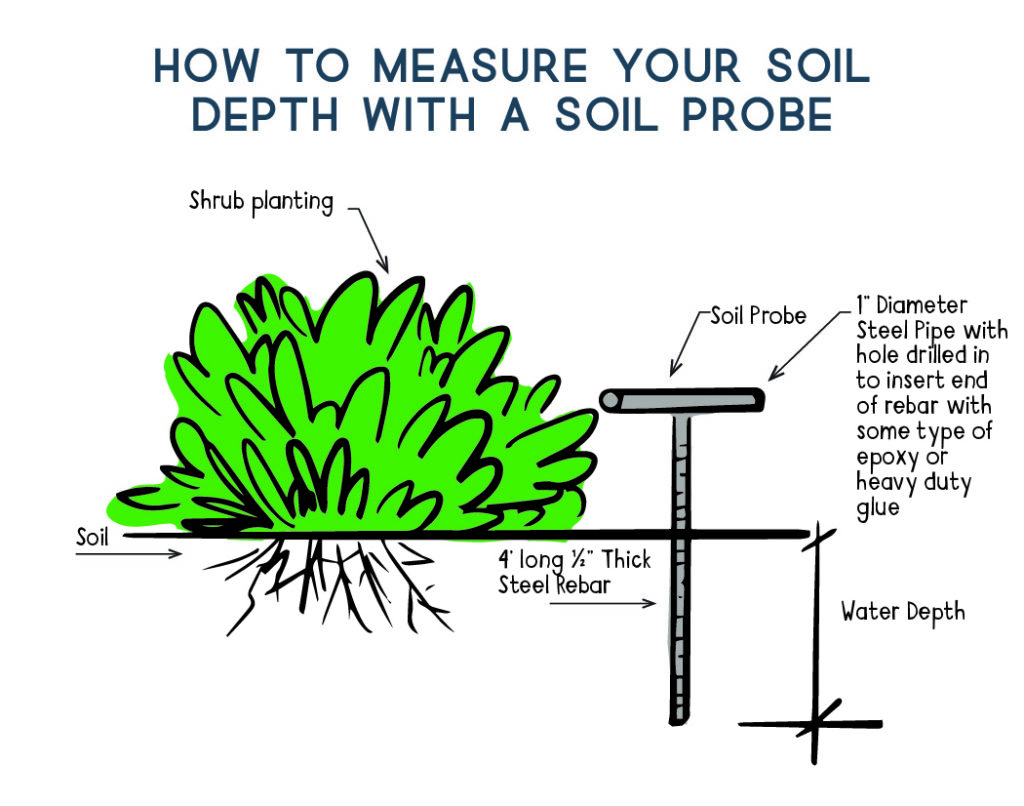
Step 3: Grab a measuring tool, such as an 18” depth screwdriver, soil probe, barbecue skewer or 24” long piece of rebar, and probe your tool into an area you didn’t water to check the soil resistance. Next, go to an area that you watered the day before. Push the probe in until it stops. It should go in fairly easily. Don’t try to push it in further once it stops because you can accidentally break a pipe. Mark the spot it went into with your finger, tape or a permanent marker. Pull out the probe and measure the number of inches. Those inches represent your current watering depth. Using the Seasonal Watering Recommendations chart you can find out the depth you need for your type of plant.
Step 4: Adjust your watering time to correctly determine the watering depth. Did you only water 4” but needed a 12” watering depth? If so, then add more time to your watering schedule and perform the test again. Did you water 24” but only needed 18”? If so, then subtract time from your watering schedule. Water again and wait 24 hours to retest.
Step 5: Once you figure out the amount of time you need to water so the water penetrates to the correct soil depth, you are set.
Step 6: Set your controller for the correct amount of time. Use our handy Seasonal Watering Recommendations chart to see how often you’ll need to water your plants.
Don’t overthink it. Our local, desert-friendly plants (native and adaptive plants typically found in our local nurseries) usually thrive in our native soil.
Learn more by checking out these other useful drip irrigation articles:
Author: Jill Brown, ASLA, is a Landscape Architect and owner of My Landscape Coach in Albuquerque, NM. Have A question about the article? [email protected]
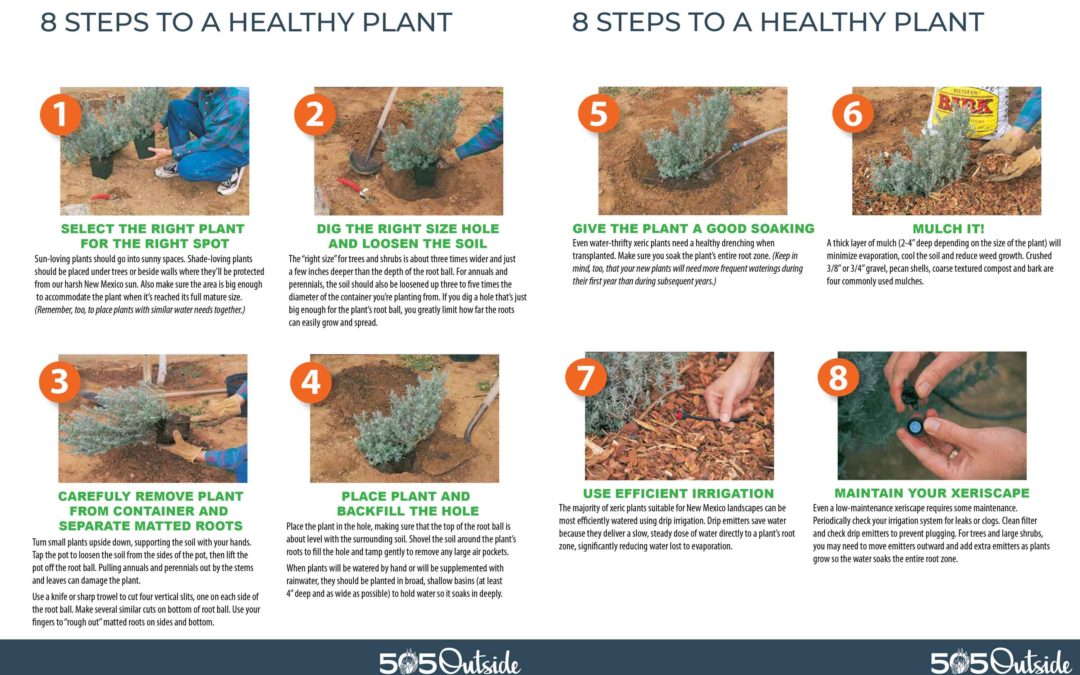
With spring fast approaching and many homeowners heading out to local plant nurseries, we want to remind you how to plant for a healthy plant. Choosing the right plant for the right place is the most important consideration. Once you’ve selected the perfect desert-friendly plant, installing and irrigating it correctly are the next steps for success.
Step 1: Select the Right Plant for the Right Spot
Sun-loving plants should be planted in sunny spaces. Shade-loving plants should be placed under trees or next to walls where they’ll be protected from our intense New Mexico sun. Be sure the area is big enough to accommodate the plant when it reaches its full mature size, and remember to place plants with similar water needs together.
Step 2: Dig the Right Size Hole and Loosen the Soil
The right size hole for trees and shrubs is about three times wider and just a few inches deeper than the depth of the root ball. When transplanting annuals and perennials, look at the diameter of the plant’s container and make sure the soil around the hole is loosened up three to five times the size of the diameter of the container. If you dig a hole that’s just big enough for the plant’s root ball, you greatly limit how far the roots can easily grow and spread.
Step 3: Carefully Remove the Plant from its Container and Separate Matted Roots
Turn small plants upside down, supporting the soil with your hands. Tap the sides of the pot to loosen the soil, then lift the pot off the root ball. Pulling annuals and perennials out by their stems and leaves can cause damage.
Step 4:Place the Plant in the Hole and Backfill the Hole
Place the plant in the hole, making sure that the top of the root ball is close to level with the surrounding soil. Shovel the soil around the plant’s roots to fill in the hole and tamp gently to remove any large air pockets. If plants are going to be watered by hand or supplemented with rainwater, they should be planted in broad, shallow basins at least 4” deep and as wide as possible to hold water so it soaks deeply into the soil.
Step 5:Give the Plant a Good Soaking
Even water-thrifty xeric plants need a healthy drenching when transplanted. Make sure you soak the plant’s entire root zone. Keep in mind that your new plants will need more frequent watering during their first year than in subsequent years.
Step 6:Add Mulch!
A thick layer of shredded wood chip mulch, 2”- 4” deep depending on the size of the plant, will minimize evaporation, cool the soil and reduce weed growth.
Step 7: Use Efficient Irrigation
The majority of desert-friendly plants suitable for New Mexico landscapes can be most efficiently watered using drip irrigation. Drip emitters save water because they deliver a slow, steady dose of water directly to the plant’s root zone, significantly reducing evaporation.
Step 8:Maintain Your Desert-Friendly Xeriscape
Even a low-maintenance xeriscape requires some maintenance. Periodically check your irrigation system for leaks or clogs. Clean the filter and check drip emitters to prevent plugging. For trees and large shrubs, you may need to move emitters outward and add extra emitters as plants grow to make sure water soaks the entire root zone. Use our Water by the Seasons Watering Recommendations for all your seasonal water needs.
Check out our free .pdf, display it in a visible place and use it when you start your spring plantings.
Learn more by checking out these other useful drip irrigation articles:
Since the Albuquerque area receives about 9” of rain on average per year and grass lawns can use up to 50” of water per year, the proper design of an irrigation system for a grass lawn is of utmost importance when it comes to water efficiency. Irrigation efficiency can save up to 30% of the water you use by avoiding water waste.
While the Water Authority does not encourage grass lawns, we understand that some homeowners may want to install new lawns or reduce the size of their existing lawns. If you are going to have a turfgrass lawn, we recommend that it’s a lawn you use and not just maintain for curb appeal. Proper irrigation layout and design are key to having a healthy and water-efficient lawn.
When designing your lawn, keep these tips in mind:
1) Lawns smaller than 10’x 10’ are hard to water with a spray irrigation system.
2) To get the most efficient irrigation coverage, design square and rectangular lawns since sprinkler heads spray in fixed patterns-such as a quarter circle, half circle or full circle-but not curves. If curves are necessary, broad curves have the best chance of being irrigated without over spraying, while zigzag narrow curves are the toughest to irrigate effectively.
3) We recommend using WaterSense Pressure Regulating Spray Sprinkler Bodies.
WaterSense labeled spray sprinkler bodies with internal pressure regulation can reduce water waste by providing a consistent flow at the sprinkler nozzle. When the sprinkler body maintains pressure near its optimal operating pressure, the connected nozzle is better able to generate the right amount of water spray and coverage for a more uniform distribution of water across the landscape. Customers can choose from a list of pre-qualified spray sprinkler bodies.
4) We also recommend using High-Efficiency Rotating Sprinkler Nozzles (multi-stream). These nozzles minimize water waste and feature a unique multi-trajectory rotating stream that delivers water at a steady rate. This slower application allows water to gently soak in at rates that soils can absorb. Use these nozzles to replace the sprinkler head on any conventional spray head body or pop up sprinkler. For more information on these nozzles read this post.
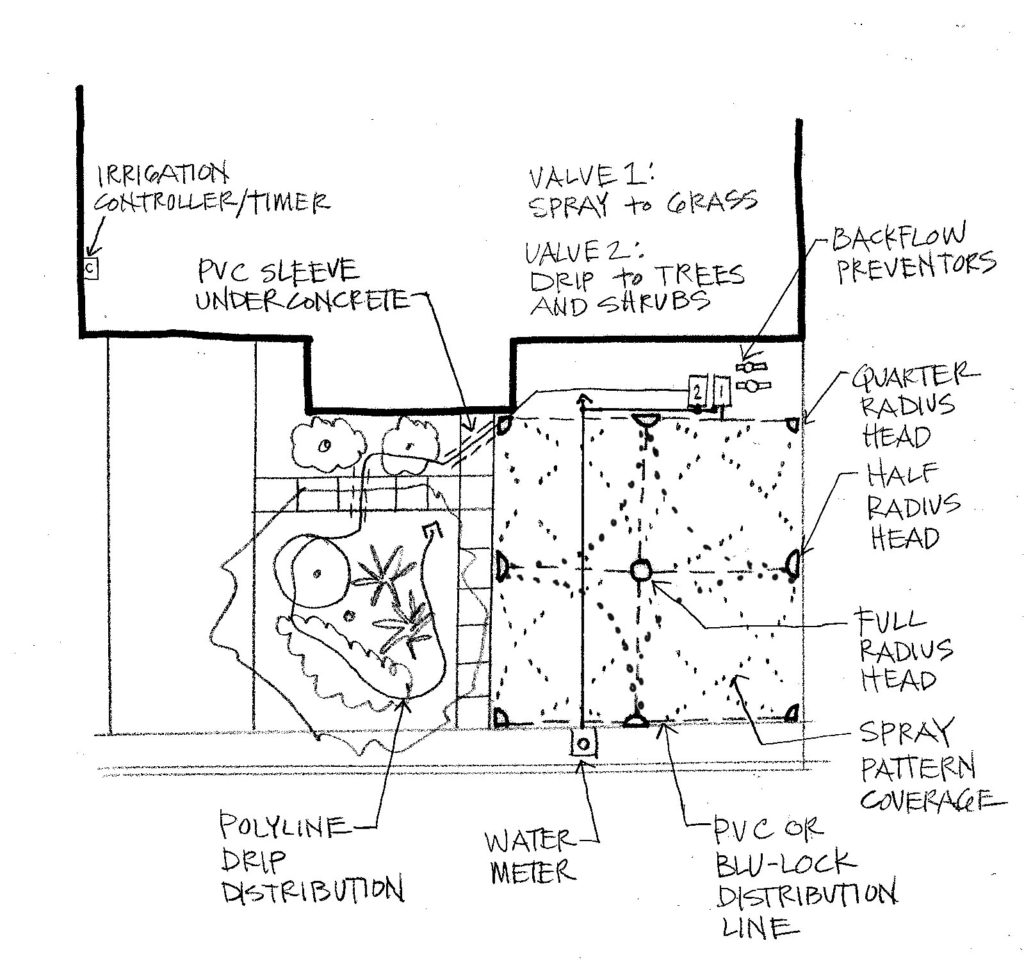
5) Irrigation sprinkler nozzles are designed for 100% overlap of watered areas, which means each sprinkle nozzle throws water to the next sprinkler in all directions. If a system is not built this way, there will be dry spots (see the below image).
Designing, reducing and changing the shape of your lawn doesn’t have to be an expensive project but it can save a lot of water. Visit your favorite local irrigation supply store for professional equipment and expert advice.
Learn more by checking out these other useful irrigation articles:
Author: Jill Brown, ASLA, is a Landscape Architect and owner of My Landscape Coach in Albuquerque, NM. Have a question about the article? [email protected]
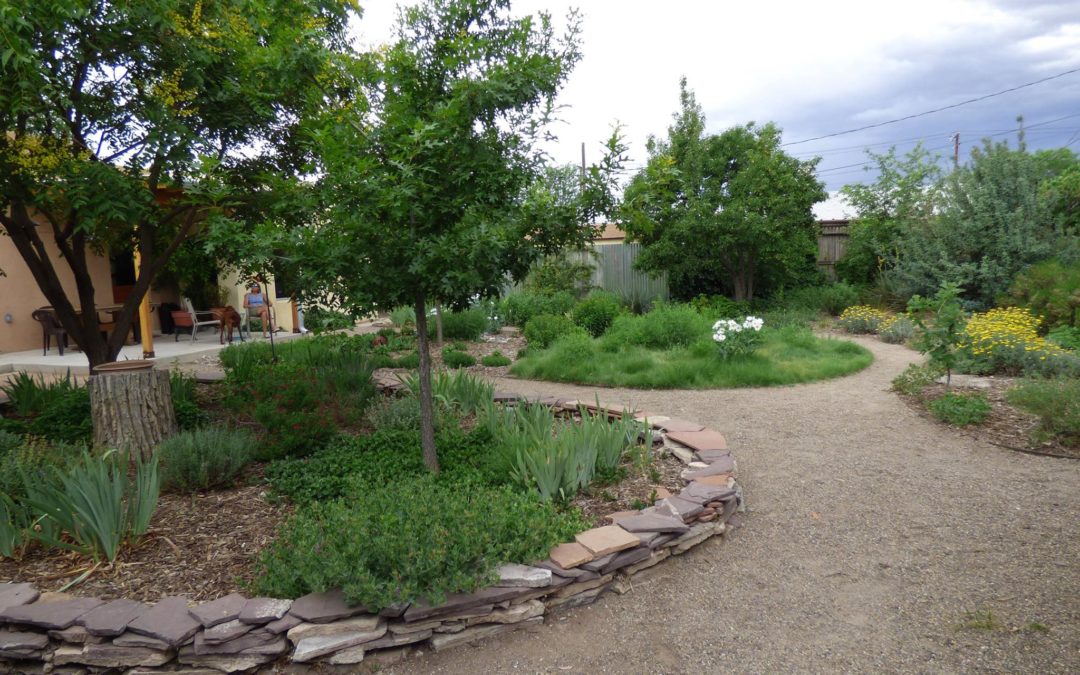
We are living in a time when our climate is going through rapid changes. Winter days have gotten warmer, and very cold nights are decreasing in number. The decrease in snowpack and early snowmelt that volatilizes before it soaks into the soil are creating drier watersheds, which are vulnerable to fires that can affect our water quality. Reduced snowpack affects streamflow. In order to take care of our Albuquerque landscapes, we need to rely on groundwater. When there’s a lack of precipitation, groundwater recharge is adversely affected. Less precipitation also means drier soils with little reserve moisture to maintain existing vegetation. Even if precipitation amounts don’t diminish, warmer temperatures affect evaporation rates from plant leaves and add to water stress. Supplemental irrigation demand is going to surge to maintain healthy landscapes. We need to implement adaptation strategies, like proper plant selection and smart watering methods, to make climate-ready landscapes a reality in Albuquerque.
We can prepare our landscapes for hotter summer daytime temperatures and warmer winters by following these strategies:
Shade surfaces: Plant trees and large shrubs against walls and near concrete to buffer sunbaked paving and cool walls that absorb heat during the day. By doing this, temperatures can be reduced by five degrees in urban areas.
Plant climate-ready trees: Check out the Climate Ready Tree list. This science-based list of trees that are most likely to survive our changing climate was put together by a diverse group of plant professionals. In mid-century, Albuquerque is projected to become as hot as El Paso, Texas. By the end of this century, our climate will become like present-day Tucson, Arizona.
Mulch everything:Mulchinsulates plant roots from both heat and cold, reducing moisture loss from the soil by evaporation, feeding beneficial soil microorganisms that enhance plant growth and improving soil health. Install 3-4” of mulch over bare dirt to reduce weeds, to enrich the soil and around all new plants to retain the moisture.
Remove or reduce turfgrass lawns: Lawns require 40 inches of water a year, compared with the 8 inches that Albuquerque gets. The greatest value of a cool- season turf is its resilience as a play surface, so if you aren’t regularly using it, consider removing it or installing a low-water grass or meadow.
Incorporate smart irrigation practices: Smart irrigation devices like smart controllers adjust the watering times based on local weather, thus saving water. Drip irrigation delivers water directly to plants. Efficient rotary spray heads reduce water use by 30% or more compared with regular spray heads.
By using these climate-ready practices, it will take less water to create a greener city, support wildlife and keep our community cooler.
Learn more by checking out these other useful drought articles:
Author: Judith Phillips, owner of Design Oasis, landscape designer, and garden writer with 30 years of experience designing arid-adapted and native gardens in the high desert. Have a question about the article? [email protected]