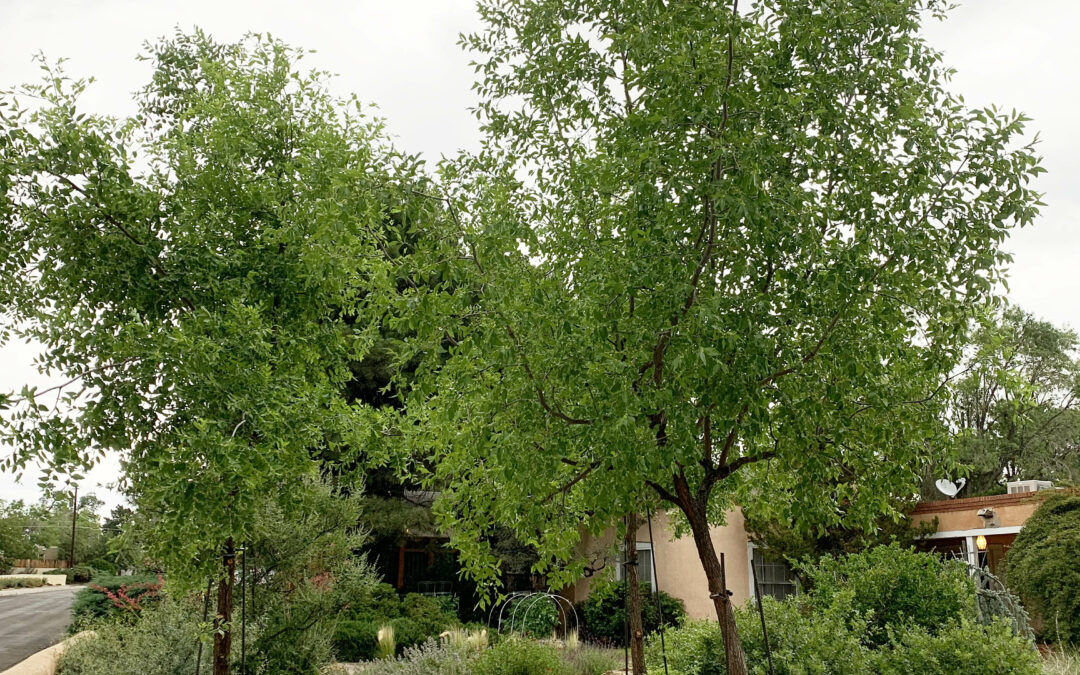
The jujube is just one of those trees that is extra! Extra fruitful, extra nutritious, extra hardy, extra beautiful. This medium sized tree comes in 400 varieties, many of which are being cultivated and taking root in Albuquerque.
The jujube tree, often called Chinese date, has been cultivated for thousands of years around the world, in Albuquerque for nearly 60 years and in the panhandle of Texas since 1875. Its small abundant fruits are high in fiber, vitamin C, potassium, antioxidants and phenolic compounds and have been used to support nervous system, cardiac and digestive health. Medicinally, it is used as a tonic sweetener in many supportive Chinese herbal remedies.
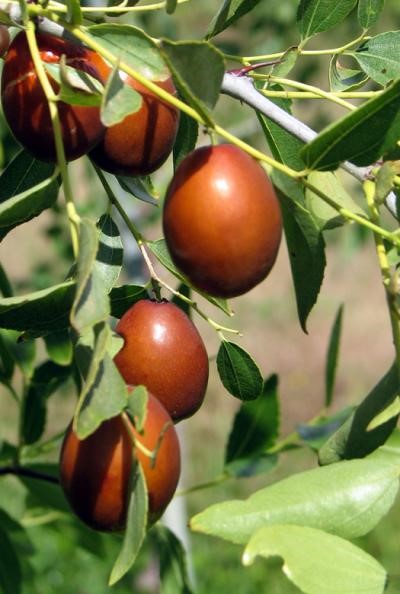
The fruit can be eaten raw, dried or cooked. Fresh from the tree, when they’re mature and a luscious mahogany brown, they have a crunchy refreshing taste, like a cross between an apple and a date. As they dry, they become sweeter and chewy. Dried, they are delicious in oatmeal, cookies, trail mix or anywhere you would use dried fruit. They make an excellent chai — just boil dried pieces with other ingredients, letting the earthy sweet flavor complement ginger, cinnamon, cardamom, pepper and other traditional chai ingredients. You also can find recipes from Korea, China, Vietnam, India, Italy and many Persian cultures that incorporate the jujube for both sweet and savory dishes.
The fruit is very easy to dry and, in fact, many that you miss harvesting will dry right on the tree. However, we do recommend bringing them inside to dry and cutting the pits out before drying so they are easier to eat and enjoy down the road. If you have a dehydrator, that will speed the process, but they will also dry if you place them on cookie sheets in a spare room, on top of a shed in the sun or even in a car and let our New Mexico dry air work its magic. Jujubes don’t bruise and spoil quickly like other stone fruits, so windfalls and bird-pecked fruits don’t make a mess and are still usable.
We love edible landscapes, so we’re naturally drawn to these fabulous trees. But even if you aren’t looking for food, the jujube is a wonderfully hardy tree for Albuquerque. This tough specimen hails from the buckthorn family, Rhamnaceae, and will grow in USDA hardiness zones 6-11, which is an extraordinary range for any tree! At the moment, Albuquerque is generally zone 7, but as we face climate disruption, landscapers and planners are encouraging planting with an eye to zone 8 or 9 so our shade and habitat trees can withstand increasing heat. Jujubes are deeply rooted and can tolerate drought and saline and alkaline soils. Once established they can survive with small amounts of water, though a strategic watering schedule will increase your yield. Because they’re so drought tolerant, we don’t recommend planting a veggie garden under them or they’ll drink up all the water intended for your zucchini. They do well in full sun or light shade. They can handle sustained days and weeks of 100 degree plus heat, 23 below zero in winter and anything in between. They must have a frost to produce fruit, which isn’t a problem here. Jujubes do sucker quite a bit from their roots, and this rootstock, if allowed to sprout, produces very small, almost inedible fruits that are mostly pit. So, we do suggest being vigilant in cutting down the root sprouts as they appear.
Jujubes make a beautiful addition to any landscape. They have an elegant zig zag branch growth pattern and bright green, shiny oval leaves that can even withstand severe hail. They can be trained to a traditional tree structure or allowed to be a little wild and shrubby. They provide cool shade and habitat for birds, pollinators and other wildlife. Speaking of wildlife, one of us has a friend whose small dog Kipper grabs himself a couple from the ground during ripening season, carrying them happily to his bed to snack on … he’s not wildlife, but that little dog seems to love a jujube even above his biscuit treats. These trees benefit from cross pollination so plant yourself two of these beauties!
Planting trees not only gives you the riches of your tree, but it is also a love letter to the future. As gardeners who are tending land and each other in the midst of climate chaos, we have the opportunity to cultivate healing, repair and hope. With every tree we plant, we can try to leave our small patch of earth a little better than how we found it — cooled with shade, brightened with birdsong and providing nutritious food via a resilient, prized and giving tree. The next time you’re sitting in your garden, allow yourself to dream of a future where someone is harvesting jujubes and appreciating the ancestors who cultivated and left these sweet trees for them.
Learn more about specific types of gardening here:
Author: Corva Rose is an arborist and founder of Tree School, and can be reached through treeschoolNM.com, Jennifer Gardner has been gardening in Albuquerque for 30 years, with an emphasis on residential scale food planting. Have a question about the article? [email protected]
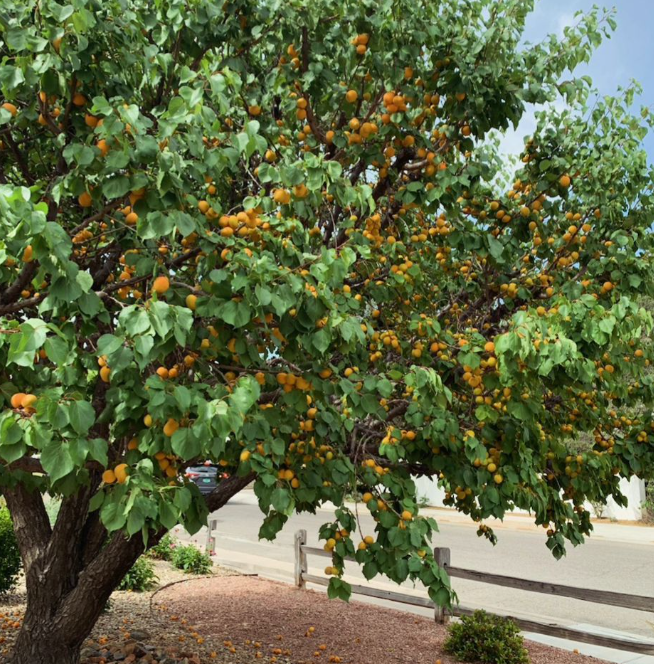
If you’ve walked around your neighborhood, you’ve probably noticed cherry trees being flocked by birds and buckets of fruit with “Free Organic Apricots” signs. Yes, it’s harvest season in Albuquerque. Have you ever wondered what becomes of all that fruit?
Back in 2014, avid canners and food preservers Erin and Trista noticed fruit trees around Albuquerque going unpicked. They placed an ad on Craigslist, asking for access to unused trees. The response was overwhelming, and this local chapter of the Food is Free Project, a global movement started in Austin, Texas, began.
Food is Free Albuquerque (FIFABQ) harnesses the abundance of fresh food within our community and connects it to people in need. The nonprofit considers fresh food a human right and aims to reduce food waste while fighting for food equity and access to fresh and nutritious food.
Volunteers help to harvest fresh food throughout Greater Albuquerque and Santa Fe. They then distribute the fresh food throughout the community in which it was gleaned to keep food as local as possible. Last year, 26,315 pounds were harvested.
FIFABQ fosters social empowerment through the growing and sharing of fresh food, striving to tap into the abundant private food resources within our community and redirecting millions of pounds to those overlooked by the existing food system. FIFABQ harvests everything aside from crab apples, mulberries and prickly pears.
The produce is predominantly distributed through collaborations with various organizations committed to feeding the community citywide. Explore the list of their partner organizations on the website.
When I mention black currants while talking fruit trees and shrubs with people in Albuquerque, I have come to expect that we are often starting the conversation thinking about different things. Most commonly, people have experienced or heard about the European black currant, Ribes nigrum.
They recall an earthy, resinous flavor with nice sweetness and a tart finishing kick. European currants are best reserved for cooking. With their strong flavor, they make incredible sauces and condiments and are equally delicious as preserves and in pies and tarts. These black currants have a devoted following. Because the flavor is very distinct, I have found people often have a binary reaction when I mention the fruit: either pleasurable nostalgia or occasionally disinterest or dislike.
The other thing people confuse for black currants are little dried raisins, similarly dark in color and confusingly sold as “currants.” These fruits are made from “raisins de Corinthe,” Greek grapes grown, dried and shipped for hundreds of years from a port of that name. These are not the black currants I am talking about.
While I do like eating and growing the European black currant here in Albuquerque (mostly as a shady understory plant), I am much more excited about our native black currant — Ribes aureum— the clove currant, aka golden or buffalo currant.
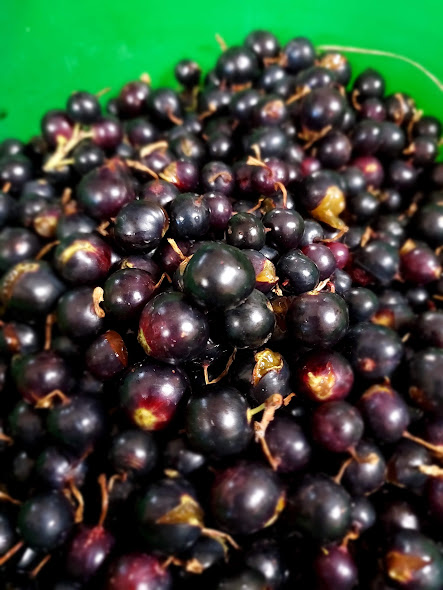
The clove currant is more fruity, less funky and a bit sweeter than its European counterpart. There is still some pleasing complexity and tartness to the fruit, but nothing mouth-puckering. They are perfect for fresh eating — or freeze them so they can be thrown in a smoothie or used as a blueberry replacement in pancakes when the snow flies. The fruits can get nice and large for a currant, from ¼ inch up to ¾ inch in size, with a shiny, blue/black color. Even the shrubs themselves are a bit larger, reaching 5 to 6 feet at maturity.
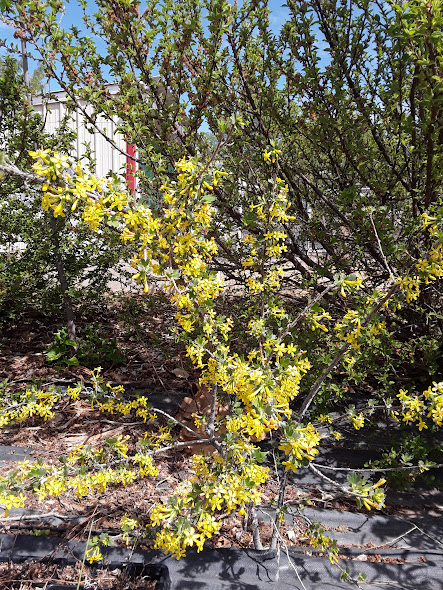
As an ornamental, the clove currant is a bit too floppy for a hedge, and they do send out runners — so consider yourself warned. However, if you give them a little space as a focal point in the garden, you will be rewarded with abundant dangling, bell-shaped yellow flowers in the spring that draw you across the yard with an overpowering vanilla and clove scent and, of course, all the incredible life that visits the flowers for their nectar. You will also get to see them with their dusky-crimson foliage in the fall. For most of the summer, you and the birds can keep eating the fruits as they ripen singly or in small clusters.
Clove currants handle the New Mexico sun and heat with grace, but they are quite adaptable and can do well with partial and even full shade. Along the river, they are only occasionally shaded out by taller thickets. If you’re out wandering in the bosque this spring, keep an eye out (or follow your nose) for these incredible flowers and fruits.
Author: Graeme Davis is an ISA certified arborist and the owner of Flora Fauna Farm, a nursery that focuses on plants that grow well in the high desert. Flora Fauna Farm grows a diversity of edible trees and shrubs, useful native plants and unique landscape plants curiously underrepresented in the urban canopy of Albuquerque. You can see its offerings at www.florafauna.farm.
Food forests and edible landscapes have been around for a very long time. They are what helped ancient humans survive and thrive. Hunter-gatherers likely did not expend precious energy by wandering aimlessly, hoping to find sustenance, but rather they were able to evaluate the landscape around them and learn to harvest food occurring naturally in their habitats.
Forest edges were rich sources of diverse plant species, and ancient humans learned what species were edible, where to find them and even ways to support and encourage the growth of plants useful to them. Food forests or edible landscapes have evolved and adapted over thousands of years as humans’ hands and minds have learned to design them to their nutritional needs and geographic limitations. A food forest will be very different depending on where it is in the world, but all share some common traits that can be adapted to almost any climate.
Food forests are very different from traditional farming or growing a vegetable garden. They are designed to mimic the natural forest edge, where species producing edible fruits, nuts, berries, roots and tubers grow in natural layers. We can imitate this pattern with species of our choosing that will do well in our hardiness zone and climate. There are many references and publications on the subject and a quick internet search is an easy way to begin, as is your local bookstore’s gardening section.
The philosophy of permaculture design, popularized over the last few decades, has brought a new awareness to our landscape and garden design; we have learned to make use of topography, natural water movement, soil structure and amendments, sun and shade patterns over the seasons, and the importance of pollinators and wildlife in our gardens and lives. A food forest is a functional, beautiful and diverse way to garden holistically.
When you imagine your food forest, think about the layers of plant species and the food sources they provide. First, at the outer edge, there is the canopy, the tallest layer of trees. These might be fruit- or nut-bearing deciduous trees or even some conifers here or there, as even a pine tree has edible parts, and the needles make a fine tea.
The second story is a mid-level layer of smaller trees, such as semi-dwarf or dwarf apple, peach and plum trees. Under the smaller fruit trees comes the shrub layer. If shaded, it could be currants or gooseberries. If sunnier, perhaps raspberries or blackberries.
After the shrubs comes the herbaceous layer, planted with perennial herbs like rosemary, garden sage and thyme. Ground covers like strawberries can sprawl under and around, followed by root crops like carrots, radishes and more. Vining plants are important, too. Some, like sweet potatoes, can be both root and vine. Others, like grapes, can utilize the structure of the trees to move up through the branches, making harvesting an easy task.
In some environments, you can grow edible mushrooms as part of the lowest layer; they will feed on the decomposing mulch and decaying wood that is part of the forest floor. Mulch is critical in any garden or landscape and a necessity in a healthy food forest. Fallen leaves are an excellent natural mulch as are wood chips. Leaving or intentionally placing dead branches and logs is a great way to recycle nutrients naturally into the soil profile. Having rocks or stones in the mix is also a very good thing as they slowly release minerals as they break down over long periods of time.
Most of the plants in your food forest will be perennials, but as you see, there are places for annual herbs or vegetables anywhere there is room and the proper amount of shade, sunlight and moisture. Companion planting is a great way to decide what goes where, and diversity is the strength of any plant community. A food forest is the oldest, most resilient agroecosystem in the world, whether occurring naturally, enhanced by human hands and minds, or entirely created by intention and design.
Some of the benefits of a food forest are increased harvests based on diversity, nutrient storage and water retention in soil protected by mulch and overstory; healthy soil holding a host of beneficial microorganisms; and less weed and pest populations, again due to density and diversity, and therefore less maintenance and inputs (think fertilizer, weed control). Of course, organic principles are the way to go when growing anything you plan on consuming.
Like any garden or landscape, a food forest can and should reflect the humans who are part of the ecosystem and should be a place where native plants, wildflowers and grasses all have a place in the garden, where beauty, joy and learning from Mother Nature are sources of education, nutrition, comfort and pleasure.
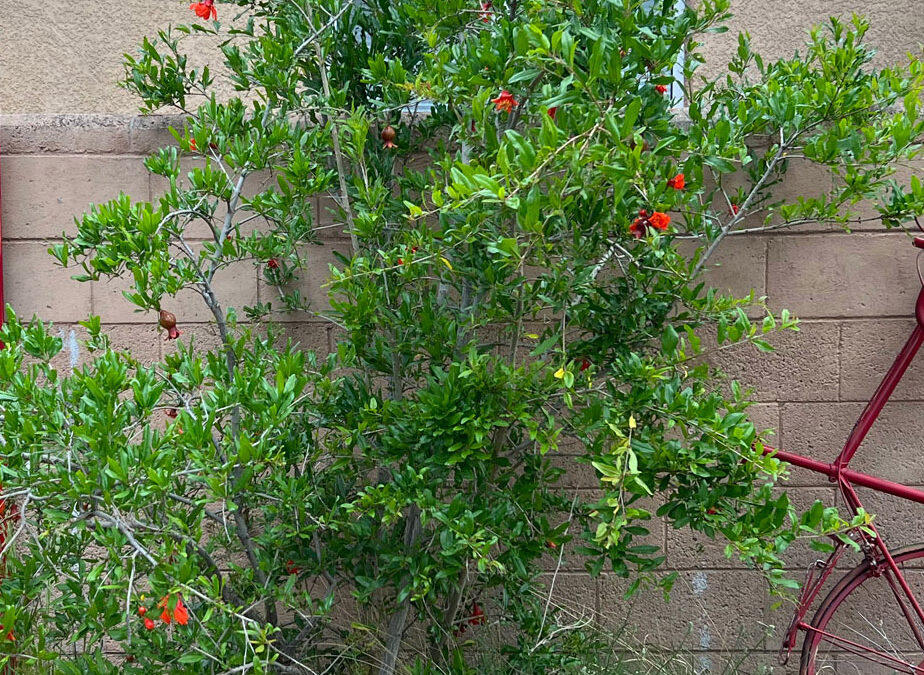
This fruit tree thrives against a hot wall with southern exposure. Beautiful orange flowers appear in the spring. After lots of pollination work by bees, pomegranates trees are covered with uniquely shaped fruit. This stunner needs only 4 feet of space because it has upright growth. During harvest time in the fall, it puts on a yellow foliage show then goes dormant for the winter. Pomegranate trees take about two growing seasons to fully set deep roots and produce fruit.
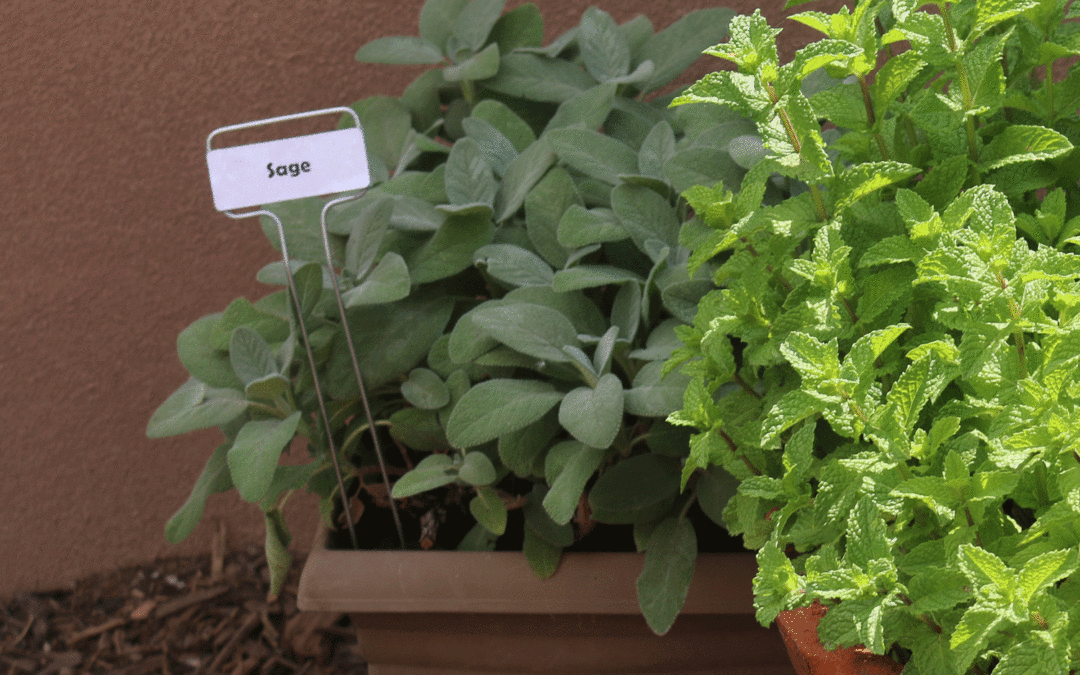
Plant this perennial among your garden beds for yearlong interest. This sage does double duty: It is edible and also a beautiful addition to any xeriscape yard. Purple blooms appear in early summer. Because it’s a Mediterranean plant, it likes to dry out between waterings.