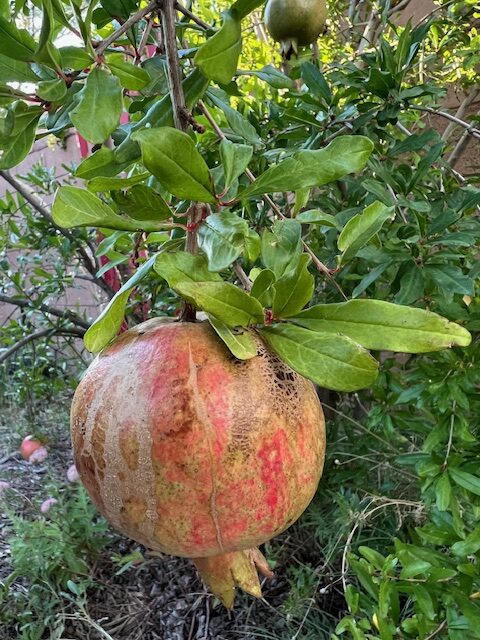
If you’ve walked around your neighborhood, you’ve probably noticed cherry trees being flocked by birds and buckets of fruit with “Free Organic Apricots” signs. Yes, it’s harvest season in Albuquerque. Have you ever wondered what becomes of all that fruit?
Back in 2014, avid canners and food preservers Erin and Trista noticed fruit trees around Albuquerque going unpicked. They placed an ad on Craigslist, asking for access to unused trees. The response was overwhelming, and this local chapter of the Food is Free Project, a global movement started in Austin, Texas, began.
Food is Free Albuquerque (FIFABQ) harnesses the abundance of fresh food within our community and connects it to people in need. The nonprofit considers fresh food a human right and aims to reduce food waste while fighting for food equity and access to fresh and nutritious food.
Volunteers help to harvest fresh food throughout Greater Albuquerque and Santa Fe. They then distribute the fresh food throughout the community in which it was gleaned to keep food as local as possible. Last year, 26,315 pounds were harvested.
FIFABQ fosters social empowerment through the growing and sharing of fresh food, striving to tap into the abundant private food resources within our community and redirecting millions of pounds to those overlooked by the existing food system. FIFABQ harvests everything aside from crab apples, mulberries and prickly pears.
The produce is predominantly distributed through collaborations with various organizations committed to feeding the community citywide. Explore the list of their partner organizations on the website.
Have you ever heard of forensic arboriculture? Probably not … but it is a thing! Figuring out why trees die can be a challenge as there are often multiple causes, and the clues may be obscured by time or a deep layer of rock mulch. If you look at enough dead and dying trees, though, patterns begin to emerge.
In our desert environment, one major overarching cause of tree death is thirst. Most of the trees we plant are not native, at least not to the desert grasslands that make up the native ecosystem throughout most of our region. Since these trees are native to regions with higher natural rainfall, we must make up the difference through irrigation.
Some trees die of thirst simply because there is not enough water in their root zones to supply the trees’ needs. Drought symptoms might include smaller leaves and less-dense canopies, dead twigs in the outer canopy, and droopy foliage. Because it takes a few years for trees to really show stress, it will take a few more years for them to show a strong response to improved conditions — but they will!
They will … assuming there aren’t other issues. One of the more common causes of drought stress, and possibly death, in trees is the presence of stem girdling roots. These are roots, usually from that same tree, that grow in a tight noose around the lower stem, just below ground level. Roots grow that way when they spend too long in a nursery pot or when they are only irrigated right at the very base of the tree. However these girdling roots start, they often end up causing a “choke point” where the trees’ vascular tissues are gradually crushed and the flow of energy-rich sap to the roots is reduced, as is the flow of life-sustaining water up to the leaves.
Stem girdling roots can be removed at planting, or even later if they are found. A sharp wood chisel often does the trick. Making sure trees are not planted too deeply is a great way to avoid creating stem girdling root problems. Many landscape trees are planted too deeply, which is rarely fatal on its own but can stunt growth, as well as setting up stem girdling roots.
Other kinds of girdling can kill a tree. All too often, mostly in public and large commercial landscapes, we find young, recently planted trees with large wounds just above soil level. These are wounds that have taken off the bark, leaving bare wood exposed to the elements. Any time a tree is wounded this way, it’s “living rind” of inner bark, cambium and sapwood are greatly compromised. The wound also exposes the inner wood to decay, so that if the tree doesn’t die quickly due to the destruction of the living rind, it runs the risk of breaking at the base when the decay cavity gets too big. By then, the tree may have some size and so present a real risk to people and their important things — cars, houses and such.
Another avoidable cause of tree death is poisoning with herbicides. In this time of instant gratification and “convenience is king” thinking, people often react to the presence of a few unwanted plants by applying a lot of chemicals to kill those plants. Often, tree roots grow in the treated areas and take in sublethal to lethal doses of herbicides. This happens in public spaces, commercial spaces, residential spaces … we could all be a lot more careful with our chemical use!
Herbicide damage usually reveals itself as weirdly deformed, often very stunted, leaf growth. These distorted leaves cannot capture enough carbon through photosynthesis to keep the tree healthy, so decline follows, with death nipping at its buds. Trees may recover from a one-time application, but repeated applications across seasons and years may well lead to death.
Large stem-girdling root on a young Chinese pistache which was dying and had to be removed.
Keep your trees alive and healthy with these simple steps. First, make sure the tree doesn’t have a stem girdling root problem. This requires carefully digging around the base until you find the main root flare, and cutting away roots that are circling tightly around the stem. Then, make sure nothing else damages that lower trunk area, keeping that outer bark intact and protecting the living rind below. Finally, make sure your irrigation system is adequate. Established trees need water broadly out under the canopy, and even beyond, but not so much at the very base.
Large stem girdling root at the base of a honey locust tree. Prompt removal of the root is recommended. Mower or string trimmer damage to a young tree. This will lead to decay and disease entering the very base of the stem.
Author: Joran Viers is an arborist at Legacy Tree Company. Contact him at joranviers@legacytreecompany.com Have a question about the article? AskAnExpert@abcwua.org
This beautiful deciduous native shrub fills with unique purple spiked flowers in May and June. This plant is adored by wildlife for its small seedpods, and pollinators love the flowers. It also serves as a host plant for some butterfly larvae. The False Indigo has small dark green deciduous leaves that are attractive in the garden. It is a workhorse when used in abandoned fields or along streambeds as it enriches heavy clay soils and stabilizes slopes.
Passive rainwater harvesting is a great way to optimize your landscape while minimizing water use. So you may ask, “What are active and passive rainwater harvesting?”
Active rainwater harvesting involves collecting rainwater runoff from roofs and other impermeable surfaces into containers such as rain barrels or cisterns for later use. These containers can vary from small (50 gallons or less) to very large (thousands of gallons). The saved water can be distributed with a hose or drip system for use in the garden.
Passive rainwater harvesting channels water from roofs, patios or driveways directly into the landscape via swales (channels) into basins (depressions in the landscape) or into French drains where the water will be stored in the soil for use by the plants. For every 1,000 square feet of hard surface, 1 inch of rain will produce about 600 gallons of water, so it’s easy to see how active systems will produce overflow and why it’s always recommended to send that overflow into a passive rainwater harvesting system. This will lessen the amount of potable water you will need for your landscape while improving plant health.
So, what plants should you choose for your passive rainwater harvesting garden? First you need to realize there will be three different zones with different amounts of water available to the plants.
1. The High Ground Zone is the area around the outside perimeter of your basin or swale where there will be limited amounts of extra water available to the plants. This will be your most xeric (low water use) zone. Plants for this area could include:
Desert willow (Chilopsis linearis)
Grasses such as sideoats grama (Bouteloua curtipendula) or sand dropseed (Sporobolus crytandrus)
Desert four o’clock (Mirabilis multiflora) or blackfoot daisy (Melampodium leucanthum)
Sideoats Grama
2. The Transition Zone is partway up the sides of the swale or basin. Plants growing here will get some extra moisture but will not be at the low points of the basin or swale.
Escarpment live oak (Quercus fusiformus)
Grasses such as blue grama (Bouteloua gracilis) or little bluestem (Schizachryium scoparium)
Salvias such as autumn sage (Salvia greggii), Mexican blue sage (Salvia chamaedryoides) or Mexican red sage (Salvia darcyii), or dwarf goldenrod (Solidago sp.)
Escarpment Live OakLittle BluestemSalvia darcyii
3. The Inundation Zone will be the wettest area during large rain events. Only plants that can tolerate periods of standing water will work here. The basins can be enhanced with soil sponges to increase storage capacity and soil quality.
Netleaf hackberry (Celtis reticulata)
New Mexico olive (Forestiera neomexicana) or fernbush (Chamebatiaria milefolium)
Grasses such as giant sacaton (Sporobolus wrightii) or Indiangrass (Sorghastrum nutans)
Horsetail milkweed (Asclepius) or creeping germander (Teucrium chaemadrys)
Always make sure the sun or shade exposure needs of the plant match your site and remember that you will need to water these plants at least until established.
The word Mediterranean may bring to mind rows of lavender in southern France, an Italian villa or maybe a Spanish courtyard or Greek olive orchard. These areas around the Mediterranean Sea all share unique plants and garden design methods that are part of their allure in movies, marketing and as tourist destinations. Luckily for residents of the Albuquerque area, the mediterranean climate is similar enough to that of our high desert home that many mediterranean plants can be successfully grown here. (Note: There are other coastal areas of the world that are climatically so similar to the area around the Mediterranean Sea that they are also known as having mediterranean climates. These areas include parts of South Africa, Australia, Chile and California. A capital “M” is used for the Mediterranean place in the world, while a lowercase “m” refers to the climate that includes all five regions.)
Albuquerque has hot and increasingly dry summers, just like the Mediterranean. This means that plants from both places do best with deep watering to reach their deep, drought-adapted roots and a good layer of organic mulch to keep moisture in the soil. Most mediterranean plants prefer full sun, although a few can tolerate some shade. Mediterranean places tend to have soils with good drainage, so make sure to keep mediterranean plants away from any areas with clay or caliche.
There are, however, a few very important differences between Albuquerque and mediterranean climates. The most significant of these differences is temperature: As coastal areas, mediterranean climates don’t get very cold. It is rare to have snow or anything other than a light freeze. Many mediterranean plants are not cold hardy enough to grow in the high desert. Others may require a protected area in a courtyard or along a south-facing wall for extra warmth. The mediterranean plants that are more cold hardy and generally do well here can still be killed by the combination of freezing temperatures and wet soil. So, as temperatures drop in the fall, stop watering your mediterranean plants and don’t start again until the chance of frost has passed in spring.
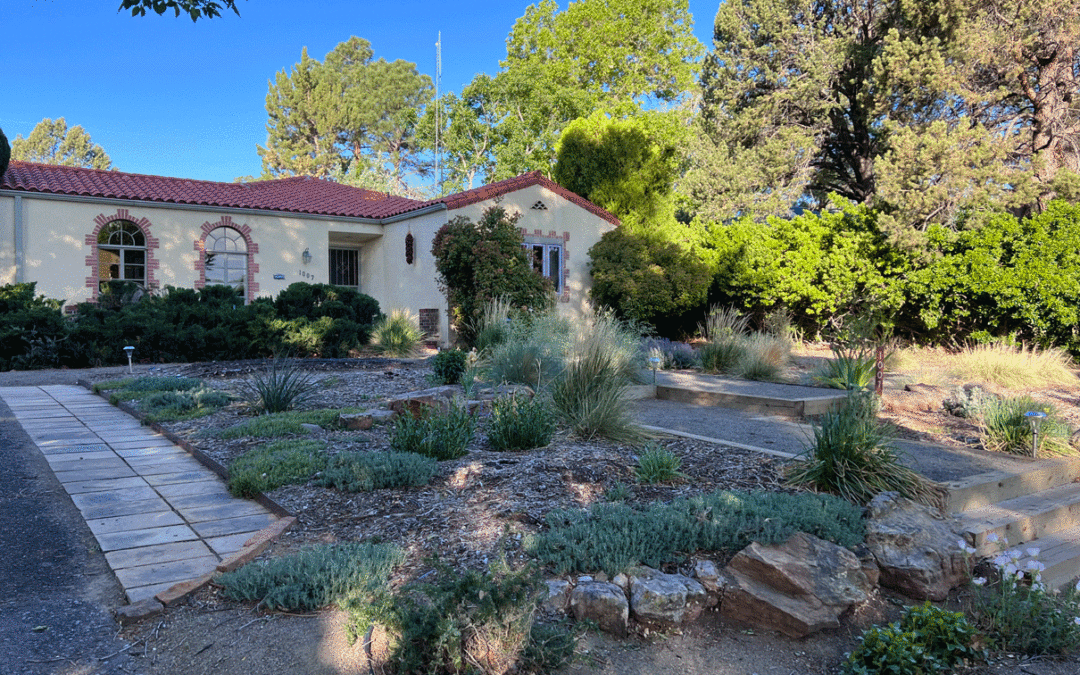
While selecting mediterranean plants for your landscape, you can also incorporate a few simple Mediterranean garden design strategies. The starting point for any Mediterranean garden is evergreen trees and shrubs. Think olive trees, Italian cypress and statuesque pines. However, since olive trees are not cold hardy in Albuquerque, instead try an escarpment live oak. Their glossy dark green leaves are a great substitute for an olive, and they are an important species for pollinators. Although Italian cypress can grow in Albuquerque (and was planted profusely in the 1970s), it is not particularly well-adapted here. A better choice is an upright juniper cultivar, such as Keteleeri. And while a Mediterranean stone pine or Aleppo pine would do well in a protected courtyard, Afghan pine is another option with better cold hardiness. Arizona rosewood, turpentine bush and manzanita hybrids are a few evergreen shrubs that will give your landscape a Mediterranean flavor.
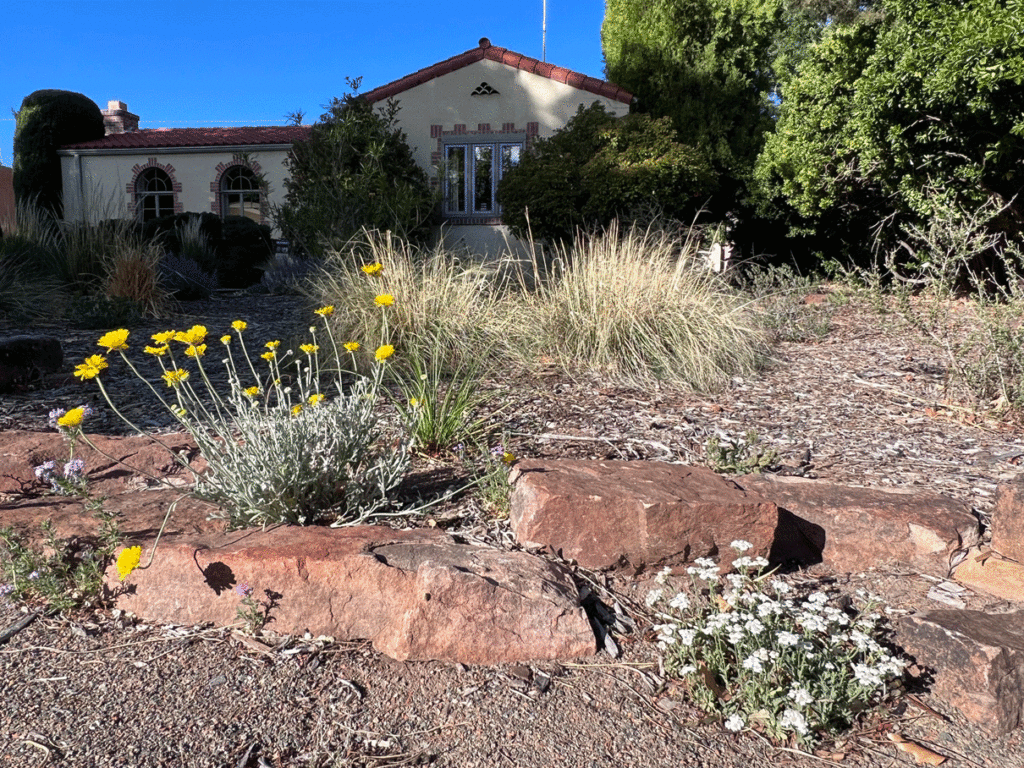
Next, include some plants with light silvery-blue leaves to contrast with the evergreens suggested above. Silvery-blue foliage is a plant adaptation to intense solar radiation, so many mediterranean and locally native plants share this quality. Mediterranean natives with this striking color include lavender, gopher spurge and grey lavender cotton (which actually has yellow flowers), while silver-leafed native plants include sand sage, germander sage and chamisa. There are also many locally native plants with silvery leaves that provide contrasting shape as well as color: Agaves, desert spoon, blue Nolina and yuccas all can accent your landscape beautifully. Of course, these locally native plants will be easier to grow and will provide better pollinator habitat than mediterranean imports.
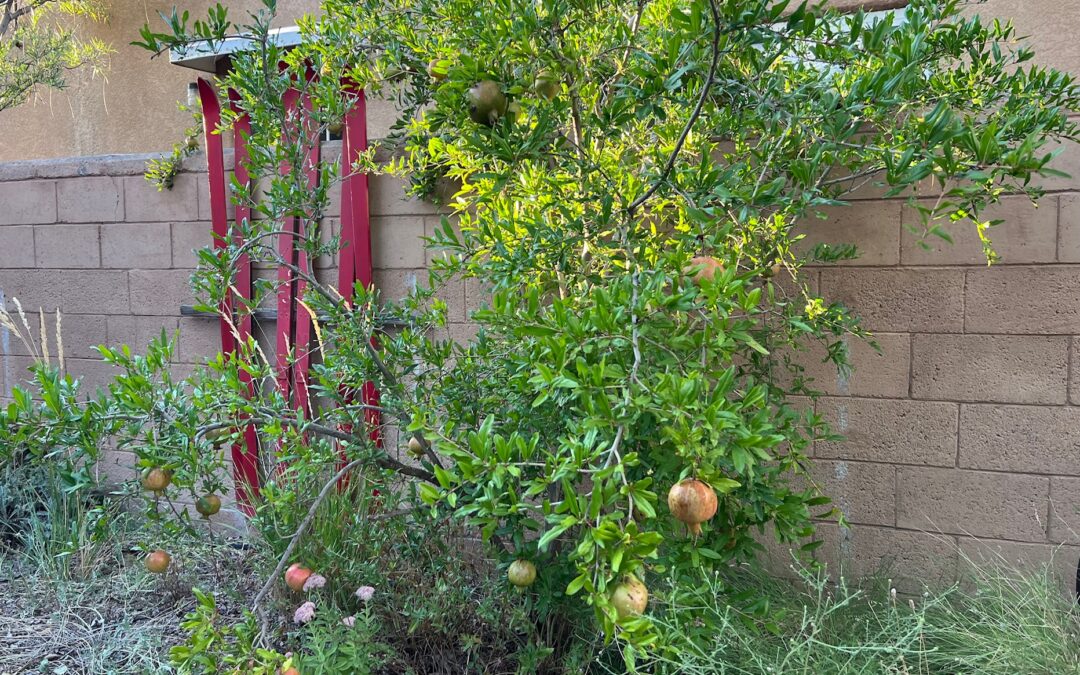
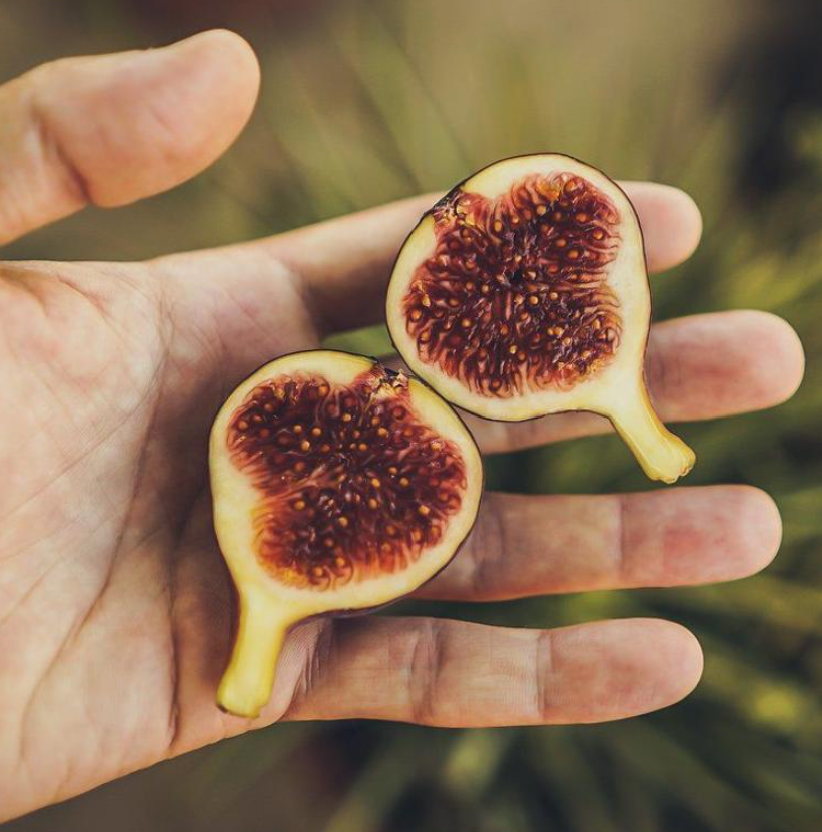
Edible plants and herbs have always been another important part of Mediterranean gardens. Rosemary, lavender, oregano, thyme, chives and culinary sage all hail from the Mediterranean and do well in Albuquerque. Mediterranean fruit trees, such as fig, pomegranate and apricot can flourish but do require a little extra water. This water need can be met by roof runoff if you plant them in a well-drained rainwater harvesting basin or swale. Fruits and herbs all provide flowers in addition to food. However, if you’re looking for an extra splash of color, red hot poker, moonshine yarrow and Bowle’s mauve are all mediterranean options.
Whatever mediterranean plants you choose, just remember to keep their roots dry when it’s cold out, make sure the soil drains well and give them a nice layer of wood mulch. They will repay you with a beautiful and low water use landscape for years to come.
Mediterranean plant options
Shade tree: Japanese pagoda
Evergreen trees: Keteleeri juniper, escarpment live oak
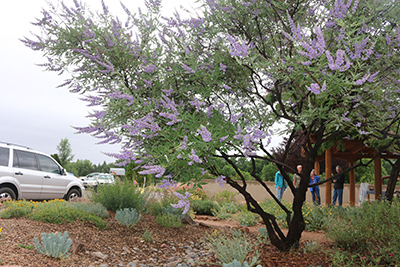
Small flowering trees: Vitex, crape myrtle
Large plants (5-8' tall/wide): Fernbush, blue Nolina, evergreen sumac
Medium plants (3-5' tall/wide): Rosemary, large agave (americana, ovata, havardiana), lavender, red hot poker, pink muhly grass