If you have heard of Bermuda grass or live in one of the older areas of Albuquerque, just the name might make you flinch or grimace. The reason it gets a bad rap is because it is dormant in winter, it spreads like crazy into garden beds and can magically appear out of a dirt mess after monsoon season.
You may be surprised to hear that some of us actually like Bermuda grass lawns. In fact, I’ve even planted the grass in my backyard. I’ll take you through the pros and cons and why I’ve come to love the Bermuda grass lawn. It can be the right plant for the right space to fill the right need.
Many homeowners would like turfgrass but feel irresponsible watering a lawn in the arid Southwest. The key to choosing a turfgrass is to determine the one most suited to the specific needs of your landscape The Water Authority is not anti-lawn that is efficiently irrigated and physically used and enjoyed. Bermuda grass cultivars are one means of having a traffic/play/dog tolerant surface that uses half the amount of water of a traditional cool season lawn
According to the “turf research lab” at New Mexico State University (NMSU), “Certain turf characteristics, such as climate adaptation, water use, traffic tolerance, color, quality, maintenance requirements, and available resources, are all factors that need to be considered when selecting a turf species. Climatic adaptation and traffic tolerance, which largely determine the future use of the turf area, are the two most important factors. Many problems encountered in maintaining turfs can be attributed directly to selecting the wrong turfgrasses for Albuquerque’s difficult growing conditions and to the lack of resources, especially water, that homeowners and professional turf growers face in the state.” This means that understanding how much traffic (kids and dogs playing) and our very dry local climate are how we should be selecting turf grass species not what the big box store happens to have in stock.
There are two different categories of turfgrasses: cool season and warm season. Common Cool season grasses are Kentucky Bluegrass, Perennial Ryegrass and Tall Fescue. These are cold tolerant, green most of the year and hold up to extensive foot traffic. But they use a lot of water, up to 50” a year If efficiently irrigated. The water authority frequently has many customers (especially commercial customers) that water grass 80-100” per year! in a town that only gets an average 8” of precipitation. Common warm season grasses are Bermuda grass, Blue Grama and Buffalo Grass. Warm season grasses have a shorter growing season. This means they green up in mid spring, are low maintenance and require less water than cool season grasses. But blue grama and buffalo grass can’t take extensive foot and paw traffic plus they go dormant in the winter.
In my case, I had an existing native buffalo and blue grama grass lawn. It had always been perfect for our home. It’s native, low water use, easy to maintain and beautiful to look at. Fast forward to three kids and two dogs later. I was noticing wear and tear in certain areas of my lawn from two large dogs leaving run paths and kids playing soccer. I’m a professional landscape architect and knew Bermuda grass is a prolific spreader but in this case, I was actually looking for a grass to take over and fill in around the heavily accessed places in my yard. I found a species that could meet both my needs called Cynodon hybrida Dog Tuff ™ Grass Plugs, originally from High Country Gardens. There are many cultivars available check out the many options researched by NMSU. It is a Bermuda grass hybrid perfect for high traffic and play areas. It has excellent durability in yards with dogs. Once established, it is highly weed resistant, deep rooted and provides a soft, cushioned feel for bare feet.
The grass itself “produces an extensive system of creeping rhizomes and stolons commonly called runner roots that often have a scaly appearance. It also produces fibrous roots at the stem nodes. Bermuda grass reproduces through seed and vegetatively through rhizomes and stolons,” according to NMSU, allowing it to spread with just a little bit of water, around 20” a year. I find that it rarely needs mowing because of the traffic we give it. I mow it about twice a summer to the highest setting my mower goes around 4”.
Bermuda grass plugs.
The data on this grass comes from NMSU, which has turf study sites in Las Cruces and Farmington. A few key points from their study sites mentions that “Bermudagrass (Cynodon dactylon) is similar to Kentucky bluegrass in its tolerance to traffic and turfgrass recuperative capabilities after stress or damage, but it appeared to be more aggressive than Kentucky bluegrass during hot weather in mid-summer.” NMSU evaluated five different varieties of bermudagrass, Guymon, Riviera, Wrangler, and Yukon, at both their northern NM and southern NM sites. “Riviera was given higher quality ratings than the other varieties due to finer leaf blades. Being a warm-season grass, the bermudagrasses required less irrigation to exhibit a quality comparable to the cool-season grasses.”
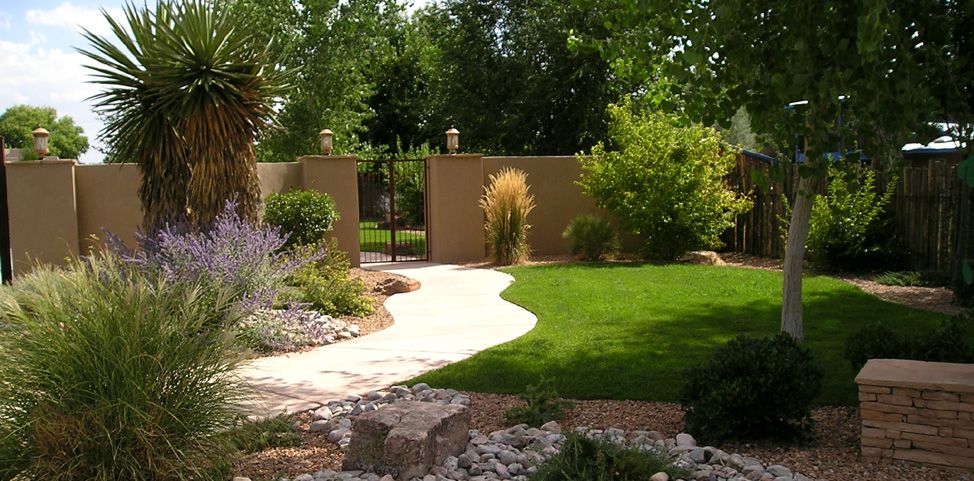
The shocking reason homeowners don’t like Bermuda grass is that it can become a troublesome weed, especially in southern NM, so it is wise to separate this grass from garden areas with a dry, unirrigated buffer strip, concrete mow strip at least 8”x 8” or other barrier. I like to design a concrete walk, patio or edger around these grass areas.
Grass lawn framed by concrete walk.
When placed strategically in a landscape this water friendly, high traffic, low mow grass is a winner in my book.
Author: Jill Brown, ASLA Landscape Architect and owner of My Landscape Coach in Albuquerque. Even more resources about turfgrasses can be found over at NMSU, one of our nations top university turfgrass science programs. Have a question about the article? AskAnExpert@abcwua.org
Dainty sky-blue blossoms appear daily on the top of tall wispy stems between the months of April and September. Blue flax is a short-lived perennial that reseeds itself in a sunny garden bed or a native grass meadow.
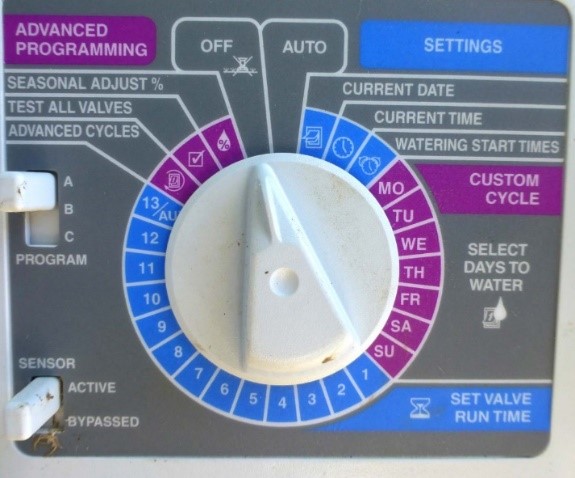
Your new xeric plants are in, and everything is looking good. What do you need to do to keep it that way? Start by looking at your irrigation controller. It may be programmed to apply water too frequently and/or for too long in order to get the plants started. If you hired a contractor, they may have set the controller to water every day because it’s easier than getting a call about a plant that doesn’t look great.
Many desert-friendly plants and trees evolved to survive on very little precipitation but also to make the most of abundant rainfall when it does happen. They’ll store the water in their roots or grow larger (and produce more seed for dry years) than they would with only adequate water. A xeriscaped yard doesn’t automatically “save” water — it is up to the homeowner to do the actual water saving by adjusting their irrigation controller. My dog would be “happier” if I fed her as much as she wanted, but it’s wasteful (among other things) to do so. Watering your desert-friendly plants too much may cause them to outgrow the space they were designed for, which might mean pruning them more than they need so they don’t grow against the house or over a path or outcompete other plants. Overwatering also creates lush, tender growth that is more attractive to pests and susceptible to frost damage.
A recent study in Arizona found that xeriscaped yards didn’t have reduced water usage because the homeowners applied the same amount of water as they would for a traditional yard with a lawn and non-natives.
Here are steps you can take to make sure you’re watering correctly for your new landscape and keeping your plants healthy:
Reduce the number of emitters if needed: The best way to do this is by cutting off the drip emitter and installing a “goof” plug in the end of the ¼ inch tubing. This is preferable to trying to pull the ¼” coupler out from the larger line, which creates a larger hole that can’t be easily plugged.
Check your irrigation controller: You’ll want to keep the soil moist around the newly installed perennials, shrubs and trees for the first week, and that might mean watering every day if it’s above 90 degrees. After the first week, switch to watering every other day. Then on week three, switch to twice a week. Exceptions would be for cacti, which I would soak once when planting and then water once a week for the first month before tapering off to once or twice a month until established. (Perennials / grasses - 8-10 weeks, Shrubs - 1 year, Trees - 1-3 years.)
Check that drip emitters are working properly, especially if a plant looks wilted: Drip emitters often get clogged after a repair is made in the larger ½” or ¾” poly tubing. If you’re using “flag”-shaped emitters and one is not flowing, you’ll want to grasp the body of the emitter while you turn the top “flag” shape counterclockwise 90 degrees to allow the top to separate from the rest. You should do this while the zone is running so that you can see if any emitters aren’t working and so that the water pressure can clear the clog. Once you’ve twisted off the top, you should have a strong flowing stream of water coming out. Hold your finger over the water stream, forcing it into the drip outlet, which clears the clog.
If you’re using “button”-shaped emitters and one is clogged, you’ll need to cut it off and replace it. Don’t try to pull it off the ¼” tubing, just cut it off and plug in a new one so that the barbed insert has fresh (not stretched out) tubing to fit into.
Keep up with plant growth: As your desert-friendly plants grow larger, you can move the emitters farther away from the base of the plant and add new ones if needed; larger plants require more water. There are several ways to do this. You can poke a new hole in the nearby larger poly tubing, insert a ¼” coupler, run an additional ¼” line to the plant and add an emitter. However, if the main poly line is more than a couple of feet away, install a ¼” “T” in the spaghetti tubing and go from there. It saves time and means fewer holes in the main poly line. Remember, when installing ¼” couplers into the main poly, always poke the hole in the side, not the top; that way if you step on them by accident, they won’t break off. Also, if your plants are on a slope, the emitter should be on the uphill side, so water flowing downhill will cover more of the root zone. Check that water wells are still in place and holding water around the plant.
Inspect your trees: Check the leaves for any insect damage and the underside of leaves for insect infestations. Also make sure the mulch or gravel isn’t covering up any of the tree trunk above the root flare, which traps moisture that can cause decay or rot. Particularly in fruit trees, this can also allow detrimental insects access to the trunk where they could bore into it.
Check the soil around the base of your plants: Often during initial watering, the soil will settle into the planting hole and can expose the root ball, which causes it to dry out quickly. If you observe or suspect this, kneel in front of the plants, move the mulch out of the way and scrape the surrounding soil back around the plant to cover up the root ball. Then replace the mulch and reposition the drip emitter as necessary.
Learn the common or scientific names of your plants: If you don’t have a list, plant tags or a detailed landscape plan, some newer smart phones have a plant identifier built into the camera app (no need to remember the app store password and download another app). The closer you can get to the plant — showing leaves, branch shapes and flowers (if any) — the better the app will work. The phone (as we all know) can be wrong, but it will give you a place to start. Alternatively, send an email with photos to askanexpert@abcwua.org and we can help you identify
Once you know the plant names you can look them up in our xeriscape guide to reacquaint yourself with their water needs and mature sizes. Need help remembering the plant names? Often the plants themselves can tell you. Is it a catmint? Rub the leaves and smell the minty aroma. Turpentine bush? Lemony pine smell, for sure. Maybe it’s the shape of the leaves. Fernbush? Examine the leaves closely and see how they resemble an actual fern from a rainier climate.
As a landscape professional, one question I’ve always dreaded is, “How much should I water this tree?” Honestly, there are so many variables that giving a blanket answer is fanciful. More than likely, a part of the answer is, “More than you are now!” Trees are big plants with lots of leaves, and they can transpire a lot of water. That water is “lost” while the leaves are making sugars via photosynthesis, so trees have a high water demand.
If supply doesn’t keep up with demand, the tree gets stressed. How do you know if your tree needs more water? Learning to recognize signs of water stress can help you stay on top of your trees’ needs. There are some common symptoms and situations that may indicate that they are thirsty.
Water stress can be long-term (chronic) or sudden (acute). Chronic drought stress occurs commonly, as many irrigation systems are set up to be adequate for a newly planted tree. As that tree grows, though, it has more leaves and needs more water. Adding emitters and covering more ground is key to keeping up with the growth. Acute drought stress is less common; it happens when a tree suddenly loses most or all of its water supply, which up to that point was adequate. Finally, most rare of all, water stress can happen from too much water in the soil.
Chronic drought stress occurs when trees haven’t had enough water for some months or years. These trees will have smaller than normal leaves, and those leaves will be sparser in the canopy than normal for that species. They may be off-color, not as vibrantly green as normal. Often, there is dieback in the small, outer branches and twigs.
Annual growth will slow down. Evidence of this can be seen in small diameter branches if you can identify the ring scars that mark the annual growth segments. Ring scars are lines that circle all the way around the twig; they are not bud scars that form at each dormant bud and do not circle the twig. If annual growth segments are shorter last year than the year before, something bad is going on.
The short distance between these ring scars indicates a year of poor growth. This may have been the year it was planted, as that is stressful to trees.
In conifers, we see similar evidence — smaller and fewer needles and shorter growth segments. Often, pine needles will brown out from their tips, maybe just a little or maybe halfway. Conifers keep their leaves for several years, so partially browned needles can really slow down growth potential as the brown part isn’t making sugars. Chronically drought stressed conifers abound in New Mexico forests. They are more susceptible to bark beetle attacks than unstressed trees. Combine beetle-killed trees with very dry trees and wildfire becomes a huge concern.
Acute drought stress might happen when a trench cuts through the root system, such as with a new sewer line is installed. Acutely stressed trees tend to have sudden yellowing and then drying of leaves, maybe just on one side of the tree (the trench side, for example). Acute stress is hard for the tree to recover from.
In either chronic or acute stress situations, leaves may develop brown and dead edges. Termed “marginal browning,” this happens when excess salt in soil water gets deposited at the furthest edge of the leaf, building up to toxic levels. Leaves will often turn pale and then yellow during mid-season, well before fall temperatures normally trigger that.
Yellowing of leaves can be a sign of stress.
How about those few trees getting too much water? In some ways, symptoms can mimic too little water. When the soil is very wet, roots stop functioning due to lack of oxygen. This is of most concern for dryland conifers like juniper and pine. Usually, it is linked to an irrigation system that only has emitters at the base of the tree that run often. The tree doesn’t have the fine root mass near the trunk to take up the water, so the soil remains wet. Fungal diseases are likely to pop up, leading to root death and then tree death. Another symptom of overly wet soils shows up in leaves on deciduous trees like cottonwood — oedema. These are corky scars on the surface of the leaf.
You can reduce tree stress with proper irrigation. Trees seem to do well when irrigation is deep, broad and not too frequent. Watering every day is actually not helpful, especially when right at the base of the tree. Cover the soil with an organic mulch to keep the soil cool and the moisture available to your trees.
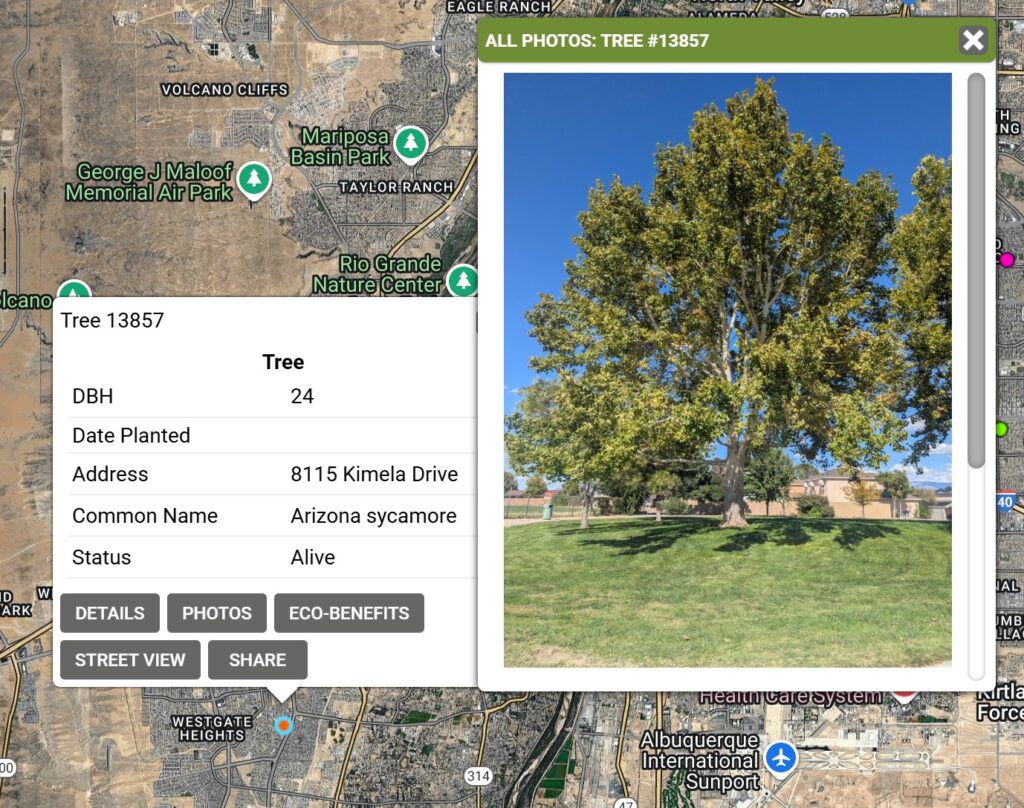
Drought stressed sycamore tree, insufficient irrigation and small growing area.
Folks, it’s a hot, dry summer here in central New Mexico. No surprise, you say — we live in a desert. Even for our location, though, it’s hot and dry. This creates a little conundrum for us: keeping our landscape plants growing while using water efficiently.
Tree and surrounding plants being watered by inline drip irrigation.
This applies especially to trees because as large plants with lots of leaves, they need regular adequate water for their size and species to remain happy and continue creating positive benefits for your yard and the city as a whole. Call that a biological law and reality. As temperatures go up, trees’ water demand goes up. That is a good starting point to keep in mind — in times of drought, you should water your trees a little more frequently than you would in a year with abundant rainfall.
Drought stressed tree showing missing leaves and yellowing.
It turns out that over 90% of the water that comes into a tree simply escapes through the leaves as water vapor; the tree keeps very little water inside to grow. This loss of water vapor provides the “suction” that causes more water to enter the root system. It also cools the leaves and keeps them within comfortable working temperatures. Someone once said trees (and plants generally) have figured out a way to guide the natural movement of water from soil to atmosphere, channeling it through their bodies and using it to grow and function, which is one part of the water cycle. Having trees increases moisture in the air, allowing your swamp cooler to perform better.
Trees “drink” very differently than you and I. We have one fairly large mouth into which all the water goes. However much we need, we have one target to hit in order to drink that water. Trees, on the other hand, take water in through their tiny, young roots out in the soil. Water has to get to a lot of soil in order to hit enough of those “mouths” to matter. A lot of tree irrigation eventually fails because there are only a few emitters (and those are often too close to the trunk). Those few emitters cannot put out enough water to satisfy the tree’s demand, nor do they wet enough surface area. (See examples in the photos below.)
Drip emitters located very close to the tree trunk.
What matters to a tree is the volume of water it has to work with. That volume is entirely dictated by the volume of soil that is holding water. And THAT volume is dictated by the surface area that received and absorbed water. The key is to disperse the water throughout the main root zone and do it in a way that allows the water to soak in where applied and not flow to low spots on the ground (which often are gutters. Science has found that most tree roots are located within the top three feet of the soil surface and quite likely even more shallow in landscapes that have not been deeply irrigated for the life of the tree, which is a common condition in Albuquerque.
To properly water your trees, you will need some sort of irrigation system. It could be a bucket you fill from the sink or a state-of-the-art sensor-controlled automated drip system. But somehow you need to put water on the soil surface in a slow, controlled manner so that it can soak into the soil where it is applied. While buckets and hoses work, their simplicity makes them very labor intensive. In-line emitter drip tubing, laid out in a spiral or concentric circles, does a much better job. Once in place, these drip systems can be set to run for two to four hours at a time, about once a week during the hottest part of the year and less often during other seasons. Irrigation improvements qualify for the Water Authority Treebate. See our rebates here.
The ideal target area to irrigate is both theoretical and grounded to the reality of the site. Imagine a donut shaped area centered around the tree trunk. The trunk sits in the center of the donut hole. The body of the donut begins halfway between the trunk and the edge of the branch canopy and extends some distance beyond the edge of the canopy. This theoretical donut represents the ideal critical irrigation zone.
Now enters site reality — maybe there is a house or driveway or sidewalk covering part of the donut (or all three, with the tree located in a tiny unpaved space). We don’t want to encourage root growth at the house foundation, so don’t water within a couple of feet of it. Similarly, where concrete or asphalt covers the soil, root growth is moisture-limited and concentrated immediately under the impervious cover and under any planned or accidental cracks that allow rainwater to slip through. Ideally, we don’t want to water next to the pavement. The more of the donut that is unavailable for watering, the more often you may need to water the limited areas of open soil. Even so, it may simply not be enough soil volume to support the tree, which will then decline. In that case, replace it with a nice xeric shrub!
Recently installed drip tubing around a newly planted Mexican elder and some to-be-planted fennel. Both of those plants are excellent pollinator forage. A 4-inch depth of wood chip mulch will be installed over the top.