There is a saying that “time is more valuable than gold.” Watering your yard can bring relaxation and time to enjoy the beauty of creation. But, for people with larger yards and those who are too busy to devote hours each week to watering, an automated irrigation system can be just what they need to save that precious time.
Automated sprinkler irrigation systems are great for lawns and meadows, and automated drip irrigation systems are perfect for all other plants, including trees. Both systems are handy devices that can provide remarkable benefits if they are properly designed, installed, and maintained:
Aesthetic Benefits: an automated irrigation system is one of the best ways to keep your landscape beautiful and healthy because it can provide the right amount of water at the right time. This is especially important during the summer months when the sun’s intensity can dry out the soil and damage your turf and other plants.
Save Water = Save Money: even though there is an upfront cost for installation of an automatic irrigation system, it will work to ensure the most efficient use of water for your specific landscape. This means more money will stay in your pocket with lowered water bills.
Improved efficiency: Different plants have different watering needs and individual zones of an automated irrigation system can allow for delivering the right amount of water with the most effective irrigation method.
Flexibility: An automated irrigation system can include a Water Sense Smart Irrigation Controller, which can take the guesswork out of scheduling. These typically run between $200-$400 if professionally installed, or $100-$200 if you install it yourself. Rebates are available!
Reduce Weeds: automated drip irrigation systems can be extremely efficient at providing water to a targeted area. This reduces the number of weeds in your yard since it will deprive them of water and instead direct that water towards desirable plants, trees, and shrubs.
More time to sleep in: the best time to water your yard is early in the morning when the sun is down because water does not evaporate as quickly, meaning your plants will have the maximum amount of time to absorb the water. This means you will use less water than if you water during the day because your sprinkler system will not be competing against the evaporating power of the sun.
More time for camping: just like a programmable thermostat, automated irrigation systems allow you to customize your watering schedule. Once programmed, the system will turn on and turn off automatically, so you do not need to be present when your yard is watered. For that reason, automated irrigation systems are popular among happy campers!
An automated irrigation system for your home offers many benefits ranging from financial to aesthetic and convenience. If you are wondering where to start, send us an email at [email protected]
Author: Carlos A. Bustos, Water Conservation Program Manager with the Water Resources Division for the Water Authority. Have a question about the article? [email protected]
With drought conditions predicted to continue for the foreseeable future, we’re likely to water more often this spring and summer. Make every drop count – and keep us on track to meet our conservation goals – by performing routine maintenance to maximize your sprinkler system’s efficiency.
Monthly
Check for leaks by inspecting water lines, sprinklers, emitters, and other components. Look for wet spots in the landscape and listen for hissing to help locate issues.
Your irrigation system is only as good as its aim. Adjust sprinklers and emitters to make sure they’re delivering water to the landscape and not onto rocks, bare earth, or pavement.
Replace damaged parts immediately with identical or equivalent parts. This ensures uniform coverage and optimal system efficiency.
Locate and clean any clogged equipment.
Use water meter and historical data to help reveal hidden leaks.
Check to make sure irrigation controller is set appropriately for the season
Spring
As the watering season gets underway, check your irrigation system for leaks and clogged, broken, or missing sprinkler heads and emitters.
An outdated irrigation system can waste time, water, and money. Consider installing a new WaterSense-labeled, “smart” irrigation controller to take the guesswork out of scheduling (rebates available).
Set the controller for watering frequency, start times, and duration per zone per program.
Replace the back-up battery in the controller.
Test the manual shut-off or isolation valve.
Check the water pressure in each irrigation zone.
Check and clean filters, wherever they are in the system.
Check and clean the filter screen in each sprinkler body. Adjust the rotor arc or spray pattern to eliminate water waste.
Test heads to make sure they are delivering consistently and efficiently.
Inspect all drip emitters (look for wet zones after running a complete cycle). Unclog or replace any that are malfunctioning.
Early Summer
Adjust controller for the appropriate seasonal setting.
Adjust sprinklers and emitters to make sure they’re delivering water to the landscape and not onto rocks, bare earth, or pavement.
Check and clean filters, wherever they are in the system.
Inspect all drip emitters (look for wet zones after running a complete cycle). Unclog or replace any that are malfunctioning.
As plants grow bigger, move the emitters to the edge of each plant’s root ball or drip line to encourage further root development.
Fall
Adjust controller for the appropriate seasonal setting.
Test the manual shut-off or isolation valve.
Check and clean filters, wherever they are in the system.
Inspect all drip emitters (look for wet zones after running a complete cycle). Unclog or replace any that are malfunctioning.
Winter
Guard your irrigation system against freezing temperatures by draining pipes and tubing and properly winterizing your system.
When temperatures are below 40 degrees Fahrenheit, discontinue automatic watering and turn on systems manually or hand water as needed.
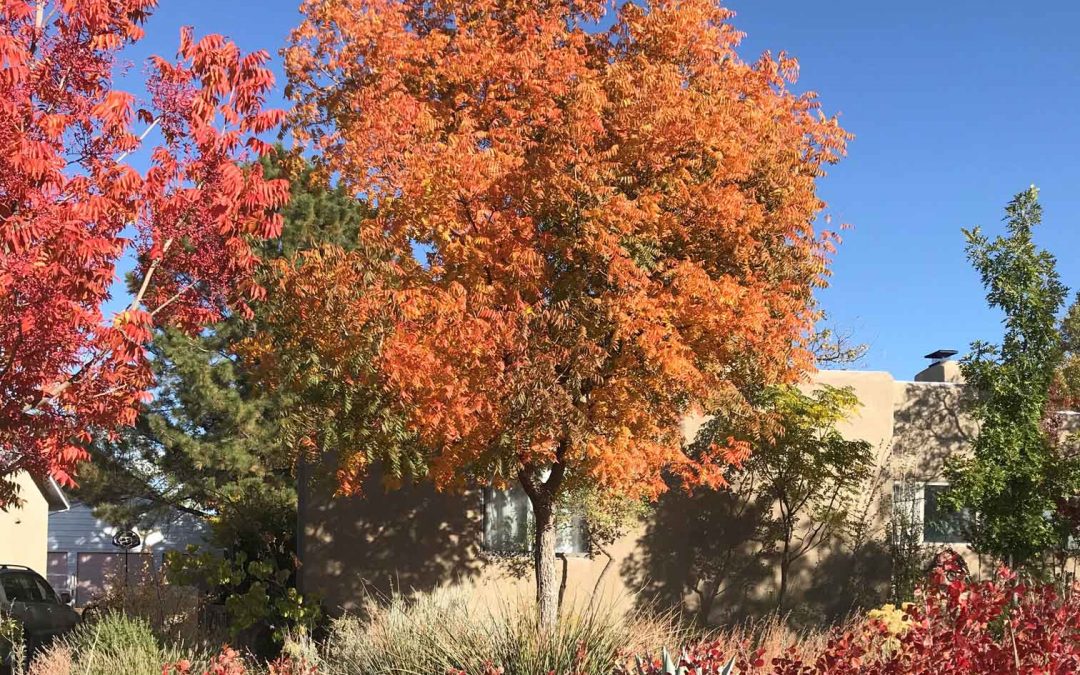
Native ornamental grasses play an integral role in a landscape. Throughout the seasons, grasses enhance the beauty of our gardens and are often at their showiest during autumn. They create a masterful mix of hues, textures, and seasonal delight. From their graceful flower clusters that gently dance in the wind to their vibrant plumage and foliage illuminated by the red glow of the sun, grasses create attractive and alluring backdrops while also adding motion and sound to our landscape.
Several considerations should be made before selecting ornamental grasses regardless of the style of the garden. Understanding the site requirements – sun tolerance, water use, and hardiness – as well as the growth form of grasses can help determine which species will be ideal for your landscape. Growing a species with weedy or invasive tendencies in moist habitats, for example, may not be ideal near the bosque. Similarly, growing a variegated variety of grass in a sun-exposed slope could result in blistering and discoloration which may detract from its beauty and health. Being aware of how site conditions and plant characteristics interact can help in selecting ideal species.
Consider adding the following ornamental grasses to the landscape:
Muhly Grasses (Muhlenbergia species)
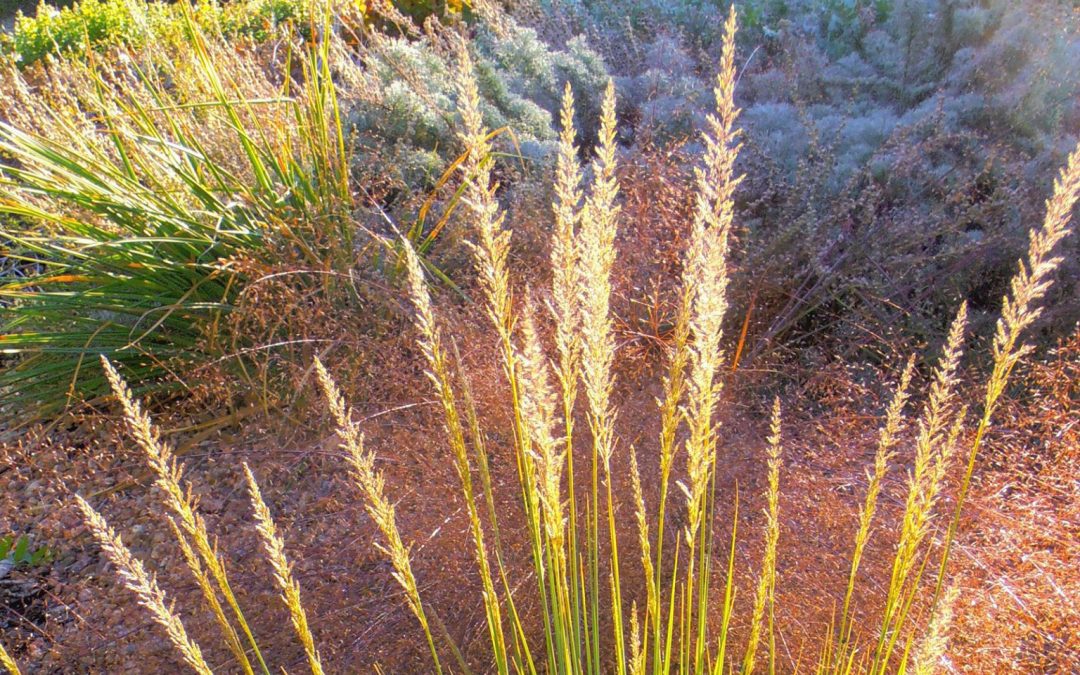
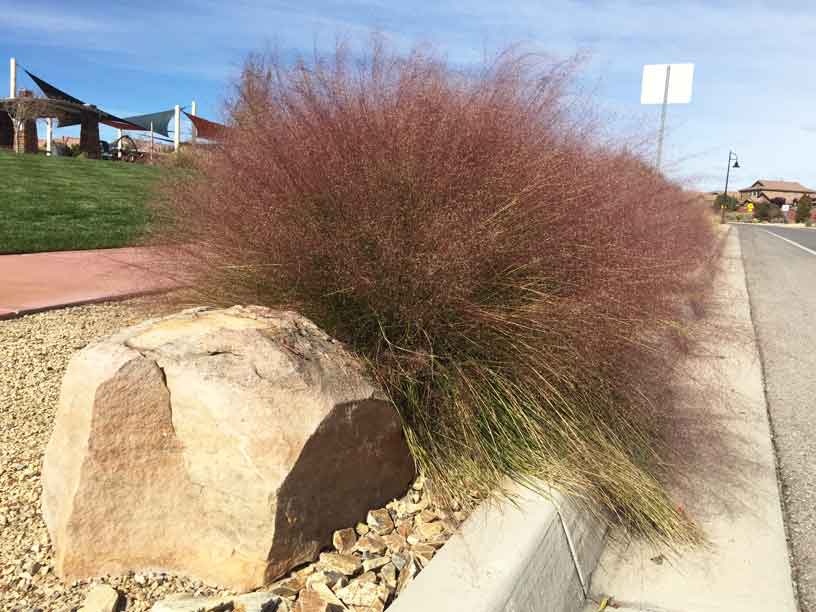
Muhly grasses (genus Muhlenbergia) are a non-invasive, ornamental grass native to the southwest. These grasses provide a wide range of favorable characteristics and perform well in full sun as well as partial shade. They are also heat and cold tolerant and can persist in most soil conditions. The plumy foliage often described as whispering, is quite attractive when a gentle breeze brings these plants to life. This species range in height from 1½ to 5 feet and has a variety of seed colors and textures blooming from August to November. Pink muhly (Muhlenbergiacapillaries) is an outstanding accent plant with its feathery, pink-hued flowers that float above dark green foliage (typically 3 feet). For a larger accent plant with a more subdued color, Deer grass (Muhlenbergiarigens) can make an excellent addition to any garden with its bright green leaves and slender tan flower stalks reaching upwards of 6 feet.
Big Bluestem Grass (Andropogon gerardii)
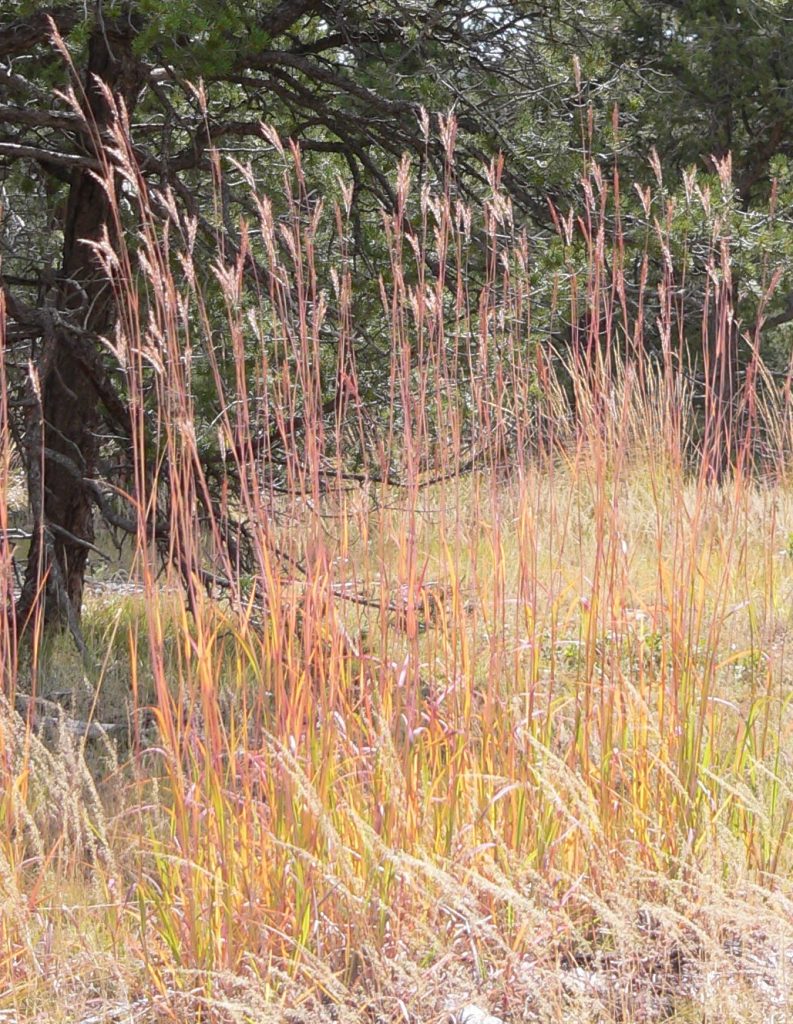
Several cultivars of the native prairie grass Big Bluestem (Andropogon gerardii) can be spectacular in a landscape and reach heights up to 6 feet. ‘Red October’ is a common cultivar that boasts year-round visual interest. It emerges in the spring with vibrant red foliage that transitions to a striking scarlet color for the remainder of the season. ‘Rain Dance’ Big Bluestem is also a very showy cultivar, providing maroon foliage in both summer and fall. These clump-forming grasses will grow in attractive mounds that add wonderful accents or backgrounds to the landscape in higher elevation plantings like the East Mountains.
Prairie Dropseed Grass (Sporobolus heterolepis)
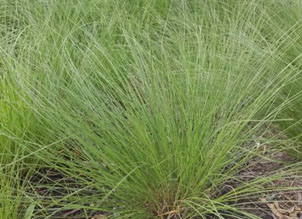
Prairie Dropseed Grass (Sporobolus heterolepis) is an exceptional bunch of grass that reaches 2 to 3 feet in height. This grass creates a fountain-like effect with its finely textured foliage – bright green in the summer and delightfully golden in the fall. Its flower spikes create a cloud of texture that becomes airier with see-through seed heads in autumn. Moreover, Prairie Dropseed Grass performs well in a wide range of conditions and soil types and is an excellent drought-tolerant addition to the landscape.
On top of their inherent aesthetic value, ornamental native grasses provide refuge and forage for pollinators and wildlife, which enhance the landscape’s ecosystems. Many bird species feast on the seeds of grasses, while the larval stage of butterflies use native grasses to shelter through the winter. For these reasons, ornamental grasses should be left uncut until early spring where they can be trimmed to encourage new growth. Incorporating ornamental grasses is a beautiful way to impart functionality and complexity to any landscape. Autumn is the perfect time to enjoy all that these grasses have to offer.
Author: Alissa Freeman, plant ecologist with an M.S. in Plant Biology, Ecology, and Evolution, has worked with NMSU Plant Extension and the City of Albuquerque on using native plants to enhance pollinator habitats. Photography: by Hunter Ten Broeck of Waterwise Landscapes and Judith Phillips of Design Oasis. Have a question about the article? [email protected]Caption for Feature Photo: Karl Forester Grass plumes with pink Bush Muhly grass located behind it.
We love our trees. Trees have a cooling effect in our yards by providing shade and they increase property value. When our trees do not “look good,” we try to help them, but when that one “magic” application does not solve the issue, we are often discouraged. A proper plant diagnosis will help your trees and save you time, money, and energy when dealing with the problem.
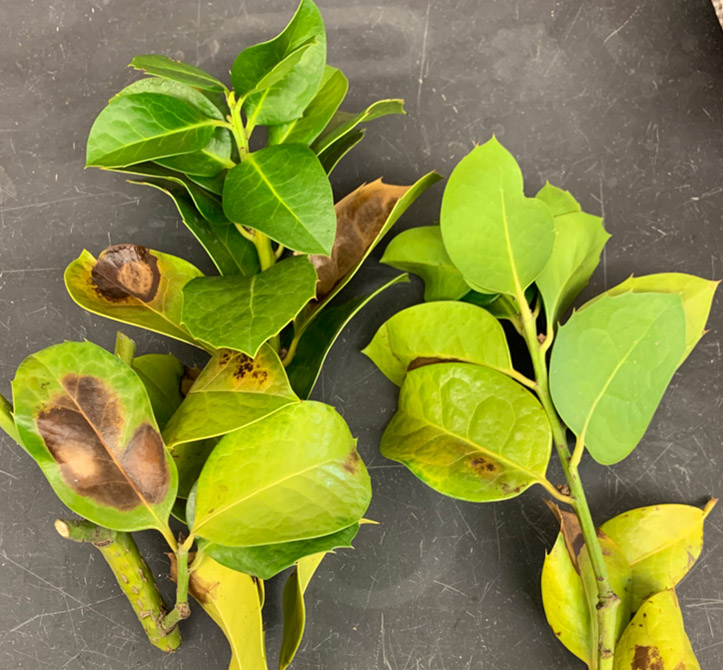
Damage to your tree can be caused by a living organism and/or environmental factors. Fungi, bacteria, viruses, nematodes, mites, insects, and animals fall under the living organism category and these tend to attack specific plants. Environmental factors that could affect trees include drought stress, salt injury, chemical injury, winter damage, improper planting, watering, and growing conditions, among others. Damage caused by living organisms can be similar to the damage caused by environmental factors. Here are a few tips to help you conclude what is causing damage to your tree:
First, identify the tree and how old it is. Knowing this will help you become familiar with the best growing conditions for that tree, and what kinds of insects and diseases are specific to it.
Inspect the tree – take a thorough look at the trunk, branches, and leaves. What abnormalities do you notice? Are the leaves discolored, bite marks, abnormal growth, unusual size, odd branches, or is the trunk oozing? What color is it? Does it smell? Do you notice any injuries or scars? Any holes? What size and shape?
Look at the environment where the tree is growing. How was the tree planted (burlap, chicken wire, planted too deep, girdling roots)? What kind of soil is it planted in (sandy, clay, poor drainage, compaction, etc.)? Is the tree near a foundation, driveway, traffic areas, wall structures, etc.? Any construction or change in the landscape around the tree area?
What watering conditions has the tree been subject to (water at the dripline, how much water, water throughout the year, etc.)? How is the water system checked? What is the soil coverage around the tree (rock, bare soil, lawn, organic mulch, etc.)? Any chemical application (herbicide, fertilizer, insecticide, etc.)?
Gather other information. Pictures help a lot to see how the issues have progressed. Collect any insect samples. Record when the symptoms started to appear.
All this information is crucial because symptoms caused by environmental factors can be like those caused by living organisms. In some cases, a lab analysis might be the best option to confirm or dismiss the presence of a pathogen and will help you develop a treatment plan.
Consider this common scenario: A 15-year-old tree grows next to a paved driveway and a wall, with gravel mulch around the base. Underneath the gravel is a plastic layer of weed fabric.
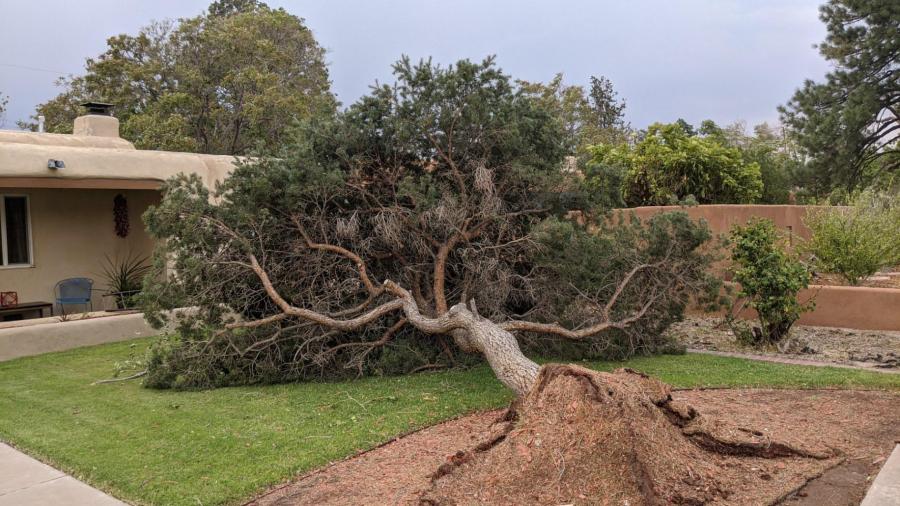
Shallow roots due to heat stress and limited watering. Photography Courtesy of James Vocasek c/o KRQE.com
The tree does not receive enough water for many years and gets no rainwater through the weed fabric. This tree is struggling to develop a good root structure and starts looking unhealthy. Eventually the tree gives up and a strong wind brings it down. In this case, chemical treatment will not improve the tree’s appearance because it is not addressing the true cause of the problem: watering improperly.
Diagnosing what is wrong with your tree will take time, but it is worth it. These local resources can help:
Author: Sara Moran, Extension Horticulture Agent, Bernalillo County, NMSU Cooperative Extension Service. Have a question about the article? [email protected]
The balancing act of watering your trees in the fall and winter is important. Established trees should be watered two to three times a month in the fall season and once a month in the winter season. If not watered properly, trees that get too dry during this time can suffer stress and drought injury. This often does not show up until the heat of the following summer, which then makes trees more susceptible to pests and disease. Fall is the time to set your trees up for winter success.
Other important factors to consider when watering trees:
Newly planted trees (trees planted within 1-3 years), are more susceptible to damage from dry conditions and should be watered more frequently than established trees. Try watering them to a depth of 24 inches three times a month in the fall and twice a month in the winter.
Evergreen trees lose water through their needles in the dry winter air. They need more stored-up water going into the winter season to make up for that. Cold, dry winds can strip water from evergreens faster than their roots can absorb it, too. That is why it is especially important to provide enough water in the fall and during dry, warm spells in the winter.
Even though they lose their leaves, deciduous trees should also not get too dry in the fall and winter. Water acts as an insulator for both the tree and soil. Soil that stays moist will be warmer. Likewise, plant cells that are plump with water will be less susceptible to damage from the cold. Water deciduous trees to a depth of 24 inches twice a month during the fall and once a month in the winter.
When watering any tree, remember to apply water out to the edge of the tree’s canopy drip line. Most established trees have a root spread equal to their height and beyond. Water deeply and avoid spraying foliage. Watering to the right depth depends on your specific soils, so you will want to measure how much water it takes your soils to reach 24 inches deep. Read this article for tips on measuring watering depth.
One of the best things you can do for your trees in the coming months is to add mulch. Layering three to four inches of organic mulch protects the soil from moisture loss and helps regulate soil temperature throughout the winter. Treebates for bulk organic mulch is available.
Pro Tip: "Watering to the right depth and managing the frequency of watering are both very important aspects of keeping our plants healthy throughout the year, but especially in the fall and winter months,” says Patrick Chavez, Trees of Corrales Wholesale Nursery.
Author: Amos Arber, Xeriscape Incentive Inspector, and Certified Arborist with the Water Resources Division for the Water Authority. Photography: Wes Brittenham Pro tip:Trees of Corrales Have a question about the article? [email protected]
Your irrigation system is only as good as its aim. Adjust sprinklers and emitters to make sure they are delivering water to the landscape and not onto rocks, bare earth or pavement.
June is a great time to check and replace any clogged spray nozzles or drip emitters. Remember, each spray head also has its own filter insert that needs checked as well.
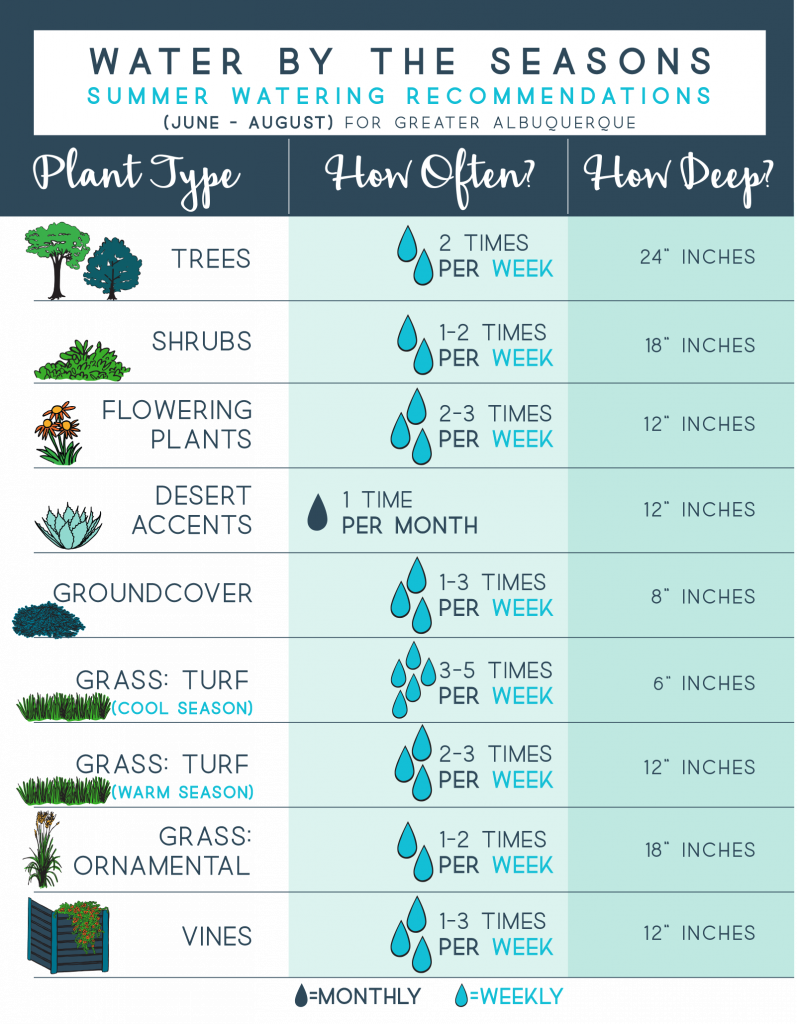
Watering Recommendations: Summer is here and so are hotter temperatures! Follow the Water by the Seasons Summer watering recommendations to keep your yard looking healthy. For turf, water 2-3 times per week. Start watering your trees and shrubs 1 time per week to keep them looking good.
Remember, if it rains more than a half inch you can skip your next scheduled watering as there is no need for supplemental irrigation.