Irrigation controllers can be intimidating, particularly because they only get adjusted seasonally and it is easy to forget how to program the timer correctly.
In this article, we are going to explain some terms and point out some functions which are universal, regardless of the type of controller you have. We are also going to provide some pointers on what will help you keep track of it all, as well as provide you with links to a few programming videos that discuss the most common irrigation controllers in Albuquerque. So let’s dig in!
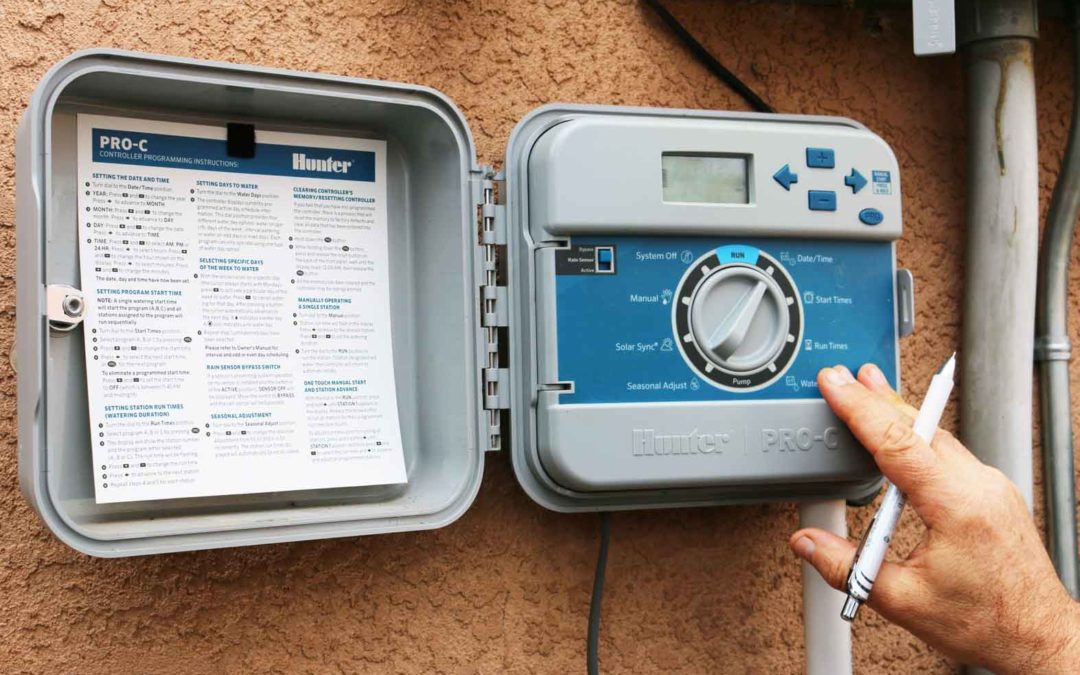
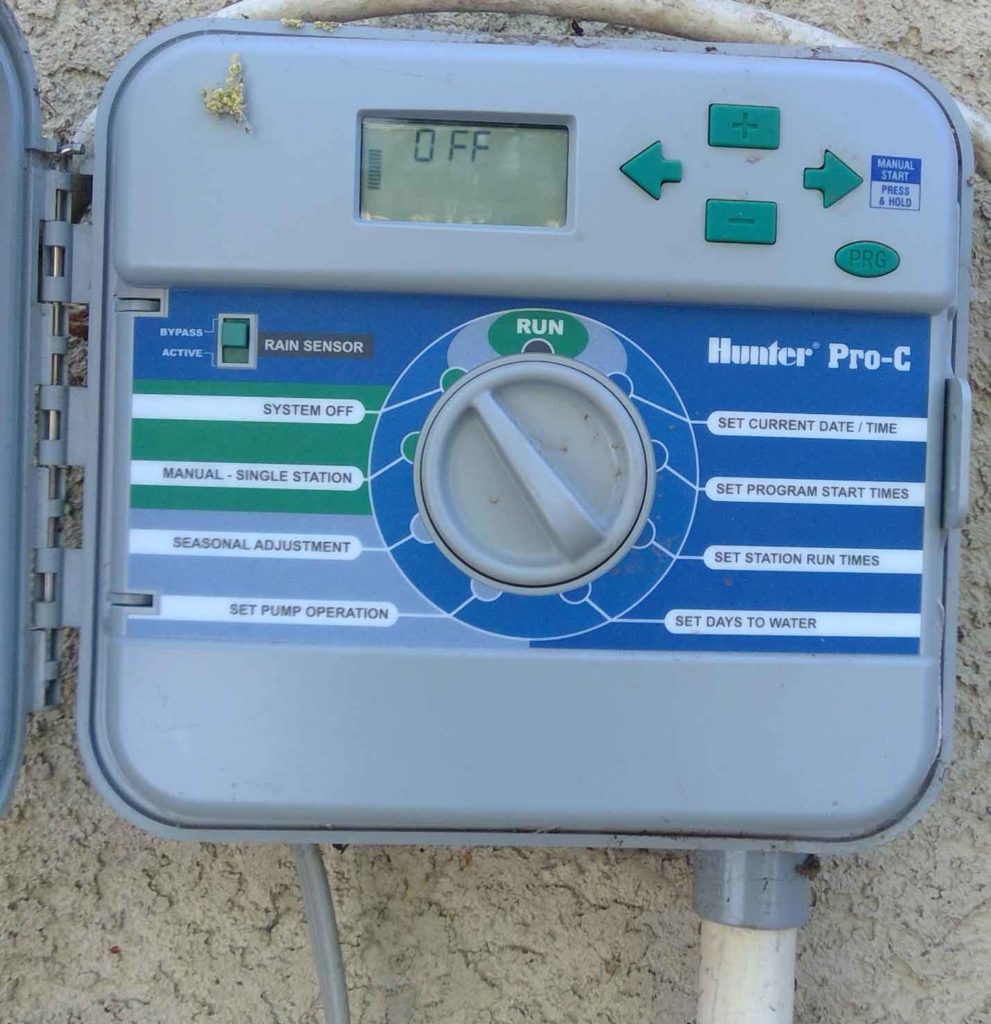
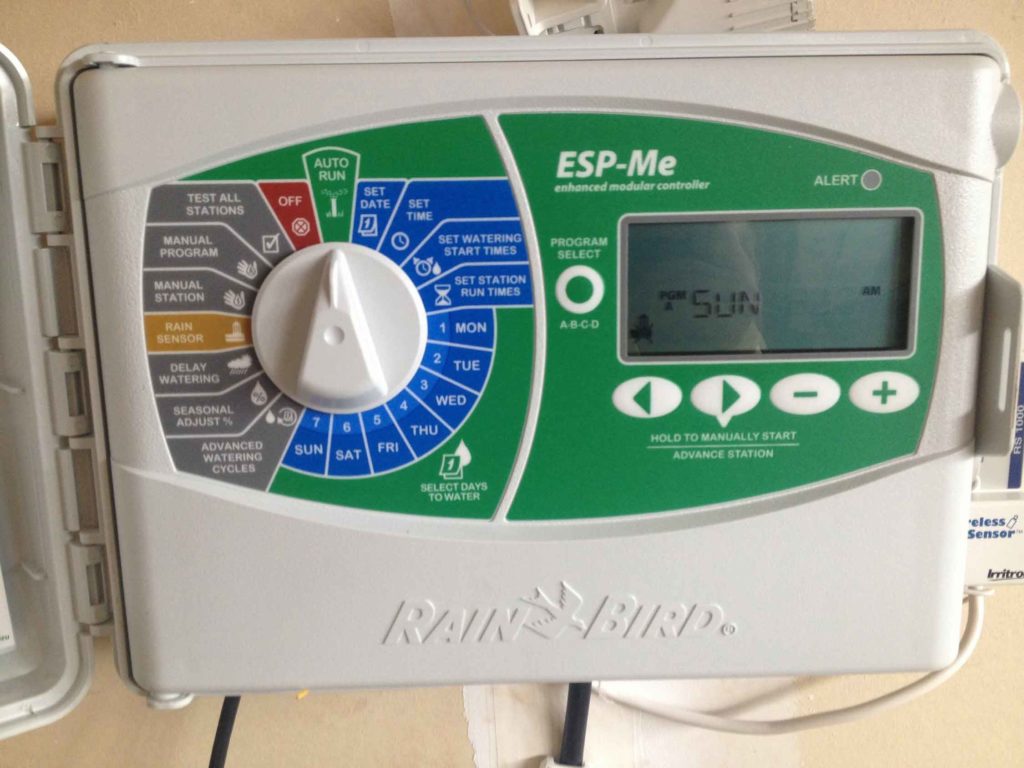
On nearly every controller you will find the following functions: program, time/date, start time, run time, days to water, autorun, and off. You will almost always have some +/- keys and some right and left arrow keys. These +/- and arrow keys are used to set your times and days. Other functions may be included on various timers as well.
Illustrated are two of the most common controllers installed in Albuquerque, the Hunter Pro-C and the Rainbird ESP-Me. They look different at first glance, but a closer inspection shows that they have essentially all the same functions.
What do you need to know to be able to set your controller this spring?
Time/Date: This is an important detail to keep up-to-date so that you are watering at the correct time and on the days that you want to water.
Zone/Station: A zone, or station, is all the sprinklers or drip lines that are controlled by a single valve. You may have one sprinkler valve and one drip valve split between your front and back yard. Each one is a separate zone which means you have two zones.
Program: Programs are how you group your zones that have plants with similar water needs. Using the above example:The lawn sprinkler zone would be selected on Program A. If the drip zone has similar water needs (trees and shrubs) you would group them both on Program B. This is because your lawn (Program A) needs to be watered differently from your trees and shrubs (Program B). If you have an additional zone, like for a vegetable garden, you will put that drip zone in Program C to water differently.
Start Time: It is important to know that the start time applies to the whole Program, not to each zone in a program. Controllers will run zones in succession within a program.
Run Time: This is the amount of time each station, or zone, waters every time it comes on
Example of spring programming:
Program A starts at 6:00 a.m.and your lawn sprinkler zone runs for eight minutes. Program A, zone 1, will quit watering by 6:08 a,m. If you had more lawn zones, they would water one right after the next.
Program B, your trees and shrubs zone starts at 10:00 a.m. It runs for 75 minutes so Program B would end watering at 11:15 a.m.
Days to Water: Once again, the days to water apply to all the zones, or stations in one program.
Example of spring programming:
Program A, your lawn, needs to be watered once or twice a week in the spring so you would set Program A to run twice a week.
Program B, your trees and shrubs, need to be watered only once a week in the spring so on Saturdays, for example, when you know that you have a better chance of checking the system for issues.
Tips & What to Watch For: Here are some tips to make programming easier and some tips to avoid common mistakes
Create a seasonal or monthly calendar and hang it up next to your controller.
Label each zone (Example: Zone 1 - front lawn close to the street)
Create calendar reminders for yourself, either on your phone or paper calendar, for each season.
Normally you won’t change the amount of time each zone waters seasonally, just how often you are watering.
Always double, or triple, check which program and zone you are on when you adjust the settings so you don’t end up setting a lawn zone to water like a drip zone.
Make sure you are back at Auto/Run whenever you have finished making adjustments. Your controller may not run at all if it isn’t, or it may revert to its emergency programming (usually 10 minutes for every zone, every day).
Replace your battery back-up every year. You don’t want to reprogram your whole controller if the power goes out.
Links to common controllers found in the Albuquerque area:
Author: Richard Perce, Irrigation Efficiency Specialist with the Water Resources Division for the Water Authority. Have a question about the article? [email protected]
Adopting water efficiency strategies will be the key to weathering the drought this year. These three simple steps can help you conserve water, rebates available for all three recommendations.
1. Update your controller with a WaterSense Smart Irrigation Controller
2. Replace your spray bodies with WaterSense Pressure Regulating Spray Sprinkler Bodies
WaterSense labeled spray sprinkler bodies with internal pressure regulation can reduce water waste by providing a consistent flow at the sprinkler nozzle. When the sprinkler body maintains pressure near its optimal operating pressure, the connected nozzle is better able to generate the right amount of water spray and coverage for a more uniform distribution of water across the landscape. Customers can choose from a list of pre-qualified spray sprinkler bodies.
High-efficiency sprinkler nozzles are a great solution for upgrading an old and poorly performing sprinkler system. These nozzles minimize water waste and feature a unique multi-trajectory rotating stream that delivers water at a steady rate. This slower application rate allows water to gently soak in at rates that soils can absorb. Use these nozzles to replace the sprinkler head on any conventional spray head body or pop up sprinkler. In most cases, you just remove the old, water wasting spray nozzle and replace it with the new head. For more information on these nozzles read this post.
Making these simple changes can result in 30% water savings. For installation, questions contact your favorite irrigation supply store professional or send us a question at [email protected]
Author: Jill Brown, ASLA, is a Landscape Architect and owner of My Landscape Coach in Albuquerque, NM. Have a question about the article? [email protected]
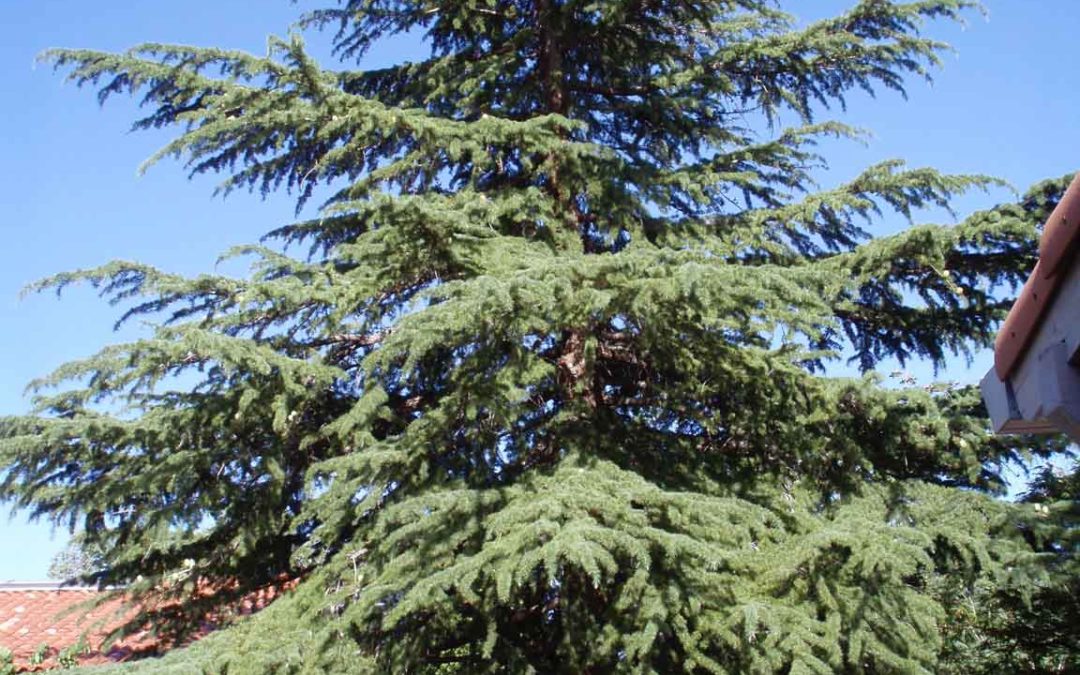
This beautiful specimen tree is a stunning focal point in any landscape. Its blue-green to silvery pendulous branches create an attractive form and provide nesting sites and food for birds. The Deodar Cedar grows well in all types of soils but doesn’t like soggy feet. Once established in the landscape, it is considered drought tolerant.
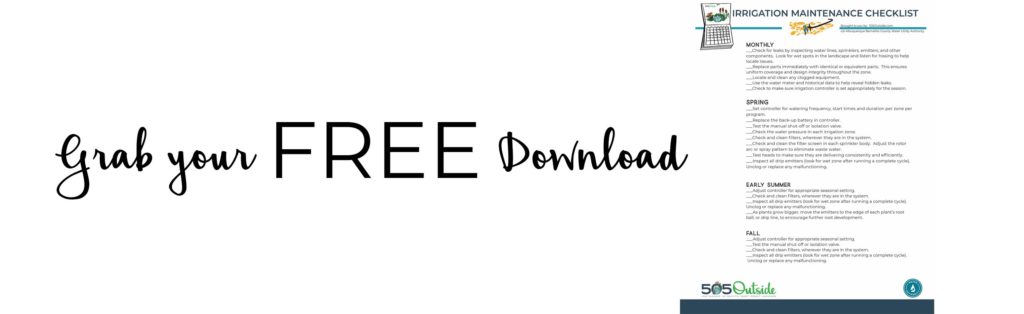
With drought conditions predicted to continue for the foreseeable future, we’re likely to water more often this spring and summer. Make every drop count – and keep us on track to meet our conservation goals – by performing routine maintenance to maximize your sprinkler system’s efficiency.
Monthly
Check for leaks by inspecting water lines, sprinklers, emitters, and other components. Look for wet spots in the landscape and listen for hissing to help locate issues.
Your irrigation system is only as good as its aim. Adjust sprinklers and emitters to make sure they’re delivering water to the landscape and not onto rocks, bare earth, or pavement.
Replace damaged parts immediately with identical or equivalent parts. This ensures uniform coverage and optimal system efficiency.
Locate and clean any clogged equipment.
Use water meter and historical data to help reveal hidden leaks.
Check to make sure irrigation controller is set appropriately for the season
Spring
As the watering season gets underway, check your irrigation system for leaks and clogged, broken, or missing sprinkler heads and emitters.
An outdated irrigation system can waste time, water, and money. Consider installing a new WaterSense-labeled, “smart” irrigation controller to take the guesswork out of scheduling (rebates available).
Set the controller for watering frequency, start times, and duration per zone per program.
Replace the back-up battery in the controller.
Test the manual shut-off or isolation valve.
Check the water pressure in each irrigation zone.
Check and clean filters, wherever they are in the system.
Check and clean the filter screen in each sprinkler body. Adjust the rotor arc or spray pattern to eliminate water waste.
Test heads to make sure they are delivering consistently and efficiently.
Inspect all drip emitters (look for wet zones after running a complete cycle). Unclog or replace any that are malfunctioning.
Early Summer
Adjust controller for the appropriate seasonal setting.
Adjust sprinklers and emitters to make sure they’re delivering water to the landscape and not onto rocks, bare earth, or pavement.
Check and clean filters, wherever they are in the system.
Inspect all drip emitters (look for wet zones after running a complete cycle). Unclog or replace any that are malfunctioning.
As plants grow bigger, move the emitters to the edge of each plant’s root ball or drip line to encourage further root development.
Fall
Adjust controller for the appropriate seasonal setting.
Test the manual shut-off or isolation valve.
Check and clean filters, wherever they are in the system.
Inspect all drip emitters (look for wet zones after running a complete cycle). Unclog or replace any that are malfunctioning.
Winter
Guard your irrigation system against freezing temperatures by draining pipes and tubing and properly winterizing your system.
When temperatures are below 40 degrees Fahrenheit, discontinue automatic watering and turn on systems manually or hand water as needed.
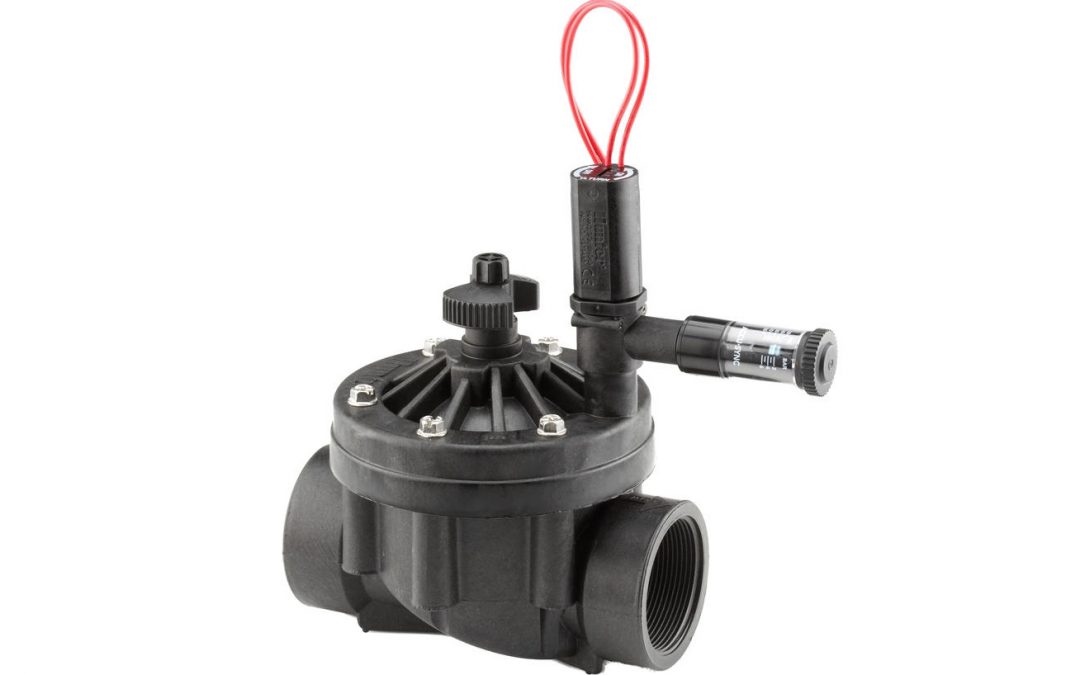
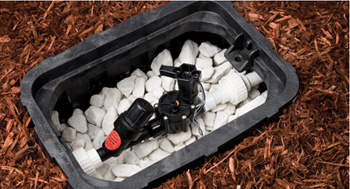
Pressure regulators are another essential technology for improving the efficiency of your irrigation system. They are an integral part of keeping your system running in peak condition. Pressure regulators come in two basic styles: inline or valve fitted. An inline regulator attaches within the piping on a lateral line and is most used with drip irrigation. A pressure-regulated valve fitting is used more often with turf irrigation where the pressure is high.
These fittings can either reduce pressure or provide sustained pressure. Valve fittings are brand specific, so we suggest visiting a local irrigation supplier to see if they are available for your brand of valve. Pressure regulators provide the following benefits:
Avoid underwatering or overwatering by maintaining a set, optimal pressure.
For lawn irrigation, they reduce misting and excessive evaporation.
With a drip system, they help keep the emitters’ water output accurate and keep them from “blowing” or “popping” off the drip line due to excessive pressure.
Earn rebates of 25% up to $100 including purchase and professional installation. Visit irrigation efficiency rebates to apply for your rebate today.
Pro Tip: Jim from Site One irrigation supply store in Albuquerque says, “An inline pressure regulator is a must in any irrigation installation in Albuquerque. They reduce the chance of blowing out your drip emitters and even out the water delivery.”
Pressure Regulator Photography courtesy of Hunter Industries
Author: Richard Perce, Irrigation Efficiency Specialist with the Water Resources Division for the Water Authority. Pro tip:Site One Irrigation. Have a question about the article? [email protected]
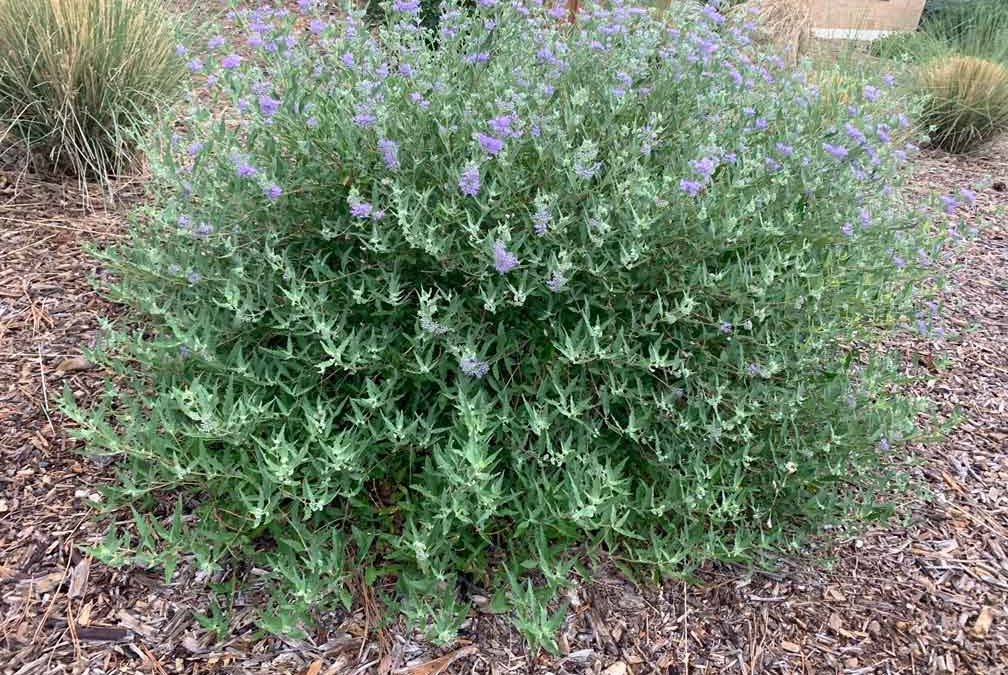
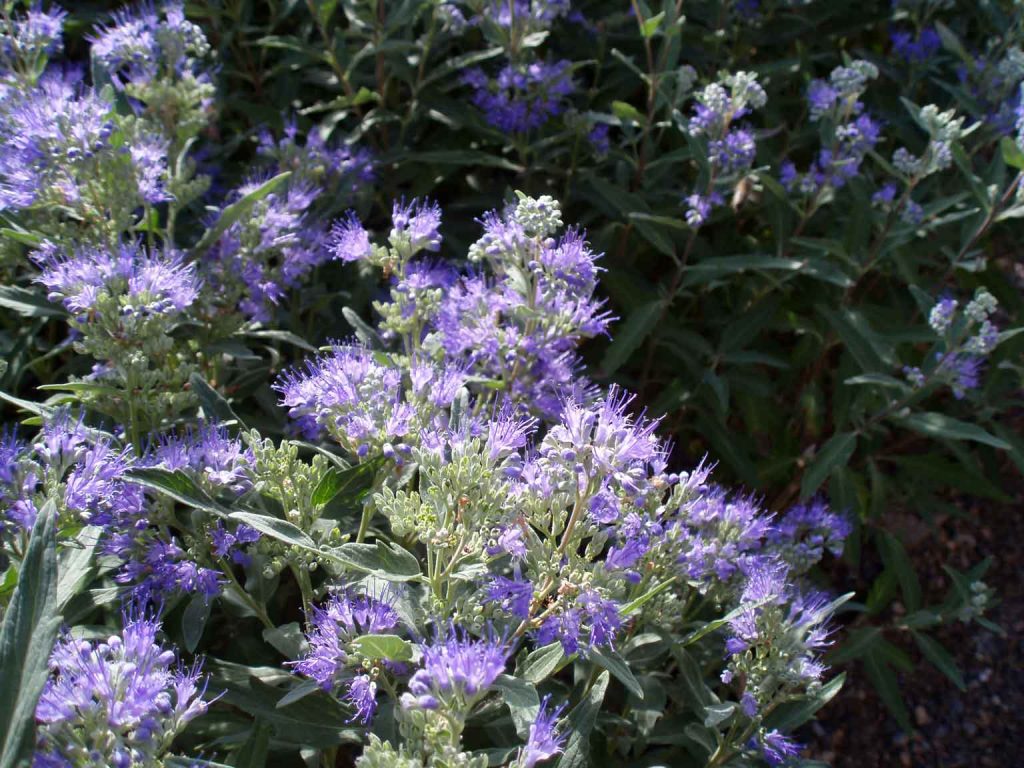
Blue Mist spirea is particularly well suited for areas with dry climates. That makes it a significant staple in New Mexico landscapes. The flowers attract a variety of life that includes bumblebees, butterflies, and even hummingbirds. Once established, it is reasonably drought tolerant, too. Pick Blue Mist spirea to add a touch of color in your garden.