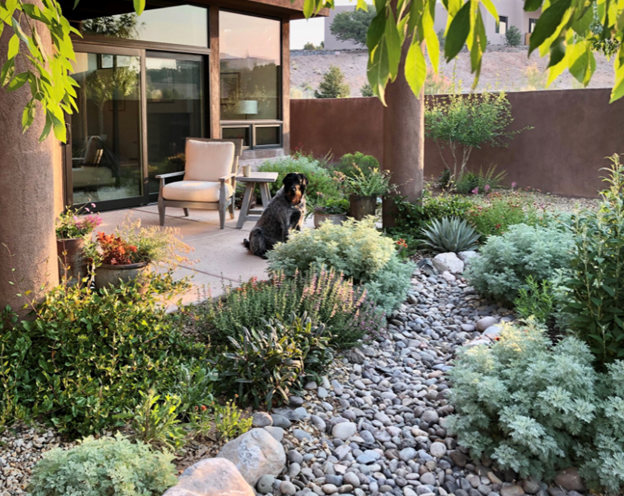
Do you want to learn how to harvest rainwater to support a beautiful, regionally adapted, low -water-use landscape in your yard? A new video series launched in June provides instruction on how to design, install, and maintain residential-scale, passive rainwater harvesting features. In passive water harvesting, rainwater is conveyed directly to a landscaped area and infiltrated in the soil.
Landscapes that incorporate rainwater harvesting and native/drought-tolerant plants require little supplemental irrigation. Rainwater harvesting provides the deep watering that large plants like trees and shrubs need in our hot and dry climate. Capturing and infiltrating rainwater also reduces runoff that carries pollutants to the Rio Grande River.
In this series, you will learn how to construct some of the most common passive rainwater harvesting features in residential applications – basins, swales and soil sponges. The training addresses site selection, sizing basins, grading swales, installing soil sponges for enhanced infiltration and selecting plants. It is presented by four local experts on rainwater harvesting and arid-adapted gardens: Jim Brooks, Tess Houle, Judith Phillips, and Hunter Ten Broeck.
The video series was developed through a collaboration between Bernalillo County, Ciudad Soil and Water Conservation District, and the Arid LID Coalition, and included the installation of a Rainwater Harvesting Learning Landscape at the Gutiérrez-Hubbell House History and Cultural Center. Please visit the Rainwater Harvesting Learning Landscape in person to see an example of a rainwater harvesting feature designed for our arid climate.
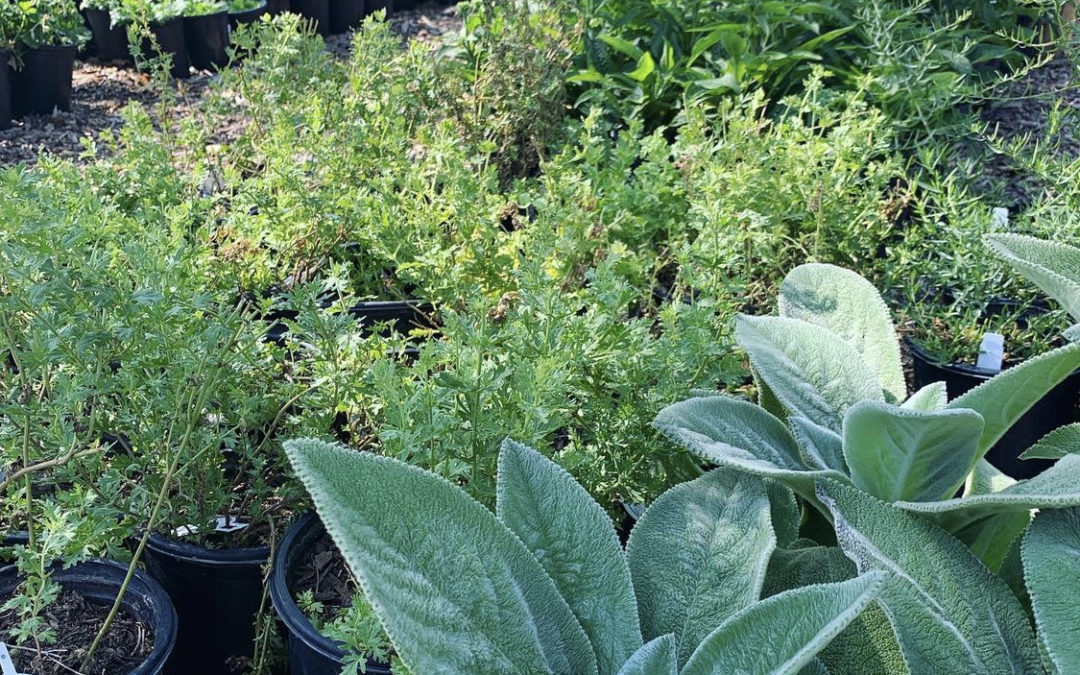
Fall can be a great time to plant, especially if you are planting higher elevation and temperate climate plants that are adapted to cooler, more humid growing conditions. In the fall, the soil is still warm enough to encourage roots to develop so watering properly makes a big difference on preparing them to survive in the winter season. What to plant? Most conifers, shade trees, cool season grass and moisture-loving fruit and ornamental trees, such as crabapples, apples and pears, are a great selection for planting in this autumn.
What not to plant this fall? The answer is plants from desert ecosystems like southern New Mexico and the Mediterranean natives. Their newly planted roots are less able to survive our winter cold. The same is true for perennial wildflowers and warm season grasses. These should be planted in the spring through early August. Succulents are another group of plants that thrive after settling into the garden during the warmer part of the growing season, so wait until the spring to plant them.
Knowing what to plant at this time of year will give you that edge you need to grow healthy plants!
Author: Judith Phillips, owner of Design Oasis, landscape designer, and garden writer with 30 years of experience designing arid-adapted and native gardens in the high desert. Photography:Plants of the Southwest. Have a question about the article? AskAnExpert@abcwua.org
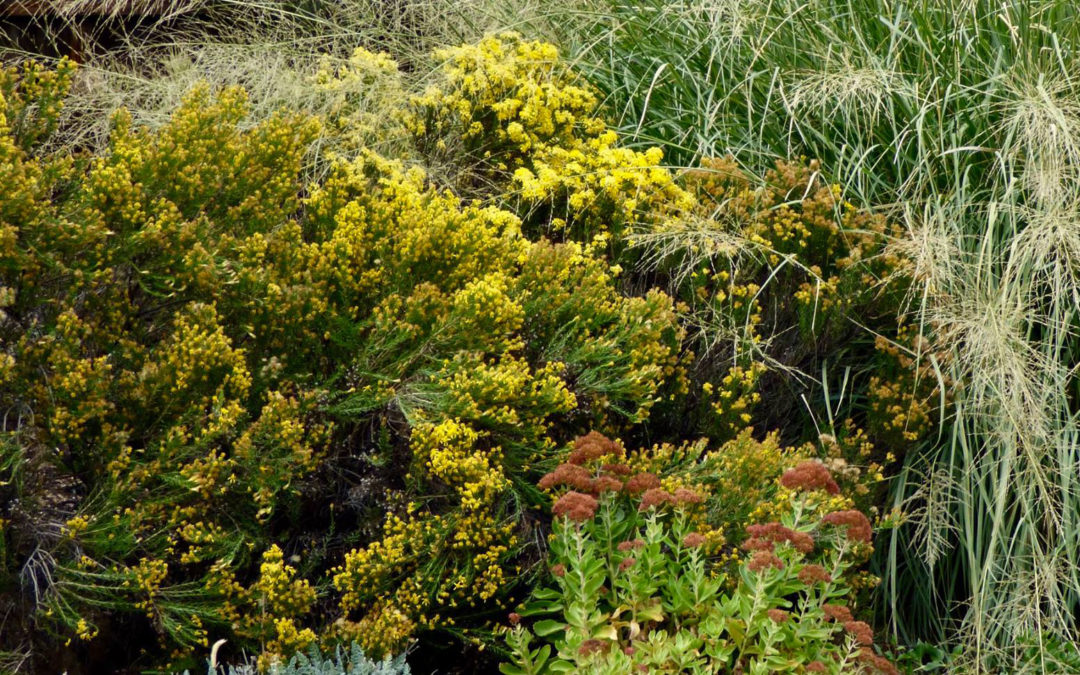
This evergreen shrub is a win-win in our high desert gardens. It has a lovely dark green color year-round, and in the fall, it has beautiful yellow blooms to brighten up the garden. There is no pruning needed due to its predictable rounded shape.
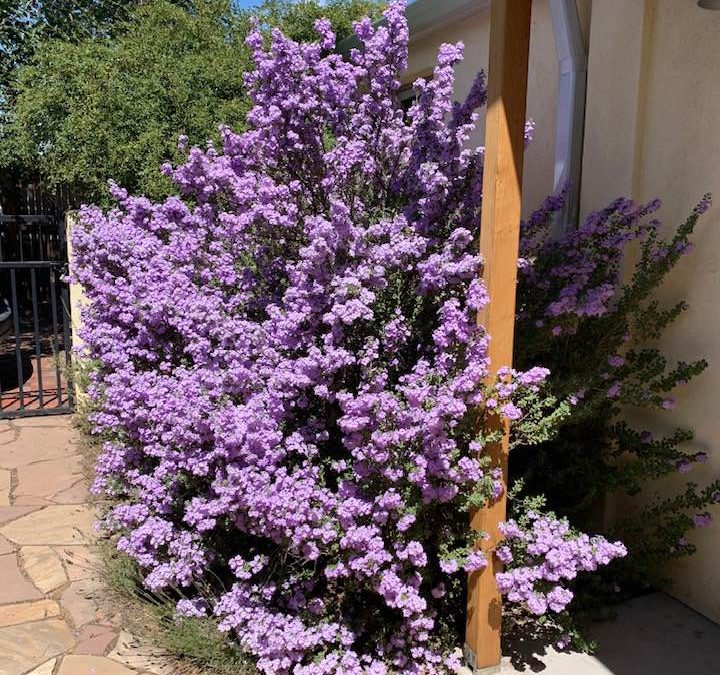
Description: This blue-green evergreen shrub likes western and southern exposures. Its predictable shape and form works well as an informal hedge in the garden. It is a welcome pop of purple during the heat of the summer when all the spring blooms have faded away. Be careful where you place it because it can freeze if located on northern protected exposures.
Did you know that half of Albuquerque homeowners do not have an irrigation system? We’ve been talking to hundreds of homeowners, and it turns out that the reason they haven’t installed one in their yard is they think an irrigation system for a typical lot (1/8 acre or 10,000 sf) will cost $5,000 or more. The good news is this is a myth! The cost for one fully installed irrigation drip system plus a controller/timer is between $1,350 and $1,900. Prices will vary depending on the size of your yard, the complexity of your water connection and if you want to add additional valves for irrigating plants with different watering needs, such as existing mature trees, vegetable beds, container plants or a turf grass lawn.
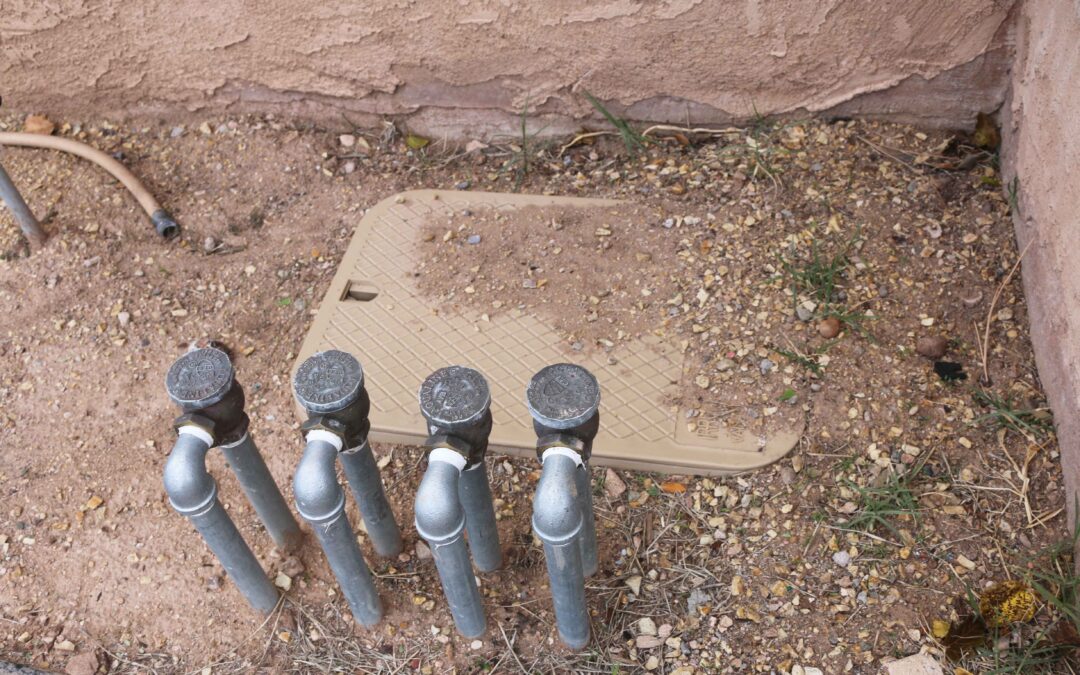
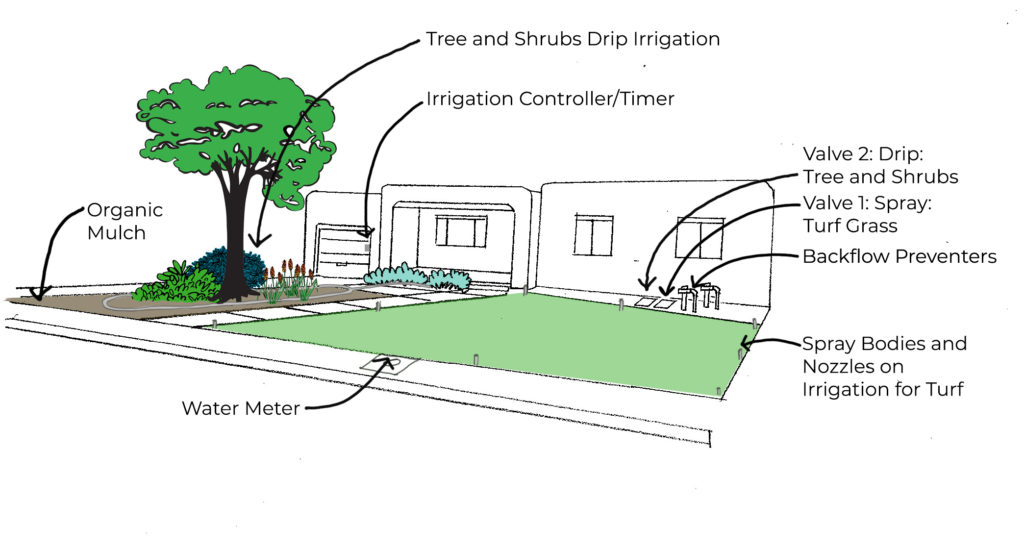
Here is what a typical irrigation system looks like. Do any of these elements look familiar to you? Perhaps you have a residential backflow preventer in your own yard and didn’t realize it or you thought it didn’t work because you’ve turned on the timer in your garage and nothing happens.
Many homes already have one or a couple of residential backflow preventers in the yard that are no longer in use. A local irrigation contractor usually can get those back up and running and include a new stub out for drip irrigation.
For those homes that don’t have any existing irrigation remnants, you’ll need to start from the beginning. One drip irrigation system is generally all you will need in a desert-friendly xeriscape for a 1/8 acre or smaller yard. Drip irrigation is the recommended method of delivering water to all your plants and trees (but not turf grasses).
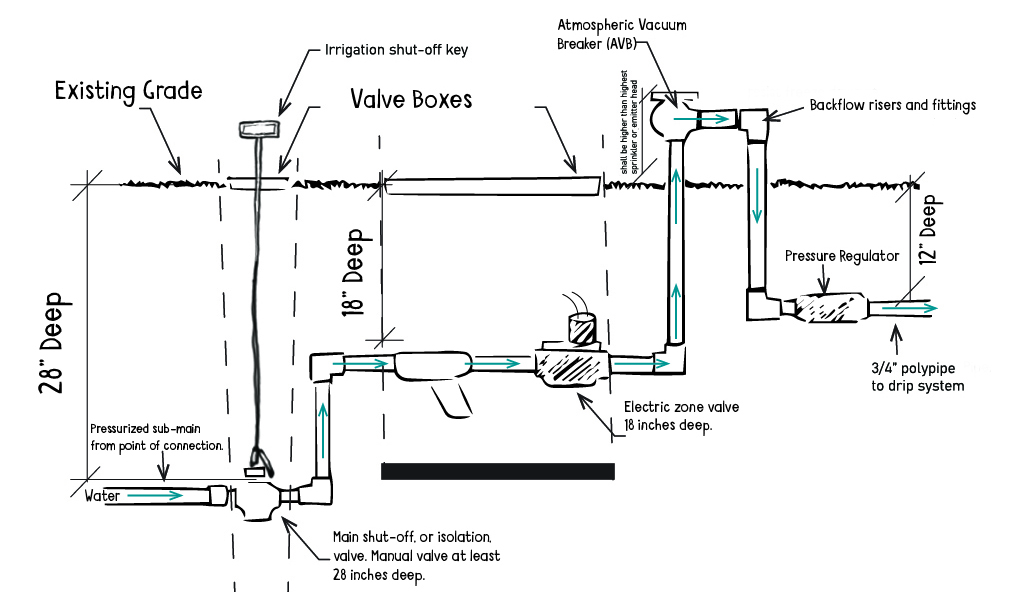
You’ll want to install one backflow preventer with one valve to run the drip system in the yard. A ¾” distribution polyline is connected to the valve. The polyline, which winds all around the yard, has ¼” spaghetti tubing connected to it so water gets directly to the plants. Due to our typically high water pressure, most drip irrigation systems require a pressure regulator to slow the water pressure, thereby reducing the chance of the drip emitters getting popped off the line.
Here is a breakdown of the costs:
One automatic residential backflow preventer with valve and pressure regulator with stub out to future dripline. $600-800 installed (includes parts and labor).
¾” dripline polyline connects to the stub out of a new valve or from an existing one and winds around the yard. Add ¼” spaghetti tube with drip flag emitters on the end to water each plant in your yard. $400-600 installed (includes parts and labor).
One automatic irrigation controller/timer (Smart Controller that connects to the Internet and your smartphone). $350-$500 (includes parts and labor) (rebates available)
A regular controller costs $350 (includes parts and labor).
Before hiring an irrigation designer and/or contractor, it’s advisable to ask them specific questions so you can make wise choices about design options and the kind of equipment you need.Click on this link to access a helpful guide put together by the Irrigation Association as developed by Cal Poly, San Luis Obispo. Adding an irrigation system (especially a drip system) means watering your plants using the least amount of water to provide optimal health. It is making sure that every drop of water you use goes to where it is needed and can be used most effectively by your plants. An irrigation system conserves water, produces a healthier landscape, saves time and is not as costly as you think!
Author: Jill Brown, ASLA. Landscape Architect and Owner of My Landscape Coach The prices quoted here are based on my experience as a landscape professional in the Albuquerque market. Prices will vary, of course, on size, complexity, and availability. Have a question about the article? AskAnExpert@abcwua.org