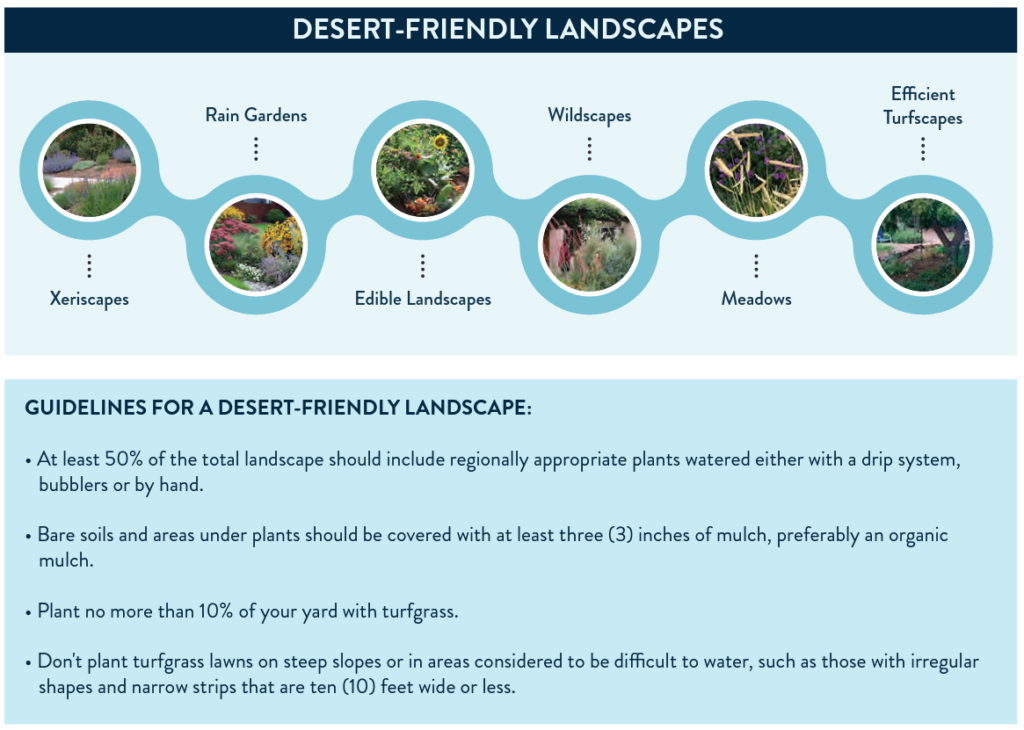
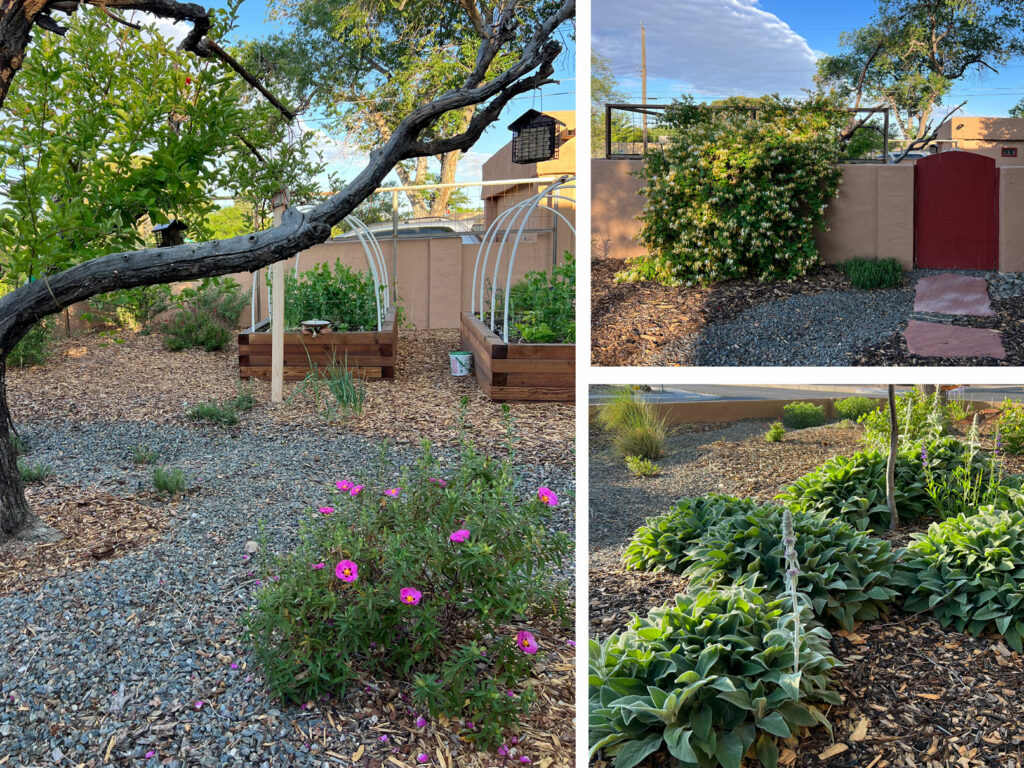
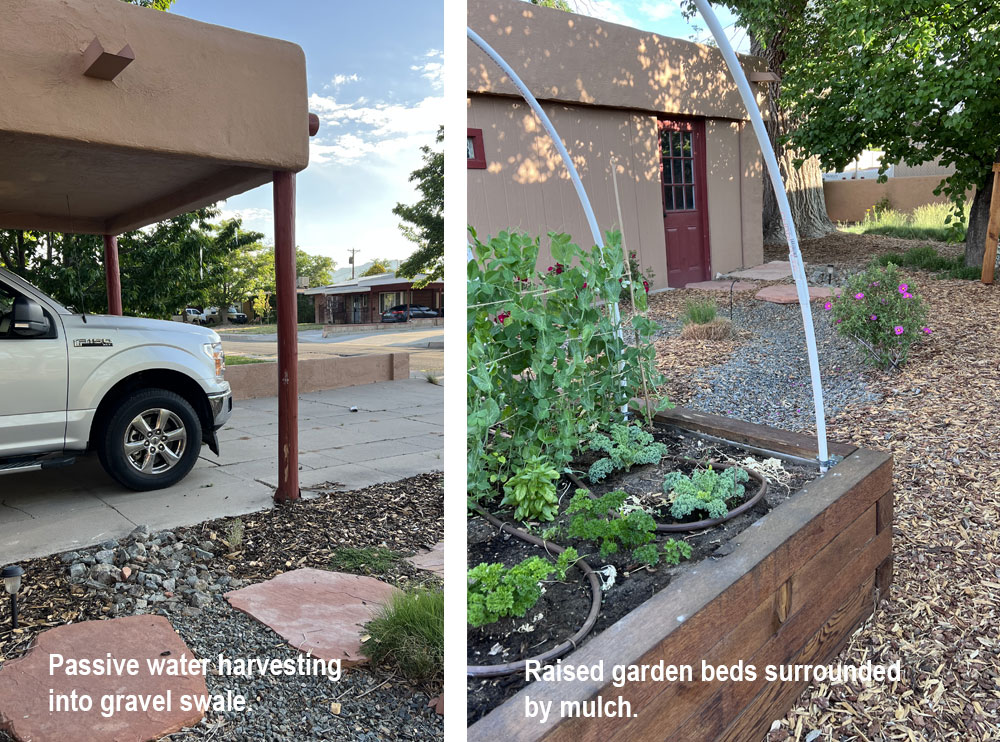
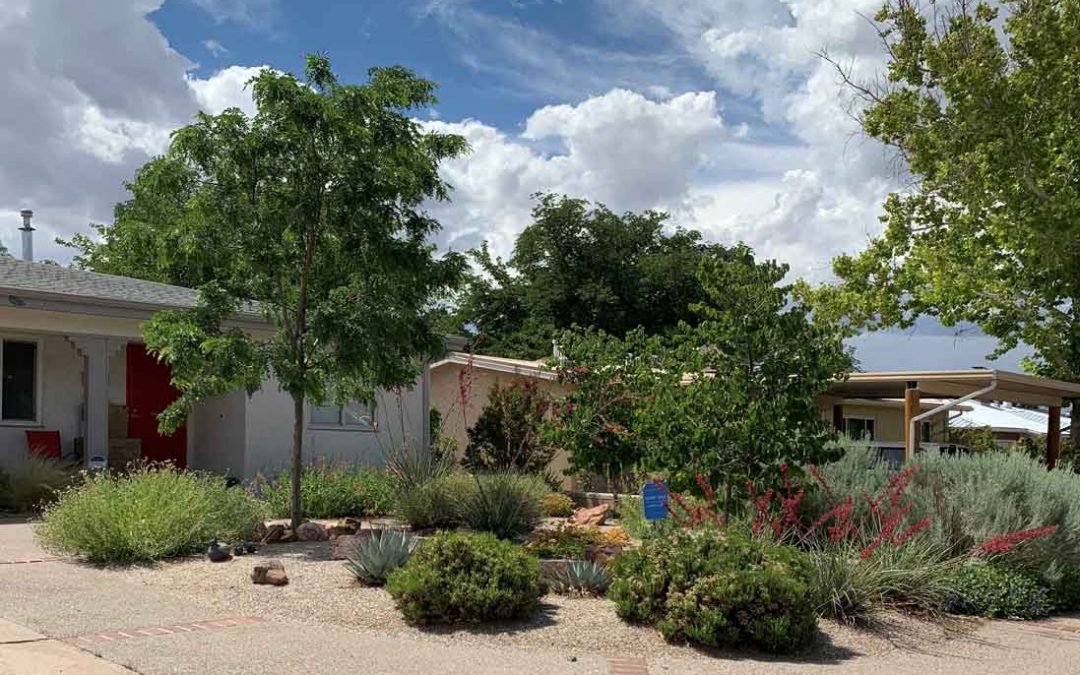
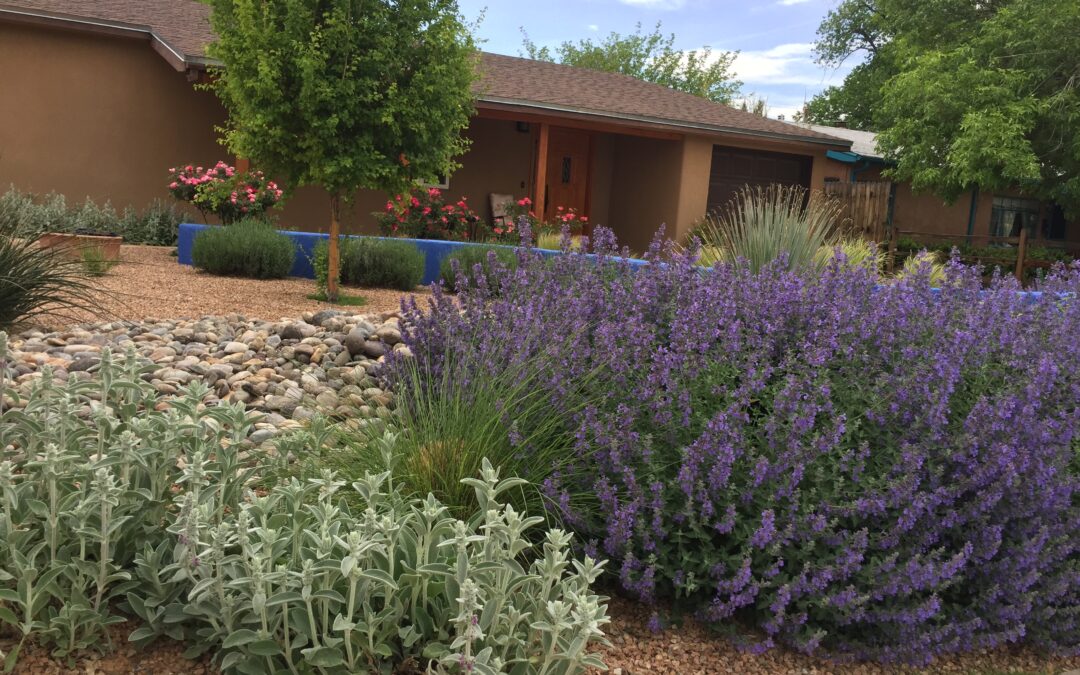
The Albuquerque metro area has a wide variety of landscapes. These include desert friendly landscapes, lush pollinator friendly xeriscapes and wildscapes or prairie plantings where native grasses and wildflowers bring the feel of a prairie to a yard and attract wildlife. Rain gardens are specifically designed to make the most of natural precipitation, while edible landscapes have garden beds or edible plants interspersed throughout them. Efficient turfscapes have smaller areas of turfgrass and diverse plantings. Conventional turfscapes, with large areas of cool-season grasses and high-water-use foundation shrub plantings, are no longer considered desert friendly landscapes. The term “desert friendly” now describes a variety of landscapes that include beautiful, diverse plantings with increased resiliency achieved through efficient watering.
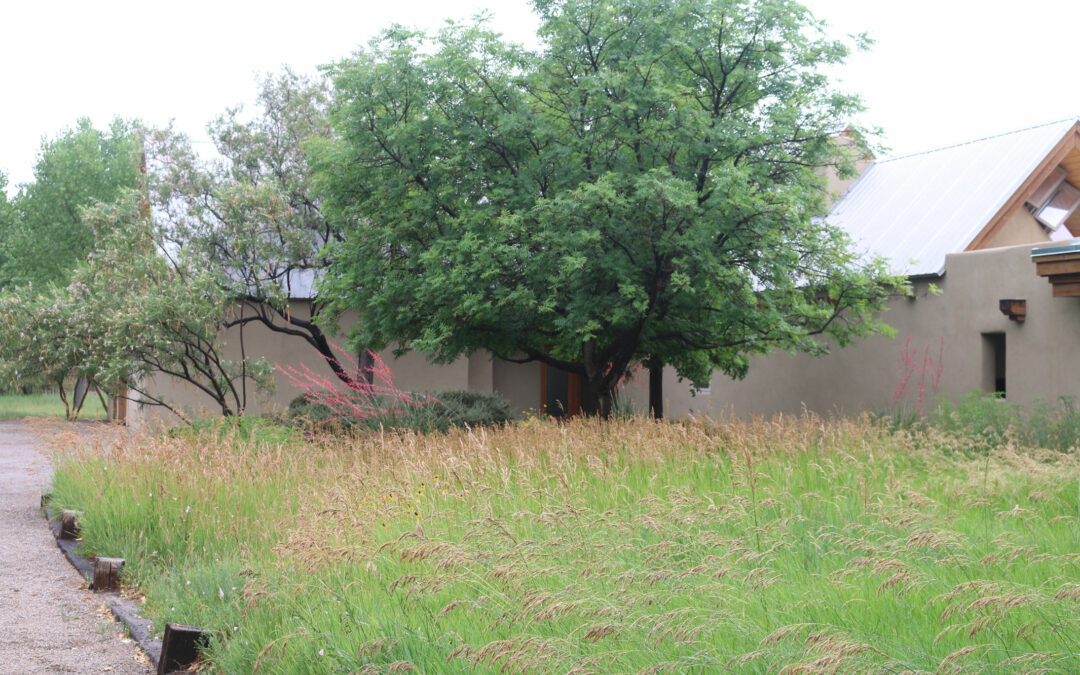
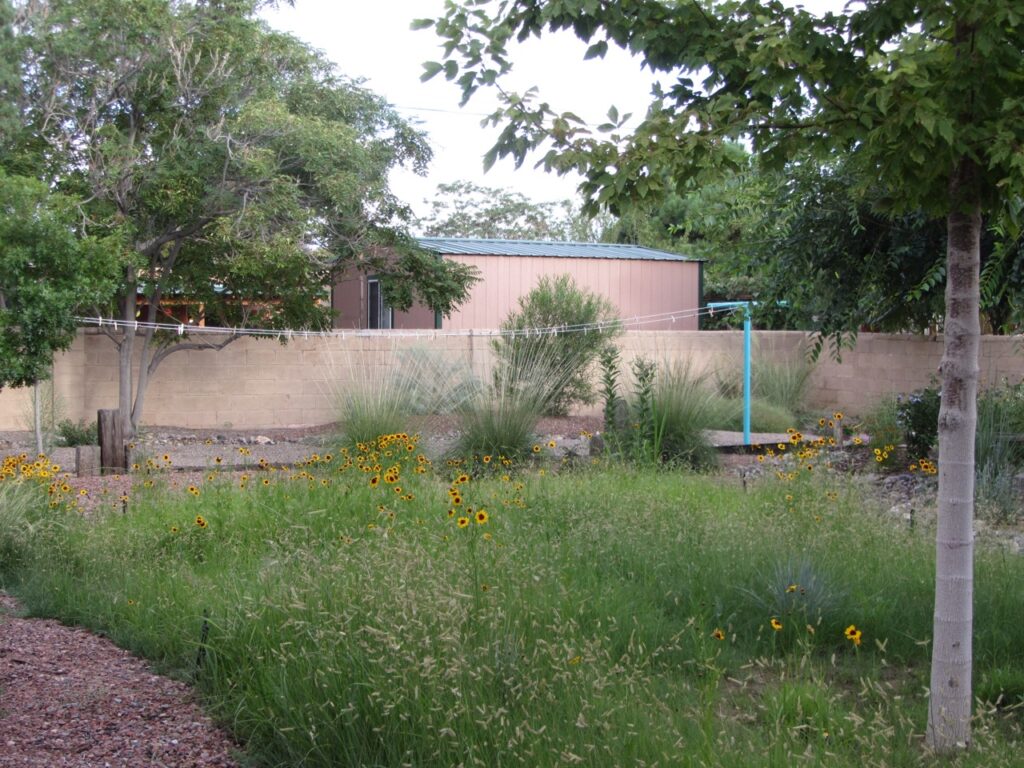
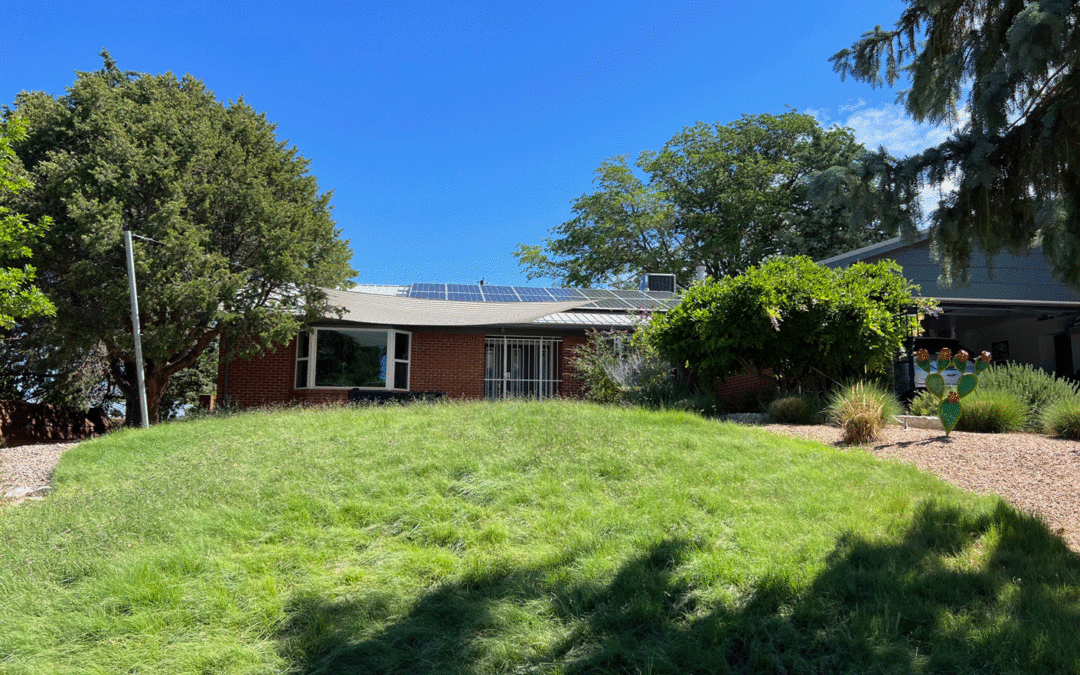
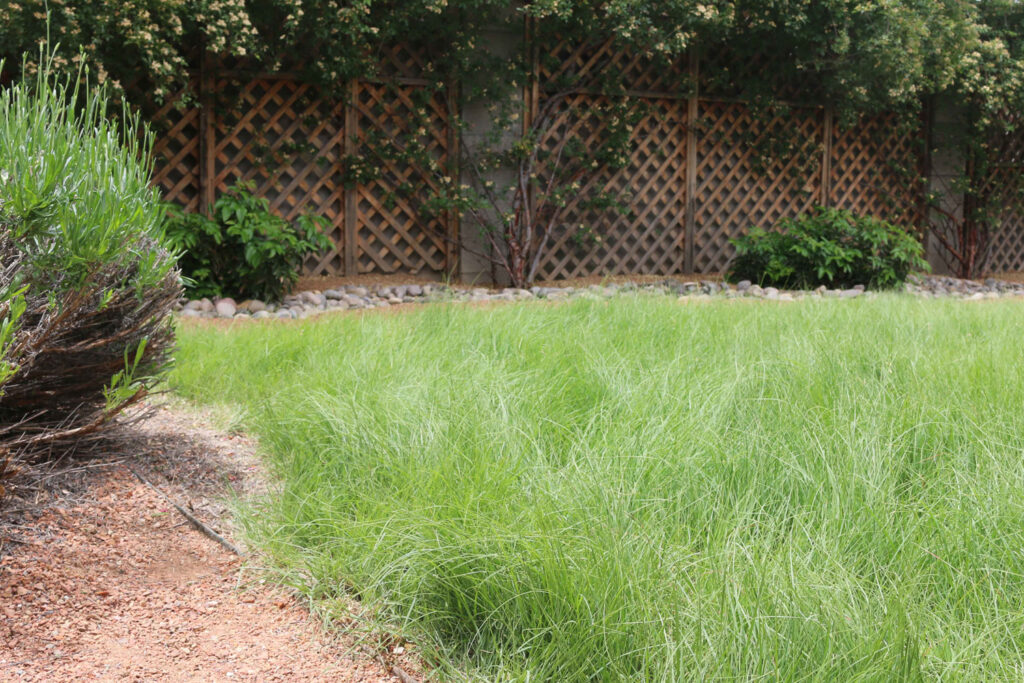
Wildscapes or prairie plantings take advantage of natural landscape techniquess and plant choices that attract wildlife. These types of landscapes include native warm-season grasses and a mix of native and adaptive plants, including wildflowers.
A wildscape may be designed to rely more heavily on natural precipitation to sustain established plants than a xeriscape. Both natural precipitation and temporary irrigation are needed at first. Establishment in the grass areas often takes three years and possibly longer for trees. Monitoring and removing weeds is critical during this early period. Wildscapes also require less frequent yet deeper watering than a regular cool season turfgrass lawn.
Pro Tips for Irrigation of Wildscapes:
• Consider a mix of high-efficiency sprayers or rotors (for the native grass area) and drip irrigation or inline dripline (for shrubs and trees) on separate zones. Specific zones can be turned off after the plantings are firmly established.
• If you are using rotors or spray irrigation in native grass areas, make sure they will clear the tall grass. Use rotors with a high angle of throw or 12-inch to 18-inch pop-up sprayers.
• Leave the irrigation system in place, even if the plan is to rely on natural precipitation, so supplemental watering is available during times of extreme heat or drought.
Learn more about specific types of gardening here:
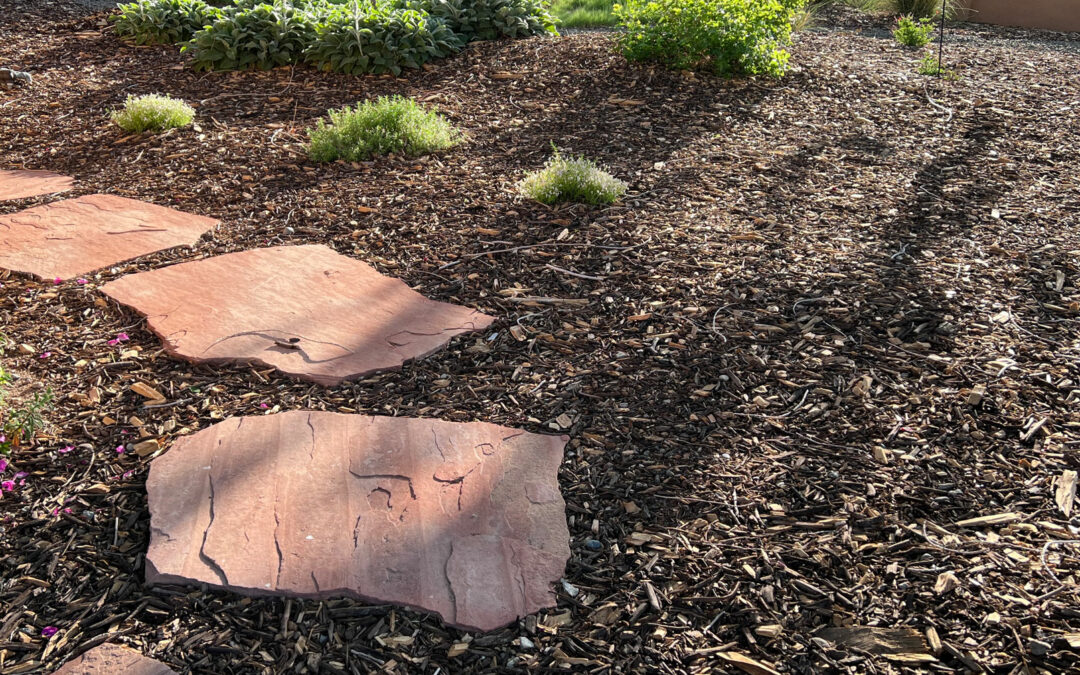
As homeowners around the Greater Albuquerque area are converting their high-water use turfgrass areas to desert-friendly xeriscapes, many are choosing to use wood chip mulch instead of gravel, which can be hot, expensive and also very good at cultivating weeds. Gravel can use up to as much as 60% of the materials cost of a landscape transformation project.
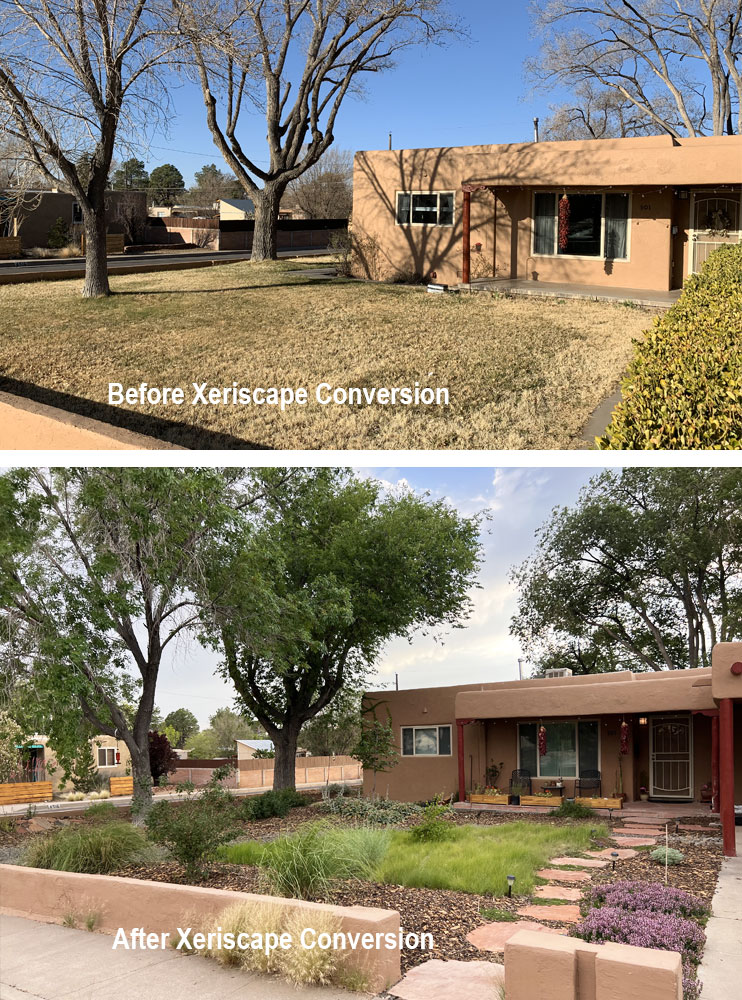
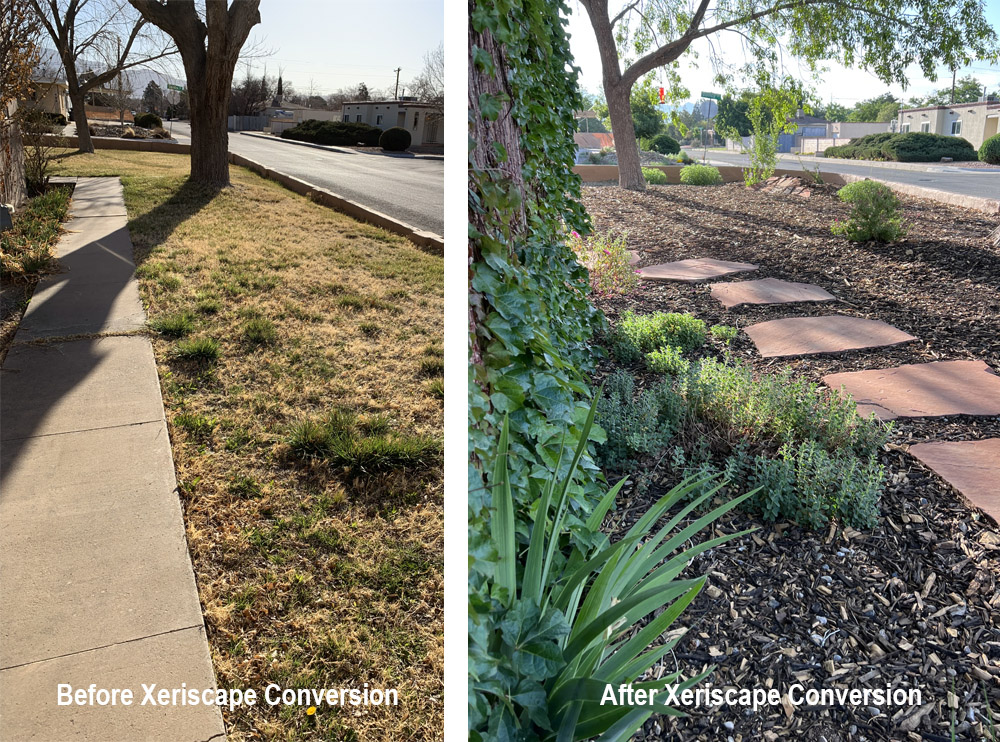
The Water Authority checked in on some recent xeriscape conversion projects that use wood chip mulch. One of these homes was built in the 1950’s and is located in the near NE Heights, an area where the original landscapes for homes consisted of both front and backyards with Bermuda grass and large elm trees. The homeowners wanted to remove the grass in both the front and back of the house and create desert-friendly xeriscapes while retaining their mature trees. They became fans of wood chip mulch many years ago while living in Florida. “Wood chip mulch is easy to maintain,” explains the homeowner. "I do nothing to it except occasionally blow out whatever drifts into the swales and top dress it every couple of years with a thin layer of new mulch. Not only does it reduce the evaporation of moisture from the soil, it helps keep our property much cooler than rock because it doesn’t retain heat or reflect the intense light we get here. I also think the mulch along with the trees helps dull the sounds of the city.”
The mulch, which is laid down 3” to 4” deep, makes weeding much less of a task. Fewer things germinate in the mulch and when things do – in particular, the zillions of elm seeds that drop every spring — all that’s needed is to rake back the mulch layer, let it dry out for a day or so, and then rake it back into place. The seedlings dry up, die and become part of the mulch layer. The hardest part of the project, according to the homeowner, was removing the Bermuda grass. Due to the nature of its rooting system, the grass was completely eradicated before beginning the installation process. In this situation, the homeowner used an herbicide treatment to eradicate the grass. Since there are many options for eradication, we invite homeowners to take advantage of our free, ask-an-expert email service, [email protected], if you have questions about what type of lawn you have or any other questions about xeriscape transformations.
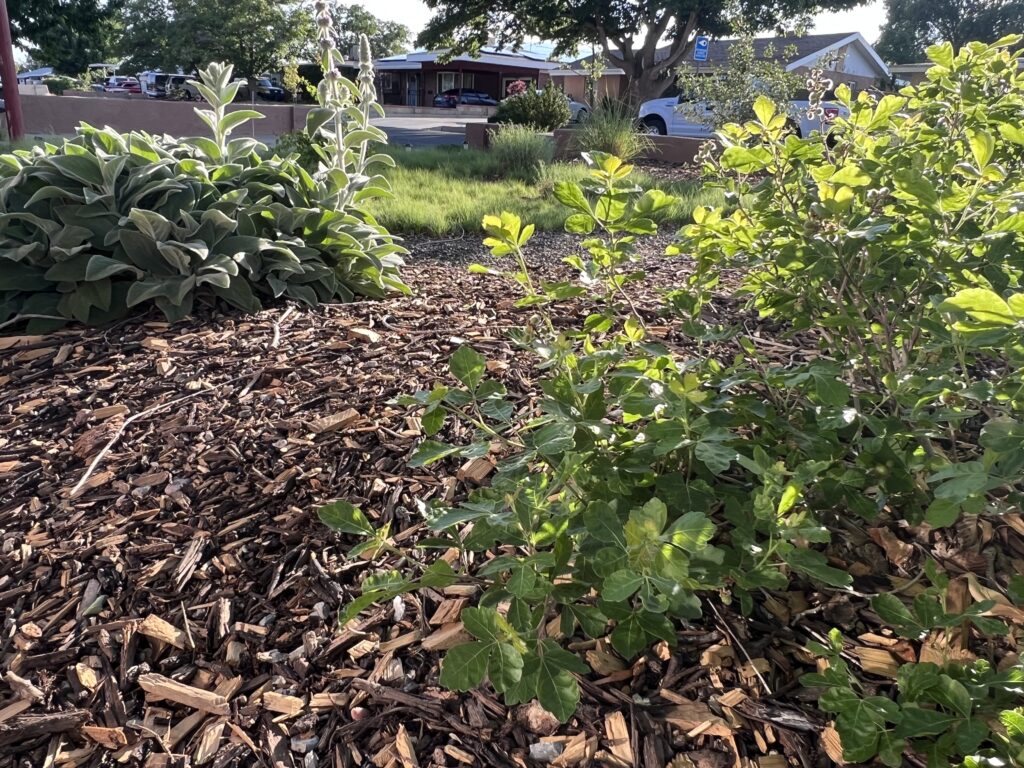
It’s been two years since their yard transformation. The homeowners say they noticed changes in the wildlife in their yard almost immediately. Fruit-bearing shrubs and wildflowers are allowed to go to seed, which means there are food sources for pollinators and birds most of the year as well as more cover in which critters can take shelter.
Since these homeowners moved to Albuquerque from a subtropical area, they did note that the one big lesson has been how much patience is required when undertaking a project like this in our desert environment. “The first year, most of what had been planted survived the winter, but a lot of things didn’t show much growth,” explains the homeowner. “I was a little frustrated. But this spring, things just burst forth – partially because of the amount of rain, but also because it simply takes that long for things to really establish a root system that can sustain significant growth.”
Sitting in their yard is more enjoyable now, say the homeowners, as the cooler landscape makes the outdoors more comfortable. They continue to learn from their landscape, picking up a few new irrigation drip skills along the way. They receive many positive comments from neighbors and are proud that their yard is an example of a healthy, sustainable and low-water use desert-friendly landscape.
Additional Facts on Mulches:
Wood chip mulchinsulates plant roots from both heat and cold, reducing moisture loss from the soil by evaporation, feeding beneficial soil microorganisms that enhance plant growth and improving soil health. This makes the soil more sponge-like and better able to hold water. By installing 3”- 4” of mulch over bare dirt, weeds are reduced, the soil is enriched and new plants retain more moisture.
Another benefit of organic mulches is that they can visually accommodate a little bit of leaf litter, reducing the need for constant raking and clean-up. A thin top dressing of mulch added every 2-3 years keeps the landscape looking fresh and replaces the material that has broken down to sustain the soil. Organic mulches are also lightweight, making them easy to transport in a wheelbarrow and spread with a rake.
Mulches are available in bags from most local garden centers (avoid the ones dyed with different colors as these will fade) and in bulk from several retailers in the Albuquerque area. When you buy from local bulk retailers, you are supporting the recycling of local organic materials that may otherwise end up wasting away in a landfill and contributing to greenhouse gas emissions. Buying bulk also means less plastic! Mulch can sometimes be available at no cost. Check with your local tree trimming companies and/or try your local county for free mulch resources. Mulches are a renewable resource that will improve landscape health and conserve water.
In areas of higher wind exposure or periodic inundation with water, use a wood chip mulch that is irregularly shaped and sized as the pieces will knit together better. This type of mulch can be recycled yard waste and tree trimmings as well as commercially-available, locally-processed wood products.
Property Data:
Homeowner converted 4,640 square feet of Bermuda grass to a desert-friendly xeriscape. Total gallons saved since conversion: 61,001 gallons. Total gallons per month homeowner saves: 3,050 gallons. Total rebate received: $4,740
Thinking about converting your yard from high-water use grass to xeriscape? Check out the Desert Friendly Xeriscape Rebate page to learn more about the qualifications, requirements and process to apply for this generous rebate. Additionally, xeriscape rebate participants get 25% off the cost of installing bulk organic mulch up to $100. If you want to top dress mulch around your trees, take advantage of our Treebates. You are welcome to contact our xeriscape specialist Amos Arber, at [email protected] or 505-208-2015
Author: Amos Arber, Xeriscape Rebate Inspector with the Water Resources Conservation Department for the Water Authority. And Jill Brown, ASLA MyLandscapeCoach.com Have a question about the article? [email protected]
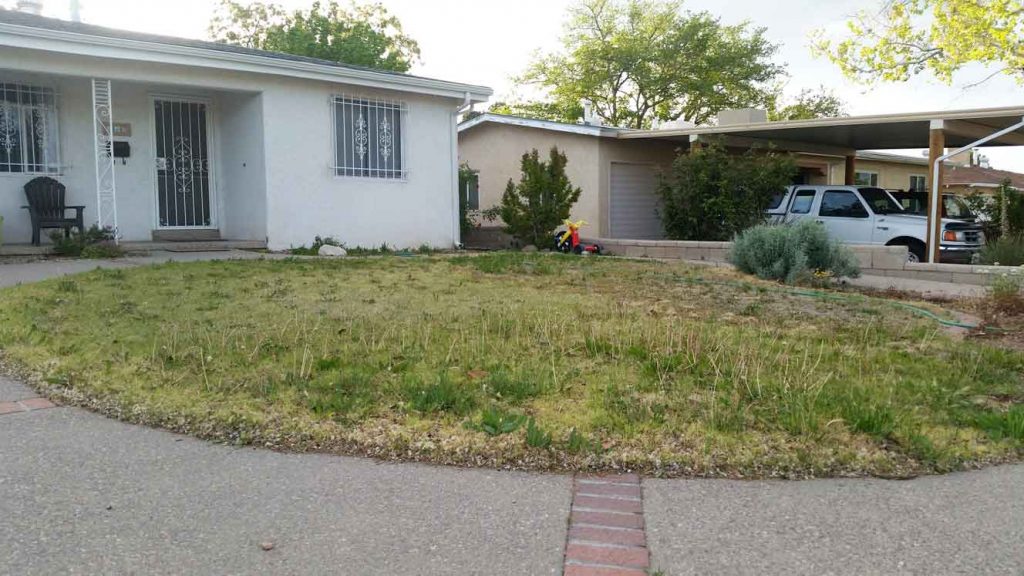
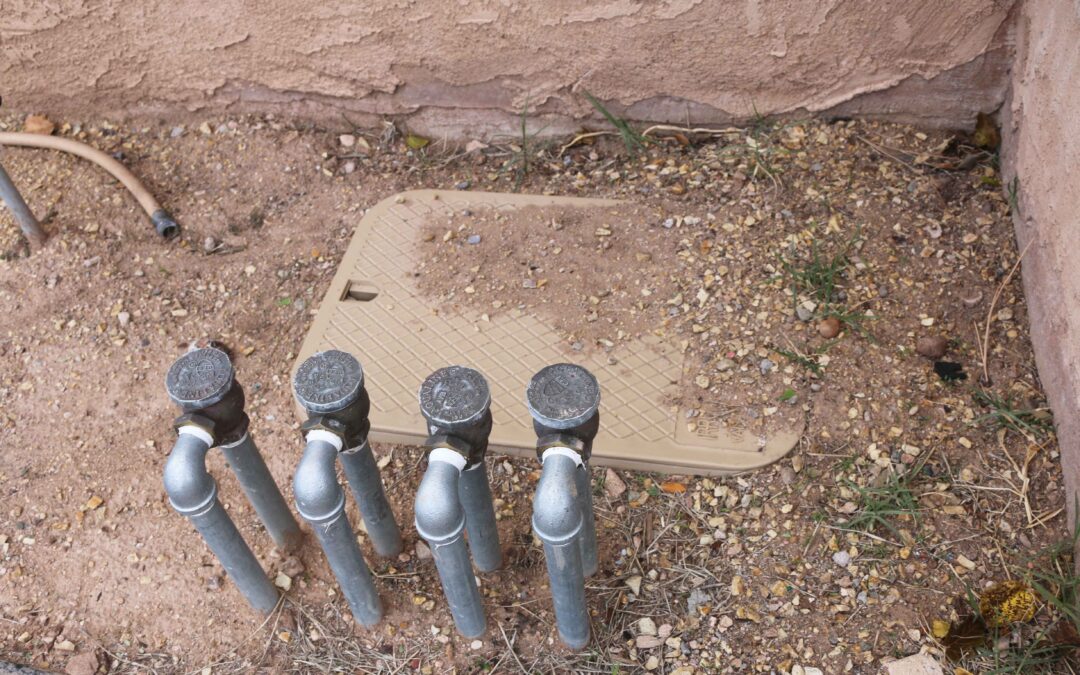
Typically, a conventional turfgrass yard includes a few large trees and some planting beds for flowers and shrubs around the foundation of the home. This type of yard often has a couple of existing irrigation valves for sprinkler irrigation. A conventional turfgrass landscape requires tremendous amounts of water to thrive in our region — a minimum of 40” (with an average of 50"-55”) of water per growing season, which is about three to five times more than what is provided by natural precipitation each year. This is why we do not consider a turfgrass yard a desert-friendly landscape.
Climate change is causing us to rethink our yards, and that includes yards with lawns. For a yard with a lawn to be truly desert-friendly, the amount and type of grass used must be considered. A desert-friendly turfscape should also have efficient sprinkler nozzles and pressure compensating sprinkler bodies to maximize the water that’s used to maintain the lawn.
We recommend that no more than 10% of your total yard is devoted to a lawn. Research from various universities in the Southwest and lawn seed producers (such as Pennington Seed) is now suggesting that New Mexico’s climate is no longer suitable for cool-season grasses to thrive. Instead, we need to make a shift to various warm-season grasses, which will grow well with significantly less water.
Cool-season and warm-season lawns are the two different categories of turfgrass lawns found in Albuquerque. Cool-season grasses (Kentucky bluegrass, perennial ryegrass and tall fescue) thrive between 65F and 75F degrees in the summer. They create a softer, darker green and lush-looking lawn. In Albuquerque, most lawns are composed of cool-season grasses that are cold-tolerant and green most of the year. They can withstand considerable amounts of foot traffic. One disadvantage is that they use a substantial amount of water in the summer months. Parkblend (a blend of cool season grasses) is the most common lawn in the Albuquerque metro area. It uses around 40” of water a year.
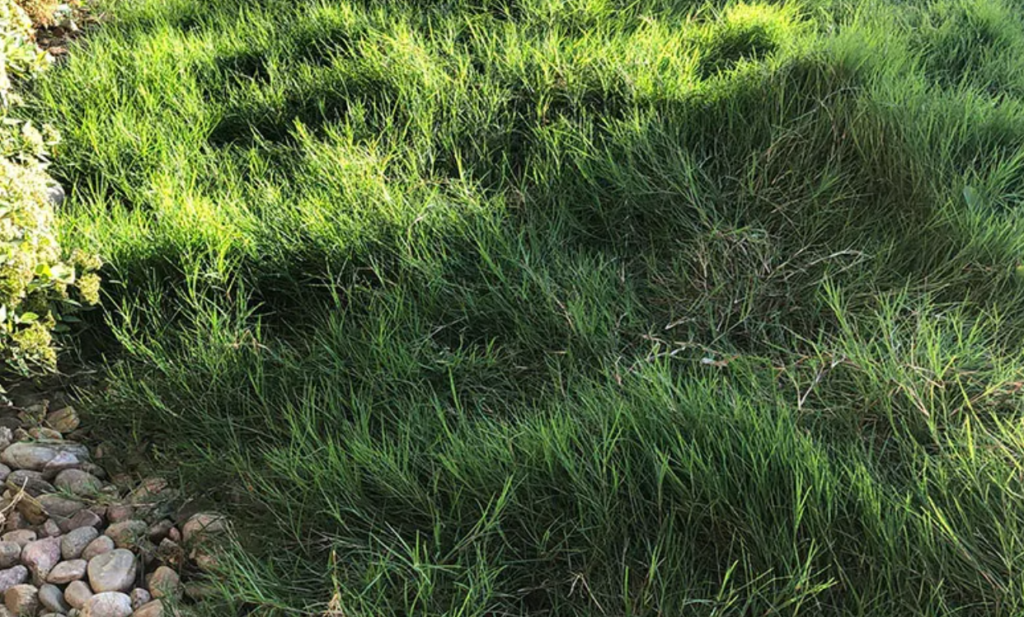
Warm-season grasses (Bermuda grass, blue grama, and buffalo grass), which thrive in 70F to 90F degrees, have been used in Albuquerque for many years. There are parts of town where they are quite prevalent. Warm-season grasses have a shorter growing season. They green up later and go dormant earlier than cool-season lawns. They are low maintenance and require less water than cool-season grasses.
Buffalo GrassBermuda Grass
Knowing what type of lawn or turfgrass is being installed or already being watered can make a significant difference in how much water should be applied. The key to choosing a turfgrass for a new area is to determine the one most suited to the specific needs of the landscape.
Water Budget (this includes 1,000 square feet of cool-season grass and a number of mature trees, shrubs and vines):
Are you ready to remove your lawn and create a desert-friendly landscape but worried about the cost? Below are cost-savings tips for transforming your yard.
Plant price tags: For homeowners wanting to transform their yards, it’s easy to feel sticker shock when adding up the cost of buying new plants. Keep in mind that the plants you buy from nurseries started as seedlings and have been nurtured for years before they are ready to sell. Most trees have been growing for 10 years before reaching stores. And remember that these same plants will enhance your yard for decades to come. To save money, buy plants in smaller pot sizes. For example, instead of buying a 5-gallon plant, buy a 1-gallon or 4” pot. Instead of buying a 2” caliper tree, buy a 24” box tree or a 15-gallon tree. Reducing the size of the plant you purchase will save money.
Irrigation woes: Fear of the unknown cost is what usually worries homeowners about installing an irrigation system. No need to worry if you are transitioning from a grass lawn with spray irrigation to drip irrigation when you already have valves in the ground. We recommend spending the money to hire a local irrigation professional to check your valves and convert your valve from spray to drip. Once you’ve done that you can save money by installing the drip polyline yourself.
Mulch madness: Choose organic shredded wood chip mulch over gravel to save money, enrich the health of your soil, eliminate weeds and greatly reduce maintenance. Shredded wood chip mulch can be up to $1 a square foot less expensive than installing gravel. Tree maintenance companies, like Baca’s Trees on Edith Blvd NE, offer mulch free to the local community. You can also visit the East Mountain Transfer station to buy inexpensive loads of mixed-sized organic mulch. This material is perfect to put over bare dirt areas of your yard that need to be covered to eliminate weed growth.
Materials stockpiled: Think outside the box and get creative when sourcing materials so you can save money and resources. Check out re-stores, thrift stores, Facebook Marketplace, Craigslist and even your neighbors, who are a valuable resource. They may have landscaping materials available for free or at a small cost. Your neighbors’ properties may have stockpiles of materials sitting around that may not be useful to them but could be put to great use in your yard. When in doubt, ask for what you are looking for. Pop onto your neighborhood’s text thread, knock on doors or even utilize the app Nextdoor.com. Someone’s trash is another person’s treasure.
Water Authority’s Rebates: Did you know you get $2.00 back for every square foot of lawn you convert? Water Authority residential customers who convert their landscapes to desert-friendly xeriscapes and use drip irrigation can qualify for a $2.00 per square foot rebate. The rebate area of your new landscape must have 50 percent coverage (at maturity) of qualifying low to medium water use plants, and the soil between and beneath all plants must be covered with at least three inches of mulch (organic mulch, gravel, etc.). If you are interested in participating in the Desert Friendly Xeriscape Conversion Rebate, be sure you don’t start your turf removal project until you have applied online to the program and received an official notice to proceed. Several conditions must be met in order to qualify for the desert-friendly xeriscape rebate.
The Albuquerque metro area has a variety of landscapes. These include desert-friendly landscapes, such as lush, pollinator-friendly xeriscapes, and wildscapes or prairie plantings, where native grasses and wildflowers bring the feel of a prairie to a yard. Rain gardens are specifically designed to make the most of natural precipitation, while edible landscapes have garden beds or edible plants interspersed throughout them. Efficient turfscapes have smaller areas of turfgrass and diverse plantings. Conventional turfscapes with large areas of cool-season grass and high-water foundation shrub plantings are no longer considered desert-friendly landscapes. Desert-friendly landscapes describe a variety of landscapes that include beautiful, diverse plantings with increased resiliency achieved through efficient watering.
A sea of gravel may require little water, but it does not create a healthy environment. Weed fabric doesn’t prevent weeds from growing on top of the fabric and has been proven to be detrimental to soil and tree health in the long term. Trees struggle if they have been part of a yard that was once heavily irrigated and has been converted to a gravelscape. We do not recommend gravelscapes for reducing water use. Instead, transform those landscapes into cooler, healthy environments by adding appropriate plants and irrigation.
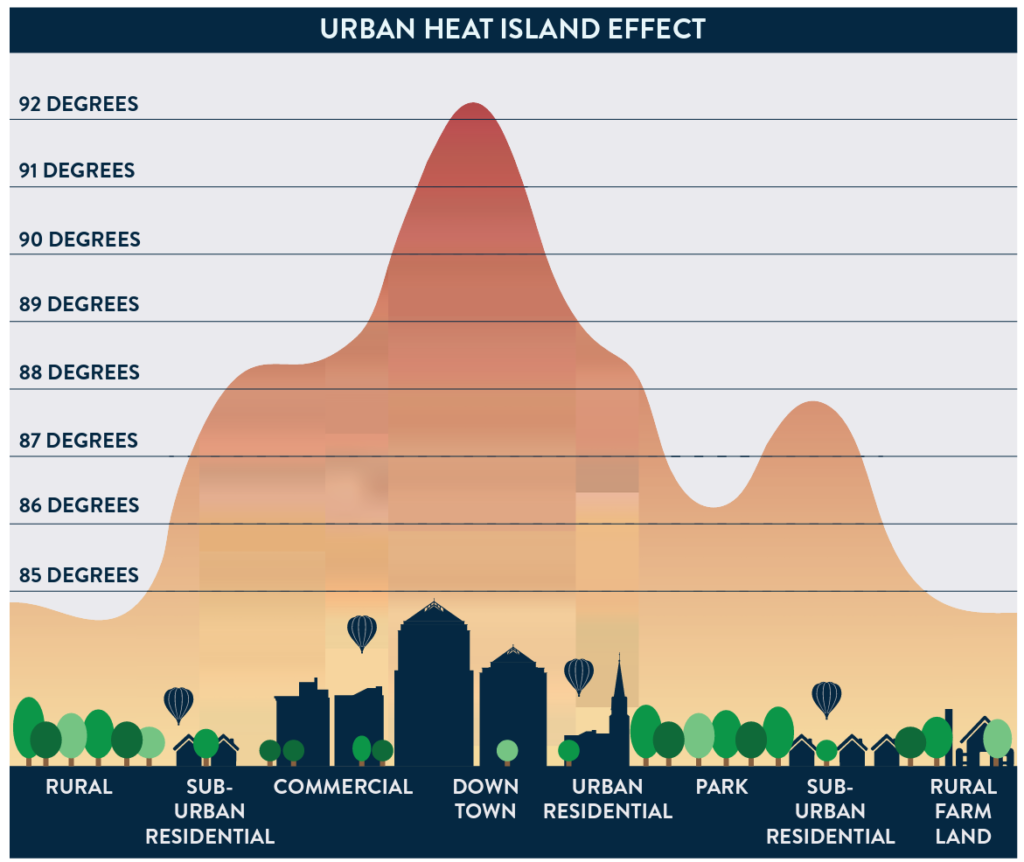
Desert-friendly landscapes make a positive contribution to lowering the urban heat-island effect, which is caused by heat emitted off surfaces including gravel, concrete and asphalt. This heat causes an updraft within an urban setting, which changes the weather patterns over a city and decreases the chances of precipitation and cooling. Plants, especially trees, help decrease or eliminate this heat island effect.
Desert-friendly landscapes help reduce noise pollution by absorbing sound. Desert-friendly plantings also increase biodiversity in your yard and in our community, generating much-needed pollinator habitat. Xeriscapes, particularly once they are established, use significantly less water than a conventional turfgrass lawn. Did you know that Albuquerque is a designated Bee City USA? To find out more, go to: Burque Bee City USA (beecityusa.org). For more information on pollinator gardens, go to ABQ Backyard Refuge Program (https:// www.505outside.com/2021/05/31/backyard-refug-es-for-people-and-wildlife/). To find out about rebates that help homeowners transform their yards into desert-friendly xeriscapes, visit: https://www.505outside.com/residential-desert-friendly-conversion-rebates-xeriscape-conversion/
Xeriscapes have been largely misrepresented and misunderstood over the past 30 years, often being mistaken for zeroscape (a.k.a. no plants). What xeriscape really means is a native, desert-adaptive or desert-friendly landscape that often feels lush and vibrant and has plants that are appropriate for the Albuquerque climate. It attracts all kinds of wildlife and changes with the seasons.
Pro Tips for Using Drip Emitters in Xeriscapes:
• Always have more than one emitter per plant in case one becomes clogged. • Switch from adjustable micro sprayers and “shrubblers” to individual emitters or in-line emitted drip lines to know exactly how much water is being provided to your plants. • When using drip or other low-flow irrigation, accommodate plant needs by adjusting the flow rate (larger or smaller gph) and number of emitters per plant. • Drip irrigation is the best way to water plants that do not like getting their leaves wet. With drip emitters and ¼” spaghetti tubing, water can be placed exactly where it is needed.
Xeriscapes often include trees, shrubs, flowering “pollinator-friendly” perennials, desert accents, groundcovers, ornamental grasses and vines. They also can contain small functional turf areas, vegetable beds and other edible plants. Xeriscape plants are medium or low-water usage plants. Some can survive with rainwater alone after an establishment period of at least three full irrigation seasons. Adding trees to a desert-friendly xeriscape increases shade and habitat, creates favorable microclimates and reduces the urban heat island effect in Albuquerque. When deciding which tree to use in a particular place, refer to our Xeriscaping Guide or The Nature Conservancy’s Climate Ready Tree List.
HOW MUCH WATER IS NEEDED TO KEEP UP A BEAUTIFUL XERISCAPE?
This budget is only for outdoor use. Please include your winter averages to complete your TOTAL usage on your billing. For typical xeriscape landscapes with 500 square feet of NATIVE grass lawn (warm-season grasses) and two medium trees
Most irrigation work can be done by the homeowner, except for one component. Tapping into your home's main water line needs to be done by a licensed contractor to ensure it is completed safely. To help homeowners know how to select and work with a contractor, we have provided the Irrigation Association's Irrigation Consumer Bill of Rights in the Appendix.
To make sure you have an efficient system, we highly recommend that you hire a professional irrigation designer to create a custom plan. Having a custom plan minimizes water waste and the chance of problems in the future and also helps ensure an efficient distribution of water, which reduces water usage. We also recommend asking a designer to produce a "call-out" list of all the parts required for the installation or renovation. This helps homeowners decide whether to DIY or hire a contractor.
SEPARATINGIRRIGATIONZONES&HYDROZONING
When you begin to plan a drip system, whether you’re installing a new system or retrofitting an existing system, it is imperative to design it so the drip valves are separate from your lawn valves. If you plan to grow a vegetable garden or water annual beds with a drip system, those areas also need to be on separate valves.
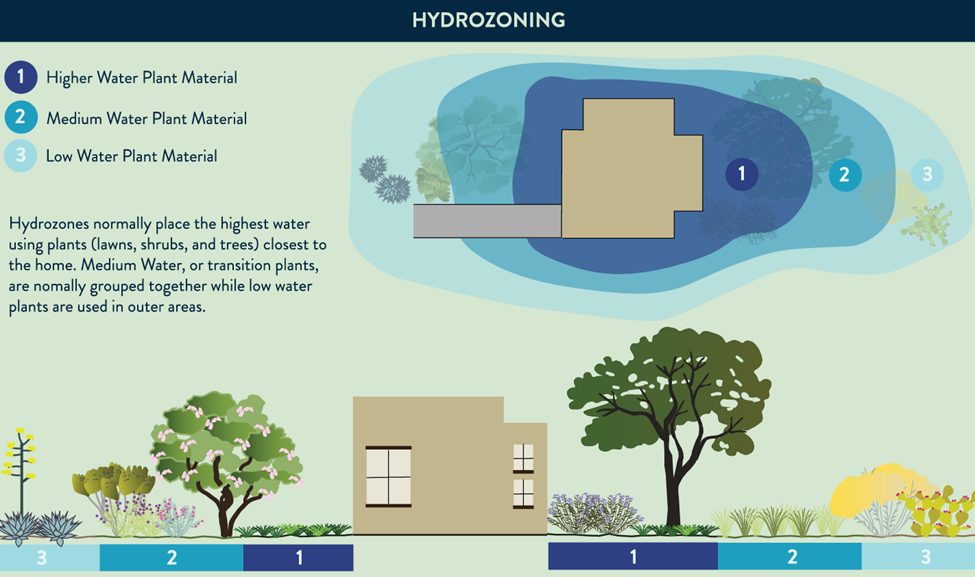
The next thing to do is organize your drip zones by plant watering needs. This means that higher water plants and lower water plants should be on separate valves (hydrozoning) whenever possible, so watering is much more efficient. Hydrozoning is not always possible when retrofitting an established landscape. In that case, you can adjust your water delivery with various sized drip emitters so plants with higher water needs receive more water per hour.
Check out our New Irrigation Efficiency Guide: Beautiful Landscapes with Less Water. Download the guide here.